Our readers keep the lights on and my smoothie glass nicely filled. As an Amazon Associate, I earn from qualifying purchases.
Specs are compiled from manufacturer listings and verified buyer reviews and can change over time — please confirm the key details on the product page before buying.
Every pitcher knows the difference the second they palm it. A good fastpitch softball spins off the fingertips with clean rotation; a cheap one wobbles, feels slick, or goes dead after a few hard hits. The right ball makes practice productive without wrecking your bat or your tendons. The wrong one wastes money and teaches bad habits. This guide nails down the softballs that survive real use — from official-game leather to budget-friendly synthetic trainers — and tells you exactly what changes between them.
I’m Mohammad Maruf — the founder and writer behind WellFizz. This guide is built by comparing the manufacturers’ published specifications and the patterns across verified customer reviews, so you get each pick’s real strengths and trade-offs instead of marketing spin.
Whichever skill level you’re equipping, picking the right fastpitch softballs depends on matching the core, cover, compression, and seam type to how you’ll actually use them — whether that’s game day, heavy batting practice, or evening catch under the lights.
Our Picks at a Glance


How To Choose The Best Fastpitch Softballs
Picking the best fastpitch softballs is not just about grabbing the cheapest dozen. A ball’s core, seam, cover, and compression all determine how it feels in the hand, how it flies off the bat, and how long it lasts before it goes egg-shaped. Here is what actually matters.
COR and Compression — the two numbers that govern feel
You will see “COR.47 / 375 lbs” on almost every regulation ball. COR stands for Coefficient of Restitution — it is a measurement of the ball’s bounce or liveliness off the bat. A.47 COR is the standard for most fastpitch leagues. Compression (.375 lbs) measures how hard the ball is — how much force it takes to squish it. A higher compression ball feels tighter and carries further; a lower one feels softer and is safer for younger players. If the ball does not list COR and compression, you cannot predict how it will perform from the box to the back fence.
Seams — raised for control, flat for distance
Pitchers can feel the seams the moment they release. Raised seams (higher stitching) give you more grip and spin control — think a clean drop ball or a sharp rise. Flat seams reduce air friction so the ball cuts through the air for longer throws. For practice, raised seams are generally preferred because they help pitchers build proper mechanics. Check the data: some balls even advertise “Super Seam Technology” with higher stitching for extra spin potential.
Cover — leather vs synthetic leather
Leather covers grip better, break in more naturally, and last longer than synthetic. But they also cost more — sometimes double. Synthetic leather covers are lighter on the wallet and still offer decent durability for batting practice, but they can get slick over time or scuff faster on rough dirt. For a travel team or serious pitcher, leather is the unspoken standard. For a recreational league or high-volume BP, synthetic is a smart trade-off.
Size — 11″ vs 12″
Nearly every fastpitch softball at the high school, college, and adult level is 12 inches in circumference. The 11-inch ball is common in youth leagues (10U and younger) because smaller hands can grip and throw it more easily. If you are buying for a young player moving up, stick to an 11-inch ball for the transition. For anyone 12U or older, the 12-inch ball is the right fit for both practice and official games.
Quick Comparison
| Model | Best For | Cover Material | Seam Type | Compression / COR | Amazon |
|---|---|---|---|---|---|
| Dudley Thunder Heat★ Best Overall | Official game & heavy pitching practice | Leather | Raised | 375 lbs /.47 | Amazon |
| SPARK CATCH Light UpFun Factor Pick | Night-time catch & fun practice | Faux Leather | Handmade stitches | Not specified | Amazon |
| OMYOPY Official SizeValue Pick | Budget practice & custom keepsakes | Faux Leather | Flat seam | Not specified | Amazon |
| Rawlings BP Softballs | Collegiate/high school batting practice | Synthetic | Raised | 375 lbs /.44 | Amazon |
| PHINIX Practice Fast-Pitch | Heavy daily training on a budget | Synthetic Leather | Raised (blue stitch) | 375 lbs /.47 | Amazon |
| Wilson ASA Synthetic Leather | Youth ASA leagues & general practice | Synthetic Leather | Raised (higher) | 375 lbs /.47 | Amazon |
| Champion Sports Softballs | High school/travel BP & fielding reps | Synthetic Leather | Raised | Medium compression /.47 | Amazon |
| Rawlings NCAA Rec Fastpitch | Entry-level practice & first-time catchers | Faux Leather | Not specified | Not specified | Amazon |
| MacGregor NFHS Fast Pitch | Versatile practice to game use | Leather | Raised | 375 lbs /.47 | Amazon |
In‑Depth Reviews
1. Dudley Thunder Heat Fastpitch Softballs
Our pick — over 4.5★ from 950+ verified ratings; the strongest balance of quality and price.
The leather-covered standard that pitchers request by name for games and the heaviest practice sessions.
If you want one ball that serves both as an official-game ball and a practice workhorse, this is it. The Dudley Thunder Heat is a 12-inch fastpitch softball with a leather cover over a poly core — a precision blended cross-linked polyurethane system designed for maximum resiliency. The raised seams give pitchers the grip they need to spin the ball hard, while the.47 COR and 375 lbs compression put it squarely in the USAB, USSSA, and NFHS approved zone. Buyers report that a dozen of these easily survives 150-200 balls per day of heavy use when stored in a dry area. Quality — durability — stands out in the feedback as what people talk about most, with the leather cover cited as the reason these outlast synthetic alternatives. For a travel team or serious pitcher, this is the single best investment you can make.
At 16 ounces per ball, these match the weight and feel of the standard — so a pitcher’s mechanics transfer directly from practice to the mound in a game. Pitchers on a 16U team specifically request this model over others, calling it durable with the leather cover “a must.” The downside is the cost; a dozen-game-quality balls is a significant outlay compared to budget synthetic packs. But the consensus across hundreds of owners is that they hold up longer, so you buy fewer replacements over the season.
Why coaches stock them
- Leather cover grips better and lasts far longer than synthetic — quality is mentioned most often among owners
- Raised seams give pitchers the spin control they need for breaking pitches
- Holds up under 150-200 balls per day of heavy practice when stored properly
One honest trade-off
- Premium price compared to synthetic practice balls — you pay more upfront for the leather and durability
The team-standard play: buy these if your pitchers demand game-quality feel all season long and you want a dozen that survives heavy daily use without going soft.
Pass them by if: your team is younger or just starting out, where synthetic balls are a more forgiving and cheaper introduction.
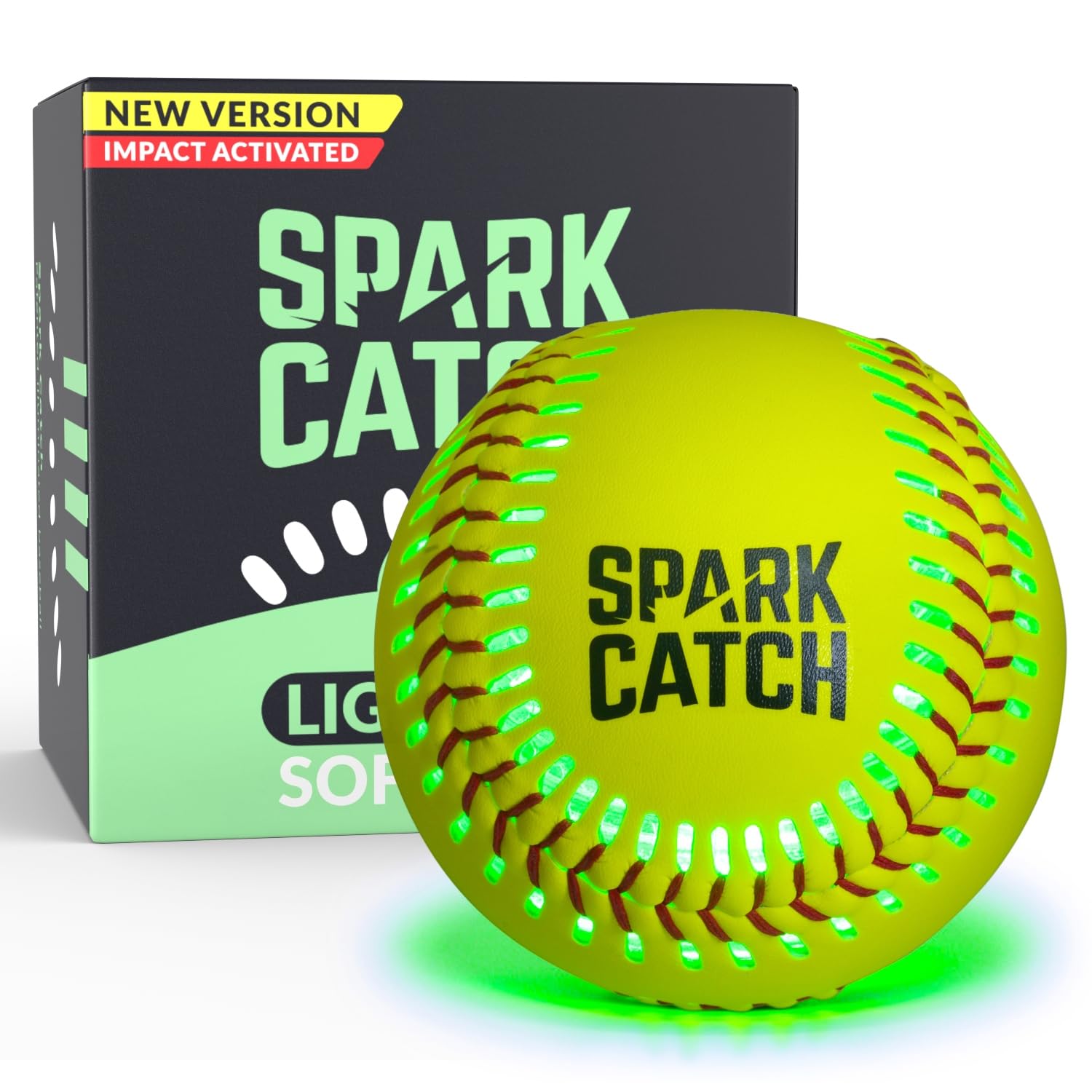
2. SPARK CATCH Light Up Glow in The Dark Fastpitch Softball
The glow-in-the-dark ball that turns dusk into prime throwing time — but keep it for catch only.
When the sun drops and the field lights flicker on, this ball keeps the session going. The SPARK CATCH is a 12-inch fastpitch softball with an impact-activated LED inside: every throw lights it up, and the LED automatically turns off when play stops. It comes with an A23 battery (included) and is clearly labeled “not for hitting” — it is strictly a catch-and-throw trainer. Owners note it “feels and throws like a real softball” and that the auto on/off feature means you never have to dig the battery out. The fun of lighting up at night — is the top thing people talk about, and the brightness gets nearly as much attention. This makes evening practice or casual backyard catch genuinely notable for younger players.
There is a trade-off. The battery compartment creates a slight wobble in the ball’s flight — as one owner put it, “the power source causes the ball to have a bit of a wobble, but it does extend our catch log past the sun setting.” That minor imbalance is not a big deal for soft toss, fielding grounders, or plain throwing drills, but it means this is not a ball for serious pitcher’s spin work.
Bright idea, honest flaw: the LED glow extends practice into dark hours and keeps young players engaged, but the compartment wobble means it is a supplementary tool — great for fun, not for game-prep feel.
Reach for this if: you have a young player who needs motivation to practice throwing after school when it gets dark early, or you want a fun gift for a softball-loving kid.
Look elsewhere if: you need a regulation-weight, regulation-feel ball for serious pitcher or batter training — the wobble and lighter weight make it a specialty item, not a primary practice ball.
3. Official Size 12″ Softballs by OMYOPY
A six-pack of blank synthetic-leather softballs that feel identical to official ones for a fraction of the price.
Sometimes you just need a dozen or half-dozen balls that behave like the real thing without draining the budget. These OMYOPY softballs are 12-inch fastpitch balls with a solid cork interior and a synthetic leather (faux leather) cover. The optic yellow color makes them easy to track in the air or under lights. What sets them apart is the flat seam — it reduces air friction for maximum throwing distance, though it gives pitchers less spin control than a raised seam. Owners find them “indistinguishable by weight or feel from the official ones” and use them regularly in practice. The blank surface is an intentional feature: the balls are unmarked, so teams can paint them with markers for keepsakes, autographs, or custom logos. Quality is the most-discussed positive, and versatility as a close second.
The cork center gives these a familiar firmness, though they lack the specific COR and compression rating you see on league-approved balls. They also only come in a 6-count pack, so a team will likely need two or more packs. A few owners note they are soft enough to use for younger players learning softball and T-ball — not just older teams.
Budget practice balls, well-made: nearly identical weight and feel to the real thing, so your daughter’s backyard throws translate directly to the field; plus they double as blank canvases for team gifts.
Missing the spec tag: no official COR/compression rating means they are training-only — not for sanctioned games or tournaments.
Grab these for: a family practicing at home, a rec team on a tight budget, or a coach who wants to personalize balls as end-of-season mementos.
Skip them for: a competitive travel team that needs regulation-grade leather balls for pitching practice and league play.
4. Rawlings Batting Practice Softballs

The synthetic-covered, raised-seam workhorse that collegiate and high school teams trust for heavy BP.
Rawlings builds these specifically for recreational and batting practice use, not for official games. They are 12-inch yellow fastpitch softballs with Poly-Core centers and synthetic covers — a combination designed to survive repeated hard hits without losing shape. The raised seams give pitchers better control during warm-up and fielding drills. The COR is.44 (slightly lower than the.47 standard) with a 375-pound compression, meaning they fly a little less off the bat but last longer under repetitive impact. Owners consistently call them great quality for the price, with one travel-team coach noting they rely on them as practice balls that hold their shape and durability. The value for money is the second-most mentioned aspect, alongside quality.
The synthetic cover is not as grippy as leather, and the.44 COR means they feel slightly deader off the bat than a game ball. That is actually fine for batting practice — you get more reps and less distance, which keeps the ball in the cage. A small number of owners mention slight discoloration over time, purely cosmetic.
Planned for punishment: the.44 COR / 375-pound compression is a deliberate trade-off — less pop means longer ball life and safer cage sessions.
One detail to know: synthetic cover is durable but less tacky than leather; store them dry to avoid premature slickness.
Best suited for: high school and college teams that run high-volume batting practices and need a dozen that can take daily hits from real bats without rapid deformation.
Not your pick if: you want a ball for official games — the.44 COR is below the.47 standard, so it won’t match game-day flight.
5. PHINIX Practice Fast-Pitch Softball
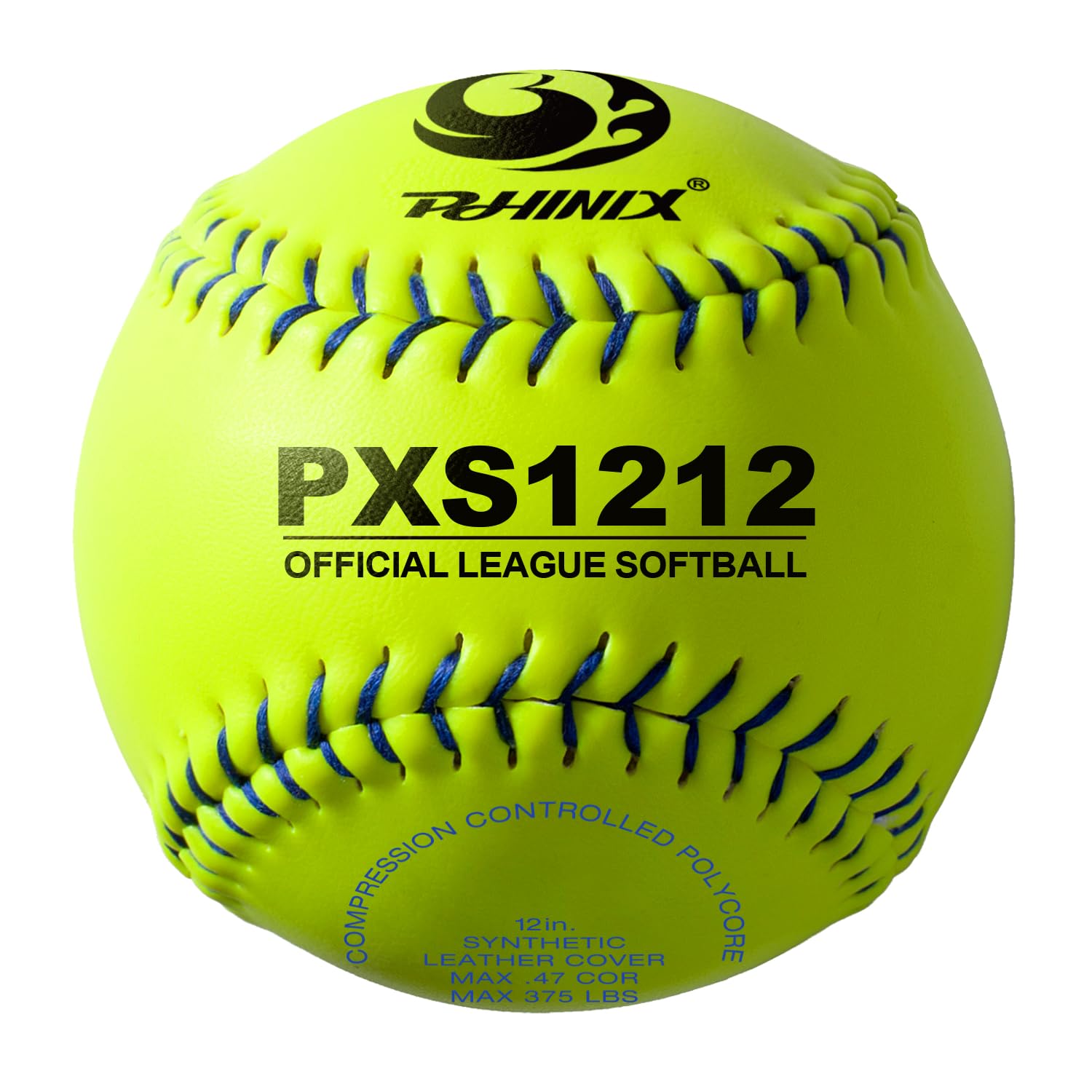
A full dozen of COR.47 / 375 balls with raised blue stitching — comparable to the Dudley Thunder Heat at a noticeably lower cost.
This is the practice ball that punches well above its price tag. The PHINIX is a 12-inch fastpitch softball built with a solid compression-controlled polycore center and a synthetic leather cover. The raised blue stitching is an intentional design choice — it gives pitchers a clear, visible seam to grip and spin off, and owners note the stitches are “consistent” across the box. The ball is rated at max 0.47 COR and max 375 lbs compression, meaning it meets the same liveliness and hardness specs as the most popular game balls. That makes it a legit stand-in for game conditions during practice. Durability is the most-praised aspect — customers note one dozen surviving “spring and fall seasons with daily use” through four buckets of 30 balls each.
Owners say this ball has “great pop” and holds up better than Rawlings equivalents at nearly the same quality level as the Dudley Thunder Heat. The synthetic leather cover means it costs less than leather but still offers a solid grip for pitchers. If your team burns through dozens of practice balls each month, this is a smart way to keep the bucket full without downgrading performance.
Practice ball, game-ball specs: the.47 COR and 375 comp mean it reacts off the bat like an official ball, so hitters and pitchers get useful feedback every rep.
One owner note: the raised blue stitches are a nice visual cue for young pitchers learning to find the seam quickly — a detail the shiny leather balls do not offer.
Buy these if: you run a heavy practice schedule (multiple buckets per session) and want game-legal COR/compression without leather pricing.
Think twice if: you need a leather cover for tournament play — the synthetic cover is durable but not approved for official leagues that mandate leather.
6. Wilson ASA Synthetic Leather Polycore Softballs

An 11-inch ball with 20% higher seams — purpose-built for young hands learning to spin a pitch.
The Wilson ASA is not a typical ball. It measures 11 inches in diameter, not the standard 12 inches, which makes it ideal for youth ASA leagues and younger players (think 10U) who need a smaller ball to throw and grip comfortably. The “Super Seam Technology” delivers seams that are higher than normal. That extra height is a real advantage for developing pitchers — they can get a stronger hold and generate more spin with less effort. The core is a compression-controlled polycore (COR.47 and 375 lbs compression) wrapped in an optic yellow synthetic leather cover. Owners note these are “very nice seams for pitchers” and describe the construction as sturdy — using them for a full year of daily hitting without a problem.
Because this is 11 inches and every bit as hard as a normal NCAA softball, it is not a soft trainer. Owners warn these are not the super-spongy RIF balls often used in youth fastpitch — they are standard hardness in a smaller size. If your league requires 12-inch balls, the Wilson ASA won’t work for games. And at 2.44 kg for a dozen, they are heavier per ball than some other synthetic models.
Built for small pitchers
- 20% higher seams give young pitchers noticeably more grip for learning spin pitches
- .47 COR / 375 lbs matches regulation hardness — performance scales as the player grows
- Polycore center resists breaking down faster than traditional cork
Size matters
- 11-inch size is only useful for youth leagues — a 12-inch ball replaces it as players age up
- Synthetic leather cover, not real leather — a few owners note it feels different initially “until you rub some dirt on them”
Perfect for: a 10U or early 12U team where pitchers need higher seams to learn proper spin without the game ball price tag.
Not the one for: any player or team using regulation 12-inch softballs — the size difference is too significant to substitute in practice.
7. Champion Sports Synthetic Leather Softballs

An NFHS-approved synthetic dozen that splits the difference between cheap practice balls and premium game leather.
Champion Sports works in a specific market: teams that need an official approval (NFHS) and a.47 cork core but do not want to pay for full leather. The SB12 is a 12-inch optic yellow synthetic leather softball with raised seams and red stitching. It pairs the.47 core with a “medium compression” level — the manufacturer does not specify the exact lbs, but it is designed to work with a wide variety of bats for optimal performance. The synthetic “Rhino” cover is tougher than basic vinyl but less expensive than leather. Quality is the top thing owners talk about, followed closely by value for money. Coaches use these for batting practice and fielding reps at high school and travel-ball levels.
The honest trade-off is that the synthetic cover can start separating from the core over a full season — a few reviewers point out the skin coming loose after a year of team use. Others note these are not as ideal for pitching practice as higher-end leather balls, since the raised seams are less pronounced than purpose-pitch models. For a rec team or JV program, these offer a legit approval badge at a practical price point. For a varsity squad or serious pitcher, the leather Thunder Heat above or the MacGregor below is a step up in durability.
NFHS authority, budget-conscious price: the official approval means you can use these in high school games without a second thought — rare at this price level for a full dozen.
Durability is mixed: about one season of heavy use before some balls show wear — fine for most rec teams, a tight timeline for a high-volume travel program.
Ideal for: a high school JV or rec league that needs an NFHS-approved ball for games but cannot justify pure leather pricing.
A downgrade for: a serious pitcher or travel team that puts 100+ reps on balls every practice — the synthetic cover wears out faster than leather.
8. Rawlings NCAA Recreational Fastpitch Softballs

A full dozen of Rawlings cork-core balls that do the job for beginning catchers and basic training — no frills.
Rawlings puts its NCAA Recreational badge on these, and “recreational” is the operative word. These are 12-inch training fastpitch softballs with a solid cork center and a synthetic leather cover. The cork core gives them the firmness of an official ball, but the synthetic cover is designed to withstand the elements rather than deliver premium grip. The key point here: this is a basic dozen. Owners find them “very good for fast pitching” and good for training a first-time catcher. But the feedback on quality is mixed — with some praising the price while others report the balls go “soft and deformed too soon” for the cost. A few detail that after hitting practice the balls deformed some.
If you need a dozen balls just to have something to throw at practice for a beginner team, this works. The cork core provides familiar weight and density. If you need balls that maintain shape for power-hitting practice or pitching drills, the mixed reviews suggest you will likely be disappointed.
A simple start: the solid cork core gives these the weight and firmness a new catcher needs to get used to receiving throws — better than a foam trainer.
The durability gap: enough shoppers say deformation after hitting practice that this is a real risk — use them for throwing and light fielding drills to extend their life.
Worth considering for: a youth team that needs balls purely for throwing and catching fundamentals, or a coach on a minimal budget who needs any 12-inch dozen.
Would not recommend for: a high school or travel team that runs batting practice daily — the cork center and synthetic cover cannot keep up with repeated hard barrel hits.
9. MacGregor NFHS Fast Pitch Softball

An NFHS-approved leather dozen that splits the difference between top-tier Dudley pricing and budget synthetic models.
MacGregor has been in the softball game for a long time, and this 12-inch ball shows why. It is NFHS approved, built with a poly graphite center, a.47 COR / 375 lb max compression rating, and a yellow leather cover. That combination — poly graphite core plus leather — gives it a dense, solid feel that owners compare favorably to the Dudley Thunder Heat without quite matching the same price. Quality is the top thing owners talk about by a wide margin, value for money is second, and the leather cover gets specific praise: “great feel and raised seams, real leather cover.” The ball holds up across “100s of BP” sessions even rotating through travel team and college players. The shape stays round and the seams remain prominent over time.
A moderate durability concern appears in the feedback: some owners find the seams can split during “continuous hitting” with older power hitters — one coach recommends it for fielding practice but not for repetitive heavy batting practice with serious hitters. That is a fair caution, but the vast majority of owners find it holds up well across hundreds of reps. At 5.4 pounds for the dozen and a poly graphite center that resists deformation, this is a legitimate leather alternative for programs that want NFHS compliance without the Dudley price tag.
Leather without the premium tax
- Real leather cover grips well in all weather and improves with use — quality is the most-discussed positive
- NFHS approved and.47 COR / 375 lbs — meets every high school regulation requirement
- Poly graphite center keeps its shape round after hundreds of practice reps
A honest limit
- Seams can split under extreme, continuous batting practice use with power hitters — treat this as a heavy practice ball, not an indestructible one
- Leather requires break-in time; it is not instantly as tacky as synthetic alternatives in the box
Reach for this if: you want an NFHS-approved leather ball that does not cost as much as the Dudley Thunder Heat, and you will use it primarily for fielding, pitching, and general practice plus occasional games.
skip it if: your team hits hundreds of BP balls every week with power bats — in that scenario, the seams may not hold as long as the Dudley’s, and a slightly higher price point for the Thunder Heat’s construction is worth considering.
Understanding the Specs
COR (Coefficient of Restitution)
This is just a fancy way of measuring how bouncy the ball is — how much energy comes back off the bat. In fastpitch softballs,.47 is the most common standard. A ball with a.47 COR will “pop” and carry more than one with a.44 COR. If you practice with a.44 and then play a game with a.47, your timing will feel slightly off because the ball leaves the bat faster. Stick to the same COR across practice and games for consistent reps.
Compression (lbs)
Compression measures how hard or soft the ball is. The standard for most fastpitch leagues is 375 lbs compression. A ball with 375 lbs compression is firm — it feels solid in the hand and carries well. Some practice balls use lower compression to be safer for younger players. A 275 lbs ball, for example, is noticeably softer and safer for beginners but will not “jump” off a composite bat the same way.
Seams — raised vs flat
Raised seams protrude higher from the cover. They give pitchers more friction and control, which makes it easier to spin the ball for curveballs, rise balls, and drop balls. Flat seams sit flush with the cover, reducing wind resistance for longer throws from the outfield. For practice, especially for pitchers, raised seams are almost always better. For infield/outfield drills focused on long toss, flat seams can help.
Leather vs Synthetic Leather
Leather is the traditional choice. It molds to your hand over time, stays tacky in dry conditions, and lasts through a full season. The catch is cost. Synthetic leather is cheaper and lighter, and it does not need to be broken in. But it can get slick when wet or dusty, and the cover can peel from the core faster than leather. For a high school team using balls daily, synthetic is a reasonable compromise. For a college or travel program, leather is the standard.
FAQ
Can I use a fastpitch softball for slowpitch games?
How many fastpitch softballs does a team typically need for a season?
What is the difference between.44 COR and.47 COR balls?
Are 11-inch softballs the same weight as 12-inch softballs?
How do I make a synthetic leather softball less slippery?
What is the difference between a polycore and a cork center in a softball?
Can I use a light-up softball in a pitching machine?
Do fastpitch softballs go dead over time?
What does “NFHS Approved” mean for a fastpitch softball?
Will a.47 COR softball damage a composite bat faster?
Final Thoughts: The Verdict
For most teams, the fastpitch softballs winner is the Dudley Thunder Heat because the leather cover, raised seams, and.47 COR / 375 lbs compression make it the most versatile ball — trusted for official games and heavy practice alike across nearly a thousand reviews. If you want an NFHS-approved leather ball that costs less than the Dudley, grab the MacGregor NFHS Fast Pitch Softball. And for night-time practice that keeps young players engaged after sunset, the SPARK CATCH Light Up Ball is the one to reach for — just keep it for catch only.
How We Picked
We do not accept paid placement. Every pick is matched to a real buyer and a real use-case; we do not hands-on test units.
Sources & Methodology
Specifications: manufacturer listings and product documentation. Review insights: verified customer reviews, as of July 2026. Pricing: not shown on this page (it changes often); check the current price via the retailer link.
As an Amazon Associate, WellFizz earns from qualifying purchases. This does not affect which products we feature.
Related Guides

Mo Maruf
I created WellFizz to bridge the gap between vague wellness advice and actionable solutions. My mission is simple: to decode the research and give you practical tools you can actually use.
Beyond the data, I am a passionate traveler. I believe that stepping away from the screen to explore new environments is essential for mental clarity and physical vitality.