Our readers keep the lights on and my smoothie glass nicely filled. As an Amazon Associate, I earn from qualifying purchases.
Specs are compiled from manufacturer listings and verified buyer reviews and can change over time — please confirm the key details on the product page before buying.
That muscle knot in your neck won’t let up, your lower back locked up after digging in the yard, or that nagging sciatica (nerve pain running down your leg) keeps flaring up — you want relief without swallowing another pill. An EMS (Electrical Muscle Stimulation) stimulator sends tiny electrical pulses through pads on your skin to block pain signals and help tight muscles let go, all in a device that fits in your hand. Dozens of models with confusing spec sheets make choosing difficult. This guide focuses on three critical specs: mode/intensity range, battery life, and pad adhesion.
I’m Mohammad Maruf — the founder and writer behind WellFizz. This guide is built by comparing the manufacturers’ published specifications and the patterns across verified customer reviews, so you get each pick’s real strengths and trade-offs instead of marketing spin.
Whether your pain lives in your neck, lower back, shoulders, or legs, I broke down the nine strongest contenders to find the best ems muscle stimulator for your exact situation — from feature-packed workhorses to pocket-sized cordless options.
Our Picks at a Glance


How To Choose The Best EMS Muscle Stimulator
An EMS muscle stimulator sends controlled electrical impulses through electrode pads placed on your skin. The goal is either to block pain signals (TENS mode) or to contract and relax muscle fibers (EMS mode) for recovery. These specs separate a useful daily tool from a frustrating gadget.
Modes, Programs, and Intensity Levels
More modes let you match the sensation to your specific pain type — deep kneading for a tight shoulder versus light tapping for nerve discomfort. Look for at least 8 modes and 20 intensity levels so you can dial in exactly what works without it feeling like a shock. Independent channels (dual or quad) let you treat your lower back and left shoulder at the same time with different settings, which is a major convenience.
Battery Capacity and Runtime
Battery life determines whether the device stays in your drawer or goes everywhere with you. A 300 mAh battery (around 40 hours) is fine for occasional home use, but a 600 mAh battery (60+ hours) means weeks between charges even with daily sessions. If you travel, check for USB-C charging so you can top off from a laptop or power bank instead of hunting for a proprietary cable.
Pad Quality and Count
Electrode pads are the only physical connection to your body. Cheap pads lose stickiness after a few uses, causing inconsistent current and frustration. Solid-gel pads rated for 45 to 50 uses with a 2mm medical-standard connector give you better adhesion and easy replacement. More pads in the box (10 to 14) also mean you can cover multiple spots without buying extras immediately.
Quick Comparison
| Model | Best For | Modes / Levels | Battery Life | Pads Included | Amazon |
|---|---|---|---|---|---|
| AUVON Rechargeable Digital TENS (8-Mode)★ Best Overall | Best Overall Drug-Free Relief | 8 modes / 40 levels | 60 hours (600 mAh) | 12 pads | Amazon |
| AUVON 4 Outputs TENS (24-Mode)Quad Coverage | Multi-Zone Quad Coverage | 24 modes | 40 hours (300 mAh) | 10 pads | Amazon |
| BHK-TENS 22-Mode Unit22-Mode Bargain | Budget-Friendly Pocket Power | 22 modes / 40 levels | 30 hours | 8 pads | Amazon |
| AVCOO Color Screen 24-Mode | Innovative Design & Color Display | 24 modes / 30 levels | 50 hours (400 mAh) | 10 pads (3 shapes) | Amazon |
| TENS 7000 Digital TENS Unit | Classic Medical-Grade Workhorse | Multiple therapy modes | 9V battery (not rechargeable) | 4 pads | Amazon |
| Lanieney U8PRO Wireless TENS | Fully Cordless Freedom | 6 modes / 16 levels | 2 hours per charge (case recharges) | 4 pads | Amazon |
| KingPavonini Wireless U13 | Dual-Unit Wireless Syncing | 6 modes / 30 levels per unit | Weeks of use (case recharges) | 4 magnetic pads | Amazon |
| NEOCARBON Ergo TENS (Black) | Maximum Modes & Extended Battery | 60 modes / 20 levels | 70 hours (80% larger battery) | 12 pads | Amazon |
| NEOCARBON TENS Ultra (Red) | Premium Kit with PMS Mode | 60 programs / 20 levels | 10 hours | 14 pads (2 sizes) | Amazon |
In‑Depth Reviews
1. AUVON Rechargeable Digital TENS Unit Muscle Stimulator, Customizable 8-Mode
Our pick — over 4.5★ from 800+ verified ratings; the strongest balance of quality and price.
The rechargeable workhorse that outlasts your recovery week by a long shot.
This AUVON unit is the crowd favorite for a clear reason: it combines a massive 600 mAh battery — good for 60 hours of continuous use — with 8 customizable modes and 40 intensity levels. So you can dial in a gentle pulse for a stiff neck after sleep or a deeper throb for a sore lower back from the gym, all without worrying about the battery dying mid-session. The 12 premium electrode pads are made with low-impedance (low-resistance) solid gel and rated for about 45 uses each, which buyers report leaves no sticky residue behind.
Compared to the 24-mode AUVON model below, this one trades raw mode count for double the battery capacity (600 mAh vs 300 mAh) and 2 extra pads. Owners consistently praise its effectiveness — the most-mentioned aspect by a wide margin — and note the interface is intuitive enough to use without the manual. The rechargeable design via USB-C means no hunting for 9V batteries, a pain point some owners of the classic TENS 7000 mention.
The honest trade-off is that some find the maximum output slightly weaker than the old 9V-powered units. For most daily soreness and tension, the range is more than sufficient. A few also note that getting used to the sensation takes a session or two if you have never used electrical stimulation before.
Relief you can rely on: If you live with regular muscle tension and want a device you can grab daily without worrying about batteries or weak pulses, this is the one. The combination of 60-hour runtime, plenty of pads, and broad intensity range makes it the most versatile pick in this lineup.
The one caution: skip it if you need the absolute strongest zap for deep chronic pain — you might prefer the NEOCARBON Ergo’s 60 modes and higher peak power.
Reach for this if: you want an all-in-one drug-free solution for back, shoulder, neck, and leg pain with minimal maintenance.
Look elsewhere if: you need four independent channels to treat four body parts at the same time.
2. AUVON 4 Outputs TENS Unit Muscle Stimulator with 24 Modes
Four outputs mean you and a partner can treat two different trouble zones at once.
Where most units offer two channels, this AUVON packs four outputs that let you attach up to 8 electrode pads across four body parts simultaneously — or share the unit with someone else. That is the headline feature here, backed by 24 therapy modes and an intuitive operation design with body-part buttons and a body contour map on the LCD (Liquid Crystal Display) screen. No scrolling through cryptic menus to find the “knead” function for your shoulder; you press the shoulder button and select the technique.
The battery is a 300 mAh rechargeable cell, which owners mention lasts about three days of regular use before needing a top-up. It holds at 40 hours standby, though that is roughly half the runtime of the 8-mode AUVON above. The unit is palm-sized and lightweight at 11.36 ounces, and customers note the 2-inch and 4-inch pads stick well with proper care. The thing that wins people over is effectiveness — 56 owners single it out — and the broad mode selection gives you everything from TENS for pain to EMS for muscle performance.
The main caveat: no storage case is included, so you will want to find a small pouch. A few owners also note the unit shuts off after 20 minutes as a safety timer, which you have to restart manually.
Ideal for shared use: If you and your partner both deal with regular aches, or you want to treat your lower back and hamstrings at the same time with different settings, this quad-channel design is unique at this level.
Not for lone users only: If you only ever treat one spot alone, the 8-mode AUVON above gives you better battery life and more pads in the box.
Grab this for: four-zone simultaneous relief or sharing with a family member.
Pass on it if: built-in storage and longer charge cycles rank higher than multi-output capability.
3. BHK-TENS 22 Modes EMS Muscle Stimulator
Pocket-sized power that slips into a bag smaller than a smartphone.
At 8.15 ounces and about the size of a folded Z Flip phone, this BHK-TENS unit is built for portability without cutting mode count. It offers 22 programs and 40 intensity levels across two output channels, which is a remarkably dense feature set for the package size. The 40 levels give you fine granularity — you can go from a barely-there tingle up to a strong contraction without big jumps in sensation.
The rechargeable lithium battery delivers about 30 hours of continuous therapy, which is adequate for weekly use but falls short of the 60-hour leaders. Reviewers point out immediate relief for leg cramps and post-workout soreness, and a few mention the EMS mode helps with muscle atrophy (muscle wasting) recovery. The 8 included upgrade electrode pads use a 2mm pin connector and the industry-leading adhesive, so they stay put during movement.
The manual is not the clearest on navigating all 22 programs, so expect a brief trial-and-error period to find your favorite settings. A very small number of owners wish the unit had a storage case, but given the size, it slips into any pocket easily.
Best for the minimalist: If you travel often, commute, or just want something that disappears into a gym bag but still offers deep program variety, this is the most compact unit with serious mode depth.
Not for marathon sessions: If you need to run the unit for hours every single day, the AUVON 8-mode or NEOCARBON Ergo offer significantly longer runtime.
Take it on the go: ideal for desk workers, travelers, and anyone who wants relief in a pocket-sized package.
pass on it if: you need more than 8 pads in the box or prefer a unit with a simpler interface.
4. AVCOO Color Screen 24 Modes TENS Unit Muscle Stimulator
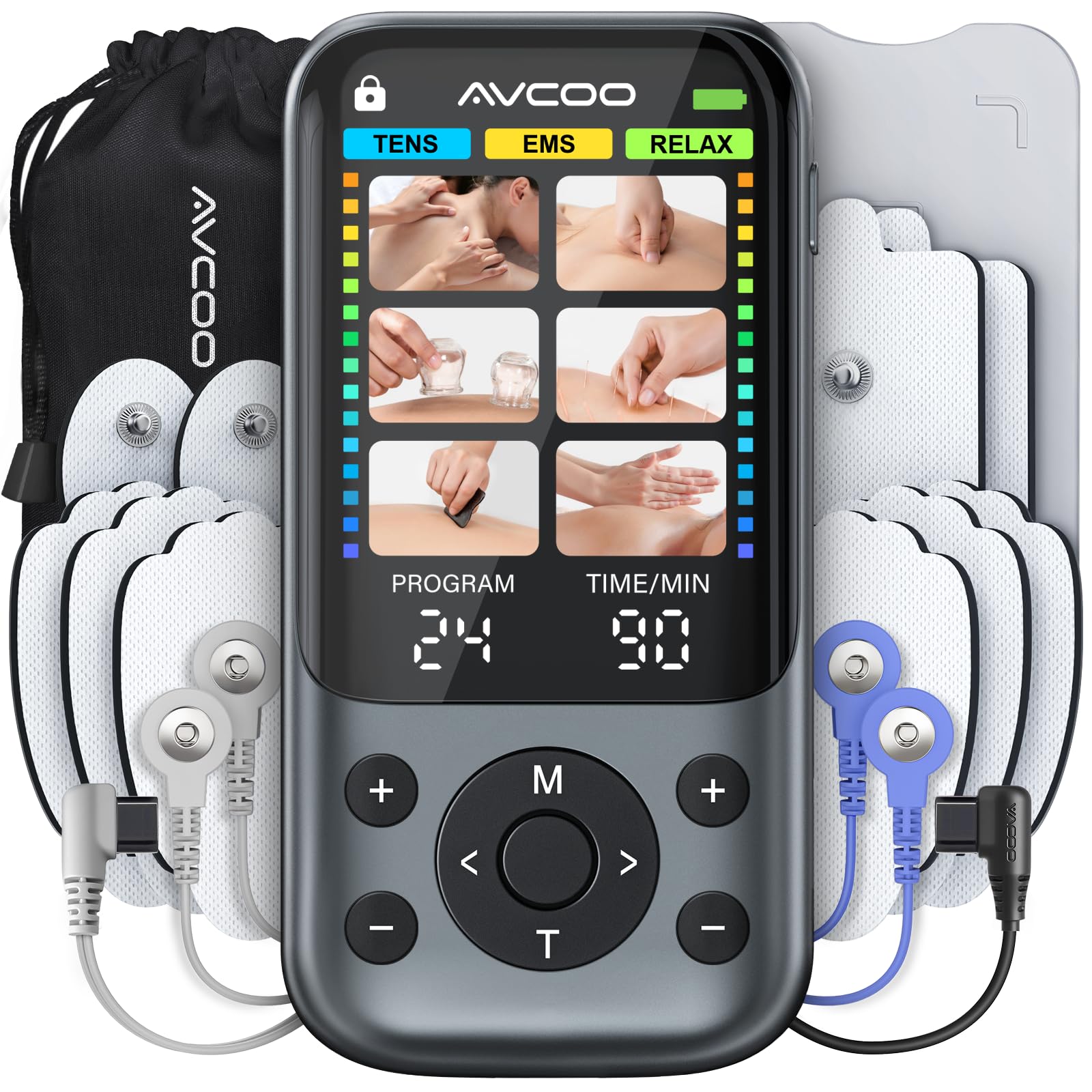
A vivid 3.3-inch color screen makes navigating 24 modes feel like using a modern gadget.
Most TENS units use a basic monochrome LCD, but the AVCOO stands out with a sharp 3.3-inch color display that shows your mode, intensity, and body area clearly. The 24 modes are split across TENS, EMS, and MASSAGE therapies, and you get 30 intensity levels per channel. A unique hardware touch is the U.S.-patented single Type-C port that uses a 4-in-1 cable — one single connection replaces the traditional dual-wire tangle, making setup much tidier.
The rechargeable 400 mAh battery lasts up to 50 hours, splitting the difference between the 30-hour budget units and the 60-hour leaders. The kit is generous: 10 pads in three shapes (palm, rectangular, and oval) that are rated for up to 50 uses each. Buyers battling herniated discs and back spasms report “temporary relief” and call it the best thing they bought for back pain. The independent dual-channel intensity means you can treat your left and right sides at different strengths.
A handful of owners note the included pads can lose stickiness faster than expected. Squaring that away, the unit itself and the screen quality earn consistent praise. A few also wish you could run different modes on the left and right channels at the same time — the unit applies the same mode but different intensities.
For the display-obsessed: If you value a clear, bright interface and hate fussing with tangled wires, the AVCOO’s color screen and single-cable design are refreshing upgrades.
The compromise to know: you cannot run TENS on one channel and EMS on the other simultaneously.
Best suited for: anyone who wants a modern, easy-to-read interface and variety in pad shapes for different body parts.
Not ideal if: you need the absolute longest battery life — the NEOCARBON Ergo beats it by 20 hours.
5. TENS 7000 Digital TENS Unit with Accessories

The medical-favorite that has been the go-to for physical therapists since 2008.
With over 3 million units sold and a 15-plus-year track record in clinics, the TENS 7000 is the benchmark that many newer rechargeable models are compared to. It runs on a standard 9V battery (included), which means you can find a replacement at any convenience store worldwide — a real advantage if you travel or forget to charge. The unit offers multiple therapy modes and a straightforward digital display that physical therapists and patients alike have relied on for years.
It comes with 2 lead wires, a four-pack of reusable premium electrode pads, and a hard carrying case that protects the unit in a gym bag or suitcase. Buyers consistently call it effective for back pain, sciatica (nerve pain running down the leg), neuropathy (nerve damage pain), and post-surgical recovery. The construction is sturdy enough that several owners mention replacing a worn-out unit with the exact same model after years of use.
The catch is battery life. A 9V battery drains faster than the modern lithium packs — shoppers say an hour or two of heavy use before needing a swap. The unit is also slightly heavier at 13.7 ounces than the pocket-sized rechargeables. And you will be buying 9V batteries regularly unless you invest in a rechargeable 9V cell.
For the traditionalist or therapist: If you want a proven clinical-grade unit with universal battery access and zero concern about lithium degradation over years, this is the timeless choice.
Not for the modern minimalist: If the idea of buying and replacing 9V batteries sounds like a hassle, any of the USB-C rechargeable options above will serve you better.
Choose this if: you want the device that physical therapists have trusted for over a decade and value instant battery swaps.
Pass if: you prefer a rechargeable, lighter, and more portable unit with longer continuous runtime.
6. Lanieney U8PRO Wireless TENS Unit Muscle Stimulator
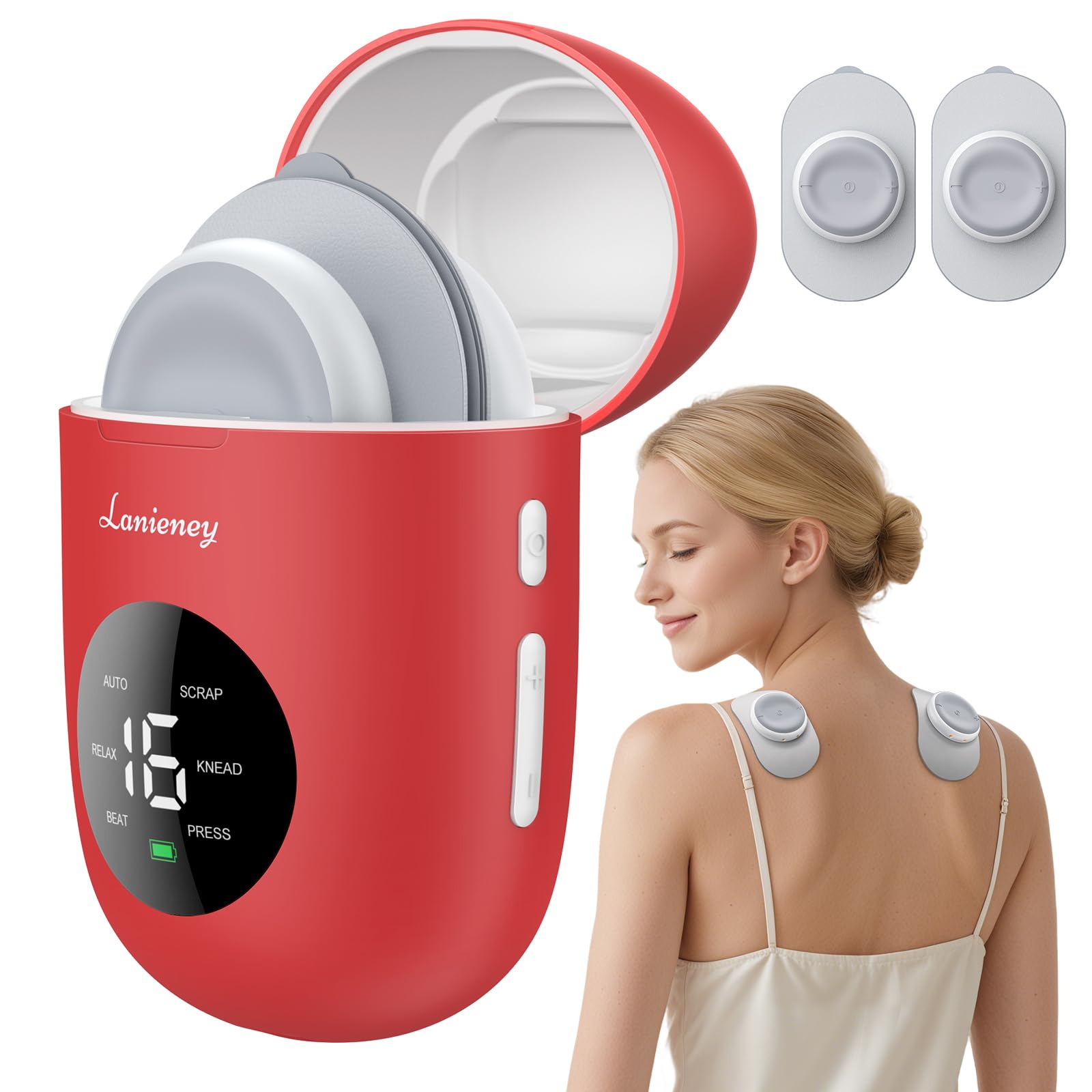
No cords, no wires, no restrictions — clip on the pods and move freely.
The Lanieney U8PRO ditches the lead wires entirely. Two small wireless pods connect to gel pads and stick directly to your skin, controlled by either the pods themselves or the sleek charging case. This is the unit to grab if you want to garden, work at a standing desk, or walk around the house during a session without a cable draping from your back. The dual-channel design lets you treat two areas at once.
It offers 6 modes (including hammering and kneading techniques) and 16 intensity levels. The full charge delivers about 2 hours of continuous use, and the charging case stores and recharges the pods between sessions. The case itself holds enough power for multiple top-ups. The 4 included PET (polyethylene terephthalate — a type of plastic) gel pads use upgraded hydrogel and PU (polyurethane) leather, and owners say rinsing them with water restores stickiness.
The biggest limitation is the lower intensity ceiling. Users who need deep, strong stimulation may find the 16 levels insufficient compared to the 40-level wired units. A few early units have had reliability issues, though most buyers report it works well for daily aching muscles and loves the freedom. The stickiness of the pads is a mixed point — some find them adequate, others replace them sooner than expected.
Best for active multitaskers: If the idea of being tethered by wires makes you skip your sessions, the U8PRO’s fully wireless design is a standout for mobility.
Not for heavy-duty relief: If you need the highest intensity levels and more mode variety for chronic deep pain, a wired unit with 40 levels is a better fit.
Ideal for: discreet use at work, during walks, or on flights where cords are a nuisance.
it’s not for you if: raw power and mode selection matter more than cordless convenience.
7. KingPavonini Wireless TENS Unit Muscle Stimulator, Model U13
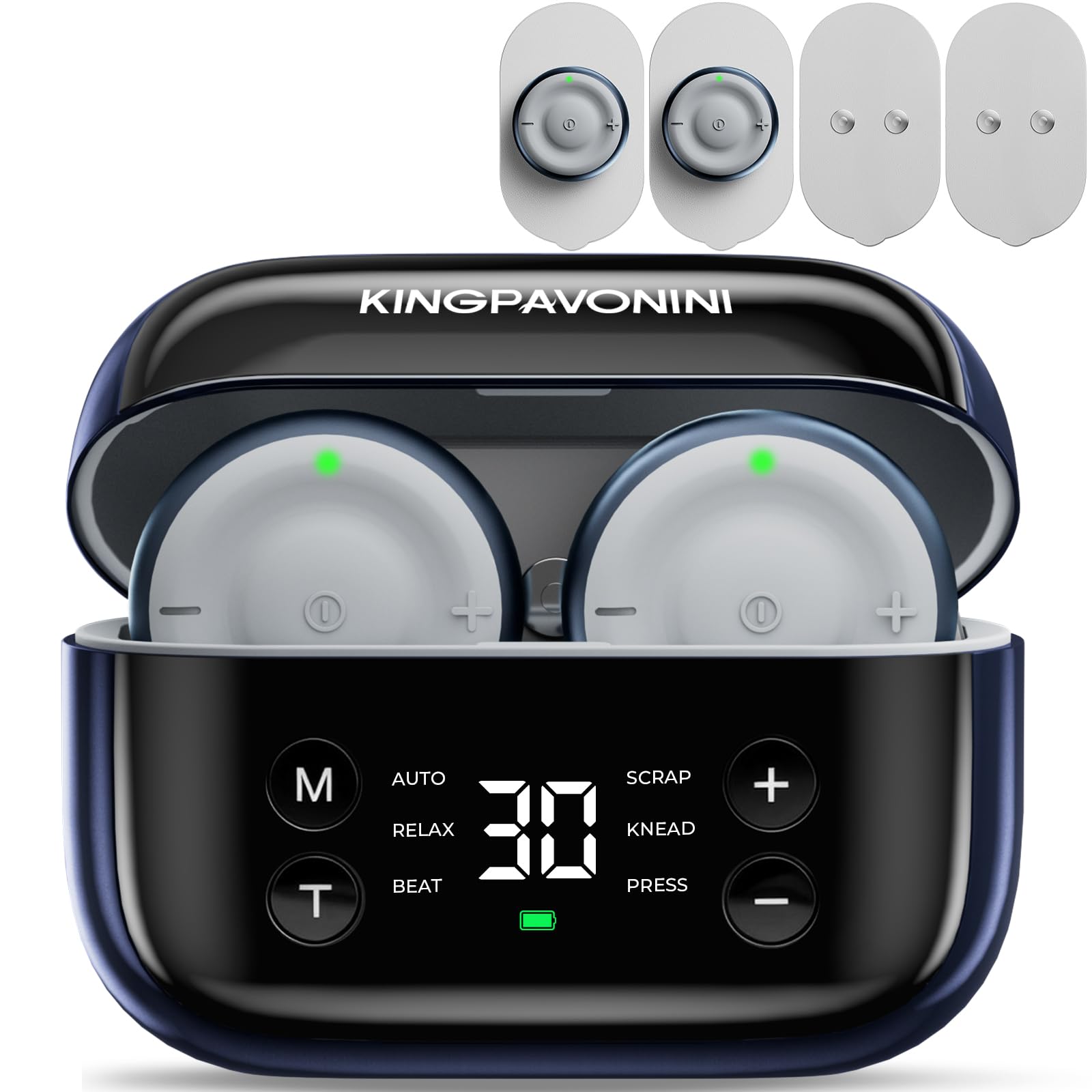
Two wireless stimulators in one kit that you can sync for full-body coverage or run separately.
The KingPavonini U13 takes the wireless concept further by including two independent TENS units inside the charging case. Each unit offers 6 modes and 30 intensity levels, and they can be used separately on two different body areas with different settings — or synced via the charging case for even, simultaneous pulses. The magnetic gel pads (3.23″ x 1.86″) attach securely and are made from latex-free gel and PU leather, rated for up to 50 washes.
The charging case doubles as storage and remote control, so you adjust settings from the case without touching the pods on your body. According to the maker, one charge delivers “weeks of use,” and the adjustable 10-60 minute auto timer adds safety. Owners call it compact and mighty, with enough power on the lowest setting to be effective without being uncomfortable. The unit is well-suited for sciatica relief, hand pain, and general back soreness.
The adhesion quality of the included pads is the most-discussed trade-off — some find they stick well, others report they lose grip faster than expected. A few also note that only 4 pads come in the box, so you will likely order replacements if you use both units on multiple spots daily.
For the flexibility seeker: If you want to treat your back and shoulder with different intensities at the same time, or let a partner use it while you do, the dual-unit design is class-leading.
Consider the extras: Factor in the cost of replacement pads if you plan to use both units heavily every day.
Great for: couples, or anyone who needs different pulse patterns on two sites simultaneously.
Not for: users who prefer a single, more powerful wired unit with a wider mode selection.
8. NEOCARBON TENS Unit Muscle Stimulator Ergo Machine
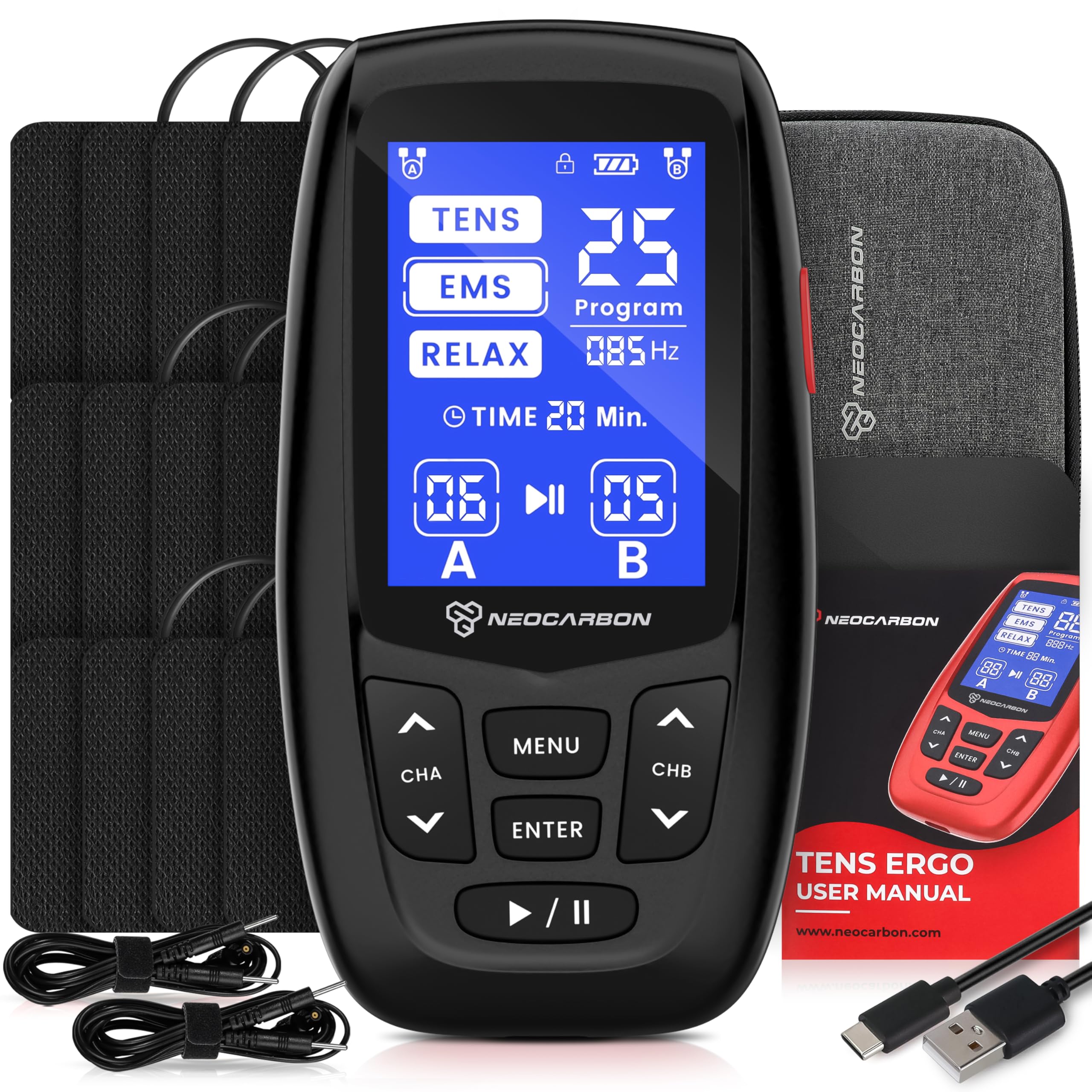
60 programs and a 70-hour battery — the endurance champion for heavy daily users.
If you want the most granular control over your therapy, the NEOCARBON Ergo offers a staggering 60 modes and 20 intensity levels, plus a dedicated Steady Mode designed for PMS (premenstrual syndrome) comfort. The upgraded battery is 80% larger than standard units, delivering up to 70 hours of continuous use — that is the longest runtime in this roundup. A full day of use every day would still mean charging only once every two weeks or more.
The ergonomic design includes a blue backlit LCD screen that is easy to read, and the interface is straightforward despite the deep mode library. The kit includes 12 reusable medical-grade electrode pads, a USB-C charging cable, and a travel case. Owners praise it for treating neuropathy in the feet and legs, with several noting that weeks of consistent use showed noticeable improvement. The unit is lightweight for its feature set at 13.12 ounces.
A small number of owners mention durability questions — some pads may lose adhesion faster than expected, and a few units have developed quirks. The screen looks a bit dated (some liken it to a 2010 cell phone), but the function is what counts. The 20 intensity levels are enough for most, though power users who want extremely fine steps may prefer the 40-level units.
Best for chronic conditions: If you manage daily pain from neuropathy, fibromyalgia, or post-surgical recovery and need the widest mode variety plus endurance, the Ergo is class-leading.
One honest note: the 70-hour battery is extraordinary, but the screen and interface feel less premium than the AVCOO’s color display.
Ideal for: heavy daily users, people with chronic nerve pain, and anyone who values maximum mode variety.
Pass if: you prefer a more modern color screen or prioritize wireless operation over raw mode count.
9. NEOCARBON TENS Unit Muscle Stimulator Ultra for Pain Relief & Recovery
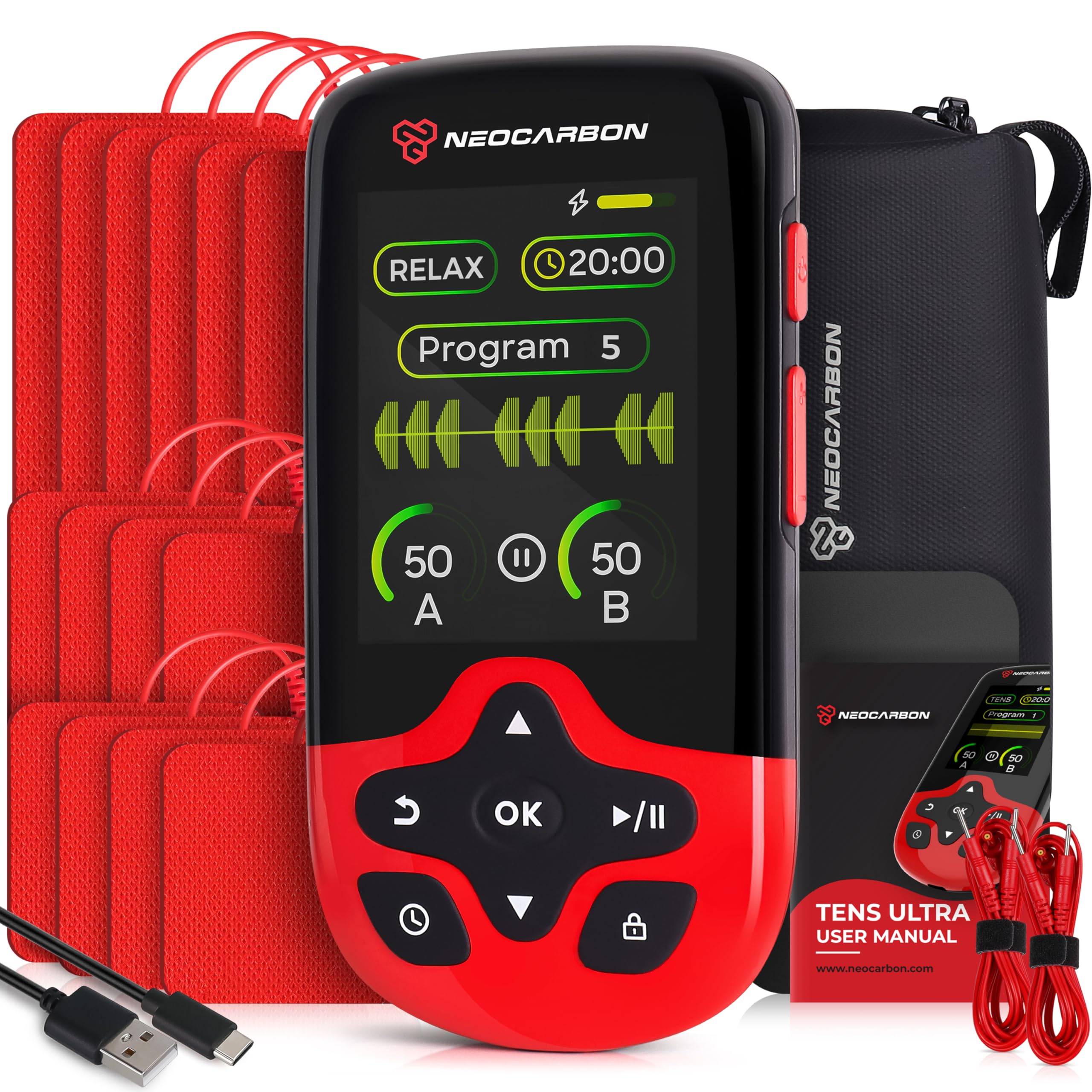
The full premium package — 60 programs, a PMS mode, and a red velvet travel case.
The “Ultra” version of the NEOCARBON lineup shares the same 60 programs and 20 intensity levels as the Ergo, but packages it with an even more complete kit: 14 reusable electrode pads in two sizes (for larger back areas and smaller joints), 2 dual-plug cables, a large pad holder, and a premium red velvet travel case. It also features a vivid color LED display that feels more modern than the Ergo’s blue backlit screen. The dedicated PMS Steady Mode uses a gentle rhythm intended to relax menstrual cramps.
Owners love the effectiveness for sore backs and legs, with several calling it “better than a doctor” for daily muscle tension. The dual-channel design lets you treat two areas independently.
The main issue surfaced by a few owners is that the no-return policy is not prominently displayed, leading to frustration if the unit does not work for them. One noted the EMS setting felt more like a surface tingle than a deep muscle contraction at higher intensities. Overall, the quality and ease of use are widely praised, and the kit is the most complete from the start.
Best for the complete starter: If you want everything included — enough pads to cover multiple spots, a carrying case, and a dedicated menstrual comfort mode — the Ultra is the most generous kit here.
Know before you buy: The 10-hour battery is adequate for daily sessions but falls well short of the Ergo’s 70-hour marathon if you tend to forget charging.
Choose this for: the most complete unboxing experience, 60-mode versatility, and the unique PMS comfort program.
look elsewhere if: you prioritize weeks of battery life over a more extensive accessory kit.
Understanding the Specs
TENS vs. EMS: Which Mode Does What
TENS (Transcutaneous Electrical Nerve Stimulation) sends gentle electrical pulses that interfere with pain signals traveling to your brain — it is designed for pain relief rather than muscle contraction. EMS (Electrical Muscle Stimulation) directly triggers muscle fibers to contract, which can improve circulation, reduce spasms, and speed recovery after workouts. Many modern units combine both, so you can switch between blocking pain and actively relaxing knots.
Battery Capacity in mAh
Measured in milliampere-hours (mAh), this tells you the energy reservoir inside. A 300 mAh battery typically runs for 30-40 hours, while a 600 mAh battery can push past 60 hours. If you plan to use the device daily for 20-minute sessions, a 600 mAh unit might need charging only once a month. For wireless pods with smaller cells, 2-3 hours per charge is common, but the charging case extends that significantly.
Electrode Pad Quality and Connectors
Pads are the only part of the system that touches your skin, and their gel layer determines adhesion and current delivery. Premium solid-gel pads (often rated for 45-50 uses) stay sticky longer and leave no residue. The 2mm “pin-in” connector is the medical industry standard, meaning you can buy replacement pads from almost any brand without compatibility issues. Larger pads (2″ x 4″) spread current over broad muscles, while smaller pads target precise spots like the wrist or knee.
Independent Dual Channels
A dual-channel unit lets you run two sets of pads at different locations (like your left shoulder and lower back) with separate intensity controls for each channel. This is essential if you want to treat multiple body areas in one session without one spot getting too much or too little current. Quad-channel units like the AUVON 4 Outputs take this further, allowing four independent zones or two users simultaneously.
FAQ
Can an EMS muscle stimulator be used on any body part?
How often can I use a TENS or EMS unit safely?
Will an EMS muscle stimulator help with sciatica pain?
What is the difference between a rechargeable and a 9V battery unit?
How long do the electrode pads last before I need replacements?
Can I use an EMS muscle stimulator after surgery for recovery?
Is there a risk of getting a shock or burn from these units?
Can I use the unit while driving or operating machinery?
Final Thoughts: The Verdict
For the majority of shoppers, the best ems muscle stimulator
Related Guides

Mo Maruf
I created WellFizz to bridge the gap between vague wellness advice and actionable solutions. My mission is simple: to decode the research and give you practical tools you can actually use.
Beyond the data, I am a passionate traveler. I believe that stepping away from the screen to explore new environments is essential for mental clarity and physical vitality.