Our readers keep the lights on and my smoothie glass nicely filled. As an Amazon Associate, I earn from qualifying purchases.
Specs are compiled from manufacturer listings and verified buyer reviews and can change over time — please confirm the key details on the product page before buying.
You walk the course, and your clubs glide behind you without pushing, pulling, or fiddling with a remote. That is the promise of an electric golf push cart that follows you. But making that “follow” feature work reliably on a hilly, windy, 18-hole course is the real engineering challenge — and the difference between a cart that feels like magic and one that feels like a headache.
I’m Mohammad Maruf — the founder and writer behind WellFizz. This guide is built by comparing the manufacturers’ published specifications and the patterns across verified customer reviews, so you get each pick’s real strengths and trade-offs instead of marketing spin.
The nine carts below represent the most capable and well-reviewed options on the market right now, broken down by how well they actually track you, how long the battery lasts, and how easy they are to live with between rounds. We’ve focused on what matters most when choosing the best electric golf push cart that follows you — real-world range, terrain handling, and whether the hands-free mode works as promised.
Our Picks at a Glance


How To Choose The Best Electric Golf Push Cart That Follows You
Picking the right hands-free golf cart depends on understanding how the follow technology actually works, how much battery you need for your typical round, and whether the cart fits your course conditions and your car’s trunk. Here are the three biggest factors to consider.
Tracking Technology: Ultrasound, RF, or Camera
Not all “follow me” modes are the same. Some carts use a combination of ultrasound and RF (radio frequency) signals to calculate your speed, distance, and angle — this works well in open sight lines but can lose you on sharp turns or around thick trees. Camera-based vision tracking, like the kind on the CaddyTrek R3X, is more advanced but struggles in direct sunlight or on steep hills where the camera loses visual contact. The simplest and most reliable method for most golfers is a dedicated remote control — it gives you full directional control without any of the guesswork.
Battery Range: 18 vs 27 vs 36 vs 45 Holes
Battery range is measured in how many holes you can play on a single charge. If you walk 18 holes every weekend, a cart with an 18-hole battery is enough — but you will need to charge it after every round. A 27-hole battery gives you a full round with a safety buffer, while 36-hole and 45-hole batteries let you play two consecutive rounds without plugging in. The trade-off is that longer-range batteries are heavier and add to the cart’s overall package weight.
Folding Size and Portability
A cart that follows you is only useful if it actually makes it to the course. Folding dimensions and weight determine how easily it fits in your trunk and how much effort it takes to load and unload. Some models fold down in seconds with one click and end up as small as 22 x 18 x 16 inches — small enough to sit beside your golf bag. Others are bulkier and require removing the wheels or battery to shrink down. If your trunk space is tight, look for a cart with a stated folded size that fits your vehicle.
Quick Comparison
| Model | Best For | Battery Range | Item Weight | Follow Mode | Amazon |
|---|---|---|---|---|---|
| Wingscaddy Max300★ Best Value Remote | Value & Remote Control | 36 holes | — | No (Remote only) | Amazon |
| CaddyTrek R2Top Performer | Ultrasound/RF Follow | 18 holes | 39 pounds | Ultrasound + RF | Amazon |
| KVV E-GT3070Compact Pick | Compact Storage | 18+ holes | 27.9 pounds | No (Remote only) | Amazon |
| tianhong G5 | Auto-Follow & Range | 45 holes | — | Smart Follow Me | Amazon |
| Alphard Cybercart | Hill Stability | 36 holes | — | No (Remote only) | Amazon |
| Motocaddy M7 Remote | Remote Range & Features | 27 holes | ~25 pounds | No (Remote only) | Amazon |
| CaddyTrek R3X Vision | AI Vision Follow | 36 holes | 31 pounds | Vision + Gesture | Amazon |
| MGI Zip Navigator AT | Reliable All-Terrain | 36 holes | 37.3 pounds | No (Remote only) | Amazon |
| MGI Zip Navigator AT Seat Bundle | Premium Bundle with Seat | 36 holes | 35.05 pounds (with battery) | No (Remote only) | Amazon |
In‑Depth Reviews
1. Wingscaddy Max300
Our pick — 4.5★ from 50+ verified ratings; the strongest balance of quality and price.
You get a workhorse remote-control cart that undercuts competitors on price without skimping on endurance — the Wingscaddy Max300 proves you do not need a fortune for a reliable electric caddy.
It runs on dual 200-watt motors with an anti-tip wheel standard, so you get strong climbing power on hilly terrain without the wobble that plagues cheaper single-motor models. The lithium battery is rated for up to 36 holes of play — enough for two full rounds between charges. Buyers report it is “lightest electric cart, lithium battery, half the price of competitors” and that it “never tipped over on undulating terrain.” Build quality is what owners praise most — the frame uses strong welds, screw-in connectors, and a leather handle that feels more premium than the price suggests. Assembly is straightforward, though the manual is minimal. One catch: this cart uses remote control mode, not a true “follow me” system. You operate it with the included remote, which works up to 30 meters and has 9 adjustable speeds. If you want a cart that tracks you automatically without a remote, this model is not that. But for anyone who wants a durable, long-range electric push cart at a price that leaves room for a new driver, the Wingscaddy is the smart buy.
What Owners Appreciate
- Dual 200W motors provide strong climbing power on steep hills
- Lithium battery lasts a verified 36 holes per charge
- Three modes: remote, trolley, and free-wheel for versatility
- Includes umbrella holder, scorecard holder, and drink holder
- Lightweight frame compared to premium competitors
Things to Keep in Mind
- No follow-me mode — remote control only
- USB port on some units caused control issues (easily fixed with own port)
- Scorecard holder can slide off during use
Smart money pick: This is the cart to buy if you want a 36-hole remote-controlled caddy that performs like models costing twice as much. skip it if you require true automatic follow technology — that feature lives on more expensive carts.
2. CaddyTrek R2
A true hands-free walking companion that uses ultrasound and RF to track you on the fairway — the CaddyTrek R2 is one of the few carts here that genuinely follows you without a remote in your hand.
It uses a combination of ultrasound and RF (radio frequency) signal technology to calculate your speed, distance, and angle — then it follows either in front of or behind you. Owners mention it works as advertised and makes walking the course enjoyable, especially for those wanting the exercise without the strain of pushing. The package weight is 49 pounds (the cart itself is 39 pounds), making it noticeably heavier than the KVV at 27.9 pounds — a weight difference that matters if you lift it into an SUV frequently. The follow mode handles long holes well, and the remote mode lets you send the cart 100 feet ahead to the next tee box while you finish putting. The aluminum alloy frame folds down in seconds, and the battery lasts a reliable 18 holes per charge. The main trade-off? The follow mode can lose connection over bumps or if the remote falls out of sight, and the included accessories (phone holder, cup holder, umbrella holder) are lower quality than the cart itself.
What Stands Out
- True follow mode using ultrasound and RF — no remote needed in hand
- Four modes: follow, marching, remote control, and manual push
- Onboard gyroscope (a sensor that keeps it stable) for straight-line tracking on uneven terrain
- Folds quickly for trunk storage
Real-World Caveats
- Follow mode can spin in circles if it loses sight of the user
- Heavier than most competitors at 39 pounds (cart only)
- Side slopes can cause shaking during follow mode
- Umbrella holder makes it top-heavy in wind
Best for hands-free walkers: Pick this if you want to walk without holding anything — not even a remote. Choose something else if you play on very hilly or narrow courses where the ultrasound could lose track of you.
3. KVV E-GT3070
An ultra-light, ultra-compact remote cart at 27.9 pounds that folds small enough to fit beside your bag — the KVV is the lightest full-featured remote cart on this list.
Its folded size of 17.5 x 18.7 x 22 inches is the smallest here, making it the go-to pick for anyone with a compact car trunk or limited home storage. The package dimensions at 22.7 x 18.5 x 16 inches are 32% smaller than the Wingscaddy Max300’s box, so it really does disappear into tight spaces. The remote control works from up to 100+ feet with 9 speeds, and customers note it handles 18 hilly wet holes on a single charge without issue — as one owner put it: “Battery lasted 18 hilly wet holes.” The front wheel rotates a full 360 degrees, which gives it exceptional maneuverability on the course, though turning on steep hills can be limited. The build quality is solid aluminum, and the included insulated cooler bag is a rare bonus. Some owners find the left/right steering jerky at higher speeds, and the cart sometimes needs help on steep slopes.
Key Strengths
- Lightest in this roundup at 27.9 pounds
- Smallest folded footprint at 17.5 x 18.7 x 22 inches
- Remote works up to 100+ feet with 9 speed settings
- Includes insulated cooler bag and carry bag
- Aluminum frame with 2-year manufacturer warranty
Honest Trade-Offs
- No true follow mode — remote control only
- Steering can feel jerky left/right at higher speeds
- Needs manual help on steeper hills
- Front wheel rotation limited on steep inclines
Perfect for tight trunks: Grab this if you have limited car space and want the lightest cart available. pass on it if you play a hilly home course — the steering and slope limitations may frustrate you.
4. tianhong G5
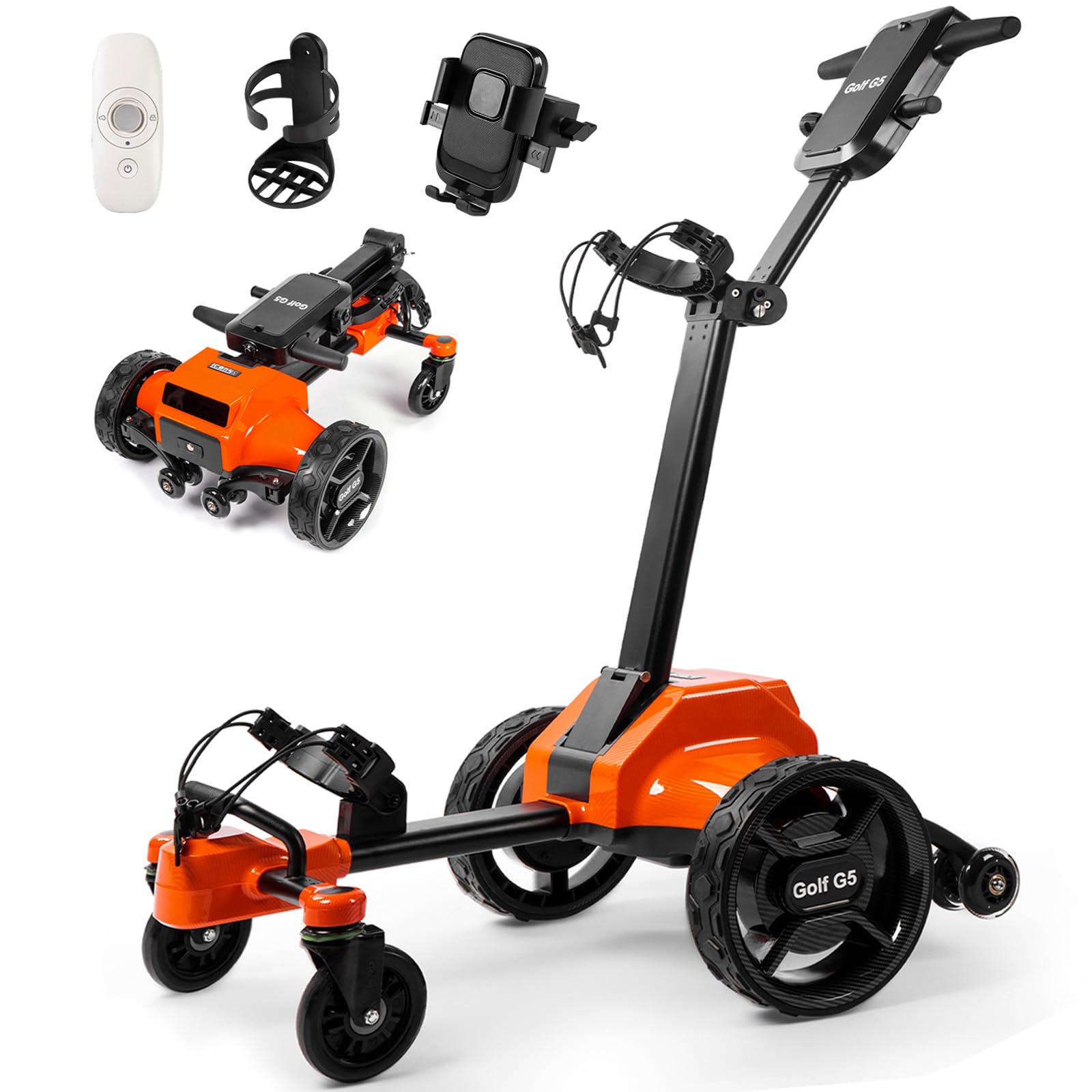
A 45-hole battery and true auto-follow sensors solve the biggest anxiety for electric cart owners: running out of battery mid-round.
The tianhong G5 runs on a high-performance lithium battery rated for a staggering 45 holes of play — enough for two full 18-hole rounds plus a nine-hole practice session, all on one charge. The cart uses Smart Follow Me technology with advanced sensors that track your position and follow you hands-free across the course. Owners confirm it handles 30-degree slopes well, thanks to dual anti-tip wheels, and has not tipped over during regular use. The follow mode works best with the remote in the included belt holster behind you, and it reliably avoids obstacles on the fairway. The color LED display shows real-time speed, battery power, mode, and mileage — a feature rare at this price point. The main durability concern after many rounds: hub covers can fall off, and the remote needs a full overnight charge (the blinking light stops early, which can be misleading). The phone app is nearly useless for actual control, so rely on the remote or follow mode.
Best for marathon players: The 45-hole battery is class-leading in this price bracket — ideal for weekend warriors who play multiple rounds without access to a charger. The trade-off is that the frame is not the most sturdy, and the phone app is essentially worthless for control.
5. Alphard Cybercart
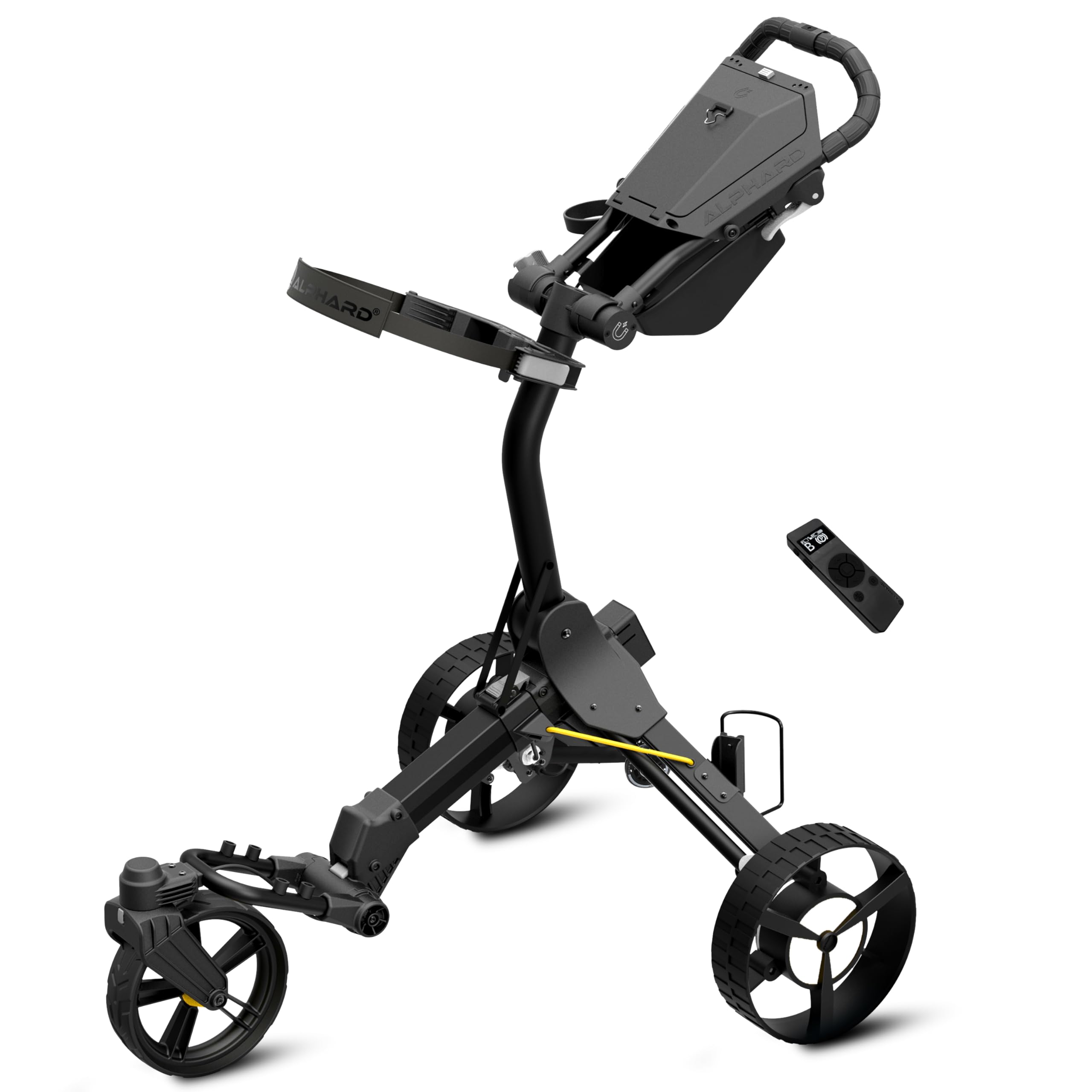
A stability-focused remote cart with a 6-axis gyroscope (a sensor that detects tilt and rotation) and hill braking that masters slopes — engineered for one thing above all else: staying upright on hills.
It has a low center of gravity, anti-tip bars, downhill speed control, and a 6-axis gyroscope that keeps the cart tracking straight even on uneven terrain. Owners say it is “super sturdy” and “could not be more stable” — the material quality earned 13 positive mentions, the highest count for this product. The 360-degree swivel front wheel provides smooth movement, and the freewheel mode lets you push it manually when you prefer. The battery is rated for up to 36 holes per charge, and buyers confirm it has plenty of power remaining after 18 holes. The Cybercart uses an LCD remote with out-of-range auto-stop for safety, plus a mobile app for backup control and a USB-C port. It is assembled in the US, which appeals to buyers who value domestic production. A small number of reviewers point out a high-pitched DC motor whine that can be irritating for sensitive ears.
Stability champion: The gyroscope and hill braking make this the safest pick for steep terrain — it simply does not tip. The catch is the occasional motor noise, which is a deal-breaker for a few sensitive ears but a non-issue for most.
6. Motocaddy M7 Remote

A well-established brand with 9 speeds, downhill control, and a remote that works from over 150 feet — the longest stated range on this list.
The Motocaddy M7 brings the full feature set: 9 speed settings, downhill control that prevents runaway carts, anti-tip rear wheels, and all-terrain tires. The remote works from over 150 feet with forward, left, right, and reverse controls plus pause and resume. The lithium battery is rated for up to 27 holes, giving you a full round with plenty of buffer. The cart folds into a compact package (roughly 26 x 19 x 17 inches folded) and the aluminum frame is lightweight for its class. It comes with a value accessory package including a phone cradle, drink holder, umbrella holder, and scorecard holder. The main concern: reliability is the aspect owners mention most with 8 mentions, and it is marked as mixed — meaning a meaningful number of owners have experienced random shutdowns or failures within the first 6 months. The US service center is responsive, but the repair process is a hassle.
Best for brand loyalty: Pick the M7 if you want the longest remote range (150+ feet), 9 speeds, and a fully featured accessory bundle. Weigh the reliability reports carefully — consider an extended warranty if you go this route.
7. CaddyTrek R3X Vision
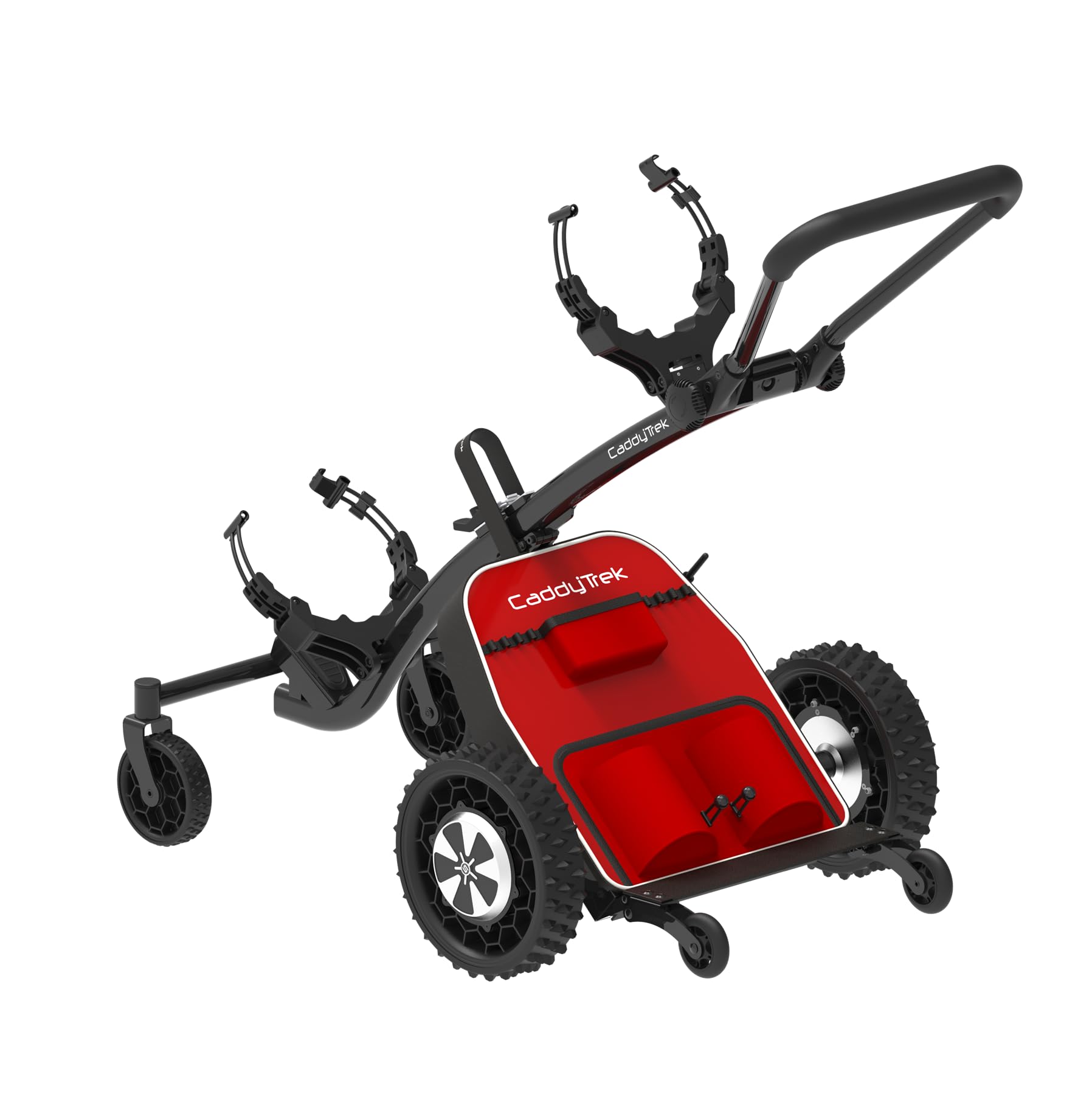
A camera-guided follow cart that lets you control it with hand gestures — no remote required. The CaddyTrek R3X is the most advanced “follow you” cart on the market.
It uses Smart A.I. Vision Tracking with a camera rather than ultrasound or RF signals. You also get Hand Gesture Control — open your palm to stop, wave to start, and the cart responds without you touching anything. Owners who have used it for 80+ rounds report it handles all terrain types including steep hills, and the wheelie wheels are effective on the steepest slopes. The 24V lithium battery lasts up to 36 holes, matching the range of premium competitors. The R3X offers four modes: follow, remote control, manual, and a new Marching mode that keeps the cart at a consistent walking pace. The remote control mode is 100% reliable according to owners, while the follow mode gets mixed reactions — it can lose sight of the user in direct sunlight or on hilly terrain, requiring you to walk back to find it. The cart weighs 31 pounds and folds to 13 x 24 x 22 inches.
what separates it
- Camera-based AI vision tracking — most advanced follow technology here
- Hand gesture control allows playing without the remote in hand
- Four modes including Marching mode for consistent pace
- 36-hole battery range with USB charging port
Know Before You Buy
- Follow mode loses the user in direct sunlight and on steep hills
- Phone app is clumsy and unreliable
- Marching mode lags and requires frequent course correction
- Hand gesture recognition is inconsistent (works 9/10 for open palm, rarely for others)
Tech-forward choice: Get this if you want the most innovative follow technology and enjoy tinkering with settings. it’s not for you if you want a “set it and trust it” experience — the follow mode is not bulletproof.
8. MGI Zip Navigator AT

A proven 230W-twin-motor cart that has earned the trust of nearly 300 owners — the most-reviewed electric caddy here by a wide margin.
The MGI Zip Navigator AT uses twin 230-watt motors — the most powerful motor spec here — to handle any terrain quietly and smoothly. The Zip Fold Technology lets you set it up and break it down quickly, with a folded size of 27.55 x 18.5 x 16.5 inches (with rear wheels inverted for transport). The total weight with battery is 37.3 pounds. The Click & Go lithium battery system is rated for 36 holes, and owners consistently confirm it delivers with charge to spare. The digital display offers variable speed control from 1 to 9, distance tracking in yards or meters, and a USB charging port under the handle. Quality is the top praise from owners — mentioned 52 times — and stability gets 32 positive mentions. The main trade-off is maneuverability, which gets mixed feedback with 38 mentions. Some owners find the cart pulls to the right when not using the remote, and it can be less stable on side hills.
The crowd favorite: With nearly 300 ratings and 4.3 stars, the MGI Zip Navigator AT is the most trusted electric caddy on this list. The twin 230W motors give it real power, but it is not the most maneuverable on side slopes.
9. MGI Zip Navigator AT Seat Bundle
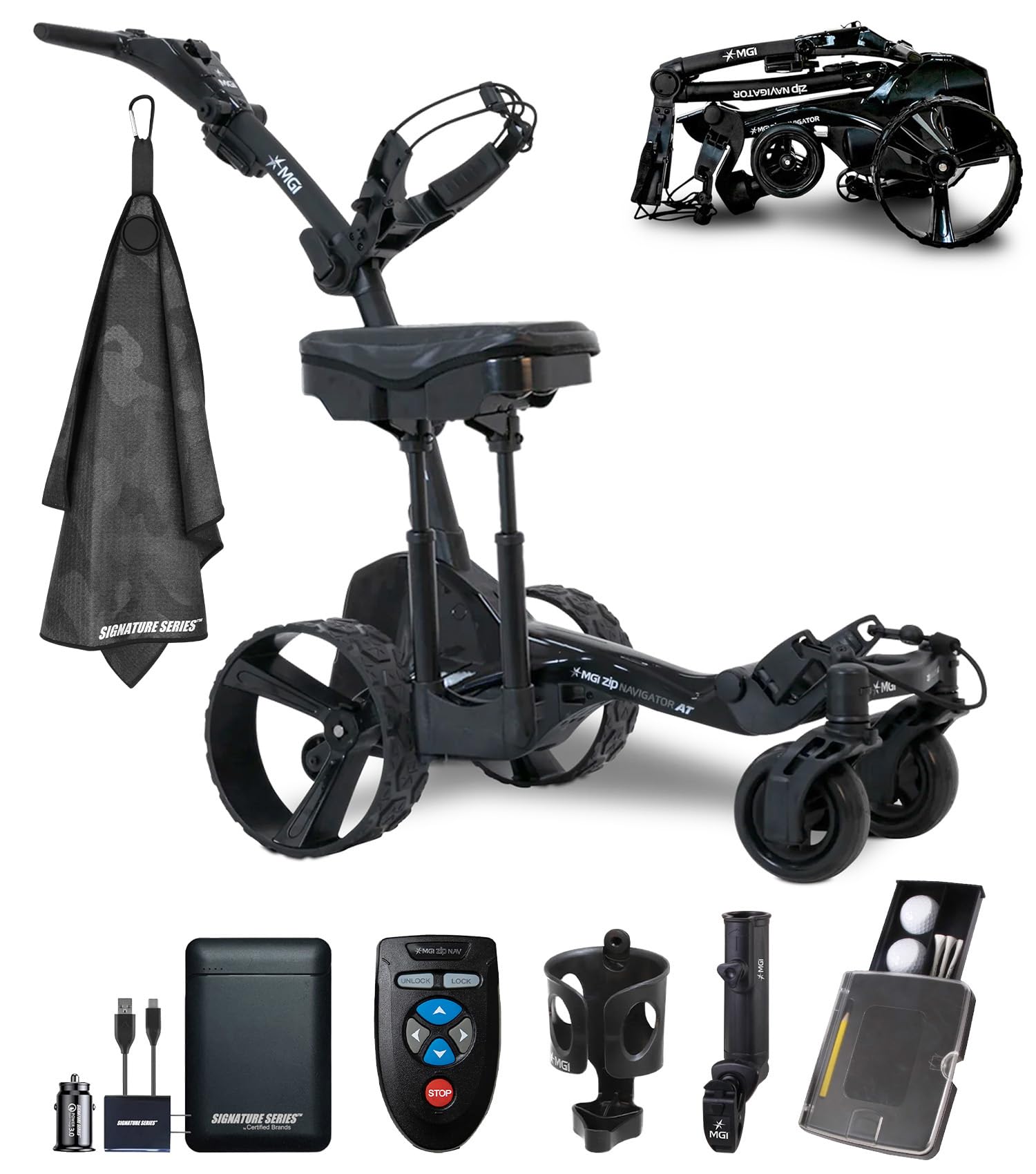
The same proven MGI platform with a padded seat and a charging bundle for the ultimate package — the same twin 230W motors and 36-hole battery, but with a place to sit between shots.
The MGI Zip Navigator AT Seat Bundle takes everything that makes the standard Zip Navigator great — the twin 230W motors, the 36-hole battery, the Zip Fold Technology — and adds a padded seat attachment with lined storage for balls and jerseys. The seat attaches to the frame between holes so you can sit down and reload. It also includes the Signature Series Power Pack for on-the-go charging of your phone or other devices. The folded dimensions are the same as the standard model at 27.55 x 18.5 x 16.5 inches, and the total weight with battery is 35.05 pounds — actually lighter than the standard model’s 37.3 pounds thanks to a revised battery design. The variable speed control goes up to 1-20 (much finer adjustment than the standard 1-9), and the all-terrain rear wheels handle everything from fairway to wet grass. Assembly requires more effort than the standard model due to the seat, and the price is the highest on this list.
All-in-one premium: The seat and power pack turn a great cart into a luxury walking experience. The trade-off is the assembly effort and the premium price — only worth it if you know you will use the seat every round.
Understanding the Specs
Follow Me Technology
This is the core feature of this category. Carts use either ultrasound and RF signals (which calculate your position based on a signal emitter you carry) or camera-based AI vision (which uses a camera to visually track you). Ultrasound/RF tends to be more reliable in direct sunlight and on hills, but can lose you around sharp turns. Camera vision is more advanced but struggles in low sun and on steep terrain where the camera loses sight. Some carts do not have follow mode at all — they rely on a remote control, which is simpler and more reliable but requires you to hold a device.
Battery Range (Holes)
Manufacturers rate battery range in holes of golf you can play on a single charge. An 18-hole battery is enough for one round but requires charging after every use. 27-hole batteries give you a full round with a safety margin. 36-hole and 45-hole batteries let you play two consecutive rounds without charging. The trade-off is weight: a 45-hole battery pack adds significant heft to the cart. If you play 18 holes once a week, a 27-hole or 36-hole battery is the balance — you get a buffer without the weight penalty of the largest packs.
Motor Power (Watts)
Motors are rated in watts, and the common range here is 200W to 230W. A 200W motor handles most flat and gently rolling courses without issue. 230W motors (seen on the MGI and Motocaddy models) provide noticeably more torque for steep hills and wet grass. Dual motors (two motors driving separate wheels) provide better traction and steering than a single-motor setup. For hilly courses, prioritize a dual-motor cart with at least 200W per motor.
Folded Size and Weight
Folded dimensions determine whether the cart fits in your trunk alongside your golf bag. Look for a cart that folds under 30 inches in its longest dimension. Weight matters because you will lift it in and out of your car after every round. The lightest carts here are around 27.9 pounds (KVV), while the heaviest are over 39 pounds (CaddyTrek R2). Every extra 10 pounds adds fatigue over a season — choose the lightest cart that still meets your battery and feature requirements.
FAQ
How does the “follow me” mode actually work on these golf carts?
Can I use the cart as a regular push cart if the battery dies?
How many holes should I look for in a battery?
Will these carts work on hilly courses?
How long does it take to fold and unfold the cart?
Are these carts allowed on all golf courses?
What is the difference between remote control and follow mode?
How long does it take to charge the battery fully?
Final Thoughts: The Verdict
For most buyers, the best electric golf push cart that follows you is the CaddyTrek R2 because it uses ultrasound and RF tracking to follow you hands-free, with a reliable 18-hole battery and four modes. If you prefer a remote-controlled cart, the KVV E-GT3070 is the lightest and most compact option, combining 27.9 pounds with a tiny folded size. And for the maximum battery range and value, the tianhong G5 offers a 45-hole battery and smart follow me sensors at a price that undercuts the premium competition by a wide margin.
How We Picked
We do not accept paid placement. Every pick is matched to a real buyer and a real use-case; we do not hands-on test units.
Sources & Methodology
Specifications: manufacturer listings and product documentation. Review insights: verified customer reviews, as of July 2026. Pricing: not shown on this page (it changes often); check the current price via the retailer link.
As an Amazon Associate, WellFizz earns from qualifying purchases. This does not affect which products we feature.
Related Guides

Mo Maruf
I created WellFizz to bridge the gap between vague wellness advice and actionable solutions. My mission is simple: to decode the research and give you practical tools you can actually use.
Beyond the data, I am a passionate traveler. I believe that stepping away from the screen to explore new environments is essential for mental clarity and physical vitality.