Our readers keep the lights on and my smoothie glass nicely filled. As an Amazon Associate, I earn from qualifying purchases.
Specs are compiled from manufacturer listings and verified buyer reviews and can change over time — please confirm the key details on the product page before buying.
You want to carry gear through rain, waves, or a river crossing without finding a soggy mess inside. A drybag backpack solves that. But not every roll-top bag seals the same way, and the wrong choice leaves you with wet clothes and a ruined phone. This guide cuts through the options to the nine models that actually keep your stuff dry — from budget-friendly day bags to submersible expedition packs.
I’m Mohammad Maruf — the founder and writer behind WellFizz. This guide is built by comparing the manufacturers’ published specifications and the patterns across verified customer reviews, so you get each pick’s real strengths and trade-offs instead of marketing spin.
These nine drybag backpacks represent the best balance of waterproofing, durability, and real-world comfort you can buy today. This is the guide to best drybag backpack picks that earn their place on any adventure.
Our Picks at a Glance

How To Choose The Best Drybag Backpack
Picking the right drybag backpack depends on three things: how wet it will get, how much you need to carry, and how you want to carry it. A kayaker wading through rapids needs a different bag than a hiker caught in a drizzle. Here is what to look for.
Waterproofing Level: Roll-Top vs Zipper vs Submersible
A roll-top closure is the gold standard for keeping water out — you fold the top down three to four times and clip it. This creates a reliable seal that works even if the bag goes overboard. Airtight zippers offer quick access but cost more and can be harder to pull. Submersible bags like those rated IPX8 can survive being fully underwater, which matters for rafting or diving trips.
Material and Build Quality
Most drybag backpacks use PVC (polyvinyl chloride), tarpaulin (a heavy-duty coated fabric), or TPU (thermoplastic polyurethane — a durable flexible plastic). PVC is affordable and waterproof but heavier. Tarpaulin is rugged and abrasion-resistant, ideal for boat decks and rocky shorelines. TPU is the premium choice — lighter, more flexible, and more durable over time. Look for high-frequency welded seams (heat-bonded rather than stitched) because stitches create holes that let water through.
Capacity and Straps
A 10L to 20L bag works for a day trip with a towel, change of clothes, and phone. A 30L to 40L bag handles multi-day gear, and anything above 55L is expedition territory. Backpack-style straps with a sternum or waist belt distribute weight better than a single shoulder strap, especially for longer portages.
Quick Comparison
| Model | Best For | Capacity | Weight | Material | Amazon |
|---|---|---|---|---|---|
| Earth Pak Dry Bag★ Best Overall | Overall best value | 30 L | 1.4 lb | PVC | Amazon |
| STOVER Dry BackpackBest Value | Quality + water resistance | 25 L | 1.45 lb | Vinyl | Amazon |
| Cressi Ocelot Dry BagCompact Pick | Compact carry | 10 L | 1.1 lb | PVC-coated polyester | Amazon |
| IDRYBAG Waterproof Backpack | Laptop carry | 25 L | — | 500D PVC | Amazon |
| GVANCA Roll Top Dry Bag | Multi-day trips | 35 L | — | 500D PVC | Amazon |
| Haimont Waterproof Duffle | Large capacity | 60 L | 2.5 lb | 500D Tarpaulin | Amazon |
| OSAH DRYPAK Backpack | Heavy-duty use | 35 L | — | 500D PVC | Amazon |
| Pelican Exodry Dry Bag | Brand reliability | 30 L | 1.6 lb | — | Amazon |
| Breakwater Supply Fogland | Full submersion | 25 L | — | TPU | Amazon |
In‑Depth Reviews
1. Earth Pak Waterproof Dry Bag
Our pick — over 4.5★ from 32,942 verified ratings; the strongest balance of quality and price.
The roll-top that doubles as an emergency float for a non-swimmer, endorsed by Wirecutter.
Earth Pak earned the top spot because it delivers what most buyers need: a bombproof seal, sensible size, and a waterproof phone case that actually works. The 30-liter version holds two towels, a change of clothes, and valuables with room to spare, while the backpack-style straps with a sternum strap keep the load stable when you are paddling or hiking. It weighs 1.4 pounds — noticeable but not heavy — and the PVC material feels thick enough to survive being dragged across a boat deck.
The included IPX8-certified phone case (for screens up to 6.5 inches) is a real bonus. You can snap photos through the clear windows while the phone stays dry, and the snap-and-lock closure is simple to operate. Reviewers report using the bag as a makeshift flotation device — as one buyer put it, “in a pinch I even blew extra air into it, along with my gear, in order to use it as a floatation device for my daughter.” The five-year warranty adds confidence.
The only trade-off: the included phone case lanyard loop has been known to fail under strain, so attach the case to the bag itself rather than around your neck. Some owners also note that the shoulder straps, while functional, are the least rugged part of an otherwise tough package.
What wins owners over
- Rock-solid roll-top seal keeps contents dry even under pressure
- IPX8 phone case is genuinely waterproof and lets you take photos
- Multiple sizes (5L to 55L) with backpack straps on 30L and above
The honest trade-offs
- Phone case lanyard loop can detach — secure it to the bag
- Shoulder straps are functional but not as durable as the bag body
Reach for this if: you want one drybag that handles kayaking, beach trips, and travel while staying affordable — the 30L size is the balance for most people.
Think twice if: you need a fully submersible bag for diving or heavy whitewater — this is splash-proof and dunk-proof, not designed for extended submersion.
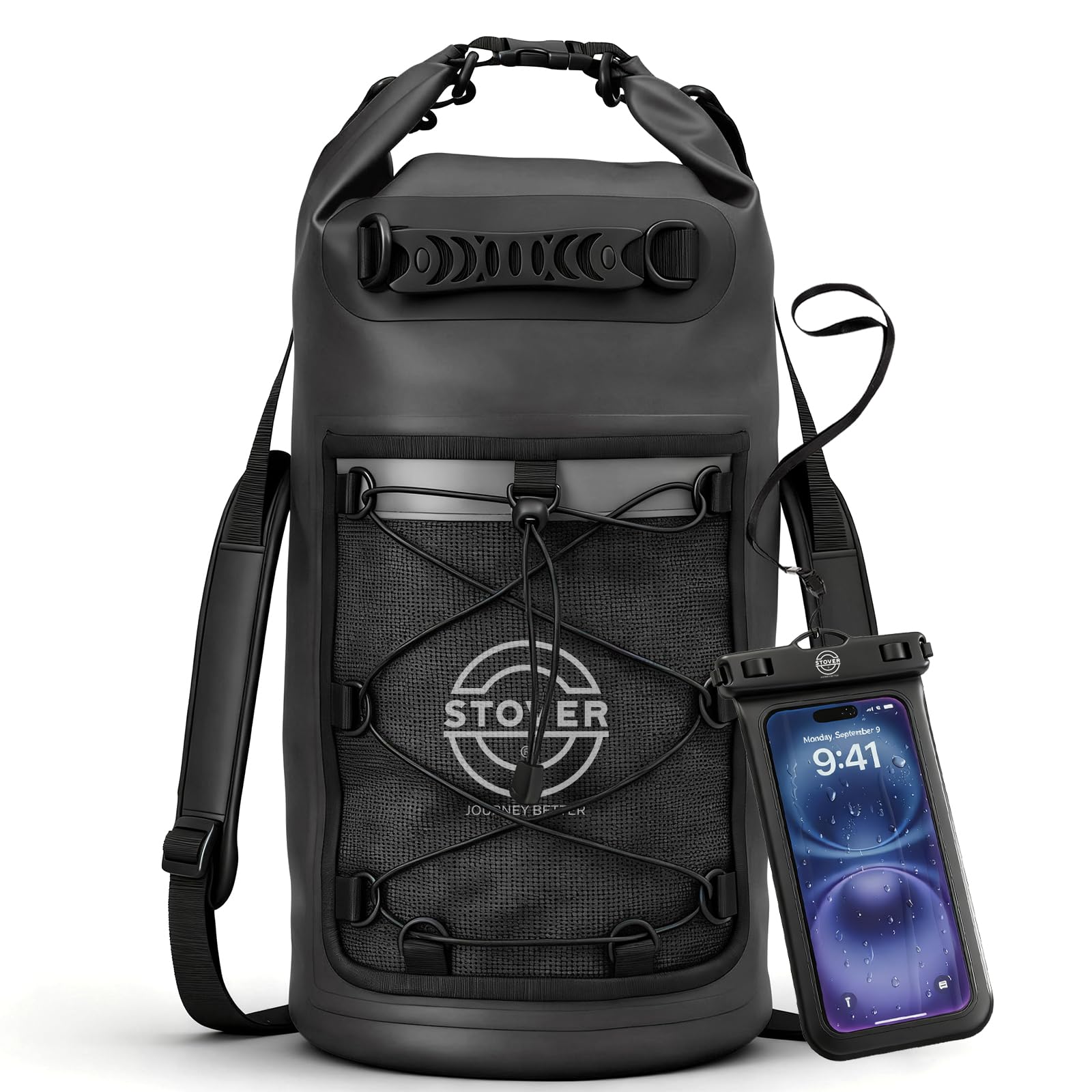
2. STOVER Waterproof Dry Backpack
A 25-liter pack that floats, organizes, and outlasts bags costing twice as much.
STOVER brings a smartly thought-out design to the budget-friendly tier. High-frequency seam bonding (heat-welded seams instead of stitched ones) makes the bag 100% waterproof, and it floats if it goes overboard — a feature that matters more than you think when you are loading gear from a kayak. The front mesh pocket separates wet clothes from dry ones, and the adjustable cargo straps keep everything snug.
Three wearing styles give it unusual versatility: wear it as a backpack with two padded straps, sling it crossbody with one strap, or carry it by the padded top handle. The reflective strip on the front pocket adds safety for low-light paddling or evening bike commutes. Reviewers consistently praise the quality and water resistance — the 25L size struck buyers as “definitely water tight and the 30l is huge,” and the bag’s airtight seal impressed those who tested it fully loaded.
The straps have drawn mixed feedback — some find them perfectly comfortable for a day hike, while others wish for more padding on longer carries. This is a nitpick at this price point, not a dealbreaker.
Versatility that earns its keep: the ability to switch between backpack, crossbody, and carry-handle modes makes this feel like three bags in one for the price of one.
Best suited for: day-trippers and commuters who want a drybag that does not scream “outdoor gear” — the clean look works in town and on the water.
Not ideal if: you need to carry a laptop or tablet — the 25L has no padded sleeve for electronics.
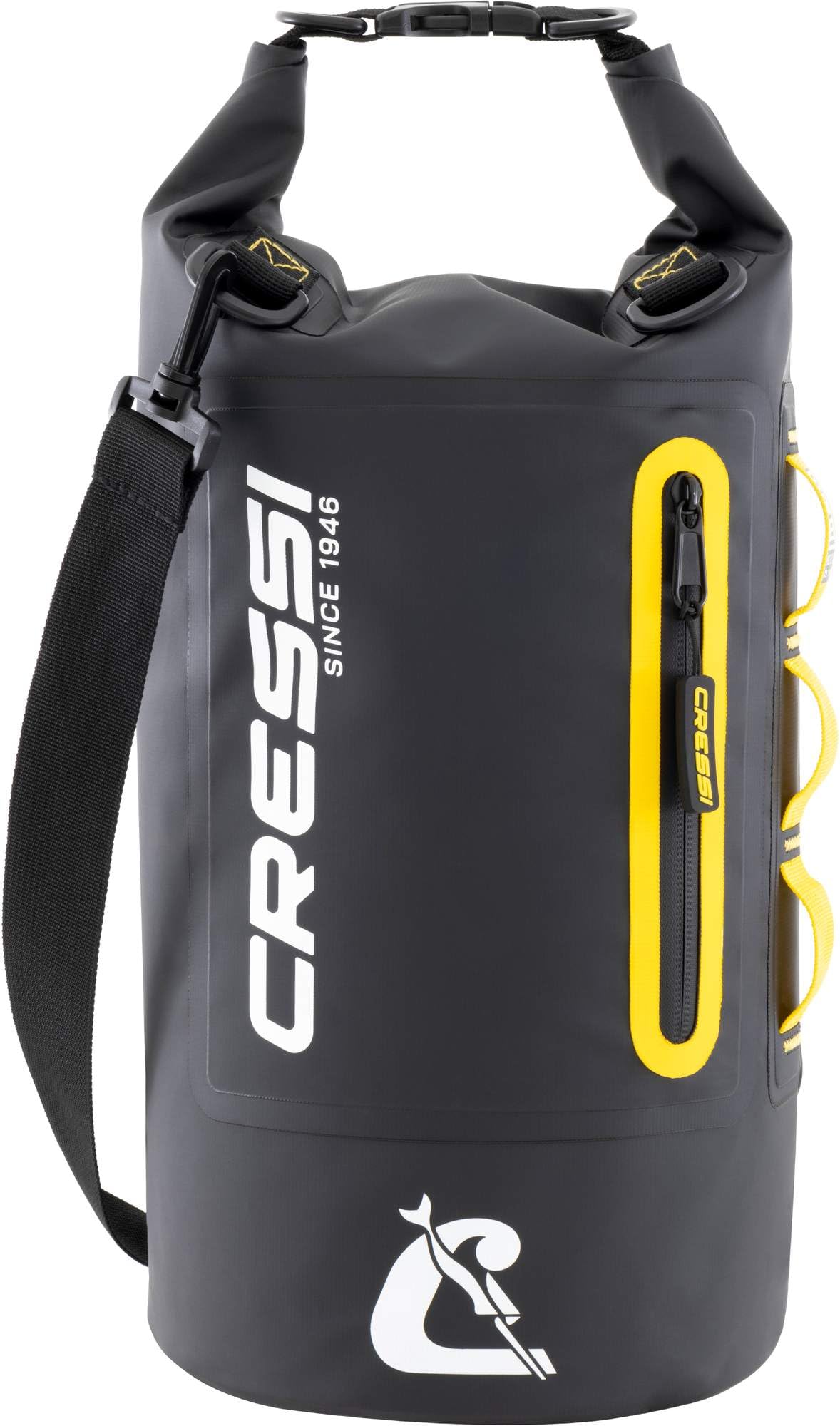
3. Cressi Ocelot Dry Bag
An Italian-designed 10-liter hauler for paddleboarders who travel light.
At just 1.1 pounds, it is the lightest bag in this lineup — ideal for paddleboarding, snorkeling, or quick beach runs where every ounce matters. The 10-liter version comes with a single crossbody strap, while the 20L and 30L models upgrade to two backpack-style straps. The PVC-coated polyester and nylon fabric feels thick and rugged, and the classic roll-down top with a plastic buckle clip creates a reliable water-resistant seal against splashes and rain.
The front zip pocket is a small but welcome touch — it gives fast access to keys or a phone without unrolling the whole bag. Reinforced webbing loops and D-rings (metal rings for clipping) let you attach fins, a wet bag, or other small gear. Reviewers paddleboarding with the 20L version found it “a great size and is waterproof,” though some wished for multiple outside pockets to organize small items that tend to sink to the bottom of the main compartment.
One honest note: the thick, durable material makes rolling and sealing the top a bit harder than thinner bags. The seal is secure once you get the hang of it, but it takes an extra push. And at 10 liters, this is strictly for essentials — not a bag for a full day’s gear.
Perfect for: quick water excursions where you carry only phone, keys, and a towel — the 10L is a minimalist’s dream.
Not for: anyone needing a laptop compartment or multi-day capacity — step up to the 20L or 30L, or look at the Earth Pak.
4. IDRYBAG Waterproof Backpack

The drybag that protects your laptop from rain and river crossings alike — unlike the STOVER which lacks a sleeve.
Most drybag backpacks treat electronics as an afterthought. IDRYBAG makes them a priority with an internal, removable laptop sleeve that holds up to a 12-inch device (or a tablet), plus a zippered pocket for cables and a charger. The 25-liter main compartment is roomy enough for a full change of clothes, a towel, and lunch, and the protective top hood adds an extra layer of insurance against leaks sneaking in through the roll-top.
The 500D PVC fabric with high-frequency welded seams gives this bag serious durability — reviewers took it to Mexico on lazy rivers and reported everything stayed bone dry. Sponge-filled shoulder straps improve comfort on longer carries, and the external mesh pocket handles wet clothes or shoes without dampening the interior. A reflective strip adds visibility for evening bike commutes, and the adjustable chest strap keeps the pack tight to your body during active movements.
The mixed feedback on durability is note — while most owners find the bag very durable, a few report strap issues after heavy use. The water bottle side pouch is also a tight fit for larger reusable bottles.
Smart organization: the internal laptop sleeve and zippered accessory pocket make this the only drybag in the lineup that works as a daily commuter pack, not just an adventure bag.
Ideal for: anyone who commutes by bike or motorcycle and needs to keep a laptop dry — the 25L is compact enough for a desk locker.
Pass on it if: you work with a 14-inch or larger laptop — the sleeve maxes out at 12 inches, though the bag itself fits a 14-inch device according to specs.
5. GVANCA Roll Top Dry Bag

A 35-liter expedition pack with a built-in whistle for emergencies — at 35 liters versus the Earth Pak 30 liters for multi-day trips.
GVANCA sized this for two to three days on the water, and the 35-liter capacity hits a balance between a day bag and a full expedition duffel. The 500D PVC material has been fully immersion-tested, so splashes, heavy rain, and even accidental dunks are no threat. The roll-top closure asks for 3 to 8 turns before clipping — more turns equal a tighter seal — and the reinforced straps on top compress the load for a more stable carry.
Comfort gets real attention here. Wide, thick shoulder straps, a movable chest strap, and a detachable waist strap distribute weight across your body rather than pulling on your shoulders. The back panel uses three separate air cushions to speed cooling and reduce pressure — a detail that matters on long portages. The orange buckle on the chest strap doubles as a safety whistle, which is smart for remote paddling or hiking. Reviewers who took the 55L version through Alaska, New Zealand, Bali, and Thailand reported it held up for three months of travel without issues, and the company replaced a mismatched clip quickly.
Keep in mind that the external pockets are not fully waterproof — only the main roll-top compartment seals tight. The bag also lacks internal organization, so small items will need packing cubes or dry bags inside.
Standout features
- Three air-cushion back panel keeps your back cool during long carries
- Detachable waist strap and chest whistle add real safety value
- Available in 35L, 55L, and 85L for trips of any length
What to know
- Outer pockets are not waterproof — keep valuables in the main compartment
- Minimal internal organization — you will want packing cubes or smaller dry bags
Best for: kayakers and campers who spend 2-3 days on the water and want a bag that carries comfortably over land too — the 35L is the perfect multi-day size.
skip it if: you need quick access to small items — the roll-top and lack of internal pockets make this a “pack once, unpack at camp” bag.
6. Haimont IPX7 Waterproof Roll-Top Dry Duffel

The 60-liter duffel that fits in overhead bins and survives a motorcycle commute in a storm — at 60 liters versus the GVANCA 35 liters.
Haimont is the bag you grab when you need to pack a week’s worth of gear and still move fast. At 60 liters with an IPX7 waterproof rating (meaning it survives immersion in up to 3 feet of water for 30 minutes), it shrugs off rain, splashes, and wet decks. The 500D tarpaulin construction is abrasion-resistant and reinforced at stress points, making it tough enough for motorcycle touring, boating, or throwing into a raft. Despite the large capacity, it fits in overhead bins on flights.
Multiple carrying options let you adapt: backpack straps for portaging, compression straps to stabilize the load, and several haul handles for grabbing it one-handed. The interior mesh pockets and quick-access front storage keep small items organized, which is rare for a roll-top duffel. Reviewers who use it for daily motorcycle commutes (32 miles one way) report it holds two work outfits, gym gear, a laptop, iPad, rain gear, and thermals — more capacity than saddlebags and a luggage rack combined.
The trade-off is that the main opening uses a roll-top with a velcro closure underneath, which some owners found drips water under extreme submersion rather than staying fully airtight. For splashes and heavy rain it performs perfectly, but it is not a submersible bag.
Huge capacity, carried well: this is a rare duffel that packs like a suitcase, carries like a backpack, and fits in the overhead bin — all while keeping your gear dry in a storm.
Ideal for: motorcycle campers, boaters, and anyone who needs to pack a lot of gear and move it comfortably — the 60L is the size that makes multi-day trips easy.
Not for: full submersion or whitewater — this is IPX7 (splash and rain proof), not IPX8 (submersible).
7. OSAH DRYPAK Waterproof Backpack
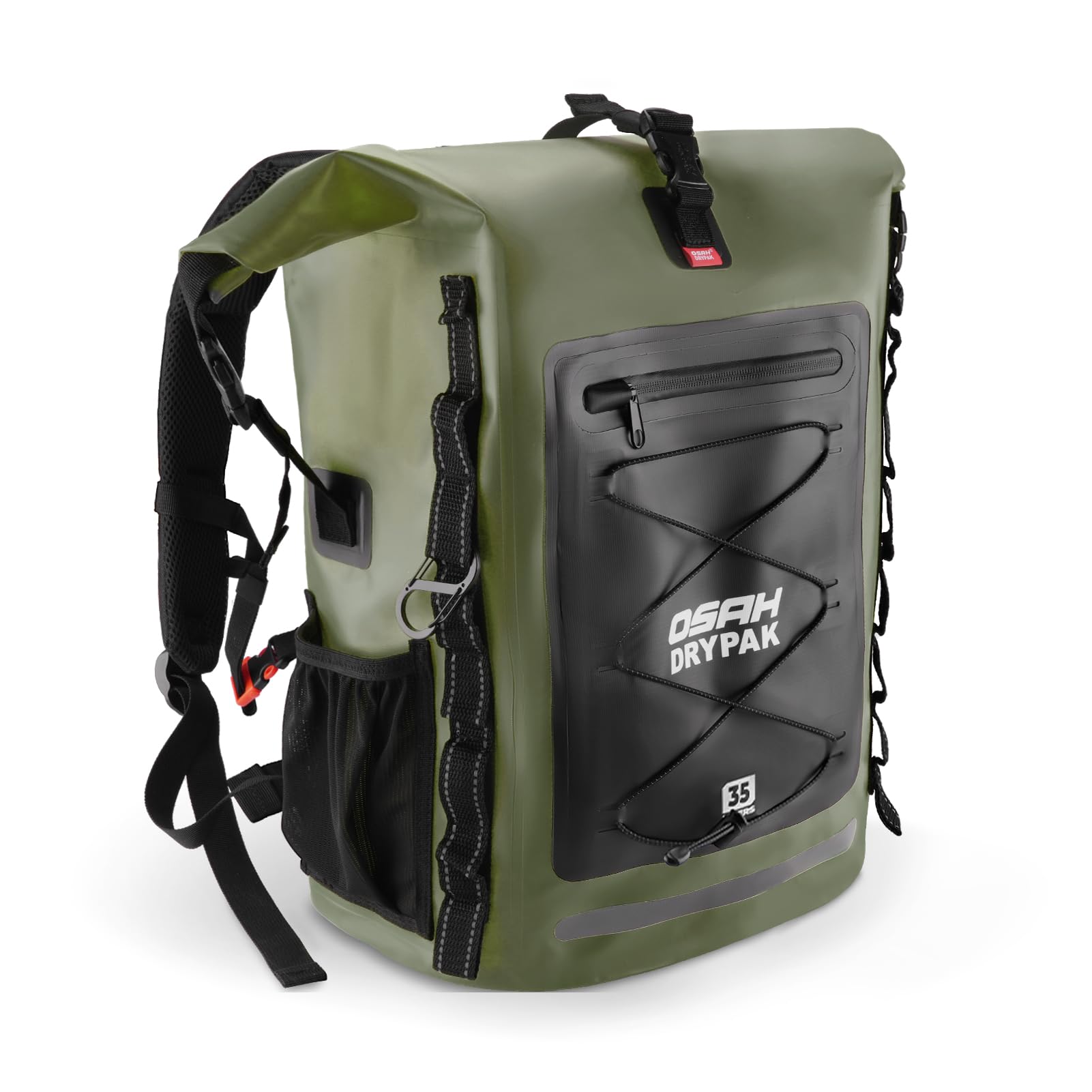
A rugged 35-liter pack with an emergency whistle and bungee cord organization — tougher than the STOVER for rough handling.
OSAH DRYPAK builds for extreme conditions. The 500D PVC material with high-frequency welded seams handles rain, river crossings, and being tossed onto sandy beaches without complaint. The roll-top closure is backed by a splash-proof front pocket (for items you need fast), side mesh bottle holders, and elastic bungee cords on the front for strapping a jacket or wetsuit. Reviewers who used it for off-road driving, rafting, and jet ski trips found it durable enough to “be tossed and placed onto different rafts and tossed onto the sandy beach.”
Comfort gets the full treatment: ergonomic shoulder straps, breathable back padding, a reinforced top handle, and an adjustable chest belt with a built-in safety whistle. The reflective strip adds night visibility, and D-ring attachment points give you options for clipping extra gear. The 35L size is right for a day hike or an overnight trip, and the bag is also available in 55L and 85L for longer expeditions.
A few owners noted that the top does not seal as tightly as some roll-tops, and the shoulder straps can slip under very heavy loads. The bag’s simple interior (a few zip pockets) means you will rely on packing cubes to stay organized.
Great for: rafters, off-roaders, and jet skiers who need a bag that takes a beating — the 35L is tough enough for the roughest days out.
Consider alternatives if: you need absolute leak-proof sealing for submersion — the roll-top is splash-proof, not submersible-rated.
8. Pelican Exodry Waterproof Dry Bag

The 30-liter Pelican that lives up to its name with rock-solid watertight integrity — at 1.6 lb versus the Earth Pak 1.4 lb, both at 30L.
Pelican is the brand divers and first responders trust for gear cases, and the Exodry dry bag brings that reputation to a portable format. The 30-liter version is rugged, flexible, and completely watertight — buyers report it held their weight when filled with water and sealed empty, proof of how airtight the construction is. Two padded backpack straps allow hands-free carrying, and integrated loops and buckles make it easy to attach extra gear like a water bottle or small accessory pouch.
The water-resistant front pocket gives quick access to smaller items without unrolling the main compartment, and the reflective accents improve visibility in low light. The bag is built to last through tough conditions — owners used it at beaches, jazz festivals, and Canaveral boat trips and reported everything stayed dry. It is available in 10L, 20L, and 30L sizes, so you can match capacity to the trip.
The main caveat is that the 30L fits essentials but not a full expedition’s worth of gear — think phone, wallet, towel, and a light jacket rather than camping equipment. Some owners also noted that contents can heat up in direct sun, which is true of any dark-colored dry bag.
Bulletproof build: the Exodry feels thicker and more rigid than most bags at this price, and the watertight seal inspires confidence even before you hit the water.
Best for: brand-loyal buyers who want the confidence that comes with Pelican’s engineering reputation — the 30L is a no-compromise drybag for beach and boat days.
Not for: ultralight packing — at 1.6 pounds for 30L, it is heavier than some competitors per liter of capacity.
9. Breakwater Supply Fogland Waterproof Backpack
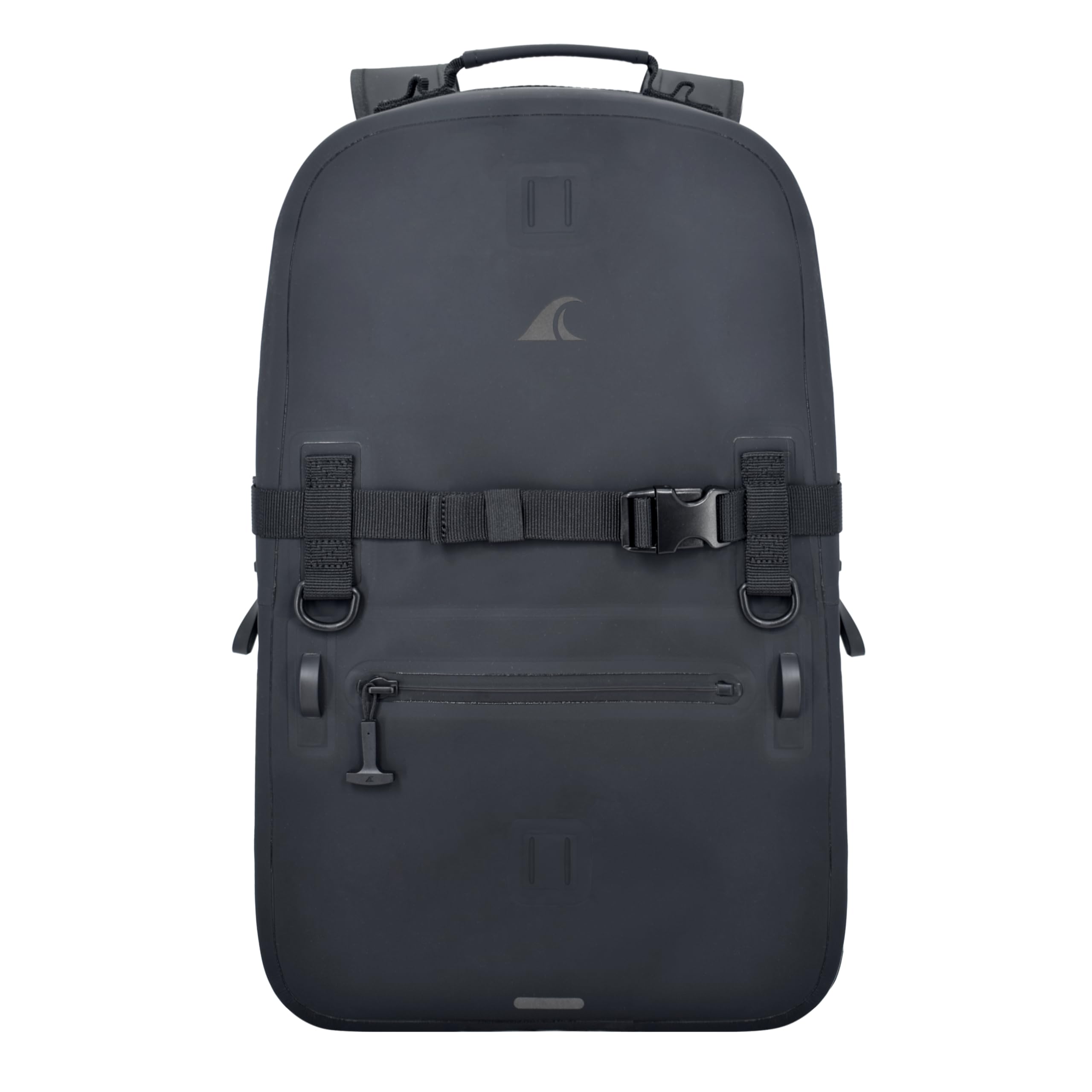
The fully submersible IP68 backpack that floats and protects a 16-inch laptop — a different league than the splash-proof Earth Pak.
Breakwater Supply’s Fogland is in a different league from every other bag here. Rated IP68 (meaning it is rated for continuous submersion deeper than 3 feet), it is 100% waterproof and fully submersible — you can drop it in a river and retrieve it with dry contents. The Hydrowall TPU material is virtually indestructible, lighter than PVC, and more flexible over time. Two airtight compartments mean the main section protects a 16-inch laptop and larger items, while the front zippered pocket gives quick access to a phone without exposing the main compartment to moisture. Both compartments are airtight and truly submersible.
Ergonomic S-curved shoulder straps are comfortable for all-day carry, and the side bottle pockets and multiple gear attachment points add real versatility. The bag floats, which is a standout if it goes overboard. Reviewers who took it fishing and rafting in Alaska — including an accidental swimming trip by itself — reported everything stayed bone dry. Another buyer used it for snorkeling, swimming, kayaking, and rain in Costa Rica and called it the best adventure bag they had owned.
The heavy-duty zippers are genuinely waterproof but stiff — some owners found them hard to pull, especially when new. The bag is also bulkier than a standard 25L due to the TPU material and the airtight zipper track, so it takes up a bit more space in storage. The higher price reflects the premium materials and US-based customer support, which owners praise for quick replacements.
What justifies the cost
- IP68 submersible rating — can survive full immersion without leaking
- Two separate airtight compartments protect a 16-inch laptop and small items
- Floats if dropped overboard — a rare and valuable feature
What to expect
- Airtight zippers are stiff and take effort to open and close
- Bulky for a 25L bag due to TPU construction and zipper track
Reach for this if: you need absolute waterproof certainty — photographers, divers, and anyone who regularly submerges gear will find the IP68 rating genuinely useful.
pass on it if: you only face splashes and rain — the Fogland’s submersible capability is overkill and the premium price is hard to justify for light use.
Understanding the Specs
IP Rating: IPX7 vs IPX8
An IP (Ingress Protection) rating tells you how much water a bag can handle. IPX7 means the bag survives immersion in up to 3 feet of water for 30 minutes — enough for a drop off a kayak into calm water. IPX8 goes further: the bag is rated for continuous submersion deeper than 3 feet, making it suitable for diving or whitewater where the bag could get pinned underwater. Most drybag backpacks are IPX6 or IPX7; the Breakwater Supply Fogland is one of the few IPX8 options on the market.
Roll-Top vs Airtight Zipper
A roll-top closure works by folding the top of the bag down 3 to 8 times and clipping it shut. The more folds, the tighter the seal. It is simple, reliable, and inexpensive — the standard for most drybags. Airtight zippers (like those on the Fogland) use a special track that seals when fully closed, giving instant access without unrolling the whole bag. They are more expensive and require periodic lubrication to stay smooth, but they are the only option for submersible-rated bags because roll-tops can eventually leak under sustained pressure.
FAQ
How do I properly seal a roll-top drybag backpack?
Can I use a drybag backpack for everyday commuting?
What is the difference between PVC, tarpaulin, and TPU materials?
Will a drybag backpack really keep my phone and wallet dry if it goes overboard?
How do I clean and maintain a drybag backpack?
What size drybag backpack do I need for a day trip?
Is a drybag backpack suitable for hiking or backpacking?
Can I put a drybag backpack in a washing machine?
Why does my drybag backpack leak after a few uses?
What is the advantage of a floating drybag backpack?
Final Thoughts: The Verdict
If you want one dependable pick, the best drybag backpack winner is the Earth Pak Dry Bag because it combines a proven roll-top seal, the right 30-liter size, an IPX8 phone case, and a five-year warranty at a price
Related Guides

Mo Maruf
I created WellFizz to bridge the gap between vague wellness advice and actionable solutions. My mission is simple: to decode the research and give you practical tools you can actually use.
Beyond the data, I am a passionate traveler. I believe that stepping away from the screen to explore new environments is essential for mental clarity and physical vitality.