Our readers keep the lights on and my smoothie glass nicely filled. As an Amazon Associate, I earn from qualifying purchases.
Specs are compiled from manufacturer listings and verified buyer reviews and can change over time — please confirm the key details on the product page before buying.
A ragged lawn edge is the difference between a yard that looks sharp and one that looks shaggy. You do not need a noisy gas-powered machine to get that crisp border — a good manual edging tool can define your flower beds and sidewalks with a single step. The challenge is picking the one that actually cuts clean without wearing you out halfway through the yard.
I’m Mohammad Maruf — the founder and writer behind WellFizz. This guide is built by comparing the manufacturers’ published specifications and the patterns across verified customer reviews, so you get each pick’s real strengths and trade-offs instead of marketing spin.
Whether you maintain a postage-stamp city lot or sprawling suburban beds, the right manual tool delivers clean, professional lines without the fumes or noise of power equipment. Here are the best options to help you find the best edging tool for the kind of lawn and garden work you actually do.
Our Picks at a Glance


How To Choose The Best Edging Tool
You want an edger that cuts cleanly without making you sore. The right tool depends on your soil type (hard clay or loose sand) and how many feet of border you edge. Three specs decide if it feels natural or punishing: the tool’s weight, its blade shape, and the handle design.
Blade Type
The blade does the actual cutting. A straight half-moon blade gives you a clean, vertical slice — ideal for defining a crisp border along a sidewalk. A serrated or saw-tooth blade bites through dense turf and shallow roots where a straight edge would just skid. A round, dished blade works more like a trenching shovel, good for cutting sod or digging a narrow channel. Match the blade to the ground you work.
Handle Length and Grip
A longer shaft (40 inches or more) saves your lower back because you stand upright while you work. A T-grip or donut-shaped handle gives you better leverage for twisting and rocking the blade loose compared to a straight D-grip. Ergonomic padding matters for a full afternoon of edging — raw steel or thin rubber can blister your palms fast.
Weight and Build
Heavier steel tools (4 to 5 pounds) power through hard clay and thick roots because the mass helps the blade drop. Lighter tools suit sandy loam or smaller yards where you value speed over raw force. A one-piece welded shaft is stronger than a bolted assembly, which can loosen with repeated stomping.
Quick Comparison
| Model | Best For | Blade Type | Handle Length | Weight | Amazon |
|---|---|---|---|---|---|
| Radius Garden Pro-Lite★ Best Overall | Overall best balance | Half-moon, carbon steel | 40.25 inches | 4 lb | Amazon |
| Root Slayer XL EdgerRoot Cutter | Heavy root cutting | Serrated half-moon | 52.5 inches | 5 lb | Amazon |
| Bully Tools 12-GaugeT-Handle Control | Durable T-grip control | Round, 12-gauge steel | 61.5 inches | 3.69 lb | Amazon |
| Colwelt Manual Edger | Budget-friendly depth | V-shape serrated | 40 inches | 4.38 lb | Amazon |
| Byhagern Professional Edge | High-value saw-tooth set | Saw-tooth half-moon | Long (ergonomic) | — | Amazon |
| CKLT One-Piece Edger | No-assembly, spring steel | Serrated spring steel | 40 inches | 5.24 lb | Amazon |
| KOMASTY 20V Weed Wacker | Cordless trimming + edging | Auto-feed string | 40 inches | Lightweight | Amazon |
| Yard Butler Step Edger | Trenching / wire burial | Straight step-blade | 37 inches | 4.5 lb | Amazon |
| WORX Cordless Edger WG898 | Powered precision edging | Rotating metal blade | 57.9 inches | 8.6 lb (w/ battery) | Amazon |
In‑Depth Reviews
1. Radius Garden 25602 Pro-Lite Carbon Steel Edger
Our pick — over 4.5★ from 500+ verified ratings; the strongest balance of quality and price.
The lightweight half-moon that slices through clay without shaking your elbows apart.
This is the edger that keeps showing up in garden beds year after year, and for good reason. It weighs just 4 pounds, and the Colwelt weighs 4.38 pounds, so you can work longer without the tool pulling your arms down. The carbon steel blade is heat-treated and measures 9 by 5 inches, giving you a wide cutting face that bites deep in a single stomp.
The donut-shaped handle lets you twist the blade loose after each step without straining your wrist. The bright green fiberglass shaft is easy to spot among foliage, and the tool stands 40.25 inches tall, so you can edge without hunching. One owner said: “This tool has been such a help creating a smooth and professional edge to my flower beds and yard.” Buyers report it handles heavy clay without any joint flex — a sign the welded construction is genuinely strong.
The trade-off is that carbon steel needs care. If you leave it wet or dirty, the blade will rust. A quick wipe after each use keeps it cutting clean for years, and the manufacturer backs it with a lifetime guarantee in the continental US. A few owners mention the edge could be slightly sharper from the factory, but pairing it with a flat shovel for the initial cut in thick turf solves that.
Why it wins
- Ergonomic donut handle gives better leverage than a straight T-grip.
- Heat-treated carbon steel blade stays sharp through repeated use.
- At 4 lb, it is light enough for petite or senior gardeners to handle comfortably.
Where it stumbles
- Blade must be wiped clean after every use to prevent rust.
- Some owners wish the factory edge was a hair sharper from the start.
Grab this if: you want the best all-around manual edger — light enough for hour-long sessions, tough enough for clay soil, and backed by a lifetime warranty.
Think twice if: you prefer a serrated blade for sawing through thick, matted roots; the straight half-moon design here excels at slicing, not sawing.
2. Root Slayer 22711 XL Serrated Garden Edger
The serrated edge that chews through roots where a straight blade just bounces off.
Where the Radius Garden slices, the Root Slayer saws. Its inverted V-shaped tip and aggressive serrated teeth are purpose-built for cutting through turf, compact soil, and shallow roots that would stop a standard half-moon dead. The blade measures 10 by 6 inches, and the Radius Garden blade measures 9 by 5 inches, giving you more ground coverage per step.
The 52.5-inch shaft is the longest in this roundup, which means almost no bending for tall gardeners. The fiberglass handle is wrapped in a non-latex grip that stays comfortable even when your hands are sweaty. Owners consistently note that the tool “cuts right through the ground” and that they can stand on the blade like a shovel to drive it deep. The thing the review pages praise most is effectiveness — over a hundred owners mention how well it performs. Some call it heavy (it weighs 5 pounds), but many say the weight helps the blade drop through hard soil without forcing.
The honest catch is that same weight. A 5-pound tool with a long shaft can feel tiring after a full afternoon of edging, especially for smaller-framed users. One owner’s sister-in-law returned it because it was too heavy for her. And like any carbon steel blade, keeping it dry and clean after use is the price you pay for that cutting ability. A few owners also note that the serrations can clog with wet clay if you do not rinse the blade promptly.
Best for heavy ground: If your yard has shallow roots, compacted clay, or overgrown borders, the serrated blade makes short work of what would exhaust you with a straight edger.
Reach for this if: your edging involves cutting through tree roots or reclaiming neglected beds — the serrated teeth earn their keep.
Look elsewhere if: you have a small yard with sandy loam and want a lighter tool; the Radius Garden above will feel more nimble.
3. Bully Tools 12-Gauge Manual Lawn Edger
The round-blade T-grip that trenches and edges without a single bolt to loosen.
This is a different breed of edger. Instead of a half-moon blade, Bully Tools uses a 12-gauge round steel edge that works like a narrow trenching shovel. It excels at creating defined edges along sidewalks and patios, but it is equally at home cutting sod or digging a shallow trench for landscape wiring. At 3.69 pounds, it is the lightest all-steel tool here, and the Colwelt weighs 4.38 pounds, which makes a real difference when you are carrying it around the yard.
The T-style steel grip gives you excellent two-handed control for rocking the blade back and forth. Owners praise its durability — one compared it directly to a Husky tool from a big-box store that had to be replaced twice, noting that the Bully held up without bending. The detachable blade extends the tool’s life; you can replace just the cutting edge when it finally dulls. It is 100% made in the USA by a family-owned company in Steubenville, Ohio, and backed by a limited lifetime warranty.
The weak spot is the rubber handle grips. Multiple owners mention that the rubber pieces are not attached to the steel T-bar and can loosen after 10 or 15 minutes of use, twisting off and requiring you to push them back on. A dab of adhesive solves it, but it is an annoyance on a tool that otherwise feels bulletproof. Also, the round blade does not create as clean a vertical wall as a half-moon — it leaves a slightly curved trench profile.
Built for versatility: This tool edges, trenches, and cuts sod without needing different attachments — the round blade handles all three jobs adequately.
Choose this for: multi-purpose work where you need one tool that edges and trenches, especially if you value American-made build quality.
skip it if: you want a half-moon blade for picture-perfect vertical cuts along a sidewalk; the Radius Garden or Root Slayer will give you a sharper line.
4. Colwelt Manual Edger Lawn Tool 40-inch

The V-shaped serrated blade that cuts 5.5 inches deep for less than most edgers cost.
Colwelt takes a different approach with its V-shaped serrated blade. Most half-moon edgers cut 2 to 4 inches deep, but this one reaches down 5.5 inches — enough to break through deep roots in a single stomp. The sawtooth edge bites aggressively, so you spend less time rocking the blade and more time moving forward. At 4.38 pounds, it is not the lightest, but the weight helps drive that V-blade into hard ground.
The cushioned T-handle gives you a solid grip for twisting and levering, and the anti-slip foot tread is wide enough (6.3 inches) for any shoe size. Owners say it works great for making garden beds as well as edging sidewalks — the V-shape is effective for digging topsoil when planting. As one buyer put it, “For the price, this is pretty good.” The thing owners praise most is functionality, with over a dozen mentioning how well it performs for both edging and trenching.
The honest downside is that the blade is not razor-sharp from the start. Several owners note that it needs sharpening before first serious use, and the blade is thick enough that a grinder or good file is the right tool for the job. The handle bolts also protrude slightly, which can be uncomfortable if you grip the shaft near the top. The Colwelt weighs 4.38 pounds; the Radius Garden weighs 4 pounds.
Great for the money: The V-serrated design offers the deepest cutting capacity in the budget tier, making it a strong choice for overgrown borders.
Buy it if: you need maximum cutting depth without spending premium money — the 5.5-inch blade handles deep roots that shallower edgers cannot touch.
Pass on it if: you want a factory-sharp blade ready to go; plan on spending 10 minutes with a file before first use.
5. Byhagern Professional Edge Lawn Tool
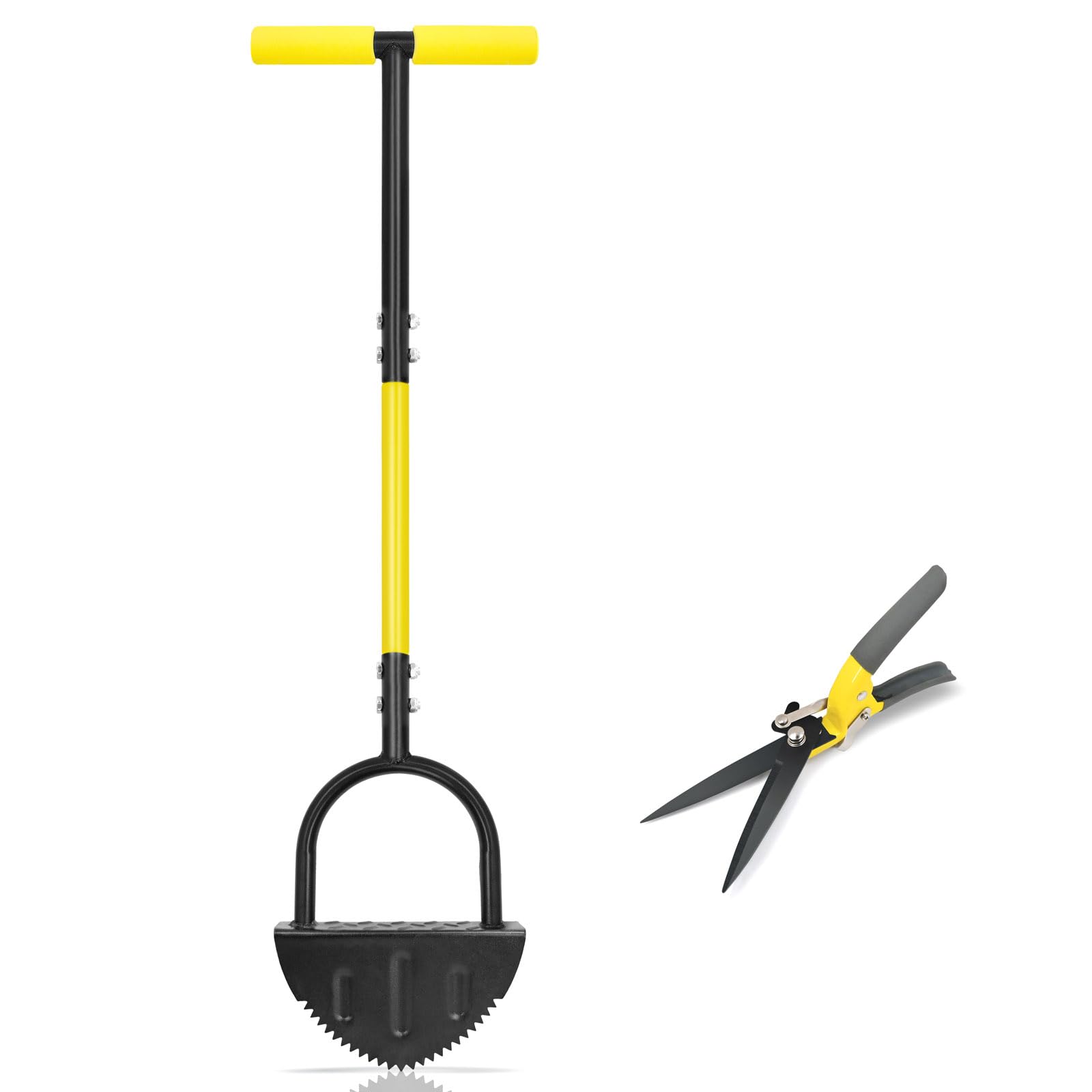
The saw-tooth half-moon that comes with shears and gloves — a complete starter kit.
Byhagern packs a lot into the box. You get the edger with its saw-tooth blade, plus a pair of sharp shears and a set of gardening gloves. The serrated half-moon blade is designed to bite and cut through dense turf and roots rather than just pushing down like a straight edge. That design choice makes it effective in heavy soil, and the long handle with padded grips reduces the strain on your back during extended use.
The wide footplate accommodates all shoe sizes and provides solid leverage when you stomp down. Owners consistently call it effective — the most-praised aspect by a wide margin. One owner found it worked “fantastic on heavy turf” after a quick sharpening pass with a grinder. Another noted that it pulled weeds out by the roots as it cut, leaving a clean trench. The yellow color makes it easy to spot if you set it down in the grass.
The mixed feedback centers on sharpness and durability. Some owners find the blade very sharp from the start; others say it is too thick at nearly 1/8 inch and needs grinding to cut cleanly through lawn. The blade is made of carbon steel, so dirt tends to stick to it, and you have to clean it after each use to prevent rust. A few owners also report that the metal can bend if you hit a large rock, though that is true of any manual edger.
What stands out
- Includes shears and gloves — saves you a trip to the hardware store.
- Saw-tooth blade design cuts through roots more effectively than a straight edge.
- Long handle with padded grips reduces back fatigue during long sessions.
What to know
- Blade thickness (~1/8″) may need grinding or filing before it cuts lawn cleanly.
- Dirt sticks to the blade easily; requires prompt cleaning after use.
Best for: budget-conscious buyers who want a complete edging kit (tool, shears, gloves) in one purchase.
Not for: anyone who wants a razor-sharp blade ready to go — plan on a quick sharpening session before first use.
6. CKLT One-Piece 40in Manual Edger Lawn Tool

The spring-steel blade that resists bending and arrives fully assembled, right from the start.
If you hate fiddling with bolts and instructions, this is the edger for you. The CKLT is a one-piece construction with a 1.18-inch diameter manganese steel tube shaft that requires zero assembly. The spring steel blade is the standout feature — it resists deformation even when you hit compacted soil or rocks, and it maintains its sharpness longer than standard carbon steel. The serrated edge helps it bite through turf without needing to rock the tool excessively.
At 5.24 pounds, it is the heaviest manual edger on this list, but that weight serves a purpose. Owners say the blade “cuts through sod and roots like butter” and that the tool is superior to expensive electric models for small areas. The blue rubber handle provides a comfortable, secure grip, and the 40-inch length keeps your back straight. A protective strip covers the blade when the tool is not in use — a thoughtful safety touch. The biggest praise from owners goes to functionality and durability, with one senior owner noting that it was easy to use even in her 60s and 70s.
The weight is the double-edged sword here. For a petite gardener or someone with arthritis, 5.24 pounds can feel heavy after 30 minutes of lifting and stomping. A few owners also note that while the spring steel blade is tough, it is harder to sharpen yourself than a standard carbon steel blade — you will likely need a professional grinder when it eventually dulls. And the one-piece design means you cannot replace a bent blade separately; you replace the whole tool.
Tough and ready: The one-piece spring steel construction removes any assembly hassle and gives you a blade that resists bending through hard ground.
Pick this if: you want a tool that arrives ready to work and can handle rocky or compacted soil without risking a bent blade.
Avoid it if: you prefer a lighter tool or need the option to replace just the blade; the 5.24-pound weight is noticeable over longer sessions.
7. KOMASTY 20V Electric Weed Wacker Cordless Edger
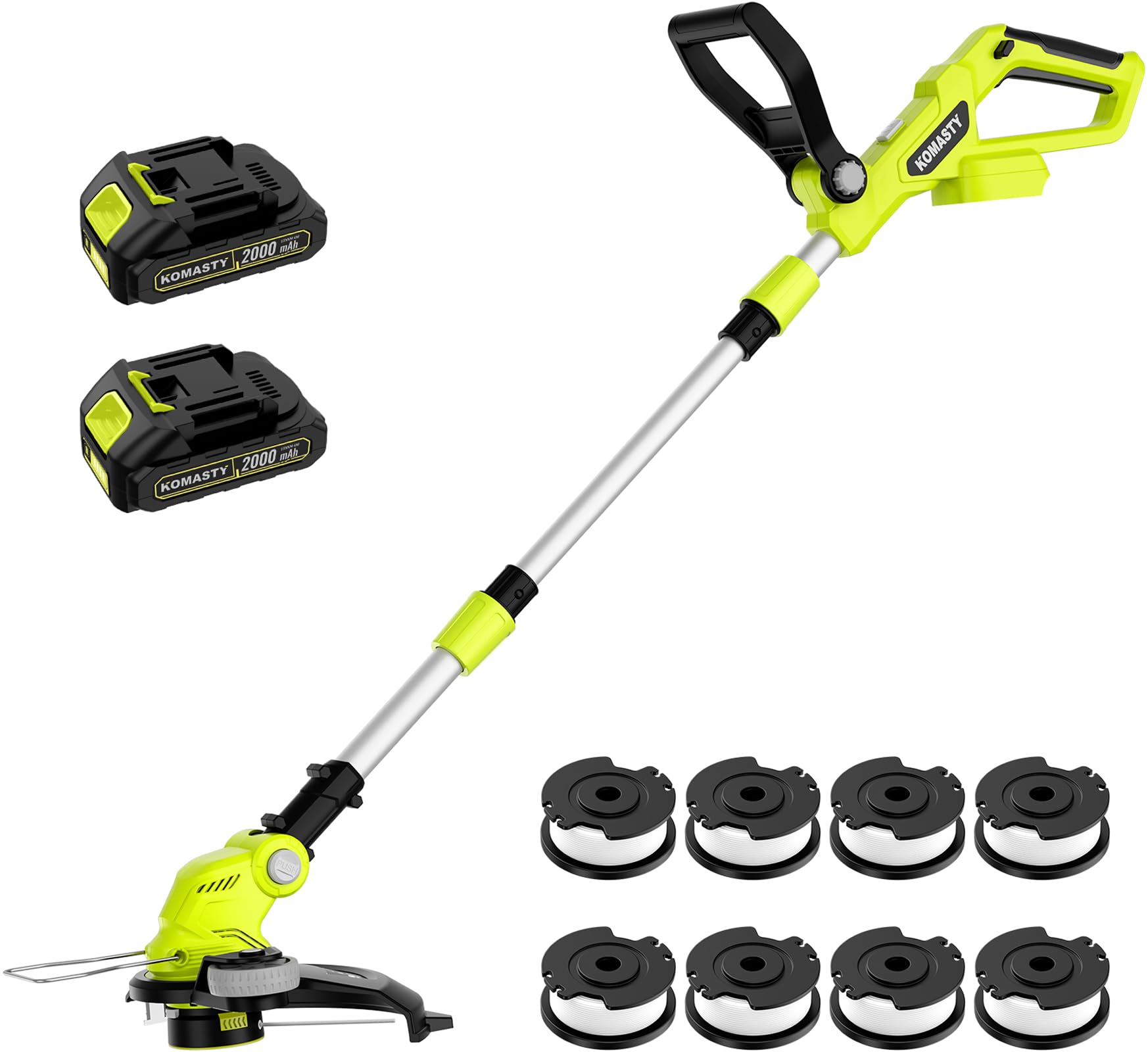
The foldable cordless trimmer that switches to edging mode with a head pivot — for small yards.
This is not a manual edger but a battery-powered 2-in-1 trimmer that handles both tall grass and lawn edges. The pivoting head rotates 90 degrees to switch from trimming to edging mode, so you do not need two separate tools. The 20V motor runs at 9,500 RPM and cuts a 12-inch swath, clearing large areas faster than a manual tool could. It comes with two 2.0Ah batteries and a charger, giving you a total runtime of roughly 30 minutes — enough for most small to medium yards.
The standout feature for small-space living is the folding shaft. It folds 180 degrees in three ways so the tool can stand vertically in a closet or corner of the garage. The automatic line feed system detects when the string is short and dispenses more cord without you having to bump the head on the ground. Owners praise the battery life most — well over a hundred owners mention it positively — and the lightweight design makes it easy to carry around. The review pages sum it up: “Great value, reliable performance, and highly recommended.”
The limitation is runtime for larger properties. The shaft is not adjustable in length, so shorter users under 5-foot-3 may find the tool awkward to handle. It is also a string trimmer, meaning it does not create the same clean vertical cut that a manual half-moon blade does — it leaves a rounded edge that some homeowners find less crisp.
Compact convenience: The 2-in-1 design and folding shaft make this a smart choice for apartment dwellers or anyone with limited storage space.
Choose this for: small yards where you want one tool that trims and edges, plus the convenience of folding storage.
pass on it if: you need a deep, sharp vertical edge along walkways — a manual half-moon edger will give you a cleaner line than a string trimmer can.
8. Yard Butler Step Edger EDGE-180

The step-down edger that double-duties as a trenching tool for burying cables and pipes.
The Yard Butler takes a different approach from the half-moon crowd. It uses a straight, narrow blade designed for stepping down hard to create a trench, not just a visual edge. Owners have put it to work burying fiber optic cable, digging 3-inch by 4-inch trenches to redirect water runoff, and installing poundable plastic edging in tough clay. The tool is 37 inches long with cushioned handles and a sturdy foot bar, and at 4.5 pounds, it feels substantial without being exhausting.
The powder-coated steel resists rust well, and the manufacturer backs it with a lifetime warranty. The long handle design keeps you standing upright while you work, which is what the “step edger” concept is all about — stomp and wiggle, and the blade sinks in. One 74-year-old owner used it to dig a trench that prevented a city water-runoff fine, calling it “easy” to use. Another pair of 80-year-olds managed 100 feet of trench in two days (two hours per day). The tool is undeniably sturdy and versatile.
The recurring complaint is that the blade is not sharp enough for thick grass, especially St. Augustine or Bermuda varieties that have tough runners. Even a 240-pound man struggled to cut through dense areas dry. The tool works best in damp soil after a rain, but in dry conditions or rocky ground, it can feel like a blunt wedge rather than a cutting edge. A few owners also felt it was overpriced for what is essentially a stamped steel blade — a standard spade shovel can do similar trenching work for less money.
Great for trenches: If your primary goal is digging a narrow channel for wiring or edging, the step-down design works faster than a half-moon.
Ideal for: burying low-voltage wire, installing metal or plastic landscape edging, or digging drainage channels along a driveway.
Not for: routine lawn edging in thick, dry turf — a sharp half-moon or serrated edger will cut cleaner with less effort.
9. WORX Cordless Lawn Edger WG898
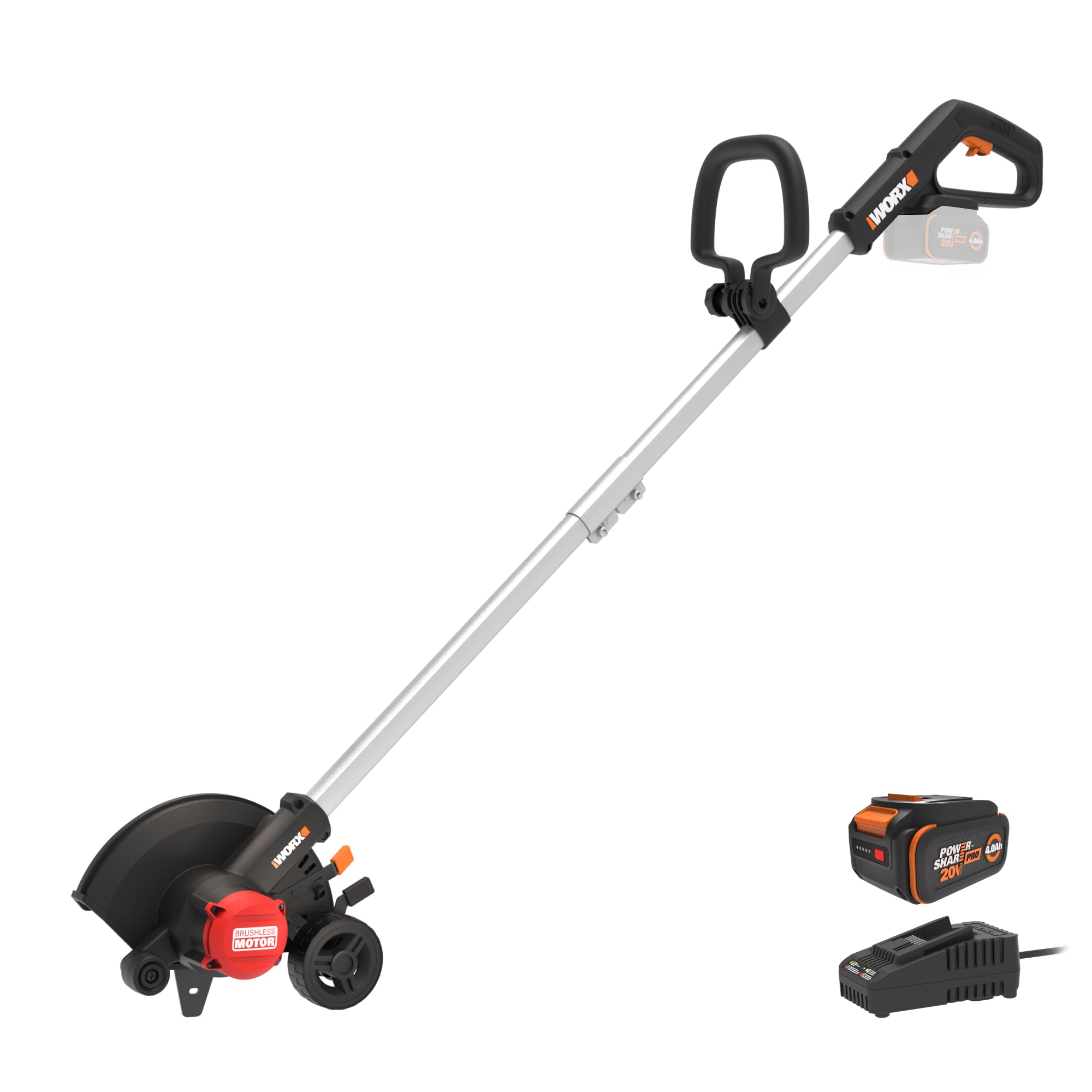
The battery-powered edger with a rotating blade and dual wheels that keeps the line straight.
For anyone with a large yard who wants the precision of a powered edger without the hassle of a gas engine, the WORX WG898 is a serious contender. It uses a brushless motor and a uniquely streamlined steel blade to cut a clean edge along sidewalks and driveways. The dual wheels keep the tool balanced and tracking straight, and the edge guide and blade indicator help you follow the concrete line without veering. At 7 pounds (without the battery), it is lightweight for a power tool.
The 20V PowerShare system means the battery works across the entire WORX lineup, so if you already own WORX tools, you can share batteries. The 4.0Ah battery provides up to 2,800 feet of edging per charge — enough for most large properties. The 3 depth settings let you adjust how deep the blade cuts, from a light trim to a full trench. Owners consistently praise the performance, with one noting it “does a great job edging concrete driveways” and that it paid for itself in a single day. The assembly is straightforward, and the tool stores easily on a wall hook.
The battery life gets mixed feedback. While WORX claims 2,800 feet per charge, some owners find the battery runs out faster in thick grass or hard soil, and the charge time is notably long. If you have more than 500 feet of edging, you may want a spare battery. A few owners also received units where the blade was not sharp from the factory, requiring replacement or sharpening before first use. And at 8.6 pounds with the battery installed, it is heavier than any manual edger on this list — you will feel it when carrying it around the yard.
Why it works
- Dual wheels and edge guide keep cuts straight along concrete.
- Up to 2,800 feet of edging per charge is enough for large properties.
- Brushless motor delivers gas-like power without the fumes or noise.
Where it falls short
- Battery life can fall short of claimed range in thick, dry turf.
- Heavier than manual options at 8.6 pounds with battery — noticeable on long walks.
Best for: homeowners with large driveways and long sidewalk runs who want powered precision without a gas engine or extension cord.
Consider a manual tool if: your yard has less than 200 feet of edging — the WORX is powerful, but a 4-pound manual edger is faster to grab and never needs charging.
Understanding the Specs
Half-Moon vs. Serrated vs. Round Blade
The blade shape determines how the tool interacts with the ground. A half-moon blade creates a clean, vertical slice — ideal for defining a crisp visual border along sidewalks and flower beds. A serrated or saw-tooth blade works like a bread knife, sawing through dense turf and shallow roots where a straight edge would skid. A round or dished blade acts more like a narrow shovel, useful for trenching and cutting sod but leaving a curved profile instead of a sharp corner. Match the blade to your soil: straight for sandy loam, serrated for clay with roots, round for trenching work.
Handle Length and Your Back
Manual edging involves a lot of lifting, stomping, and rocking. A handle that is too short forces you to bend at the waist, which leads to back pain after 20 minutes. Look for a shaft length of at least 40 inches if you are average height, or longer (52 inches like the Root Slayer) if you are over 6 feet. The grip style also matters — a T-grip or donut-shaped handle lets you twist the blade free with both hands, while a straight D-grip relies more on wrist strength. Ergonomic padding on the grip reduces blisters during longer sessions.
FAQ
Can a manual edger cut through tree roots?
Do I need to sharpen a lawn edger before first use?
How deep should a lawn edger cut?
What is the difference between a half-moon edger and a step edger?
Will a manual edger work in rocky soil?
How do I maintain a manual edger so it lasts?
Should I get a cordless electric edger instead of a manual one?
Can I use a lawn edger to dig a trench for irrigation?
Final Thoughts: The Verdict
For the majority of shoppers, the best edging tool is the Radius Garden Pro-Lite Carbon Steel Edger because it balances a sharp, heat-treated blade with a lightweight 4-pound build and an ergonomic donut handle that makes hour-long sessions manageable. If you regularly battle thick roots and compacted clay, grab the Root Slayer XL Serrated Edger — its aggressive teeth and 52.5-inch shaft power through what a straight blade cannot. And for those who want powered precision on a large property, the WORX Cordless Lawn Edger WG898 delivers up to 2,800 feet of edging per charge without the noise of a gas engine.
How We Picked
We do not accept paid placement. Every pick is matched to a real buyer and a real use-case; we do not hands-on test units.
Sources & Methodology
Specifications: manufacturer listings and product documentation. Review insights: verified customer reviews, as of July 2026. Pricing: not shown on this page (it changes often); check the current price via the retailer link.
As an Amazon Associate, WellFizz earns from qualifying purchases. This does not affect which products we feature.
Related Guides

Mo Maruf
I created WellFizz to bridge the gap between vague wellness advice and actionable solutions. My mission is simple: to decode the research and give you practical tools you can actually use.
Beyond the data, I am a passionate traveler. I believe that stepping away from the screen to explore new environments is essential for mental clarity and physical vitality.