Our readers keep the lights on and my smoothie glass nicely filled. As an Amazon Associate, I earn from qualifying purchases.
Specs are compiled from manufacturer listings and verified buyer reviews and can change over time — please confirm the key details on the product page before buying.
Picking your first real camera can feel like a test you didn’t study for. Every model throws a dozen specs at you — megapixels, sensor size, autofocus points, burst rates — and none of it tells you which one actually makes you want to take it everywhere. You are looking for the one that rewards your mistakes gently, helps you learn without a manual the size of a textbook, and still delivers images you’ll actually print.
I’m Mohammad Maruf — the founder and writer behind WellFizz. This guide is built by comparing the manufacturers’ published specifications and the patterns across verified customer reviews, so you get each pick’s real strengths and trade-offs instead of marketing spin.
The list we’ve put together covers mirrorless, DSLR, and compact models across every price tier, all chosen to make your first steps easier. Whether you are shooting family portraits, travel adventures, or wildlife from a distance, our roundup of the very best digital cameras for beginners focuses on image quality, ease of use, and real-world performance you can trust.
Our Picks at a Glance


How To Choose The Best Digital Cameras For Beginners
The first camera decision is rarely about the brand — it is about the form factor that matches your life. A DSLR gives you a classic optical viewfinder and excellent battery life, but it is bulkier. A mirrorless camera is smaller, lighter, and shows you exactly what the sensor sees in real time, which makes learning exposure a lot faster. A compact bridge camera packs a huge zoom into a fixed-lens body, perfect for travel and wildlife without carrying extra glass. Know which shape fits how you actually shoot before you chase any spec.
Sensor size and resolution
The sensor is the part of the camera that captures light, and bigger sensors generally produce cleaner, more detailed images with better low-light performance. Most beginner-friendly cameras use an APS-C sensor (around 24MP) or a Micro Four Thirds sensor (around 20MP). Both are large enough for sharp prints and great image quality — you do not need a full-frame sensor to get beautiful results as a beginner. More megapixels matter only if you plan to crop heavily or print very large; for social media and standard prints, 20MP to 24MP is plenty.
Autofocus system
Autofocus is what keeps your subject sharp when you press the shutter halfway. Cameras with phase-detection autofocus (PDAF) are generally faster and more reliable than those using only contrast detection, especially for moving subjects. Look for a system with subject tracking and eye detection — those features do the hard work for you, so portraits stay crisp even if your child or pet moves. The number of autofocus points tells you how much of the frame the camera can cover; more points mean better tracking across the whole scene.
Lens ecosystem and expandability
Interchangeable-lens cameras (DSLRs and mirrorless) let you swap lenses as your skills grow. A kit lens like an 18-55mm covers everyday needs from groups to portraits, but the real value lies in being able to add a fast prime lens or a telephoto later. Canon’s RF mount, Nikon’s F-mount, Sony’s E-mount, and the Micro Four Thirds system all have huge lens libraries at every price point. A fixed-lens camera like a bridge or compact gives you a massive zoom range in one sealed unit — no lens swapping, but also no upgrade path.
Quick Comparison
| Model | Best For | Sensor | Autofocus Points | Continuous Shooting | Amazon |
|---|---|---|---|---|---|
| Nikon D5600★ Best Overall | Versatile learning DSLR | 24.2 MP APS-C | 39 | 5 fps | Amazon |
| Canon EOS R100 (Kit)Mirrorless Star | Compact mirrorless starter | 24.1 MP APS-C | 143 | 6.5 fps | Amazon |
| Canon EOS Rebel T7Classic DSLR Value | Budget DSLR bundle | 24.1 MP APS-C | 9 | 3 fps | Amazon |
| Nikon D3200 | Classic entry-level DSLR | 24.2 MP APS-C | 11 | 4 fps | Amazon |
| OM System E-M10 Mark IV | Stylish mirrorless with stabilization | 20.3 MP Micro 4/3 | 121 | 8.7 fps | Amazon |
| Panasonic LUMIX ZS99 | Travel zoom compact | 20.3 MP 1/2.3 | 121 | 10 fps | Amazon |
| Sony ZV-E10 Bundle | Vlogging and content creation | 24.2 MP APS-C | 425 | 11 fps | Amazon |
| KODAK PIXPRO AZ528 | Budget superzoom bridge | 16 MP BSI CMOS | 25 | 6 fps | Amazon |
In‑Depth Reviews
1. Nikon D5600 with 18-55mm VR Lens
Our pick — over 4.5★ from 650+ verified ratings; the strongest balance of quality and price.
The DSLR that grows with you, from your first auto-mode snapshot to manual control mastery.
This Nikon gives you a 24.2-megapixel sensor that produces crisp, vibrant photos right from the start, and its 39-point phase-detection autofocus, compared to the 25 points of a typical budget bridge camera, keeps moving subjects locked in. The 3.2-inch 1.037m-dot Vari-Angle touchscreen flips out and rotates, so you can compose from high angles, low angles, or selfie positions without guessing. Full HD 1080p video at 60 fps is smooth enough for family events and hobby projects.
Buyers report that the battery arrives charged and ready, letting you shoot immediately. The same crowd praises the image quality as the most-discussed strength, with crystal-sharp optics and excellent value for the price. The connectivity gets mixed reactions — Wi-Fi works well for remote shooting, but the Bluetooth pairing can be finicky and sometimes requires re-pairing. A single command dial makes full manual mode trickier than it could be, and there is no USB charging, so keep the spare battery handy. It is also notably lighter than the older D5300, a welcome change for all-day carries.
What owners love
- Image quality praised most among all aspects — sharp and vibrant straight out of camera
- Lightweight build makes a big difference for carrying all day
- Vari-angle touchscreen is fantastic for creative angles and video work
What to know
- Connectivity is mixed — Bluetooth pairing can be unreliable for some
- Single command dial makes manual exposure adjustments slower
- No USB charging, so plan for a spare battery on long shoots
the balance: If you want a DSLR that balances beginner-friendly ease, excellent image quality, and room to grow into manual settings, the D5600 is your best starting point.
Think twice if: You want a fully modern mirrorless experience with USB-C charging and smooth app connectivity — this one still uses older Bluetooth standards.
2. Canon EOS R100 with RF-S 18-45mm Kit
Canon’s lightest mirrorless body packs beginner-friendly power without the bulk.
The R100 is the smallest and lightest body in the entire EOS R series, yet it holds a 24.1-megapixel APS-C sensor driven by the DIGIC 8 processor. That combination delivers 4K video at 24 fps, uncropped Full HD at 60 fps, and 120 fps HD slow-motion when you want it. The Dual Pixel CMOS AF covers 143 zones — a massive leap from the 9-point system on the Rebel T7 — with human face and eye detection for both photos and video. You also get animal and vehicle detect autofocus, a feature rarely seen at this level.
Quality and image quality are the top two positive aspects buyers talk about, with many calling it an amazing compact powerhouse that produces crisp results. A few owners note the battery life is the weakest point — expect to keep a spare or a portable charger on day trips. The R100 does not come with a battery charger in the box, so you will need to pick up an LP-E17 charger separately. That minor frustration aside, the fast continuous shooting at 6.5 fps with One-Shot AF and the modern RF lens mount give you a future-proof platform that beats the D5600’s 5 fps burst rate and older F-mount ecosystem.
Why it stands out
- Smallest and lightest EOS R body — fits in a small bag easily
- 143-point Dual Pixel AF with animal, vehicle, and eye detection
- 4K video and 120 fps slow motion in a beginner-priced package
Watch out for
- Battery life is the most common negative point — carry a spare
- No battery charger included in the box (USB charging only)
- Functionality reports are mixed, with some units experiencing issues
Great for: Anyone who wants a modern, compact mirrorless camera with advanced autofocus and 4K video in a beginner-friendly body.
skip it if: You need all-day battery life for long hikes or events without carrying spare power — the battery is the weak link here.
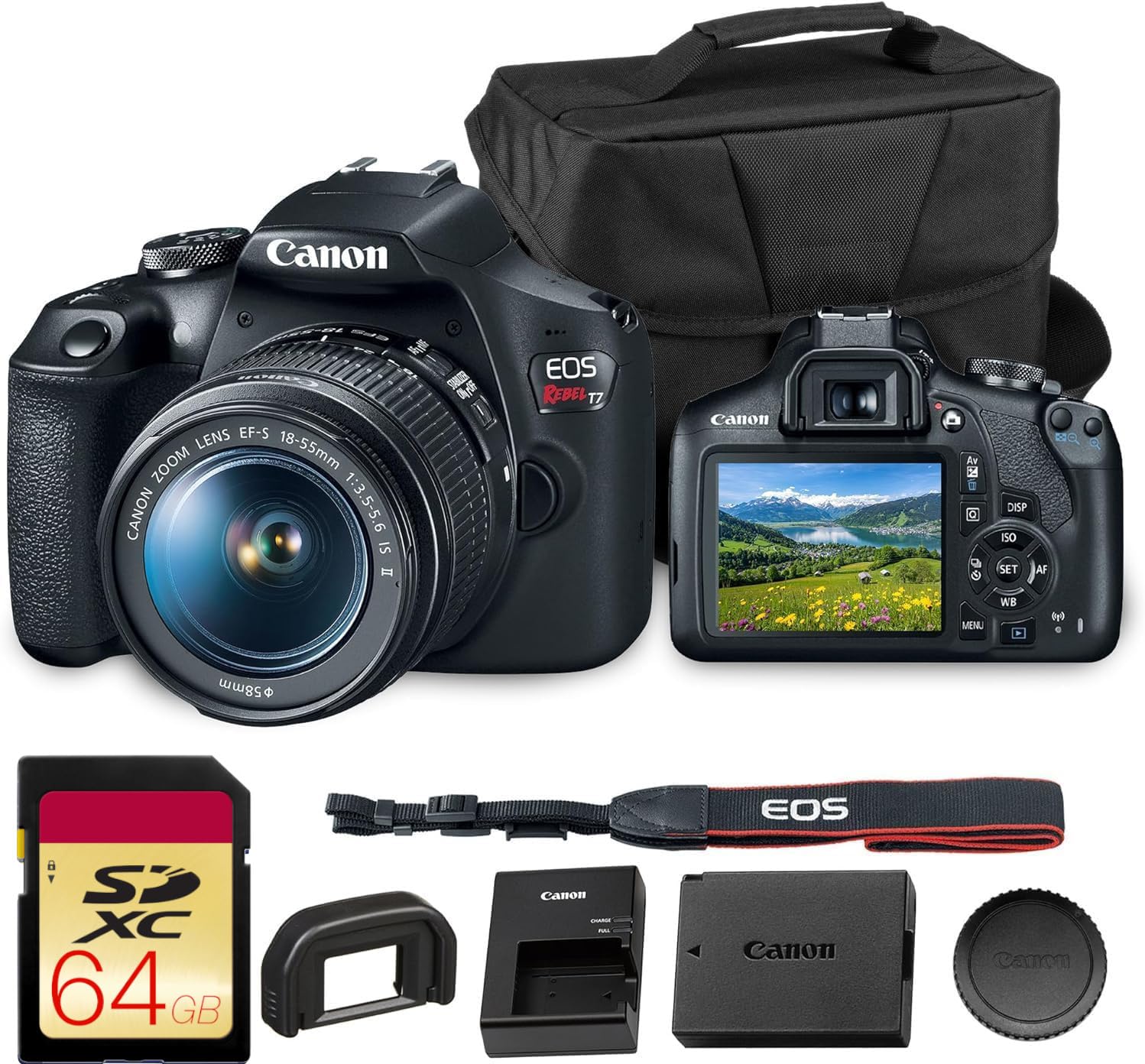
3. Canon EOS Rebel T7 with 18-55mm, Bag, and 64GB Card
A tried-and-true DSLR bundle that puts classic image quality into your hands without the learning curve.
The Rebel T7 pairs a 24.1-megapixel APS-C CMOS sensor with the DIGIC 4+ processor, producing vibrant, true-to-life photos that owners consistently praise for their quality — it is the most-mentioned aspect by a wide margin. This bundle includes a shoulder bag, a 64GB memory card, and the LP-E10 battery and charger, so you have everything to start shooting immediately. The 9-point autofocus system is basic compared to modern mirrorless models, but for stationary subjects and beginners learning composition, it gets the job done without confusion.
Buyers find this camera exceptionally easy to use, with one first-time photographer saying it was simple to handle and produced clear stills and video. The built-in Wi-Fi and NFC let you transfer photos to your phone easily for sharing. The major trade-off here is the autofocus — just 9 points, a fraction of the 143 on the R100 — and the 3 fps continuous shooting is slower than almost anything else on this list. Think of the T7 as an affordable entry point into the Canon EF lens ecosystem: start here, upgrade glass later, keep the body as a backup.
Where it shines
- Top-rated quality across 400+ reviews — owners consistently praise the image output
- Complete bundle with bag, card, and charger saves you from buying extras
- Lightweight and easy to handle, even for complete beginners
Where it shows its age
- 9-point autofocus system is very basic — not ideal for moving subjects
- Slow 3 fps burst rate limits action photography
- Compatibility and functionality feedback is mixed from some owners
Reach for this if: You want a budget-friendly DSLR kit with solid image quality and a clear upgrade path through Canon’s EF lens lineup.
Look elsewhere if: You need fast autofocus for kids’ sports or pets — the 9-point system will struggle to keep up.
4. Nikon D3200 with 18-55mm VR Lens

An entry-level classic that still delivers stunning 24.2MP results for a fraction of the price.
The D3200 runs Nikon’s EXPEED 3 image processor and a 24.2-megapixel DX-format CMOS sensor, producing crisp, color-true photos that owners describe as stunning for the price point. Its 11-point autofocus system is simple but reliable, and a wide ISO sensitivity range (100–6400, expandable to 12800) means you can shoot in dimmer conditions without immediate noise. One-touch Full HD 1080p movie recording is a welcome convenience for beginners. The camera does not include built-in Wi-Fi, but it is compatible with an optional WU-1a wireless adapter for remote shooting and phone transfers.
Owners praise the battery life, reporting 300–500 shots per event day without needing a recharge — noticeably better than many mirrorless options. The guide mode built into the menu system walks new users through settings step by step, which reviewers call an excellent teaching tool. The 4 fps continuous shooting is modest but adequate for casual action captures. The D3200 lacks an internal memory slot, so you will need an SD card from day one. It also uses an older proprietary USB connection rather than USB-C, but for the price, the image quality per dollar is still among the best.
What makes it great
- Excellent battery life — 300 to 500 shots per charge in real-world use
- Guide mode menu teaches beginners exposure and settings step by step
- 24.2MP sensor delivers stunning image quality for the price
What to expect
- No built-in Wi-Fi — needs optional adapter for wireless transfer
- Small, dim optical viewfinder is the most common ergonomic complaint
- 4 fps burst rate is slow for fast action photography
Perfect for: The budget-conscious new photographer who wants superb image quality and a teaching tool built into the camera itself.
Not for: Anyone who needs built-in Wi-Fi/LTE, fast continuous shooting, or a modern USB-C port — the D3200 is an older design.
5. OM System (Olympus) E-M10 Mark IV with 14-42mm EZ Kit

A retro-styled mirrorless that slips into a jacket pocket while delivering pro-level stabilization.
The E-M10 Mark IV uses a 20.3-megapixel Micro Four Thirds sensor paired with an in-body 5-axis image stabilization (IBIS) system capable of 4.5 shutter speed steps of compensation — meaning you can handhold shots at shutter speeds that would be blurry on almost any other camera. That is a serious advantage for low-light street photography, indoor family shots, and video without a gimbal. The 14-42mm EZ pancake zoom collapses into a flat profile, so the whole kit can truly fit in a jacket pocket. The flip-down monitor activates an automatic selfie mode when you pull it down, making vlogging and group shots easy.
Quality and image quality are the top positive aspects by a large margin, with owners calling it a fun, compact camera that takes great photos without fuss. The built-in 16 Art Filters — including an Instant Film setting for a nostalgic look — give beginners creative options without needing editing software. The 121 contrast-detect autofocus points are fast and accurate in good light. Reliability is the most common negative theme; a few owners mention the camera not recognizing the lens or failing to power on. The app and Wi-Fi connection for file transfer is also slow compared to modern standards. But for image stabilization in a compact, interchangeable-lens body, this camera has no equal in its price range.
Standout strengths
- 5-axis in-body stabilization is best in class — 4.5 stops of compensation for handheld shots
- Compact pancake zoom lens makes the whole kit pocketable
- Flip-down monitor with dedicated selfie mode for vlogging and group photos
Be aware
- Reliability reports are mixed — some units have lens recognition issues
- App and Wi-Fi transfer is slow compared to newer cameras
- No USB-C charging; uses a proprietary connector
Reach for this if: You want the smallest interchangeable-lens camera with professional-grade image stabilization for handheld low-light shooting.
Look elsewhere if: You prioritize instant reliability and smooth app connectivity over sheer stabilization performance.
6. Panasonic LUMIX ZS99 with 30x Optical Zoom

A true pocket rocket that brings stadium seats and mountain peaks into sharp 30x zoom reach.
The ZS99 packs a Leica 24-720mm lens with 30x optical zoom into a body that actually fits in a pants pocket — no interchangeable lens, no bag required. That makes it the only camera on this list that can shoot a wide landscape and then instantly pull in a distant animal or a concert stage with genuine optical sharpness. The 20.3-megapixel 1/2.3-inch MOS sensor and 5-Axis HYBRID O.I.S.+ stabilization help keep those telephoto shots steady. It records 4K video at 30p and can pull 4K PHOTO bursts at 30 fps from video to grab the exact frame. An 1,840k-dot tiltable touchscreen and USB-C charging make it modern and travel-friendly.
Quality and zoom capability are the most-discussed positives, with owners finding the 30x optical zoom class-leading by any smartphone for concert, sports, and wildlife video. The compact size makes it perfect for slipping into a bag or men’s pocket, and the Intelligent Auto mode lets beginners shoot without fiddling with settings. The recurring trade-off is low-light performance — the small 1/2.3-inch sensor struggles in dim conditions, producing noticeable noise. A few customers note overheating that stops video recording after extended use, and the 4K recording has a 15-minute limit. The flip-up viewfinder hinge also drew a durability complaint from one long-term user. For daytime travel shoots, though, nothing else this small reaches this far.
What wins people over
- 30x optical zoom (24-720mm Leica lens) is class-leading in this size category
- Compact enough for a pants pocket — no bag needed for travel
- USB-C charging, tiltable touchscreen, and Bluetooth 5.0 for easy sharing
Honest trade-offs
- Low-light performance is the weakest aspect — noise visible in dim scenes
- 4K video has a 15-minute time limit; overheating can stop recording
- Tilt-screen hinge durability is a concern for some owners
Great for: Travelers and concert-goers who want a true pocket camera with extreme zoom reach for daytime outdoor shooting.
Not for: Anyone who shoots indoors or at night regularly — the small sensor produces noisy images in low light.
7. Sony ZV-E10 Bundle with 16-50mm, 128GB Card, Tripod & More

Sony’s vlogging powerhouse bundled with every accessory a beginner content creator could want.
The ZV-E10 is purpose-built for vloggers and social creators, with a 24.2-megapixel APS-C Exmor CMOS sensor, UHD 4K30p video, and a 425-point Fast Hybrid AF system — the most autofocus points on this entire list. Real-time Eye AF and tracking keep faces sharp even when you move around the frame, and the Background Defocus button instantly blurs the background for that professional look. The side flip-out 3-inch touchscreen lets you see yourself while recording, and the directional 3-capsule microphone with a windscreen delivers clean audio without an external mic. This bundle layers in a 64GB Extreme PRO SD card, a tripod, a grip, a spare battery and charger, a.43 wide-angle and 2x telephoto lens attachments, a filter kit, and Movavi editing software.
Owners love the video and image quality from the start, with many calling it the perfect camera for starting a YouTube channel or podcast. The 11 fps burst shooting and ISO range of 100–32000 (expandable to 50) make it versatile for both stills and video. The huge bundle value is a common talking point — everything works right from the start. A few reviewers point out that the bundle can arrive missing the software or the wide-angle lens attachment, so inspect the box contents promptly. The battery lasts a couple of days for casual use, but for all-day vlogging, the included spare battery is essential. This is the most complete creator-focused package on the list.
Why creators choose it
- 425-point Fast Hybrid AF with Real-Time Eye Tracking — best autofocus here
- Complete creator bundle: spare battery, tripod, wide-angle lens, filters, editing software
- Directional 3-capsule mic with windscreen for clean audio without an external mic
Watch the bundle contents
- Some bundles arrive missing the software disc or the wide-angle lens attachment
- No built-in flash — plan a separate light for indoor video
Best for: The beginner vlogger, podcaster, or content creator who wants a dedicated video-first camera with pro-level autofocus and a full accessory kit.
Consider something else if: You primarily want a stills camera for photography and will rarely record video — the ZV-E10’s design skews heavily toward creators.
8. KODAK PIXPRO AZ528 with 52x Optical Zoom

The most reach for the least cash — a 52x zoom bridge camera that brings faraway birds into frame.
The AZ528 is a bridge camera with a fixed 52x optical zoom lens (24mm wide-angle to a massive telephoto reach), making it the zoom champion of this list by a wide margin. It uses a 16-megapixel BSI CMOS sensor with Optical Image Stabilization to combat hand shake at full zoom — essential when you are shooting wildlife or sports from a distance. The 6 fps burst mode captures rapid sequences, and the 3-inch LCD lets you review them. Built-in Wi-Fi transfers photos to your phone for sharing, and full 1080p HD video at 30p covers basic video needs. It accepts SD, SDHC, or SDXC cards up to 512 GB, giving you plenty of storage for day-long shoots.
Camera quality and ease of use are the top positive aspects, with owners calling it affordable, lightweight, and simple to pick up. The zoom gets mixed reactions: when you zoom all the way in, you need steady hands or a tripod or the image gets noticeably blurry — a limitation of any long-zoom compact. Owners also note the battery life is short but that replacement batteries are cheap, and the body scuffs easily. The 25-point contrast-detect autofocus is slower and less precise than the phase-detection systems on the DSLRs and mirrorless cameras above. For the price, though, the AZ528 offers class-leading reach in a single-lens solution.
Why it is popular
- 52x optical zoom gives you an incredible reach that no phone or kit lens can match
- Very affordable entry point for beginners interested in wildlife or bird photography
- Lightweight and easy to use right from the start
The fine print
- Full zoom requires very steady hands or a tripod — image gets blurry easily at max reach
- Battery life is short, but cheap replacement batteries are available
- Body finishes scuff easily; handle with care
Reach for this if: You are on a tight budget and want maximum zoom range for outdoor daytime wildlife or bird photography from a single camera.
pass on it if: You want sharp low-light images, fast autofocus, or intend to upgrade lenses later — this is a fixed-lens bridge camera, not a system.
Understanding the Specs
APS-C vs Micro Four Thirds sensors
An APS-C sensor (found in the Nikon D5600, Canon R100, and Sony ZV-E10) is physically larger than a Micro Four Thirds sensor (found in the OM System E-M10 Mark IV). A larger sensor generally captures more light, giving you better low-light performance and more background blur potential. Micro Four Thirds cameras are physically smaller and lighter, making them easier to carry, and the lens ecosystem is very deep. Both produce excellent image quality for beginners — pick the size that fits your portability needs.
Autofocus points and what they mean
Autofocus points are small areas on the sensor that the camera uses to lock focus. More points mean the camera can track subjects across a wider portion of the frame. A camera with 9 points (like the Canon Rebel T7) is fine for static subjects but will struggle with moving targets near the edge of the frame. A camera with 143 or 425 points (like the Canon R100 or Sony ZV-E10) covers almost the entire frame, so you can compose creatively and still get sharp focus on a moving subject. Phase-detection AF points are faster and more reliable than contrast-detection points, especially in lower light.
FAQ
Should a beginner buy a DSLR or a mirrorless camera?
Is 24 megapixels enough for a beginner?
Can these cameras shoot 4K video?
Do I need a separate lens for portraits or wildlife?
What does image stabilization do?
How long do the batteries last on these cameras?
Can I transfer photos to my phone wirelessly?
What memory card do I need for these cameras?
Final Thoughts: The Verdict
Across the board, the very best digital cameras for beginners pick is the Nikon D5600 because it blends excellent image quality, a vari-angle touchscreen, and a deep lens ecosystem with a price that leaves room for accessories. If you want a compact mirrorless that rides in a small bag and has modern autofocus with animal detection, the Canon EOS R100 is the one to grab. And for the dedicated vlogger or content creator who needs 4K video and 425-point autofocus right from the start, the Sony ZV-E10 bundle delivers the most complete creative kit.
How We Picked
We do not accept paid placement. Every pick is matched to a real buyer and a real use-case; we do not hands-on test units.
Sources & Methodology
Specifications: manufacturer listings and product documentation. Review insights: verified customer reviews, as of July 2026. Pricing: not shown on this page (it changes often); check the current price via the retailer link.
As an Amazon Associate, WellFizz earns from qualifying purchases. This does not affect which products we feature.
Related Guides

Mo Maruf
I created WellFizz to bridge the gap between vague wellness advice and actionable solutions. My mission is simple: to decode the research and give you practical tools you can actually use.
Beyond the data, I am a passionate traveler. I believe that stepping away from the screen to explore new environments is essential for mental clarity and physical vitality.