Our readers keep the lights on and my smoothie glass nicely filled. As an Amazon Associate, I earn from qualifying purchases.
Specs are compiled from manufacturer listings and verified buyer reviews and can change over time — please confirm the key details on the product page before buying.
Dirt bikes come with a lot of noise—both literal and figurative. Between gas-powered torque monsters and silent electric speedsters, the real question isn’t which brand has the flashiest graphics, but which machine actually matches how and where you ride. This guide cuts through the spec-sheet fog to match six very different off-road machines to the rider who will actually enjoy them.
I’m Mohammad Maruf — the founder and writer behind WellFizz. This guide is built by comparing the manufacturers’ published specifications and the patterns across verified customer reviews, so you get each pick’s real strengths and trade-offs instead of marketing spin.
Whether you crave the instant torque of an electric motor or the rugged simplicity of a 250cc four-stroke, finding the right machine starts with understanding what each bike actually delivers on the trail. Here is your honest breakdown of the best dirt bikes for every kind of rider.
Our Picks at a Glance

How To Choose The Best Dirt Bikes
Picking a dirt bike is about matching the machine to your terrain and your mechanical confidence. Open desert trails reward top speed, while tight wooded singletrack demands low-end torque and a light chassis. If you are comfortable turning a wrench, a carbureted 250cc bike is cheap to fix. If you just want to ride and forget, an electric bike with a sealed motor and a high-capacity 60V battery avoids most maintenance headaches entirely. Start by asking yourself where you will ride most and how much tinkering you enjoy.
Engine Type: Gas Torque vs. Electric Instant Power
A 250cc four-stroke gas engine (like the 223cc unit in the X-PRO models) delivers a broad powerband that pulls from low revs and keeps pulling. It is familiar, easy to repair with basic tools, and you can refuel in minutes at any gas station. Electric motors, such as the 7000W peak unit in the COSWHEEL, provide instant full torque from a standstill—no clutch feathering needed—and run silently. The catch is that they need hours to recharge a 60V 30Ah battery, and range can drop sharply on aggressive singletrack versus a moderate trail ride.
Weight and Wheel Size
A 265-pound gas bike like the Hawk 250 feels planted on fast fire roads but becomes a handful when you need to pick it up off a muddy slope. Electric bikes like the COSWHEEL weigh just 124 pounds—a difference of over 140 pounds that you feel on every jump, rut, and tip-over. Wheel size matters too: a 21-inch front wheel (found on the X-PRO Hawk 250 and the Apollo 250) rolls over logs and rocks more easily than a 17-inch front tire, which is better for packed dirt and pavement.
Quick Comparison
| Model | Best For | Engine / Motor | Top Speed | Weight | Amazon |
|---|---|---|---|---|---|
| X-PRO Hawk 250★ Best Overall | Budget gas trail riding | 250cc Gas | ~70 mph | 265 lbs | Amazon |
| LIFEMAGIC 5500W3-Speed Torque | Budget electric trail | 5500W Peak Motor | 56 MPH | 143.3 lbs | Amazon |
| COSWHEEL 7000W | Fast electric trail | 7000W Peak Motor | 55 MPH | 124 lbs | Amazon |
| Apollo RFN Thunder 250 | Mid-range gas upgrade | 250cc Gas | ~70 mph | 233 lbs | Amazon |
| X-PRO 250 EFI (MC-N366) | Starter gas commuter | 223cc EFI Gas | ~70 mph | — | Amazon |
In‑Depth Reviews
1. X-PRO Hawk 250 Dirt Bike
Our pick — over 4★ from 450+ verified ratings; the strongest balance of quality and price.
The gas-powered trail thrasher that owners call the best value in the category — warts and all.
For the price of a decent mountain bike, you get a full-size 250cc enduro with an electric and kick starter, braided brake lines, and a billet gas cap. The Hawk 250 is what the crowd of nearly 500 owners raves about for value: at 265 pounds it is heavy, but that heft translates to planted stability on fast Jeep trails. The 21-inch front wheel and 18-inch rear roll over obstacles that would swallow a smaller setup. What wins people over is the value — 80 owners single out the bang-for-buck, and 72 call the overall quality a win for the money.
The trade-off is mechanical patience. Several buyers report the speedometer reads 15 mph low, and the stock battery is weak. The factory carburetor on some units refuses to hold an idle. But the flip side is a bike that is dead simple to wrench on: you can swap the carb, shim the needle, and check the valves in an afternoon. The seller has a reputation for sending free replacement parts fast. A few unlucky owners had transmission failures within the first few miles, but the overwhelming consensus — as owners mention — is “most durable cheap bike you can buy.”
The Hawk weighs 265 pounds and the COSWHEEL weighs 124 pounds, so mud-picking and single-track loop recoveries are a real workout. It is also a machine that demands pre-ride inspection. But if you want a proper motorcycle that teaches you how to ride and wrench for the lowest entry price, this is it.
Owners love
- Unbeatable value for a full-size 250cc — 80+ owners call it out as the best bang-for-buck
- Electric and kick start give you redundancy on the trail
- Simple, fixable design with online community support and responsive parts replacement
The honest trade-offs
- Significant assembly required (3–4 hours) with no printed instructions included
- Durability is mixed — some units arrive with bent rims, weak batteries, or transmission failures within the first few rides
- Front forks are soft and bottom out easily; excessive vibration at higher speeds is common
Reach for it if: you want a real, fixable 250cc motorcycle on a tight budget and enjoy learning mechanical basics.
Think twice if: you want a turn-key, zero-maintenance ride or weigh much over 160 lbs (the soft suspension and rear swingarm will feel under-gunned).
2. LIFEMAGIC 5500W Electric Dirt Bike
An electric trail bike that gives you three speed personalities — slow cruise, fast rip, or full 56 MPH attack.
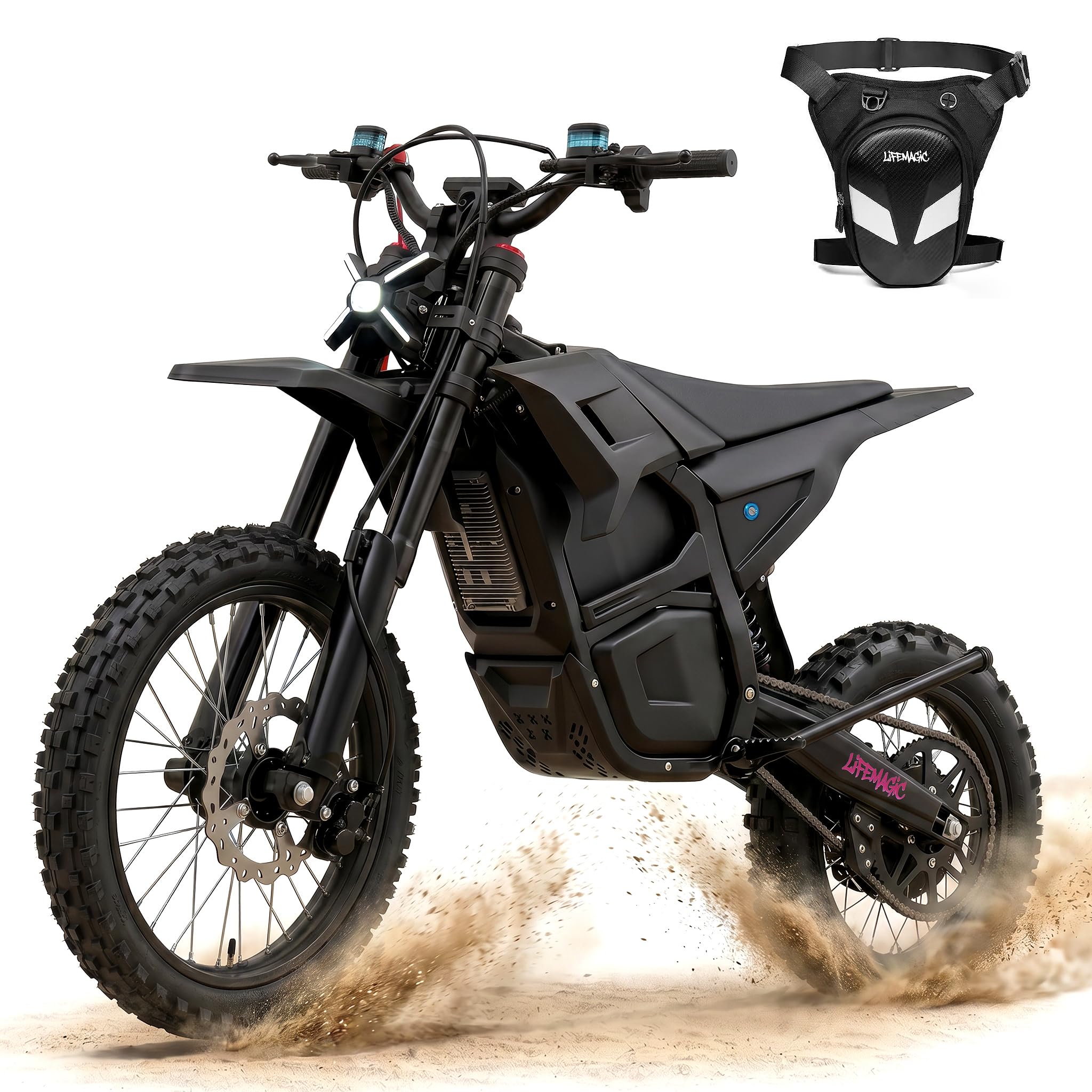
The LIFEMAGIC electric dirt bike packs a 5500W peak motor and a 60V 30Ah lithium-ion battery, letting you switch between 22 MPH, 41 MPH, and 56 MPH modes depending on the terrain. That is a useful real-world feature: you can keep the bike tame for a new rider on a fire road then flip it to full power when the trail opens up. The dual suspension and full hydraulic brakes give it the stopping power that trail riding demands. Full hydraulic disc brakes here are a step above the mechanical setups on some budget gas competitors.
At 143.3 pounds, it is heavier than the COSWHEEL (124 pounds) but still dramatically lighter than any 250cc gas bike in this list. The crowd, while small, is enthusiastic: owners call it surprisingly fast and strong for the price. As one owner who came from a 1000cc gas bike put it, the transition felt natural. The battery supports extended range for long forest trails. That said, a couple of units arrived with cosmetic damage and defects that the seller reportedly refused to take back — a caution note despite the otherwise good customer service reports.
Chain mishaps on aggressive trails have been reported, though the company resolved those quickly. The 3-speed adjustability gives this bike a versatility edge over the COSWHEEL, which lacks the same mode-based top-speed control.
Owners love
- Three distinct speed modes (22/41/56 MPH) let you tailor power to the rider and terrain
- Light at 143.3 lbs — easy to load, lift, and flick around tight corners
- Full hydraulic brakes and dual suspension soak up bumps for a controlled ride
The honest trade-offs
- Quality control issues reported — some bikes arrive with cosmetic damage or defects (tail light, kickstand, brake)
- Only a small pool of owners so far, so long-term durability is unproven
- Value-for-money opinions are mixed; some owners feel it is priced against more established brands
Best for: riders who want an electric trail machine with adjustable speed modes for mixed-skill use and a 330-lb load capacity.
Pass if: you require flaw-free delivery — the QA track record here is a roll of the dice.
3. COSWHEEL Electric Dirt Bike 7000W
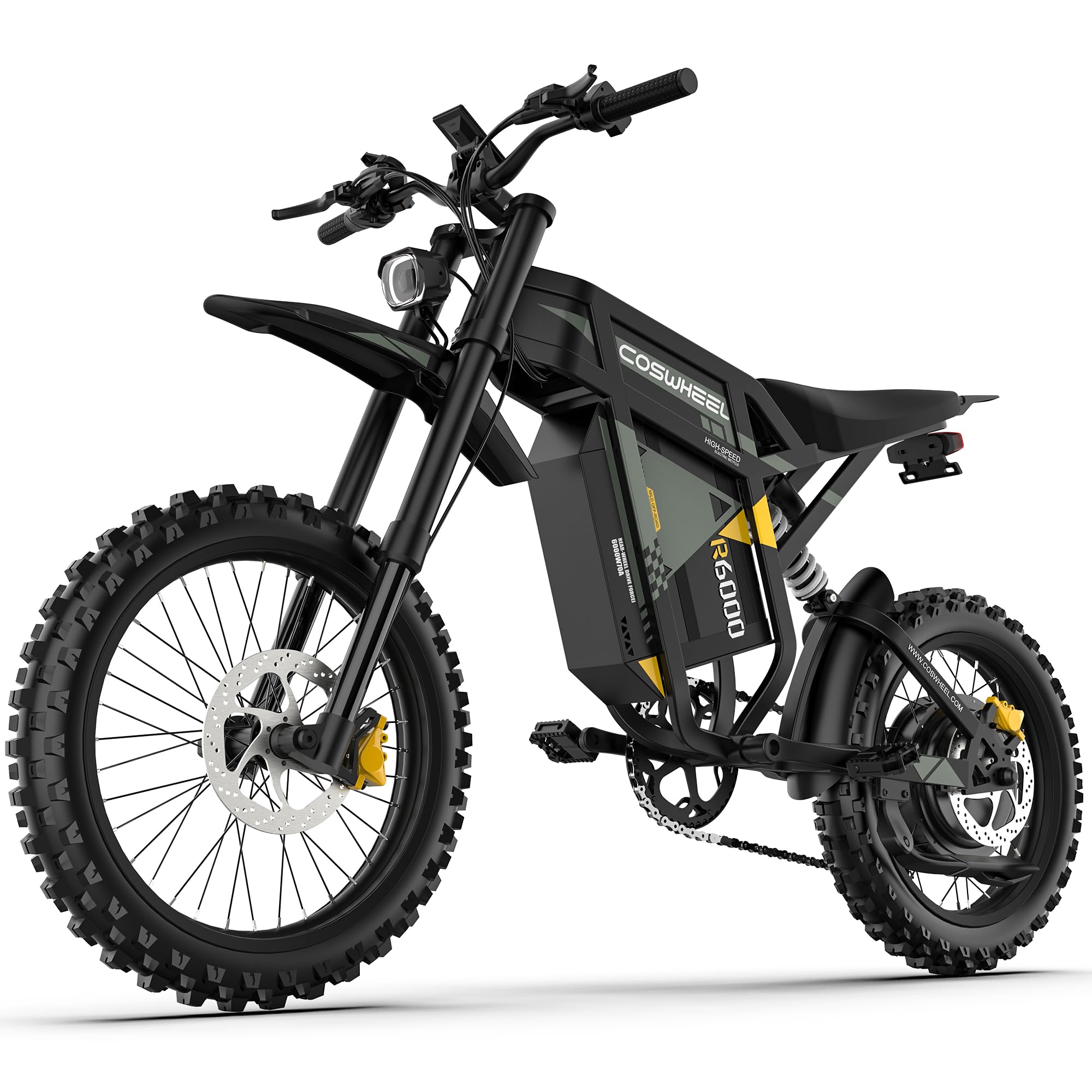
At 124 pounds with 7000W of peak punch, this is the lightweight torque king of the electric class.
The COSWHEEL R6000 is a featherweight by dirt bike standards — it weighs just 124 pounds, compared to 265 pounds for the X-PRO Hawk 250 and 143.3 pounds for the LIFEMAGIC. That weight advantage shows up every time you hit a jump, slide through a corner, or pick the bike up off a hill. The 7000W peak brushless motor hits a very real 55 MPH, nearly matching the LIFEMAGIC’s 56 MPH despite the COSWHEEL being the lighter machine. The 60V 30Ah 1800WH battery provides what the company calls an 80-mile range, though owners on real off-road trails report 25 to 30 miles of mixed riding at a 190-lb rider weight.
Assembly is genuinely quick — owners say about an hour from crate to ride. The 17-inch dirt tires grip well on gravel, sand, and mountain trails, and the dual hydraulic disc brakes give strong, predictable stopping power. The thing the crowd admires most is quality and value: the bike feels fast, looks clean with the decals removed, and runs a genuine 55 mph on pavement. A few owners note that the battery rattles in its compartment on bumpy terrain and the seat is uncomfortable on longer rides. The non-dimming display screen is blinding in the dark, and one owner called the swingarm squeak “unbearably embarrassing.”
Where this bike beats the LIFEMAGIC is raw lightness and peak power. Where it falls short is build refinement: the battery plate rattles, decals peel, and the seat ergonomics divide opinion. For riders who prioritize flickability and speed-to-weight over polish, this is the electric pick.
Owners love
- Incredibly light 124-lb chassis with a powerful 7000W peak motor — best power-to-weight ratio here
- Quick assembly (~1 hour) and genuine top speed around 53.5 mph
- Dual hydraulic disc brakes and full suspension provide real off-road control
The honest trade-offs
- Battery rattles loudly in its mount on rough trails; the seat is uncomfortable beyond 20 miles
- Swingarm squeak is a known issue that bothers some owners enough to call it embarrassing in public
- Non-dimming display is dangerously bright at night; decals peel quickly
Best for: weight-conscious riders who want maximum electric speed in a bike that feels more like a mountain bike than a motorcycle.
Skip if: you need a comfortable saddle for all-day trail riding or want silent, vibration-free operation — the swingarm squeak is a real nuisance.
4. HHH Apollo RFN Thunder Proactive 250

Adjustable inverted forks and a 5-speed manual give this 250cc gas bike a true dirt-bike feel for the price.
The Apollo RFN Thunder Proactive 250 is a 233-pound gas-powered machine that leans hard into trail capability. The adjustable inverted front forks offer a real 200mm of travel, and with the big 21-inch front tire and 18-inch rear, the ground clearance sits at over 13 inches. That is genuine obstacle-eating geometry that the budget gas bikes can’t always match. The 5-speed manual transmission is quick-shifting and familiar for experienced riders, while the electric starter with kickstart backup means cold starts and high-altitude fire-ups are reliable.
Owner reports pin the bike’s quality and performance as the top strengths — owners say it runs well and the build quality beats other Chinese-market bikes. The common move is to swap the stock carburetor for a Nibbi PE28 or 30mm unit, which dramatically improves throttle response and tuning. Even straight from the crate, the bike gets praise for starting easily, pulling stable wheelies, and holding up across multiple track sessions. The stock seat and grips are commonly upgraded, but the chassis itself is solid.
The flip side: the bike arrives 70 percent assembled in a metal crate, and you need to mount the tires, handlebar, and more. The stock carburetor is the weak point, and almost every serious owner plans to replace it immediately. If you are not comfortable with carb swaps and basic jetting, this bike will frustrate you until you upgrade it.
Good for: riders who know their way around a carburetor and want a 250cc chassis with legitimate suspension travel for the trail.
Not for: beginners who want to ride straight out of the crate without immediately sinking money into a carburetor upgrade.
5. X-PRO 250cc 6 Speed EFI Fuel Injection Dirt Bike

Electronic fuel injection removes the carburetor guessing game, but the reliability track record is a real gamble.
This X-PRO 250 EFI swaps the traditional carburetor for electronic fuel injection (EFI), which means no manual choke, no carb tuning, and no altitude adjustments. The 223cc engine with a 6-speed manual transmission gives you the highway-friendly gearing that the 5-speed bikes lack — it lowers RPM at cruising speed, which saves fuel. The 17-inch front and rear tires are better suited for mixed street-and-off-road duty than pure knobby trail bikes. The bike arrives 95 percent assembled; you just connect the battery and install the mirrors.
At 5 feet 10 inches and 245 pounds, one owner reached a real 70 mph, which is usable for back-road commuting. The crowd calls it a great starter bike — it is easy to learn on, easy to work on, and fun to ride. The snappy low gears are good for learning clutch control. The EFI eliminates the cold-start problems that plague carbureted bikes. But the reliability side is concerning: the most-mentioned aspect is reliability, and it is a negative one. Several units stalled at every stop from day one. One owner went through two clutches in three months with the seller refusing a refund. Others report cracked visors in shipping, non-functional gas gauges, and difficulty insuring the bike due to VIN registration hold-ups.
The EFI is a genuine step forward for low-hassle starting, but the bike’s overall reliability and durability score lower than the Hawk 250’s. For a starter bike, a stall-at-every-stop problem is a deal-breaker for a new rider who does not know how to troubleshoot a TMAP sensor.
Only if you are prepared to fix: the EFI is nice, but you should budget for a potential sensor or clutch replacement early on. The reward is a 70-mph commuter that teaches you the basics at a low entry cost.
Solid pick for: mechanically inclined beginners who understand that EFI convenience comes with a higher chance of electrical or sensor gremlins.
Walk away if: you need a reliable daily-runner from the start — this bike’s failure rate is too high to trust without a backup plan.
Understanding the Specs
Peak Motor Power vs. Engine Displacement
Electric dirt bikes are rated by peak motor wattage (like 5500W or 7000W), which represents the maximum power the motor can deliver in short bursts for acceleration and hill climbing. Gas bikes are rated by engine displacement in cubic centimeters (cc) — 223cc or 250cc — which defines the size of the combustion chamber. A 7000W peak electric motor can match or exceed a 250cc gas engine’s acceleration from a stop because electric motors deliver full torque instantly. But a gas engine keeps pulling at high RPMs for sustained speed on long straights, while an electric motor’s power drops as the battery depletes.
Battery Capacity and Real-World Range
The 60V 30Ah figure on electric bikes describes the battery’s voltage (60V) and capacity (30 amp-hours), which together give the total energy stored — roughly 1800 watt-hours. That energy determines how far you can ride. Manufacturer claims of 80 miles are measured on flat pavement at low speed with a light rider. Real off-road range at aggressive throttle is typically 25 to 30 miles for a rider around 190 pounds. Cold temperatures, steep hills, and deep sand drain the battery faster. Always plan for half the advertised range on technical terrain.
Suspension Travel and Wheel Size
Suspension travel (measured in millimeters, like 200mm on the Apollo 250) tells you how much the forks and rear shock can compress before bottoming out. More travel means the bike can absorb bigger jumps, logs, and rocks without bucking you off. Wheel size matters too: a 21-inch front wheel rolls over obstacles more easily than a 17-inch wheel, which is better for hardpack and pavement stability. Bigger wheels maintain momentum over rough ground, while smaller wheels accelerate faster but get stuck in ruts.
EFI vs. Carburetor
Electronic fuel injection (EFI) uses sensors and a computer to meter the exact amount of fuel the engine needs, so starting is instant regardless of altitude or temperature, and fuel efficiency is better. A carburetor mixes fuel and air mechanically using jets and a float bowl. Carburetors are simpler to repair with basic tools — you can clean a jet on a trail with a piece of wire — but they require manual adjustment for altitude changes, cold starts need a choke, and a clogged jet can leave you stranded. EFI is more reliable day-to-day but harder to troubleshoot in the field without a diagnostic tool.
FAQ
Will a 250cc gas dirt bike go fast enough for highway riding?
How much assembly is really required for these crate dirt bikes?
Can I get a title and register these bikes for street use?
How long does an electric dirt bike battery last on a full charge?
Are electric dirt bikes quieter than gas bikes?
What is the real weight difference between a gas and electric dirt bike?
Do I need to upgrade the carburetor on a budget gas dirt bike?
Which type of brakes handle better for off-road riding?
Final Thoughts: The Verdict
For most riders, the dirt bikes winner is the X-PRO Hawk 250 because it delivers a genuine 250cc motorcycle experience at a price that leaves room for upgrades, and the massive owner community proves its value holds up over time. If you want electric silence and a featherlight chassis that corners like a mountain bike, grab the COSWHEEL 7000W. And for the beginner who just wants to twist the throttle and ride without an afternoon of assembly, the X-PRO Roadster 250 EFI is the one to reach for.
How We Picked
We do not accept paid placement. Every pick is matched to a real buyer and a real use-case; we do not hands-on test units.
Sources & Methodology
Specifications: manufacturer listings and product documentation. Review insights: verified customer reviews, as of July 2026. Pricing: not shown on this page (it changes often); check the current price via the retailer link.
As an Amazon Associate, WellFizz earns from qualifying purchases. This does not affect which products we feature.
Related Guides

Mo Maruf
I created WellFizz to bridge the gap between vague wellness advice and actionable solutions. My mission is simple: to decode the research and give you practical tools you can actually use.
Beyond the data, I am a passionate traveler. I believe that stepping away from the screen to explore new environments is essential for mental clarity and physical vitality.