Our readers keep the lights on and my smoothie glass nicely filled. As an Amazon Associate, I earn from qualifying purchases.
Specs are compiled from manufacturer listings and verified buyer reviews and can change over time — please confirm the key details on the product page before buying.
Keeping a basement warm is a tough job. You are asking a heater to battle cold concrete walls, limited insulation, and damp air that settles below ground level. The right unit needs to push warm air evenly, run safely for hours unattended, and not spike your electric bill — all while fitting into a space that usually has no spare floor room. Most heaters sold for bedrooms or living rooms simply lack the power to handle it.
I’m Mohammad Maruf — the founder and writer behind WellFizz. This guide is built by comparing the manufacturers’ published specifications and the patterns across verified customer reviews, so you get each pick’s real strengths and trade-offs instead of marketing spin.
After reviewing the numbers and actual owner feedback, I have found the models that can handle a basement’s demands. This is your grounded look at the best basement heater options available now, ranked by what holds up where it counts.
Our Picks at a Glance

How To Choose The Best Basement Heater
Buying a heater for a basement means you are buying for a specific kind of cold. Basements stay cooler than the rest of the house because they sit below ground and often lack central heating ducts (the network of pipes that carry warm air from your furnace). Here are the three specs that separate a basement-worthy heater from one that just takes up shelf space.
Heat Output and Coverage Area
A standard 1500-watt heater is the most common power level, but the coverage area it claims matters far more. A heater rated for 150 square feet will struggle in a typical 500-square-foot basement, running constantly without ever catching up. Look for a heater that states its coverage honestly, like “300 sq ft primary / 1000 sq ft supplemental,” so you know if it can handle your room size or if you will need two units.
Oscillation and Air Circulation
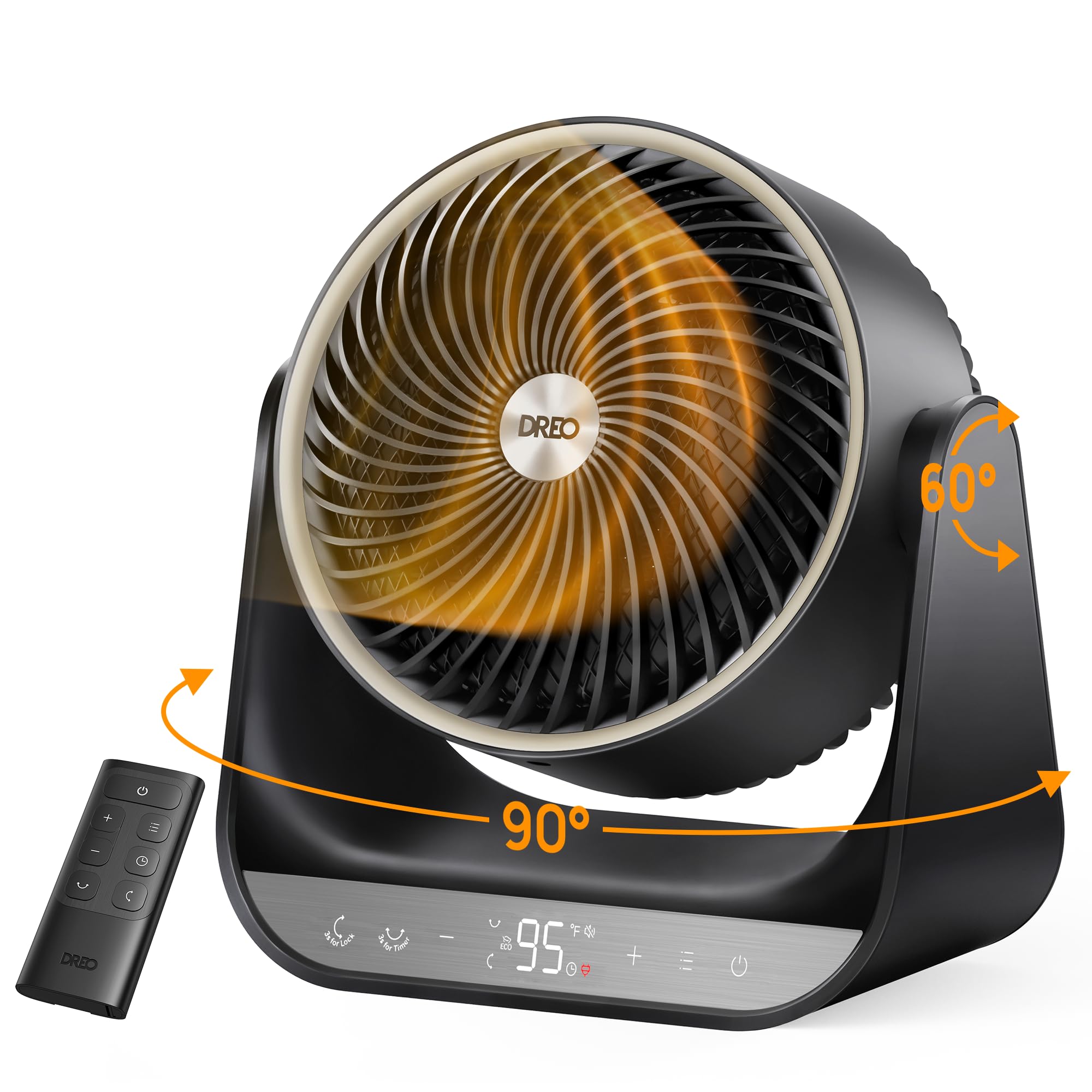
Basements often have odd layouts — low ceilings, support columns, and unfinished walls. A heater with wide oscillation (90 to 120 degrees) helps move warm air around obstacles rather than blasting one spot. A model that oscillates both side-to-side and up-and-down (like the DREO 714) is a major advantage for even heat distribution in a basement where cold air settles near the floor.
Safety Features for Unattended Use
You will likely run a basement heater for hours at a time, sometimes overnight. Overheat shutoff (which cuts power if internal parts get too hot) and tip-over protection (which turns off the heater if it is knocked over) are non-negotiable. A cool-touch exterior and a child lock (for wall-mounted units) add confidence. ETL (Electrical Testing Laboratories) listing means the heater has passed a recognized safety standard — always check for it on the spec sheet.
Quick Comparison
| Model | Best For | Heat Output | Coverage Area | Oscillation | Amazon |
|---|---|---|---|---|---|
| DREO Whole Room Heater 714★ Best Overall | Whole-room coverage | 1500W | 161-269 ft² | 60° Vertical & 90° Horizontal | Amazon |
| Wall-Mounted Heater JNDROSpace Saver | Saving floor space | 1500W | 200 sq.ft | 60°/90°/120° | Amazon |
| Lasko 1500W Ceramic TowerValue Champion | Mid-sized rooms | 1500W | 150 sq.ft | Widespread | Amazon |
| ZAFRO Electric Fireplace Stove | Style + heat combo | 5100 BTU / 1500W | 600 sq ft | None | Amazon |
| GiveBest Wall Mounted Smart Heater | Smart home integration | 1500W | 100-300 sq.ft | None | Amazon |
| Givebest 1500W Wall Mount | Flexible placement | 1500W | — | 120° | Amazon |
| Shinic 2-Pack Ceiling Mount | Large garages & workshops | 1500W per unit | 400-600 sq.ft per unit | 90° (adjustable angle) | Amazon |
| Heat Storm Portable Cabinet | Large supplemental heating | 5200 BTU / 1500W | 300 ft² (Primary) / 1000 ft² (Secondary) | None | Amazon |
| EdenPURE CopperPLUS | Quiet, whole-room infrared heat | 5000 BTU / 1500W | 1000 sq ft | None | Amazon |
In‑Depth Reviews
1. DREO Whole Room Heater 714
Our pick — over 4.5★ from 750+ verified ratings; the strongest balance of quality and price.
The heater that pushes warm air every direction — including straight into a cold basement corner.
This DREO 714 beats the Lasko tower (review #3) on coverage because its unusual 3D oscillation — 60 degrees vertically and 90 degrees horizontally — spreads heat across a whole room instead of piling it near the ceiling. At 1500 watts of PTC (positive temperature coefficient) ceramic heat (a type that self-regulates to avoid overheating), it fires up in about 2 seconds. One owner reported that it heats a 1200 sq ft combined living room and kitchen, which is far beyond its stated 161-269 ft² coverage, meaning it has serious overhead for a typical basement.
The brushless DC motor keeps things whisper-quiet at 34dB (roughly as loud as a quiet library), which matters when the heater runs for hours in a room you might use as a home office or TV den. The ECO mode lets the thermostat maintain a set temperature between 41°F and 95°F in 1°F steps, so it is not blasting full power all day. Owners also note the tip-over protection, child lock, and flame-retardant housing as confidence boosters. The only real gap — there is no smart app for remote scheduling, though the included remote and 12-hour timer cover most daily needs.
Basement-dominating warmth
- 3D oscillation (vertical + horizontal) pushes heat into corners a standard tower cannot reach.
- Whisper-quiet 34dB brushless motor — no distracting hum during movies or work.
- Instant 2-second warm-up with ECO mode to avoid running full 1500W all day.
- Excellent stability and tip-over protection for homes with kids or pets.
Only trade-off
- No WiFi or app control — you cannot turn it on from upstairs before heading down.
- Touch controls can be hard to read without glasses, per owner feedback.
grab this for: Any basement up to ~1200 sq ft where you want quiet, even heat without furnishing every corner with a separate unit.
think twice if: You need smart-home scheduling — this one relies on its timer and remote, not an app.
2. Wall-Mounted Space Heater by JNDRO
A wall-mounted solution that keeps your valuable basement floor clear while still throwing heat.
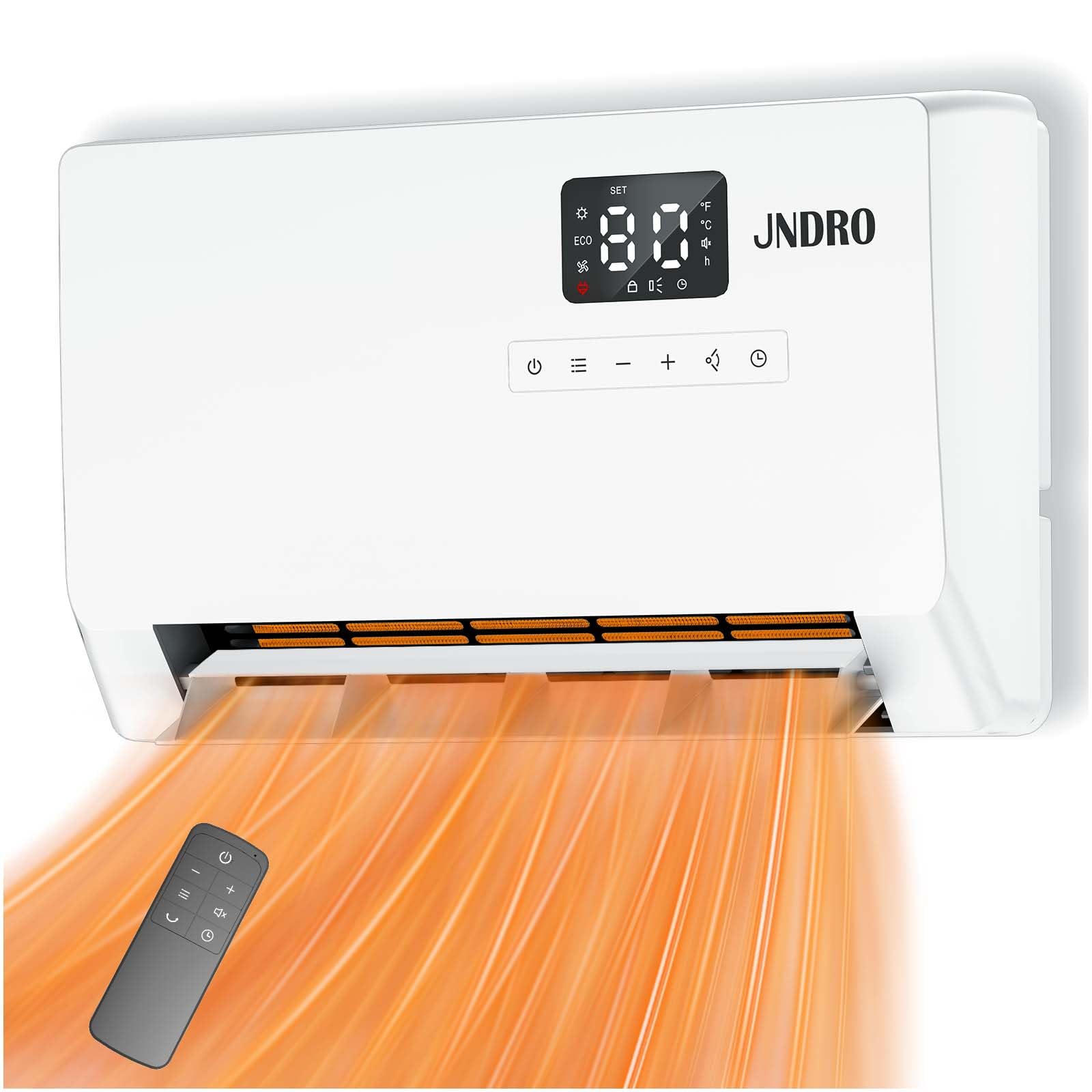
This JNDRO heater bolts onto the wall and stays out of the way, a big advantage if your floor is taken by storage or workbenches — unlike the DREO 714 which takes up floor space. At just 4.65 inches deep and weighing little, it is shallow enough to mount below a low basement window or between studs. The heating coverage is rated at 200 sq. ft, but in practice, owners say it “maintains above freezing in an uninsulated cabin (3200 ft³) and 54°F in an insulated shop (6875 ft³).” That is honest: it works great for a finished basement or a small shop, not for a wide-open garage.
You get three oscillation angles (60°, 90°, and 120°) plus a 24-hour timer and a remote control. The ECO thermostat (which adjusts power to hold your target temperature) lets you set between 41°F and 95°F. Buyers consistently mention the easy installation — one noted it comes with a handy stencil for marking screw holes — and the quiet run. The catch is the radiant heating element. Unlike forced-air PTC heaters, radiant heat warms objects directly, so large, cold concrete surfaces will absorb much of the heat before the air feels warm. This heater fits a finished, insulated basement room, not a raw concrete shell.
Wall-mounted efficiency
- Wall-mount design frees up every inch of floor space — critical in a cluttered basement.
- Quiet operation and easy installation with included template and hardware.
- Three oscillation angles cover a wide area for a wall-mounted unit.
Know before buy
- Radiant heat is slower to warm cold concrete and air compared to a forced-air PTC unit.
- Stated 200 sq. ft coverage is modest — best for a single finished room, not an entire basement.
reach for this if: Every inch of your basement floor is taken up by storage, a workbench, or gym equipment and you need heat from the wall.
look elsewhere if: Your basement is an unfinished, wide-open space with concrete walls — radiant heat will struggle here.
3. Lasko 1500W Ceramic Tower Space Heater
A classic workhorse with over 40,000 owners backing its performance and price.
This Lasko tower is a crowd favorite because of its sheer volume of owner experience. At 22.5 inches tall and 7.25 inches wide, it stands on the floor and oscillates to spread forced-air ceramic heat across a room. The 1500-watt output is standard, but the tens of thousands of ratings set it apart — “performance” and “heat output” are the two most-praised aspects. One owner said it “heated the living room well” and “replaced central heat with two units, lowered electricity bill,” which is exactly the kind of real-world use a basement demands.
The remote control stores right on the unit so you never lose it. The thermostat lets you choose preset temperatures between 60°F and 85°F plus a MAX mode, and the programmable timer runs from 1 to 7 hours. Buyers consistently call it whisper-quiet. The honest trade-off is reliability — out of 1,000 reviews mentioning reliability, the sentiment is negative, with some owners reporting units that stopped working after a limited time. This is the statistical reality of a massively popular product: most units run fine, but a small percentage fail early. The self-regulating ceramic element and overheat protection are standard safety features that keep it from being a fire risk.
best for: A budget-conscious buyer who wants proven, quiet heat for a small-to-medium basement room and values the convenience of remote control and oscillation.
skip it if: You need a heater for a very large, uninsulated basement — this model is rated for 150 sq. ft and runs best as a supplemental source.
4. ZAFRO Electric Fireplace Stove
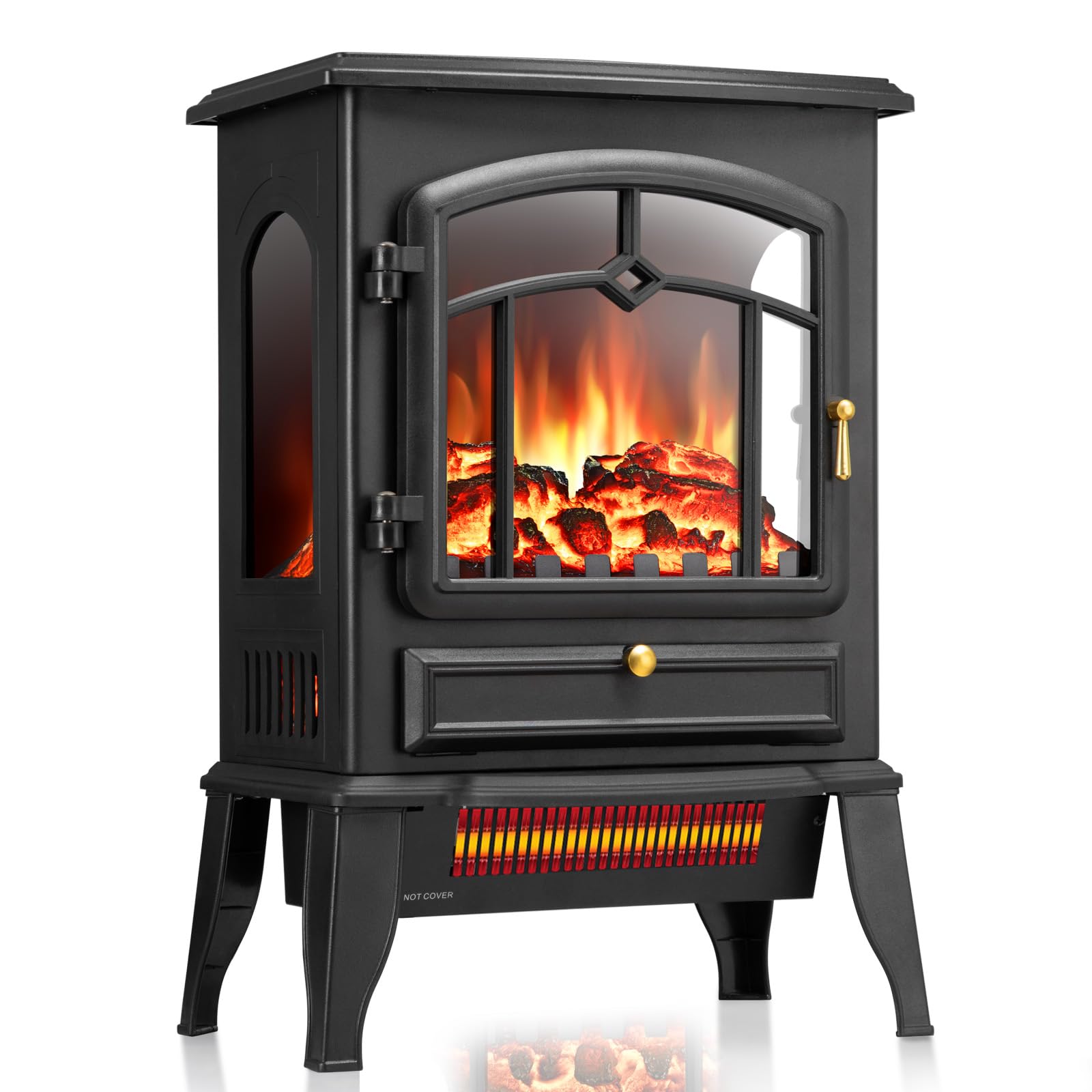
A compact stove that brings serious 5100 BTU heat and a lot of visual charm to a cold basement.
Do not let the vintage look fool you — this ZAFRO stove pushes 5100 BTU (the heat output equivalent of 1500W) with two power modes. At 15.35 inches wide and 22 inches tall, it is a freestanding unit that sits on the floor and looks like a real cast-iron stove, complete with a glass viewing window and 3D dancing flame effect you can adjust from dim to bright. Owners praise its heat output — the most-discussed positive aspect — and its appearance equally, saying “it makes rooms cozy” and looks “gorgeous.”
The stated heating coverage is 600 sq ft, which is generous for a unit this size. It heats a 700+ sq ft space quickly on the 1000W setting, according to one owner. The downsides are that there is no remote control, the fan can be noisy for light sleepers, and some found it smaller than expected. For a basement man cave, workshop, or guest room where you want the ambiance of a fire without the chimney work, this is a compelling option. The overheat protection and wide base for tip stability are solid safety basics.
reach for this if: You want a heater that doubles as a decor piece — the flame effect turns a drab basement into a cozy hangout.
think twice if: You need quiet operation for a bedroom or nursery — the fan noise is noticeable, and there is no remote to adjust it from across the room.
5. GiveBest Electric Wall Mounted Heater (Alexa)

A wall-mounted smart heater you can tell Alexa to fire up before you even head to the basement.
This GiveBest unit is similar to the JNDRO wall mount above, but with a key upgrade: full smart control. You can adjust it via the touchscreen, the included remote, a WiFi-connected app, or even through Alexa voice commands. Imagine telling your smart speaker to turn on the basement heat while you are still upstairs grabbing a drink — that is the convenience here. It also offers three power levels (P1 at 600W, P2 at 1000W, and P3 at 1500W), plus an ECO mode and a fan-only setting for summer circulation.
At 16.1 inches wide by 11 inches tall, it mounts on the wall and fits neatly under a basement window or on an unfinished wall. The heating coverage is cited as 100 to 300 square feet, and owners confirm it “heats quickly, very quiet, works with Alexa, energy efficient, compact yet powerful.” The LED display can be turned off at night, and the operating sound can be muted for silent running. Installation is straightforward, and the mini temperature setting range (40°F to 99°F, in 1°F increments) gives you fine control. The honest limit is the same as any radiant heater: it works best in a finished, insulated space, not a raw concrete basement.
best for: Anyone who wants to integrate basement heating into their smart home routine and values the ability to preheat a room from an app or voice command.
pass on it if: Your basement is large and uninsulated — this unit is designed for a single room of up to 300 sq. ft, not a wide-open space.
6. Givebest 1500W Wall Mount Space Heater
A wall-mounted heater that can also stand on its base — and it rotates 120 degrees to reach every corner.
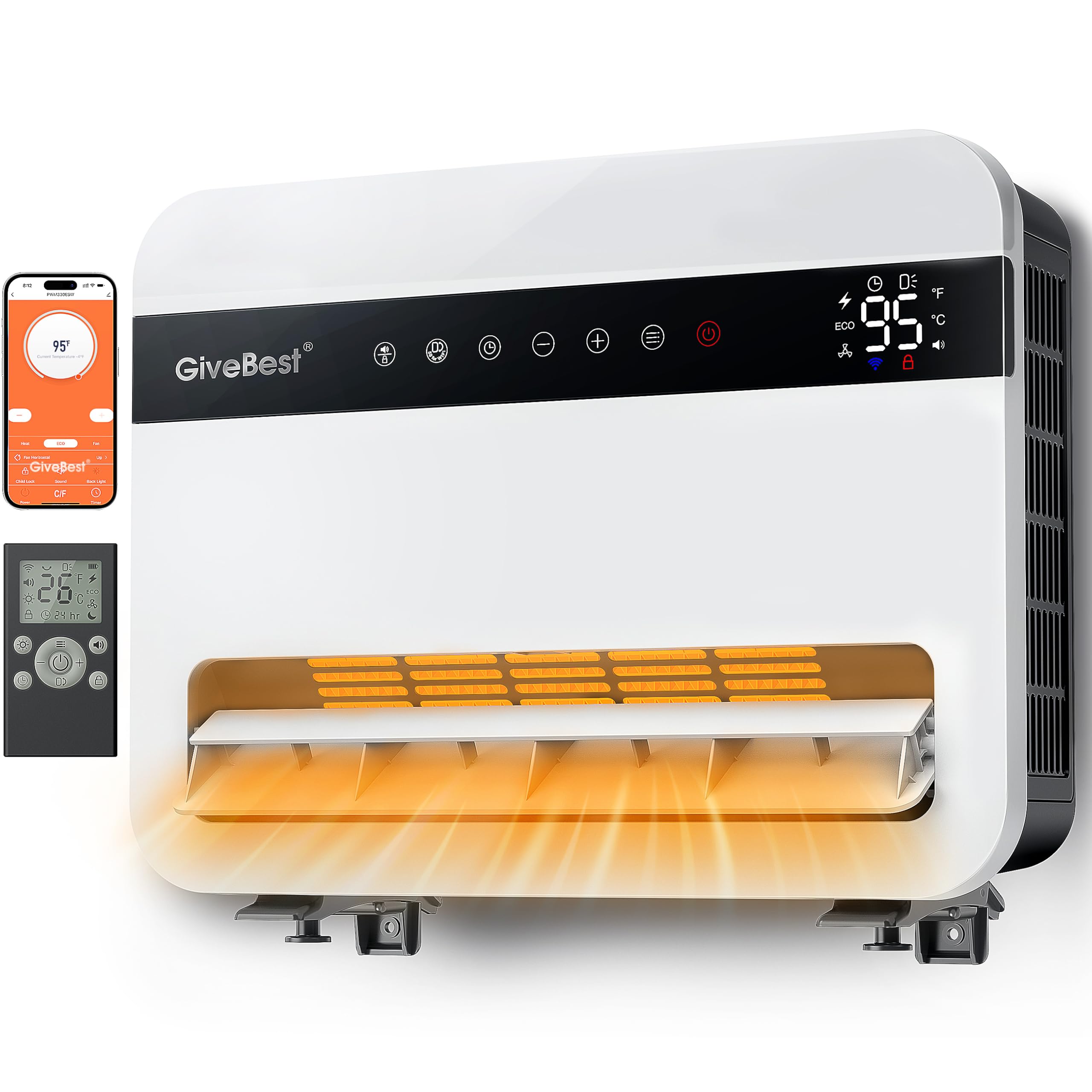
This is the most flexible placement option in the list. The Givebest can be mounted on the wall to save floor space or placed on the floor using its included standing base. That dual-mode design is rare and useful in a basement where you might want to test different positions before committing to a permanent wall mount. The 120-degree wide oscillation is wider than most wall units, helping distribute warm air across a room’s entire width rather than blasting one spot. Buyers report it is “powerful, quiet” and that it “warmed a single-digit-degree room to too hot in one hour,” which tells you the 1500-watt output is no joke.
Smart controls include WiFi and Alexa compatibility, plus the usual remote and touchscreen. The ECO mode is claimed by the brand to reduce energy costs by up to 40% by adjusting power based on room temperature. ETL certification, overheat protection, and a child lock cover the safety essentials. The most common caveat is noise — it is quiet for a forced-air unit, but light sleepers in the same room may notice it. At 7.3 pounds, it is light enough to move between rooms easily.
grab this for: A basement with changing needs — wall-mount it over a workbench one season, stand it in a corner the next, all with app control.
think twice if: You need absolute silence in a bedroom or nursery — the fan has a noticeable hum at higher speeds.
7. Shinic 2-Pack Ceiling Mount Radiant Heaters

A two-pack of ceiling-mounted radiant heaters built for the open, drafty spaces a basement heater hates.
When your basement is a large workshop, garage, or storage area with high ceilings, a standard floor heater like the Lasko tower just cannot push warm air down to where you stand. The Shinic heaters mount on the ceiling and use dual quartz tubes to radiate heat directly onto people and objects below — just like the sun warms the ground. Each unit pushes 1500W (750W on low) and covers 400 to 600 square feet, so the two-pack can handle a sizeable space. It also includes a bright halogen work light (a type of high-efficiency bulb), which turns your heater into a dual-purpose shop light.
The 90-degree adjustable angle lets you aim the heat exactly where you work. The pull-string switch cycles through five modes, including heat-only and heat-plus-light options. Buyers call it “amazing” for garage warmth and note it “heats up garage very well” even in cold weather. The honest gripes are two-fold: the pull string mechanism has been reported to break on some units (durability is the most-noted negative aspect), and on the high setting, the light cannot be turned off independently — you get heat and light together if you need the light or not. This is a situational tool, not a primary living-space heater.
reach for this if: You need to heat a large, uninsulated garage or workshop without taking up floor or wall space — the ceiling mount is ideal for that.
it’s not for you if: You want quiet, ambient heat for a finished basement living room — the radiant quartz glow and pull-string operation feel industrial.
8. Heat Storm Portable Infrared Cabinet Heater

A cabinet-style infrared heater that covers up to 1000 sq ft as a supplemental source — ideal for a big basement.
The Heat Storm sits somewhere between a powerful space heater and a furnace replacement. It puts out 5200 BTU (1500W) and uses infrared quartz heating, which warms objects and people directly rather than just heating the air. That is a real advantage in a basement, where cold concrete and drywall soak up heat from forced-air units like the DREO 714. The stated coverage is 300 sq ft as a primary heat source and up to 1000 sq ft as a supplemental source — meaning it is designed to take the edge off a large space while your central system handles the rest.
At 13.5 inches deep and 15 inches tall, it sits on the floor and has optional casters (not included standard) for moving between rooms. The digital thermostat with LED display shows the ambient temperature and lets you set it precisely. Owners praise its quiet operation and the fact that the exterior stays cool to the touch, making it safer around kids and pets. The 1-year warranty adds confidence. The biggest trade-off is that infrared is slower than forced-air PTC — it takes longer to feel the warmth because the heater needs to heat objects first, not just push hot air. It also lacks oscillation, so placement matters more.
best for: A large, finished basement where you want steady, quiet heat that does not dry out the air and can supplement your existing HVAC.
think twice if: You want instant warmth — infrared takes longer to feel than a forced-air ceramic heater, especially in a cold room.
9. EdenPURE CopperPLUS Infrared Heater
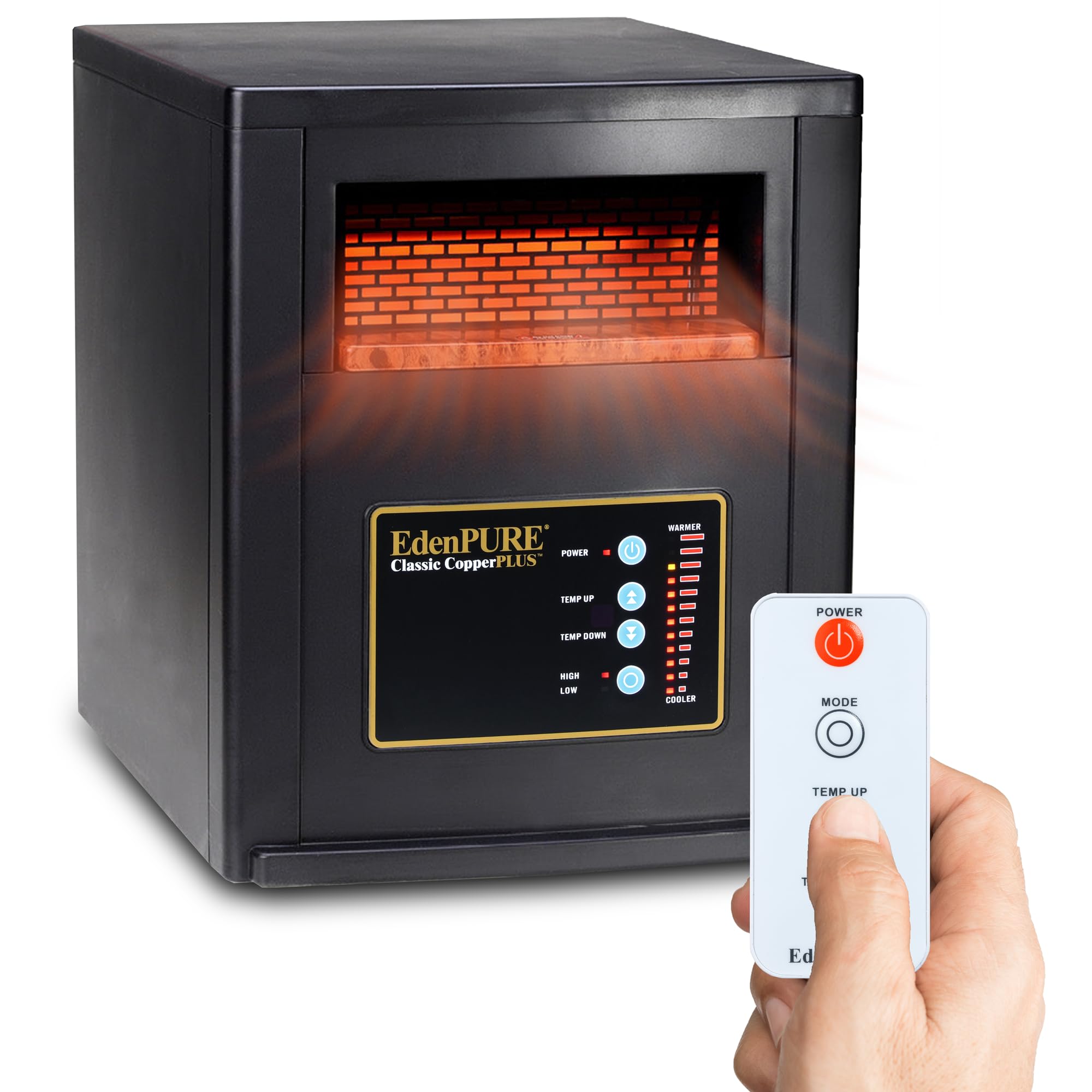
An infrared heavyweight that blankets up to 1000 sq ft with quiet, even heat — no dry air, no rattling fan.
The EdenPURE CopperPLUS is the premium option because it uses a copper PTC element with over 3.5 square feet of copper surface to transfer heat efficiently. The method is infrared radiant, which means it warms people, furniture, and floors directly rather than just pushing hot air around — a key difference from the forced-air DREO 714. Owners say it “heats surfaces and air, not just air” and that the “even heat distribution keeps room warm after opening door.” The 24 precision heat settings let you dial in from 40°F to 90°F across 24 preset levels, so you can set it to 72°F and let the thermostat handle the rest.
At 24 lbs and with built-in rolling casters, it is heavy but easy to roll from a basement bedroom to a workshop. The heating coverage is a full 1000 sq ft (at 5000 BTU), which is the highest in this list. The lifetime washable filter means you never buy replacements, saving money over the long haul. The upfront cost is high, but the claimed energy savings — one owner says it “saved on half billing cycle” — can offset that over a winter or two. The downsides are that the remote control is small and mixed in reviews, and infrared heat is slower to feel compared to a forced-air ceramic unit. This is a long-term investment in quiet, comfortable warmth.
reach for this if: You want true whole-basement heat (up to 1000 sq ft) with whisper-quiet operation and the ability to low-maintenance for years.
think twice if: Your budget is tight — this is the highest-priced option here, and you can get good heat for less if your basement is under 400 sq ft.
Understanding the Specs
Watts vs. BTUs
Watts measure the electrical power the heater uses, and BTUs (British Thermal Units) measure the actual heat output. A 1500-watt heater typically produces about 5,100 to 5,200 BTU. This is the standard for most portable heaters, but the coverage it claims tells you more. A heater rated for 150 sq ft will struggle in a basement that is 500 sq ft, even if both run at 1500W.
PTC Ceramic vs. Infrared Quartz
PTC (positive temperature coefficient) ceramic heaters use a self-regulating element that heats the air directly, then a fan pushes it out. They warm a room fast. Infrared quartz heaters warm objects and people in the path of the infrared beam, not the air. They feel natural and do not dry out the air, but they take longer to raise the overall temperature of a cold basement.
Oscillation and Airflow
Oscillation moves the heater’s head to spread warm air. A heater that oscillates 90 degrees covers a 90-degree arc; one that oscillates 120 degrees covers a wider angle. For a basement with an odd layout, wider oscillation (90 to 120 degrees) or 3D oscillation (vertical + horizontal) helps push heat around support columns and low ceilings.
Safety Certifications
ETL (Electrical Testing Laboratories) or cETL listing means the heater has been tested to North American safety standards. Overheat shutoff and tip-over protection are mechanical switches that cut power if the unit gets too hot or falls over. A child lock prevents children or pets from changing settings. Cool-touch housing means the exterior stays safe to touch even when running at high power.
FAQ
What size heater do I need for my basement?
Can a wall-mounted heater really heat a whole basement?
Is it safe to leave a basement heater running all night?
What is the difference between forced-air and radiant heat in a basement?
Will a basement heater increase my electric bill a lot?
Do I need a heater with a thermostat or just a timer?
Can I use an extension cord with a basement heater?
What is the quietest type of heater for a basement bedroom?
Final Thoughts: The Verdict
Across the board, the best basement heater winner is the DREO Whole Room Heater 714 because its 3D oscillation pushes warm air into every corner a basement throws at it. If you want to save floor space, grab the JNDRO Wall-Mounted Heater. And for a large, open basement where you need quiet, even heat across 1000 sq ft, the EdenPURE CopperPLUS is the one to reach for.
How We Picked
We do not accept paid placement. Every pick is matched to a real buyer and a real use-case; we do not hands-on test units.
Sources & Methodology
Specifications: manufacturer listings and product documentation. Review insights: verified customer reviews, as of July 2026. Pricing: not shown on this page (it changes often); check the current price via the retailer link.
As an Amazon Associate, WellFizz earns from qualifying purchases. This does not affect which products we feature.
Related Guides

Mo Maruf
I created WellFizz to bridge the gap between vague wellness advice and actionable solutions. My mission is simple: to decode the research and give you practical tools you can actually use.
Beyond the data, I am a passionate traveler. I believe that stepping away from the screen to explore new environments is essential for mental clarity and physical vitality.