Our readers keep the lights on and my smoothie glass nicely filled. As an Amazon Associate, I earn from qualifying purchases.
Specs are compiled from manufacturer listings and verified buyer reviews and can change over time — please confirm the key details on the product page before buying.
A self-tape is your first impression — and casting directors judge the frame as much as the performance. Grainy footage, shaky pans, or that moment the autofocus hunts for your face mid-monologue can pull a viewer straight out of the scene. This guide cuts through the marketing noise to find the camera that captures you cleanly, locks focus on your eyes, and delivers file quality that matches your craft. Whether you are submitting for a Netflix lead or a regional theater spot, your gear should disappear behind the performance.
I’m Mohammad Maruf — the founder and writer behind WellFizz. This guide is built by comparing the manufacturers’ published specifications and the patterns across verified customer reviews, so you get each pick’s real strengths and trade-offs instead of marketing spin.
Every camera here was chosen because it meets the real demands of audition recording: reliable autofocus that tracks facial movement, video resolution of 1080p or higher, and a form factor that fits a home setup without a full crew. The result is a tight, honest shortlist for anyone searching for the best camera for self tapes.
Our Picks at a Glance

How To Choose The Best Camera For Self Tapes
Choosing a camera for self-tapes means looking past megapixel marketing and focusing on what actually helps you land a callback. You need reliable face-tracking autofocus, a sensor that handles your living-room lighting without turning your skin tone artificial, and video resolution that lets a casting director watch on a large monitor without cringing. Here is what to prioritize.
Sensor Size — The Foundation of Natural-Looking Footage
A 1-inch or larger sensor (like the APS-C or full-frame sensors found on mirrorless cameras) captures more light, which means cleaner footage in typical indoor lighting. A larger sensor also produces a softer background blur, called bokeh, which separates you from your background wall — that alone makes your tape look more professional than any filter ever could.
Autofocus — The Make-or-Break Feature for Performers
The single most important spec for a self-tape camera is face and eye-detection autofocus. You move, gesture, lean in for an emotional beat, and look down at a script — the camera needs to track your face and keep your eyes sharp without you thinking about it. A camera that hunts for focus during your first line is a camera that ruins a take. Look for “Real-time Eye AF” or “Dual Pixel CMOS AF” in the specs; these technologies lock onto a face and follow it across the frame.
4K Resolution — More than a Buzzword
You do not need to upload 4K to every casting site, but recording in 4K gives you important flexibility. It lets you crop the frame in editing (to remove a messy corner of a room, for example) and still output a clean 1080p file. Aim for 4K at 24 frames per second — the standard cinematic frame rate that casting directors are used to seeing — or 30 fps if your material feels better at that cadence.
Audio — Do Not Let the Mic Undercut Your Slate
A self-tape with perfect video but muddy audio will be skipped. Most built-in camera mics are too far from your mouth to capture clean slate and monologue audio. Look for a camera with a 3.5mm microphone jack so you can plug in a small external microphone. Some pocket cameras include a wind-reducing deadcat or a third-mic design that cuts background room noise.
Quick Comparison
| Model | Best For | Sensor & Resolution | Video Resolution / FPS | Key Feature for Self-Tapes | Amazon |
|---|---|---|---|---|---|
| DJI Osmo Pocket 3★ Best Overall | Best Overall | 1-inch CMOS, 9.4 MP | 4K up to 120fps | 3-axis stabilization + face/object tracking | Amazon |
| Insta360 Luna UltraTop Performer | Professional 8K | 1-inch + 1/1.3″ Leica, 12 MP | 8K up to 30fps with Dolby Vision | Dual Leica lenses + detachable OLED screen | Amazon |
| Sony ZV-E10 (Gen 1 Kit)Best Value | APS-C Interchangeable Lens | APS-C 24.2 MP Exmor CMOS | 4K up to 30fps (oversampled) | Interchangeable E-mount + 3-capsule mic | Amazon |
| FlyFrost 8K Video Camera | Budget Starter | 88 MP | 8K UHD (7680p) | 18x digital zoom + IR night vision | Amazon |
| Xtra Muse Vlogging Camera | Budget Pocket Gimbal | 1-inch CMOS | 4K up to 120fps | 3-axis gimbal stabilizer + Master Follow tracking | Amazon |
| Canon PowerShot V10 | Ultra-Compact Vlogging | 1-inch BSI CMOS, 15.2 MP | 4K up to 30fps | Built-in stand + stereo mics with noise reduction | Amazon |
| Sony ZV-E10 II (Gen 2 Kit) | Advanced APS-C Creator | APS-C 26 MP Exmor R | 4K up to 60fps | Real-time Eye AF for human/animal/bird | Amazon |
| Nikon Z6 III | High-End Full-Frame | Full-Frame 24.5 MP | 6K/60p N-RAW / 4K/120p | 4000-nit EVF + 5-axis IBIS (8 stops) | Amazon |
| Canon EOS R7 | Versatile APS-C Workhorse | APS-C 32.5 MP | 4K up to 60p | Dual Pixel CMOS AF + 7-stop IBIS | Amazon |
In‑Depth Reviews
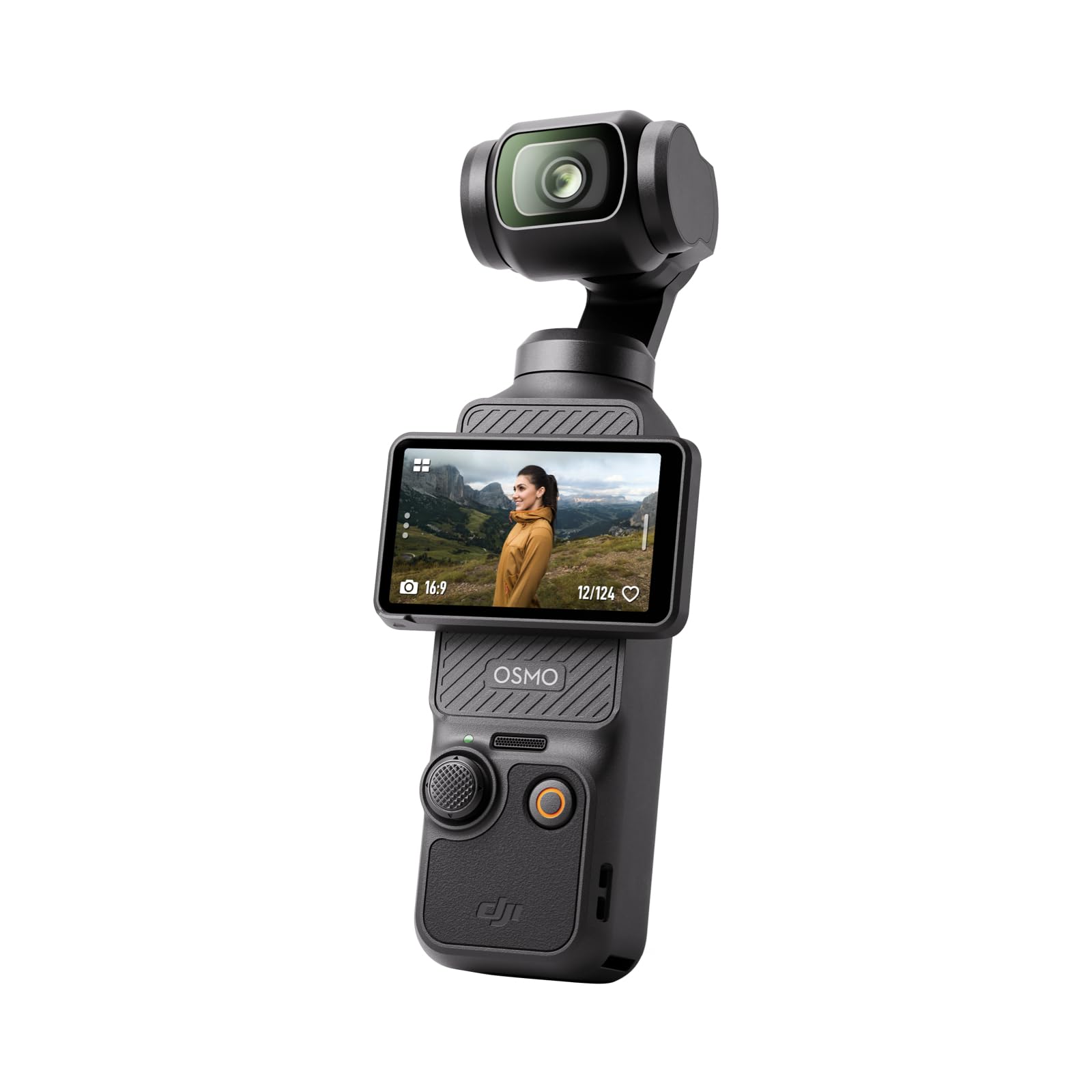
1. DJI Osmo Pocket 3
Our pick — 4.5★ from 3,000+ verified ratings; the strongest balance of quality and price.
The pocket-sized dynamo that locks onto your face and never lets go for flawlessly stable self-tapes.
For an actor setting up in a bedroom or living room, the single biggest challenge is keeping the frame steady while you move through a scene. The DJI Osmo Pocket 3 solves that with its advanced 3-axis mechanical stabilization — meaning no wobble when you gesture or lean, and no need for a heavy tripod. The 1-inch CMOS sensor records 4K resolution at up to 120fps, so you can shoot at the standard 24 or 30 fps for a cinematic look that casting directors recognize instantly.
The feature that makes it a self-tape powerhouse is ActiveTrack 6.0. Mount it on a tripod, start recording, and the camera stays centered on your face as you jump, spin, or walk toward the lens. The 2-inch rotatable touchscreen flips for horizontal or vertical framing, which is handy if a casting site asks for a specific aspect ratio. The battery average life is 166 minutes — enough for multiple takes without hunting for a charger.
Buyers report that the “excellent image quality from 1″ CMOS sensor; 4K/120fps; outstanding stabilization; fast autofocus; face/object tracking” makes it viable for full-scale production. The crowd favorite — 4.5 stars across thousands of owners — reflects how reliably it handles the core job: keeping you in crisp focus while you act.
Why It Works for Self-Tapes
- Face and object tracking keeps you sharp as you move through the scene.
- 3-axis mechanical stabilization delivers tripod-smooth footage even handheld.
- Rotatable 2-inch touchscreen allows quick switch between horizontal and vertical framing.
The Real Trade-Off
- Fixed wide-angle lens means you cannot zoom in on your performance — you set the frame and stay in it.
- The built-in sensor is 9.4 MP, which is far lower than the 88 MP of the FlyFrost, though the larger sensor gives better low-light quality.
Reach for This If: You want a grab-and-go camera with pro-level stabilization and face tracking that demands zero setup fuss.
Look Elsewhere If: You need interchangeable lenses or the ability to zoom into a tight close-up of your face without moving the camera.
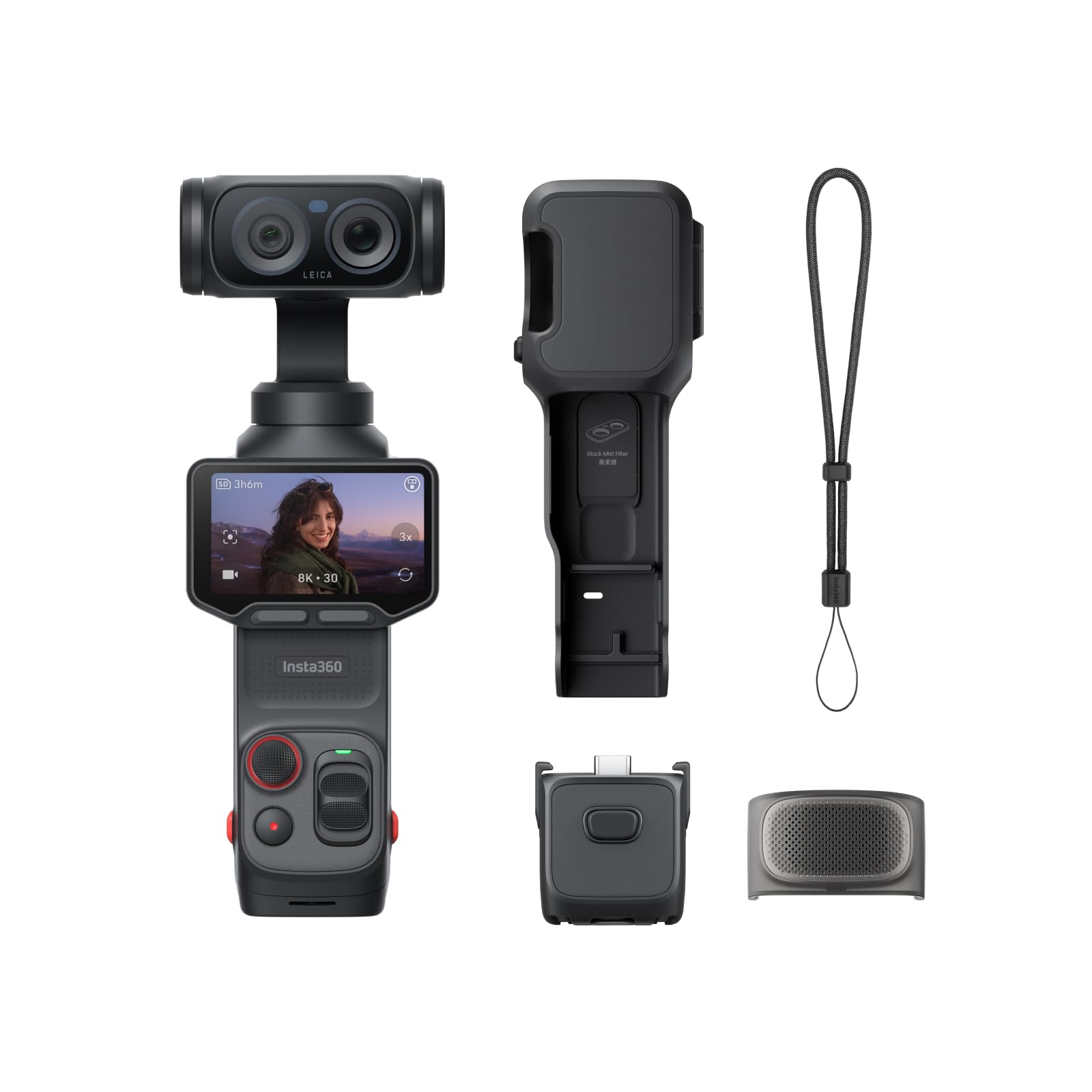
2. Insta360 Luna Ultra
Dual Leica optics and a detachable screen make this the serious actor’s pocket studio.
The Insta360 Luna Ultra is built for those who want to deliver an 8K self-tape without a crew. Its dual Leica lens design combines a 1-inch main sensor with a pro-grade telephoto lens featuring a 1/1.3-inch sensor and F2.0 aperture — giving you lossless zoom up to 6x and a full 12x zoom range. That means you can frame a tight close-up of your face from across the room, then cut to a wide master shot without moving the camera.
The 2-inch OLED touchscreen detaches for wireless control up to 20 meters away, so you can start and stop recording, check your framing, and review takes from your mark. The 10-bit I-Log color profile captures smooth tonal transitions for professional post-production, and the 4-hour battery life with fast charging to 80 percent in 23 minutes means you never cut a session short. The gimbal provides 3-axis mechanical stabilization, and AI tracking keeps your face centered even when you move dynamically through your scene.
Buyers praise the “exceptional 8K video, low-light performance, smooth stabilization, detachable OLED touchscreen, dual Leica lenses for wide/telephoto” as setting a new standard for compact cameras. With 4.4 stars across a growing number of owners, it earns its premium position by doing everything a pro self-tape demands without compromise.
Optics That Deliver: The dual Leica lenses give you genuine telephoto reach and background blur that makes your tape look like it was shot on cinema glass.
Best Suited For: Dedicated actors who want a single camera that covers wide masters and tight close-ups for serious audition material.
One Caution: It is not weatherproof or rugged, so treat the detachable screen and gimbal carefully during transport.
3. Sony ZV-E10 (Gen 1 Kit)
The APS-C sensor power of a proper mirrorless camera packed into a beginner-friendly self-tape machine.
The Sony ZV-E10 kit is the most popular entry point into interchangeable-lens self-tape gear. Its 24.2 MP APS-C Exmor CMOS sensor is roughly ten times larger than a smartphone sensor, giving you natural skin tones, soft background blur, and clean detail in the variable lighting of a home setup. The kit lens is the Sony E PZ 16-50mm f/3.5-5.6 OSS — a versatile zoom that lets you go from a full-body master shot to a medium close-up without switching lenses.
For video, it records oversampled 4K at up to 30fps, meaning the camera captures more detail than a standard 4K sensor and then downsizes it for a sharper final image. The vari-angle touchscreen flips around for self-framing, and the built-in three-capsule microphone with a supplied windscreen catches your slate audio cleanly. The kit also includes a 64GB memory card, soft bag, card reader, and flexible tripod — everything you need to start taping right after unpacking.
The bundle is a strong value, and the high rating reflects how many first-time mirrorless buyers end up satisfied. If you plan to grow your setup over time (adding a prime lens for tighter close-ups or an external LED light), the E-mount system gives you endless options without needing to replace the body.
Interchangeable Future: The Sony E-mount ecosystem means you can later buy a fast prime lens (like a 35mm f/1.8) that makes your self-tape background blur even more dramatic.
Ideal For: Actors who want a proper interchangeable-lens camera at an accessible price, with room to upgrade lenses as their setup evolves.
Skip If: You need 4K at 60fps or higher continuous frame rates for slow-motion performance analysis.
4. Canon PowerShot V10

A camera so small it lives in your backpack, with a built-in stand that sets up in seconds.
The Canon PowerShot V10 is a purpose-built vlogging camera that happens to be excellent for self-tapes. Its 15.2-megapixel 1-inch back-illuminated CMOS sensor pulls in light effectively even in typical indoor conditions, and the fixed 19mm wide-angle lens (35mm equivalent) captures a clean head-to-shoulders or full-body frame depending on your distance from the camera. The built-in stand folds forward or backward, letting you prop the camera on a desk or shelf without any tripod.
what separates it is the audio. It has a pair of stereo microphones plus a third microphone in the middle that helps remove unwanted background noise — so your slate sounds clear without needing an external mic. The 2-inch flip touchscreen faces forward for easy framing, and the camera supports 4K video recording at up to 30fps. If you need smooth slow-motion, it records Full HD at up to 60fps.
Buyers consistently praise the “great video/audio quality” and note that “no zoom” is the main trade-off — you set your frame by moving the camera closer or farther. With a 4.3-star rating across 300+ owners, it is a reliable, ultra-portable option for tapers who prioritize simplicity and packability over lens versatility.
Built-In Stand Advantage: The integrated stand means you do not need to buy or carry a separate tripod — the camera is ready to record the moment you flip it open.
Grab It For: Auditioning on the go — you can fit this camera in a fanny pack and set up a clean self-tape on a hotel desk or coffee shop table.
Know This: The lack of any digital or optical zoom means you cannot tighten the frame without physically moving the camera closer to you.
5. Sony ZV-E10 II (Gen 2 Kit)

The second-generation creator camera that brings pro-level AI autofocus and 4K/60p to your self-tape setup.
The Sony ZV-E10 II is a meaningful upgrade over the original, and for self-tapes the biggest news is the 26-megapixel APS-C Exmor R back-illuminated sensor combined with Real-time Eye AF. This autofocus system recognizes and tracks not just human faces and eyes, but also animals and birds — though for your tape it means the camera sticks to your eyes even when you look down at a script and then snap back up for a line. The sensor provides visibly better low-light performance and more natural depth of field.
On the video side, you get 4K video at up to 60fps, with the option to shoot slow-motion at 120fps in Full HD using the S&Q mode. The Creative Look function offers 10 presets you can customize in-camera, so you can dial in a subtle color grade that suits the mood of your scene without needing post-production software. The included E PZ 16-50mm F3.5-5.6 OSS II zoom lens covers the ideal self-tape range from a wide master to a tight medium shot.
The trade-off mentioned most is battery life — some owners find it average and often use the camera plugged into USB power during longer sessions. The build is compact and lightweight, making it easy to mount on a tripod in a tight apartment corner. With a 4.1-star rating, it is a strong choice for actors who want the latest autofocus and color science from Sony.
Autofocus Advantage
- Real-time Eye AF for human, animal, and bird tracking; locks onto your eye even during quick head movements.
- 4K/60p oversampled video for sharp slow-motion or smooth regular playback.
- Interchangeable E-mount system allows lens upgrades for tighter close-ups.
Honest Limits
- Battery life is average; plan to record plugged into USB during extended sessions.
- Overheating can occur after prolonged 4K recording in warm rooms (above 80°F).
Best For: Actors who want class-leading autofocus and the flexibility to upgrade lenses as their self-tape operation grows.
Consider Skipping: If you record self-tapes in a hot room or need a camera that can shoot 4K for hours on end without a break.
6. Nikon Z6 III

6K internal RAW recording and a full-frame sensor for self-tapes that rival theatrical-grade footage.
When your self-tape needs to stand up on a cinema-size monitor during a callback review, the Nikon Z6 III is the kind of overdeliver that makes sense. Its full-frame 24.5-megapixel sensor records 6K/60p internal N-RAW video, which means you capture an extraordinary amount of detail and color information. You can then downscale that 6K footage to 4K in editing, getting a final image with less noise and more natural skin texture than a native 4K sensor would produce.
The 5-axis in-body image stabilization (IBIS) is rated at up to 8 stops of correction — the highest in this list. That means even if you hand-hold the camera for a take, the micro-adjustments cancel out hand shake so effectively that the footage looks tripod-mounted. The autofocus detection goes down to -10 EV (extremely dim light), and it uses Nikon’s Deep Learning technology for multi-subject recognition. The 4000-nit electronic viewfinder lets you frame perfectly even when a bright window is behind you.
Buyers call it “fast, reliable, excellent low-light performance” and note the “extensive menu customization.” With a 4.5-star rating, it is clearly a favorite among serious shooters. The trade-off is the price and the learning curve — this is a professional tool that rewards time spent learning its menu system and features.
Pro-Level IBIS: The 8-stop stabilization means you can shoot handheld and still get butter-smooth footage — rare for any camera and a huge advantage if you do not own a quality tripod.
Ideal For: Working actors who also shoot their own demo reels, short films, or corporate headshots and want a single camera that excels at all of them.
A Fair Warning: The battery life is roughly 2 hours per charge, so keep a spare battery or plug into USB power during long self-tape sessions.
7. Xtra Muse Vlogging Camera

A budget-conscious alternative to the DJI that delivers near-identical stabilization and tracking for half the price.
The Xtra Muse is the strongest competitor to the DJI Osmo Pocket 3, and for actors on a tighter budget it is a compelling choice. It packs the same 1-inch CMOS sensor and records 4K resolution at 120fps, with a 3-axis gimbal stabilizer that cancels out shake whether you are walking across a room or gesturing during a scene. The Master Follow feature keeps your face centered in the frame during movement, much like the DJI ActiveTrack system.
The 2-inch touchscreen rotates for horizontal and vertical shooting, and the 10-bit X-Log color mode captures up to one billion colors for professional grading in post. The battery life is 161 minutes — very close to the DJI — and the bundle includes a carrying bag, wrist strap, handle with 1/4-inch thread, and USB-C cable. Owners mention that many DJI Pocket 3 accessories (like tripod mounts and lens adapters) also fit the Xtra Muse.
What wins people over is the build quality and the sheer value — it delivers “crisp, clean video and onboard audio” that makes content creators consider it “near-identical to competitor at half price.” With a 4.5-star rating, it is a legitimate option for performers who want gimbal-level stabilization without the premium DJI price.
Strengths at a Glance
- Same 1-inch CMOS sensor and 4K/120fps recording as the category leader.
- Excellent 3-axis gimbal stabilization and reliable face/object tracking.
- Compatible with DJI Pocket 3 accessories, expanding your setup options.
Where It Falls Short
- Microphone connectivity receives mixed feedback from owners.
- Battery life is rated as mixed — some find it decent, others poor.
Reach for This If: You want DJI-level gimbal stabilization and a 1-inch sensor but need to keep the budget under the premium tier.
Look Elsewhere If: You need a proven accessory ecosystem or rely heavily on external microphone compatibility.
8. FlyFrost 8K Video Camera
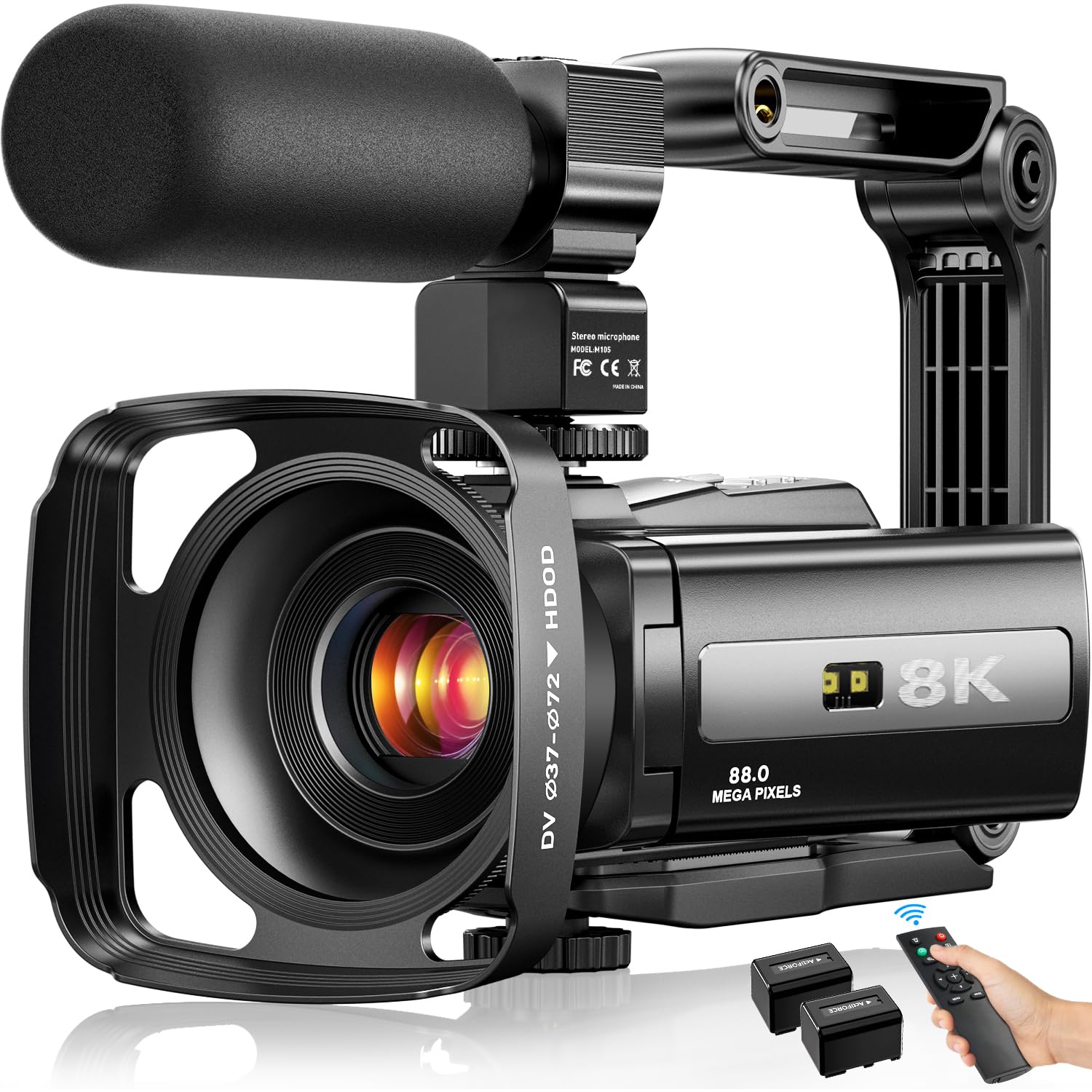
An all-in-one bundle with 8K ambition and every accessory a beginner actor could want for their first tape.
The FlyFrost 8K Video Camera is built for someone buying their first dedicated camera and wanting maximum gear for the minimum spend. It captures video at 8K resolution (7680 pixels effective video resolution) and stills at 88 MP; the DJI Osmo Pocket 3 captures stills at 9.4 MP.
The bundle is the real story here. It includes an external microphone with a wind-reducing design, a lens hood, a handheld stabilizer, two batteries, a 2.4G remote control, and a camera bag. The 3-inch touchscreen rotates 270 degrees for self-framing, and the IR night vision mode captures black-and-white footage in low light. The Wi-Fi connectivity lets you transfer clips to your phone using the “iSmart DV2” app, and the webcam function means the camera doubles as a high-quality streamer for virtual callbacks.
What owners rave about most is the video quality — it is the top positive aspect by a wide margin. The bundle offers “good value for beginners in content creation” and the camera is described as “easy to use with a simple setup.” The 18x digital zoom is a feature customers note is useful, though they caution that quality drops at higher zoom levels.
Starter Bundle Power: The included external microphone, remote, spare battery, and bag mean you do not have to buy any accessories separately — you can start recording self-tapes immediately.
Perfect For: New actors who want a complete self-tape kit in one box and are willing to learn the quirks of a budget camera.
Know the Limit: At 8K resolution, the frame rate drops to 15fps — stick to 4K mode for smooth 30fps playback that casting directors expect.
9. Canon EOS R7

32.5 megapixels of APS-C resolution with 7-stop stabilization for self-tapes that hold up to any lens upgrade.
Canon’s EOS R7 is a mirrorless camera that pushes APS-C performance further than most. Its 32.5-megapixel CMOS sensor — the highest resolution in this list — captures extraordinary detail that lets you crop the frame in editing and still output a sharp 1080p or 4K file. The DIGIC X image processor powers 4K video at up to 60fps, and the 5-axis in-body image stabilization gives up to 7 stops of shake correction, meaning you can shoot handheld and still get jitter-free footage.
For self-tapes, the Dual Pixel CMOS AF II with subject detection is the standout. It covers 651 autofocus points across the sensor and uses deep-learning AI to recognize human faces and eyes. The included RF-S 18-150mm f/3.5-6.3 IS STM lens gives you a generous zoom range — from a wide master shot to a tight close-up that lets casting directors see your micro-expressions. The high-speed continuous shooting of up to 15 fps with the mechanical shutter is more than you need for video, but it means the AF tracking keeps up with any movement during recording.
Buyers coming from older Canon DSLRs (like the T7i) describe it as a “huge improvement” and praise the “excellent low light, precise autofocus.” The build quality is the most-praised aspect, followed by performance. With a 4.6-star rating, it is a durable, versatile workhorse that gives you room to grow into a full filmmaking kit while delivering excellent self-tape footage from day one.
Resolution to Burn: At 32.5 MP, you can shoot a wider frame than you need, then crop to a tight close-up in editing while maintaining more than enough resolution for 4K delivery.
Ideal For: Canon shooters upgrading from a DSLR or actors who want a camera that handles both self-tapes and professional still photography.
Consider This: The RF-S 18-150mm lens is versatile, but the variable aperture (f/3.5-6.3) means you lose light at the telephoto end — a fast prime lens like the RF 35mm f/1.8 will give you better low-light close-ups.
Understanding the Specs
Sensor Size and Its Effect on Your Tape
The sensor is the light-gathering chip inside the camera. A larger sensor (APS-C or full-frame) captures more light, which gives you cleaner footage in dim rooms and a natural background blur that separates you from the wall. A 1-inch sensor (found in pocket cameras like the DJI Osmo Pocket 3) is a solid middle ground — it is much larger than a phone sensor but keeps the camera body small. For self-tapes, a 1-inch or larger sensor is the baseline for professional-looking footage.
Autofocus Technology — Keeping You Sharp
A camera’s autofocus system uses sensors and algorithms to track a subject’s face and eyes. For self-tapes, you want a system with “face detection” and “eye AF” (auto-focus). Sony calls theirs “Real-time Eye AF,” Canon uses “Dual Pixel CMOS AF,” and Nikon uses “Deep Learning AF.” These systems lock onto your eyes and keep them sharp even as you move, gesture, and look down at a script. Avoid cameras that only offer contrast-detection autofocus, which tends to hunt or pulse during video.
FAQ
Can I use a smartphone instead of a dedicated camera for self-tapes?
What is the minimum resolution I should use for a self-tape?
Do I need an external microphone for self-tape audio?
How does a 1-inch sensor compare to an APS-C sensor for self-tapes?
What frame rate should I use for my self-tape?
Is digital zoom useful for self-tapes?
Do I need a camera with image stabilization for self-tapes?
What is the difference between 4K/30fps and 4K/120fps for self-taping?
Can I use a webcam mode on these cameras for virtual auditions?
How long does the battery last on these cameras for a self-tape session?
Final Thoughts: The Verdict
For most actors, the camera for self tapes winner is the DJI Osmo Pocket 3 because it combines a 1-inch sensor, reliable face tracking, and 3-axis stabilization in a package you can set up and start recording in under a minute. If you want full-frame flexibility and can invest in a professional tool, the Nikon Z6 III delivers 6K internal RAW and 8-stop stabilization for footage that truly rivals cinema. And for the actor on a budget who wants a complete kit in one box, the FlyFrost 8K Video Camera bundles a mic, remote, spare battery, and bag so nothing holds you back from your next submission.
How We Picked
We do not accept paid placement. Every pick is matched to a real buyer and a real use-case; we do not hands-on test units.
Sources & Methodology
Specifications: manufacturer listings and product documentation. Review insights: verified customer reviews, as of July 2026. Pricing: not shown on this page (it changes often); check the current price via the retailer link.
As an Amazon Associate, WellFizz earns from qualifying purchases. This does not affect which products we feature.
Related Guides

Mo Maruf
I created WellFizz to bridge the gap between vague wellness advice and actionable solutions. My mission is simple: to decode the research and give you practical tools you can actually use.
Beyond the data, I am a passionate traveler. I believe that stepping away from the screen to explore new environments is essential for mental clarity and physical vitality.