Our readers keep the lights on and my smoothie glass nicely filled. As an Amazon Associate, I earn from qualifying purchases.
Specs are compiled from manufacturer listings and verified buyer reviews and can change over time — please confirm the key details on the product page before buying.
You know those dark, opaque-backed panels that can only suck up light from one side? Bifacial solar panels flip that idea on its head — they grab rays from both the front and the rear, turning reflected ground-light into usable power. That extra energy, often 25 to 30 percent more juice from the same footprint, is the single biggest reason homeowners and RV owners are swapping to them. But not all bifacial panels are built the same way. The difference in cell technology, wattage, weight, and durability for your roof or campsite runs deep.
I’m Mohammad Maruf — the founder and writer behind WellFizz. This guide is built by comparing the manufacturers’ published specifications and the patterns across verified customer reviews, so you get each pick’s real strengths and trade-offs instead of marketing spin.
if you need a massive 1100-watt home system or a portable 200-watt companion for your power station, the right bifacial solar panels can transform how much clean energy you capture from the same sunny spot.
Our Picks at a Glance
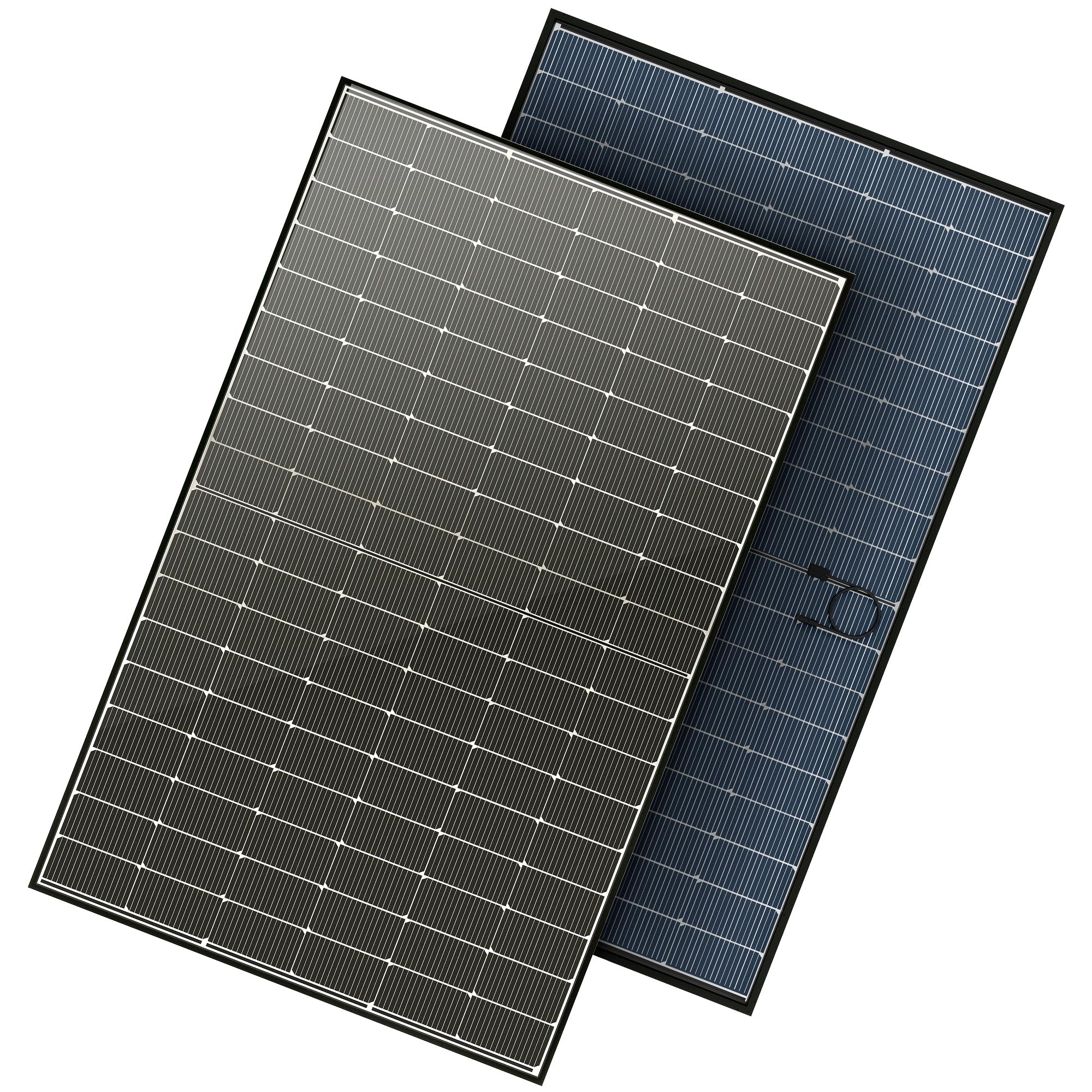

How To Choose The Best Bifacial Solar Panels
Bifacial panels capture reflected light — think light bouncing off snow, concrete, or a white roof — so your real-world wattage often exceeds the label. But that extra gain depends on the cell type, the busbar count, and how you mount them. Here are the key specs that separate a good buy from a dud.
Cell Technology: N-Type vs P-Type
N-type cells start with a different doping process that avoids boron-oxygen defects — the main cause of power loss in older P-type cells. The result is higher efficiency (often 25% or more) and a much slower degradation curve over 25 years. You pay a small premium, but the long-term yield is higher.
16BB vs Fewer Busbars
A busbar is the thin metal strip on the cell that carries current. Sixteen-busbar (16BB) panels split the current path into 16 lines. That means even if a crack or shadow hits one strip, the other 15 keep flowing. Compared to 9BB or 10BB designs, a 16BB panel handles partial shade far better and runs cooler.
Quick Comparison
| Model | Best For | Total Power | Item Weight | Cell Type | Amazon |
|---|---|---|---|---|---|
| JJN 425W Bifacial★ Best Overall | Home / Off-Grid System | 425 W | 51.6 lb | N-Type 16BB | Amazon |
| Callsun N-Type 16BB 200WTop Performer | 12V RV Systems | 200 W | 23.8 lb | N-Type 16BB | Amazon |
| SOLUPUP 200W PortableCompact Pick | Camping / Power Stations | 200 W | 12.9 lb | Monocrystalline | Amazon |
| Epoch 400W (200W×2) | RV / Marine | 400 W | 46 lb | N-Type | Amazon |
| Callsun N-Type 16BB 400W (2×200) | Class B Van / Rooftop | 400 W | 23.8 lb | N-Type 16BB | Amazon |
| Jackery SolarSaga 200W | Jackery Power Stations | 200 W | 14.3 lb | Monocrystalline (IBC) | Amazon |
| AFERIY 400W Portable Foldable | Off-Grid / Home Backup | 400 W | 25.3 lb | N-Type | Amazon |
| EF ECOFLOW 4×125W (500W) | Modular / RV Solar System | 500 W | 37 lb | N-Type | Amazon |
| JJN 550W Bifacial (2PCS, 1100W) | Large Home Installation | 1100 W | 123.4 lb | Monocrystalline | Amazon |
In‑Depth Reviews
1. JJN Bifacial 425 Watt Solar Panel
Our pick — over 4.5★ from 450+ verified ratings; the strongest balance of quality and price.
The 425-watt ground-mount that consistently punches above its rating in the real world.
This panel delivers a serious 425 watts of maximum power from its N-Type 16BB cells, pulling 13.78 amps at 38 volts. That power density means you need fewer panels on your roof or ground array to hit your daily target — buyers report a flat-mount on a camper still averages 87 watts per panel and hits 106 percent of the rated output in cool, full sun. The 25 percent efficiency rating translates to real overcast performance: the bifacial backsheet keeps generating electricity even when clouds roll in, something owners specifically praise.
Build quality is a major talking point among owners. The frame is black corrosion-resistant aluminum rated to withstand snow loads of 5400Pa and wind loads of 2400Pa, which is about half a ton of snow pressure per square meter. The IP65 junction box and IP68 connectors keep water and dust out. At 51.6 pounds per panel, you get a rigid, durable construction that buyers call “consistent quality” with “excellent power output.”
JJN backs this panel with a transferable 30-year power output warranty — the longest commitment in this lineup. The catch is the panel size: at 44.7 inches long by 67.8 inches tall, it is a full-size residential panel that needs dedicated roof or ground space, not a tiny RV fitment. Some owners note minor cosmetic scratches on the frame from shipping, but the glass and cells arrive intact.
Why It Wins
- N-Type 16BB cells deliver 25% efficiency with superior shade tolerance
- sturdy aluminum frame handles 2400Pa wind and 5400Pa snow loads
- 30-year transferable power output warranty is the strongest in the class
- Real-world reports of 106% rated production in cool, full sun
Consider This
- Large footprint (44.7 x 67.8 inches) requires substantial mounting space
- At 51.6 lb, it is a two-person lift for roof installation
- Occasional cosmetic frame scratches during shipping
Who it fits: Homeowners and off-grid builders who want the highest single-panel wattage backed by a three-decade warranty — this is the workhorse for a serious solar array.
The trade-off: If you need a portable panel for camping or a lightweight option for a small van roof, the 51.6-pound weight and large size will be too much for those uses.
2. N-Type 16BB 200W Bifacial Solar Panel (Callsun)
The 200-watt panel that regularly hits 250 watts thanks to its clever dual-module design.
This Callsun panel uses N-Type 16BB cells that capture light from both sides through a transparent backsheet, boosting total power by up to 30 percent compared to a conventional opaque panel. The 200-watt rated max power is routinely exceeded in the real world — one common report from owners is “250+ watts” on sunny days, a full 25 percent over the sticker. The 8.43 amp current and 23.74 volt maximum voltage make it a perfect match for 12-volt battery systems in RVs and vans.
The TwinCell anti-shade feature divides the panel into two independent halves. If a tree branch or antenna casts a shadow on half, the other half keeps pumping power — owners mention this works “a little bit better than other panels when partially shaded.” The IP68 junction box and 3.8mm tempered glass with a corrosion-resistant aluminum frame mean it is built for decades of rooftop weather. At 23.8 pounds and 51.3 x 30.3 x 1.4 inches, it is a compact fit for Class B vans.
Callsun offers 10 years of technical support and a 25-year performance commitment that guarantees at least 84.5 percent output after 25 years. The low temperature coefficient of -0.3 percent per kelvin means power loss stays minimal even in scorching summer heat. What owners note most is the quality and power output — these are the two most-discussed aspects, and both earn consistent praise.
Why It Shines
- Consistently overproduces — customers note 250W+ from a 200W-rated panel
- TwinCell anti-shade design keeps half the panel generating when the other half is shaded
- Ultra-low temperature coefficient (-0.3%/K) for stable summer performance
- 84.5% output guaranteed after 25 years
A Note
- It is a rigid panel — not foldable or portable for camping
- Some units arrived with cosmetic scratches on the frame
- Requires a compatible MPPT charge controller to handle the voltage
Best for: RV and van owners who want a light, over-performing 200W panel that handles partial shade without tanking the whole array.
Look elsewhere if: You need a portable, ground-deployable panel for camping trips — this is a fixed-mount rooftop panel only.
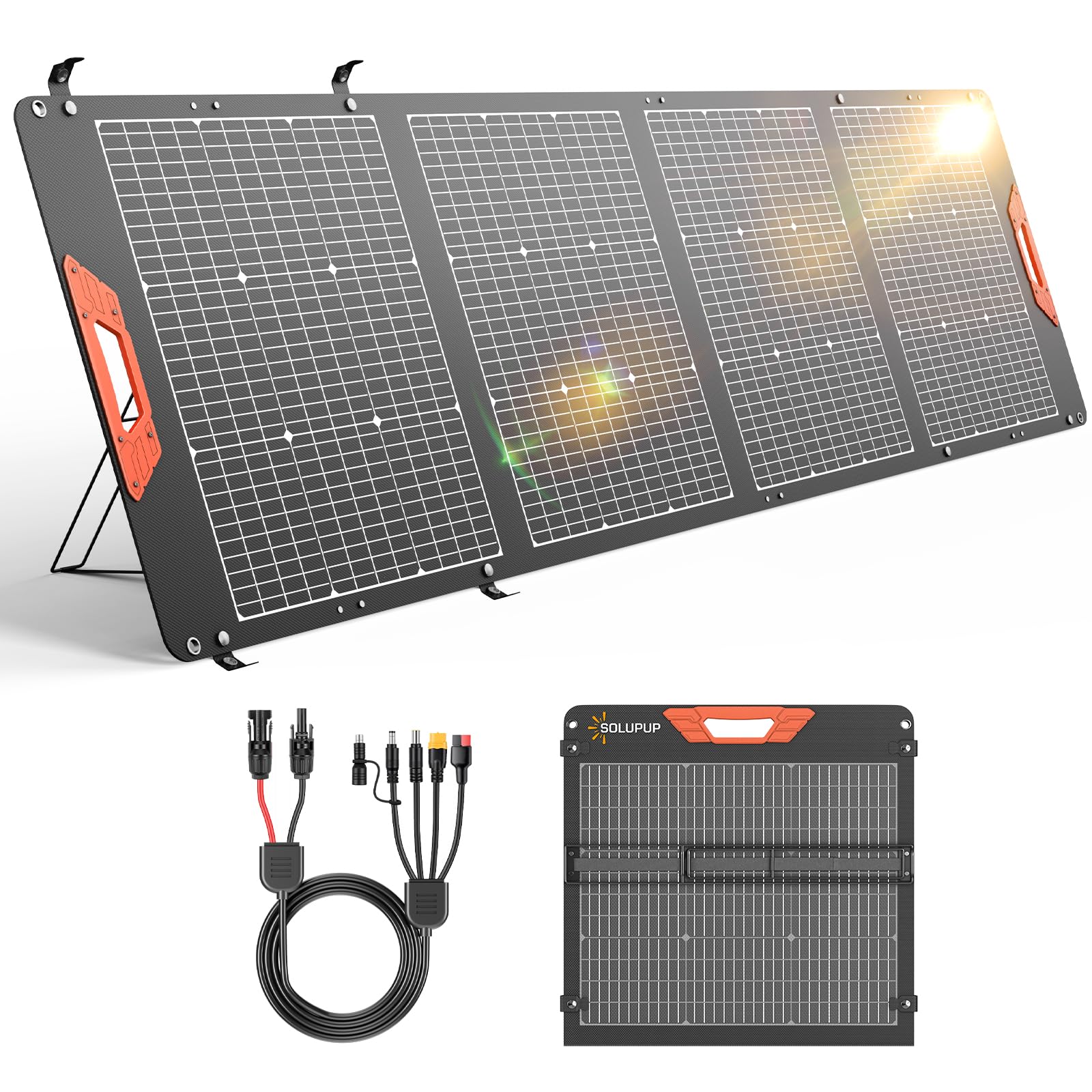
3. SOLUPUP 200W Bifacial Portable Solar Panel
The 12.9-pound folding panel that sets up in seconds and feeds your power station on the trail.
This is not a roof-mounted panel — it folds down to 24.41 x 24.02 x 0.79 inches and weighs just 12.9 pounds, with a non-slip rubber handle for carrying. The bifacial monocrystalline cells achieve 24 percent conversion efficiency from the front, and that jumps to over 30 percent when the rear side collects reflected light. Reviewers point out a calculated 205.9 watts on a mid-March day, proving it exceeds the 200-watt rating even in less-than-perfect conditions.
It comes with an MC4 to 5-in-1 DC cable supporting XT60, DC5521, DC7909, DC8020, and Anderson connectors — so it plugs straight into Anker, Jackery, and EcoFlow power stations without extra adapters. The adjustable kickstand lets you angle it toward the sun, and hanging grommets allow wall mounting. The ETFE lamination is tougher than standard panel coatings and delivers IP65 waterproofing, meaning a sudden rain shower won’t ruin your afternoon.
The main negative from owners is the short built-in cable — some 4.5 feet — and the 16 AWG wire gauge is thinner than ideal. On uneven ground, the three-leg kickstand can be tricky, and the panel is light enough that wind can knock it over if not secured. Still, for a portable camping companion, the charging speed and compact footprint are tough to top.
Portable powerhouse: Excellent output for the weight. The 5-in-1 cable eliminates adapter hunting, and the IP65 rating means you leave it out in light rain without panic.
A caveat: The short cable and thin wire require an extension cord for comfortable placement, and the lightweight build needs stakes or bags in breezy conditions.
Reach for this if: You camp, tailgate, or need emergency backup power — it deploys in seconds, charges a Jackery or EcoFlow fast, and stows smaller than a suitcase.
Think twice if: Your plan is a permanent roof installation — this is a portable folding panel, not a rigid mount.
4. Epoch 400W Bifacial Solar Panels (200W × 2)
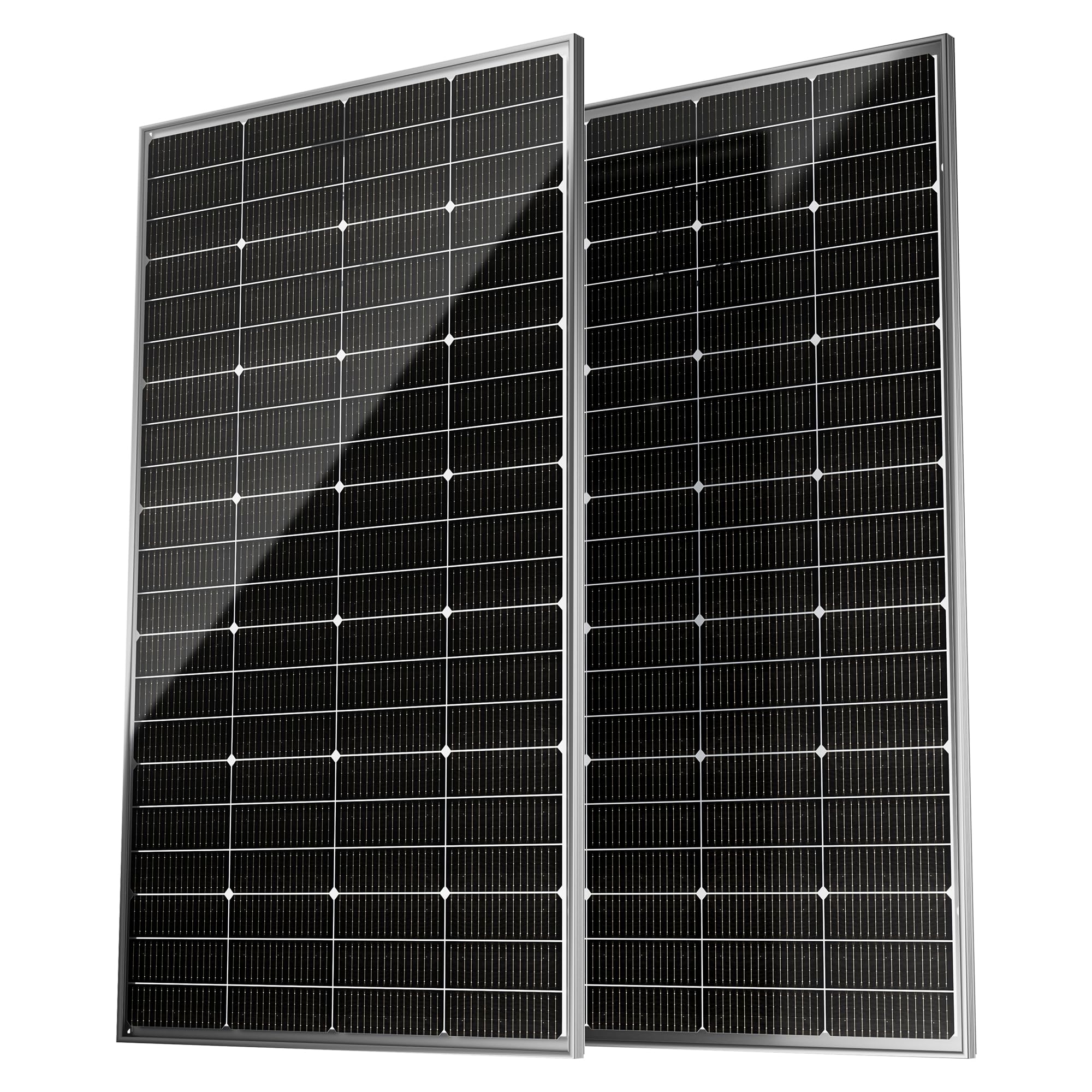
The two-panel kit that has owners pulling 380-plus watts per panel from ground reflection alone.
This is a set of two 200-watt Epoch bifacial panels wired together for a total system of 400 watts. Each panel uses A+ grade N-type cells with PERC, half-cut cell, bypass diodes, and 10 busbars to boost output even when partially shaded. The IP68 junction box and IP67 connectors provide serious weather sealing. Shoppers say individual panels producing 380-plus watts — 90 percent of the 400-watt system rating — and 100-plus watts on cloudy days, thanks to the bifacial rear side harvesting ground reflection.
The panels measure 30.3 x 1.18 x 53.7 inches each and weigh 46 pounds for the pair. Pre-drilled holes on the back allow quick mounting with standard Z brackets or tilt mounts. A two-panel parallel setup on an RV roof has been measured delivering 1200 to 1500 watts from the pair, generating 6000 to 10000 watt-hours per day — enough to cover baseline home power needs. The 25-year power output warranty and 12-year quality assurance add confidence.
The most common complaint is packaging — the first shipment can arrive damaged, with bent frames or cracked glass, though replacements are handled quickly. The panels are big and heavy, so a second person helps during installation. Still, when you consider the real-world output, the value per watt is excellent.
Massive output: Owners consistently praise the “380+ watts” real-world production and note the panels perform spectacularly in snow, where reflection boosts rear-side gain.
Shipping risk: The packaging is the weak link — order with confidence that support will replace damaged units, but brace for potential handling issues.
Best for: RVers and off-grid homeowners who want a two-panel kit that dramatically over-delivers on its 400W rating and handles snowy climates beautifully.
Skip if: You need a single lightweight panel for a small system — these are big (46 lb total) and built for serious rooftop arrays.
5. N-Type 16BB 400W Bifacial Solar Panel (Callsun, 2×200W)
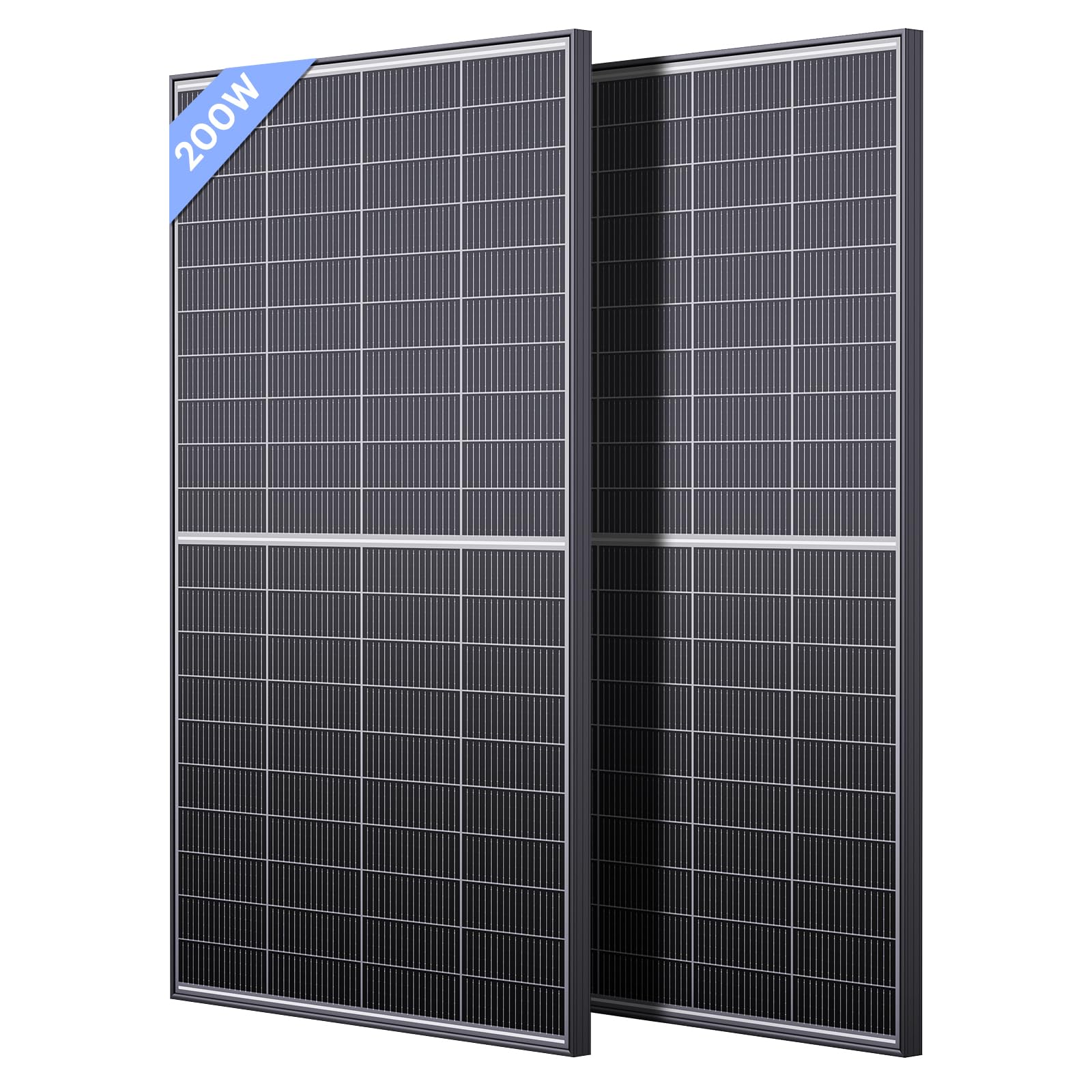
The twin 200-watt panels that hit 420 watts peak by capturing light from the concrete below.
This Callsun package pairs two of their 200-watt N-Type 16BB bifacial panels for a combined 400-watt system. The key design here is the TwinCell anti-shade architecture — each panel splits into two independent halves, so shading from an antenna or vent on one half leaves the other half fully active. Buyers report a consistent peak output of 420 watts for the pair, with seven panels averaging 275 to 300 watts each in full sun — far exceeding the 200-watt rating per panel.
At 23.8 pounds per panel and dimensions of 51.3 x 30.3 x 1.4 inches, the pair is a strong fit for Class B vans and tight rooftops where every inch counts. The 3.8mm tempered glass, aluminum frame, and IP68 junction box mean they are built to last decades. Callsun backs them with 10-year technical support and a 25-year performance commitment holding at least 84.5 percent output. Owners highlight the sturdy packaging — multiple owners mention “no damage received” even from freight shipping.
The package delivers more than just raw power. One owner with a 60-volt charge limit runs three sets (six panels) and hits 1300 watts from a 1200-watt rated setup, partially thanks to the bifacial gain from concrete ground reflection. The stellar build quality is the aspect buyers mention most, followed closely by the power output.
Why It Impresses
- TwinCell anti-shade design keeps half the panel producing even under partial shade
- Real-world output of 420W from a 400W-rated pair is common
- Light 23.8 lb per panel makes rooftop installation manageable solo
- IP68 waterproofing and 25-year performance commitment
What to Know
- You are buying two 200W panels, not a single 400W panel — wiring takes a few minutes
- The panels are rigid and not portable for camping
- Some customers note needing to use an MPPT controller to capture the full voltage
Who this suits: Van lifers and small-roof owners who want twin panels that over-produce and keep generating even when the tree shadow creeps across half the array.
The honest limit: If you want a single-panel 400W solution for a ground array, the JJN 425W above is a better fit — this is a two-panel system designed for tight mounting spaces.
6. Jackery SolarSaga 200W Portable Solar Panel

The brand-name folding panel that hits 200 watts with IBC cell tech and charges your Jackery fast.
Jackery uses its own IBC (interdigitated back contact) cell technology in this 200-watt bifacial panel, achieving a conversion efficiency of up to 26.7 percent — the highest percentage in this list. The panel is IP68 waterproof and dustproof, operating from -4°F to 149°F. Reviewers point out pulling 198 watts in direct sun at 6000 feet of elevation, and 60 to 100 watts under cloud cover. It folds to 24 x 21.7 x 1.8 inches and weighs 14.3 pounds, making it smaller and lighter than many folding panels.
The included 9.8-foot multi-functional charging cable gives you DC8020, DC7909, USB-A, and USB-C outputs, so you can power a Jackery Explorer power station and devices simultaneously. Six panels fully charge a 2042Wh E2000 Plus in about 2.5 hours. The ergonomic handle and 10-second setup time make it genuinely easy for camping and emergency use.
The most-discussed aspect is performance, which owners rate positively. However, charging speed gets mixed feedback — some find it slow when using the USB ports directly, and the panel’s light weight means it blows over easily in wind without stabilization. It is also the most expensive 200W panel here. For Jackery power station owners, the smooth compatibility is worth the premium. For everyone else, the price and wind instability are worth considering.
Jackery synergy: For anyone already in the Jackery ecosystem, this panel plugs in wirelessly with no adapters. The 26.7% IBC efficiency is genuinely top-tier. The catch is stability — the panel is a kite in any breeze without sandbags or stakes.
Price premium: You pay a brand tax, but the rugged build, 5-year warranty, and real-world 198W output justify the cost for dedicated Jackery users.
Best for: Jackery Explorer owners who want a guaranteed plug-and-play 200W panel that packs small and delivers rated power in full sun.
Look elsewhere if: You are on a tight budget or want a panel for a non-Jackery power station — universal options like the SOLUPUP offer better value for generic use.
7. AFERIY 400W Portable Foldable Bifacial Solar Panel
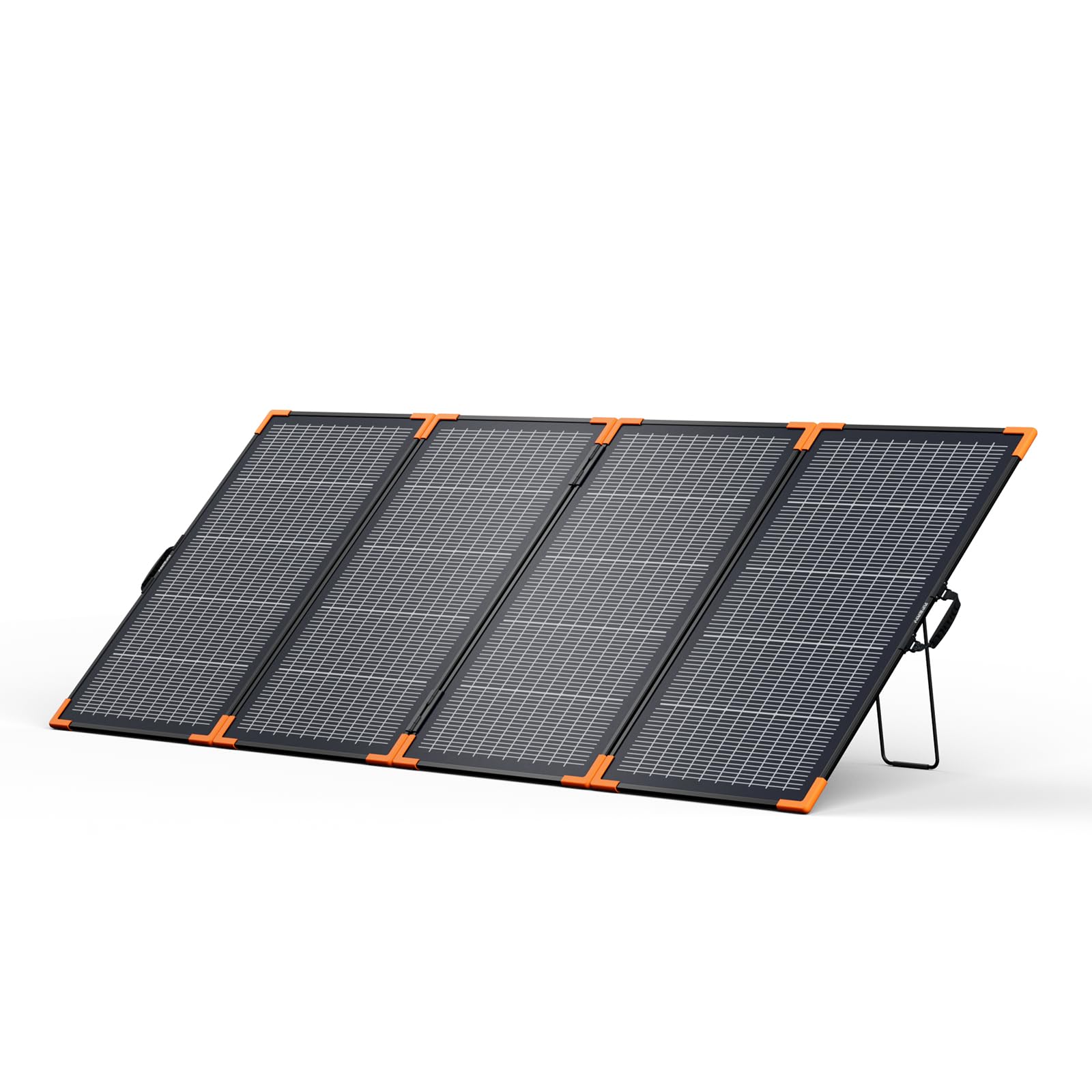
The 400-watt folding beast that charges a power station in a day and stows in its own carry bag.
This is the highest-wattage portable panel in the roundup, delivering 400 watts from N-type cells with 25 percent conversion efficiency. Open it up and you get a 96.5 x 38.5 inch active surface with an IP67 waterproof rating and an ETFE scratch-resistant surface. Shoppers say a maximum output of 242 watts on a clear day — below the 400W rating but still enough to recharge an EcoFlow Delta Max 2 in roughly 1.5 days. The included 0.6-meter and 3-meter MC4 extension cords give you flexibility in placement.
Portability is the headline here — the panel folds into a compact bundle with an Oxford fabric carry bag lined with reflective film. The adjustable kickstands let you tilt it toward the sun, though some owners find the retracting brackets finicky and the panel unstable in wind due to the lack of stake rings. At 25.3 pounds, it is the heaviest foldable panel, but it delivers four times the wattage of a typical camping panel.
The customers-say summary highlights portability as the most praised aspect, followed by conversion performance. Buyers describe it as “perfect for travel” and note it “charges devices and power station quickly in direct sunlight.” The 2-year official after-sales service covers manufacturing defects with free repair or replacement. The real trade-off is that real-world output (242W) only hits about 60 percent of the rated 400W under typical conditions, so manage expectations on cloudy days.
Why It Stands Out
- Highest portable wattage at 400W — charges large power stations directly
- IP67 waterproof rating handles rain and dust without worry
- Comes with multiple MC4 cables and a dedicated carry bag
- N-type cells deliver 25% conversion efficiency
Be Aware
- Real-world output (242W max reported) is below the 400W rating in typical sun
- Retracting kickstands are finicky and the panel is unstable in wind
- At 25.3 lb, it is significantly heavier than 200W portable panels
Who it fits: Full-time van dwellers and off-grid campers who need a high-wattage portable panel to recharge a large power station and have the space and patience to set up a 96-inch-long array.
The honest caveat: If you expect 400W output every time, you will be disappointed — the real-world number is closer to 240W, so treat this as a “240W panel that can peak higher” and plan accordingly.
8. EF ECOFLOW 4PCS 125W Solar Panels (500W Bifacial)

The modular 4-panel system that scales from 125W to 1656W with built-in angle guides.
EcoFlow’s modular approach gives you four 125-watt bifacial panels that you can deploy individually or connect as a 500-watt array. Each panel uses N-TYPE cell technology with a 1mm ultra-thin tempered glass front and POE films for UV and moisture resistance. The built-in 30-to-60-degree adjustable support and Solar Angle Guide help you aim each panel for maximum sun exposure. Buyers report the four-panel setup routinely pulls around 500 watts, with one user measuring 507 watts peak from the array.
The system connects via waterproof XT60-W connectors that auto-parallel when you link multiple panels. You can run up to 8 panels in parallel (1000W) or 12 panels in a 4-parallel, 3-series configuration for up to 1656 watts. At 37 pounds for the full 4-panel set, each panel weighs just 9.26 pounds — making this one of the lightest rigid panels per watt. The modular design lets you split the system into individual 125W panels for lighter loads or single-panel setups.
The aspects owners mention most are lightweight design and build quality — both get strong positive feedback. The integrated angle guide is a hit, helping users boost output without guesswork. The downsides are that the tempered glass is fragile against sharp impacts, and the panels are light enough to be blown away in wind without sandbags or stakes. The XT60i connectors are non-standard, so adapters may be needed for third-party systems.
Flexible scaling: You start with 500W and expand to over 1600W without replacing hardware — the modular design is genuinely useful. The built-in angle guide is a clever addition that sets this apart from fixed-angle panels.
Handling required: The thin glass and light weight demand careful placement. Use tent stakes or sandbags in any breeze, and avoid dropping tools on the panel surface.
Best for: EcoFlow power station owners who want a modular expandable system that you can split or combine as your energy needs grow.
skip it if: You need a single high-wattage panel for a simple ground array — the multi-panel setup adds complexity with connectors and cable management.
9. JJN 550 Watt Bifacial Solar Panels (2PCS, 1100W)
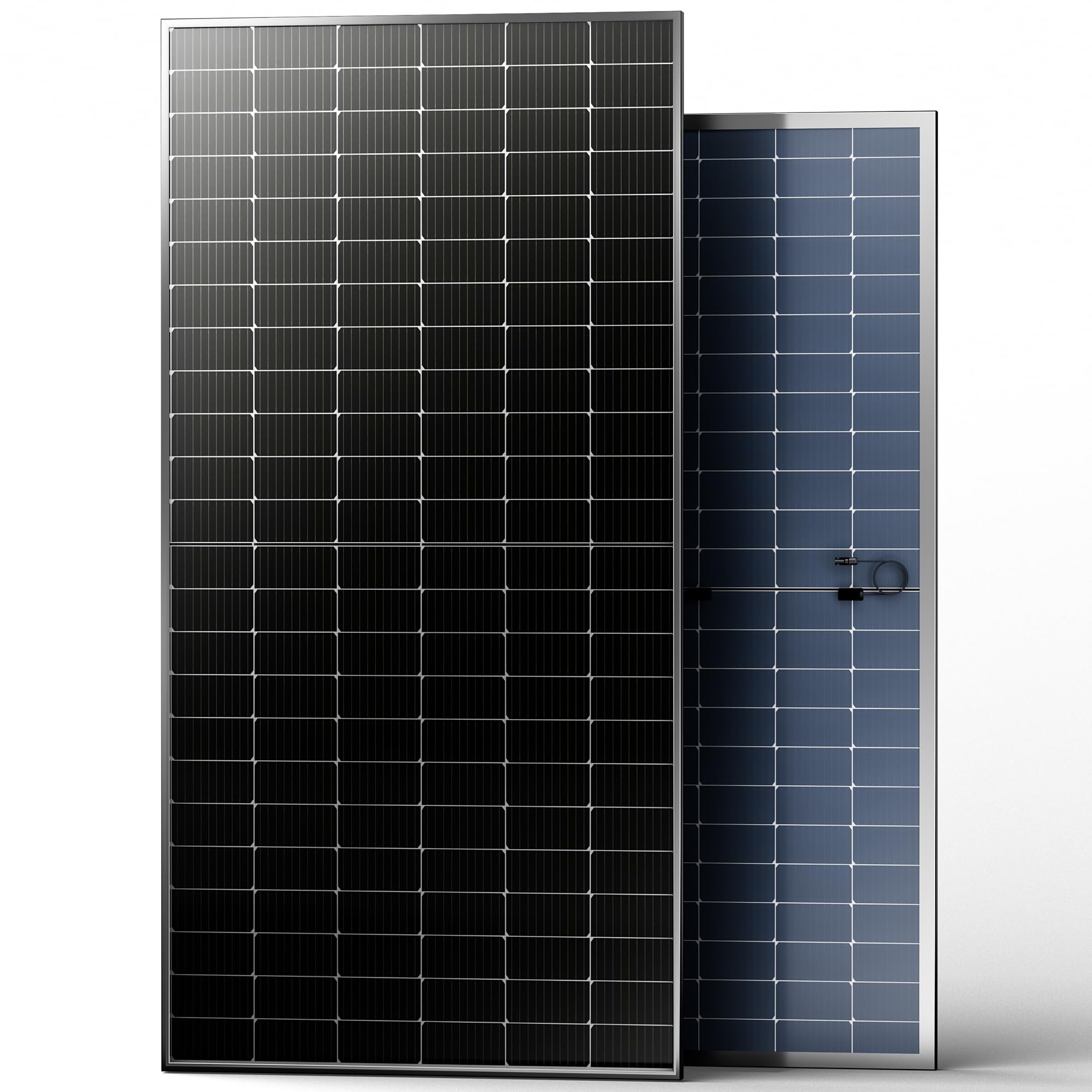
The 1100-watt home system that delivers 760-watt peaks and powers a full shop for hours.
This is the heaviest hitter in the lineup — two 550-watt bifacial panels combined for 1100 watts total. The transparent backsheet design allows up to 30 percent increased efficiency compared to regular panels, and owners mention impressive real-world numbers. One buyer measured up to 760 watts from a single panel, blowing past the 550-watt rating. The 14-amp current and 49.5-volt maximum voltage make it suitable for 12, 24, or 48 volt systems.
Each panel measures 89.61 x 44.65 x 1.38 inches and weighs 123.4 pounds for the pair. That means you need a solid roof structure or a ground-mount frame to support them. The pre-drilled mounting holes and simple series/parallel connections mean fewer brackets and wires than an equivalent array of smaller panels. JJN claims over 55 percent savings on balance-of-system expenses because you need fewer mounting components.
Owner feedback is extremely positive on build quality and power output. One full-time shop user runs 8 of these panels (4 kits), powering AC units, tools, and a welder for 6-plus hours daily — the panels deliver “full wattage” consistently. The main downside is that one panel in a set occasionally arrives shattered due to packaging that some owners call “subpar.” The sharp edges also require care during handling. Despite this, the 775-plus reviews with overwhelmingly high ratings show this is a crowd favorite for large installations.
Why It Dominates
- Immense 1100W total power from just two panels — minimal roof footprint
- Real-world peaks of 760W per panel, far exceeding the 550W rating
- 30% bifacial efficiency boost from the transparent backsheet
- Fewer mounting brackets and wires needed, reducing installation costs
Heads Up
- Each panel weighs over 61 pounds — a two-person job for roof installation
- Packaging is inconsistent — some panels arrive with shattered glass
- Sharp edges demand careful handling during setup
Who this is for: Homeowners who want the most panel power possible from the smallest number of panels — this is the definitive large-scale residential bifacial system.
Who should pass: If you are equipping a small RV roof or a portable camping setup, these massive panels will be physically impossible to mount and far too heavy to move.
Understanding the Specs
Bifacial Gain
The transparent backsheet on bifacial panels captures light hitting the rear side — reflected off the ground, a white roof, or snow. This can boost total energy output by 25 to 30 percent compared to a traditional opaque panel of the same wattage. The gain depends heavily on the surface below: light concrete gives a bigger boost than dark gravel.
N-Type 16BB Cells
N-type cells avoid the boron-oxygen degradation that reduces efficiency in older P-type cells. The 16-busbar (16BB) design spreads the current across 16 thin metal strips on each cell. If one strip cracks or gets shaded, the other 15 keep working — that means less power loss from partial shade and fewer hot spots over the panel’s 25-year life.
FAQ
Can I mount bifacial panels flat on my RV roof?
Do I need a special charge controller for bifacial panels?
How much power can I really expect from a 200W bifacial panel?
Are bifacial panels more fragile than standard panels?
Can I mix bifacial and conventional panels on the same system?
How long do bifacial solar panels last?
Is the extra cost of bifacial panels worth it?
Do bifacial panels work in partial shade?
Final Thoughts: The Verdict
If you want one dependable pick, the bifacial solar panels winner is the JJN 425W Bifacial because it pairs N-Type 16BB efficiency with a 30-year warranty and consistent real-world overproduction. If you want a compact, over-performing 200W panel for your van or small system, grab the Callsun N-Type 16BB 200W. And for large-scale home power that crushes your energy bills with just two panels, the JJN 550W Bifacial 2-Panel Kit is the one to reach for.
How We Picked
We do not accept paid placement. Every pick is matched to a real buyer and a real use-case; we do not hands-on test units.
Sources & Methodology
Specifications: manufacturer listings and product documentation. Review insights: verified customer reviews, as of July 2026. Pricing: not shown on this page (it changes often); check the current price via the retailer link.
As an Amazon Associate, WellFizz earns from qualifying purchases. This does not affect which products we feature.
Related Guides

Mo Maruf
I created WellFizz to bridge the gap between vague wellness advice and actionable solutions. My mission is simple: to decode the research and give you practical tools you can actually use.
Beyond the data, I am a passionate traveler. I believe that stepping away from the screen to explore new environments is essential for mental clarity and physical vitality.