Our readers keep the lights on and my smoothie glass nicely filled. As an Amazon Associate, I earn from qualifying purchases.
Specs are compiled from manufacturer listings and verified buyer reviews and can change over time — please confirm the key details on the product page before buying.
Yellowstone’s vast landscapes—from the Grand Canyon of the Yellowstone to the Hayden Valley—demand a binocular that can pull in a distant grizzly at dawn and hold steady through a long day in the backcountry.
I’m Mohammad Maruf — the founder and writer behind WellFizz. This guide is built by comparing the manufacturers’ published specifications and the patterns across verified customer reviews, so you get each pick’s real strengths and trade-offs instead of marketing spin.
for the best binoculars for yellowstone, balancing magnification for wide views against the light-gathering power you need in low-light park hours.
Our Picks at a Glance


How To Choose The Best Binoculars For Yellowstone
Yellowstone is a grand-scale park; you aren’t looking across a backyard, you’re looking across valleys and thermal basins. The right pair balances reach, brightness, and carry-weight for a full day on the trail.
Magnification and Objective Lens
This is the “8×42” or “10×50” number stamped on every set. The first number (8x, 10x) is how many times closer an object appears. The second (42, 50) is the diameter of the front lens in millimeters, which dictates how much light enters the optic. A bigger number here means a brighter image in low light, but also a heavier and larger binocular.
Field of View
Measured in feet at 1,000 yards or degrees of arc, this is the width of the scene you see. A wider field is a godsend for tracking a running coyote or scanning a ridgeline without moving your head too much. A narrow field feels like looking through a straw.
Waterproofing and Fog-proofing
Yellowstone’s weather is famously fickle—sun one minute, hail the next. A nitrogen-purged binocular (filled with inert gas) won’t fog internally when you come in from the cold, and O-ring seals keep rain and creek splashes out of the optics.
Quick Comparison
| Model | Best For | Magnification | Objective Lens | Eye Relief | Amazon |
|---|---|---|---|---|---|
| Steiner Marine 7×50★ Best Overall | Low-Light & Boat Scopes | 7x | 50 mm | 20 mm | Amazon |
| Leupold BX-1 Rogue 10×25Compact Companion | Ultra-Compact Carry | 10x | 25 mm | 15 mm | Amazon |
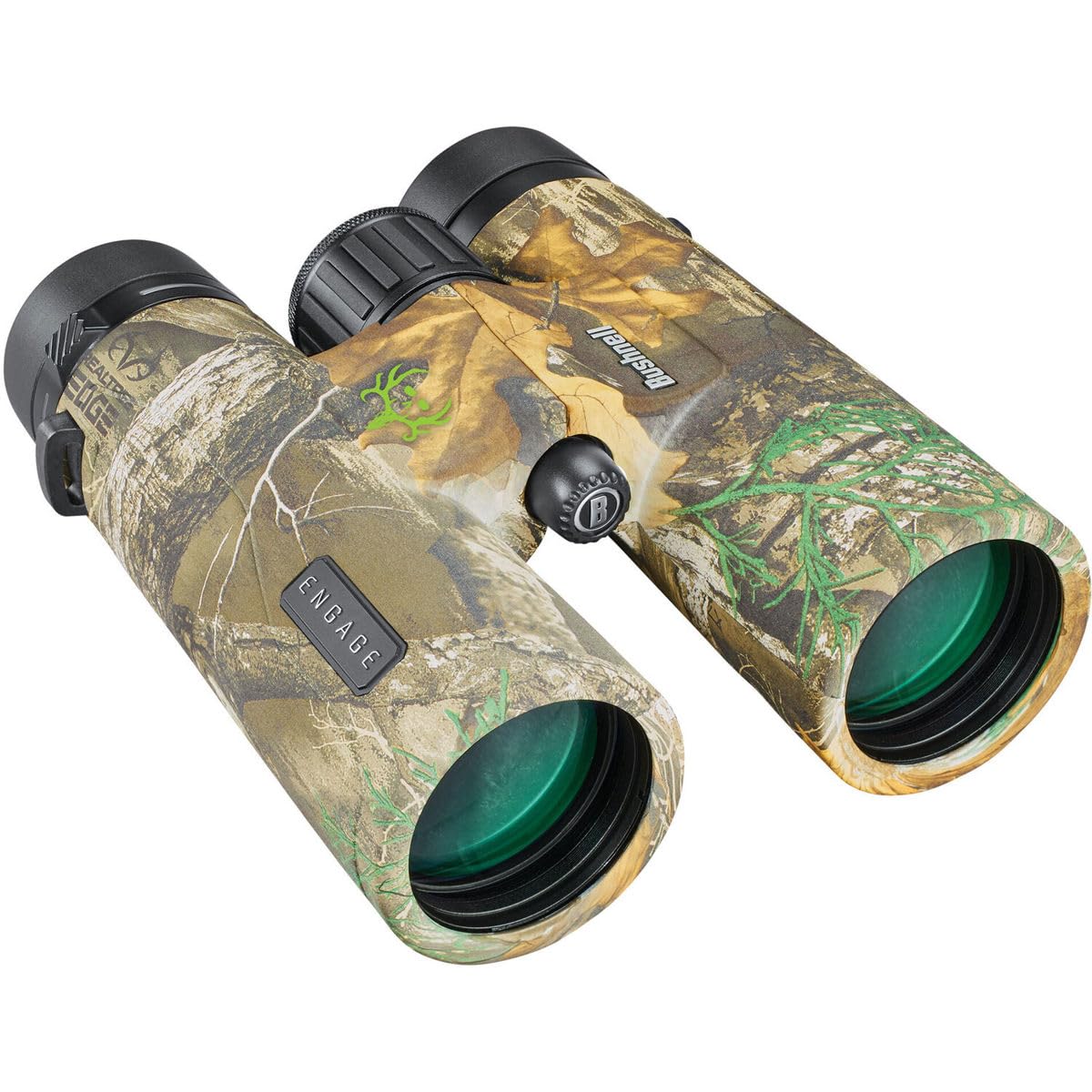
| Bushnell Engage X 10×42Best Value | All-Round Performance | 10x | 42 mm | 18 mm | Amazon |
| Nikon Prostaff P7 10×42 | Budget to Mid-Range Jump | 10x | 42 mm | 15.7 mm | Amazon |
| Nikon Monarch M5 8×42 | Extra-Wide Tracking | 8x | 42 mm | 19.5 mm | Amazon |
| Celestron TrailSeeker ED 8×42 | Birding & Detail | 8x | 42 mm | 17.2 mm | Amazon |
| Steiner Military-Marine 10×50 | Long-Range Power | 10x | 50 mm | 16 mm | Amazon |
| Athlon Midas G2 UHD 12×50 | Maximum Detail | 12x | 50 mm | 15 mm | Amazon |
| ZEISS Terra ED 10×42 | Premium Compact | 10x | 42 mm | 18 mm | Amazon |
In‑Depth Reviews
1. Steiner Marine 7×50 Binoculars
Our pick — over 4.5★ from 450+ verified ratings; the strongest balance of quality and price.
This is the binocular that turns Yellowstone’s twilight into your best viewing hour without ever needing to re-focus.
You get a bright image even in dim light because the 50mm objective lens gathers lots of light, and the 7.14mm exit pupil (the circle of light reaching your eye) means you see a big, bright disc when your pupils are wide open at dusk. Where the Leupold 10×25 has a 2.5mm exit pupil, the Steiner delivers a 7.14mm exit pupil versus the Leupold’s 2.5mm, so those last wolves moving across the Lamar Valley at last light stay crisp, not shadowy. The Sports Auto Focus is a real curveball: you set one eyepiece per eye once, and the view stays sharp from 20 yards out to infinity. That means no fumbling with a center wheel when a fox appears at the edge of a meadow. The trade-off is clear. At 7x magnification, you don’t get the reach of a 10x, and the weight is real—this is a substantial, solid instrument, not a trail-running companion.
Owners most often praise the build quality, with clarity scoring just behind. Buyers report the build weathers rain and salt spray without issue, and the rubber armoring gives a positive grip in damp conditions.
Night-Owl Verdict: If your Yellowstone day starts before sunrise and ends after sunset—or if you plan to use them from a boat on Yellowstone Lake—the Steiner’s light-gathering and rock-solid focus make it the best overall choice. The weight and 7x magnification mean this is for the devoted observer, not the ultra-light hiker.
Reach for them if: low-light viewing is your priority and you can manage the weight of a 7×50.
Look elsewhere if: you need a 10x reach or a pocket-sized binocular for a day hike.
2. Leupold BX-1 Rogue 10x25mm Binoculars
This pocket-sized binocular proves 10x reach does not require a giant frame.
Slip this into a jacket pocket for the Mammoth Hot Springs boardwalk or a quick detour into the backcountry. The inverted Porro prism design packs 10x magnification into a body that barely takes up space. The 25mm objective lens, however, is small—so this is a bright-day tool. In the deep shade of a forest or late twilight, the 2.5mm exit pupil limits how much light reaches your eye. Clarity is the top praise from owners, and owners mention that the extension eyecups help block ambient light for a crisp view, even at last shooting hours. The fully multi-coated optics deliver good brightness for the size class, and the focus wheel is smooth.
The build is aluminum with rubber armor, and a 100% waterproof and fog-proof seal means a surprise Yellowstone rainstorm won’t ruin the internals. The 15mm eye relief is serviceable but not generous for glasses wearers. What you lose in low-light performance, you gain in convenience: this is the pair you always have with you because it never feels like a burden.
Trail-Carry Verdict: The Leupold BX-1 Rogue is the perfect secondary binocular or primary for day hikes where weight is the ultimate constraint. It falls short of the Steiner in low light but beats it on portability.
Grab this if: you want binoculars that vanish into a daypack for a quick afternoon in the park.
Think twice if: you plan to glass the Hayden Valley at dusk—the 25mm objective won’t keep up.
3. Bushnell Engage X 10x42mm Binoculars
the balance where 10x magnification meets a 42mm objective at a price that does not hurt.
This hits the classic “all-rounder” spec: 10x magnification for pulling in bison on the Firehole River and a 42mm objective for solid brightness as the sun drops. The IPX7 waterproof rating (it can survive submersion in 1 meter of water for 30 minutes) means a dunking in a creek or a downpour won’t damage it—rare at this price point. The EXO Barrier is a permanent coating on the exterior lens that repels water, oil, and dust, so a smudge from a rain drop wipes cleanly away. Customers note the image quality is a top highlight, and one buyer took them on an Alaskan cruise with excellent results. The 18mm eye relief is comfortable, and the twist-up eyecups let you adjust for glasses. The weight is about 2 pounds, which feels balanced but not ultralight. Compared to the Steiner, the Bushnell offers more magnification (10x vs 7x) for scanning wide open terrain, though it cedes some low-light brightness to the Steiner’s big 50mm lenses.
The focus is manual and smooth, and the build is a rugged, plastic housing with rubber armor. An occasional note is that the weight feels noticeable during a full-day carry, but the value is undeniable.
Value Verdict: The Bushnell Engage X delivers the most useful all-around spec for Yellowstone at a mid-range cost. It doesn’t have the premium ED glass of the higher picks, but for the vast majority of park visitors, it gets the job done brilliantly.
Choose this if: you want one binocular that handles everything from roadside photospots to short hikes while staying affordable.
Consider another if: you need the highest possible low-light performance or demand an ultra-light package.
4. Nikon Prostaff P7 10×42 Binoculars

A step up from budget options, with dielectric coatings that push brightness close to premium glass.
This is where the jump to a higher tier of optical quality happens. The Prostaff P7 uses dielectric high-reflective multilayer prism coatings, which according to the manufacturer reflect more than 99% of the light to your eyes. The result is an image that feels noticeably brighter and more vibrant than entry-level binoculars, especially in the variable light of a Yellowstone forest. The 10x42mm configuration gives you the reach to spot a distant coyote and a wide 367-foot field of view at 1,000 yards—broader than the Bushnell’s—so you don’t have to search as hard. The locking diopter ring is a small but valuable detail: once you set the focus to your eyes, it stays put. Lens quality is the top praise, and owners say the image is crisp and clear edge-to-edge. The build uses a fiberglass-reinforced polycarbonate body with rubber armor, and the turn-and-slide eyecups are comfortable. The 15.7mm eye relief is shorter than some, so glasses wearers should try them first.
Compared to the Bushnell Engage X, the Nikon edges ahead on optical refinement and field of view, but both are 10×42. The real step up from here is to the Monarch M5 or the premium picks.
Glass-Head Verdict: If your budget can stretch a bit above the entry-level tier, the Prostaff P7 delivers noticeably crisper, brighter images for those long afternoons on a Yellowstone trail.
Best for: the enthusiast who feels the difference between “good” and “great” glass but isn’t ready for a four-figure investment.
Skip if: you need an ultra-light set or require 19-20mm of eye relief for glasses.
5. Nikon Monarch M5 8×42 Binoculars
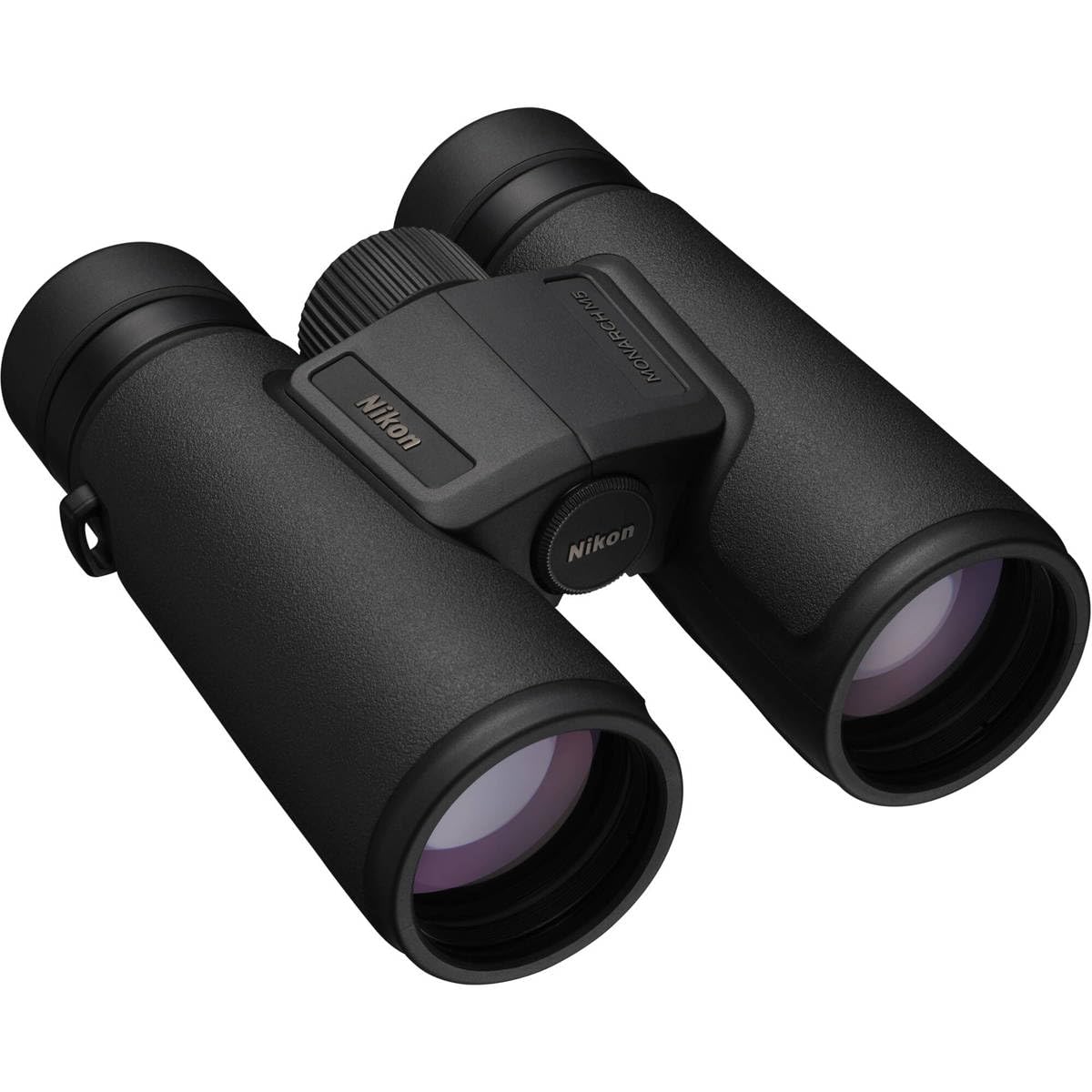
The widest view in the lineup lets you track a running pronghorn without losing it.
This is the 8×42 champion. The lower magnification (8x vs 10x) gives you a noticeably broader and steadier view—the 335-foot field of view feels like opening a window compared to a 10x’s narrower tunnel. For following fast-moving wildlife like a coyote along a ridgeline, the stability is a real advantage. The Extra-low Dispersion (ED) glass is the key feature here: it virtually eliminates color fringing (the purple or green halo along high-contrast edges), so tree branches against a bright sky stay clean. The dielectric prism coatings push brightness high, and the 5.3mm exit pupil (wider than the 4.2mm on the 10×42 options) means your eye captures all the light without squinting. Owners consistently praise the optical quality, and the clarity scores are excellent. The 19.5mm eye relief is the best in the entire list for glasses wearers, beating even the Steiner. The build is a rugged, waterproof, nitrogen-purged body with a smooth center focus.
The trade-off is reach. You won’t see as far as a 10x at the same distance, but in Yellowstone’s open valleys, 8x is often plenty, and the steadier image can actually reveal more detail than a shaky 10x. Compared to the Prostaff P7, the Monarch M5 has a more premium feel and the ED glass, but it costs more.
Tracking Verdict: For birders and wildlife watchers who prioritize a wide, steady, bright view over absolute magnification, the Monarch M5 is a top contender.
Reach for this if: you wear glasses (the 19.5mm eye relief is a standout) or you find 10x binoculars too shaky.
Consider the 10x if: you are primarily scanning the far side of a canyon or lake shore.
6. Celestron TrailSeeker ED 8×42 Binoculars
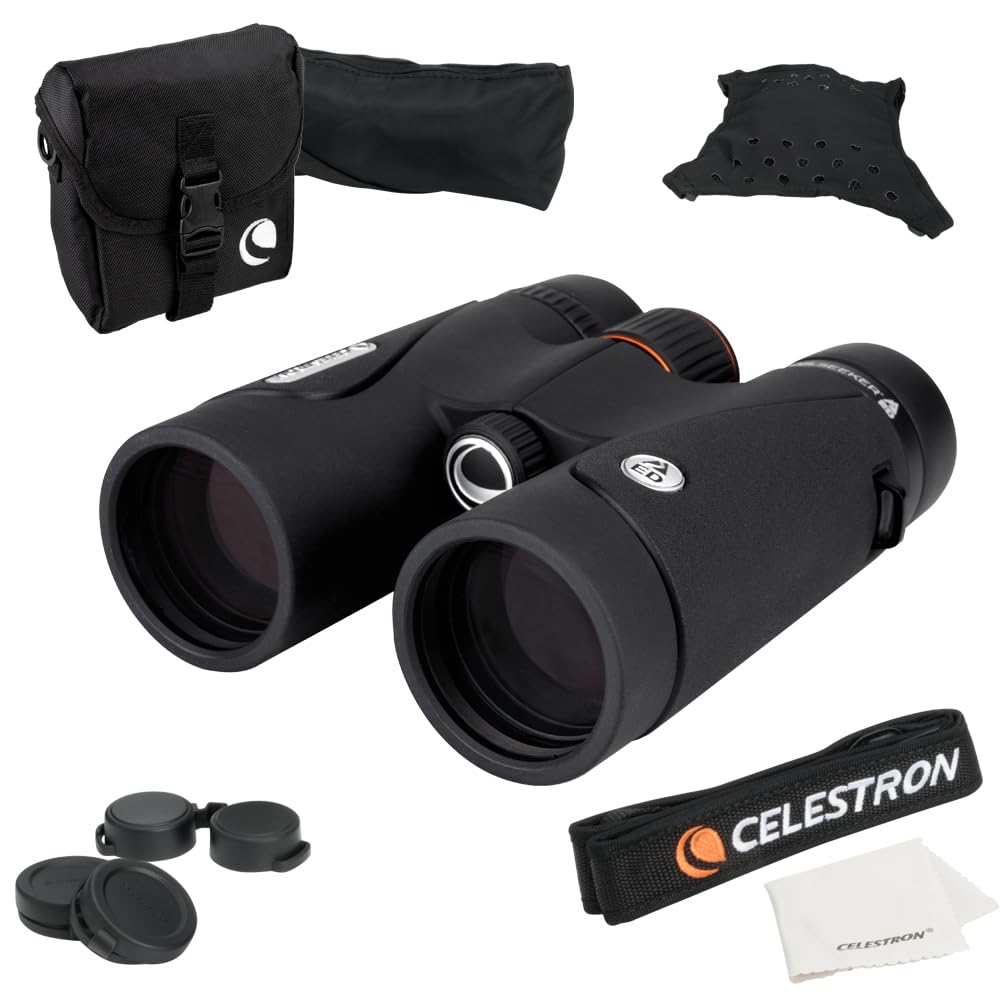
A dedicated birding tool with ED glass that delivers razor-sharp detail down to a 6-foot close focus.
This is a specialist for the birder who wants to see every feather detail on a Western tanager. The ED (Extra-low Dispersion) glass eliminates chromatic aberration, giving an image that is crisp, high-contrast, and color-accurate. The phase-coated BaK-4 prisms boost light transmission, so the view stays bright. The field of view is 425 feet at 1,000 yards—the widest on the list—making it superb for scanning a forest edge. The close focus is 7 feet, so you can pick out the fine markings on a flower or a nearby warbler. Owners rave about the clarity and the fast focus wheel. The body uses a rubber-armored polycarbonate housing that is fully waterproof and nitrogen-purged. The twist-up eyecups adjust for glasses, and the 17.2mm eye relief is good. The 30-ounce weight is noticeable for overnight backpacking, and the included padded neck strap can cause fatigue on a long day, but for dedicated birding, the performance is stellar.
Compared to the Nikon Monarch M5, the Celestron has a wider field of view and a closer minimum focus, making it slightly more specialized for bird-in-bush scenarios. The Nikon edges it on overall build refinement.
Feather-Detail Verdict: If your Yellowstone trip centers on bird-watching, the TrailSeeker ED’s combination of wide field, close focus, and crisp ED glass is tough to top in its class.
Best for: the birder who spends hours scanning treetops and wants the ED glass sharpness.
Not ideal for: the ultralight hiker who counts every ounce.
7. Steiner Military-Marine 10×50 Binoculars

10x power with a 50mm light bucket, built to handle the brutal impact of a fall from a truck bed.
This is the high-power, bombproof option. The 10×50 configuration gives you the longest reach alongside the Steiner Marine 7×50’s big objective lens. The 50mm objectives gather substantial light for dawn and dusk viewing, and the Makrolon polycarbonate housing with NBR rubber armoring is rated to withstand 11 Gs of impact—meaning a drop from the back of a van onto a rocky trail is unlikely to phase it. The Sports-Auto-Focus system works the same as the Marine model: calibrate once, and the view stays sharp from 20 yards to infinity without a focus wheel. The clarity and quality are the top praises, and owners say the optics are crisp with minimal chromatic aberration. The 16mm eye relief is adequate. The twin downsides are the same: heft. This is a heavy, substantial instrument. Owners say it is not something they would want to hike a 14,000-foot peak with, but for car-based viewing, a spotting scope, or RV use, it’s fantastic.
Compared to the Steiner Marine 7×50, this 10×50 gives you much more reach (10x vs 7x) for pulling in details across a far canyon, but it’s heavier and the field of view is narrower (302 feet vs 356 feet).
Impact-Resistant Verdict: The Steiner Military-Marine is for the observer who demands maximum reach and refuses to baby their gear. It’s the toughest binocular on this list.
Choose this if: you want a 10×50 for long-range glassing from a vehicle, campsite, or boat, and you need military-grade durability.
Avoid if: you plan to hike a long trail with it—the weight and bulk are prohibitive.
8. Athlon Optics 12×50 Midas G2 UHD Binoculars

12x magnification that pulls a grizzly from a mile away into your field of view.
This is the specialist for detail at extreme distance. The 12x magnification is the highest in the list, and it makes a real difference when you are trying to identify a distant wolf’s pack or count the tines on an elk’s antler from the other side of a valley. The 50mm objective lens and the ESP Dielectric coating reflect over 99% of the light, according to the manufacturer, so the image remains bright despite the high magnification. The extra-low dispersion (UHD) glass minimizes color fringing. The magnesium chassis reduces weight by as much as 35% compared to a standard metal body, and it feels solid. The XPL coating on the exterior lenses protects against dirt and scratches. Optics and image quality are the top praises from owners. The 15mm eye relief is shorter, and the 4.17mm exit pupil is tighter than the 8×42’s—so you need to hold it steady on a brighter day to get the full picture. The weight is also up, and the high magnification makes every natural hand tremor more visible; a tripod can be helpful.
Compared directly to the Steiner Military-Marine 10×50, the Athlon gives you 12x versus 10x magnification for pulling in those last details, but it demands a steadier hand and the field of view narrows to 5.4 degrees.
Distance King Verdict: For the dedicated wildlife photographer or observer who needs to identify features at the edge of visible range, the Athlon Midas G2 delivers stunning clarity. But it is a specialized tool.
Ideal for: the spotter who wants to read a bird band from 300 yards or scan a whole mountain face for climbers.
Not for: general hiking or scanning—the narrow field and shake make it frustrating for casual use.
9. ZEISS Terra ED 10×42 Binoculars

German-engineered compactness that delivers 88% light transmission without the weight penalty.
This is the premium entry point from ZEISS, and it shows in every handling detail. The 10×42 configuration uses Schmidt-Pechan ED glass with a hydrophobic multi-coating that transmits 88% of the available light. The image quality is described by owners as exceptionally clear, bright, and color-accurate, with a superior viewing angle compared to other optics in its class. The focus wheel is large and perfectly placed—your index finger falls naturally on it, ready to fine-tune when a bison suddenly appears at the edge of a thermal pool. The build uses a fiberglass-reinforced casing, making it compact and lightweight for a 10×42. It is fully waterproof and packed with a neoprene strap and bag. The 18mm eye relief is generous, and the 60-degree apparent angle of view gives a wide, rich feel. Quality and clarity are the top praises from owners, and many say it is the best binocular they’ve owned under.
The weight is noticeably lower than the Steiner or Athlon options, making it a genuine candidate for all-day carry. The trade-off is that at this price point, you are paying for the ZEISS name and that 88% transmission figure, but the ergonomics and optical quality justify the cost for the dedicated user.
Glass-Snob Verdict: The ZEISS Terra ED brings a legendary brand’s engineering into a practical, all-day carry binocular. It is the most refined, compact, and enjoyable 10×42 to use on a long hike.
Best for: the observer who values lightweight, ergonomic perfection and wants the best possible image quality in a compact package.
Consider another if: you need the raw light-gathering of a 50mm objective or the reach of 12x magnification.
Understanding the Specs
Magnification and Objective Lens (8×42, 10×50)
These two numbers define the whole character of the binocular. The first (8x, 10x, 12x) tells you how many times closer the subject appears. 10x is a great all-rounder for Yellowstone — strong pull without making you feel like you’re steering a ship. 8x is steadier and gives you a wider field of view for tracking moving animals. The second number (42mm, 50mm) is the diameter of the front lens; a 50mm objective gathers much more light than a 25mm one, so you’ll see more detail at dawn and dusk.
Eye Relief
This is the distance in millimeters from the eyepiece to your eye that still shows the full image. If you wear glasses, you want at least 16mm or more. A long eye relief of 19-20mm means you can see the entire bright circle without your glasses scratching the lens. The Steiner has 20mm and the Nikon Monarch M5 has 19.5mm, making them the best choices for eyeglass wearers.
FAQ
Is 8x or 10x magnification better for Yellowstone?
Do I need a waterproof binocular for Yellowstone?
What does eye relief mean and why does it matter for glasses?
What does “exit pupil” mean?
What is ED glass and do I need it?
How heavy is too heavy for a day of hiking?
Can I use a tripod with these binoculars?
What is “close focus” and why does it matter?
Are these binoculars good for watching the Old Faithful eruption?
Final Thoughts: The Verdict
For most buyers, the binoculars for yellowstone winner is the Steiner Marine 7×50 because its massive 50mm objective lens and generous 20mm eye relief deliver the most usable low-light performance for the park’s famous twilight hours, backed by the highest owner ratings. If you want a lightweight, all-day carry for hikes, grab the Bushnell Engage X. And for the dedicated birder who needs ED glass and a wide field of view, the Celestron TrailSeeker ED is the one to reach for.
How We Picked
We do not accept paid placement. Every pick is matched to a real buyer and a real use-case; we do not hands-on test units.
Sources & Methodology
Specifications: manufacturer listings and product documentation. Review insights: verified customer reviews, as of July 2026. Pricing: not shown on this page (it changes often); check the current price via the retailer link.
As an Amazon Associate, WellFizz earns from qualifying purchases. This does not affect which products we feature.
Related Guides

Mo Maruf
I created WellFizz to bridge the gap between vague wellness advice and actionable solutions. My mission is simple: to decode the research and give you practical tools you can actually use.
Beyond the data, I am a passionate traveler. I believe that stepping away from the screen to explore new environments is essential for mental clarity and physical vitality.