Our readers keep the lights on and my smoothie glass nicely filled. As an Amazon Associate, I earn from qualifying purchases.
Specs are compiled from manufacturer listings and verified buyer reviews and can change over time — please confirm the key details on the product page before buying.
When someone collapses in the break room or on the factory floor, you need a device that talks a complete stranger through saving a life. A workplace AED (automated external defibrillator — a portable machine that delivers an electric shock to restart a stopped heart) does exactly that. The difference between a good one and a great one depends on how clearly it guides you when your hands are shaking.
I’m Mohammad Maruf — the founder and writer behind WellFizz. This guide is built by comparing the manufacturers’ published specifications and the patterns across verified customer reviews, so you get each pick’s real strengths and trade-offs instead of marketing spin.
Whether you are equipping a church, a gym, or a 100-person office, the right aed for workplace safety needs to be ready the moment someone collapses, with clear voice prompts that every bystander can follow.
Our Picks at a Glance

How To Choose The Best AED For Workplace
Selecting an AED for your workplace is simpler than you think. You are essentially choosing a voice — one that must be calm, clear, and loud enough to be heard over a panicked room. The core decision points are how the device guides a bystander, how often it checks itself, and how you plan to store it so anyone can grab it fast.
Voice prompting and ease of use
The entire point of a modern AED is that no training is required to use it. You want step-by-step voice prompts that explain exactly where to place the pads, when to stand clear, and how to perform CPR in real time. The best units deliver a shock within 8 seconds of analyzing the heart rhythm and then immediately guide the rescuer through the next step — no manual, no waiting, no second-guessing.
Self-testing and maintenance burden
A workplace AED often sits in a cabinet for months or years without being touched. That is why automatic self-testing is essential. Top-tier units perform a daily, weekly, and monthly self-check without any human involvement — you just look at the green status light. The battery and the pads both have expiration dates (batteries typically last 4 years, pads 2 years), and you need a unit that lets you track those dates easily so the readiness is never in doubt.
Storage and accessories
Think about where the AED will live. A slim carry case works for a small office or a gym bag, while a wall-mount cabinet with an alarm and a wall sign is better for a large warehouse or a public facility. Some packages include a Fast Response Kit with extra supplies like a CPR pocket mask. Match the storage option to your environment so the device is always visible and reachable within 90 seconds of a collapse.
Quick Comparison
| Model | Best For | Voice Prompts | Self-Test | Included Accessories | Amazon |
|---|---|---|---|---|---|
| Philips HeartStart OnSite M5066A-CO2★ Best Overall | Immediate readiness in any workplace | Step-by-step CPR instructions | Daily / weekly / monthly | Slim carry case, battery, SMART Pads | Amazon |
| Philips HeartStart OnSite M5066A-C02VPBSmart Value | Full installation kit for offices | Step-by-step CPR instructions | Daily / weekly / monthly | Wall mount, wall sign, Fast Response Kit, slim case | Amazon |
| SMFM Portable AED | Budget-conscious setups | Clear step-by-step guidance | Visual inspection recommended | Carry case, battery, pads | Amazon |
| Philips HeartStart OnSite M5066A-C02BPB | Large facilities with cabinet storage | Step-by-step CPR instructions | Daily / weekly / monthly | Basic cabinet, wall sign, Fast Response Kit, slim case | Amazon |
In‑Depth Reviews
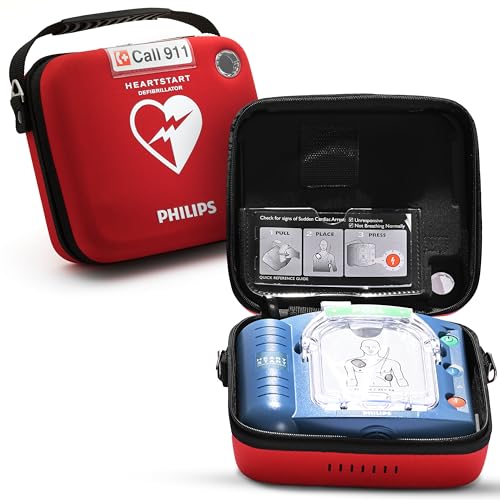
1. Philips HeartStart OnSite AED Defibrillator, Slim Carry Case M5066A-CO2
Our pick — over 4.5★ from 100+ verified ratings; the strongest balance of quality and price.
The gold standard that weighs 5.34 pounds and tells you exactly what to do next.
This is the unit that the crowd has settled on — a 4.6-star favorite among over 130 owners for a reason. The moment you open the slim carry case, the Philips HeartStart OnSite begins issuing step-by-step voice prompts that guide a complete stranger through the rescue. Its SMART Analysis technology assesses the heart rhythm automatically, and if a shock is needed, the Quick Shock feature delivers it within 8 seconds — no button-mashing, no guesswork. Right after the shock, the same voice walks you through CPR in real time.
The self-test schedule is another big reason workplaces choose this one. The device performs a daily, weekly, and monthly self-check on its own, so you never have to calibrate it manually. Just glance at the green light and know it is ready. The AED itself carries an 8-year warranty, while the battery is covered for 4 years and the pads until their printed expiration date. At just 5.34 pounds, it is lighter than the SMFM portable model (9.4 pounds), making it far easier to carry from a cabinet to a victim in a hurry.
The only catch is that the voice prompts are available in English only. If your workplace has a multilingual team, you may want to verify that everyone can follow the instructions. But for most offices, restaurants, and gyms, the simplicity is the whole point — training is not required for use.
Why it wins
- Quick Shock delivers a shock within 8 seconds after analyzing the rhythm
- Full self-test cycle (daily, weekly, monthly) means zero manual calibration
- Weighs only 5.34 pounds — easy to grab and go
- 8-year warranty on the AED itself gives long-term confidence
The trade-off
- Voice prompts are English-only — not ideal for multilingual teams
- Slim case holds the AED and pads, but no space for a spare battery or extra cartridge
Right for: Any workplace that wants a proven, lightweight AED with self-maintenance and crisp voice guidance — from churches and small offices to gyms and restaurants.
Look elsewhere if: Your team needs a unit that speaks multiple languages, or you want a case that stores a spare battery and pads together.
2. Philips HeartStart OnSite AED Defibrillator, Standard Carry Case M5066A-CO1
The office-ready bundle that mounts on the wall and announces itself.
This is the version that turns an AED into an installed safety station. The Value Package includes the slim carry case AED plus a wall mount, an AED wall sign, and a Fast Response Kit. The wall mount lets you install the unit at the recommended height (4 to 5 feet high, one-hand accessible) so anyone can grab it without a step stool. The wall sign makes the location obvious — critical when adrenaline is running and seconds count. The Fast Response Kit typically includes extra supplies like a CPR pocket mask.
The good word-of-mouth here centers squarely on value for money (11 owners cite it as the top positive aspect) and ease of use (9 owners). One buyer who added this to a 5,000-square-foot venue called it a complete package ready for use until medics arrive. The battery is rated for 4 years and the pads for 2 years, with affordable replacements available. The self-diagnostics run daily, weekly, and monthly so you never have to second-guess readiness. The total package weight is 8.9 pounds — the wall mount and extra accessories add heft, but the AED itself stays in the slim case.
What comes with it
- Wall mount and AED wall sign for a permanent installation
- Fast Response Kit with a CPR pocket mask and extra supplies
- Daily, weekly, and monthly automatic self-tests
- Battery lasts 4 years, pads last 2 years before expiration
The one thing to note
- At 8.9 pounds total, the package is heavier than the stand-alone unit — the wall mount and extras add weight
Right for: An office, church, or small business that wants a turnkey installation — mount it on the wall, put up the sign, and you are done.
pass on it if: You already own a wall cabinet or plan to keep the AED in a carry bag; you would be paying for accessories you do not need.


