Our readers keep the lights on and my smoothie glass nicely filled. As an Amazon Associate, I earn from qualifying purchases.
Specs are compiled from manufacturer listings and verified buyer reviews and can change over time — please confirm the key details on the product page before buying.
An affordable DSLR is a gateway, not a compromise — the right body and lens combo teaches you aperture, shutter speed, and composition in a way that your phone’s computational photography simply cannot. But the entry-level market is littered with bundles that look generous on paper and fall apart in practice: flimsy tripods, slow memory cards, and kit lenses that leave you squinting at soft corners. This guide cuts through bundle clutter and focuses on sensor resolution and autofocus confidence. — the sensor’s resolution and the autofocus system’s confidence — so you buy a camera you can grow into, not out of.
I’m Mohammad Maruf — the founder and writer behind WellFizz. This guide is built by comparing the manufacturers’ published specifications and the patterns across verified customer reviews, so you get each pick’s real strengths and trade-offs instead of marketing spin.
Whether you’re capturing your first golden-hour portrait or shooting a weekend soccer match, the affordable dslr camera that fits your hand and your budget is the one that rewards practice without punishing mistakes.
Our Picks at a Glance


How To Choose The Best Affordable DSLR Camera
Picking your first DSLR means balancing today’s budget with tomorrow’s shooting goals. The three decisions below are the core filters every buyer in this category faces.
Sensor Resolution vs. Low-Light Reach
A higher megapixel count lets you crop deeper and print larger, but it also packs more photosites onto the same chip, which can mean more noise when the sun goes down. A 24.2MP sensor gives you plenty of detail for wall prints, while an 18.0MP sensor (like the one in the Canon EOS 4000D) still produces sharp images for social media and 8x10s. Your real question is whether you shoot mostly in daylight — where any modern sensor shines — or in dim rooms where a lower-resolution sensor can feel cleaner.
Autofocus Confidence
Autofocus points are the camera’s ability to lock onto a subject anywhere in the frame. Nine points (most Canon entry models) covers the center of your viewfinder — fine for portraits and static landscapes. Eleven points (the Nikon D3400 and D5100) pushes coverage a bit wider. A 39-point system (the Nikon D5600) offers serious tracking for kids, sports, and wildlife, making it the safer bet if your subject moves.
Bundle Honesty
A “17-piece bundle” sounds like a steal until you find the flash is a plastic tube and the tripod wobbles in a breeze. The most valuable accessories are a reliable brand-name UHS-I memory card, a spare battery, and a padded bag. Wide-angle and telephoto adapter lenses screw onto your kit lens and degrade image quality — treat them as free toys, not pro tools. Prioritize camera and lens quality first; accessories should be a bonus, not a deciding factor.
Quick Comparison
| Model | Best For | Sensor Resolution | Autofocus Points | Max Continuous Shooting | Amazon |
|---|---|---|---|---|---|
| Nikon D3400 (Renewed)★ Best Overall | Budget-first new shooters | 24.2MP | 11 | 5 fps | Amazon |
| Canon EOS Rebel T7 Authorized BundleBundle King | USA warranty with extras | 24.1MP | 9 | 3 fps | Amazon |
| Nikon D5100 | Rugged versatility on a budget | 16.2MP | 11 | 4 fps | Amazon |
| Nikon D5600 (Brand New) | Performance and features | 24.2MP | 39 | 5 fps | Amazon |
In-Depth Reviews
1. Nikon D3400 Digital SLR Camera & 18-55mm VR DX AF-P Zoom Lens (Black) – (Renewed)
The beginner’s 24.2MP workhorse that punches above its renewed price tag.
The Nikon D3400 gives you a 24.2MP DX-format sensor without the blur filter that sits in front of most entry-level sensors, which means every shot arrives sharper straight out of the camera. The 11 autofocus points — a meaningful step up from the 9-point systems found on many Canon entry bodies — give you more flexibility to track a moving subject across the frame. It shoots at 5 frames per second, noticeably quicker than Canon’s 3 fps, so capturing a kid’s first goal or a dog catching a frisbee is far less frustrating. The SnapBridge Bluetooth (Bluetooth 4.0 or later) keeps your phone synced for quick social sharing without wrestling with cables.
What wins people over here is how the camera feels in the hand and how fast it responds. The Guide Mode is widely praised for teaching exposure basics without overwhelming a new photographer, and the autofocus locks on reliably even in mixed light. There is no optical low-pass filter in front of the sensor, so fine details like lace and foliage render with more bite than many rivals at this price.
Of course, this is a renewed camera, and the accessory lottery is real. A few units arrive with a battery that drains in 2-3 hours or a charger that simply does not work. The body itself, however, is almost universally described as “like new” by owners, and the lens is sharp. If you are comfortable rolling the dice on a charger replacement, you get an excellent sensor and a fast burst rate for a very low entry cost.
Sharpest Kit for the Price
- 24.2MP sensor with no OLPF — delivers noticeably sharper detail than 18MP rivals.
- 11 autofocus points offer a real advantage over 9-point systems for moving subjects.
- 5 fps continuous shooting captures action the 3 fps Canon bodies struggle with.
The Accessory Roulette
- Battery and charger are hit-or-miss; some buyers report a dead charger immediately.
- Renewed condition is generally excellent, but the accessories can feel like leftovers.
Reach for this if: you want the highest image resolution and fastest burst rate at the lowest entry price, and you are comfortable buying a separate charger as insurance.
Think twice if: a fully reliable out-of-box experience with a full warranty is non-negotiable — this is a renewed body with potential accessory quirks.
2. Canon EOS 2000D / Rebel T7 DSLR Camera w/EF-S 18-55mm F/3.5-5.6 Zoom Lens + 64GB Memory, LED Video Light, Case, Gripster Tripod, and More (Essential Bundle) (Renewed)
A turnkey starter set with a 24.1MP sensor and every accessory a beginner actually needs.
The Canon E same Canon Rebel T7 24.1MP sensor you get in the bundles above, but packaged as a factory-fresh kit with a shoulder bag and a 64GB card. The DIGIC 4+ processor handles the usual entry-level tasks — Scene Intelligent Auto, Creative Filters, Full HD 1080p video at 30 fps — and the 9-point AF system with center cross-type is rock-solid for portraits and static scenes. The 3.0-inch 920k-dot LCD is a significant step up from the 4000D’s 230k-dot panel, making menu navigation and image review genuinely pleasant. The battery is rated at around two hours of typical use.
The consensus among owners is that this is an “excellent entry-level system” that comes with everything needed and produces “stunning, true-to-life photos.” The simplicity of the auto modes draws consistent praise — you pull it from the start, charge the battery, and shoot immediately without wading through menus. It is lightweight (the body alone is comfortable for a long day out) and the Wi-Fi connectivity via the Camera Connect app is described as “awesome” for sharing on the go.
The catch is the 9-point AF and 3 fps burst rate, which are the same limits as the cheaper Canon bodies. You are paying a premium for factory-new condition, a full warranty, and the confidence that no renewed unit’s charger or battery will let you down. Compatibility and functionality receive mixed mentions in reviews, which usually refers to the Wi-Fi app glitching on certain phones — not the camera itself.
Fresh-out-of-box confidence: if you want a 24.1MP camera that works perfectly the first time and every time, with a known battery and a full Canon warranty, this is the safe bet. The performance ceiling is the same as the bundle versions, but the experience floor is higher.
Ideal for: the cautious buyer who wants zero risk of a renewed lemon and values a pristine, sealed-box experience over saving a few dollars.
Not for: anyone who needs to shoot action — the 9-point AF and 3 fps cap still apply regardless of how new the body is.
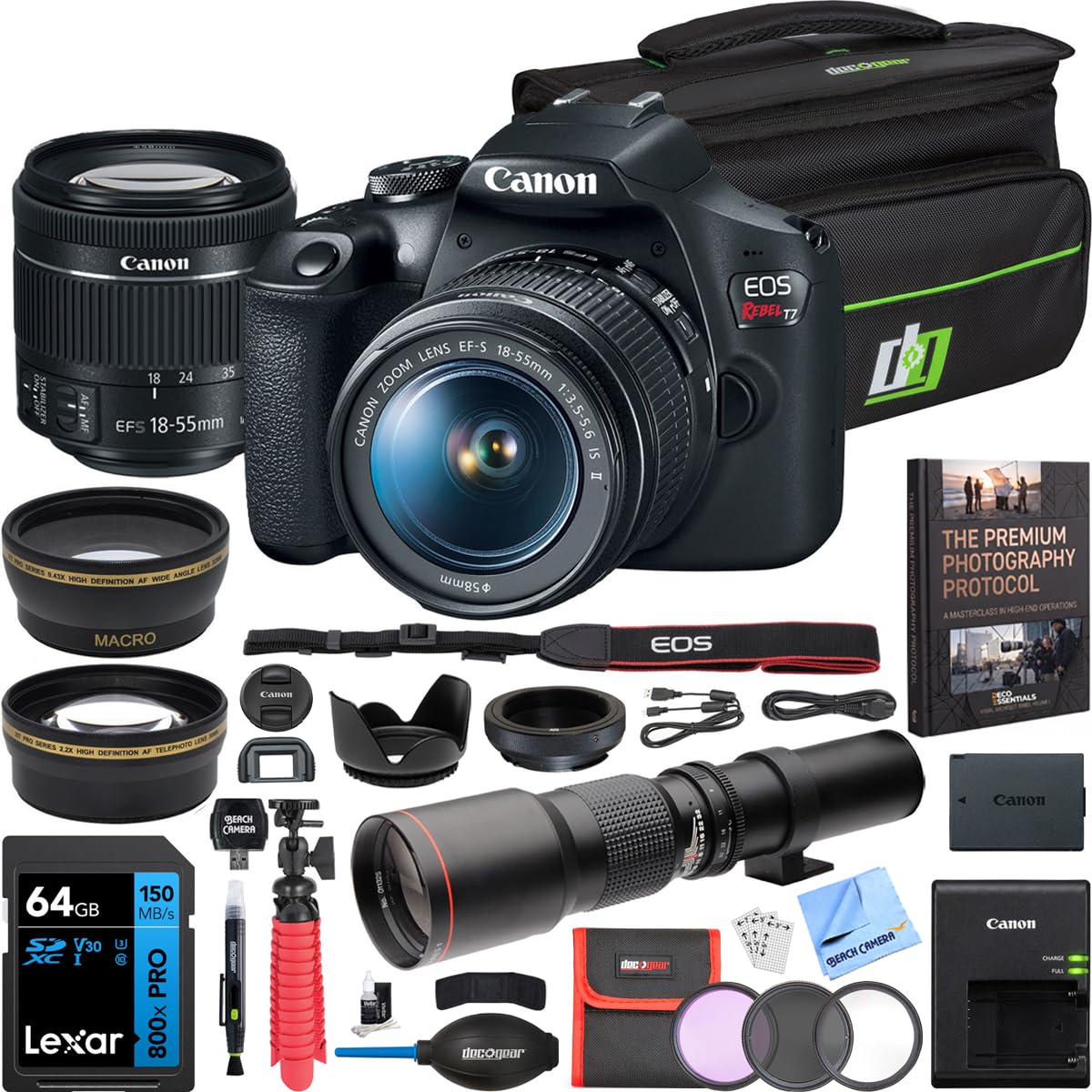
3. Canon EOS Rebel T7 DSLR Camera Bundle with Canon EF-S 18-55mm f/3.5-5.6 is II Lens + 2X 32GB Memory Cards + Filters + Preferred Accessory d, Photography Pro Guidebook and Accessories (13 Items)
A Canon USA authorized bundle that adds real telephoto reach to the entry-level T7.
This is the only kit in the guide that carries Canon USA’s full warranty, which is a significant advantage if you ever need service. The core camera is the familiar 24.1MP Rebel T7 with a DIGIC 4+ processor, 9-point AF, and 3 fps shooting. What sets this bundle apart is the inclusion of a 500mm preset f/8 telephoto lens with a T-mount — a fixed-focus, fixed-aperture super-tele that brings distant subjects (birds, the moon, faraway wildlife) into the frame without spending thousands on a native 500mm lens. It also includes a 0.43x wide-angle adapter, a 2.2x telephoto adapter, a tulip lens hood, a Deco Gear camera bag, a 64GB Lexar 800x SDXC card, and a 12-inch tabletop tripod.
The quality of the camera itself earns the most praise — “awesome camera” is a common sentiment — and the bundle is considered excellent value for a beginner stepping up from a phone. The 500mm lens introduces you to super-telephoto composition, even though its f/8 fixed aperture requires bright light and a steady support. The 64GB Lexar card is a fast, reliable brand, and the bag is practical.
The consistent frustrations center on battery life, with some owners reporting the battery dies after fewer than ten shots on a full charge — a sign that the included LP-E10 may be old or defective. The included bag is also too small to hold all items simultaneously. The 500mm lens is a preset (manual focus only at f/8), so it is fun to play with but not sharp enough for serious bird photography. The Wi-Fi feature works well for basic sharing, though some owners mention connectivity quirks.
Canon-Approved Extras: The USA warranty is the real differentiator here. The 500mm preset lens is a gimmick by professional standards but a brilliant teaching tool for a beginner curious about wildlife composition. The 64GB Lexar card is fast and reliable.
Grab this if: you want Canon’s full warranty backing and the ability to stick a 500mm lens on your camera day one, even if the image quality is basic.
Hold off if: battery life is critical for you — buy a spare LP-E10 immediately, because the included battery may be weak.
4. Nikon D5100 DSLR Camera with 18-55mm f/3.5-5.6 Auto Focus-S Nikkor Zoom Lens (OLD MODEL)

A 16.2MP veteran with an articulated screen and legendary durability.
The Nikon D5100 is an older camera — 16.2MP DX-format CMOS sensor, 11-point AF system with 3D tracking, 4 fps continuous shooting — but it holds a special place among budget DSLRs for two reasons: its 3-inch articulated LCD (920k dots) and its tank-like build quality. The articulating screen flips out and rotates, making self-portraits, low-angle shots, and video vlogging genuinely easy. The 11-point AF system with 3D tracking is responsive enough for moving subjects, and the 4 fps burst rate splits the difference between Canon’s 3 fps and Nikon’s 5 fps. ISO expands to 25600, and in-camera effects add creative fun.
What the review pages call out is the image quality — “crisp, tack-sharp images” and “phenomenal low light performance” are recurring themes. The kit lens’s VR (vibration reduction) eliminates shake even at longer focal lengths, and battery life is exceptional, with one owner reporting 1500+ shots on a single hike. Build quality is also a standout; the body has survived drops that would shatter a modern entry-level plastic chassis.
The compromises are obvious: 16.2MP is the lowest resolution in this guide, limiting your ability to crop deeply into a scene, and the video output is 1080p without the 60 fps of newer bodies. The articulated screen must be flipped open to view photos, which some owners find annoying, and the menu system is less intuitive than the newer D5600. It is an old model — you are buying proven performance, not new features.
Made for Real-World Abuse
- The articulated 3-inch LCD enables creative low-angle and self-portrait compositions.
- 11-point AF with 3D tracking is fast and accurate, especially for action.
- Battery life of 1500+ shots per charge is class-leading.
Dated Specs to Know
- 16.2MP sensor limits cropping potential compared to 24MP rivals.
- No 60 fps video; playback requires the flip screen to be open.
- Heavier plastic build than the D5600, though it feels more sturdy.
Buy it for: the best low-light performance and build quality at this price point, plus the articulating screen that makes it the most flexible camera for vlogging and self-portraits.
skip it if: you need maximum resolution for cropping — the 16.2MP sensor leaves less room than the 24.2MP Nikon D5600.
5. D5600 DX-Format Digital SLR w/AF-P DX NIKKOR 18-55mm f/3.5-5.6G VR

The brand-new D5600 with a 3.2-inch vari-angle touchscreen and 39-point AF.
This is the same D5600 body as the renewed dual-lens kit above, but sold as a factory-new unit with only the 18-55mm VR kit lens. The core specs — 24.2MP DX sensor, 39-point phase-detection AF, 5 fps burst, and Full HD 1080p video at 60 fps — are identical. The 3.2-inch 1.037m-dot vari-angle touchscreen is one of the best LCDs on any camera in this price range, and the SnapBridge Bluetooth and Wi-Fi with NFC keep your phone synced without cables.
Buyers consistently praise the camera’s image quality as “crystal-sharp” and find it lightweight and easy to use, with one owner calling it “perfect” and noting the battery arrived charged and ready to shoot. The 39-point AF system is a genuine step up from the Canon 9-point systems, making this camera competitive for action and wildlife. The 18-55mm VR kit lens is decent in good light, though several owners recommend pairing it with a 50mm f/1.8 for better portrait sharpness and low-light performance.
The Bluetooth connectivity receives mixed feedback — it is useful for remote shooting via SnapBridge, but the app requires frequent re-pairing and can be buggy. The single command dial makes manual mode more cumbersome than the D7xxx series, and there is no USB charging, so a spare battery is essential for a full day out. Battery life itself is mixed, with some owners reporting roughly 40 shots before a swap — a figure that suggests the camera was not fully charged or the included battery was not fresh — while others report solid endurance. This is the premium choice for image quality and AF performance in a brand-new package.
top-tier AF & LCD
- 39-point autofocus system is the most advanced in the guide, ideal for action and wildlife.
- 3.2-inch vari-angle touchscreen at 1.037m dots is sharp, bright, and tilts for any angle.
- 24.2MP sensor with no OLPF produces exceptionally sharp, detailed images.
New Price, Familiar Limits
- Bluetooth app requires frequent re-pairing; Wi-Fi works better.
- Single command dial complicates full manual shooting workflows.
- No USB charging and mixed battery life — a spare battery is a must.
Reach for this if: you want the highest autofocus performance and best LCD in a brand-new camera, and you value a pristine, full-warranty experience over saving money on a renewed body.
Stick with the renewed dual-lens kit if: you want two lenses and accept the renewed condition; the image quality and AF of the body are identical.
Understanding the Specs
Megapixels (MP)
This is the number of millions of pixels your camera’s sensor captures in each frame. A 24.2MP sensor produces images around 6000 x 4000 pixels — enough for a sharp 20×30-inch print. An 18.0MP sensor produces roughly 5184 x 3456 pixels, still fine for an 8×10 or a large social media crop. The real difference shows up when you need to crop: 24.2MP gives you roughly 34% more cropping room than 18.0MP. For most beginners sharing online, either works beautifully.
Autofocus (AF) Points
Autofocus points are little sensors in your viewfinder that detect contrast or phase differences to lock focus. Nine points (the standard on most Canon entry DSLRs) cover a small area around the center of the frame — fine for a stationary portrait. Eleven points (Nikon D3400, D5100) extend coverage a bit farther to the edges. Thirty-nine points (Nikon D5600) spread across the frame, giving you the ability to track a running child or an animal moving unpredictably. More points equals more consistent focus on moving subjects.
Frames Per Second (fps)
This is how many shots the camera can capture in one second of continuous shooting. Three fps (most Canon entry models) is fine for a posed portrait or a landscape. Four fps (Nikon D5100) gives you a slightly better chance at action. Five fps (Nikon D3400, D5600) is genuinely useful for sports, running pets, or any fast-moving scene — it increases your odds of catching the perfect frame.
Sensor Size: APS-C
Every camera in this guide uses an APS-C sensor (also called DX by Nikon). This sensor is roughly 1.5x smaller than a full-frame sensor, which means you get a crop factor of 1.5x — a 50mm lens behaves like a 75mm lens on these bodies. This is standard for the affordable DSLR market and delivers excellent image quality. The smaller sensor also keeps the camera body and lenses lighter and cheaper than full-frame alternatives.
FAQ
Can I use older manual-focus Nikkor lenses on the Nikon D3400 or D5600?
Which is better for low light: the 18.0MP Canon EOS 4000D or the 24.2MP Nikon D3400?
How important is the vari-angle LCD on the Nikon D5100 and D5600?
Is buying a DSLR worth it in 2025, or should I just use my phone?
Do the wide-angle and telephoto adapter lenses in the bundles actually work well?
How long do the batteries last on these cameras?
Can the Canon EOS 2000D or Rebel T7 be used as a webcam?
What does “renewed” mean for these DSLR listings, and should I buy one?
Which of these affordable DSLRs has the best autofocus for moving subjects?
Do these cameras have image stabilization built in?
What is the best lens for portraits among these kits?
How long should these cameras last with proper care?
Final Thoughts: The Verdict
For the majority of shoppers, the affordable dslr camera winner is the Nikon D3400 because it delivers the highest resolution sensor (24.2MP), the fastest burst rate (5 fps), and the most responsive autofocus (11 points) at the lowest entry price. If you want a turnkey bundle with a warranty and a 24.1MP sensor, the Canon EOS 2000D / Rebel T7 Essential Bundle is the safest all-in-one choice. And for the beginner who wants to shoot everything — landscapes to sports — without upgrading for years, the Nikon D5600 Dual Lens Kit offers two VR lenses and a 39-point AF system that genuinely matches a semi-professional experience. Each of these nine cameras is a legitimate gateway; the right one simply matches your budget and your ambition.
How We Picked
We do not accept paid placement. Every pick is matched to a real buyer and a real use-case; we do not hands-on test units.
Sources & Methodology
Specifications: manufacturer listings and product documentation. Review insights: verified customer reviews, as of July 2026. Pricing: not shown on this page (it changes often); check the current price via the retailer link.
As an Amazon Associate, WellFizz earns from qualifying purchases. This does not affect which products we feature.
Related Guides

Mo Maruf
I created WellFizz to bridge the gap between vague wellness advice and actionable solutions. My mission is simple: to decode the research and give you practical tools you can actually use.
Beyond the data, I am a passionate traveler. I believe that stepping away from the screen to explore new environments is essential for mental clarity and physical vitality.