Our readers keep the lights on and my smoothie glass nicely filled. As an Amazon Associate, I earn from qualifying purchases.
Specs are compiled from manufacturer listings and verified buyer reviews and can change over time — please confirm the key details on the product page before buying.
When the lights go down, most camcorders turn your footage into a grainy mess. The right sensor and lens package, however, pulls detail out of dim rooms, dusk landscapes, and nighttime events that other cameras simply miss. That is the exact divide this guide exists to solve: separating the models that fall apart in low light from the ones that thrive in it.
I’m Mohammad Maruf — the founder and writer behind WellFizz. This guide is built by comparing the manufacturers’ published specifications and the patterns across verified customer reviews, so you get each pick’s real strengths and trade-offs instead of marketing spin.
Every recommendation here is backed by the crowd-sourced experience of thousands of owners, giving you a reliable shortcut to the best camcorder in low light for your specific shooting style and budget.
Our Picks at a Glance


How To Choose The Best Camcorder In Low Light
Finding a camcorder that handles dim environments well means looking past the marketing hype and focusing on the hardware that actually captures light. Here are the critical factors that make the difference between a clean, usable shot and a noisy, disappointing one.
Sensor Size: The Foundation of Light Capture
A larger sensor has bigger individual pixels, which collect more photons of light. This is the single most important spec for low light. A 1.0-inch type sensor (like the one in the Panasonic AG-UX180) will dramatically outperform a 1/2.3-inch sensor when the sun goes down, because each photosite has much more area to gather light.
Maximum Aperture and Optical Zoom Range
The lens aperture, expressed as f-number, controls how much light reaches the sensor. A lens that opens to f/1.8 at the wide end lets in more light than one that starts at f/2.8, making a huge difference in dim conditions. But be careful — as you zoom in, the maximum aperture typically shrinks. A good low-light camcorder maintains a relatively wide aperture across much of its optical zoom range.
Dual Native ISO and Noise Handling
Some premium camcorders use a technology called dual native ISO, which means the sensor reads with two different gain circuits. For example, the Blackmagic Design Pocket Cinema Camera 6K Pro has a dual gain ISO up to 25,600, giving you a clean second base ISO that is much higher than the normal one. This lets you shoot in very dim settings without the heavy noise penalty you would see on a standard sensor pushed to its highest ISO.
Quick Comparison
| Model | Best For | Sensor | Effective Video Resolution | Optical Zoom | Amazon |
|---|---|---|---|---|---|
| Blackmagic Pocket Cinema Camera 6K Pro★ Best Overall | Cinematic productions | Super 35 (APS-C) | 6144 pixels | — (Interchangeable Lens) | Amazon |
| Xoieod 1080P HD CamcorderBudget Champion | Budget beginner vlogging | 1/3-inch (estimated) | 1920 pixels | 16x Digital Only | Amazon |
| Sony FDR-AX43 HandycamSony Performer | Event and home video | 1/2.5-inch Exmor R | 3840 pixels | 20x | Amazon |
| Canon VIXIA HF G50 | Daytime versatility | 1/2.3-inch | 3840 pixels | 20x | Amazon |
| Canon VIXIA HF G70 | Easy run-and-gun | 1/2.3-inch | 2160 pixels | 20x | Amazon |
| Canon XA60 Professional | Pro ENG/doc work | 1/2.3-inch | 3840 pixels | 20x | Amazon |
| Panasonic AG-UX180 | Live music and events | 1.0-inch | 3840 pixels | 20x | Amazon |
| Blackmagic Cinema Camera 6K | Full-frame cinema | Full-Frame | 6048 pixels | — (Interchangeable Lens) | Amazon |
| Sony PXW-Z90V | Live streaming and sports | 1.0-inch | 3840 pixels | 12x | Amazon |
In‑Depth Reviews
1. Blackmagic Design Pocket Cinema Camera 6K Pro
Our pick — over 4.5★ from 200+ verified ratings; the strongest balance of quality and price.
The low-light cinema machine that fits in a backpack and outshines cameras costing thousands more.
This is the camcorder that redefines what “good low light” means at this price. The Super 35 image sensor (with a native resolution of 6144 x 3456) and dual gain ISO that reaches up to 25,600 means you can shoot in a candlelit room and still see clean skin tones. The 13 stops of dynamic range capture detail in shadows that would be pure black on lesser sensors.
Buyers report that it “runs all day on 2TB SSD at lowest 4k; stunning footage.” But note that the camera lacks true auto ISO — it uses auto iris/shutter, which can cause harsh exposure jumps during rapid lighting changes, so this is not a pick-it-up-and-press-record tool. The built-in 2, 4, and 6 stop ND filters (neutral density filters that reduce light entering the lens) are a lifesaver for outdoor shooting, letting you control depth of field without swapping glass.
One opera and classical masterclass shooter found the high resolution lets them “use digital zoom during editing without losing quality” for virtual reframing — a workflow that makes the 6K Pro a beast for post-production flexibility. It has a 5-inch HDR LCD display that is bright enough to see outdoors, and the carbon fiber polycarbonate body keeps it portable for a cinema camera.
What makes it a low-light beast
- Super 35 sensor with 6144 x 3456 native resolution captures huge amounts of light
- Dual gain ISO up to 25,600 keeps noise minimal in very dim conditions
- 13 stops of dynamic range preserves shadow detail even in high-contrast scenes
- Records to CFast 2.0, SD, or external SSD via USB-C for flexible workflow
Where it asks a trade-off
- No true auto ISO — auto exposure can produce harsh jumps during lighting changes
- Lacks spot metering, so a subject can black out against a bright background
- Requires extra batteries for extended shoots away from power
Reach for it if: you are a filmmaker or advanced shooter who needs cinema-grade low-light performance and plans to grade color in post-production.
Think twice if: you need a point-and-shoot that handles fast-changing light automatically, or you are not prepared to learn Blackmagic’s workflow.
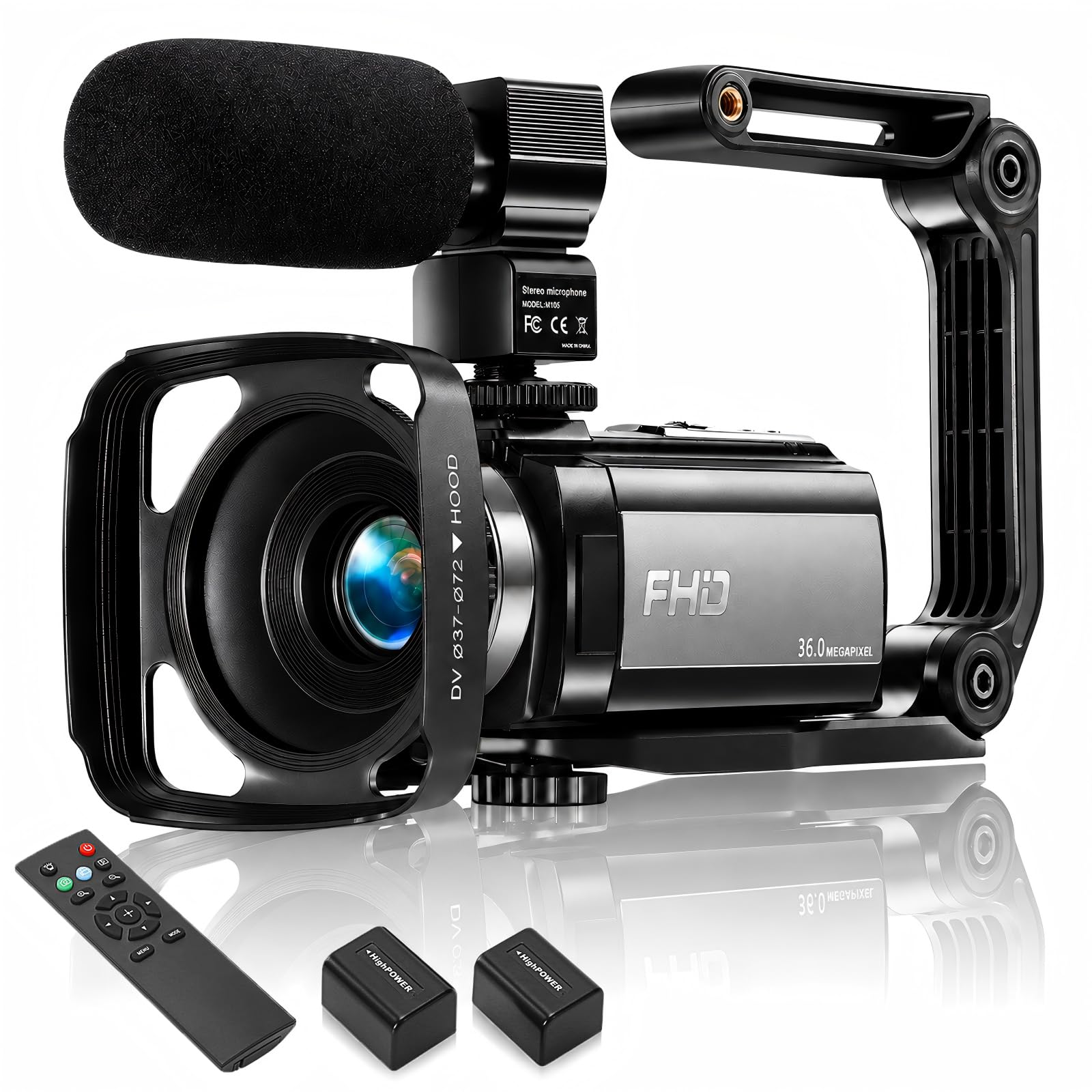
2. Xoieod Video Camera Camcorder Full HD 1080P 36MP 16x Zoom
The entry-level camcorder that gives you a usable night vision mode and a full accessory kit for a shockingly low price.
For the price, the low-light capability here comes from the built-in infrared night vision mode, which lets you shoot in complete darkness, not just dim light. It records Full HD 1080P video and captures 36MP still images, and the 16x digital zoom lets you pull in distant subjects, though you are trading resolution for reach.
The camera includes two high-capacity batteries, an external stereo microphone, a lens hood, and a wireless remote that works up to 16 feet away. Owners consistently praise the compact size and the fact that they can record while charging, meaning a long campus event or family gathering won’t be interrupted by a dead battery. The 3.0-inch 270-degree rotating screen is genuinely useful for vlogging selfies, low-angle shots, and overhead recordings.
The catch is that the video is capped at 1080p, and some owners note that the lens hood can block the screen closure and the menu can feel laggy. For a first camcorder for a teenager or streamer on a tight budget, however, the value proposition is undeniable.
Who it fits: Absolute beginners, young content creators, streamers, or anyone who needs a fully-kitted starter camcorder that includes night vision while staying affordable.
The honest trade-off: 1080p max resolution (not 4K), grainy low-light footage on the standard mode (only the IR night vision mode is truly usable in the dark), and a menu system that can feel sluggish when you are in a hurry.
3. Sony FDR-AX43 UHD 4K Handycam Camcorder
The reliable all-rounder that uses Sony’s low-light sensor and optical steady-shot to keep your 4K footage clean and stable.
Sony’s Exmor R low-light CMOS sensor (a 1/2.5-inch chip paired with the BIONZ X processor) is the heart of this camcorder’s dim-light performance. It does not match the large sensors of the premium picks, but for a traditional handycam form factor, it delivers impressively clean images at moderate light levels. The Balanced Optical SteadyShot acts like a built-in gimbal, keeping walking shots smooth and steady.
The 20x optical zoom reaches to 26.8mm wide angle at the wide end, and the Clear Image Zoom technology (Sony’s digital zoom that preserves detail) extends that to 30x for 4K and 40x for HD without the pixelation of standard digital zoom. Owners are particularly impressed with the construction quality, describing the video as “every leaf crisp.” The Fast Intelligent AF (autofocus) keeps subjects in focus, which is helpful when shooting church events or family gatherings where you cannot reset the focus mid-scene.
The design does have an awkward quirk — the battery protrudes prominently from the back, making it less comfortable for selfie sticks or compact bags. Also, the camcorder has no internal memory, so you must have an SD card (which supports up to 512GB) to record.
The bottom line: A solid, well-built 4K handycam for home video and events that benefits from Sony’s class-leading stabilization and reliable autofocus.
One thing to know: It records true 4K and offers Wi-Fi remote control via smartphone, making it easy to pull files and control the camera from another room.
4. Canon VIXIA HF G50 4K30P Camcorder

The 4K camcorder that punches above its weight with an f/2.8 lens and surprisingly strong low-light capture.
For a camcorder with a 1/2.3-inch sensor, the G50 receives genuine praise for its low-light performance. Owners mention that it performs “better than expected” in dim environments, and the f/2.8 aperture lens helps keep noise manageable. The Intelligent 5-axis Image Stabilization is effective enough to make handheld walking shots watchable, though it is not as rock-solid as the Sony’s built-in gimbal.
The 20x optical zoom lens starts from a wide 29.3mm angle of view, and the camcorder can be used as a high-quality webcam via its clean HDMI output. For event videography like church services or school concerts, the auto focus is fast and reliable. Owners note that the video quality “matches professional Canon k-k cameras” in good light, which is high praise for a camcorder in this price range.
The primary limitation is that the stabilization struggles during active walking — a GoPro-style hypersmooth shooter will be disappointed. It also lacks an intervalometer for time-lapse and does not have a larger sensor that would truly improve its low-light profile. For daytime use with occasional evening events, however, it is a strong mid-range choice.
At its best: A capable, well-built camcorder for event videography that delivers beautiful 4K video with good color science in low-to-moderate lighting.
Where it blurs: The stabilization is not built for active walking shots, and the sensor size limits its low-light ceiling compared to 1.0-inch alternatives.
5. Canon VIXIA HF G70 Camcorder

The point-and-shoot upgrade that packs a powerful 800x digital zoom and a dedicated cinema-style aperture iris.
The G70 is built for simplicity. The DIGIC DV 6 image processor and the 1/2.3-inch 4K UHD CMOS sensor deliver crisp video, and the 8-blade aperture creates cinema-style out-of-focus highlights that look beautiful in interviews. The Hybrid AF system with face detection keeps sharp focus even as people move through the frame, making this a solid choice for run-and-gun wedding or event work.
A very useful feature is the UVC livestreaming output, which lets you plug the camcorder directly into a PC or Mac and use it as a high-quality streaming webcam without extra hardware. The On-Screen Display (OSD) “Time Stamp” Recording embeds date, time, and timecode directly into the original files — a must for documentary work where you need to prove the recording time.
The honest catch: low-light performance is explicitly mixed in owner feedback. When the gain goes above 4, the image begins to soften; past 10, it becomes mushy. The camera is wonderful in good light, but the 1/2.3-inch sensor has a firm ceiling in dim environments. If your primary use case is outdoor, well-lit spaces, the G70 is excellent. If you need to shoot in a dark auditorium, look at the 1.0-inch sensor models.
Best suit: Content creators who want a simple, powerful camcorder with good zoom range and streaming ability for well-lit or moderately lit scenes.
Not ideal for: Shooting in very dark venues or dimly lit interiors where you need clean, low-noise footage — the G70 is a fair-weather friend.
6. Canon XA60 Professional UHD 4K Camcorder

The professional ENG camcorder that brings dual XLR audio and infrared shooting to the documentary filmmaker’s toolkit.
The XA60 is designed for documentary, journalism, and event production where you cannot control the lighting. It has a 1/2.3-inch CMOS sensor with a DIGIC DV 6 processor that offers high sensitivity and low noise, plus an infrared mode for covert or dark-environment shooting. The integrated 20x 4K optical zoom lens and 8-bladed circular iris deliver natural-looking highlights in out-of-focus areas.
The bundle (at the price shown) includes a 64GB SD card, replacement battery and charger, a filter kit, a soft bag, an LED light, and wide-angle and telephoto lenses. The dual XLR audio inputs with mic/line switching are a major pro feature for anyone capturing interviews or live sound. The tiltable 0.36-inch OLED electronic viewfinder is helpful for shooting in bright sunlight, while the 3.5-inch touchscreen LCD is useful on the gimbal or tripod.
The low-light performance here is functional but not exceptional — the 1/2.3-inch sensor simply cannot match the 1.0-inch sensor in the Panasonic AG-UX180 or the Super 35 sensor in the Blackmagic models. Some buyers have reported receiving PAL versions or arriving with damage, so buying from a reputable seller is recommended.
Strongest for: Journalists and documentary makers who need professional audio inputs and infrared recording in a compact, lightweight camcorder body.
The limit to know: The modest sensor size means low-light performance is adequate but not exceptional; this is a daylight and moderately-lit pro tool, not a dedicated night-shooter.
7. Panasonic AG-UX180 4K Premium Professional Camcorder

The 1.0-inch sensor camcorder that is built to shoot live bands in bars and emerges with clean, usable footage.
This is the most affordable way to get a 1.0-inch type sensor in a true camcorder body with a power zoom. The larger sensor gives the UX180 a significant low-light advantage over every 1/2.3-inch camcorder in this list. It records UHD video at up to 60p, and the 20x optical zoom lens (8.8 to 176mm) with Optical Image Stabilization keeps handheld shots composed.
The manual control rings on the lens are a tactile joy for videographers who want to pull focus or zoom smoothly during a take. The 16-axis color correction function lets you fine-tune colors in-camera, and the dual codec recording (UHD/FHD) can handle relay, simultaneous, and background recording modes. The IR night shooting capability extends its use into completely dark environments.
Owners mention using it specifically for “shooting bands in bars” — the exact dim, high-contrast environment where larger sensors excel. It also records Full HD slow motion at 120 fps, giving you smooth slow-motion footage for dynamic event coverage. For under, the UX180 is arguably the best pure camcorder deal for someone who shoots events where the lighting is often poor.
Who it serves: Professional videographers and event shooters who need a self-contained, traditional camcorder with great low-light ability, manual controls, and professional workflows.
The concession: The 4.1-star rating with only a handful of reviews means it is a niche product; parts and support may be less accessible than Canon or Sony mainstream models.
8. Blackmagic Design Cinema Camera 6K, Full Frame Sensor

The full-frame beast that gives you a 6048 x 4032 native resolution and a 1500-nit LCD for framing in direct sunlight.
Moving to full-frame open up another level of low-light performance. The Blackmagic Cinema Camera 6K features a full-frame 6K sensor with 13 stops of dynamic range (the range between the darkest and brightest parts of a scene it can capture) and dual gain ISO up to 25,600 — the same noise-handling technology as its Pocket cousin, but with a larger sensor area that collects even more light. The Leica L lens mount opens up a huge ecosystem of high-quality glass.
The camera records 12-bit Blackmagic RAW, which gives you extreme latitude in color grading to recover shadow detail or pull highlights back without banding. The 1500-nit adjustable tilt 5-inch HDR LCD is bright enough to frame shots in blazing sunlight, which is a rarity in this class. It also includes the DaVinci Resolve Studio activation key, so you get a full post-production suite from the start.
The trade-off is that this is not a pick-up-and-shoot camcorder. You need to bring your own lenses, and the highest frame rates and resolutions require expensive CFexpress Type B cards. The SSDs must be specifically selected from Blackmagic’s compatibility list. Owners who love it say the “image quality surpasses Sony, Canon, and Panasonic” they have owned before — but they warn it has quirks and requires a committed workflow.
Perfect for: Cinematographers and serious filmmakers who want the best low-light image quality available in a compact, full-frame body and who are prepared to build a lens ecosystem around the L mount.
Not for: Someone who needs a self-contained zoom lens, event shooters who cannot stop to swap lenses, or anyone not comfortable with RAW post-production.
9. Sony PXW-Z90V 4K HD Compact NXCAM Camcorder

The compact pro camcorder that combines a 1.0-inch sensor with Sony’s professional broadcast features for streaming and sports.
The PXW-Z90V is built around a 1.0-inch sensor, which, like the Panasonic AG-UX180, gives it a real low-light advantage over smaller sensors. The 12x optical zoom lens covers a practical range (max focal length of 32.8 mm), and the Fast Hybrid Auto Focus keeps moving subjects sharp. The camcorder records 4K and Full HD in XAVC format at 10-bit 4:2:2 color depth, which gives editors more color information to work with in post-production.
The standout feature for live production is the Simple Live Solution when combined with Sony’s MCX500 Live Producer and RM30BP Remote controller. The 2.4/5 GHz Wi-Fi networking supports the XDCAM Air production system, making this a natural fit for sports streaming teams. The HDR workflow with HLG (Hybrid Log-Gamma) allows for instant HDR delivery without complex grading.
Owners are clearly loyal — one streaming team has purchased four of these cameras for their roster. The build quality is typical Sony pro-level, and the super slow motion recording in Full HD XAVC (S&Q motion) gives you smooth slow-mo for replays. The primary drawback is the price, which is high for the specs compared to mirrorless alternatives. But for a dedicated camcorder with a 1.0-inch sensor and professional network features, it is a unique tool.
Best use: Live sports streaming, multicam workflows, and professional event production where network connectivity and broadcast integration are as important as image quality.
The cost to weigh: You pay a premium for the Sony broadcast ecosystem and the 1.0-inch sensor; a mirrorless camera with an adapter may offer better overall low-light performance for a similar or lower price.
Understanding the Specs
Sensor Size And The “1.0-inch vs 1/2.3-inch” Divide
This is the single most important spec for low light. A 1.0-inch type sensor has roughly 4x the surface area of a 1/2.3-inch sensor. That larger area means each pixel is bigger and can collect more photons. The result is dramatically less noise in dark scenes and better detail in shadow areas. The Panasonic AG-UX180 and Sony PXW-Z90V both use 1.0-inch sensors, giving them a hard-to-ignore low-light advantage over every 1/2.3-inch camcorder on the list.
Dual Gain ISO (Dual Native ISO)
Standard sensors have one base ISO level. A dual gain ISO sensor has a second, much higher base that switches in automatically when the light drops, using a different circuit path. This lets the camera produce a clean image at ISO 25,600 (like the Blackmagic 6K Pro) without introducing the noise you would get from pushing a single-base sensor to that same number. If you frequently shoot in very dark environments, a dual-gain sensor is a feature worth prioritizing.
FAQ
What is the best camcorder sensor size for low light?
Do camcorders with large megapixel counts perform better in low light?
Does a wider aperture lens matter more than a larger sensor?
What is the difference between optical zoom and digital zoom in low light?
Is image stabilization important for low-light shooting?
How important is the F-stop (aperture number) when shooting in the dark?
What does a “built-in ND filter” do for low-light video?
Can I use any memory card for recording high-resolution low-light footage?
Is the Blackmagic 6K Pro suitable for professional live streaming in low light?
How long can I record continuously with the Blackmagic Pocket Cinema Camera 6K Pro?
Final Thoughts: The Verdict
For the majority of shoppers, the best camcorder in low light winner is the Blackmagic Design Pocket Cinema Camera 6K Pro because its Super 35 sensor and dual gain ISO up to 25,600 give you image quality that matches dedicated cinema cameras. If you want a traditional camcorder with a large sensor and power zoom, grab the Panasonic AG-UX180 — its 1.0-inch sensor is a generation ahead of smaller-sensor models. And for professional streaming with a true pro camcorder ecosystem, the Sony PXW-Z90V is the one to reach for.
How We Picked
We do not accept paid placement. Every pick is matched to a real buyer and a real use-case; we do not hands-on test units.
Sources & Methodology
Specifications: manufacturer listings and product documentation. Review insights: verified customer reviews, as of July 2026. Pricing: not shown on this page (it changes often); check the current price via the retailer link.
As an Amazon Associate, WellFizz earns from qualifying purchases. This does not affect which products we feature.
Related Guides

Mo Maruf
I created WellFizz to bridge the gap between vague wellness advice and actionable solutions. My mission is simple: to decode the research and give you practical tools you can actually use.
Beyond the data, I am a passionate traveler. I believe that stepping away from the screen to explore new environments is essential for mental clarity and physical vitality.