Our readers keep the lights on and my smoothie glass nicely filled. As an Amazon Associate, I earn from qualifying purchases.
Specs are compiled from manufacturer listings and verified buyer reviews and can change over time — please confirm the key details on the product page before buying.
A riding mower on a budget usually means settling for less power, a smaller deck, or constant trips to the gas station. But a new generation of machines is changing that — offering electric muscle and gas-engine grunt at prices that won’t make you wince. The trick is knowing which trade-offs matter and which ones you can skip entirely.
I’m Mohammad Maruf — the founder and writer behind WellFizz. This guide is built by comparing the manufacturers’ published specifications and the patterns across verified customer reviews, so you get each pick’s real strengths and trade-offs instead of marketing spin.
Whether you’re eyeing a zero-turn for a sprawling lawn or a battery-powered option for quieter mornings, this roundup of the top-performing budget riding lawn mower choices helps you match the right machine to your yard without overpaying.
Our Picks at a Glance
How To Choose The Best Budget Riding Lawn Mower
A riding mower is a multi-year investment even when you are buying on a budget. The cheapest option isn’t always the most affordable if it can’t handle your terrain or chews through expensive parts each season. Here are the three numbers that separate a smart buy from a costly mistake.
Cutting width vs. yard size
The deck width — measured in inches — directly determines how many passes you need to finish your lawn. A 42-inch deck covers roughly one-and-a-half times more grass per pass than a 30-inch deck. If you mow half an acre or more, jumping from a 30-inch to a 42-inch deck can save fifteen to twenty minutes each time you mow.
Gas vs. battery: the real trade-off
Battery-powered mowers eliminate oil changes, spark plugs, and gas-can trips. The trade-off is run-time: a set of batteries will handle a specific acreage before needing a recharge, while a gas tank keeps cutting until you refill it. For yards around an acre or less, modern electric riders are a fair match. Above that, gas still holds the edge on raw endurance.
Zero-turn vs. standard steering
A zero-turn mower pivots on its own axis, letting you whip around trees and flower beds without backing up and repositioning. Standard steering turns like a car, which is simpler but slower around obstacles. If your lawn has many tight corners, zero-turn is worth the premium. If your yard is mostly open, a standard steer model gets the job done for less money.
Quick Comparison
| Model | Best For | Cutting Width | Engine / Power | Weight | Amazon |
|---|---|---|---|---|---|
| Greenworks 60V 30”★ Best Overall | Electric quiet, small yards | 30 inches | Electric (60V battery) | 631 lbs | Amazon |
| Husqvarna Z242F 42” | Budget zero-turn agility | 42 inches | 21.5 HP Kawasaki gas | 551 lbs | Amazon |
| Husqvarna Z254F 54” | Large acreage speed | 54 inches | 24 HP 726cc FR730 gas | 595 lbs | Amazon |
In‑Depth Reviews
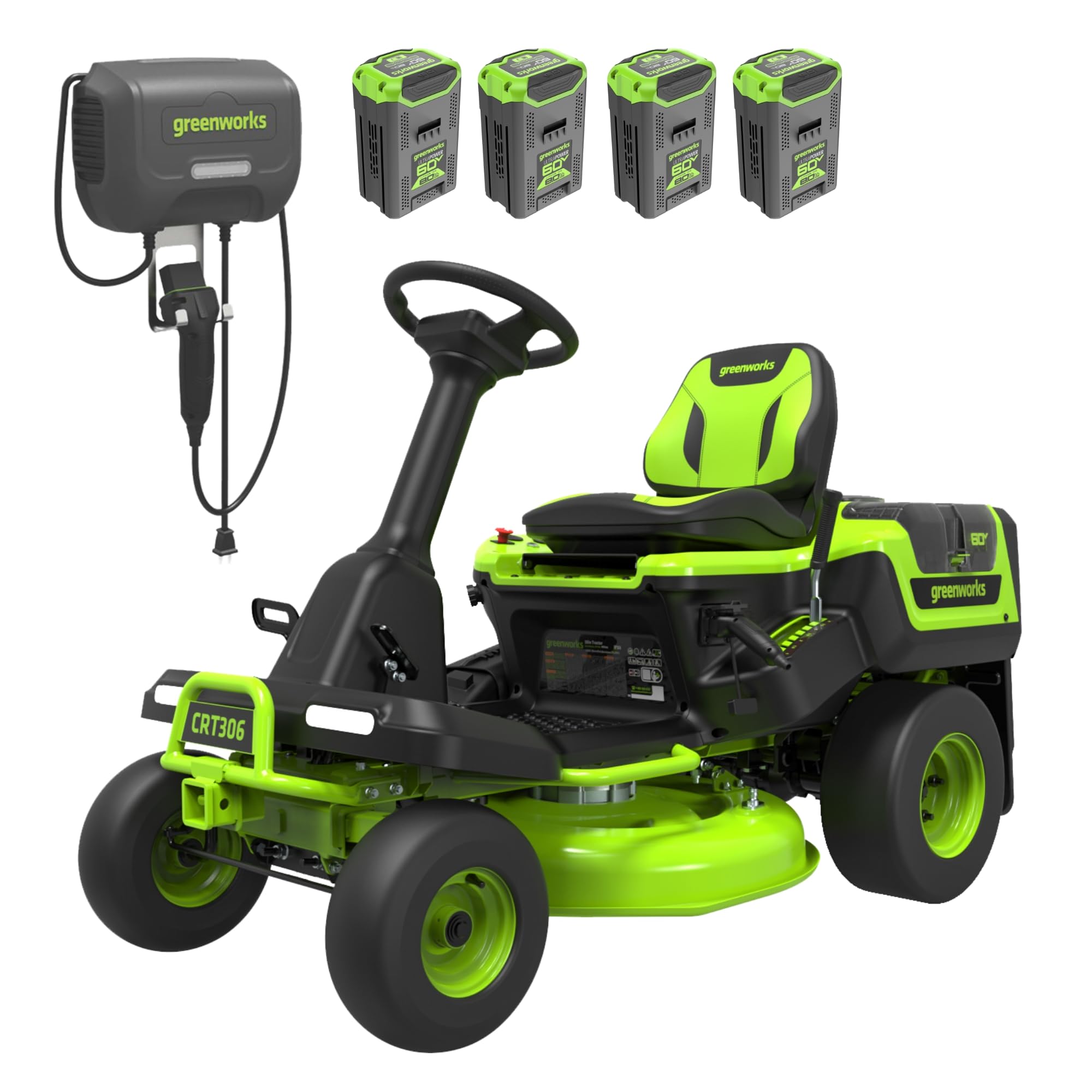
1. Greenworks 60V 30″ Riding Lawn Mower
The electric rider that slashes fuel costs and noise in one clean cut.
Silence is the first thing you notice. Instead of a roaring engine, you hear the blades whirring at a steady clip — and the neighbors might actually wave instead of scowl. This machine runs on four 8.0Ah 60V batteries (that is a total of 1,920 Wh of stored power), and owners confirm it handles a quarter-acre plus leaf blowing on a single charge, with juice still left over. The 30-inch stamped steel deck cuts at speeds up to 6 MPH, and a single lever adjusts the cutting height anywhere from 1.5 inches to 4.5 inches across seven positions.
The biggest selling point here is the electric endurance: the batteries power over 75 different tools in the same 60V Greenworks family, so one investment fuels your whole yard kit. SmartCut technology auto-adapts the torque when the grass gets thick, preventing bogging without you touching a dial. It also climbs slopes up to 15 degrees with adaptive traction control that keeps the mower tracking straight instead of sliding sideways. The rear hitch tows up to 200 pounds — enough for a small trailer or a sprayer.
The catch is the side discharge chute. At lower deck heights — around 2.5 inches — it drags on the ground and can pop off on uneven terrain. Assembly is straightforward, but the shipping crate is metal and requires a second person to unload. At 631 pounds, this is a heavy machine, so plan for delivery to a solid driveway.
Why Owners Stick With It
- Nearly silent operation — mow early without waking the house
- Buyers report “quick charge, excellent battery life” — one mowed 1/4 acre plus leaf blowing and still had 100% battery left
- Tows up to 200 lbs and powers 75+ tools from the same battery system
The Real-World Trade-Off
- Side chute drags at lower deck heights and can detach on uneven ground
- Heavy crate delivery — you will need help unloading at 631 pounds
Best for the quiet-hour mower: If you want to cut the fuel cord entirely and own a yard under 1.25 acres, this electric rider pays off every Saturday morning in peace and zero gas cans.
Think twice if: Your lawn has many low curbs or uneven dips where a dragging chute becomes a nuisance — a gas zero-turn may serve you better.
2. Husqvarna Z254F (54″) 24HP Zero Turn Mower

The wide-deck brute that chews through acreage in record time.
You cover more grass with each pass because the 54-inch fabricated steel deck is 12 inches wider than the Greenworks and 29 percent wider than the 42-inch Husqvarna Z242F. That means a two-hour chore on a smaller mower becomes a forty-five-minute cruise on this one. Under the hood sits a 24HP 726cc FR730 engine — a commercial-grade power plant that owners describe as making “fast work of cutting the grass.” The cutting height drops as low as 1 inch for that golf-course-short finish, adjustable across six positions.
Performance is the most-praised aspect from over a dozen owners. The deck handles hills and tight turns without drama. Buyers also note that the controls feel safe and convenient once the deck arrives properly aligned (a small crate adjustment was needed for some). The zero-turn capability means you pivot around trees and garden beds without backing up, saving more time on complex lawns.
The honest downside shows up at assembly. As owners mention, “mower didn’t start after assembly” — in one case a simple blown fuse solved it, but the frustration of a no-start after a big purchase is real. A few owners also mention a gas leak that required finding a local dealer for warranty work. The build quality draws mixed feedback overall, so treat the first few cuts as a shakedown period to tighten bolts and check connections.
Where This Mower Dominates
- 54-inch deck is the widest here — fewer passes, faster finish
- 24HP FR730 engine pulls through thick grass without bogging
- Zero-turn agility for obstacle-heavy yards
What to Watch For
- Occasional no-start after delivery (often a simple blown fuse)
- Build quality gets mixed owner feedback — budget time for initial adjustments
Reach for this if: You are managing 2-plus acres and want the fastest finish time your budget allows — the 54-inch deck and 24HP engine make short work of big fields.
Look elsewhere if: You are not handy with basic mechanical checks after delivery; a dealer-purchased zero-turn may give you more confidence out of the crate.
3. Husqvarna Z242F (42″) 21.5HP Kawasaki Zero Turn Mower

The entry-level zero-turn that packs a Kawasaki punch at a garage-friendly price.
At 551 pounds, this is the lightest machine in the lineup — a full 80 pounds lighter than the Greenworks electric and 44 pounds lighter than the Z254F. That lower weight makes it easier on turf and easier to maneuver in tight spots, but it also means the stock tires can spin out on level ground when the grass is damp. Owners who swapped to taller ATV-style tires at 3 PSI report the problem disappears entirely. The 42-inch cutting width splits the difference between the 30-inch electric and the 54-inch beast above, making it a solid middle-ground for yards around half an acre.
The 21.5HP Kawasaki engine is the star here — owners praise it as powerful and reliable, with no clogging even in wet grass thanks to the well-designed deck. The hydrostatic transmission requires no maintenance, and a clever automatic park brake engages when you move the steering levers outward — a nice safety detail when you hop off to move a sprinkler or pick up a branch.
The trade-off is consistency from the start. Some units arrive missing bolts and nuts, or without a battery. Others suffered from a stiff steering feel that never loosened up, and in one case the mower stopped moving forward entirely the next season. These are not universal problems, but they underscore the value of buying from a local dealer who can do the setup and stand behind the machine.
The 0.5-Acre balance: For a half-acre lawn with moderate obstacles, the Kawasaki engine and zero-turn agility give you gas-powered speed without the premium price tag of the 54-inch model. Just budget for aftermarket tires if your ground is soft.
Best value play for the half-acre owner: You get zero-turn capability and a respected Kawasaki engine at a price that undercuts most competitors by hundreds.
The honest caveat: Delivery assembly can be hit-or-miss — if missing bolts or a dead battery would sour the experience, consider buying from a local Husqvarna dealer instead.
Understanding the Specs
Cutting width and deck material
This is the single biggest time-saver on a riding mower. A wider deck covers more grass per pass, so you finish faster — especially on open lawns. Stamped steel decks (like the Greenworks 30-inch) are lighter and cheaper. Fabricated steel decks (like the Husqvarna 54-inch) are welded from thicker plate steel and handle more abuse over several seasons. For a budget buy, stamped steel is perfectly fine for most residential yards.
Zero-turn vs. traditional steering
A zero-turn mower uses independent rear wheels so you can spin 180 degrees in place, which cuts mowing time on complex lawns by eliminating three-point turns. Traditional steering is simpler and cheaper, but requires more room to turn around. If your yard has many trees, flower beds, or fence corners, zero-turn is worth stretching your budget for.
FAQ
How many acres can a budget riding mower handle?
Is a battery riding mower as powerful as a gas one?
What does “zero-turn” actually mean for my lawn?
How do I maintain a budget riding mower?
Can a budget mower handle hills and slopes?
Will a 30-inch deck take too long on my lawn?
Do I need to assemble the mower after delivery?
How long do the batteries last on the electric model?
What is the warranty on these mowers?
Final Thoughts: The Verdict
For most buyers, the budget riding lawn mower winner is the Greenworks 60V 30″ because it eliminates fuel, oil, and noise while still covering a typical suburban lawn on a single charge — and the battery system grows with you across 75+ outdoor tools. If you need maximum speed on 2-plus acres, grab the Husqvarna Z254F 54″ with its 24HP engine and wide fabricated deck. For the half-acre owner who wants zero-turn agility at the lowest entry price, the Husqvarna Z242F 42″ delivers a proven Kawasaki engine in a nimble, lightweight chassis.
How We Picked
We do not accept paid placement. Every pick is matched to a real buyer and a real use-case; we do not hands-on test units.
Sources & Methodology
Specifications: manufacturer listings and product documentation. Review insights: verified customer reviews, as of July 2026. Pricing: not shown on this page (it changes often); check the current price via the retailer link.
As an Amazon Associate, WellFizz earns from qualifying purchases. This does not affect which products we feature.
Related Guides

Mo Maruf
I created WellFizz to bridge the gap between vague wellness advice and actionable solutions. My mission is simple: to decode the research and give you practical tools you can actually use.
Beyond the data, I am a passionate traveler. I believe that stepping away from the screen to explore new environments is essential for mental clarity and physical vitality.