Our readers keep the lights on and my smoothie glass nicely filled. As an Amazon Associate, I earn from qualifying purchases.
Specs are compiled from manufacturer listings and verified buyer reviews and can change over time — please confirm the key details on the product page before buying.
Winter means waking up to snow piled across your driveway. You want a machine that cuts through drifts fast and does not break down halfway through. The key numbers — engine size, track system, and throw distance — decide whether you clear a drive in one hour or spend the whole morning out there. This guide covers four strong options for heavy use, from a 389cc gas powerhouse to a cordless model that skips the fumes.
I’m Mohammad Maruf — the founder and writer behind WellFizz. This guide is built by comparing the manufacturers’ published specifications and the patterns across verified customer reviews, so you get each pick’s real strengths and trade-offs instead of marketing spin.
Managing a long gravel driveway or a commercial lot? The right machine saves your back and your schedule. Here is the shortlist of the best commercial snow blowers for winter 2024, ranked by what owners actually say and the cold-hard specs.
Our Picks at a Glance
How To Choose The Best Commercial Snow Blower
Engine Displacement and Power
Measured in cubic centimeters (cc), this is the raw muscle behind the auger (the spinning blade that chews snow) and the impeller (the fan that throws it). A 270cc engine handles moderate residential loads. For deep, wet snow and frequent use, 300cc and up is the safer starting point. The Honda GX series engines are the gold standard here — commercial-grade reliability backed by decades of small-engine expertise.
Clearing Width and Intake Height
The clearing width determines how many passes you need for a given driveway. A 28-inch or 30-inch path cuts a two-lane drive in a few passes. Intake height matters for the first storm of the season — a 21-inch or 22-inch opening lets the auger pull in a deep drift without the top of the housing acting as a wall.
Track Drive vs. Wheels
On pavement that stays mostly dry, wheels with aggressive tread are fine. For slopes, gravel, or a base layer of ice, dual rubber tracks provide superior grip and balance. A track drive with a hydrostatic transmission (a system that uses fluid pressure to change speed smoothly without gear shifts) lets you adjust forward speed continuously without shifting gears. The auger keeps spinning at full speed regardless of how fast you move.
Throwing Distance
If your driveway is long and narrow, a 40-foot throw will leave snow banks right at the edge of the pavement. The next plow truck will push it back. A 56-foot or 60-foot throw puts the snow deeper into the yard, so it stays out of the way for good.
Quick Comparison
| Model | Best For | Engine Displacement | Clearing Width | Max Throw Distance | Amazon |
|---|---|---|---|---|---|
| Honda HSS1332AATD★ Best Overall | Large slopes and deep drifts | 389 cc | 32 inches | 56 feet | Amazon |
| Honda HSS928AAT | Gravel driveways and reliability | 270 cc | 28 inches | 52 feet | Amazon |
| EGO Power+ SNT2800 | No-gas, no-fumes convenience | Electric (motor) | 28 inches | 60 feet | Amazon |
| Massimo 384927523959 | Budget entry for paved surfaces | 302 cc | 30 inches | 40 feet | Amazon |
In‑Depth Reviews
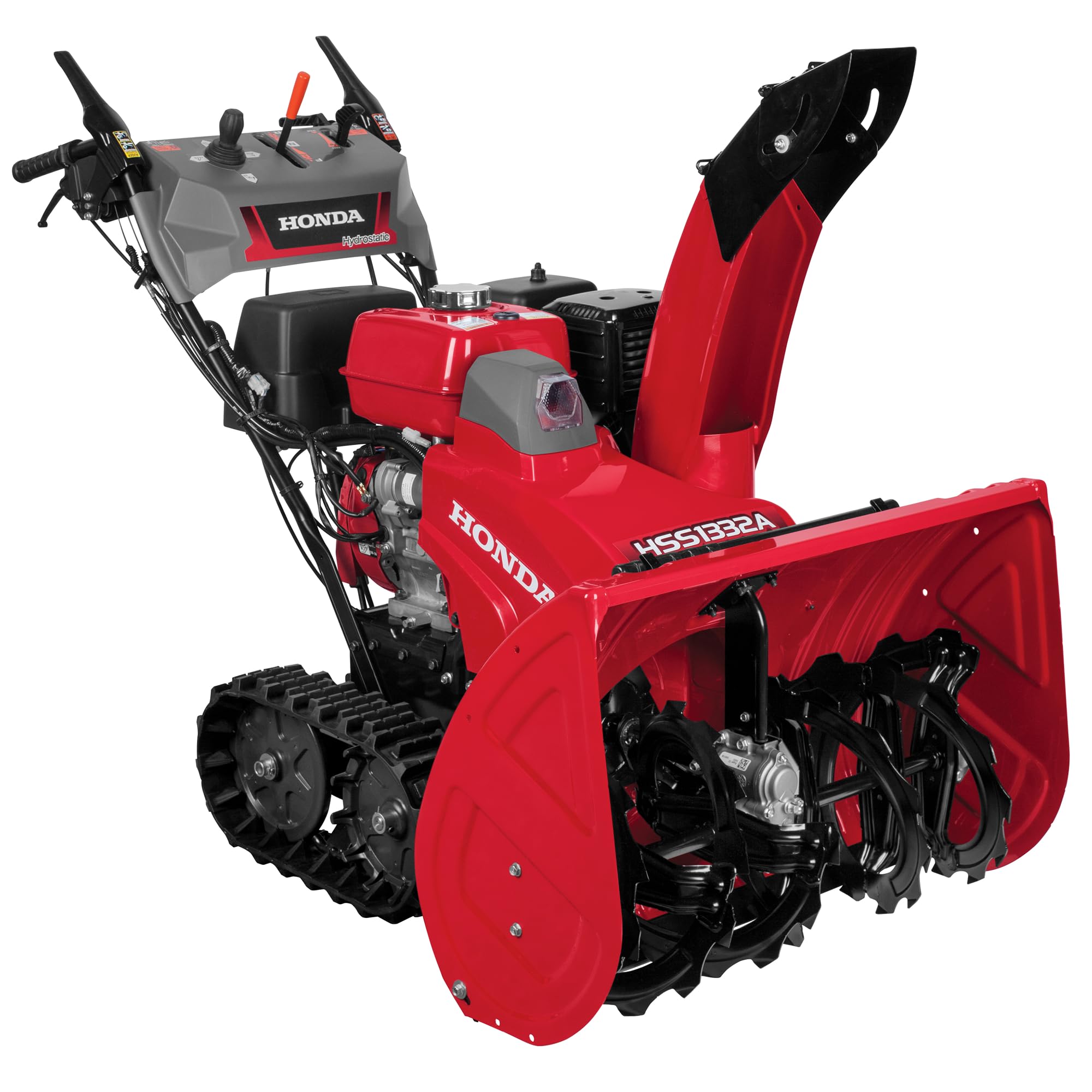
1. Honda HSS1332AATD
Our pick — over 4.5★ from 30+ verified ratings; the strongest balance of quality and price.
The 389cc track-drive beast that turns a 30-degree incline into a flat sidewalk.
You want one machine that handles every storm without excuses. The Honda HSS1332 delivers that with its commercial-grade GX390 OHV engine (389 cubic centimeters — the largest in this lineup). It powers a 32-inch clearing width and a 21.7-inch intake height, so it pulls in drifts that would stop smaller units cold. The dual rubber tracks with low-temperature cleats grip ice and loose gravel in a way wheels cannot match. The hydrostatic drive lets you move a lever to adjust speed without ever touching a gear shifter. The auger keeps spinning at full speed regardless.
Electric start means you turn a key on cold mornings instead of yanking a cord. An auger height control lever lets you dial in ground clearance for gravel without tools. The trade-off is turning effort — the track system demands some muscle to pivot. Reviewers across 39 ratings give it an average of 4.6 stars, backing the claim that this is a long-term investment, not a seasonal throwaway. Compared to the HSS928, you get 44% more engine displacement (389cc versus 270cc) and a 32-inch width versus 28 inches, which makes the HSS1332 better at churning through deeper drifts in one go.
Three-season confidence: Owners call the GX engine “tough to top” and describe the build quality as comparable to 1970s Ariens, with smooth operation and an expected lifespan measured in decades.
One honest trade-off: The rubber tracks grip everything, but pivoting on pavement demands shoulder effort. If your lot is tight with a turnaround, budget for extra maneuvering room.
Reach for this if: you have a long, sloped driveway, deep drifts, or commercial-grade expectations that demand a machine that starts every time and throws snow 56 feet.
Think twice if: your main lot is a small, flat slab where the extra track traction adds cost you will not use.
2. Honda HSS928AAT
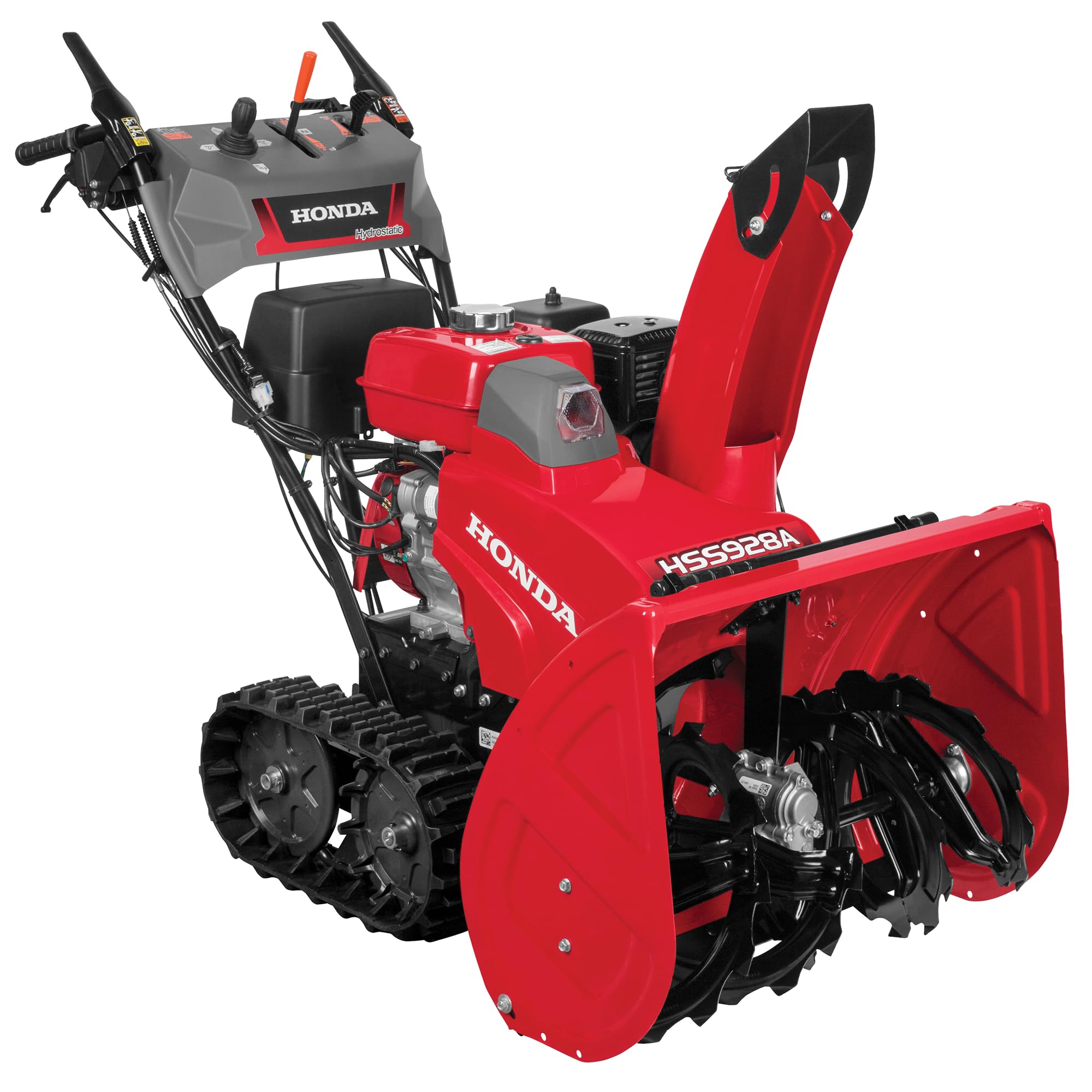
Seven years of owner loyalty and the same track-drive confidence in a slightly smaller package.
The HSS928 shares the same dual rubber track system and hydrostatic transmission as the larger HSS1332. It wraps those around a 270cc GX270 engine and a 28-inch clearing width. You still get the sure-gripping cleats on icy slopes and the no-shift speed control. The total machine clears 1900 pounds per minute instead of the HSS1332’s 2750. For most residential driveways and light commercial lots, that is plenty of appetite. Owners who have had this unit for seven years describe it as “a beast” that still “works great” with zero regrets.
The throwing distance reaches 52 feet, which trails the HSS1332’s 56 feet but still puts snow well past the pavement edge. Where this machine truly shines is on uneven, gravel-covered surfaces. Buyers report that after adding aftermarket side-mount skid shoes to fix an initial shear-pin issue (the rear-mounted skids created too much drag), the HSS928 handles steep gravel driveways as if they were paved. The trade-off: this model uses a recoil pull-start rather than electric start. Cold mornings require a firm tug to get the GX270 running. The crowd consensus across 28 ratings holds a 4.6-star average, with the most common praise being raw effectiveness on deep, slushy snow.
Where it leads
- Track-drive traction on gravel, ice, and slopes without wheel-spin aggravation
- Hydrostatic transmission keeps auger speed steady no matter how fast you walk
- Owner-reported 7-year history of trouble-free operation
Where it gives ground
- Recoil start demands arm strength in sub-zero temps
- 28-inch width and 270cc mean more passes and slightly less punch than the HSS1332 in very deep snow
Best for: owners with uneven or gravel driveways who want Honda track-drive reliability without paying for the biggest engine in the lineup.
skip it if: you need electric start in bitter cold or you regularly face drifts deeper than 24 inches — step up to the HSS1332.
3. EGO Power+ SNT2800
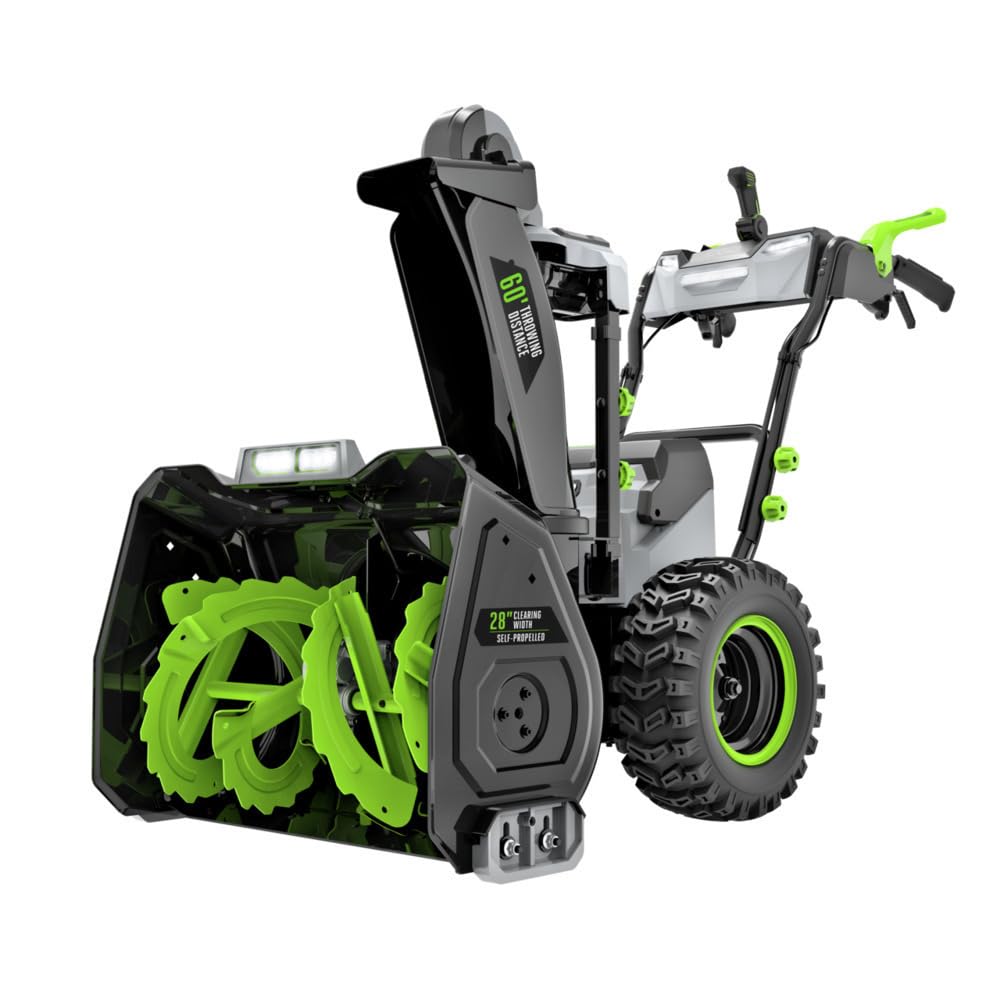
The cordless machine that throws snow 60 feet without a drop of gas or a single pull-start.
The EGO SNT2800 is the only battery-powered unit on this list. It earns its place by matching — in some cases exceeding — the throw distance of the gas contenders. The self-propel system uses trigger-controlled steering to help you pivot on the spot. The joystick-controlled chute rotates 200 degrees so you can aim the stream without stepping off the machine. Heated handle grips keep your hands comfortable on the coldest mornings.
The headline number is the clearing capacity: a single charge of two 12.0Ah batteries handles up to a 32-car driveway with 8 inches of snow. That places this EGO in a different convenience category — no gas to mix, no carburetor to winterize, no exhaust fumes while you work. Owners mention that the unit “runs through deep 15-inch heavy snow with ease.” They also warn that debris like sticks and stones can jam the gearbox. There is no shear pin (a breakable bolt designed to snap under impact), so an impact can require a full gearbox replacement. The average of 25 ratings sits at 3.9 stars. The most divisive topic is the electrical system reliability: a small group of owners experienced chute pitch seizure that burned out the control board. While the throw distance is 60 feet — better than the HSS1332’s 56 feet — the EGO works best for lighter snows where you do not test that gearbox with hidden debris.
The quiet advantage: you can clear snow at 6 AM without waking the neighbors, and there is zero engine maintenance between seasons. No oil changes, no spark plugs, no stale gas.
The honest limit: 8-inch ideal depth means this machine is best for lighter snows or areas where you clear after every storm. A single massive 24-inch dump may require the gas reserve.
Choose this for: convenience-driven buyers who hate gas station runs and prefer a push-button start that always works, on paved lots with manageable snowfall.
Consider the gas option if: your climate sees regular 18-inch+ storms or your driveway hides rocks and sticks that could wreck an un-shear-pinned auger.
4. Massimo 384927523959

A 30-inch, 302cc gas blower that looks the part but has drawn sharp feedback on durability.
The Massimo is the value play here. It offers a wide 30-inch clearing width and a 302cc engine that sits between the two Honda models in displacement. Features include electric push-button start, five forward speeds, two reverse speeds, and an LED light for low-visibility clearing. The 40-foot throw distance is the shortest of the four. That means snow lands closer to the pavement edge, which can become a problem with repeated plowing.
The honest reality from the owner base (22 ratings, averaging 3.3 stars) is a split story. Several customers note that the machine is heavy and difficult on uneven ground, with the front lip catching ice protrusions and the wheels spinning on packed snow. The most common owner complaint is belt breakage. Multiple reviewers point out the auger belt failed on first or third use, and replacement took weeks under warranty. One account sums up the frustration: “belt broke on 3rd use; seller/manufacturer refused return.” On the positive side, the customer service did offer a full refund and pickup to at least one owner who experienced a detached drive clutch cable. The recommendation that emerges from the reviews is clear: this blower works best on well-paved, flat surfaces where traction friction is not critical. It needs a careful pre-season inspection of belts and cables before the first storm.
What it delivers
- Wide 30-inch clearing path and a 302cc engine that pulls hard through heavy snow
- Electric push-button start and an LED light for dark-morning clearing
- Responsive customer service that has offered full refunds on defective units
What to watch for
- Recurring belt breakage reports suggest the auger belt is a known weak point requiring pre-season inspection
- Wheels struggle on ice or packed snow without chains; best considered as a paved-surface machine
Consider it for: a tight budget on a flat, paved driveway where you are handy with a wrench and can replace a belt yourself.
Look elsewhere if: you need a machine that starts working the day it arrives with zero part swaps, or if your lot includes any slope or gravel.
Understanding the Specs
Engine Displacement (cc)
This is the volume inside the engine’s cylinders. More cubic centimeters generally means more torque to spin the auger through wet, heavy snow. A 270cc engine is a strong residential choice. 389cc is the commercial balance that keeps the impeller spinning at full speed even in a 2-foot drift. The Honda GX engines on this list are overbuilt small engines designed for daily commercial use, not seasonal residential duty.
Track Drive vs. Wheel Drive
A track drive uses rubber belts with cleats — like a mini bulldozer — to distribute weight and grip over a larger surface area. That makes track-drive blowers stable on slopes, ice, and loose gravel where wheels dig in and spin. The trade-off is a heavier unit that requires more effort to turn on hard pavement. Wheel-drive machines are lighter and pivot easily, but they need aggressive tread or chains to match the same slope performance.
Clearing Width and Intake Height
Clearing width (in inches) determines how many passes it takes to clear a given path. 28 inches is standard; 32 inches saves one or two passes on a wide drive. Intake height is the opening the auger can grab per pass. A 20-inch intake height means the machine can eat a drift that deep in a single bite. Anything deeper requires the auger to cut the top off and then come back for the bottom.
Throwing Distance (Feet)
How far the impeller shoots the snow out of the chute. A 40-foot throw works when you have a wide yard, but the pile lands near the pavement. A 56-foot or 60-foot throw puts the snow deep into the lawn so the plow truck does not push it right back onto the driveway. The trade-off is that higher-throw machines typically need a larger engine and more fuel per hour.
FAQ
Will a track-drive snow blower damage my asphalt driveway?
How deep of snow can a 389cc Honda handle compared to a 270cc model?
Can the EGO battery blower handle an entire winter on a single set of batteries?
What maintenance does a gas commercial snow blower need each season?
Is a two-stage blower always better than a single-stage for commercial use?
Will a 28-inch clearing width save significant time over a 30-inch width?
How does the hydrostatic transmission help on a sloped driveway?
Can the Massimo blower be retrofitted with track drive for better traction?
Final Thoughts: The Verdict
For the majority of shoppers, the commercial snow blower winner is the Honda HSS1332AATD because its 389cc GX engine, 32-inch clearing width, and 56-foot throw distance turn the most punishing storm into a manageable chore with proven 4.6-star owner satisfaction. If you prefer a cordless, low-maintenance option that throws snow 60 feet without gas or fumes, the EGO Power+ SNT2800 is the one to reach for. And for the best Honda track-drive value on a tighter budget, the Honda HSS928AAT delivers the same hydrostatic control and rubber-track traction with a 270cc engine at a lower entry point.
How We Picked
We do not accept paid placement. Every pick is matched to a real buyer and a real use-case; we do not hands-on test units.
Sources & Methodology
Specifications: manufacturer listings and product documentation. Review insights: verified customer reviews, as of July 2026. Pricing: not shown on this page (it changes often); check the current price via the retailer link.
As an Amazon Associate, WellFizz earns from qualifying purchases. This does not affect which products we feature.
Related Guides

Mo Maruf
I created WellFizz to bridge the gap between vague wellness advice and actionable solutions. My mission is simple: to decode the research and give you practical tools you can actually use.
Beyond the data, I am a passionate traveler. I believe that stepping away from the screen to explore new environments is essential for mental clarity and physical vitality.