Our readers keep the lights on and my smoothie glass nicely filled. As an Amazon Associate, I earn from qualifying purchases.
Specs are compiled from manufacturer listings and verified buyer reviews and can change over time — please confirm the key details on the product page before buying.
The appeal of a compact 35mm film camera is simple: you want the look of film without lugging a brick of metal and glass around your neck all day. The trade-off is usually a plastic build and a fixed focus, but the latest generation of pocket cameras is closing the gap on image quality while keeping the weight under a cup of coffee.
I’m Mohammad Maruf — the founder and writer behind WellFizz. This guide is built by comparing the manufacturers’ published specifications and the patterns across verified customer reviews, so you get each pick’s real strengths and trade-offs instead of marketing spin.
You want a camera that slips into your jeans pocket and gives you that classic film look without spending a lot. The right compact 35mm film camera for you depends on three things: how much automation you want, whether you prefer a half-frame model (which gives you 72 shots per 36-exposure roll instead of 36), and how much plastic construction you can accept.
Our Picks at a Glance
How To Choose The Best Compact 35mm Film Camera
The three biggest decisions you face are the frame format (standard vs half-frame), the lens material, and how much control you want over the exposure. Here is how each breaks down in real-world shooting.
Frame format: half-frame or full-frame
A half-frame camera shoots two normal exposures per single 35mm frame, so a 36-exposure roll yields 72 pictures. That means half as many film changes and half the developing cost per shot. The catch is that each image is smaller on the negative, which limits how large you can print before grain becomes visible. If you share mostly on social media or make small prints, half-frame is a huge advantage.
Glass vs plastic lens
A glass lens element (like the one in the KODAK Snapic A1) delivers sharper detail and better contrast than the acrylic lenses found on the cheapest disposable-style cameras. Look for the words “glass lens” or “coated glass lens” in the spec sheet. That single sentence often makes the difference between a soft, hazy photo and one that looks crisp and intentional.
Automatic vs manual exposure
Most compact cameras in this category are point-and-shoot designs that handle the aperture and shutter speed for you. A few models offer a manual mode or exposure compensation. If you plan to shoot in changing light — from bright sun to heavy shade — an auto-flash or a program mode will save you from underexposed frames. But if you like to dial in the look yourself, look for manual ISO control and zone focus rings.
Quick Comparison
| Model | Best For | Lens Type | Focus System | Weight | Amazon |
|---|---|---|---|---|---|
| KODAK Snapic A1★ Best Overall | Best Overall point-and-shoot | 3-element glass lens | 2-zone focus | 117 g | Amazon |
| Pentax 17 Half-Frame Kit | Premium half-frame control | 25mm f/3.5 coated glass | 6-zone focus | 16 oz | Amazon |
| KODAK EKTAR H35N | Budget half-frame with extras | coated improved glass lens | Focus-free | 110 g | Amazon |
| Canon AE-1 Program Renewed | Classic SLR experience | 50mm f/1.8 FD mount | Split-image rangefinder | 735 g | Amazon |
In‑Depth Reviews
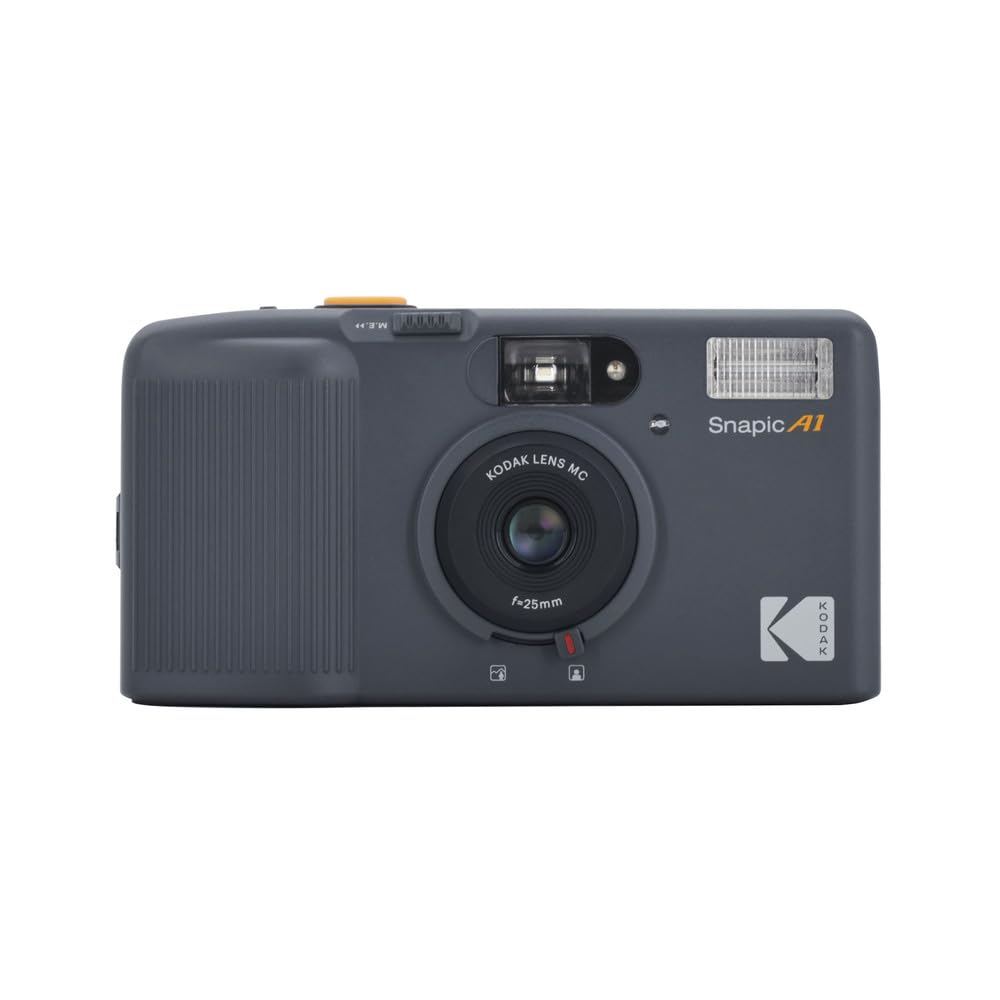
1. KODAK Snapic A1 35mm Film Camera
Our pick — 4.5★ from 100+ verified ratings; the strongest balance of quality and price.
A glass-lens point-and-shoot that weighs less than a soda can and costs less than a dinner out.
The thing that wins people over here is the 3-element glass lens. On a compact camera at this level, a glass lens instead of a plastic one is the single biggest difference between photos you want to print and photos you delete. Combined with a 2-zone focus system — anything past 5-6 feet goes on the distance setting — you get sharp, intentional images without any guesswork. The auto flash includes red-eye reduction, and it handles day-to-night transitions smoothly.
Weight is a huge part of the appeal here. At just 117 grams and measuring 4.65 x 2.44 x 1.38 inches, it slips into a front jeans pocket without bulging. It also auto-winds the film, auto-detects when to fire the flash, and auto-rewinds when you finish the roll. The only real limit is low light: as owners put it, “Daytime shots with Kodak Gold 200 are great; night shots underexposed.” That is the honest ceiling of a fixed-aperture compact — use it as a daylight companion and you will love it. The crowd loves the quality most — that is the aspect owners praise the most by a wide margin.
What wins people over
- Genuine 3-element glass lens delivers noticeably sharper images than plastic-lens competitors
- Auto film winding, auto flash, and auto rewind make it genuinely point-and-shoot simple
- Light and pocketable at 117 grams — you will forget it is there until you need it
The daylight-only limit
- Night shots come out underexposed even with the flash; stick to sunny or well-lit scenes
- Plastic build feels fine in hand but will not survive a drop onto concrete
The go-everywhere choice: If you want the sharpest photos from a jacket-pocket camera that does all the thinking for you, this is the pick. The glass lens gives you quality that the EKTAR H35N cannot match, while the price stays far below the Pentax 17.
The honest caveat: If you plan to shoot indoors or at night regularly, the underexposure issue will frustrate you — this camera lives for daytime and brightly lit rooms.
2. Pentax 17 Half-Frame Compact Film Camera Kit

A precision half-frame that packs 72 shots per roll and genuine creative control into a compact body.
The Pentax 17 sits in a category of its own among these picks. It uses a half-frame format, so a standard 36-exposure roll gives you 72 frames — ideal if you shoot a lot and want to save on developing costs. But what really separates it is the zone-focus system with six distinct zones from 0.25 meters to infinity. That gives you far more precision than the 2-zone systems on the budget models, while keeping the operation faster than through-the-lens manual focus.
It also has a 25mm f/3.5 fixed lens with Pentax’s HD coating, which reduces flare noticeably in backlit scenes. The manual ISO range of 50 to 3200 and exposure compensation of plus or minus 2 EV means you can adjust for tricky light without giving up on auto exposure. The downsides are real though: a handful of owners received units with shutter malfunctions, which points to a quality-control inconsistency at this price point. At 16 ounces, it is heavier than the Kodak options, though still comfortable for a day out. As one owner summed it up, it is “everything I wanted from a point and shoot” — but pick the right film speed for your conditions.
Six-zone precision: The zone-focus system spans 0.25m to infinity, giving you sharp focus at distances where fixed-focus cameras would go soft. The HD-coated 25mm f/3.5 lens delivers sharpness that justifies the premium price.
The quality-control gamble: A small but notable number of buyers report shutter failures on arrival. At this price, that is a frustrating hit-or-miss that the Snapic and EKTAR do not have.
For the enthusiast who shoots a lot: If you want half-frame efficiency, sharp glass, and flexible manual controls in a compact body, this is the most capable camera on the list. The 72-shot-per-roll format is a real advantage for daily carry.
Proceed with caution: The shutter-failure reports mean you should test the unit immediately on arrival. If you prefer a zero-headache experience, the Snapic A1 is the safer bet for significantly less money.
3. KODAK EKTAR H35N Half Frame Film Camera

72 shots per roll, a built-in star filter, and a focus-free lens that is pure grab-and-go.
The EKTAR H35N is a half-frame camera, so you get roughly 72 exposures from a standard 36-shot roll of film — the biggest per-roll value in this lineup. It uses a coated, improved glass lens (one element) and a focus-free system, meaning everything from a few feet out to infinity is in acceptable focus. That simplicity is exactly the point: load the film, point, and shoot. It also includes a built-in star filter that turns small light sources into four-beam flares, a fun effect for night shots.
At 110 grams, it is even lighter than the Snapic A1 and genuinely pocket-sized. The “bulb function” (a long-exposure mode) lets you capture light trails if you mount it on a tripod — a feature almost no other compact at this level offers. But the all-plastic build is very obvious in the hand; one owner called it “really cheap material but it works.” The slide-to-open button is also easy to hit accidentally inside a bag. As owners put it, “got decent pictures with it” using EKTAR 100 film. For the price, it is a friendly, low-stakes entry to half-frame shooting.
72 shots, one roll: Half-frame doubles your film economy. Combine that with the coated glass lens and built-in star filter, and you have a creative tool for the cost of a few rolls of film.
The all-plastic reality: The entire body is plastic — it works fine but feels cheap, and the slide-open button is prone to accidental opening in a bag. Handle it with care.
Best for first-time half-frame shooters: If you are curious about the 72-shot format and want the lowest-cost way in, this is your camera. The star filter and bulb function add creative options you will not get on the Snapic A1.
What to expect material-wise: The plastic shell is a genuine trade-off — it will not survive a drop, and anyone who wants a solid metal feel should look at the Canon AE-1 instead.
4. Canon AE-1 Program 35mm SLR Film Camera Kit

The legendary AE-1 with a 50mm f/1.8 FD lens, renewed and ready for shooters who want through-the-lens precision.
The Canon AE-1 Program is not a compact in the pocket-camera sense — the body alone is large enough that the Snapic A1 would be invisible next to it — but it is the most capable film camera on this list by a wide margin. It uses Canon’s FD lens mount, which opens up decades of sharp, affordable glass. The 50mm f/1.8 lens included in this kit gives you a fast, versatile prime that blows away any fixed-lens compact in low light and background blur.
This is a renewed (refurbished) unit, and the experience varies. Many owners received a camera in “flawless” condition, calling it a “beautiful collectors piece.” Others received a unit that was “dirty, nasty, and bad condition,” with one reporting a non-functioning shutter. At 735 grams and 7 x 4 x 4 inches, it is at 735 grams versus the KODAK Snapic A1 at 117 grams — a genuine heft that makes it a bag camera, not a pocket camera. The split-image rangefinder in the viewfinder makes manual focusing accurate and fast. It also offers a program mode (fully automatic aperture and shutter speed) plus full manual control. The most-discussed aspect is camera quality, with praise for the build when it arrives in good condition.
The legendary appeal
- Interchangeable FD lens mount means you can upgrade lenses later for different looks
- Fast f/1.8 aperture gives you real low-light capability and depth-of-field control
- Program mode makes it approachable as a first SLR while full manual mode grows with you
The renewed lottery
- Condition varies dramatically — some units arrive flawless, others are dirty or non-functional
- At 735 grams and bulky dimensions, this is the opposite of pocket-friendly compared to the Kodak models
- Reliability is a roll of the dice on a renewal with a 3.7-star average
For the dedicated enthusiast: If you want a true SLR experience with interchangeable lenses and fast glass, and you are willing to inspect the unit on arrival, this is the most rewarding photographic tool on the list. The 735-gram weight is a factor you feel all day.
Not a low-maintenance buy: The renewed condition is inconsistent. If a pocketable point-and-shoot that works from the start is your priority, the Snapic A1 or EKTAR H35N are far less risky choices.
Understanding the Specs
Half-frame vs full-frame
A half-frame camera captures two separate images on each standard 35mm frame, effectively doubling your film roll. A 36-exposure roll gives you 72 shots. The trade-off is that each negative is smaller, which limits how large you can enlarge a print before grain becomes visible. Full-frame cameras use the entire frame for one image, giving you more detail per shot but burning through film twice as fast.
Zone focus vs focus-free
Zone focus lets you select a specific distance range (like “near,” “group,” or “landscape”) using a ring on the lens. Six-zone systems are more precise than two-zone ones. Focus-free cameras keep everything from a few feet away to infinity in acceptable focus by using a small aperture and a wide-angle lens. That makes them simpler but less sharp at any specific distance. The Pentax 17 uses six zones; the KODAK Snapic A1 uses two; the EKTAR H35N is focus-free.
FAQ
Do compact 35mm film cameras need batteries?
What is the difference between half-frame and full-frame on a 35mm camera?
Is a glass lens on a compact camera worth the extra cost?
Can I use any 35mm film with these cameras?
How does the star filter on the EKTAR H35N work?
Will the Canon AE-1 Program fit in a pocket?
What does “zone focus” mean on a compact camera?
How many photos will I get from a 36-exposure roll on a half-frame camera?
Final Thoughts: The Verdict
For most people looking for a compact 35mm film camera, the KODAK Snapic A1 is the one to grab because it pairs a genuine 3-element glass lens with auto-everything simplicity at a weight you cannot feel in your pocket. If you want to double your shots per roll with a half-frame format and enjoy a built-in star filter, the KODAK EKTAR H35N is a low-stakes, fun entry point. And if you have the budget and want the sharpest half-frame experience with real zone-focus control, the Pentax 17 delivers premium image quality in a still-compact body.
How We Picked
We do not accept paid placement. Every pick is matched to a real buyer and a real use-case; we do not hands-on test units.
Sources & Methodology
Specifications: manufacturer listings and product documentation. Review insights: verified customer reviews, as of July 2026. Pricing: not shown on this page (it changes often); check the current price via the retailer link.
As an Amazon Associate, WellFizz earns from qualifying purchases. This does not affect which products we feature.
Related Guides

Mo Maruf
I created WellFizz to bridge the gap between vague wellness advice and actionable solutions. My mission is simple: to decode the research and give you practical tools you can actually use.
Beyond the data, I am a passionate traveler. I believe that stepping away from the screen to explore new environments is essential for mental clarity and physical vitality.