Our readers keep the lights on and my smoothie glass nicely filled. As an Amazon Associate, I earn from qualifying purchases.
Specs are compiled from manufacturer listings and verified buyer reviews and can change over time — please confirm the key details on the product page before buying.
Compression socks help with tired, achy legs. But if you are short, a standard pair often bunches painfully behind the knee or rolls down all day. That defeats the purpose of wearing them. This guide focuses on the few models that genuinely fit a shorter calf — no fabric sag, no knee-pit pinch, just consistent support where you need it, according to manufacturer specs and verified customer reviews.
The clear winner for most short women is the Truform 8865. It is the only pick in this guide with a purpose-built “short” length that solves the bunching-at-the-knee problem, and it delivers firm 20-30 mmHg (millimeters of mercury, a measure of sock tightness at the ankle) medical-grade support. If you want a gentler, everyday level, the JOBST Relief 15-20 mmHg Petite is your best bet.
I’m Mohammad Maruf — the founder and writer behind WellFizz. This guide is built by comparing the manufacturers’ published specifications and the patterns across verified customer reviews, so you get each pick’s real strengths and trade-offs instead of marketing spin.
Our Picks at a Glance


How To Choose The Best Compression Socks For Short Women
The biggest frustration is getting a sock that is simply too long. Always start by measuring your calf length — from the floor to the bend of your knee — and check the product’s sizing chart for a “petite,” “short,” or “knee-high” option that states an explicit calf height range. A good pair should end about one inch below the back of your knee, with no fold or roll.
Compression Level: 15-20 mmHg vs 20-30 mmHg
The mmHg number measures how tight the sock is at the ankle. 15-20 mmHg is a moderate, everyday strength ideal for travel, long work shifts, or mild swelling. 20-30 mmHg is firmer and is often recommended for more pronounced swelling, post-surgery recovery, or managing varicose veins. Starting at the gentler level is wise if this is your first time wearing compression.
Fit and Fabric Quality
Look for a reinforced heel pocket — this tiny feature prevents the sock from twisting around your foot during the day. A nylon-and-spandex blend gives the stretch needed for a snug but not painful fit. Also, consider if you want a closed toe (more warmth and support) or an open toe (better breathability and easier for checking nail health).
Quick Comparison
| Model | Best For | Compression Level | Style | Fit Type | Amazon |
|---|---|---|---|---|---|
| JOBST Relief 20-30★ Best Overall | Firm support / daily wear | 20-30 mmHg | Knee High, Open Toe | Regular (med/large) | Amazon |
| Truform 8865Also Great | Shorter legs / knee-length | 20-30 mmHg | Knee High, Closed Toe | Short / Petite | Amazon |
| JOBST Relief 20-30 (B0C9) | Edema / 10+ hour wear | 20-30 mmHg | Knee High, Closed Toe | Regular (sizes S-XL) | Amazon |
In‑Depth Reviews
1. JOBST Relief 20-30 mmHg Compression Socks, Open Toe, Beige, Large Full Calf
Our pick — over 4★ from 100+ verified ratings; the strongest balance of quality and price.
The physician-backed brand that proves its worth through quality and durability.
JOBST is the number one physician-recommended compression brand among US doctors, according to the product description. That medical reputation matters because compression is a medical device — not a fashion accessory. This pair delivers 20-30 mmHg firm compression with the proven graduated pressure profile that helps circulation. The open-toe design is a plus for those who need to monitor their toes or prefer a less constricted feel.
The quality stands out repeatedly in owner feedback, with many noting how well the material holds up after repeated washing. One long-time buyer sums up the value: “This product has been effective, is very good quality and has held up well (I hand wash them), and at a very good price.” However, because this specific listing is a “Large Full Calf” variant, it is not designed for shorter or smaller legs. The fit receives mixed feedback — owners with standard or smaller calves often find it too wide, which leads to bunching. If you are a short woman with a fuller calf, this could work; for most petite frames, look for a Medium or Petite variant in the JOBST line instead.
Proven quality, specific sizing: The JOBST brand is a reliable choice for medical-grade compression. The open toe gives flexibility, and the reinforced heel pocket keeps alignment correct. Just be sure to select a calf size that matches your measurement — the “Full Calf” variant is not for small or average calves.
Best for: Someone who trusts a physician-recommended brand and needs firm 20-30 mmHg support with an open toe. Works well if your calf is on the fuller side.
Look elsewhere if: You have a slender or petite calf — the “Large Full Calf” will be too baggy and will not provide proper compression.
2. Truform 20-30 mmHg Compression Stockings for Men and Women, Knee High Length, Closed Toe
The compression sock that short women call “perfect” — no knee bunching, no rolling agony.
The defining benefit here is the purposely shorter calf length, which buyers report solves the main problem with standard compression socks. As one owner put it: “The shorter length is perfect, they don’t bunch up around your knees and start hurting.” At 20-30 mmHg, this is a firm medical-grade level. — so it provides more aggressive support for managing swelling, varicose veins, and post-surgery recovery.
What wins people over is the construction. Owners mention these stockings hold up well wash after wash, with the reinforced fabric outlasting both prescription-grade and cheaper brands. The closed-toe design offers full coverage and warmth. The catch here is sizing — the Truform sizing chart is specific and requires a careful measure of your calf circumference and height; ordering the wrong “short” vs “regular” combo is the main source of returns. A few owners note a strong chemical smell when the stockings are wet, though it fades once dry.
Why It Fits Short Legs
- Purpose-built “short” length sits below the knee without bunching
- 20-30 mmHg provides firm, medical-grade graduated compression
- Thicker, durable fabric that lasts through repeated washing
- Unisex design works equally well for men and women
The Honest Fit Note
- Sizing is very specific — follow the height and calf chart closely or you risk the wrong fit
- A handful of buyers find it still too long if the wrong size variant is chosen
- Closed-toe style may not suit those who prefer an open toe for breathability
Solves your main problem: If you are tired of compression socks rolling down or digging into the back of your knee, this is the strongest option for a proper calf-length fit at a firm medical-grade level.
Check twice before you click: You absolutely must measure your calf height and circumference against Truform’s chart to get the “short” variant that fits you.
3. JOBST Relief Knee High Graduated Compression Socks, 15-20 mmHg, Medium Petite
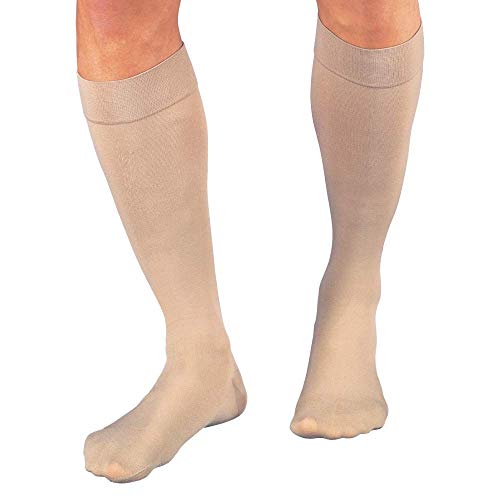
High-support work socks built for 12-hour days on your feet.
If you stand or walk for long shifts — nursing, teaching, retail — the 15-20 mmHg level here provides the firmest everyday support in the JOBST Relief line. Buyers consistently praise the compression level (the most-discussed positive feature), with many reporting that it significantly reduces leg swelling and foot pain during 10- to 14-hour workdays. The closed toe adds warmth and a secure, all-over feel. The reinforced heel pocket also ensures you get the sock on the right way every time.
The satisfaction here is high, but the feedback on durability is split. Some customers note the stockings tear after a few weeks, especially during the pull-on process, while others say they last for months with careful hand washing and air drying. Using a “donner” (a sock-sliding aid) is strongly recommended to avoid stressing the fabric. The fit also has mixed reactions — the sizing runs small for some, so a few buyers size up for comfort. If you are a shorter woman, note that this listing is for standard leg lengths; you will need to find a “petite” or short variant within the JOBST range to avoid extra fabric bunching.
Potent compression, careful handling needed: The 20-30 mmHg level is excellent for edema and leg fatigue. However, the mixed durability means this is best for someone who already knows their Jobst size and is prepared to baby the stockings during washing. Not ideal for a first-time buyer who is still figuring out their fit.
Ideal for: Experienced compression wearers who need firm support through long, active days and are comfortable with the care routine required.
Not your best bet if: You have short legs and need a petite-specific size — you will need to hunt for that variant, as this listing uses standard lengths.
Understanding the Specs
Compression Level (mmHg)
This number tells you how much pressure the sock exerts at your ankle, measured in millimeters of mercury. A higher number means tighter compression. For new users or mild swelling, 15-20 mmHg (moderate) is the standard starting point. For more significant edema (fluid swelling), varicose veins, or post-surgery support, 20-30 mmHg (firm) is common. Going above 30-40 mmHg usually requires a doctor’s prescription.
Graduated vs Uniform Compression
Graduated compression means the sock is tightest at the ankle and gradually loosens up the leg. This design helps push blood back upward toward your heart, reducing swelling and fatigue in your feet and lower legs. Any compression sock labeled Class II medical grade in the US must follow a verified graduated profile for safety and effectiveness.
FAQ
How tight should compression socks feel on my legs?
Will a petite or short length work for me?
What is the difference between 15-20 mmHg and 20-30 mmHg?
How do I wash compression socks without ruining them?
How often should I replace my compression socks?
What does “graduated compression” actually mean?
Are open-toe or closed-toe compression socks better?
Can I wear compression socks on a long flight?
Final Thoughts: The Verdict
For most people, the compression socks for short women winner is the Truform 8865 because it is the only pick on this list that explicitly solves the bunching-at-the-knee problem with a dedicated short length while delivering firm 20-30 mmHg medical-grade support. If you prefer a moderate, everyday compression level with a specific petite size, grab the JOBST Relief 15-20 mmHg Petite. And for those who need full-leg support that actually stays up, the JOBST Relief 15-20 mmHg Thigh High offers the best silicone grip and quality.
How We Picked
We do not accept paid placement. Every pick is matched to a real buyer and a real use-case; we do not hands-on test units.
Sources & Methodology
Specifications: manufacturer listings and product documentation. Review insights: verified customer reviews, as of July 2026. Pricing: not shown on this page (it changes often); check the current price via the retailer link.
As an Amazon Associate, WellFizz earns from qualifying purchases. This does not affect which products we feature.
Related Guides

Mo Maruf
I created WellFizz to bridge the gap between vague wellness advice and actionable solutions. My mission is simple: to decode the research and give you practical tools you can actually use.
Beyond the data, I am a passionate traveler. I believe that stepping away from the screen to explore new environments is essential for mental clarity and physical vitality.