Our readers keep the lights on and my smoothie glass nicely filled. As an Amazon Associate, I earn from qualifying purchases.
Specs are compiled from manufacturer listings and verified buyer reviews and can change over time — please confirm the key details on the product page before buying.
You want a chef knife that stays sharp, feels well-balanced in your hand, and won’t flex when you tackle a dense butternut squash — but staying within a budget can feel like a minefield of flashy blades that dull fast and slippery handles. This guide cuts through that confusion, focusing on the real specs and performance that matter for your daily prep, from edge retention (how long the blade stays sharp) to handle comfort.
I’m Mohammad Maruf — the founder and writer behind WellFizz. This guide is built by comparing the manufacturers’ published specifications and the patterns across verified customer reviews, so you get each pick’s real strengths and trade-offs instead of marketing spin.
Every knife below shares the same mission: to turn chopping, slicing, and dicing into a fluid, easy experience. Whether you are a home cook or a seasoned chef on a tight budget, these are the best options worth your attention. Use this guide as your final checklist when searching for the best chef knife under 50.
Our Picks at a Glance
How To Choose The Best Chef Knife Under 50
Choosing the right chef knife under this budget means knowing which corners to cut and which specs to prioritize. A premium-looking knife with a soft steel core will frustrate you after a month, while a simpler design with good geometry can last for years. Focus on a few key areas that determine daily usability.
Blade Steel and Hardness
The steel type directly controls how long the edge stays sharp. High-carbon stainless steel is the balance at this price — it resists rust while holding a keen edge. A Rockwell hardness rating (HRC, a scale that measures steel hardness) of 56 to 58 is a solid sign. Below 55, the blade will dull fast. Above 60, it may chip if you hit bone or a cutting board edge.
Handle Comfort and Grip
You will spend hours holding this knife, so the handle shape matters. Look for an ergonomic profile that fills your palm and prevents slipping when wet. Materials like Pakkawood (resin-impregnated wood), resin, or textured synthetic (TPE, Santoprene) offer a secure grip. A full-tang construction — where the steel runs the full length of the handle — adds weight balance and prevents the handle from snapping off under heavy use.
Edge Angle and Sharpness
A thinner edge angle (around 14 to 16 degrees per side) cuts with less resistance, making it easier to glide through tomatoes and meats. Many budget knives claim a razor edge, but hand-sharpened or laser-calibrated finishes are more reliable than a generic machine grind. Check if the blade comes pre-sharpened to a consistent angle, as this saves you a trip to the stone on day one.
Quick Comparison
| Model | Best For | Blade Length | Steel Type | Hardness (HRC) | Amazon |
|---|---|---|---|---|---|
| Damascus Chef Knife (Emojoy)★ Best Overall | All-round sharpness & presentation | 8 inch | 67-layer Damascus | 58 | Amazon |
| Huusk Japanese StainlessTop Performer | sturdy build with artistic handle | 8 inch | High Carbon Stainless | — | Amazon |
| SYOKAMI CleaverBest Value | Multi-purpose cleaver with herb stripper | 7 inch | High Carbon Stainless | 56+ | Amazon |
| Mercer Culinary M18000 | No-frills pro workhorse | 8 inch | Japanese High-Carbon | — | Amazon |
| Sunnecko 8 Inch | Versatile everyday home use | 8 inch | High Carbon Stainless | — | Amazon |
| SYOKAMI Kiritsuke | Precision carving and fine slicing | 8.2 inch | High Carbon Stainless | 56+ | Amazon |
| KEEMAKE Chef Knife | Ultra-sharp edge for precision work | 8 inch | 1.4116 High Carbon Stainless | 58±2 | Amazon |
| Kimura Chef Knife | Lightweight Japanese starter | 7.9 inch | High Carbon Molybdenum Stainless | 57 | Amazon |
| Victorinox Fibrox Pro | Time-tested pro standard | 7.9 inch | Stainless Steel | — | Amazon |
In‑Depth Reviews
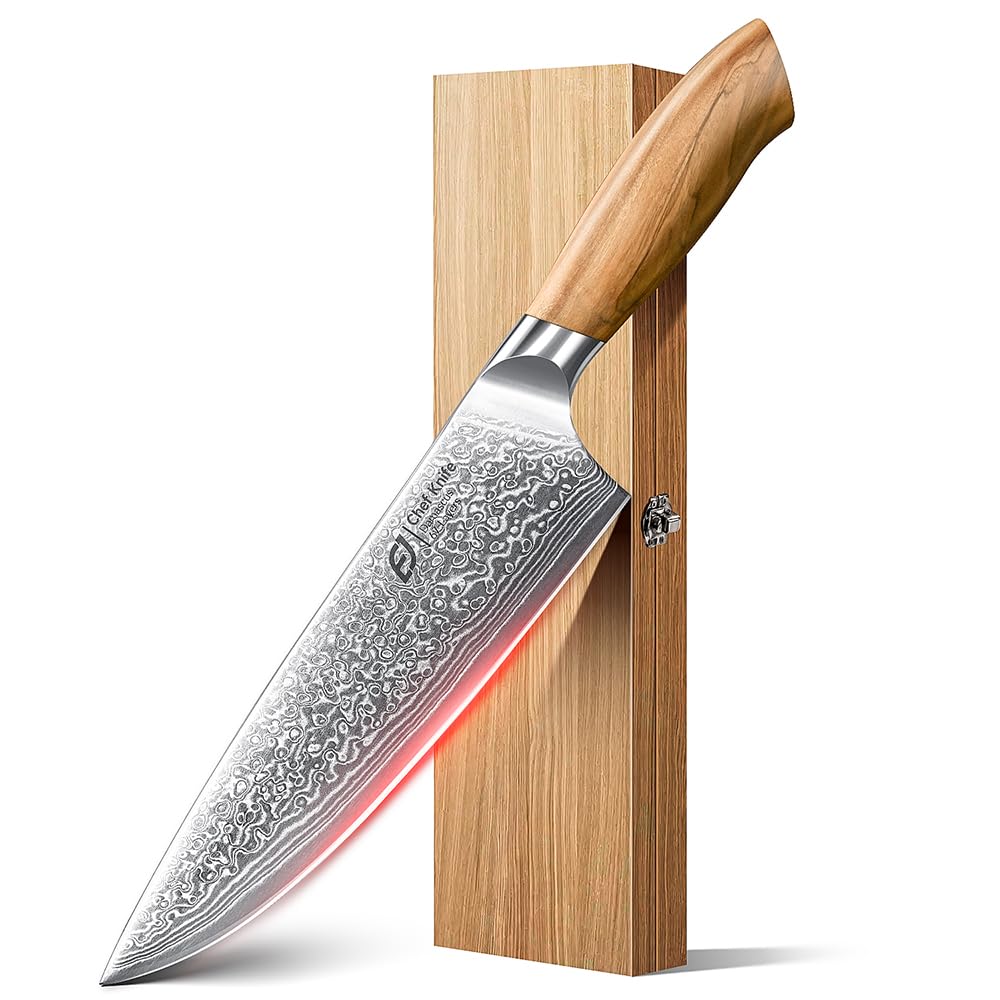
1. Damascus Chef Knife in Japanese Steel (Emojoy)
A beautifully layered blade that delivers surgical sharpness straight from the start.
The thing that wins people over here is sharpness — it is the most-discussed aspect by a large margin, with owners reporting that it glides through meat and vegetables “like butter.” The 67-layer Damascus cladding is not just for looks; it adds a rust-proof layer to the 0.98% carbon and 18% chromium steel, which is hardened to a solid 58 HRC. That hardness means you get a 15-degree edge that holds far longer than typical budget knives, so you are not resharpening every week.
The CALABRIAN olive wood handle feels substantial and comfortable for most hand sizes, and the half-bolster design lets you grip close to the blade for detailed work. At an 8-inch blade length, it sits right in the balance between leverage and control. The full-tang construction and lifetime warranty add confidence, though the blade’s hardness means it deserves gentle handling — avoid twisting it against bone or frozen food. Buyers report that the included wooden gift box makes it a strong presentation piece, and the overall consensus is that the build quality feels far above the sticker price.
As owners put it: “This knife exceeded my expectations! Super sharp, well balanced, and very comfortable to hold.”
Fit for a home chef: The Damascus pattern and olive wood handle make this a standout gift or countertop centerpiece, and the 58 HRC steel ensures you cut through dense squash and raw meat without repeated sawing.
Mind the care: You will need to hand wash and dry it immediately — the high-carbon core is stain-resistant but not impervious, and the wood handle should not soak in water.
Reach for this if: You want a razor-sharp, eye-catching daily driver with genuine Damascus layering and a comfortable handle that won’t fatigue your hand during heavy prep.
Look elsewhere if: You prefer a dishwasher-safe blade or need a heavy cleaver that can hack through small bones routinely.
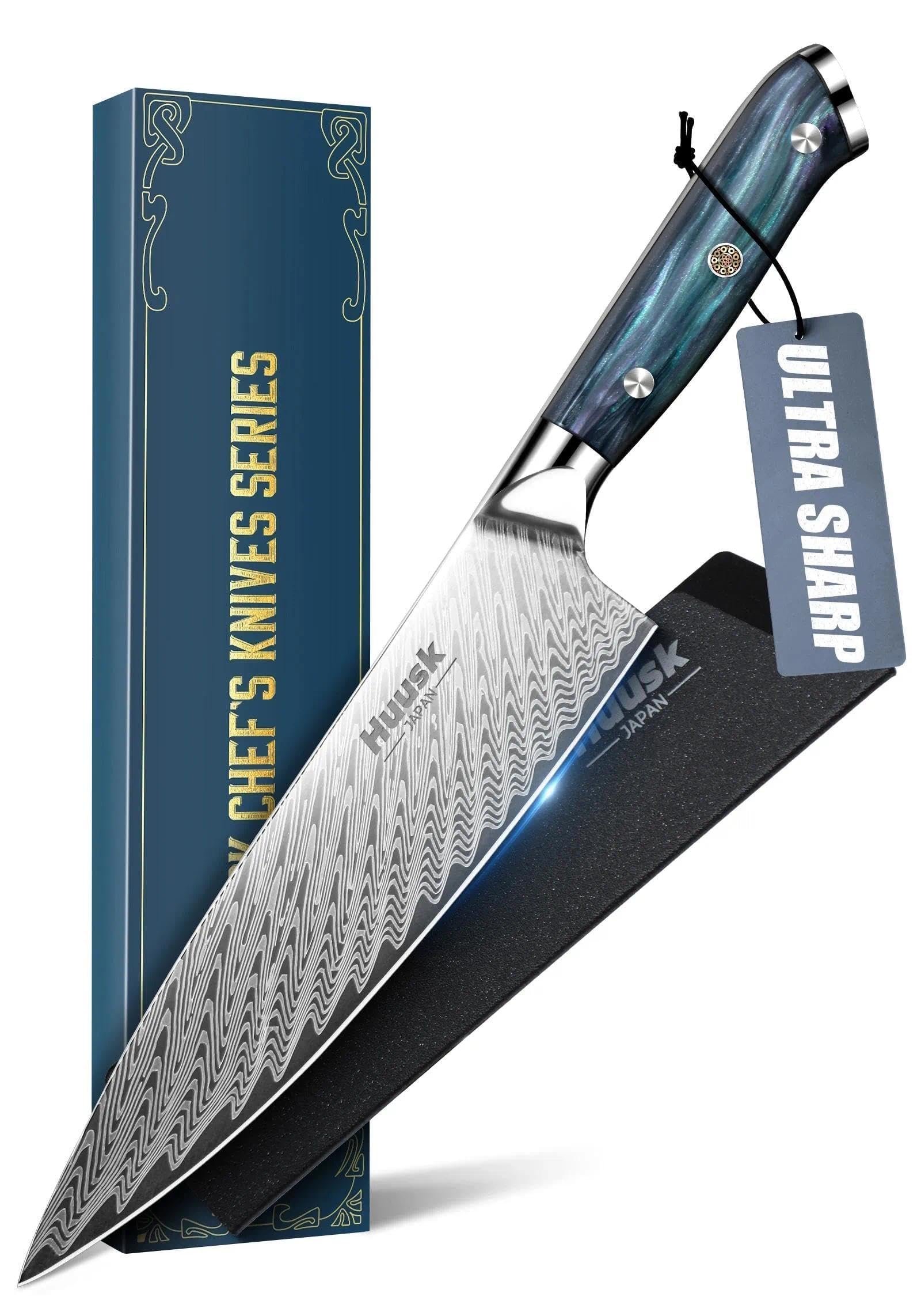
2. Huusk Japanese Stainless Chef Knife
A full-tang workhorse with a vibrant resin handle that stands out.
The crowd favorite here is quality — it is the top-mentioned aspect, with owners consistently impressed by how the 8-inch blade feels in hand. Forged from Japanese high-carbon stainless steel, the blade is hand-polished to a razor edge and held by a full-tang construction fastened with triple rivets. That build gives it a solid, reassuring weight without being clumsy, and owners mention that it stays sharp through weeks of daily chopping.
The ergonomic resin handle is the defining feature. It is molded with a sunflower mosaic rivet that adds grip, and the shape naturally contours to reduce wrist strain during long prep sessions. At 12 inches overall, the knife is well-balanced, with the blade weight sitting forward for momentum through dense ingredients. The included sheath is a practical bonus for drawer storage. Some owners mention that the edge could be even finer from the start, but the consensus is that the overall stability and comfortable hold make it a kitchen mainstay. Buyers praise the fact that it “feels great in your hand and well balanced,” calling it outstanding value.
Solid grip, serious edge: The triple-riveted full tang and resin handle mean this knife can handle heavy veggie prep and light meat breakdown without feeling flimsy — a rare combination at this price point.
The catch: The blade is slightly thicker behind the edge than some ultra-thin Japanese profiles, so it won’t slide through onions with zero resistance, but that also means it’s less prone to chipping.
Best for: Cooks who want a sturdy, durable knife that feels substantial and won’t slip when wet — the resin handle and full tang give it a confident, steady feel.
skip it if: You are after an ultra-thin, laser-like blade for delicate filleting or precise vegetable work where minimal drag matters most.
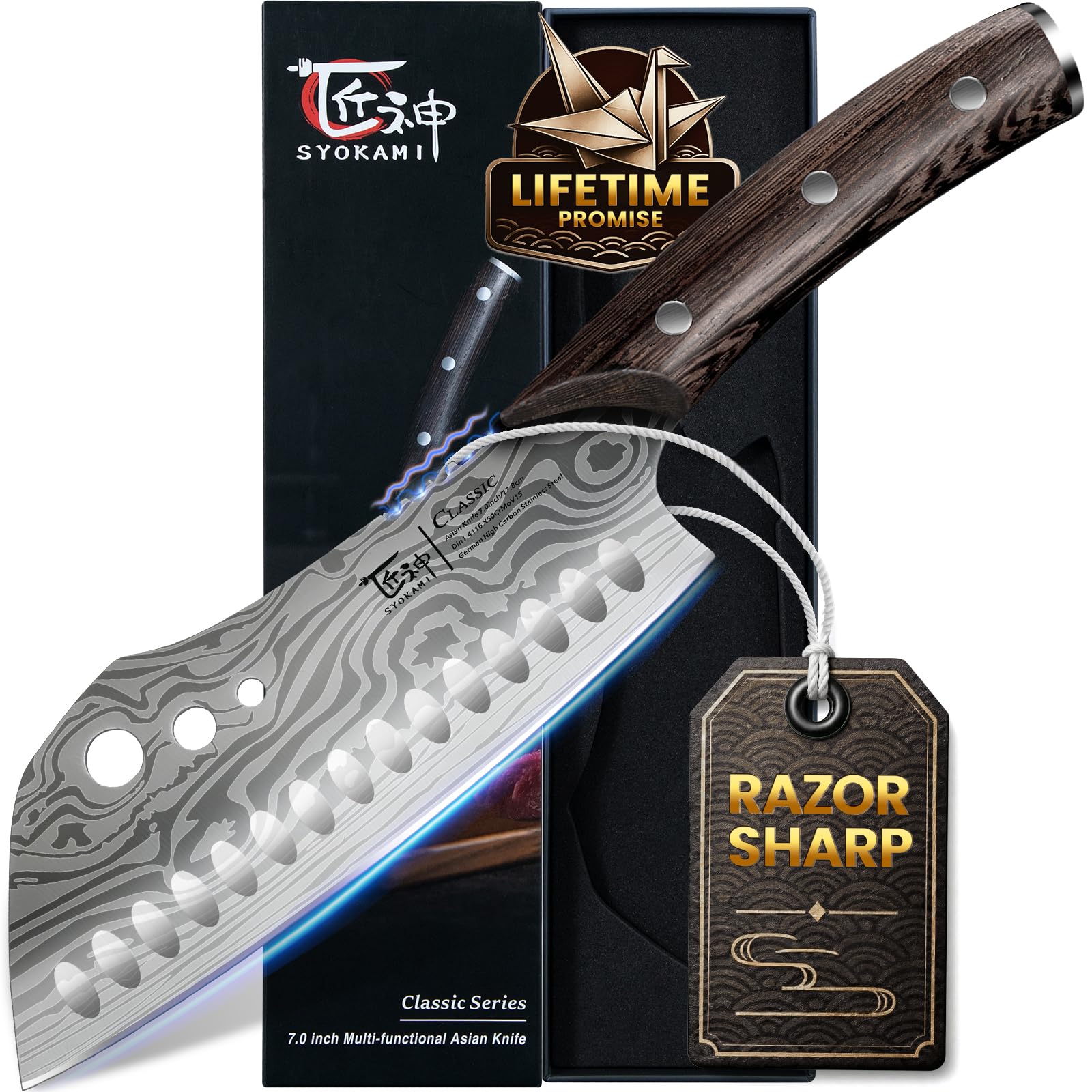
3. SYOKAMI Cleaver Chef Knife with Herb Stripper
A clever cleaver that doubles as a herb stripper without sacrificing edge quality.
This knife earned the second-highest quality praise count across the entire list, with owners routinely praising its build and sharpness. At 7 inches, its blade is 14% shorter than the 8-inch Emojoy, but the broad cleaver shape gives you a tall cutting surface that makes scooping diced ingredients easy. The blade is forged from imported high-carbon German steel, hand-polished to a 14-to-16 degree edge per side, and rated at 56+ Rockwell hardness — a solid threshold for edge retention.
The real twist is the 3-hole herb stripper built into the blade spine. You can strip rosemary, thyme, or kale leaves straight into your prep without switching tools. The wenge wood handle has gear-tooth texturing that provides a surprisingly secure grip even when your hands are wet, which addresses the most common complaint about slippery wooden handles. Some owners note that the handle can stain from moisture if left wet, and the blade’s stain resistance is decent but not invincible. Overall, the consensus is that it slices through vegetables and meats with little effort, and many owners call it “super sharp” and “great quality overall.”
Versatile geometry: The cleaver profile acts like a chef’s knife, a santoku, and a nakiri all in one — perfect for mincing garlic, dicing onions, and chopping herbs with the same tool.
The herb stripper limitation: The holes work well for stripping soft herbs, but they can catch on tougher stalks, so treat it as a bonus rather than a replacement for a dedicated tool.
Reach for this if: You want a single knife that handles everything from meat breakdown to delicate herb work, and you appreciate the built-in efficiency of the herb stripper.
Look elsewhere if: You need a longer blade for large roasts or prefer the feel of a traditional narrow chef knife for rocking cuts.
4. Mercer Culinary M18000 Millennia 8-Inch Chef’s Knife

The no-fuss, textured handle that pro kitchens trust for hours of wet prep.
This is the knife line cooks and culinary students rely on, and the sharpness aspect earns the most praise by a solid margin. The 8-inch wide blade is hollow-ground, meaning the sides curve inward slightly, which reduces food sticking during slicing — a genuine time-saver when you are dicing a pile of onions or potatoes. The Japanese high-carbon steel takes a keen edge quickly and is easy to resharpen with a steel or stone, unlike some harder steels that require diamond abrasives.
The standout feature is the handle: a Santoprene and polypropylene blend with textured finger points that provide slip resistance even when coated in oil or juice. At 4.64 ounces, it is noticeably lighter than most forged knives, which reduces wrist fatigue during long prep sessions. Some buyers find the blade size generous for smaller hands, and the included thin guard is more utilitarian than decorative. But as customers note, it is a “no-frills knife” that makes cooking more fun due to its razor edge right from the start.
Workhorse grip: The textured Santoprene handle is purpose-built for safety — you will not lose control even when handling wet, slippery ingredients like tomatoes or raw chicken.
The trade-off: Being a stamped blade, it is not as heavy or stiff as a forged knife, so it might flex slightly on very hard squash, though most home cooks will never notice.
Best for: Anyone who wants a reliable, no-nonsense blade that is easy to maintain and excels in wet, fast-paced prep — it is a proven industry standard for good reason.
pass on it if: You prefer the heft and aesthetic of a forged, full-tang knife with a wooden handle and a more traditional look.
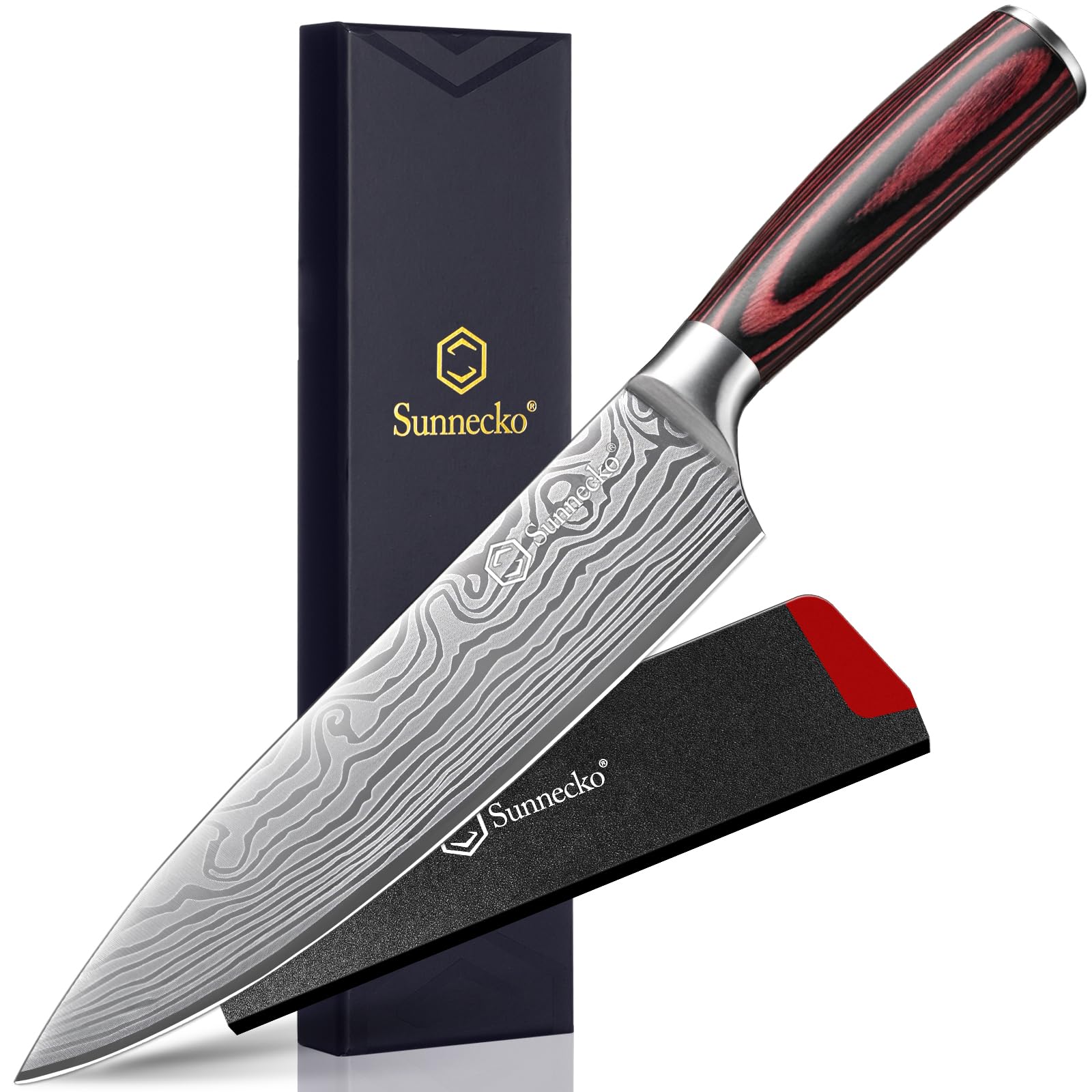
5. Sunnecko 8 Inch Chef Knife
A hand-sharpened edge at 12-15 degrees that glides through produce without crushing.
Quality and sharpness dominate the discussion here, with owners consistently impressed by how thin the edge is straight from the box. The hand-sharpened 12-to-15 degree angle per side is notably more acute than most budget knives (which often sit around 17-20 degrees), meaning it requires less force to cut through tomatoes, peppers, and boneless meats. The high-carbon stainless steel blade is forged and full-tang, giving it the strength to handle 90% of daily prep tasks without flexing.
The Pakkawood handle is ergonomically shaped and fitted with a steel bolster for balanced pinch-grip control. At just 0.2 kg (about 7 ounces), it is light enough for quick, repetitive cuts yet substantial enough for chopping. The included PVC sheath protects the edge during storage and is handy for camping or travel. One buyer’s report sums up a common sentiment: “Excellent value at this price point. Razor sharp out of box, cuts paper/hair.” Some found the initial sharpness less impressive than expected, but the vast majority call it a good trusted mid-range brand that lasts.
Thin edge advantage: That 12-15 degree bevel means this knife excels at precise slicing of soft produce — you can cut a tomato without crushing the flesh, which is rare at this price.
Consider the care: The acute edge is more prone to chipping if twisted against bone or frozen food, so reserve this for vegetable prep and boneless meats for best longevity.
Reach for this if: You want an ultra-sharp blade for precise vegetable work, fine mincing, and slicing soft fruits without tearing the skin or flesh.
Look elsewhere if: You need a beater knife for hacking through small bones or frozen ingredients — the thin edge demands a softer touch.
6. SYOKAMI Japanese Kitchen Knife, 8.2 Inch Kiritsuke
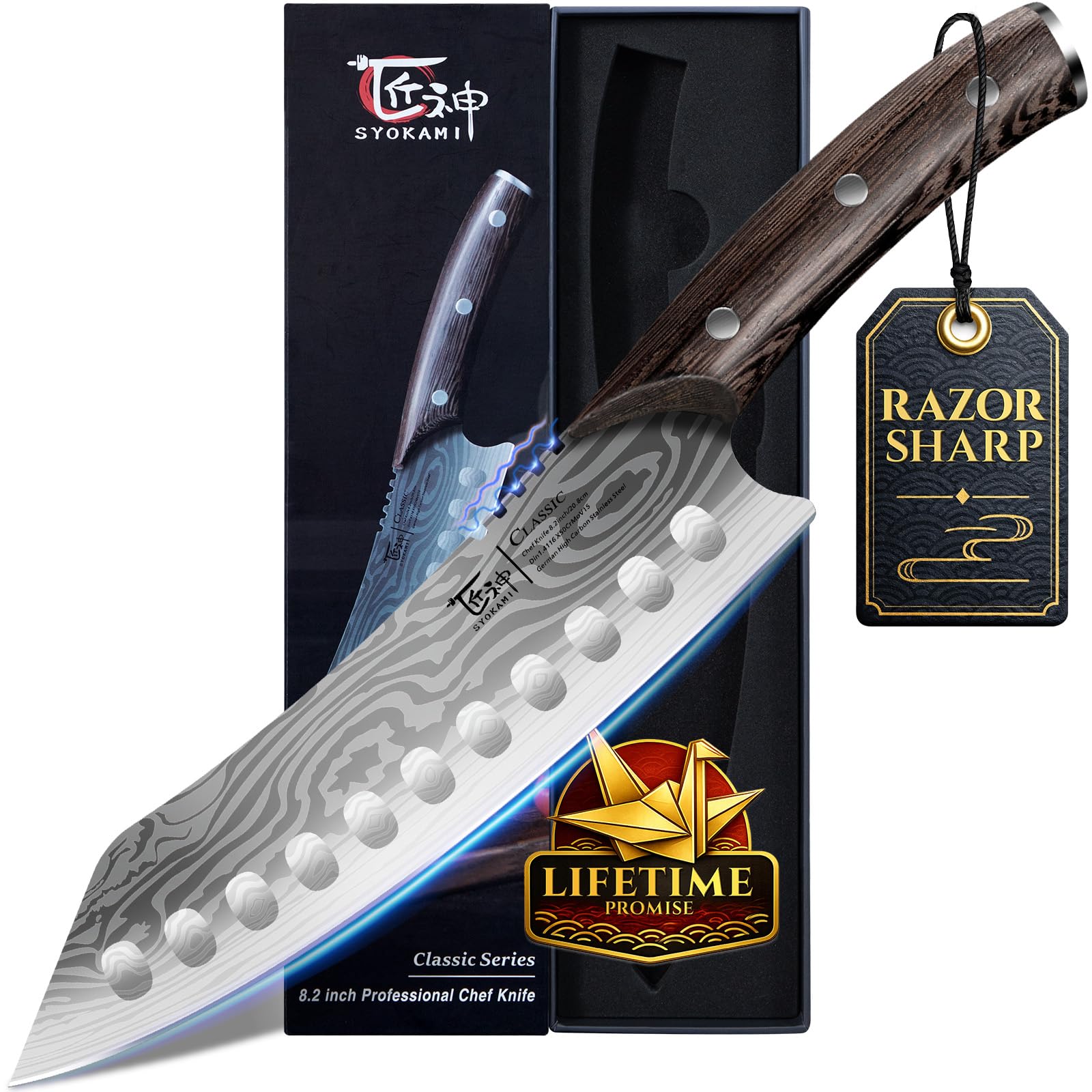
A 60-degree sharp tip designed for non-resistance piercing through meat and fish.
Sharpness is the most-praised aspect here, and for good reason. The 8.2-inch Kiritsuke blade has a sharp tip that creates over 500MPa of pressure on contact, according to the maker, allowing it to pierce through ingredients without tearing muscle fibers. This makes it a strong choice for carving roasted meats and fine sashimi work. The blade is forged from imported high-carbon German steel with a 56+ HRC rating and hand-polished to 14-16 degrees per side.
The handle is made from FSC-certified wenge wood with a guarded grip design that prevents your hand from sliding onto the blade — a thoughtful safety feature that suits both left- and right-handed users. The gear-tooth texturing adds stability when the handle is wet. Some owners mention the weight feels heavier than expected for a Japanese-style blade, which can be a plus for chopping but takes a moment to adjust to. The overall build quality and performance are called “impressive at any price,” with one buyer noting it easily replaces their serrated knife for tomato work.
Piercing precision: The 60-degree tip is not just marketing — it genuinely reduces resistance when you pierce chicken skin or score fish, giving you cleaner cuts with less downward force.
The weight balance note: The full-tang wenge handle adds heft, shifting the balance slightly toward the back. It is comfortable but feels different from a traditional lightweight Japanese gyuto.
Best for: Home cooks who want a specialized Kiritsuke profile for precise carving, delicate fish prep, and vegetable work, plus the added safety of a guarded grip.
it’s not for you if: You prefer a lighter, more nimble blade for fast, repetitive mincing — this one has a solid, deliberate feel that favors control over speed.
7. KEEMAKE Chef Knife 8 Inch
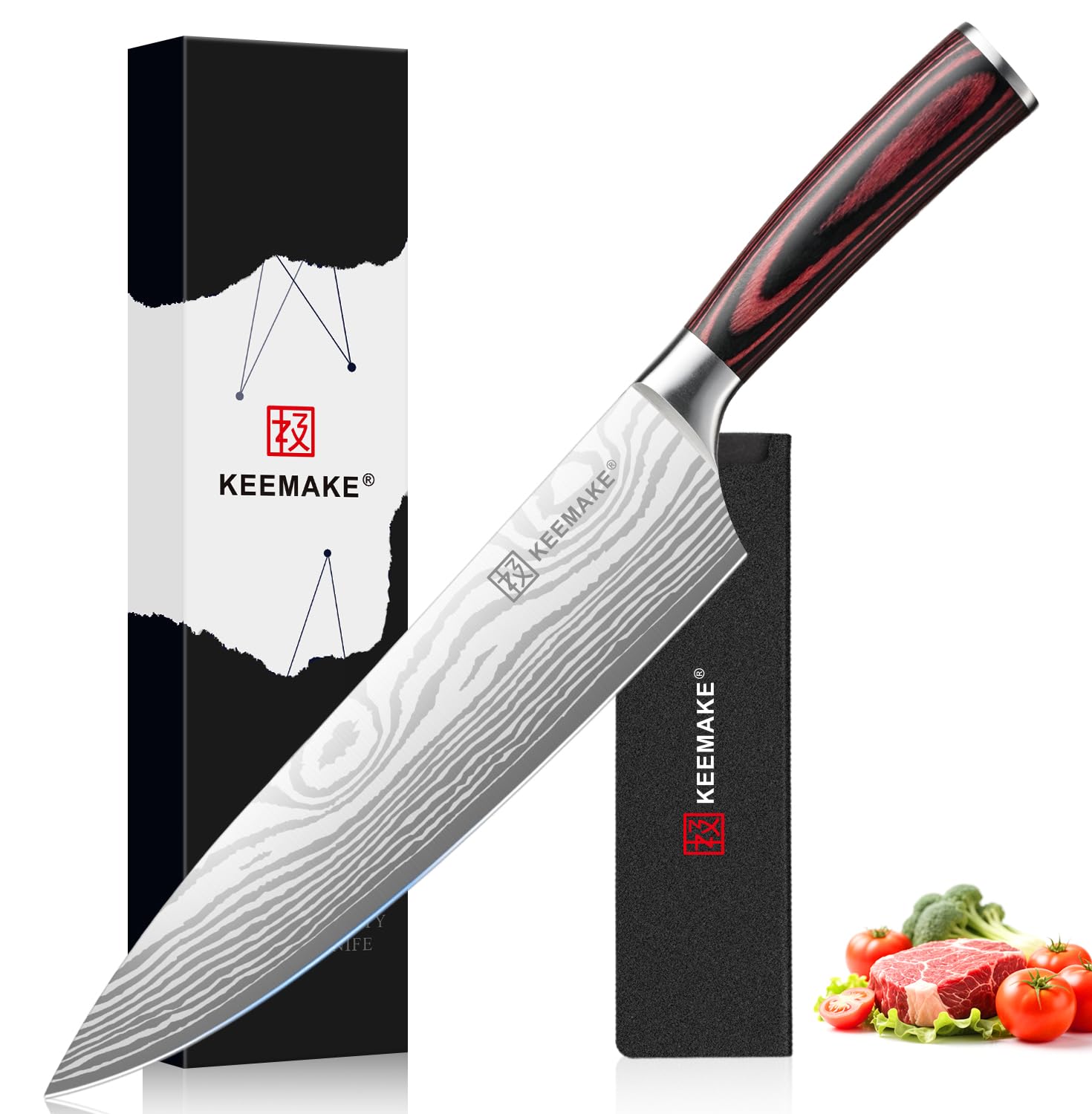
1.4116 German steel with a razor-sharp 8-to-12 degree edge — a precision tool for serious cooks.
This knife uses premium 1.4116 high-carbon stainless steel, the same type found in many German workhorse brands, with a 58±2 HRC hardness that balances edge retention and chip resistance. The hand-sharpened edge is exceptionally thin at 8 to 12 degrees per side, making it one of the sharpest options on the list. Reviewers point out it cuts tomatoes like butter and goes through prime rib bone cartilage without resistance.
The Pakkawood handle features a curved design with a sloped bolster that promotes a secure pinch grip, reducing wrist strain during marathon prep sessions. At 8.48 ounces, it has a satisfying heft that gives you momentum for chopping while remaining agile enough for detail work. A few shoppers say the Damascus pattern is laser-etched rather than forged layering, but the consensus is that the performance rivals knives costing significantly more. The included gift box and sheath add presentation value for gifting.
Edge geometry excellence: That 8-to-12 degree bevel is as thin as it gets in this price range, meaning this knife excels at precise, low-friction cuts through soft fruit, raw fish, and boneless proteins.
The etched pattern truth: The laser-etched Damascus look is purely cosmetic — it does not affect performance or rust resistance, but it does keep the blade easier to maintain than a true multi-layer Damascus.
Reach for this if: You want a sharp-out-of-the-box, ergonomic blade that handles delicate tasks like sushi prep or chiffonade basil with surgical precision.
Look elsewhere if: You need a rough-and-tumble blade for hacking through bone or frozen ingredients — the acute edge is best treated with care on cutting boards.
8. Kimura Chef Knife, Made in Japan, 8 Inch

A genuine Seki-forged blade that delivers Japanese precision at a down-to-earth price.
Quality is the most-cited aspect here, and for a knife made in Seki, Japan — a historic cutlery hub — that reputation is earned. The blade uses high-carbon chrome molybdenum stainless steel, heat-treated to 57 HRC and hand-sharpened to a 15-degree angle by Kimura craftsmen. This steel choice offers a good balance between edge retention and ease of sharpening, making it a solid entry point for those new to Japanese knives.
The POM resin handle is designed for comfort, with a full bolster that allows for a pinch, pointed finger, or standard grip. At just 175 grams (about 6.2 ounces), it is noticeably lightweight, which owners with smaller hands find ideal. It is perfect for daily vegetable prep — dicing onions, slicing tomatoes — but a few users mention it feels a bit short for large leafy greens like romaine. The blade is double-beveled, making it suitable for right- and left-handed users. The premium gift box with traditional Japanese Kanji design adds a thoughtful touch for gifting.
Lightweight precision: The 57 HRC steel and thin 15-degree edge mean this knife slides through produce with minimal effort, making it ideal for cooks who find heavier knives tiring.
Honest trade-off: Some owners note the fit at the tang end feels unfinished, and the bolster may be a welded weak point over very long-term heavy use, though most home cooks will not hit that limit.
Best for: Home cooks with smaller hands or those transitioning from Western knives who want an affordable, authentic Japanese Gyuto for dedicated vegetable and meat prep.
look elsewhere if: You need a heavy-duty blade for breaking down large squashes or frequent bone contact — this knife is built for precision, not brute force.
9. Victorinox Fibrox Pro 8 Inch Chef’s Knife
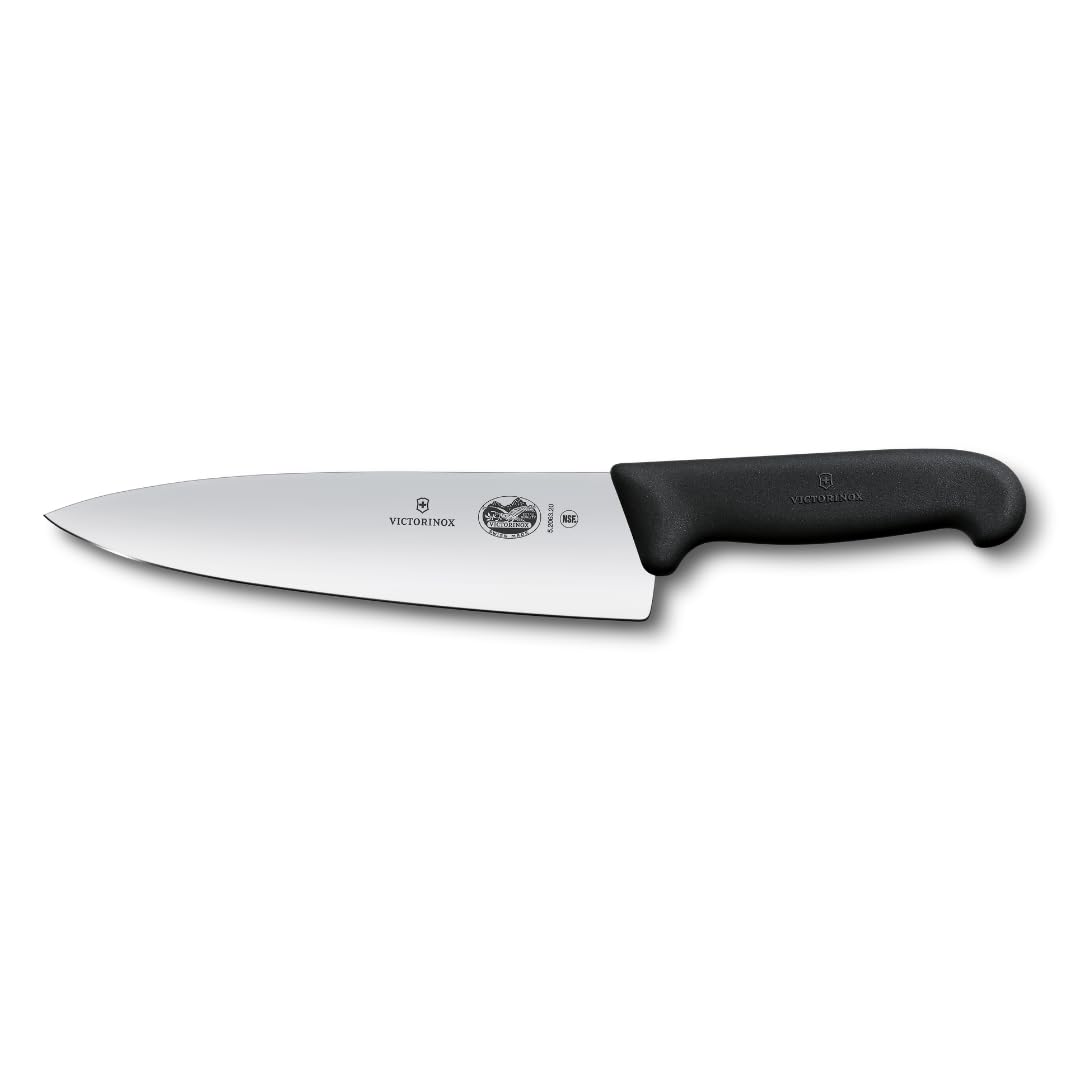
The iconic Swiss workhorse that pro kitchens have relied on for decades — now dishwasher safe.
This knife is the most-reviewed knife in the entire category, and for good reason. The Fibrox Pro has been a top recommendation from America’s Test Kitchen for years, and its popularity is built on raw utility. The 7.9-inch stainless steel blade is laser-tested for consistency and arrives scalpel-sharp, ready to chop, mince, slice, and dice with almost no effort. At roughly 5.7 ounces, it is lighter than most forged alternatives, reducing hand fatigue during long prep sessions.
The thermoplastic elastomer (TPE) handle is the star — it is ergonomically shaped, non-slip even when wet, and significantly more comfortable than the hard plastic handles found on cheap knives. The blade depth is generous enough to keep your knuckles clear of the cutting board. The Swiss-made build quality is backed by a lifetime warranty against defects. A few owners note that the edge will eventually need sharpening, and the relatively softer steel (around 55-56 HRC) does not hold an edge as long as harder Damascus blades, but it is also easier to resharpen. The general sentiment is clear: this is a “flawless, scalpel-sharp edge” at a bargain price, and it “retains edge for 2.5+ months without sharpening” under normal use.
Grip that works: The TPE handle is genuinely non-slip when wet or greasy — it is the reason this knife is standard issue in commercial kitchens where safety and speed matter.
Edge reality check: The steel is on the softer side, so you will need to steel it regularly and sharpen it a few times a year, but the trade-off is a blade that is very difficult to chip and easy to restore.
Reach for this if: You want a kitchen-tested, no-nonsense knife that prioritizes grip comfort and easy maintenance over flash, backed by thousands of pro cooks who rely on it daily.
Look elsewhere if: You prefer the aesthetic and edge retention of a high-hardness forged blade or want a knife that comes in a premium gift box.
Understanding the Specs
Rockwell Hardness (HRC)
This number tells you how hard the steel is. A higher HRC (like 58-60) means the blade stays sharp longer but can chip if you cut into bones. A lower HRC (52-55) is easier to sharpen but dulls faster. For a chef knife under, aim for 56 to 58 — it gives you a good balance of edge retention and durability for everyday home cooking.
Full Tang vs. Stamped
A full-tang knife means the steel runs the entire length of the handle, usually sandwiched between scales or molded into one piece. This gives you better balance, weight, and strength — the handle is far less likely to break off under pressure. A stamped blade is cut from a sheet of steel. It is lighter and cheaper to make, but often less durable and balanced. At this budget, a full-tang design is a strong indicator of quality.
Edge Angle (Degrees Per Side)
The edge angle determines how sharp the knife feels. A 14-16 degree angle per side is typical for Japanese-style knives and allows for thinner, more precise cuts. A 17-20 degree angle is common on German-style knives and offers more edge durability. An acute angle (12-15 degrees) cuts with less force but requires gentler handling.
Blade Steel Types
High-carbon stainless steel is the standard for this category. It resists rust and staining better than pure carbon steel while holding a sharper edge than basic stainless. Some knives use Damascus steel (layered high-carbon steel), which adds aesthetic patterns and can improve rust resistance and edge toughness. The chromium content in stainless steel (like 18%) helps prevent corrosion.
FAQ
What is the best chef knife under for sharpness from the start?
Can a cheap chef knife be dishwasher safe?
How do I tell if a chef knife has a full tang?
What does Rockwell hardness (HRC) mean for a knife?
Is a 7-inch blade too short for a chef knife?
What is the difference between a chef knife and a cleaver?
How often should I sharpen a budget chef knife?
Are Japanese-style knives better than Western-style ones at this price?
What maintenance does a Damascus steel chef knife need?
Is a chef knife with a wooden handle better than a synthetic one?
Final Thoughts: The Verdict
For most people, the best chef knife under 50 is the Damascus Chef Knife (Emojoy) because it combines genuine 67-layer Damascus steel, a 58 HRC hardened edge, and a comfortable olive wood handle — all at a price that feels like a steal. If you want a kitchen-tested workhorse with a guaranteed non-slip grip, grab the {“@context”: “https://schema.org”, “@graph”: [{“@type”: “ItemList”, “name”: “9 Best Chef Knife Under 50”, “url”: “https://wellfizz.com/best-chef-knife-under-50/”, “numberOfItems”: 9, “itemListElement”: [{“@type”: “ListItem”, “position”: 1, “name”: “Damascus Chef Knife in Japanese Steel (Emojoy)”, “url”: “https://wellfizz.com/best-chef-knife-under-50/#product-1”}, {“@type”: “ListItem”, “position”: 2, “name”: “Huusk Japanese Stainless Chef Knife”, “url”: “https://wellfizz.com/best-chef-knife-under-50/#product-2”}, {“@type”: “ListItem”, “position”: 3, “name”: “SYOKAMI Cleaver Chef Knife with Herb Stripper”, “url”: “https://wellfizz.com/best-chef-knife-under-50/#product-3”}, {“@type”: “ListItem”, “position”: 4, “name”: “Mercer Culinary M18000 Millennia 8-Inch Chef’s Knife”, “url”: “https://wellfizz.com/best-chef-knife-under-50/#product-4”}, {“@type”: “ListItem”, “position”: 5, “name”: “Sunnecko 8 Inch Chef Knife”, “url”: “https://wellfizz.com/best-chef-knife-under-50/#product-5”}, {“@type”: “ListItem”, “position”: 6, “name”: “SYOKAMI Japanese Kitchen Knife, 8.2 Inch Kiritsuke”, “url”: “https://wellfizz.com/best-chef-knife-under-50/#product-6”}, {“@type”: “ListItem”, “position”: 7, “name”: “KEEMAKE Chef Knife 8 Inch”, “url”: “https://wellfizz.com/best-chef-knife-under-50/#product-7”}, {“@type”: “ListItem”, “position”: 8, “name”: “Kimura Chef Knife, Made in Japan, 8 Inch”, “url”: “https://wellfizz.com/best-chef-knife-under-50/#product-8”}, {“@type”: “ListItem”, “position”: 9, “name”: “Victorinox Fibrox Pro 8 Inch Chef’s Knife”, “url”: “https://wellfizz.com/best-chef-knife-under-50/#product-9”}]}, {“@type”: “Product”, “position”: 1, “name”: “Damascus Chef Knife in Japanese Steel (Emojoy)”, “image”: “https://m.media-amazon.com/images/I/61DF+okMC1L.jpg”, “brand”: {“@type”: “Brand”, “name”: “Damascus”}, “url”: “https://www.amazon.com/dp/B0DXPQ88ZV/?tag=wellfizzmo-20”, “offers”: {“@type”: “Offer”, “url”: “https://www.amazon.com/dp/B0DXPQ88ZV/?tag=wellfizzmo-20”}}, {“@type”: “Product”, “position”: 2, “name”: “Huusk Japanese Stainless Chef Knife”, “image”: “https://m.media-amazon.com/images/I/81iCxaDFOTL.jpg”, “brand”: {“@type”: “Brand”, “name”: “Huusk”}, “url”: “https://www.amazon.com/dp/B0DB7VSY2R/?tag=wellfizzmo-20”, “offers”: {“@type”: “Offer”, “url”: “https://www.amazon.com/dp/B0DB7VSY2R/?tag=wellfizzmo-20”}}, {“@type”: “Product”, “position”: 3, “name”: “SYOKAMI Cleaver Chef Knife with Herb Stripper”, “image”: “https://m.media-amazon.com/images/I/81Oz2xlhsbL.jpg”, “brand”: {“@type”: “Brand”, “name”: “SYOKAMI”}, “url”: “https://www.amazon.com/dp/B0DHS55XSF/?tag=wellfizzmo-20”, “offers”: {“@type”: “Offer”, “url”: “https://www.amazon.com/dp/B0DHS55XSF/?tag=wellfizzmo-20”}}, {“@type”: “Product”, “position”: 4, “name”: “Mercer Culinary M18000 Millennia 8-Inch Chef’s Knife”, “image”: “https://m.media-amazon.com/images/I/514iET-d31L.jpg”, “brand”: {“@type”: “Brand”, “name”: “Mercer”}, “url”: “https://www.amazon.com/dp/B005P0OIP8/?tag=wellfizzmo-20”, “offers”: {“@type”: “Offer”, “url”: “https://www.amazon.com/dp/B005P0OIP8/?tag=wellfizzmo-20”}}, {“@type”: “Product”, “position”: 5, “name”: “Sunnecko 8 Inch Chef Knife”, “image”: “https://m.media-amazon.com/images/I/71JQKBiwfVL.jpg”, “brand”: {“@type”: “Brand”, “name”: “Sunnecko”}, “url”: “https://www.amazon.com/dp/B0B3DM77BQ/?tag=wellfizzmo-20”, “offers”: {“@type”: “Offer”, “url”: “https://www.amazon.com/dp/B0B3DM77BQ/?tag=wellfizzmo-20”}}, {“@type”: “Product”, “position”: 6, “name”: “SYOKAMI Japanese Kitchen Knife, 8.2 Inch Kiritsuke”, “image”: “https://m.media-amazon.com/images/I/712tpZm3CzL.jpg”, “brand”: {“@type”: “Brand”, “name”: “SYOKAMI”}, “url”: “https://www.amazon.com/dp/B0F3J4FBWC/?tag=wellfizzmo-20”, “offers”: {“@type”: “Offer”, “url”: “https://www.amazon.com/dp/B0F3J4FBWC/?tag=wellfizzmo-20”}}, {“@type”: “Product”, “position”: 7, “name”: “KEEMAKE Chef Knife 8 Inch”, “image”: “https://m.media-amazon.com/images/I/71l4oB0MpPL.jpg”, “brand”: {“@type”: “Brand”, “name”: “KEEMAKE”}, “url”: “https://www.amazon.com/dp/B0F53TN1NH/?tag=wellfizzmo-20”, “offers”: {“@type”: “Offer”, “url”: “https://www.amazon.com/dp/B0F53TN1NH/?tag=wellfizzmo-20”}}, {“@type”: “Product”, “position”: 8, “name”: “Kimura Chef Knife, Made in Japan, 8 Inch”, “image”: “https://m.media-amazon.com/images/I/714e2OUPc0L.jpg”, “brand”: {“@type”: “Brand”, “name”: “Kimura”}, “url”: “https://www.amazon.com/dp/B09GCGQKNZ/?tag=wellfizzmo-20”, “offers”: {“@type”: “Offer”, “url”: “https://www.amazon.com/dp/B09GCGQKNZ/?tag=wellfizzmo-20”}}, {“@type”: “Product”, “position”: 9, “name”: “Victorinox Fibrox Pro 8 Inch Chef’s Knife”, “image”: “https://m.media-amazon.com/images/I/41Xx3Xy7NhL.jpg”, “brand”: {“@type”: “Brand”, “name”: “Victorinox”}, “url”: “https://www.amazon.com/dp/B008M5U1C2/?tag=wellfizzmo-20”, “offers”: {“@type”: “Offer”, “url”: “https://www.amazon.com/dp/B008M5U1C2/?tag=wellfizzmo-20”}}, {“@type”: “FAQPage”, “mainEntity”: [{“@type”: “Question”, “name”: “What is the best chef knife under for sharpness from the start?”, “acceptedAnswer”: {“@type”: “Answer”, “text”: “The KEEMAKE Chef Knife with its 8-to-12 degree edge and the Damascus Chef Knife (Emojoy) with its 58 HRC hardness both arrive exceptionally sharp. Many buyers report they cut through tomatoes and meat like butter without any initial honing.”}}, {“@type”: “Question”, “name”: “Can a cheap chef knife be dishwasher safe?”, “acceptedAnswer”: {“@type”: “Answer”, “text”: “Yes, but only the Victorinox Fibrox Pro is explicitly rated as dishwasher safe among the picks here. Knives with wooden handles — like the Emojoy Damascus (olive wood) or the Sunnecko (Pakkawood) — should always be hand washed and dried immediately to protect the handle and edge.”}}, {“@type”: “Question”, “name”: “How do I tell if a chef knife has a full tang?”, “acceptedAnswer”: {“@type”: “Answer”, “text”: “Check the product images for rivets or visible steel running through the handle. If the steel runs the full length of the handle, it is a full tang. Knives like the Huusk and KEEMAKE explicitly advertise full-tang construction, which gives better balance and prevents the handle from breaking.”}}, {“@type”: “Question”, “name”: “What does Rockwell hardness (HRC) mean for a knife?”, “acceptedAnswer”: {“@type”: “Answer”, “text”: “HRC measures steel hardness. A rating of 56-58 HRC is ideal for a budget chef knife — it stays sharp for weeks of daily use but is still tough enough to handle home prep without chipping. Lower than 55 HRC means the blade will dull faster, requiring frequent sharpening.”}}, {“@type”: “Question”, “name”: “Is a 7-inch blade too short for a chef knife?”, “acceptedAnswer”: {“@type”: “Answer”, “text”: “Not necessarily. A 7-inch blade like the SYOKAMI Cleaver is easier to maneuver for detailed work and fits smaller hands well. However, an 8-inch blade (the standard for most recipes) gives you more leverage for large produce like cabbage or squash and a longer slicing stroke for meat.”}}, {“@type”: “Question”, “name”: “What is the difference between a chef knife and a cleaver?”, “acceptedAnswer”: {“@type”: “Answer”, “text”: “A chef knife has a curved blade designed for rocking cuts. A cleaver has a flat, rectangular blade designed for chopping through bones and heavy vegetables. The SYOKAMI combines both shapes into a versatile hybrid profile, making it suitable for most kitchen tasks.”}}, {“@type”: “Question”, “name”: “How often should I sharpen a budget chef knife?”, “acceptedAnswer”: {“@type”: “Answer”, “text”: “It depends on the steel. Softer stainless blades (like the Victorinox) benefit from steeling before each use and a full sharpening every 2-3 months. Harder Damascus blades (like the Emojoy at 58 HRC) hold their edge longer, potentially needing sharpening only every 4-6 months under normal home use.”}}, {“@type”: “Question”, “name”: “Are Japanese-style knives better than Western-style ones at this price?”, “acceptedAnswer”: {“@type”: “Answer”, “text”: “Japanese-style knives (like the Kimura or SYOKAMI Kiritsuke) tend to have thinner, harder edges, making them sharper for precise slicing. Western-style knives (like the Mercer or Victorinox) are more sturdy and easier to sharpen. The best choice depends on your primary cutting tasks — precision work or heavy-duty chopping.”}}, {“@type”: “Question”, “name”: “What maintenance does a Damascus steel chef knife need?”, “acceptedAnswer”: {“@type”: “Answer”, “text”: “Damascus steel knives should be hand washed and dried immediately — never soaked or left wet. The layered steel is rust-resistant but not rust-proof. The wood handles on many Damascus knives (like the Emojoy) also require drying after each wash. Regular steeling and occasional honing will keep the edge sharp.”}}, {“@type”: “Question”, “name”: “Is a chef knife with a wooden handle better than a synthetic one?”, “acceptedAnswer”: {“@type”: “Answer”, “text”: “Wooden handles (olive, Pakkawood, wenge) offer a warm, comfortable feel and can absorb some hand moisture, improving grip over time. Synthetic handles (Santoprene, TPE, POM resin) are more durable, often non-slip when wet, and can be made dishwasher safe. Both are excellent — it depends on whether you prefer aesthetics and comfort (wood) or maintenance ease (synthetic).”}}]}]}
Related Guides

Mo Maruf
I created WellFizz to bridge the gap between vague wellness advice and actionable solutions. My mission is simple: to decode the research and give you practical tools you can actually use.
Beyond the data, I am a passionate traveler. I believe that stepping away from the screen to explore new environments is essential for mental clarity and physical vitality.