Our readers keep the lights on and my smoothie glass nicely filled. As an Amazon Associate, I earn from qualifying purchases.
Specs are compiled from manufacturer listings and verified buyer reviews and can change over time — please confirm the key details on the product page before buying.
A commercial water filter decides whether your coffee shop’s espresso tastes clean or metallic, whether your restaurant’s ice comes out clear or cloudy, and how much you spend on your water bill each month. The category ranges from simple carbon-block systems (which use activated carbon to trap chlorine and sediment) built for one ice machine, all the way to tankless reverse-osmosis beasts (systems that push water through a super-fine membrane to strip out over 1,000 contaminants) designed to feed an entire small factory. Pick the wrong one, and you get a slow trickle that frustrates your staff, or a machine that’s too big for your counter space.
I’m Mohammad Maruf — the founder and writer behind WellFizz. This guide is built by comparing the manufacturers’ published specifications and the patterns across verified customer reviews, so you get each pick’s real strengths and trade-offs instead of marketing spin.
The true winner among the best commercial water filter options balances raw flow rate with long-term filter costs and a tankless footprint that fits your real floor plan. The iSpring CRO1000 delivers a true 1,000 GPD output with a tankless freestanding design that moves easily on wheels, making it the crowd-pleaser for most busy businesses.
Our Picks at a Glance

How To Choose The Best Commercial Water Filter
Choosing the wrong commercial water filter means slow service, bad-tasting drinks, or a machine that doesn’t physically fit under your counter. The three specs below are the only ones that matter during your first pass — get these right and everything else falls into place.
Flow Rate: The Speed That Keeps You Open
Flow rate, measured in gallons per minute (GPM), tells you how fast the filter can push water to your faucet, ice machine, or espresso maker. A low-flow system (0.7 GPM) is perfectly fine for a single drip coffee station. A high-flow system (6.7 GPM) is what you need if you are simultaneously filling a steam kettle, a coffee urn, and an ice bin. Match the GPM to your peak usage — not your average usage — or you will bottleneck your busiest hour.
Capacity and Filter Life: The Hidden Operating Cost
Capacity, usually given in gallons per day (GPD), tells you how much clean water the system can produce before its membrane or filter cartridge wears out. A system rated for 1,000 GPD can serve a medium-volume restaurant; an 800 GPD unit fits a busy coffee shop. Keep in mind that replacement filters have their own cost and frequency — some need changing every few months, while some membranes last two to three years. Factor that into your total cost of ownership beyond the initial purchase.
Physical Size and Installation: Measure Before You Buy
Commercial filters range from compact under-sink boxes (around 18 inches tall) to freestanding frames on wheels that stand nearly 40 inches tall. Measure your available space — especially under-sink height and depth — before you order. Tankless designs eliminate the big storage tank, which saves significant space and removes the risk of bacterial growth that can happen in a tank. Also confirm whether your incoming water pressure meets the system’s working range (usually listed in psi) and if you need an accessory booster pump.
Quick Comparison
| Model | Best For | Max Flow Rate | Daily Capacity | Dimensions (H x W x L) | Amazon |
|---|---|---|---|---|---|
| iSpring CRO1000★ Best Overall | High-volume business needing pure RO water | 0.7 GPM | 1000 GPD | 38.25″ x 10.5″ x 23.5″ | Amazon |
| Ecoviva RO800G | Compact under-sink install with alkaline water | 0.54 GPM | 800 GPD | 18.8″ x 6.5″ x 17.1″ | Amazon |
| Everpure EV9328-06 | High-flow carbon for ice & coffee machines | 6.7 GPM | 20″ cartridge length | 22″ x 5″ x 18″ | Amazon |
In‑Depth Reviews
1. iSpring CRO1000 4-Stage Tankless Commercial Reverse Osmosis System
Our pick — over 4.5★ from 600+ verified ratings; the strongest balance of quality and price.
This workhorse RO system keeps a busy business running without hiccups.
You buy this system when you need real commercial-grade reverse osmosis (a process that pushes water through a super-fine membrane to strip out over 1,000 contaminants) and you need it at a high volume — 1,000 gallons per day. The tankless design delivers water on demand at 0.7 GPM (gallons per minute), so you don’t wait around for a storage tank to refill. Buyers report that “it produces 500 gallons of RO water” easily, and the built-in inlet and outlet gauges let you monitor pressure at a glance, which is a huge help when troubleshooting slow flow.
It handles 4-stage filtration: a large 20-inch sediment filter with a transparent housing so you can see when it’s dirty, two carbon block filters that improve taste, and the RO membrane itself (housed in stainless steel). The freestanding metal frame rolls on wheels with locking brakes, making it easy to position near your espresso machine or ice maker. The iSpring team is known for responsive customer support, which comes in handy if you have installation questions.
The biggest practical trade-off is the flow rate: at 0.7 GPM, it is far slower than the 6.7 GPM Everpure EV9328-06. That matters if you need to fill large pots or multiple carafes simultaneously. It is also a tall unit: 38.25 inches, so it needs floor space, not just a cabinet. This is the crowd favorite for a reason — the thing everyone raves about is the consistent water quality (owners highlight it nearly 150 times) and the reliable water flow.
Why It Wins
- 1000 GPD output covers restaurants, coffee shops, and light industrial use without slowing down
- Transparent sediment housing lets you see when the pre-filter needs changing
- Freestanding on wheels with brakes — roll it where you need it, lock it down
- Rated for 20.5 lbs overall, so it’s solid but still movable
The Honest Trade-Off
- 0.7 GPM flow is slow compared to high-flow carbon systems (6.7 GPM) — not ideal for filling large pots quickly
- Tall frame (38.25″) needs dedicated floor space, not a cabinet
- Requires at least 80 psi incoming water pressure; optional booster pump adds cost
Grab this if: you run a business that demands high-volume pure RO water — think espresso shops, tea houses, breweries, or a workshop that needs spot-free rinse water.
Think twice if: your operation peaks with simultaneous high-flow filling (multiple large urns) and you’d trade some contaminant removal for raw speed — look at a carbon-block system instead.
2. Ecoviva RO800G Tankless 9-Stage Commercial Reverse Osmosis System
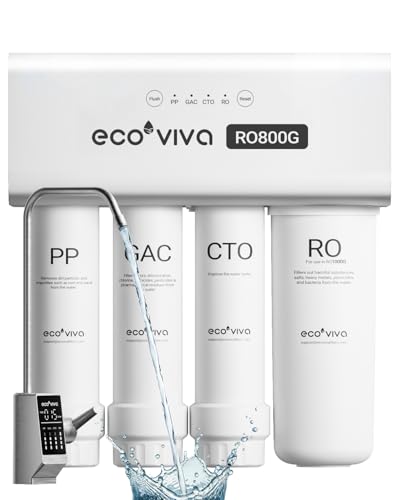
This German-engineered tankless RO adds alkaline minerals back into your water.
At just 18.8 inches tall, the Ecoviva RO800G is much more compact than the iSpring CRO1000 (18.8 inches vs 38.25 inches tall), which makes it the pick for anyone with tight under-sink real estate. The 9-stage filtration goes beyond standard RO: after removing contaminants, it passes water through an Indonesian coconut shell carbon block and an alkaline boost filter to raise the pH and improve taste — a feature espresso enthusiasts and tea shop owners specifically look for.
The smart LED faucet shows real-time TDS (total dissolved solids, a measure of how much stuff is left in the water) and filter life, so you always know when a change is due. The 3:1 pure-to-drain ratio means you waste only one gallon for every three gallons of clean water — that’s better than many older RO systems that waste 3 or 4 gallons. However, a small number of early buyers experienced issues with leaks at the fittings; as one owner put it: “I want to like this thing, but I’m on day 3 of hook up, and it’s still leaking in 2 spots.”
The proprietary replacement filter set, which adds up faster than the iSpring’s more standard-size filters. The 10-year lifespan claim is backed by over 100,000 units deployed across Europe., but you are locked into the brand’s cartridges. For a compact under-sink setup that delivers high-quality alkaline water without a full-frame footprint, this is an impressive piece of engineering.
Alkaline edge: The 9-stage process includes a remineralization step that the iSpring lacks — so if you want pH-balanced, mineral-enhanced water from a tankless RO that fits under a bar sink, this is the only one on the list that does it.
Best fit for: a coffee shop, tea house, or small restaurant that values compact size and wants alkaline water without a full-size floor-mounted unit.
Watch out for: proprietary replacement filters and reports of fitting leaks that require careful installation.
3. Everpure EV9328-06 High Flow CSR Triple-MC2 System

This carbon-block speed demon pours 6.7 gallons per minute without a second thought.
If your business depends on filling large volumes quickly, this Everpure system is in a different league. Its 6.7 GPM flow rate is much faster than the iSpring CRO1000’s 0.7 GPM, which means you can fill a 5-gallon urn in under a minute rather than waiting seven. It uses activated carbon filtration rather than reverse osmosis, so it reduces chlorine, bad tastes, and sediment without stripping minerals from the water. The Micro-Pure II media actually inhibits bacterial growth inside the filter itself.
The Triple-MC2 design feeds three points of use (a fountain, a coffee maker, and an ice machine) from one system, and the SR-X cartridge with SS-IMF media specifically prevents scale buildup in ice machines and coffee brewers — a huge deal for equipment longevity. Owners who bought it through commercial suppliers say it is far cheaper than going through a local water-treatment dealer, and the taste and clarity improvements are immediate. NSF certification ensures the system meets commercial health and safety standards.
The honest catch is reliability of the unit as shipped: a few buyers received units with a broken valve or found that the bowl-style cartridge housing leaked after several months. At this price point, those quality-control issues are frustrating, and the overall rating reflects that inconsistency — significantly lower than the iSpring’s score. For a high-flow carbon system that is purpose-built for coffee brewers and ice machines, though, nothing else on this list keeps up with its speed.
Speed That Matters
- 6.7 GPM flow rate — by far the fastest on this list, ideal for high-volume filling
- Scale-inhibiting SR-X cartridge protects coffee brewers and ice machines from mineral buildup
- NSF certified for chlorine reduction and cyst removal — meets commercial health standards
- Three-point-of-use output from a single unit (fountain, coffee, ice)
The Downside
- Tangible quality-control concerns — some units arrive with broken valves or develop leaks
- Does not remove dissolved solids (no RO membrane), so it won’t soften hard water
- Bowl-style cartridge replacement is less convenient than the twist-and-lock designs on newer systems
Reach for this if: raw speed is your priority — you run a high-volume kitchen, a multi-machine ice setup, or you need to fill large containers all day long.
Look elsewhere if: you need total dissolved solids removal or soft water; this carbon-block system only removes particles and chlorine, not dissolved minerals or hardness.
Understanding the Specs
Flow Rate (GPM)
Gallons per minute (GPM) tells you how fast filtered water comes out of the faucet. It matters most if multiple people or machines draw water at the same time. A 0.7 GPM system might serve one drip coffee station well, but you will feel the bottleneck during a breakfast rush if you also need to fill an urn. A 6.7 GPM system like the Everpure handles simultaneous use with no slowdown. Match GPM to your busiest minute, not your average one.
Capacity (GPD) vs. Filter Life
Gallons per day (GPD) is the theoretical max the system can produce in 24 hours. A 1,000 GPD system can keep up with a small restaurant; an 800 GPD system fits a coffee shop. But GPD is different from filter life — the membrane or cartridge will eventually clog. Check the manufacturer’s recommended replacement schedule (often 6–12 months for pre-filters, 2–3 years for RO membranes) and factor that recurring cost into your budget. A system that looks cheap upfront may have expensive proprietary filters.
Reverse Osmosis vs. Carbon Filtration
Reverse osmosis (RO) pushes water through a semi-permeable membrane that removes up to 99% of contaminants including lead, arsenic, fluoride, and dissolved solids. The water is very pure but comes out slowly. Carbon filtration uses activated carbon to trap chlorine, sediment, and odors — it is fast but leaves dissolved minerals in the water. Choose RO if you need ultra-pure water for espresso or cooking. Choose carbon if speed is more important than mineral removal.
Tankless Design and Footprint
Tankless RO systems filter water on demand instead of storing it in a pressurized tank. That saves significant under-sink space and eliminates the risk of bacterial growth from stagnant water in a tank. Tankless systems also produce water continuously, so you never run out of filtered water during a busy service. The trade-off is that they rely on sufficient incoming water pressure (typically 80–130 psi) and may need a booster pump if your building’s pressure is too low.
FAQ
Will a commercial water filter work with my existing espresso machine?
How often do I need to replace the filters on a commercial RO system?
What is the difference between GPM and GPD, and which one matters more?
Can I install a commercial water filter myself, or do I need a plumber?
What is TDS and why does my filter’s faucet display it?
Will a tankless RO system fit under a standard kitchen sink?
How does the pure-to-drain ratio affect my water bill?
Do I need a booster pump for my commercial RO system?
Final Thoughts: The Verdict
Across the board, the commercial water filter winner is the iSpring CRO1000 because it delivers a true 1,000 GPD output with a tankless freestanding design that moves easily on wheels, and its large standard-size filters keep replacement costs predictable. If you need under-sink compactness and want alkaline mineral water, grab the Ecoviva RO800G. And for pure speed — the 6.7 GPM that can keep pace with a high-volume kitchen — the Everpure EV9328-06 is the one to reach for, just be prepared to inspect it carefully on arrival for any damage.
How We Picked
We do not accept paid placement. Every pick is matched to a real buyer and a real use-case; we do not hands-on test units.
Sources & Methodology
Specifications: manufacturer listings and product documentation. Review insights: verified customer reviews, as of July 2026. Pricing: not shown on this page (it changes often); check the current price via the retailer link.
As an Amazon Associate, WellFizz earns from qualifying purchases. This does not affect which products we feature.
Related Guides

Mo Maruf
I created WellFizz to bridge the gap between vague wellness advice and actionable solutions. My mission is simple: to decode the research and give you practical tools you can actually use.
Beyond the data, I am a passionate traveler. I believe that stepping away from the screen to explore new environments is essential for mental clarity and physical vitality.