Our readers keep the lights on and my smoothie glass nicely filled. As an Amazon Associate, I earn from qualifying purchases.
Specs are compiled from manufacturer listings and verified buyer reviews and can change over time — please confirm the key details on the product page before buying.
Your biggest worry with a cheap dive computer is not the price. It is trusting a wrist-mounted device to keep you safe on every descent. Budget-friendly models have caught up — they give you the core algorithms (the brain that calculates safe dive times) and clear displays you need, without emptying your gear fund. Here are three affordable picks that deliver where it counts.
I’m Mohammad Maruf — the founder and writer behind WellFizz. This guide is built by comparing the manufacturers’ published specifications and the patterns across verified customer reviews, so you get each pick’s real strengths and trade-offs instead of marketing spin.
Whether you are a new diver logging your first open-water dives or a seasoned weekend warrior who just wants a dependable backup, this roundup of the best cheap dive computer options cuts through the catalog noise. It finds the machines divers actually trust on every descent.
Our Picks at a Glance
How To Choose The Best Cheap Dive Computer
A budget dive computer must inspire confidence, not doubt. Choosing poorly can ruin a dive trip or compromise safety. Focus on these key features when balancing cost and performance.
Algorithm and Decompression Safety
The algorithm calculates safe dive times and mandatory stops. Most entry-level machines use the Buhlmann ZH-L16C algorithm, a proven model that many expensive computers also rely on. A dual-gradient-factor implementation adds a layer of conservatism that is great for recreational divers who want a safety cushion.
Display Readability Underwater
The display is your primary source for critical dive data. Look for a high-contrast display with large numerals and a backlight for low-light or night dives. A hard-to-read screen is a dangerous distraction underwater.
Battery Life and User Replacement
A user-replaceable battery eliminates shop visits and extends the computer’s life. Pay attention to the battery type: a CR2430 button cell promises up to three years of use, while a CR2450 (common in newer models) aims for roughly 100 dives before a swap. The difference matters when you are packing for a liveaboard.
Quick Comparison
| Model | Best For | Algorithm | Battery Life | Connectivity | Amazon |
|---|---|---|---|---|---|
| Cressi Leonardo 2.0★ Best Overall | Beginners wanting large, clear numerals | Cressi proprietary (ZH-L16C derived) | CR2430 — up to 3 years | Infrared (IR) | Amazon |
| Mares Puck Pro Ultra | Versatile recreational diving with app logging | Buhlmann ZH-L16C with dual gradient factors | CR2450 — up to 100 dives | Bluetooth | Amazon |
| Suunto Zoop Novo | Divers wanting a backlit display and 330′ depth rating | Suunto proprietary (conservative RGBM) | CR2430 (approx.) | None (PC cable optional) | Amazon |
In‑Depth Reviews
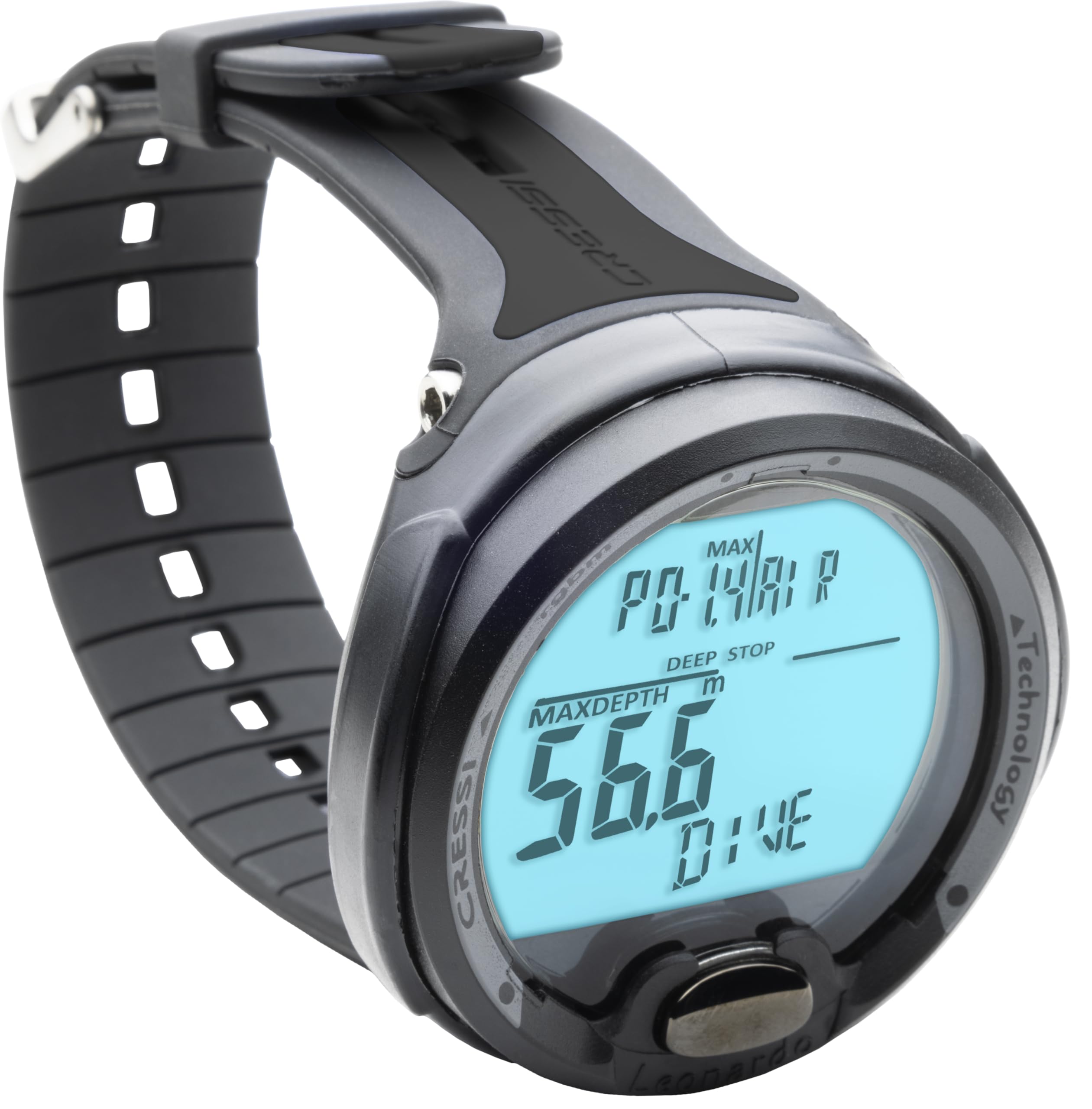
1. Cressi Leonardo 2.0 Scuba Dive Computer
The crowd-favorite entry-level computer is built around one big, readable screen and a button you can find by feel. That is why it earns the best overall spot in this guide.
The Cressi Leonardo 2.0 shows up everywhere — on rental fleets, with open-water students, and in bags of instructors who trust a simple backup. Over 200 owners praise its functionality. The reason is straightforward: one button handles everything. Switch between Air, Nitrox (21%-50% FO2 — that is the fraction of oxygen in the mix), and Gauge modes (a mode that disables decompression calculations) without a manual. The clarity helps divers with less-than-perfect vision. Buyers report the numerals stay crisp underwater. One diver says the screen is readable even with astigmatism (a common eye condition that blurs vision).
The real-world trade-off is the strap. It is large and can spin around a smaller wrist. A few owners with S/M wrists mention this as an annoyance, not a dealbreaker. Display durability gets mixed notes — owners mention it works perfectly for some, while a handful have had units stop after a short time. The CR2430 battery claims up to three years of use. Replacement is straightforward at an authorized center. Audible alarms for ascent violations (warnings when you rise too fast) are clear. But the ascent meter itself is a basic indicator without fine seconds, so one diver finds it a bit tricky to read at a glance.
Compared to the Suunto Zoop Novo below, the Cressi feels more streamlined for beginners. The single-button logic eliminates menu confusion. The Suunto offers a deeper depth rating of 330 feet versus the Cressi’s stated limits for those pushing deeper recreational profiles.
What wins people over
- Large, high-contrast numerals are easy to read even with astigmatism
- Single-button interface simplifies mode switching underwater
- Adjustable conservatism levels (3 settings) plus audible ascent alarms
- Compatible with Nitrox up to 50% and customizable PO2 (partial pressure of oxygen)
The honest trade-offs
- Wristband is oversized and can rotate on smaller wrists
- Backlight is noticeably weak for night diving
- No wireless PC sync — relies on IR (infrared) which requires a separate cable
- Ascent meter shows minutes only, no seconds detail
Reach for this if: you want the most proven, no-fuss entry-level computer with a screen that is actually easy on the eyes, backed by thousands of owners who keep diving with it.
Think twice if: you have a below-average wrist size or you need a backlight strong enough for night dives — those are the corners this model cuts.
2. Mares Puck Pro Ultra Dive Computer
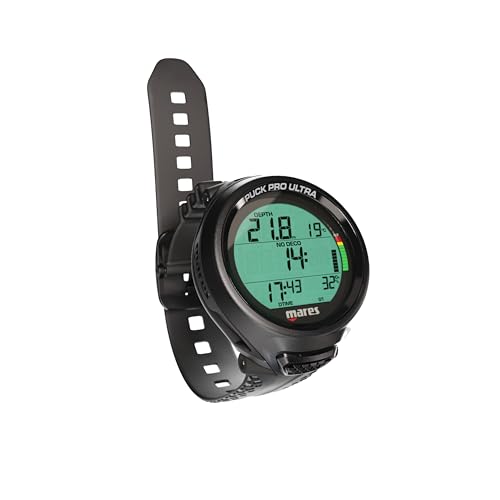
This Bluetooth-enabled puck logs your dives automatically while keeping operation dead simple. That wireless convenience makes it the top performer for divers who want a modern logbook.
The Mares Puck Pro Ultra uses the Buhlmann ZH-L16C algorithm with dual gradient factors — the same decompression backbone found in many premium computers. Your no-deco limits and safety stops are calculated with a reliable, conservative cushion. The real headline is integrated Bluetooth: after surfacing, your depth chart, water temps, and dive times transfer wirelessly to your phone via the Mares app. Owners describe it as simple and effective. This feature alone makes it more convenient than either the Cressi Leonardo or the Suunto Zoop Novo, both of which need a separate cable for a PC connection.
The benefit-first spec that stands out is the battery. The CR2450 cell is user-replaceable and rated for up to 100 dives. You can swap it yourself before a liveaboard week without hunting down a shop. The display is clear and high-contrast, large enough to read at a glance. The single Nitrox setting (21%-50%) covers every recreational enriched-air need. Owners who have used it in saltwater for a full week report it performed very well. One calls it “unbeatable at this price point” for recreational levels.
The catch is that the Puck Pro Ultra is very new (with relatively few reviews), so long-term durability data is still light. A few owners mention the plastic build feels lighter than expected at 0.75 lb, but that same weight makes it more comfortable on the wrist over repeated dives.
The standout strengths
- Bluetooth connectivity for easy dive-log syncing without cables
- Reliable Buhlmann ZH-L16C algorithm with dual gradient factors
- User-replaceable CR2450 battery lasting up to 100 dives
- High-contrast screen remains readable in low-light underwater conditions
What to weigh
- Fewer long-term reviews available to gauge durability across hundreds of dives
- No multiple gas settings — single gas Nitrox only (21%-50%)
- Plastic case feels lightweight, which some perceived as less premium
Reach for this if: you want the easiest logbook management in the budget tier and a trusted algorithm that does not demand a learning curve.
Look elsewhere if: you prefer a computer with years of owner history and thousands of reviews to confirm durability — the Puck is still building its reputation.
3. Suunto Zoop Novo Wrist Scuba Diving Computer

With a backlit screen and a depth rating of 330 feet (100 meters), the Zoop Novo dives deeper than most recreational divers ever need. That makes it the premium pick for those who want extra headroom.
The Suunto Zoop Novo gives you a clear, backlit display and a depth rating that outpaces the other two picks here by a significant margin. That 330-foot ceiling handles everything from recreational profiles to deeper technical dives within the no-decompression envelope. The screen is easy to read in low-light and night conditions. Owners consistently describe it as a simple, good-value unit ideal for amateur divers. One review page sums it up: “Reliable for dozens of dives to 99′.”
Ease of use is what owners praise most (18 positive mentions), followed closely by overall quality. The computer offers four operating modes: Air, Nitrox (21%-50%), Gauge, and a Freedom mode. It is programmable in imperial or metric, includes decompression-stop data, and features audible alarms for ascent speed and no-deco limits. The auto-activation at roughly 2 feet of depth means you never worry about forgetting to start the dive. On durability, feedback is mixed — several customers note it is built well, while others find the plastic case less confidence-inspiring.
One note on connectivity: the Zoop Novo does not have built-in Bluetooth. To transfer dive logs to a PC, you need a separate D-series cable specific to this model. That is an extra cost and a bit of a hunt to source. This is a clear step down in convenience compared to the Mares Puck Pro Ultra, which transfers data wirelessly for free.
what separates it
- Backlit display is genuinely useful for low-light and night dives
- 330-foot depth rating exceeds typical recreational requirements
- Four operating modes (Air, Nitrox, Gauge, Freedom) for flexibility
- Auto-activation at 2 feet plus audible alarms for safety
Consider this first
- PC log transfer requires a separate D-series cable (not included)
- Some owners find the menu navigation less intuitive than expected
- Durability feedback is mixed — some cases have not held up over extensive use
Reach for this if: you want the deepest depth rating in this price tier and a backlit screen that is genuinely easy on the eyes during night or low-visibility dives.
Consider another pick if: wireless dive-log syncing is important to you — this model needs an optional cable, and tracking it down can be annoying.
Understanding the Specs
Decompression Algorithm
The algorithm manages your oxygen budget to prevent decompression sickness. The Buhlmann ZH-L16C is a widely trusted model originally developed for altitude diving and is used by both the Mares Puck Pro Ultra and many high-end computers. Its dual-gradient-factor implementation adds a safety margin that is especially valuable when conditions or gas mixes are less predictable underwater.
Nitrox Compatibility
Nitrox is an oxygen-enriched air mix that extends your bottom time by reducing nitrogen absorption. The 21%-50% FO2 (fraction of oxygen) range covers standard recreational Nitrox mixes like 32% and 36%. A computer that supports this range lets you take advantage of longer dives without switching to a pricier multi-gas computer. The PO2 (partial pressure of oxygen) setting, adjustable from 1.2 to 1.6 bar, sets the maximum safe oxygen exposure — a higher value is riskier and should only be used with proper training.
FAQ
Can I trust a cheap dive computer with my safety?
How long does a dive computer battery last before I need to replace it?
What does single-button interface mean, and is it hard to use underwater?
Do I need Bluetooth on a dive computer?
What is the difference between Air, Nitrox, and Gauge modes?
Will a cheap dive computer fit my small wrist?
How deep can a budget dive computer go?
What is the best dive computer for an absolute beginner?
Final Thoughts: The Verdict
For most people, the best cheap dive computer is the Cressi Leonardo 2.0 because it balances a proven single-button interface, a screen that people with less-than-perfect vision actually enjoy reading, and a price that undercuts the competition while still offering Nitrox compatibility. If you want the modern convenience of wireless dive-log syncing, grab the Mares Puck Pro Ultra — its Bluetooth and 100-dive battery are genuinely handy. And for a deeper depth rating and a backlit display that works well at night, the Suunto Zoop Novo is the one to reach for.
How We Picked
We do not accept paid placement. Every pick is matched to a real buyer and a real use-case; we do not hands-on test units.
Sources & Methodology
Specifications: manufacturer listings and product documentation. Review insights: verified customer reviews, as of July 2026. Pricing: not shown on this page (it changes often); check the current price via the retailer link.
As an Amazon Associate, WellFizz earns from qualifying purchases. This does not affect which products we feature.
Related Guides

Mo Maruf
I created WellFizz to bridge the gap between vague wellness advice and actionable solutions. My mission is simple: to decode the research and give you practical tools you can actually use.
Beyond the data, I am a passionate traveler. I believe that stepping away from the screen to explore new environments is essential for mental clarity and physical vitality.