Our readers keep the lights on and my smoothie glass nicely filled. As an Amazon Associate, I earn from qualifying purchases.
Specs are compiled from manufacturer listings and verified buyer reviews and can change over time — please confirm the key details on the product page before buying.
Swollen feet and aching legs make every step harder, especially for elderly loved ones who already deal with limited mobility. The right pair of compression socks can change that — by boosting circulation and easing the pressure that builds up during the day. But not all socks are equal, and some are nearly impossible to get on without help. This guide cuts through the choices to find the ones that actually fit, actually work, and are actually manageable for aging hands.
I’m Mohammad Maruf — the founder and writer behind WellFizz. This guide is built by comparing the manufacturers’ published specifications and the patterns across verified customer reviews, so you get each pick’s real strengths and trade-offs instead of marketing spin.
After looking closely at the most popular options, we narrowed down the field to the nine pairs that consistently deliver on comfort, graduated pressure, and ease of wear. This is our ranking of the very best compression socks for elderly with swollen feet available right now, based on real owner experiences and hard specs that matter.
Our Picks at a Glance

How To Choose The Best Compression Socks For Elderly With Swollen Feet
Buying compression socks for an older person is not the same as picking a pair for a runner or a pregnant woman. The priority shifts from performance to daily manageability — can the wearer put them on alone? Will the fabric irritate thin, sensitive skin? Does the fit accommodate swelling that changes through the day? Here are the key things to get right.
The Compression Level (mmHg) Must Match the Swelling Severity
This is the only number that truly matters. Measured in millimeters of mercury (mmHg), the compression level tells you how much pressure the sock applies. For mild swelling that goes down overnight, 15-20 mmHg is usually enough and feels lighter. For moderate to severe edema that lingers, 20-30 mmHg is the standard medical-grade range used for varicose veins and post-surgery recovery. Going too low won’t help; going too high without a doctor’s guidance can be uncomfortable or risky.
Don’t Skip the Zipper (But Know the Trade-Off)
Standard compression socks require serious pulling and tugging to get on — something elderly hands with arthritis or reduced grip strength simply cannot manage. A side zipper solves that instantly. The catch? Some zippers can pinch skin or be hard to zip up alone if you have limited hand mobility. The best zipper designs use a protective fabric flap under the zipper and an extended pull tab that makes the motion easier. If even a zipper is too hard, look for open-toe styles that are generally easier to slide on.
Measure the Calf, Do Not Guess the Size
Swollen feet almost always come with swollen calves. Buying a pair based on shoe size alone guarantees a poor fit. You need to measure the circumference of the widest part of the calf and the length from the floor to the back of the knee. Many brands include a specific sizing chart in their product images. Use it. A sock that is too tight at the top will cut off circulation, defeating the entire purpose. A sock that is too loose will slide down and offer no real compression.
Quick Comparison
| Model | Best For | Compression | Material | Toe Style | Amazon |
|---|---|---|---|---|---|
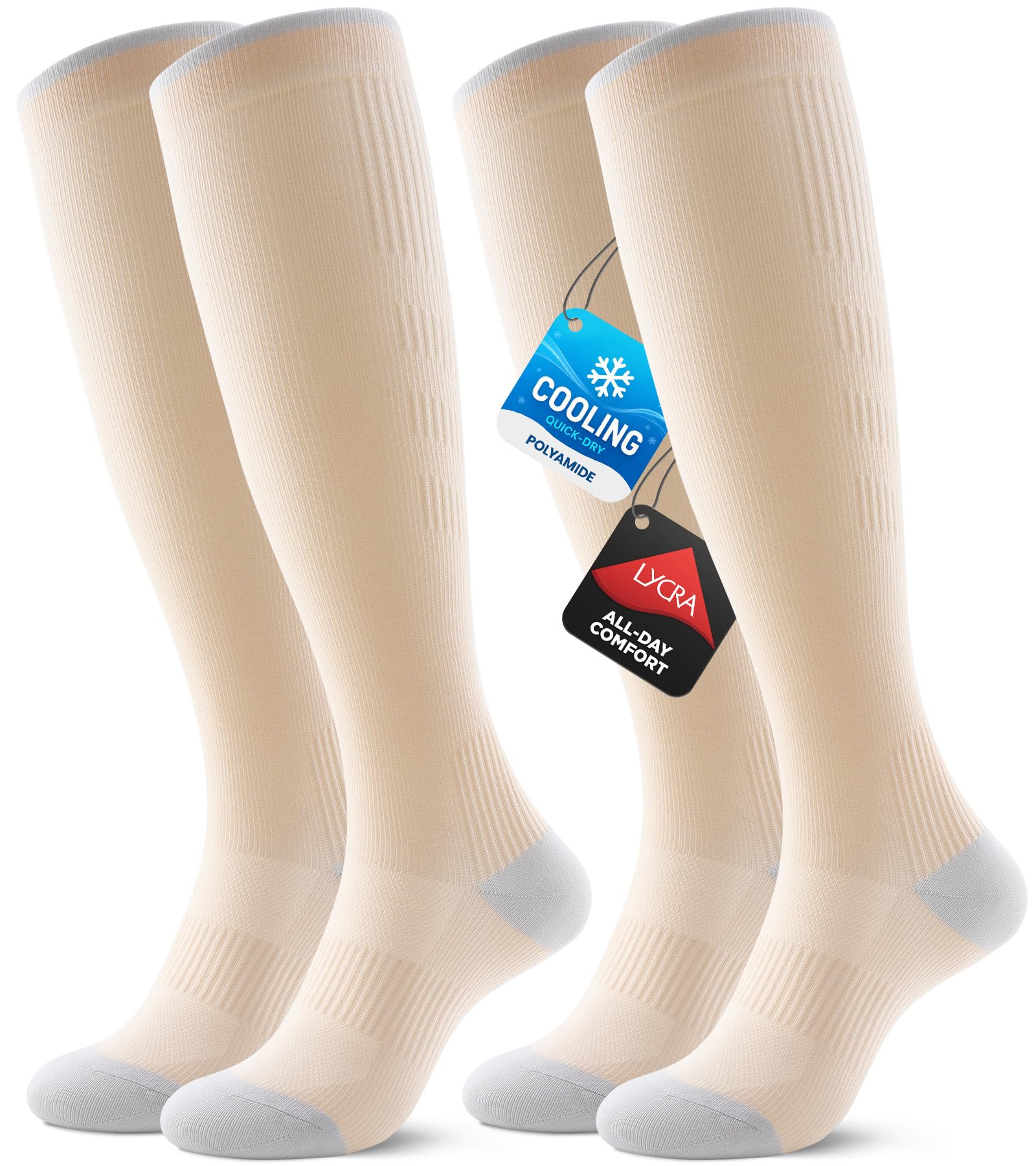
| Benirap Breathable★ Best Overall | Overall best | 20-30 mmHg | Nylon/Spandex | Closed | Amazon |
| Athbavib 2-Pack ZipperEasiest On/Off | Easiest on/off | 15-20 mmHg | 75% Nylon, 25% Spandex | Closed | Amazon |
| BraceAbility Open Toe | Open-toe comfort | 20-30 mmHg | Nylon/Spandex | Open | Amazon |
| NEENCA Zipper | Zipper + high compression | 20-30 mmHg | 65% Nylon, 15% Polyester, 20% Spandex | Closed | Amazon |
| LEVSOX Cotton | Breathable cotton feel | 20-30 mmHg | Cotton | Closed | Amazon |
| Lalapapa Wide Calf 3-Pack | Wide calves | 20-30 mmHg | Cotton/Nylon/Spandex | Closed | Amazon |
| Ailaka Zipper (X-Large) | Largest size range | 20-30 mmHg | 70% Nylon, 30% Spandex | Closed | Amazon |
In‑Depth Reviews
1. Benirap Breathable Compression Socks
Our pick — over 4.5★ from 500+ verified ratings; the strongest balance of quality and price.
The crowd favorite that finally solves swelling without making you sweat.
This is the pair that owners keep coming back to — and the numbers back it up. At 20-30 mmHg, you get medical-grade graduated compression that tackles moderate to serious swelling head-on. But what really sets the Benirap pair apart is how it feels on the skin. The fabric is breathable enough that an elderly man who wears them in summer “surprisingly doesn’t get too hot,” according to his family. Another owner reported that his swollen feet and rashes cleared up “faster than any cream ever could.” The sock weighs just 3.53 ounces, so it never feels heavy or restrictive, and the slim 0.79-inch package means the fabric itself is lightweight and finely knit.
It comes as a 2-pack, which is a practical bonus for elderly users who need a clean pair every day without scrambling for backups. The closed-toe design provides full coverage, and the knee-high length works well under trousers or with casual shoes. Owners consistently praise the comfort and the way these socks reduce leg fatigue, even after standing for hours.
Why this is the top pick
- 20-30 mmHg compression is the medical standard for serious swelling
- Breathable enough for summer wear; no overheating reported
- Easy to put on and take off; comfortable for all-day use
- Comes in a 2-pack for daily rotation
The honest limit
- No side zipper — requires some pulling to put on
- Closed toe may not suit those with very sensitive or painful toes
Reach for these if: you need serious 20-30 mmHg pressure for moderate to severe swelling and want a breathable, all-day sock that owners rave about.
Think twice if: the wearer has arthritis or very limited hand strength and cannot manage pull-on compression socks without help.
2. Athbavib 2 Pairs Zipper Compression Socks
The zipper sock that an elderly father-in-law can manage entirely on his own.
For many seniors, the hardest part of wearing compression socks is getting them on. Athbavib solves that with a full side zipper. Buyers report that elderly parents and in-laws can put these on without assistance — a huge win for dignity and daily independence. The zipper includes a protective inner fabric flap that prevents skin from rubbing against the metal. At 15-20 mmHg, the compression is lighter than medical-grade 20-30 mmHg, making this a gentler option for mild swelling or for someone who is new to compression socks.
The material is 75% nylon and 25% spandex, which gives it a durable, four-way stretch feel. It comes in a 2-pack with multiple color options, and the closed-toe design is specifically noted by wearers to help with foot swelling. The package is notably larger than others at 7.99 x 6.26 x 2.48 inches and weighs 7.05 ounces — nearly 2.8x heavier than the BraceAbility socks — because of the zipper hardware and double pack. One honest caveat: some buyers with larger calves found the sizing restrictive, especially in the XL range. If the wearer has very wide calves, measure carefully against the size chart first.
What wins people over
- Side zipper makes putting on and taking off genuinely easy for elderly hands
- Closed toe reduces foot swelling specifically
- Comes in a 2-pack with color variety
- Durable nylon/spandex blend holds up to daily washing
The honest limit
- 15-20 mmHg is a lighter compression — not enough for moderate to severe swelling
- Sizing is limited; larger calves may not fit
Best for: mild swelling and seniors who cannot manage pull-on compression socks and need the independence of a zipper.
Consider skipping if: the swelling is significant — the 15-20 mmHg level may not provide enough pressure, and the 20-30 mmHg NEENCA pair below is a better fit.
3. BraceAbility Compression Socks for Circulation
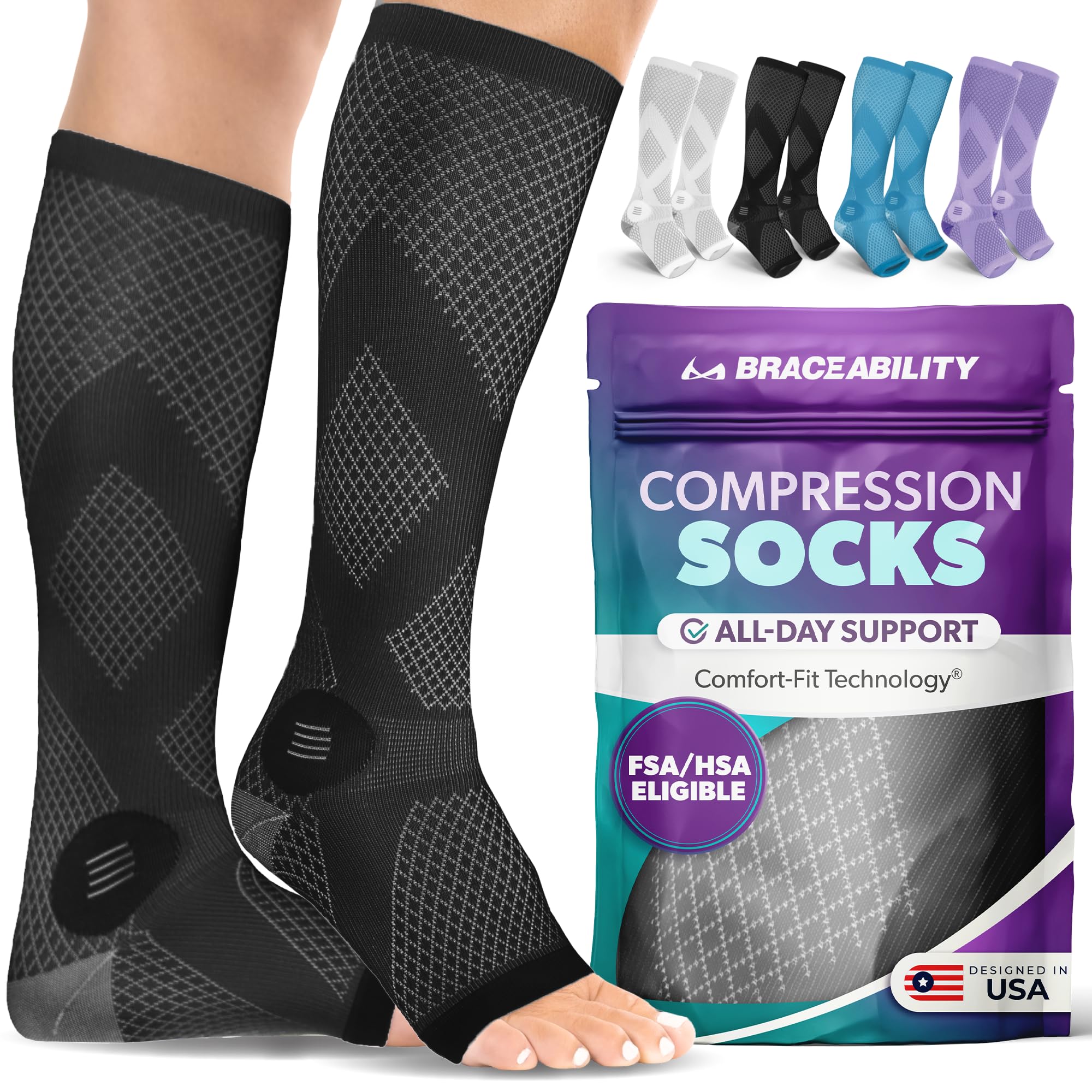
The featherweight open-toe sock that does not bunch up or roll down.
At just 2.56 ounces, these are the lightest socks on this list by a significant margin — the Athbavib pair is nearly three times heavier at 7.05 ounces, so the difference on tired legs is immediate. The open-toe design is a standout for anyone with sensitive, swollen, or painful toes. It allows toes to breathe and move freely, and the sock works with sandals in warmer weather. The 20-30 mmHg graduated compression targets the ankle and lower shin specifically, where edema usually concentrates. Owners with over 10 years of compression sock experience say these are “very comfortable even in the heat of the summer” and “stay up without falling down.”
The material is a soft-stretch nylon blend with moisture-wicking properties, and the fit works well for people of short to average height (around 5’4″ with a 16-inch calf measurement). The lavender color option gets specific praise for its appearance. On the durability front, the feedback is mixed: many owners mention the socks hold up well, but a notable number mention that the fabric can start unraveling after a few months of consistent use. If the wearer is hard on socks or needs them to last significantly longer, this is worth factoring in.
Why it stands out
- Open-toe design relieves pressure on sensitive toes and is cooler in summer
- At 2.56 oz, it is the lightest option — barely noticeable on the leg
- Stays put without rolling or bunching
The honest limit
- Durability is a concern; some customers note unraveling after a few months
- Sizing is best for short to average-height users; tall wearers may find them too short
Ideal for: elderly users with very sensitive toes who want medical-grade 20-30 mmHg compression in a barely-there, breathable package.
skip it if: you need socks that will survive heavy daily washing and frequent wear for more than a season or two.
4. NEENCA Zipper Compression Socks
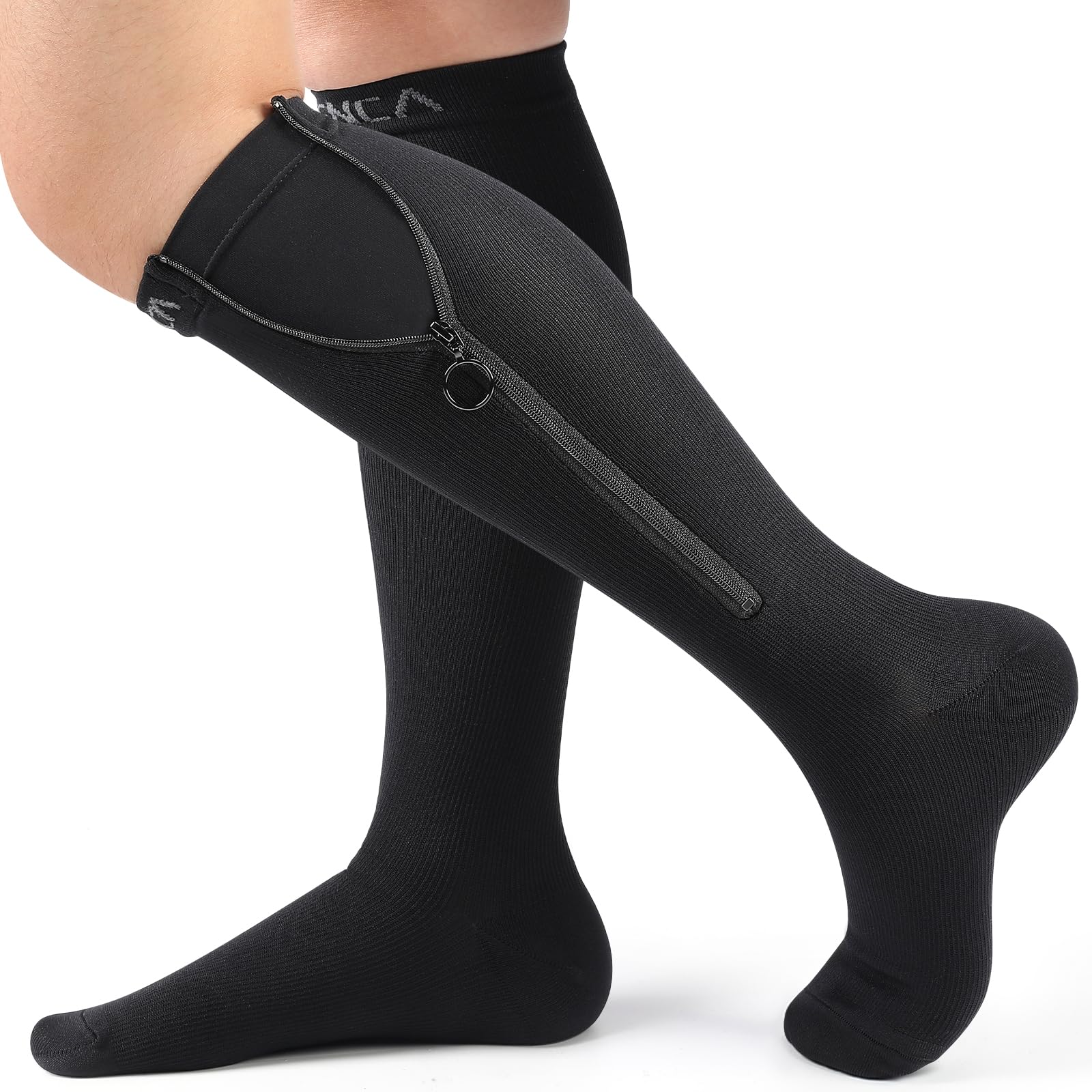
Medical-grade 20-30 mmHg compression with a zipper that actually stays in place.
If you need the stronger compression of 20-30 mmHg but the wearer cannot manage a pull-on sock, the NEENCA is the answer. It combines a full side zipper with the higher pressure level, offering 33% more compression than the 15-20 mmHg Athbavib pair. The zipper itself has a ring pull tab that makes it “super easy to zip,” according to owners. One family reported that after just one week of use, the swelling in their mother’s calves reduced by 2 cm. The material is a blend of 65% nylon, 15% polyester, and 20% spandex, which gives it a soft, non-scratchy feel that does not aggravate sensitive skin.
The sock is lightweight at 3.53 ounces and the 360-degree ergonomic fit hugs the leg curve without creating pressure points. The maker positions it as a Class 1 Medical Device. The honest trade-off? The zipper can be tricky to operate alone if the wearer has very weak hands or arthritis that limits two-handed coordination. Some owners note they need a helper to zip it up. The sizing is precise — measuring the calf correctly is essential, and several buyers found the sizing chart accurate only when they followed it exactly.
The big wins
- 20-30 mmHg medical-grade compression with the convenience of a zipper
- Proven results: reviewers point out measurable reduction in calf swelling
- Soft, non-irritating fabric; no itching or scratching
- Zipper hardware includes a ring pull for easier grip
The honest limit
- Zipping up alone can be tough for someone with arthritis or very limited hand strength
- Sizing is precise; measuring incorrectly can lead to a poor fit
Reach for these if: you need the full 20-30 mmHg pressure but want to avoid the struggle of pull-on socks, and the wearer has a helper available for zipping.
Look elsewhere if: the wearer must put them on entirely alone and has limited grip strength in both hands.
5. LEVSOX Cotton Compression Socks

Cotton compression that keeps skin cool and rash-free all day.
Sensitive skin and synthetic materials do not always get along. The LEVSOX pair is made primarily from cotton, which is a relief for anyone who finds nylon and polyester socks irritating. Owners with skin allergies and rashes report that switching to these cleared up their irritation. The 20-30 mmHg compression level is full-strength, so the swelling reduction is on par with the best medical-grade socks here. The socks are opaque, with thicker cushioned soles that provide an extra layer of comfort for walking around the house. The material breathes well, making them cool enough for warm weather.
The toe area has no internal seam, which prevents the rubbing and pressure that can cause discomfort during long wear. One owner noted that even after 12+ hours of wear, the compression held up without slipping. The main sizing caveat is that the medium/large runs closer to a medium in reality, so buyers with average-to-large legs may need to size up. A few owners also found the sock too long from ankle to knee, causing it to bunch behind the knee if rolled down. Hand washing or a gentle cycle with hang drying is recommended to preserve the cotton fibers.
What makes it special
- Cotton fabric is ideal for sensitive or rash-prone skin
- 20-30 mmHg full-strength compression that lasts all day
- No toe seam means zero irritation at the toes
- Thicker cushioned sole for comfort while walking
The honest limit
- Runs a bit long for shorter wearers; may bunch behind the knee
- Medium/large fits closer to a medium — larger legs need to size up
- Cotton may wear faster than synthetic blends if machine washed
Best for: elderly users with sensitive skin, allergies to synthetic blends, or rashes that worsen with nylon compression socks.
Think twice if: you are tall (over 5’8″) and need the sock to reach high without pulling tight at the knee.
6. Lalapapa Wide Calf Compression Socks 3-Pack
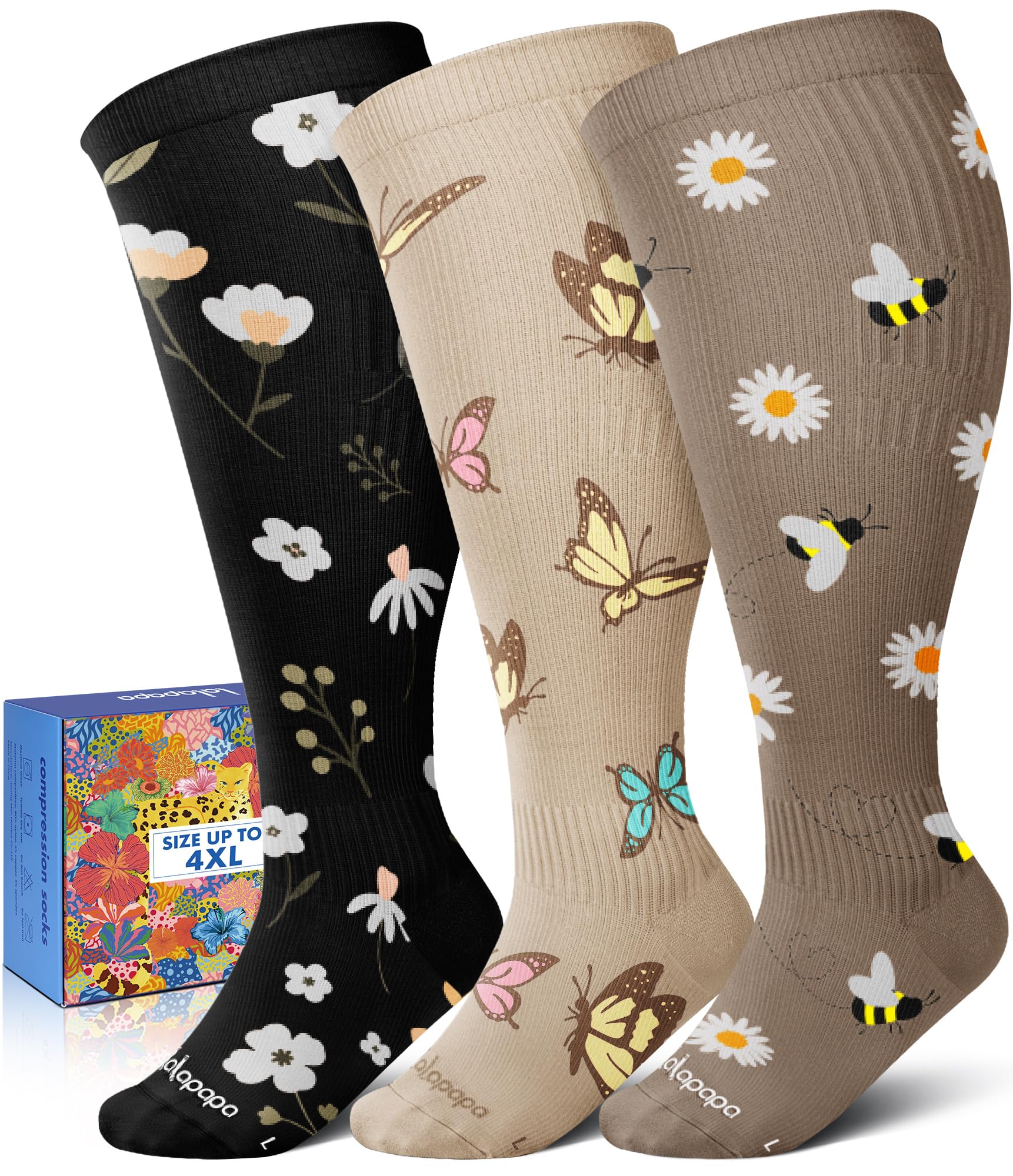
Wide calf? Finally, a 20-30 mmHg sock that actually stays up without digging in.
Swollen feet often come with swollen calves, and standard compression socks either roll down or cut off circulation at the top band. This Lalapapa 3-pack is built specifically for wider legs. The stretchy band is designed to stretch over larger calves without digging in, and the compression level is a solid 20-30 mmHg. Owners with 18-inch calves and lipedema (a condition where fat accumulates in the legs) report that these fit comfortably and stay put. The socks come in cute patterned designs — bees, butterflies, florals — which is a small but meaningful morale boost for someone who has to wear compression socks every day.
The trade-off is the patterned knit itself. Because of the way the design is woven into the fabric, some shoppers say that the pattern imprints on the skin after a few hours. For most, it is not painful, but one owner noted that the imprinting becomes uncomfortable during a full work shift. The material is heavier than the other socks here — it is thicker and more like a traditional athletic sock — which provides more cushioning but may not be ideal for hot climates.
Why it is a winner for wide legs
- Designed for larger calves; fits 18-inch calf circumference comfortably
- 20-30 mmHg graduated compression that reduces edema noticeably
- 3-pack offers excellent value for daily rotation
- Fun patterns add a bit of personality to medical wear
The honest limit
- Patterned knit can leave imprints on the skin during long wear
- Thicker material may feel warm in hot weather
Reach for these if: swollen calves are the main fitting challenge and you want strong 20-30 mmHg compression in a cute, cushioned 3-pack.
Skip if: you need the slimmest, most breathable sock — the thicker material and pattern imprints can be a bother for all-day wear.
7. Ailaka Zipper Compression Socks

Sizes from M up to 5X-Large — the one sock that fits even severe calf swelling.
When leg swelling is extreme, off-the-shelf sizing simply does not work. The Ailaka socks are available in a range from medium all the way up to 5X-Large, which is rare in the compression sock world. The 20-30 mmHg graduated compression uses a YKK zipper with an extended pull handle that makes it easier for elderly users to zip up alone. The fabric is 70% nylon and 30% spandex, providing a durable, four-way stretch that accommodates larger shapes without feeling restrictive. Buyers report that the socks are “surprisingly easy to put on” and are effective at keeping swelling down in the lower legs throughout the day.
The closed-toe design provides full coverage, and the material is opaque, so it looks like a normal dress sock rather than a medical device. One owner who wears them for 6 months daily says they held up well. The downside echoed by many is that the socks can run small compared to the size chart, especially for the larger sizes. Several buyers recommend going up one size from your measurement for a comfortable fit. The longer length is also a consideration for shorter wearers — a 5’2″ individual may find the sock extends too high up the leg.
The big strengths
- Sizes up to 5X-Large accommodate severe calf swelling and larger body types
- YKK zipper with extended pull handle aids independent use
- Effective 20-30 mmHg compression that reduces swelling during daily wear
- Durable enough for 6 months of daily use
The honest limit
- Sizing runs small — go up one size from your measurement
- Too long for shorter wearers; may bunch above the knee
Best for: elderly individuals with very large or severely swollen calves who need 20-30 mmHg compression and the ease of a zipper.
Consider skipping if: the wearer is under 5’4″ or has relatively average-sized calves — the extended length and size range may not be necessary.
Understanding the Specs
Graduated Compression (mmHg)
This is the pressure the sock applies, measured in millimeters of mercury. A “graduated” design means the pressure is highest at the ankle and gradually decreases up the calf. This pushes blood upward, helping it flow back to the heart instead of pooling in the feet and lower legs. For swollen feet, 20-30 mmHg is the standard medical grade that doctors typically recommend for moderate edema, varicose veins, and post-surgery recovery. The lower 15-20 mmHg range is lighter and better suited for mild swelling, travel, or first-time users who are not used to the feeling of compression.
Zipper vs Pull-On Design
A zipper makes getting the sock on dramatically easier for anyone with arthritis, weak grip, or limited mobility. The best zipper designs include a fabric guard underneath to prevent the metal from rubbing against the skin, plus an extended pull tab or ring that makes the hook-and-pull motion easier. The trade-off is that a zipper adds bulk, and some wearers with very weak hands still find it difficult to zip up alone — they may need a helper. Pull-on socks require more effort to put on but are simpler in construction, cheaper, and lighter.
Open Toe vs Closed Toe
An open-toe (or toeless) sock leaves the toes exposed, which is a major comfort advantage for anyone whose toes are swollen, painful, or sensitive. It also allows the foot to breathe better in hot weather and lets you wear sandals. The closed-toe design provides full coverage and keeps the entire foot warm, plus it applies gentle compression to the toes themselves, which can help with foot swelling. For elderly users with neuropathy (nerve pain) or bunions, the open-toe style is usually more comfortable because nothing presses on the tips of the toes.
Material Composition
Most compression socks are a blend of nylon and spandex because those synthetic fibers provide the stretch and durability needed to maintain consistent pressure wash after wash. Cotton is a rarer option — it is softer and less irritating for sensitive skin, but it can lose its compression shape faster than synthetics if not washed with care (gentle cycle, hang dry). For someone with itchy or rash-prone skin, a cotton blend is often the only comfortable choice. The trade-off is that cotton socks tend to be thicker and warmer than ultra-thin nylon stockings.
FAQ
What does 20-30 mmHg mean and is it safe for my elderly parent?
How do I measure my mom’s calf to get the right size?
Can my elderly father wear compression socks to bed at night?
How tight should compression socks feel for swollen feet?
How long do compression socks typically last before they lose their pressure?
What is the difference between a zipper compression sock and a regular pull-on one?
Are open-toe compression socks better for elderly swollen feet than closed-toe?
Can compression socks cause skin irritation or rashes on elderly skin?
How many hours a day should an elderly person wear compression socks for swelling?
Final Thoughts: The Verdict
Across the board, the compression socks for elderly with swollen feet winner is the Benirap Breathable Compression Socks because it delivers full 20-30 mmHg medical-grade pressure in a breathable, well-loved design that owners consistently call the most comfortable solution. If the wearer struggles with arthritis and cannot manage a pull-on sock, grab the Athbavib 2-Pack Zipper Socks for the easiest on/off experience. And for wide calves that nothing else fits — and up to 5X-Large sizing — the Ailaka Zipper Socks are the ones to reach for.
How We Picked
We do not accept paid placement. Every pick is matched to a real buyer and a real use-case; we do not hands-on test units.
Sources & Methodology
Specifications: manufacturer listings and product documentation. Review insights: verified customer reviews, as of July 2026. Pricing: not shown on this page (it changes often); check the current price via the retailer link.
As an Amazon Associate, WellFizz earns from qualifying purchases. This does not affect which products we feature.
Related Guides

Mo Maruf
I created WellFizz to bridge the gap between vague wellness advice and actionable solutions. My mission is simple: to decode the research and give you practical tools you can actually use.
Beyond the data, I am a passionate traveler. I believe that stepping away from the screen to explore new environments is essential for mental clarity and physical vitality.