Our readers keep the lights on and my smoothie glass nicely filled. As an Amazon Associate, I earn from qualifying purchases.
Specs are compiled from manufacturer listings and verified buyer reviews and can change over time — please confirm the key details on the product page before buying.
Baby chicks do not have teeth. That is not a cute fact; it is the whole reason you are here. Without grit — tiny, sharp-edged stones — a chick cannot grind its feed inside its gizzard (its muscular stomach), so the food passes right through undigested. The best chick grit solves that problem with particles so precisely sized that even a day-old bird can swallow and use them, keeping your flock growing strong from the start. This guide compares two top contenders so you know exactly which bag delivers that critical chew-power.
I’m Mohammad Maruf — the founder and writer behind WellFizz. This guide is built by comparing the manufacturers’ published specifications and the patterns across verified customer reviews, so you get each pick’s real strengths and trade-offs instead of marketing spin.
The crowd favorite — holding a 4.8-star score across over 500 buyers — nails the tiny-particle balance from hatch day to week eight, which is exactly what makes it a leading candidate for the title of best chick grit available today.
Quick Picks
- Mile Four Chick Grit for Baby Chicks — Best Overall
- Small Pet Select Chick Grit (for Your Babies) — Best Value
How To Choose The Best Chick Grit
Picking the right grit for your baby chicks depends on three things: particle size, source material, and dust content. A bag that is too coarse chokes your birds; one that is too fine blows through them without doing any grinding work. Here is how to cut through the noise.
Particle Size and Age Window
Starter grit is marketed for chicks from hatch to roughly 8 weeks old. The pieces need to be small enough that a tiny bird can pick them up and swallow them easily. If the grit looks like miniature pebbles rather than coarse sand, it is likely adult-sized and dangerous for a baby crop (the pouch in its throat where food is stored). Look for a product that explicitly states its intended age range — 0–8 weeks is the standard window.
Mineral Type: Granite vs Quartzite
Nearly all chick grit is crushed natural stone, either granite or quartzite. Both are hard enough to grind feed inside the gizzard, but quartzite tends to produce sharper, more angular edges that stay effective longer before wearing smooth. Granite is often washed to remove fines (stone dust) and clay, which means less mess in the feeder. Either works; the key is that the stone is crushed, not naturally rounded river pebbles that slide through the digestive tract without doing any work.
Dust and Fines
A bag full of stone dust is wasted money — the dust does not help digestion, it just coats the feed and the feeder. Quality grit is washed or screened to minimize this fraction. The best indicator is an owner’s experience: if the consensus says “low dust,” that is reliability you cannot see on the label. A clean bag also reduces respiratory irritation for you and your birds.
Quick Comparison
In‑Depth Reviews
1. Mile Four Chick Grit for Baby Chicks

The finest grit on the list — tiny quartzite shards a chick can swallow from day one.
Getting grit into a day-old chick is the whole challenge, and this bag solves it with particles so uniformly fine that owners repeatedly call it “perfect fine grit.” Made from all-natural crushed quartzite, it stays angular inside the gizzard longer than softer minerals, meaning your flock gets more grinding work per pebble. The dust is extremely minimal — owners note how clean the bag pours, which means less airborne dust around your brooder and less waste in the feeder. A single 4-pound bag is estimated to last 15 to 20 chicks through their starter phase, which works out to about a quarter-pound per bird per month.
Compared to the 9.95-pound Small Pet Select bag, this one weighs in at just 4 pounds — a 2.5x gap — but it targets a narrower window (0–8 weeks versus a broader hatch-to-8-weeks range) with a sharper stone that owners say stays effective. “I love Mile Four’s products! Their chick grit is super high quality, fine, and extremely minimal dust,” writes a regular buyer. The product even carries a recommended switch-over cue: move to adult grit after 8 weeks, which is clearly marked on the bag.
The catch? It costs the same upfront as the larger Small Pet Select bag but gives you less than half the weight by volume. If you hatch in big batches or keep multiple small flocks through the season, you will burn through 4 pounds fast and need to reorder sooner. The mixed verdict on value-for-money from a handful of owners backs that up — the per-pound price is higher, even if the quality is top-tier. A 64-ounce bag is not a season’s supply for a busy hatchery.
What wins owners over
- Exceptional uniform fineness — chicks as young as day-olds swallow it easily
- Very low dust, keeps the feeder area cleaner than most grits
- High-quality quartzite stays sharp for better digestion
The honest trade-off
- Only 4 pounds — a 2.5x smaller bag than the competitor at the same price point
- Value-for-money is mixed among owners; reorder frequency is higher for large flocks
Best for: first-time chick owners, small backyard hatches, and anyone who prizes ultra-fine particle size above raw volume.
Think twice if: you raise large numbers of chicks annually — the per-pound cost is steeper and the bag runs out fast.
2. Small Pet Select Chick Grit (for Your Babies)
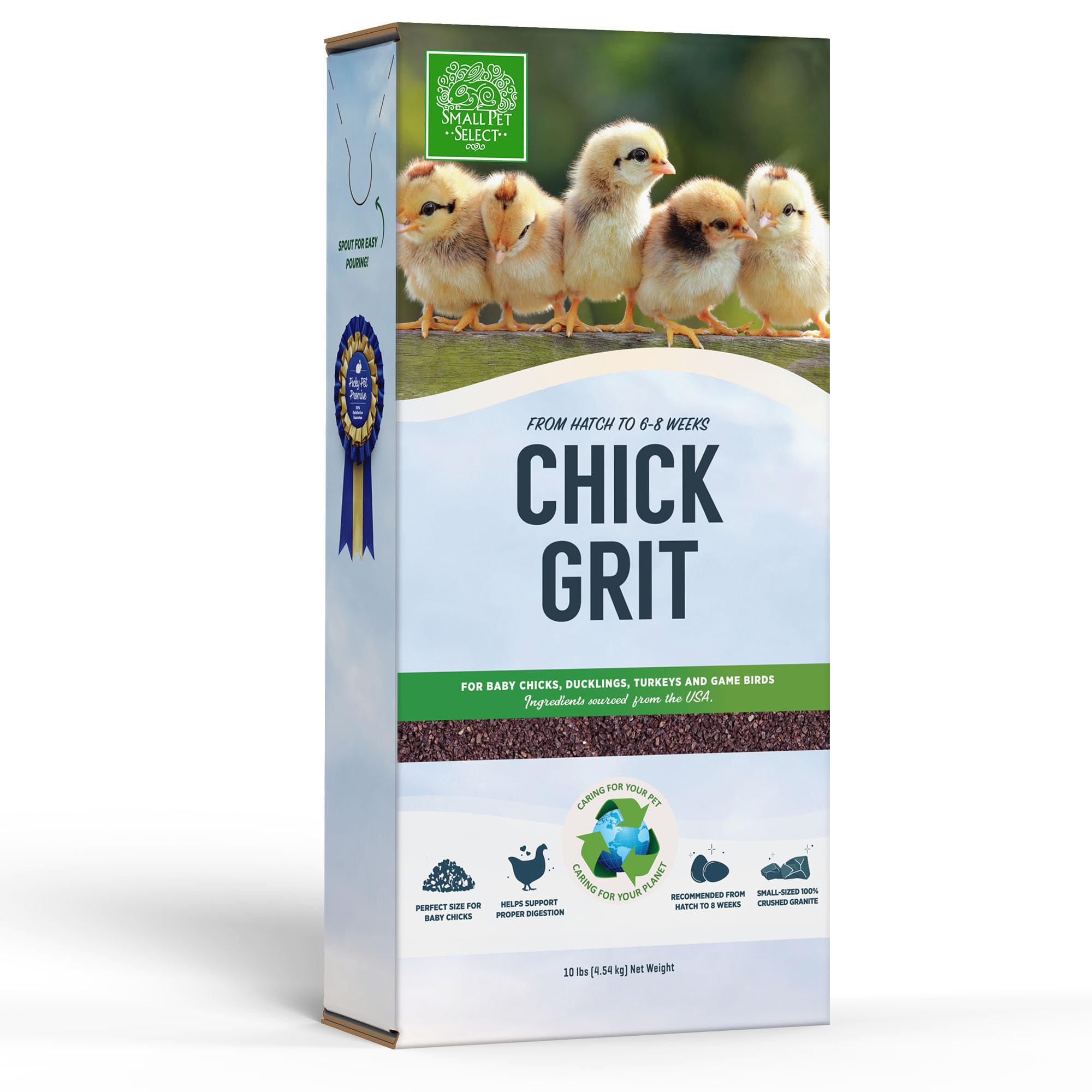
Nearly 10 pounds of crushed washed granite that costs the same as a bag half its size.
If volume-to-dollar ratio is your deciding metric, this bag wins in a walk. At 9.95 pounds, it is roughly 2.5 times heavier than the Mile Four bag for the same entry price, which translates into a season’s worth of grit for a moderate flock rather than a few weeks’ supply. The grit itself is 100% crushed washed granite, sourced in the USA, meaning the majority of clay fines (powdery dust) and stone dust have been removed during washing. The result is a clean, consistent granule that owners say looks “just the right size for my baby chicks” — a relief for anyone who has ever opened a bag of adult grit and found pieces too big for tiny beaks.
The product is recommended from hatch to 6–8 weeks of age, a slightly shorter intended window than the Mile Four bag’s 0–8 weeks, but buyers report using it successfully on older chicks and even on tiny non-chicken species: “we use for button quail and diamond doves, good size for both,” notes one buyer. The brand also backs the bag with a 100% satisfaction guarantee, and the owner community highlights the company’s customer service — when a delivery mishap left a bag soaked, the company refunded even though it was not at fault.
The trade-off is that granite, while perfectly effective, is softer than quartzite and may wear down faster in a gizzard, potentially requiring your birds to eat slightly more grit over time to keep the same grinding action. A few owners also mention that the particle size works well, but the bag could include more volume — the product description explains that crushed granite settles during shipping, so the bag may appear less full than you expected, though the net weight is accurate. The 4.5-star score across over 200 ratings reflects a very satisfied base, but the consensus is a notch below the near-perfect 4.8 of the Mile Four.
Why it stands out
- Nearly 10 pounds for the same price as a 4-pound competitor — class-leading value per bag
- Washed granite means minimal dust and clean handling
- Versatile enough for button quail and diamond doves, not just chicks
The honest trade-off
- Granite is less durable in the gizzard than the quartzite in the top pick
- The bag can look under-filled due to settling, even though the weight is correct
Reach for this if: you raise chicks in volume or want a single bag to carry you through multiple hatch cycles without reordering.
Look elsewhere if: ultra-fine particle consistency is your top priority and you prefer quartzite hardness over granite economy.
Understanding the Specs
Mineral Type: Quartzite vs Granite
The rock your grit is crushed from matters more than you would think. Quartzite is metamorphic sandstone that fractures into very sharp, angular shards and holds that edge longer as your chick’s gizzard works on it. Granite is an igneous rock that is plentiful and cheap, and gets washed to remove dust, but it rounds off faster. Both work; quartzite is generally considered the premium option for its longevity in the digestive tract.
Weight and Volume Per Bag
A chick eats roughly a quarter-pound of grit per month, so a 4-pound bag covers about 16 bird-months — fine for a small backyard hatch. A 10-pound bag covers roughly 40 bird-months. The catch is that crushed stone settles during shipping, so a bag can look half-empty even though the listed net weight is correct. Weigh it if you are not sure; the label is honest, but the visual can be deceiving.
Age Window Labeling
Starter grit is formulated for chicks from hatch day to around 8 weeks old. After that, their throats and gizzards are large enough to handle “grower” or “layer” grit, which has bigger particles. Feeding adult grit to a day-old chick can cause crop impaction (a blockage in the throat pouch) because the pieces are too large to pass. Always match the bag’s printed age recommendation to the actual age of your birds.
Washed vs Unwashed Grit
A “washed” product has been rinsed to remove the powdery stone dust (fines) that naturally clings to crushed rock. Less dust means less waste in the feeder and less respiratory irritation for both you and your birds. Unwashed grit is cheaper but messier. If you see owners praising low dust, that is a reliable sign the washing process is effective.
FAQ
Can I feed adult chicken grit to baby chicks?
How much grit does a baby chick need per month?
What happens if my chick eats too much grit?
Can I use chick grit for other birds like quail or doves?
Is washed grit better than unwashed grit?
How do I offer grit to my chicks?
Do chicks need grit if they eat only commercial crumble?
What is the difference between granite and quartzite grit?
Can I mix starter grit with layer grit for a mixed-age flock?
Why does my bag of chick grit look only half full?
Final Thoughts: The Verdict
For most buyers, the best chick grit winner is the Mile Four Chick Grit because its ultra-fine quartzite particles are uniformly sized for day-old chicks, produce minimal dust, and earn a near-flawless consensus from over 500 owners. If you want the most grit per dollar and raise chicks in volume, grab the Small Pet Select Chick Grit — at 9.95 pounds for the same price as a 4-pound bag, it is the obvious value play. And if your flock includes tiny species like button quail or diamond doves, the Small Pet Select bag doubles as a multi-species grit, stretching your purchase even further.
How We Picked
We do not accept paid placement. Every pick is matched to a real buyer and a real use-case; we do not hands-on test units.
Sources & Methodology
Specifications: manufacturer listings and product documentation. Review insights: verified customer reviews, as of July 2026. Pricing: not shown on this page (it changes often); check the current price via the retailer link.
As an Amazon Associate, WellFizz earns from qualifying purchases. This does not affect which products we feature.
Related Guides

Mo Maruf
I created WellFizz to bridge the gap between vague wellness advice and actionable solutions. My mission is simple: to decode the research and give you practical tools you can actually use.
Beyond the data, I am a passionate traveler. I believe that stepping away from the screen to explore new environments is essential for mental clarity and physical vitality.