Our readers keep the lights on and my smoothie glass nicely filled. As an Amazon Associate, I earn from qualifying purchases.
Specs are compiled from manufacturer listings and verified buyer reviews and can change over time — please confirm the key details on the product page before buying.
A competition kettlebell keeps the same body dimensions no matter the weight you pick. Standard cast-iron bells get bigger and bulkier as the weight goes up, but every competition bell in a set shares the same handle thickness, overall height, width, and flat base. That uniformity lets you drill the same movement pattern at 8 kg as you do at 32 kg — exactly what sport competitors and serious strength athletes need. The real decision depends on handle feel, surface finish, and how well the weight is balanced. Here is what the market actually offers right now.
This guide compares the manufacturers’ published specifications and patterns across verified customer reviews, so you get each pick’s real strengths and trade-offs.
The three competition kettlebells below represent the cleanest cross-section of the current market — the crowd favorite with many ratings, a precision-cast premium option, and a budget-friendly contender that nails the basics. Read on to find out which competition kettlebells deserves a spot on your gym floor.
Our Picks at a Glance
How To Choose The Best Competition Kettlebells
A competition kettlebell is a specialised tool, and buying the wrong one can mess up your technique or cause unnecessary hand pain. The three things that matter most are handle dimensions, balance, and the surface texture. Here is how to evaluate each one.
Handle Diameter and Texture
Competition bells standardise on a handle thickness, usually around 33 mm to 35 mm. If you have larger hands, a 33 mm handle can feel cramped for two-handed swings, while a 35 mm handle offers more room. The surface finish — untreated steel versus a coating — also affects grip, especially if you train without chalk.
Construction and Balance
A true competition kettlebell uses a hollow-core (empty interior) single-piece casting. The hollow interior centres the weight, so the bell feels stable and predictable during overhead work. Solid-cast bells, while durable, can shift slightly during movement, which matters less for general fitness but is a deal-breaker for sport-specific training.
Weight Accuracy and Size Consistency
The whole point of a competition bell is that every weight in the set has the exact same body dimensions. That means the handle diameter, the window opening, and the overall height and width stay constant from 8 kg to 32 kg. Check the product specs for this — any variation defeats the purpose of buying competition-grade equipment.
Quick Comparison
| Model | Best For | Handle Diameter | Item Weight | Construction | Amazon |
|---|---|---|---|---|---|
| Kettlebell Kings Competition★ Best Overall | Precision and premium build | 33 mm | 32 kg | Hollow-core cast steel | Amazon |
| POWERT Competition Kettlebell | Value and crowd approval | 1.3 in | 6 kg | Rust-resistant alloy steel | Amazon |
| Titan Fitness Competition Kettlebell | Single-piece casting reliability | 1.378 in | 18 lb | Hollow-core single casting | Amazon |
In‑Depth Reviews
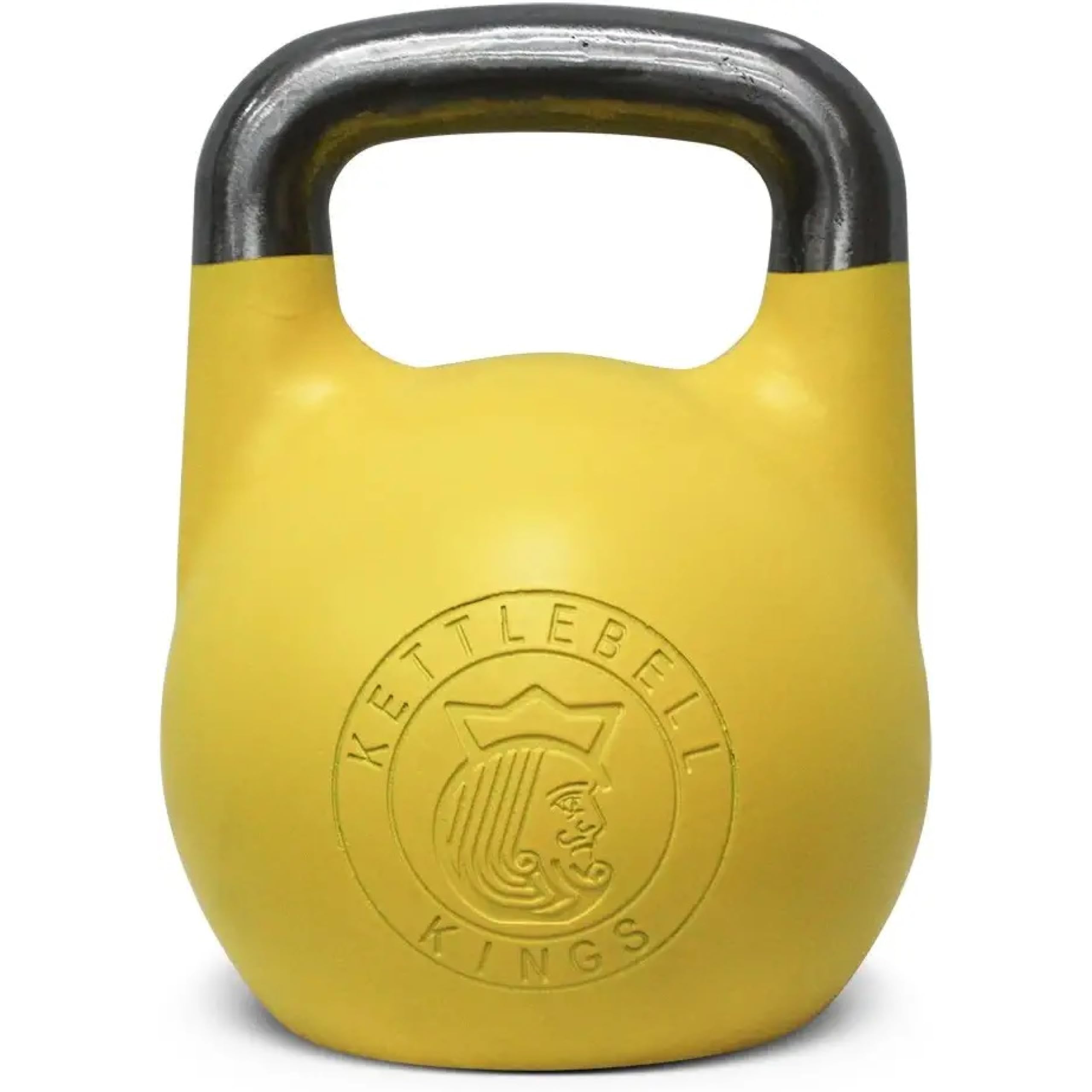
1. Kettlebell Kings Competition Kettlebell (33 mm Handle)
Our pick — over 4★ from 50+ verified ratings; the strongest balance of quality and price.
The premium cast-steel bell that serious lifters trust for its precision balance.
This bell is built from a single cast of steel with no welds or fillers. That makes it more durable than standard painted kettlebells, according to the manufacturer’s specs. Every piece in the range shares the same body dimensions, so your movement technique stays constant whether you grab an 8 kg or a 32 kg. The hollow core (empty interior) is centred precisely, reducing any shifting during snatches and overhead holds — you get a steady, predictable feel rep after rep.
The handle is an untreated steel grip at 33 mm. Owners say it provides a secure hold without needing chalk. However, some buyers with larger hands find the 33 mm handle a bit cramped during two-handed swings. As several owners put it, the bell is “well made and balanced” and delivers the consistency you expect from a competition-grade tool. The trade-off is the higher price — at 32 kg this bell is a significant investment, but the build quality matches the cost.
Colour coding on the weights is standard, but one reviewer noted that a specific colour shown on Amazon (yellow at 8 kg) did not match the delivered unit (pink). Check the manufacturer’s colour chart before ordering if that matters to you.
Precision casting, no shortcuts: The single-piece hollow-core construction means every rep feels balanced and controlled — exactly what you want for sport-specific training.
Handle note: The 33 mm grip works well for most, but if you have especially large hands, you might find it snug for two-handed movements. It is a minor fit issue, not a quality problem.
Reach for this if: you want a premium, competition-spec bell with a centred hollow core and consistent dimensions across your entire set — ideal for serious strength athletes and sport competitors.
Look elsewhere if: your budget does not stretch to the premium tier, or you have very large hands and prefer a 35 mm handle for double-handed work.
2. POWERT Competition Kettlebell

The crowd-pleasing entry-level bell that outrates bells costing twice as much.
Owners consistently highlight the quality of the alloy steel construction and the way the weight is distributed. The shell body is solid (no hollow core) and treated to resist rust, which makes it a low-maintenance choice for home gyms where sweat and humidity are factors.
The handle measures 1.3 inches in diameter — about 33 mm — which is noticeably smaller and smoother than a standard cast-iron bell. Buyers report preferring this competition-style handle over iron because the reduced diameter and smooth surface are easier on callouses during high-rep work. The 6 kg version we weighed is a lightweight start, but the line runs up to 28 kg, and each bell is colour-coded and weight-marked in kg for quick identification. Note: the POWERT line tops out at 28 kg, while the Kettlebell Kings line goes to 32 kg — this means you cannot build a full set to 32 kg with the POWERT alone.
The biggest praise across the reviews is the value for money. Owners call it “awesome quality at a great price” and note the excellent packaging — double-strapped boxes that arrive undamaged. The most-discussed aspect is quality itself, with 11 mentions, followed by weight distribution at 5 mentions.
Owners rave about
- Smooth, callous-friendly handle at 1.3 inches
- Solid, non-hollow construction with no visible weld
- Rust-resistant shell ideal for humid home gyms
- Exceptional value at the price point
The honest trade-off
- Not a hollow-core design — no centered weight shift like premium competition bells
- Limited weight range stops at 28 kg
Choose this if: you want a reliable, smooth-handled competition bell that costs a fraction of the premium options — perfect for home lifters who want competition feel while staying affordable.
skip it if: you need a full set up to 32 kg or require the centred hollow-core balance for sport-specific training — this bell is solid-cast, not hollow-core.
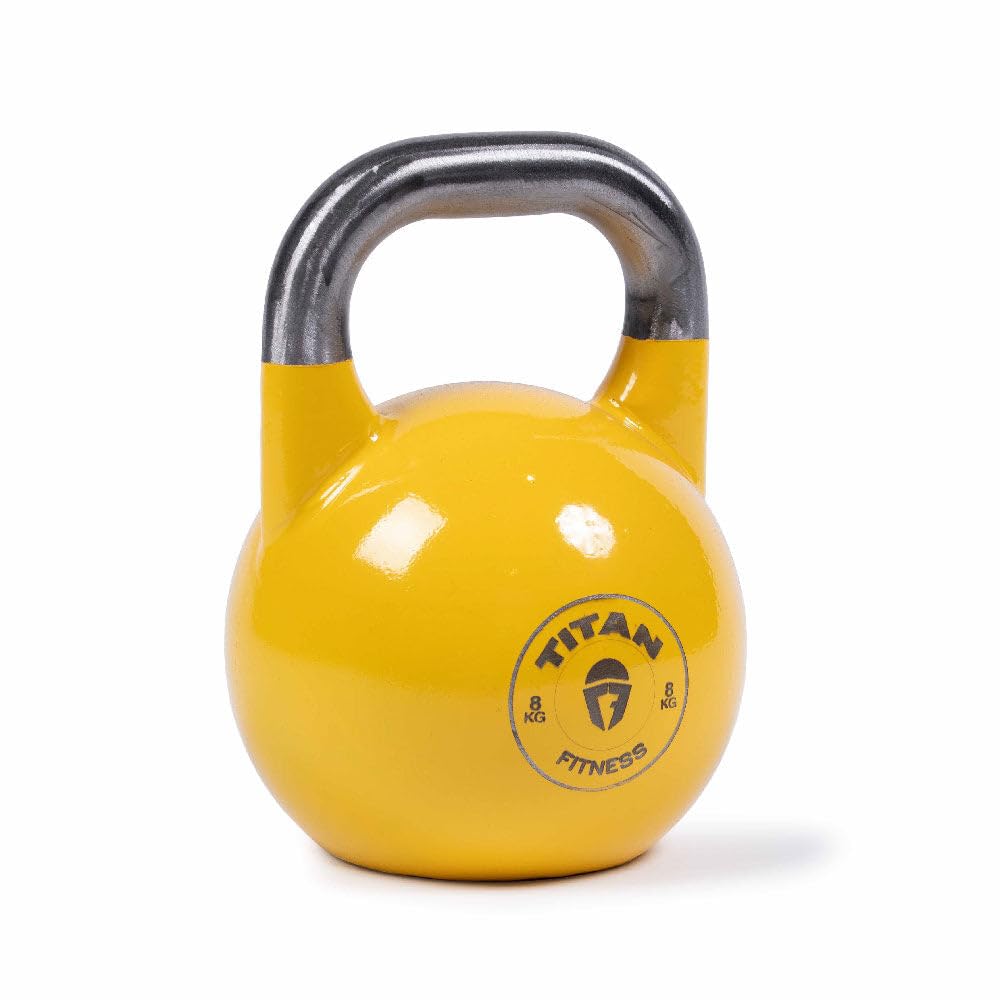
3. Titan Fitness Competition Kettlebell
A single-piece casting that delivers exact weight and a comfortably thick handle.
Titan Fitness takes a slightly different approach from the Kettlebell Kings — the handle diameter here is 1.378 inches (about 35 mm), compared to the POWERT’s 1.3-inch handle (about 33 mm). That extra thickness matters for lifters with bigger hands or those who prefer more room for two-handed moves like swings and farmer carries. The hollow-core (empty interior) single casting means each bell is cast to a precise weight with no filler, and the finished texture holds chalk well but also provides enough grip that chalk is optional.
Every bell in the line shares the same 8.3-inch diameter and 11.4-inch height, so the dimensions stay uniform across weights. Owners call it “solid upgrade from cast iron” and note that there are no wobbles, seams, or chips in the powder coating after regular use. A few buyers did weigh their units and found marginal differences (16.15 kg versus 16.25 kg on an 16 kg bell), which is within normal tolerance but note if you are a stickler for exact competition weight.
Quality is the most-discussed aspect, with 17 mentions, followed by value for money at 10 mentions. Buyers consistently describe the bell as “beautifully made” and “reasonably priced.”
Thicker handle, solid feel: The 35 mm handle gives you more surface area for two-handed work, and the single-piece casting keeps every rep wobble-free.
Weight tolerance note: A few owners saw a small variance on the scale (under 0.1 kg). If exact competition-grade precision down to the gram is critical, this may not meet that standard — but for practical training, it is more than accurate enough.
Reach for this if: you prefer a thicker 35 mm handle and want a hollow-core single-piece casting at a mid-range price — a strong choice for double-bell work and general strength training.
Look elsewhere if: you need exact competition-grade weight tolerance (down to the gram) or prefer a narrower handle for single-handed snatches and cleans.
Understanding the Specs
Handle Diameter
This is the thickness of the handle in millimetres or inches. A standard competition handle sits around 33 mm to 35 mm. A 33 mm handle tends to suit most hands for one-arm work, while a 35 mm handle offers more room for two-handed grips. Buyers with larger hands often prefer the thicker end of the range to avoid a cramped feel during swings.
Hollow-Core vs. Solid-Cast Construction
A hollow-core casting means the interior of the bell is empty, which shifts the weight toward the outer edges and keeps the bell stable during overhead movement. Solid-cast bells are fully dense, which makes them sturdy but can cause the centre of gravity to shift slightly during dynamic exercises. For sport training, hollow-core is generally preferred; for general fitness, solid-cast works fine.
FAQ
What makes a kettlebell competition grade?
Is a 33 mm or 35 mm handle better for me?
Can I use a competition kettlebell for standard gym workouts?
Why does a hollow core matter for kettlebell balance?
How do I choose the right starting weight?
Are colour-coded weights consistent across brands?
Will a competition kettlebell damage my floor?
How do I clean and maintain a competition kettlebell?
Final Thoughts: The Verdict
If you want one dependable pick, the competition kettlebells winner is the Kettlebell Kings Competition Kettlebell because it delivers the best combination of precision hollow-core casting, consistent dimensions across weights, and a comfortable 33 mm untreated steel handle. If you want a crowd-approved bell that costs less, grab the POWERT Competition Kettlebell. And for a thicker 35 mm handle with a single-piece casting at a mid-range price, the Titan Fitness Competition Kettlebell is the one to reach for.
How We Picked
We do not accept paid placement. Every pick is matched to a real buyer and a real use-case; we do not hands-on test units.
Sources & Methodology
Specifications: manufacturer listings and product documentation. Review insights: verified customer reviews, as of July 2026. Pricing: not shown on this page (it changes often); check the current price via the retailer link.
As an Amazon Associate, WellFizz earns from qualifying purchases. This does not affect which products we feature.
Related Guides

Mo Maruf
I created WellFizz to bridge the gap between vague wellness advice and actionable solutions. My mission is simple: to decode the research and give you practical tools you can actually use.
Beyond the data, I am a passionate traveler. I believe that stepping away from the screen to explore new environments is essential for mental clarity and physical vitality.