Our readers keep the lights on and my smoothie glass nicely filled. As an Amazon Associate, I earn from qualifying purchases.
Specs are compiled from manufacturer listings and verified buyer reviews and can change over time — please confirm the key details on the product page before buying.
A good chef’s knife is the difference between dreading dinner prep and actually enjoying it. The problem is that most decent knives start around the mark, and the cheap ones dull after two onions. This guide skips both traps — every pick here cuts well straight from the box, holds an edge through a week of meal prep, and sits comfortably under the $50 line. You get real Japanese steel, layered Damascus blades, and ergonomic handles without needing to stretch your budget or replace them in six months.
I’m Mohammad Maruf — the founder and writer behind WellFizz. This guide is built by comparing the manufacturers’ published specifications and the patterns across verified customer reviews, so you get each pick’s real strengths and trade-offs instead of marketing spin.
if you need a single workhorse blade or a compact set, these are the cooking knives under $50 that owners actually praise for sharpness, balance, and long-term value.
Our Picks at a Glance

How To Choose The Best Cooking Knives Under $50
Picking a knife at this price is about finding the right balance between steel quality, edge sharpness, and handle comfort. You do not need to spend triple digits to get a blade that glides through a tomato, but you do need to know where these knives cut corners and where they deliver genuine value.
Steel Type and Hardness (HRC)
The steel determines how sharp the knife can get and how long it stays that way. High-carbon stainless steel (like 1.4116 or 10Cr15MoV) is the balance under $50 — it resists rust better than pure carbon steel and holds a finer edge than basic stainless. Look for a hardness rating between 56 and 62 HRC. Higher numbers (60+) mean the edge stays sharper longer but can be slightly more brittle if you hit bone or frozen food.
Edge Angle and Sharpness
Most budget knives use a 15-degree edge per side, which balances sharpness with durability. Some premium options in this range go as low as 8 to 12 degrees, giving you a razor-like feel that glides through produce. A thinner edge cuts with less force but requires more careful use and a good honing rod to maintain.
Handle Construction and Comfort
You want a full-tang blade (the steel runs all the way through the handle) for balance and strength. Materials vary — Pakkawood (resin-impregnated wood) offers a warm, grippy feel that ages well, while ABS and G10 glass fiber handles are more impact-resistant and easier to keep clean. Avoid handles that feel hollow or have a visible seam.
Quick Comparison
| Model | Best For | Blade Length | Steel / Hardness | Edge Angle | Amazon |
|---|---|---|---|---|---|
| Damascus Chef Knife (Emojoy)★ Best Overall | Best overall value + gift-ready | 8″ | Damascus / 58 HRC | 15° | Amazon |
| XCHIEF PRO 3-Piece SetVersatile Set | Versatile 3-knife starter set | 8″ + 6.7″ + 5″ | High-Carbon / 60 HRC | 15° | Amazon |
| Matsato Osuren 6.3″Compact Blade | Compact, nimble daily blade | 6.3″ | 1.4116 Japanese / — | — | Amazon |
| Sunnecko 8″ Chef Knife | Ultra-sharp all-purpose workhorse | 8″ | High-Carbon SS / — | 12–15° | Amazon |
| KEEMAKE 8″ Chef Knife | Razor precision with slim edge | 8″ | 1.4116 / 58±2 HRC | 8–12° | Amazon |
| Victorinox Fibrox Pro 8″ | Pro-grade, dishwasher-safe staple | 7.9″ | Stainless / — | — | Amazon |
| Brewin 3-PC Professional Set | Full 3-knife set with premium weight | 8″ + 7″ + 5″ | 1.4116 German / 56+ HRC | 14–16° | Amazon |
| SHAN ZU Damascus Nakiri 6.5″ | Real Damascus + vegetable specialist | 6.5″ | 10Cr15MoV / 62 HRC | 12° | Amazon |
| imarku 8″ Chef Knife | Lightweight performer with non-stick finish | 8″ | 10Cr15CoMoV / 59±2 HRC | 12°±2° | Amazon |
In‑Depth Reviews
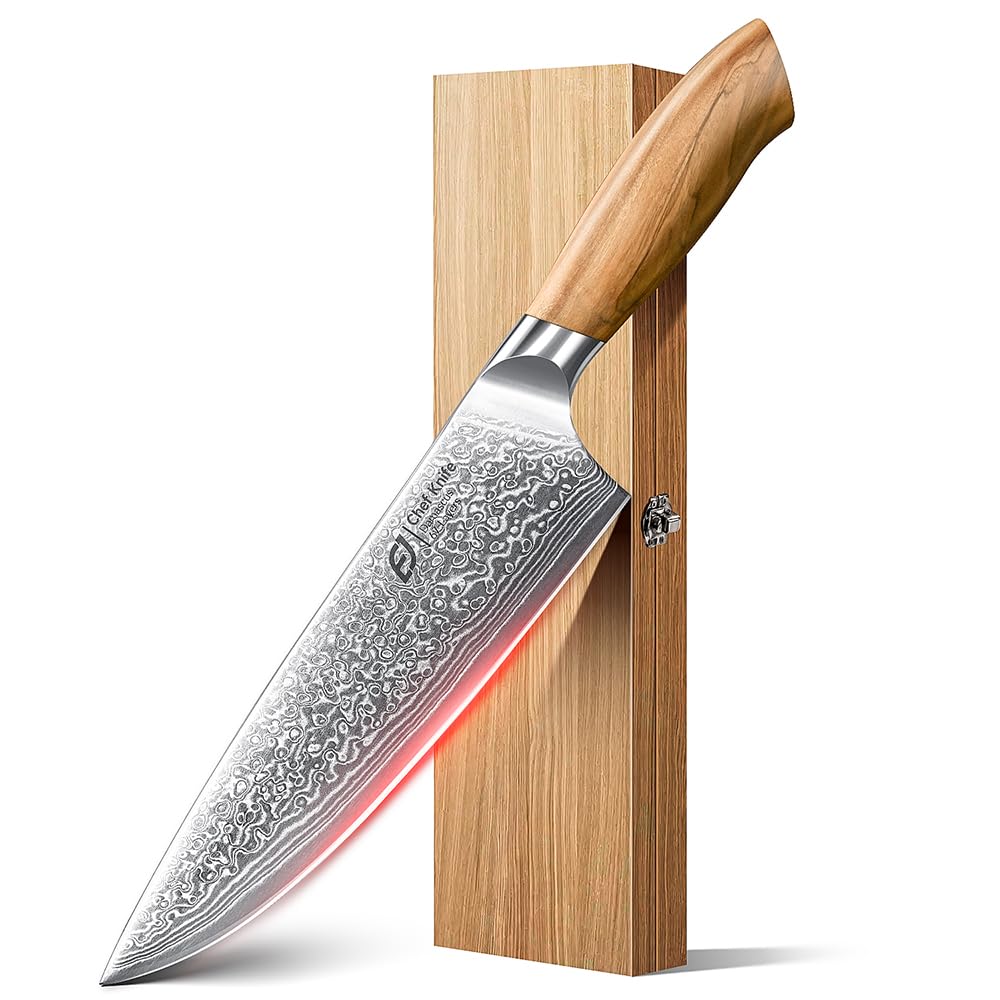
1. Damascus Chef Knife in Japanese Steel, 67-Layers (Emojoy)
A 67-layer Damascus blade with a hand-polished 15° edge, packed in a wooden gift box.
This knife delivers the most complete package at this price point. The 67-layer damascus cladding paired with 0.98% carbon and 18% chromium content gives you a hard center (58 HRC) with soft outer layers — a combination that resists chipping while staying easy to sharpen. Owners say the razor-sharp edge glides through meat, fish, and vegetables without resistance.
The Calábrian Oliva wood handle is shaped for a secure pinch grip and suits nearly any hand size. What wins people over is the total experience: super sharp from the start, balanced in hand, and presented in a wooden gift box that makes it ready for gifting. The only real caution is that the Damascus pattern needs hand-washing and drying immediately — no dishwasher. This single knife stands up to the Victorinox in performance while adding premium aesthetics at a lower entry point.
Why it stands out
- True 67-layer Damascus cladding with rust-proof patterns
- Laser-calibrated 15° bevel for surgical sharpness from the start
- Calábrian Oliva wood handle offers comfortable, non-slip grip
- Includes premium wooden gift box with lifetime warranty
The fine print
- Requires hand washing and immediate drying — not dishwasher safe
- Single-piece knife; no sheath included for storage
Reach for this if: You want a single stunning chef knife that performs like a premium blade and arrives gift-ready.
Look elsewhere if: You prefer a multi-knife set or need something you can toss in the dishwasher.
2. Kitchen Knife Set, 3 Pieces Japanese High Carbon Stainless Steel (XCHIEF PRO)
Three forged blades — chef, santoku, and utility — at a combined 60 HRC with wooden handles.
This set delivers the three most-used kitchen knives without the typical price hike. The 8-inch chef’s knife, 6.7-inch santoku, and 5-inch utility knife each feature a hand-ground 15-degree edge and high-carbon Japanese stainless steel rated at 60 HRC — that is harder than most single knives at this level. Owners describe them as “extremely sharp,” slicing lemons and tomatoes easily, and note the ergonomic wooden handle minimizes fatigue even for hands that tire easily.
The set comes in a sleek gift box with blade protectors, which helps edge longevity. While a few buyers received a blade that was not sharp, the overwhelming consensus says these are solid, well-balanced knives that compete with sets costing twice as much. The utility knife is the hidden star here — it handles smaller tasks a chef’s blade is too wide for.
Set logic: You get three distinct blade shapes for the price of one premium knife, all with the same 60 HRC hardness. The catch: a very occasional unit may arrive with a dull edge, so budget a few minutes with a honing rod when you unbox it.
Best suited for: Anyone setting up a kitchen from scratch or wanting a dedicated utility blade alongside their chef knife.
Better to skip: If you only use one blade and prefer a single higher-end knife over three decent ones.
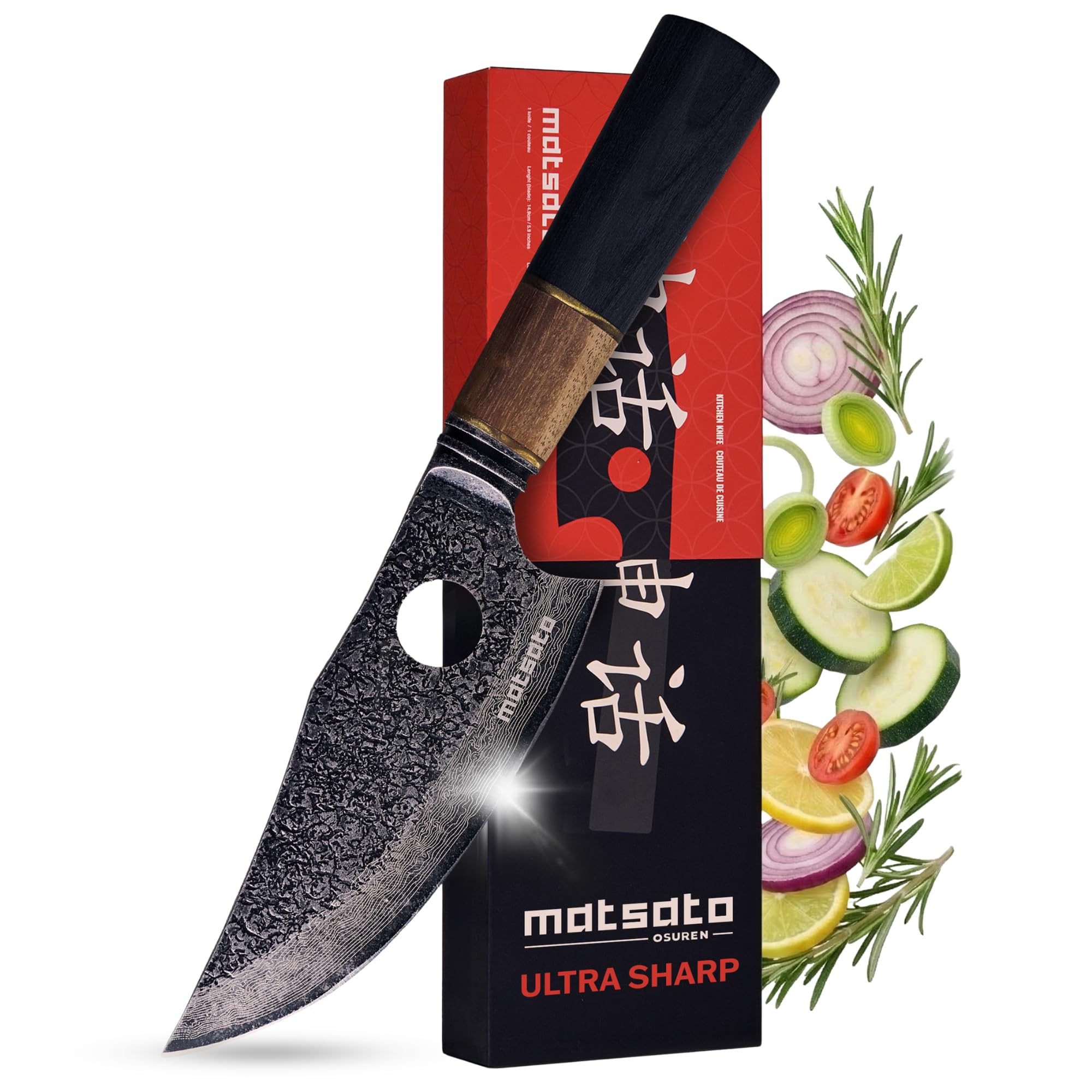
3. Matsato New 2026 Osuren Chef Knife 6.3 Inch
A nimble 6.3-inch blade with 1.4116 Japanese steel and an acacia wood handle.
Not everyone needs an 8-inch blade. The Matsato Osuren is built for cooks who want maneuverability — a shorter, lighter profile that excels at dicing onions, trimming vegetables, and working in tight spaces. The 1.4116 Japanese stainless steel is a well-regarded alloy that balances sharpness with stain resistance, and the acacia wood (pakkawood) handle offers a warm, secure grip. The blade’s weight and sharpness make cutting large roasts and chickens easy, as owners put it.
Sharpness feedback is mixed: some call it “very sharp,” while others say it dulls faster than expected. The 180-gram weight is noticeably lighter than a full-size chef knife, which helps reduce fatigue during longer prep sessions. If you find standard chef knives unwieldy or you primarily work with vegetables and boneless proteins, this compact pick delivers better control without overspending.
Who it fits: Home cooks with smaller hands, or anyone who prefers a lighter, more agile blade for everyday vegetable prep and boneless meats.
Best for: Those who want a nimble everyday blade that feels less intimidating than a full 8-inch knife.
Skip if: You need to break down large roasts or squash regularly — the shorter blade lacks the leverage for heavy duty work.
4. Sunnecko 8 Inch Chef Knife
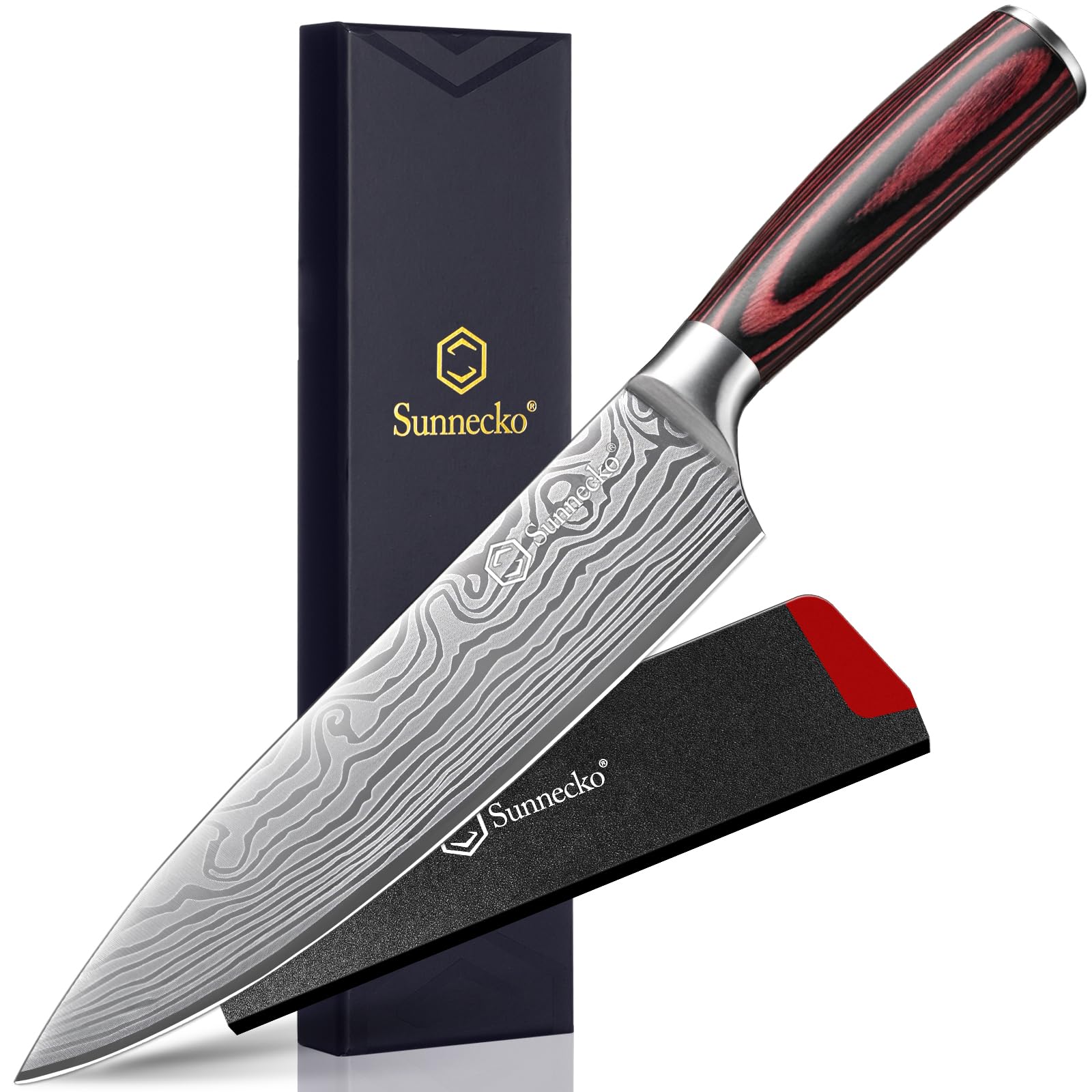
A hand-sharpened 12-15° edge with high-carbon stainless steel and a Pakkawood handle.
This is the most popular mid-range chef knife on the list, for good reason. The edge is hand-sharpened to a 12-15° angle per side — sharper than the typical 15-degree budget blade — which lets it glide through tomatoes without crushing them. The high-carbon stainless steel resists rust and corrosion, and the full-tang design means the blade won’t snap under pressure. Buyers report it is “razor sharp from the start,” capable of cutting paper and hair, and many have bought a second as a gift.
The Pakkawood handle is ergonomically shaped and includes a steel bolster for balance, making the pinch grip feel natural. A PVC sheath is included for safe storage. The occasional complaint is that sharpness is “mediocre” compared to pricier knives, but for the money, the Sunnecko consistently punches above its weight — it handles 90% of prep tasks, from fine mincing garlic to portioning large roasts. If you want one knife that handles almost everything well, this is it.
Strengths
- Hand-sharpened 12-15° edge for precision cutting
- Full-tang forged construction with excellent balance
- Includes PVC sheath for safe storage and transport
- Versatile 8-inch blade handles 90% of prep tasks
Limitations
- Some owners find the out-of-box sharpness could be keener
- Not dishwasher safe — Pakkawood handle requires hand washing
Best for: Home cooks who want a single, versatile 8-inch blade that balances price, sharpness, and durability.
Better suited to: Buyers who prefer a full-tang, forged construction over stamped blades.
5. KEEMAKE Chef Knife 8 Inch
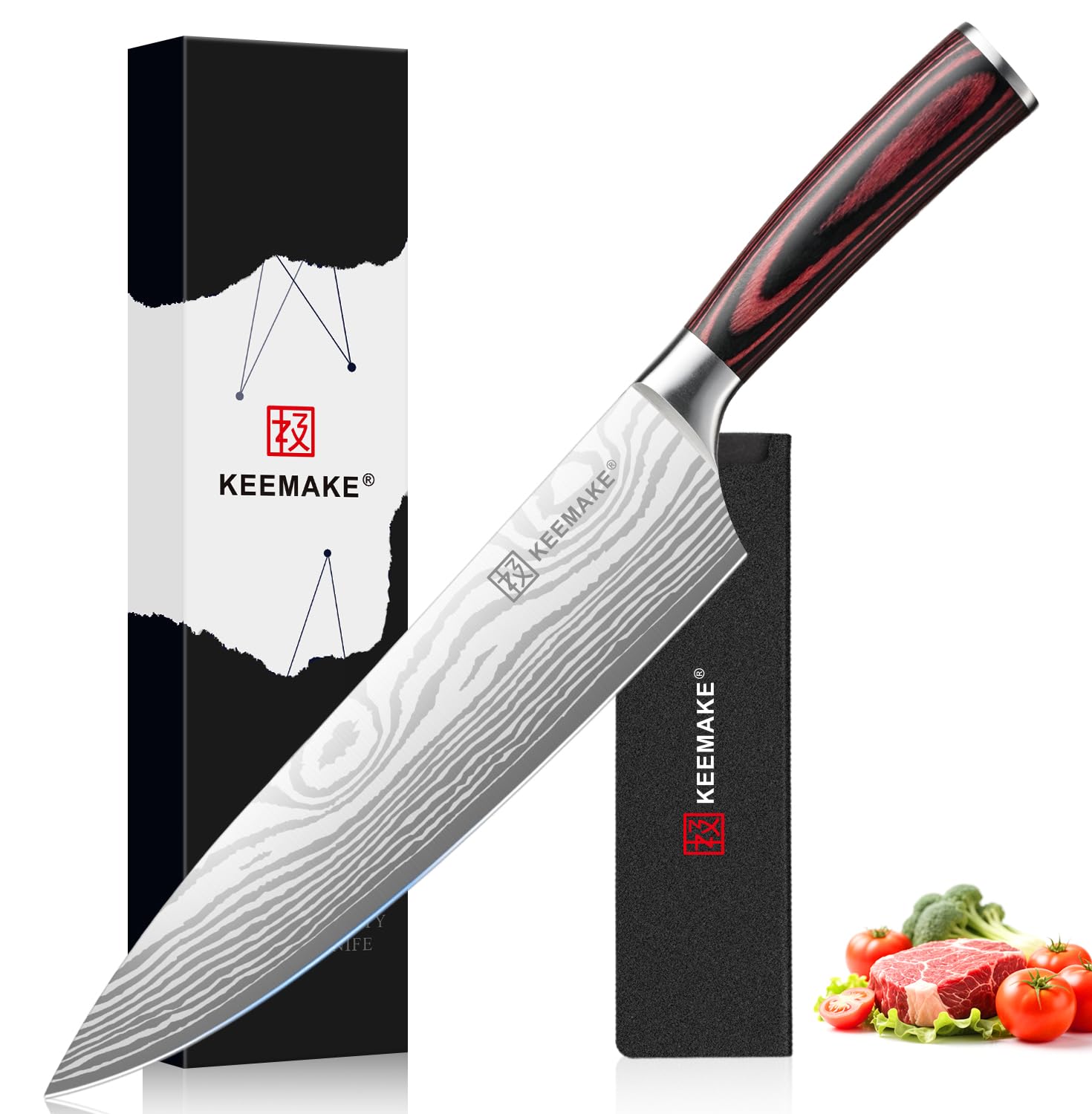
A hand-sharpened 8-12° edge on 1.4116 high-carbon steel, with a Pakkawood handle.
The KEEMAKE stands out with one of the thinnest edge angles in this price range — 8 to 12 degrees per side — requiring less force to cut delicate foods like ripe tomatoes, brie, or raw fish for sushi without crushing them. The 1.4116 high-carbon stainless steel at 58±2 HRC provides solid edge retention, and the Pakkawood handle features a curved design with a sloped bolster that promotes a secure pinch grip and reduces wrist strain during long sessions. Owners praise it as “badass for its price,” noting it cuts everything “like butter.”
The knife includes a protective sheath and is packaged in a stylish gift box. At 8.48 ounces, it has a nice heft that helps with heavier cuts but still feels balanced. One note: some buyers mention the knife is initially very sharp and recommend caution — it is easy to cut yourself. The handle also felt slightly heavy for smaller hands initially, but most adjusted quickly. This is a premium-feeling knife for cooks who want razor-sharp precision without exceeding $50.
Sharpness philosophy: A thinner edge (8-12°) cuts cleaner but demands more careful use and a good honing steel. The KEEMAKE is for cooks who value precision and are willing to maintain their blades properly.
Perfect for: Enthusiast home cooks and aspiring chefs who want a near-professional edge angle without a professional price tag.
Not ideal for: Anyone who tosses their knife in a drawer or wants something they can share with heavy-handed family members.
6. Victorinox Fibrox Pro 8 Inch Chef’s Knife
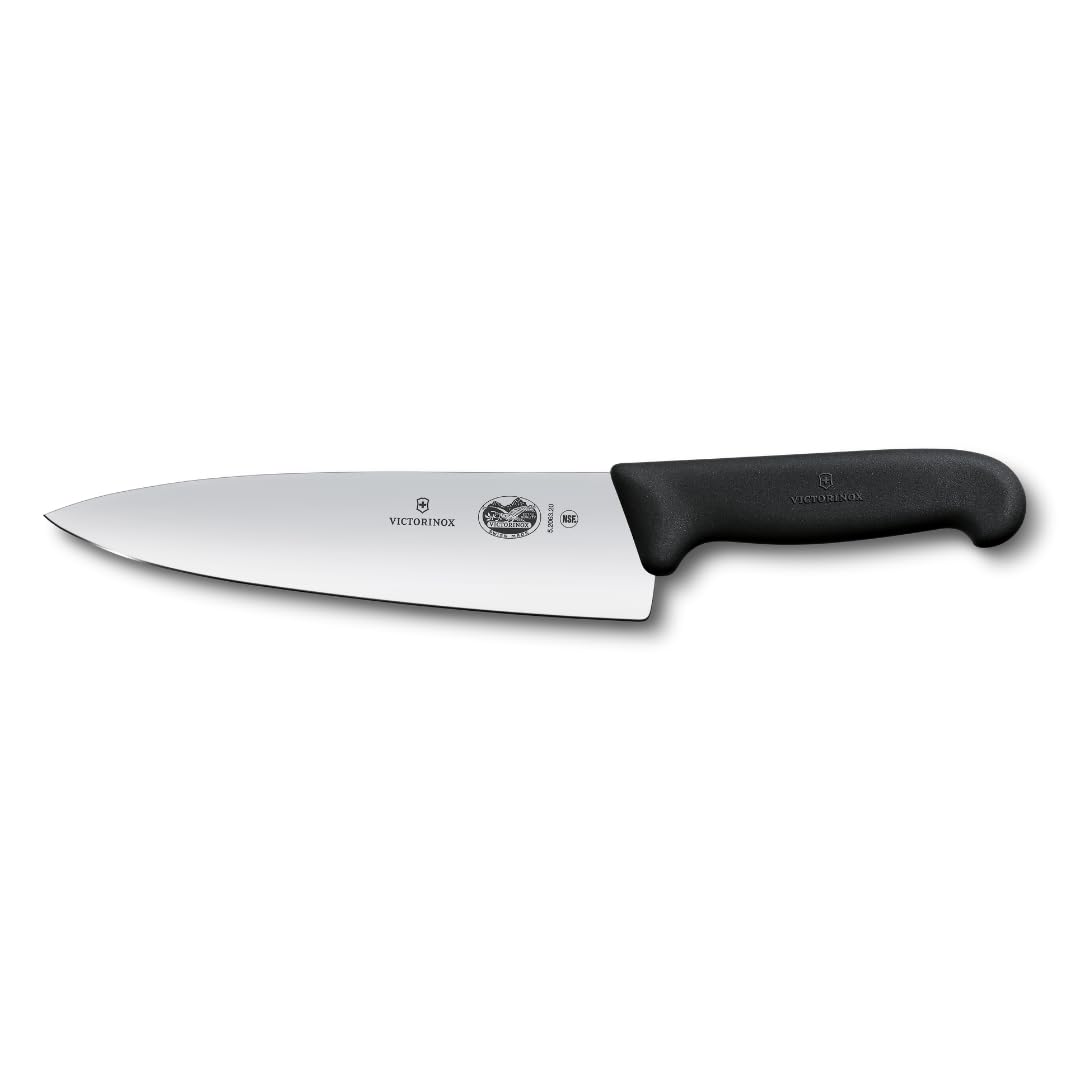
Swiss-made stamped 8-inch blade with a textured TPE handle that is dishwasher safe.
This is the knife that America’s Test Kitchen has repeatedly named their top budget pick for a reason. The Victorinox Fibrox Pro uses a stamped (not forged) stainless steel blade that is laser-tested for consistency, and the real trick is the thermoplastic elastomer (TPE) handle — it stays grippy even when wet and provides a non-slip feel that many forged knives cannot match. Owners call it “scalpel-sharp” and note it retains its edge for over 2.5 months of regular home use without sharpening. At roughly 6 ounces, it is lighter than most forged knives, which reduces hand fatigue during marathon meal prep.
The biggest practical advantage is that it is dishwasher safe — the one knife in this guide you can safely throw in the top rack. It is also Swiss-made with a lifetime warranty against defects. The trade-off is that the stamped construction feels less substantial than forged blades, and some find the 8-inch length large for their hand. It is a pragmatic, high-performance workhorse built for function over flash. If you want a no-nonsense knife that survives a busy kitchen and the dish pile, this is your pick.
Why it is a legend
- Dishwasher-safe for easy cleanup — unique among these picks
- Non-slip TPE handle stays grippy even when wet or oily
- Light at ~6 oz, reducing fatigue for long prep sessions
- Lifetime warranty from a Swiss brand with over 140 years of history
Consider this
- Stamped blade, not forged — lighter but less substantial feel
- Some users find the 8-inch length too large for smaller hands
Who it is for: Practical cooks who value low maintenance, dishwasher convenience, and a proven track record over visual flair.
Not for: Those who want a forged, full-tang knife with a wood handle or showpiece aesthetics.
7. Brewin Professional Kitchen Knives, 3PC Chef Knife Set

Three forged knives from 1.4116 German steel, triple-riveted ABS handles, and a premium gift box.
The Brewin set offers the best value among the 3-piece options in this guide. It includes an 8-inch chef knife, a santoku, and a utility knife, all forged from high-carbon 1.4116 German stainless steel with a 56+ Rockwell hardness rating. The razor-sharp edge is hand-polished at 14-16 degrees per side. What owners praise most is the quality and sharpness — mentioned well over a hundred times in reviews — with many calling it the “best budget 3-knife set” they have used. The triple-riveted ABS handle with full tang offers a balanced, non-slip grip that feels solid even during heavy tasks like breaking down a watermelon or cutting steak.
The set includes a foam-lined case for secure storage, and the packaging is elegant enough for gifting. The one recurring note: some users found the knives arrived barely sharp and needed a few passes on a sharpening stone to reach razor status. Once dialed in, they hold an edge well through large meal prep. At under $50 for three full-tang forged blades, this set undercuts most competitors while delivering real German steel and a comfortable weight (0.85 kilograms for the set).
Set advantage: You get a chef, santoku, and utility knife for roughly what a single premium blade costs. The German steel and full-tang construction put it ahead of other budget sets in durability and balance.
Ideal for: Cooks who want a complete forged-knife set without spending + and are comfortable doing a quick touch-up when they unbox them.
Better to skip: If you only use one kitchen knife and prefer a single high-end blade over having three decent ones.
8. SHAN ZU Chef Knife, Damascus Professional 6.5 Inch Nakiri
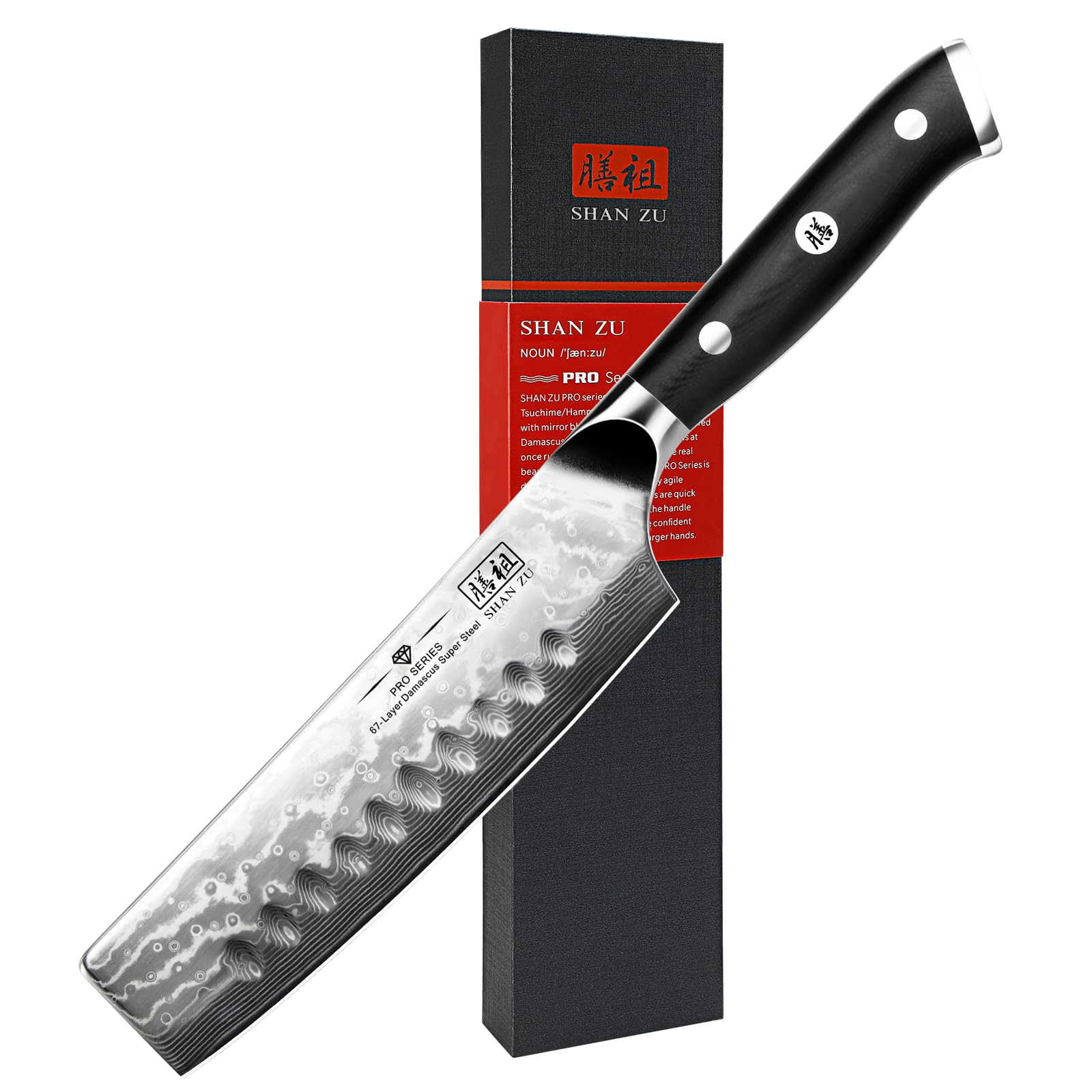
A real 67-layer Damascus blade with 62 HRC hardness and a G10 glass-fiber handle.
Most knives in this price range use laser-etching to fake a Damascus pattern. The SHAN ZU does not — it is forged from 67 layers of carbon steel with a 10Cr15MoV Japanese steel core, producing a genuine damascus pattern that becomes more visible with polishing. The hardness rating of 62 HRC is the highest in this guide, which means the edge holds exceptionally well. Owners note it is the sharpest out-of-box knife they have owned — capable of shaving hair — and after one year of daily use prepping 8-10 pounds of carrots each week, it only needed its first sharpening.
The G10 glass-fiber handle is a different approach than the wood handles on most picks here. It is more durable, moisture-resistant, and provides a secure grip even when wet. The blade profile is a Nakiri style (a straight-edged vegetable knife), so it excels at chopping veggies with a clean push-cut motion. The catch: the blade is welded to the tang rather than being a single solid piece of Damascus, which matters to purists but does not affect daily cutting performance. For serious vegetable prep and those who want confirmed real damascus, this knife is a standout.
what separates it
- Real 67-layer Damascus forging, not laser-etched pattern
- Highest hardness in this roundup at 62 HRC for long edge life
- G10 glass-fiber handle is tough, grippy, and moisture-resistant
- Excellent edge retention even with heavy daily vegetable prep
The nuance
- Blade is welded to the tang, not one solid piece of Damascus
- Nakiri shape is specialized for vegetables — less versatile for meat
Great for: Vegetable-heavy cooks who want genuine Damascus steel, extreme hardness, and a handle that withstands moisture without warping.
Not for: Anyone needing a general-purpose blade for meat carving or boning.
9. imarku Chef Knife, Japanese 8 Inch
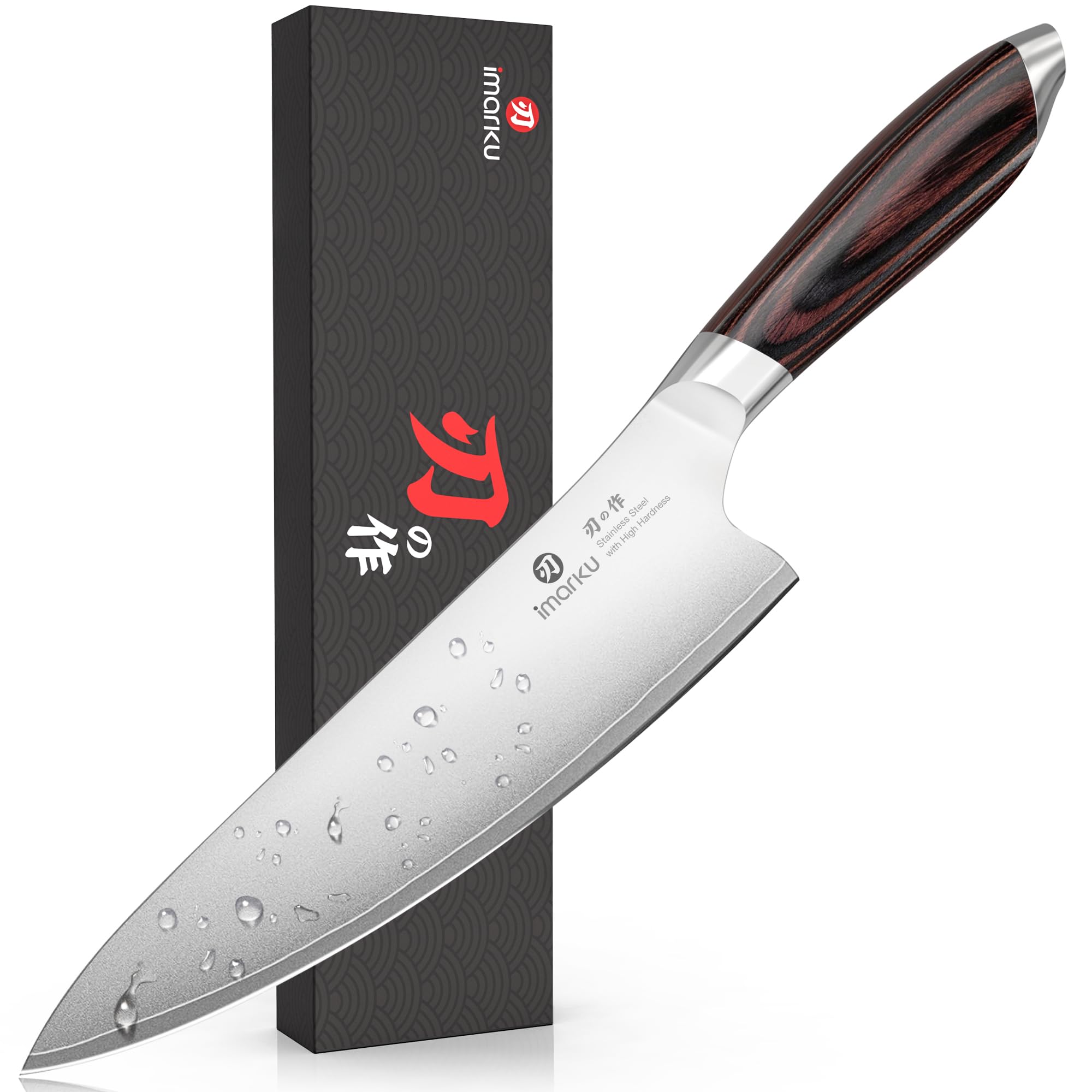
An 8-inch Japanese chef knife at only 210 grams with a 12° edge and non-stick finish.
The imarku is built for cooks who find standard chef knives too heavy. At 210 grams, it is significantly lighter than most 8-inch blades, yet the FSC-certified Pakkawood handle keeps it balanced. The core is Japanese 10Cr15CoMoV high-carbon stainless steel with triple-layer clad construction and a 12°±2° double-bevel edge (59±2 HRC). The sandblasted matte finish on the blade reduces surface friction, so sliced foods slide off rather than sticking — a genuine time-saver when dicing potatoes or slicing cheese.
It comes in a premium gift box with a soft flannel interior, backed by a lifetime warranty. The one limitation: this knife is not designed for chopping bones, frozen foods, or hard squash rinds — treat it as a precision slicer, not a cleaver. Owners praise its sharpness and how easily it cuts through sourdough crusts and dense vegetables. For smaller-handed cooks or anyone who wants a light, precise blade that still delivers professional performance, this is the pick.
Weight philosophy: At 210g, the imarku is roughly 40% lighter than a typical forged chef knife. That makes it ideal for long prep sessions where heavier blades cause wrist fatigue — but you do lose the momentum that weight provides for powering through dense ingredients.
Best for: Home cooks with smaller hands, anyone prone to wrist fatigue, and precision-focused slicing tasks.
Skip if: You regularly break down whole poultry, cut through winter squash, or prefer the heft of a heavier blade.
Understanding the Specs
Damascus vs Laser-Etched Steel
A true Damascus blade is forged by layering and folding different types of steel, creating a natural wavy pattern that combines a hard cutting edge with softer, flexible layers. This gives you a blade that stays sharp longer and resists chipping. Many knives in the budget range use laser etching to fake the pattern on plain stainless steel — it looks good but offers no performance benefit. The SHAN ZU and Emojoy knives in this guide feature real Damascus layers, which matters if you want genuine wear-resistance and the ability to sharpen the knife for years.
Edge Angle and Cutting Feel
The angle at which the blade is sharpened determines how it interacts with food. A standard 15-degree edge is a good all-rounder — sharp enough for clean cuts but durable enough for daily use. Thinner edges (8-12 degrees) reduce cutting resistance, so you can slice a tomato without crushing it, but they require more careful handling and a quality honing rod. Thicker edges (above 15 degrees) are more durable for heavy chopping but will wedge through softer foods instead of slicing cleanly. For most home cooking, a 12-15 degree edge hits the balance.
FAQ
How hard should a good cooking knife be?
Can I put these knives in the dishwasher?
How often do I need to sharpen a kitchen knife?
Is a stamped knife worse than a forged one?
What does full tang mean and does it matter?
How do I store a high-carbon steel knife?
What is the best blade length for a first chef knife?
Should I buy a single chef knife or a set?
What is the difference between a santoku and a chef knife?
Is real Damascus steel worth the extra cost?
Final Thoughts: The Verdict
For the majority of shoppers, the cooking knives under $50 winner is the Damascus Chef Knife in Japanese Steel because it combines genuine 67-layer Damascus construction, a hand-sharpened 15° edge, and a premium olive wood handle with a wooden gift box — all for roughly half the price of comparable knives. If you want the no-fuss workhorse that survives the dishwasher and has a legendary track record, grab the Victorinox Fibrox Pro. And for a complete forged-knife set with German steel and comfortable ABS handles, the {“@context”: “https://schema.org”, “@graph”: [{“@type”: “ItemList”, “name”: “9 Best Cooking Knives Under $50”, “url”: “https://wellfizz.com/best-cooking-knives-under-50/”, “numberOfItems”: 9, “itemListElement”: [{“@type”: “ListItem”, “position”: 1, “name”: “Damascus Chef Knife in Japanese Steel, 67-Layers (Emojoy)”, “url”: “https://wellfizz.com/best-cooking-knives-under-50/#product-1”}, {“@type”: “ListItem”, “position”: 2, “name”: “Kitchen Knife Set, 3 Pieces Japanese High Carbon Stainless Steel (XCHIEF PRO)”, “url”: “https://wellfizz.com/best-cooking-knives-under-50/#product-2”}, {“@type”: “ListItem”, “position”: 3, “name”: “Matsato New 2026 Osuren Chef Knife 6.3 Inch”, “url”: “https://wellfizz.com/best-cooking-knives-under-50/#product-3”}, {“@type”: “ListItem”, “position”: 4, “name”: “Sunnecko 8 Inch Chef Knife”, “url”: “https://wellfizz.com/best-cooking-knives-under-50/#product-4”}, {“@type”: “ListItem”, “position”: 5, “name”: “KEEMAKE Chef Knife 8 Inch”, “url”: “https://wellfizz.com/best-cooking-knives-under-50/#product-5”}, {“@type”: “ListItem”, “position”: 6, “name”: “Victorinox Fibrox Pro 8 Inch Chef’s Knife”, “url”: “https://wellfizz.com/best-cooking-knives-under-50/#product-6”}, {“@type”: “ListItem”, “position”: 7, “name”: “Brewin Professional Kitchen Knives, 3PC Chef Knife Set”, “url”: “https://wellfizz.com/best-cooking-knives-under-50/#product-7”}, {“@type”: “ListItem”, “position”: 8, “name”: “SHAN ZU Chef Knife, Damascus Professional 6.5 Inch Nakiri”, “url”: “https://wellfizz.com/best-cooking-knives-under-50/#product-8”}, {“@type”: “ListItem”, “position”: 9, “name”: “imarku Chef Knife, Japanese 8 Inch”, “url”: “https://wellfizz.com/best-cooking-knives-under-50/#product-9”}]}, {“@type”: “Product”, “position”: 1, “name”: “Damascus Chef Knife in Japanese Steel, 67-Layers (Emojoy)”, “image”: “https://m.media-amazon.com/images/I/61DF+okMC1L.jpg”, “brand”: {“@type”: “Brand”, “name”: “Damascus”}, “url”: “https://www.amazon.com/dp/B0DXPQ88ZV/?tag=wellfizzmo-20”, “offers”: {“@type”: “Offer”, “url”: “https://www.amazon.com/dp/B0DXPQ88ZV/?tag=wellfizzmo-20”}}, {“@type”: “Product”, “position”: 2, “name”: “Kitchen Knife Set, 3 Pieces Japanese High Carbon Stainless Steel (XCHIEF PRO)”, “image”: “https://m.media-amazon.com/images/I/71izZmUVwxL.jpg”, “brand”: {“@type”: “Brand”, “name”: “Kitchen”}, “url”: “https://www.amazon.com/dp/B0F9XB3XT6/?tag=wellfizzmo-20”, “offers”: {“@type”: “Offer”, “url”: “https://www.amazon.com/dp/B0F9XB3XT6/?tag=wellfizzmo-20”}}, {“@type”: “Product”, “position”: 3, “name”: “Matsato New 2026 Osuren Chef Knife 6.3 Inch”, “image”: “https://m.media-amazon.com/images/I/81Z0517ABSL.jpg”, “brand”: {“@type”: “Brand”, “name”: “Matsato”}, “url”: “https://www.amazon.com/dp/B0GQTLVLT5/?tag=wellfizzmo-20”, “offers”: {“@type”: “Offer”, “url”: “https://www.amazon.com/dp/B0GQTLVLT5/?tag=wellfizzmo-20”}}, {“@type”: “Product”, “position”: 4, “name”: “Sunnecko 8 Inch Chef Knife”, “image”: “https://m.media-amazon.com/images/I/71JQKBiwfVL.jpg”, “brand”: {“@type”: “Brand”, “name”: “Sunnecko”}, “url”: “https://www.amazon.com/dp/B0B3DM77BQ/?tag=wellfizzmo-20”, “offers”: {“@type”: “Offer”, “url”: “https://www.amazon.com/dp/B0B3DM77BQ/?tag=wellfizzmo-20”}}, {“@type”: “Product”, “position”: 5, “name”: “KEEMAKE Chef Knife 8 Inch”, “image”: “https://m.media-amazon.com/images/I/71l4oB0MpPL.jpg”, “brand”: {“@type”: “Brand”, “name”: “KEEMAKE”}, “url”: “https://www.amazon.com/dp/B0F53TN1NH/?tag=wellfizzmo-20”, “offers”: {“@type”: “Offer”, “url”: “https://www.amazon.com/dp/B0F53TN1NH/?tag=wellfizzmo-20”}}, {“@type”: “Product”, “position”: 6, “name”: “Victorinox Fibrox Pro 8 Inch Chef’s Knife”, “image”: “https://m.media-amazon.com/images/I/41Xx3Xy7NhL.jpg”, “brand”: {“@type”: “Brand”, “name”: “Victorinox”}, “url”: “https://www.amazon.com/dp/B008M5U1C2/?tag=wellfizzmo-20”, “offers”: {“@type”: “Offer”, “url”: “https://www.amazon.com/dp/B008M5U1C2/?tag=wellfizzmo-20”}}, {“@type”: “Product”, “position”: 7, “name”: “Brewin Professional Kitchen Knives, 3PC Chef Knife Set”, “image”: “https://m.media-amazon.com/images/I/71Cx7lJ0MRL.jpg”, “brand”: {“@type”: “Brand”, “name”: “Brewin”}, “url”: “https://www.amazon.com/dp/B09YQXJDX5/?tag=wellfizzmo-20”, “offers”: {“@type”: “Offer”, “url”: “https://www.amazon.com/dp/B09YQXJDX5/?tag=wellfizzmo-20”}}, {“@type”: “Product”, “position”: 8, “name”: “SHAN ZU Chef Knife, Damascus Professional 6.5 Inch Nakiri”, “image”: “https://m.media-amazon.com/images/I/71LkSgbjR6L.jpg”, “brand”: {“@type”: “Brand”, “name”: “SHAN”}, “url”: “https://www.amazon.com/dp/B07X3FCYZM/?tag=wellfizzmo-20”, “offers”: {“@type”: “Offer”, “url”: “https://www.amazon.com/dp/B07X3FCYZM/?tag=wellfizzmo-20”}}, {“@type”: “Product”, “position”: 9, “name”: “imarku Chef Knife, Japanese 8 Inch”, “image”: “https://m.media-amazon.com/images/I/71GnRFBfO+L.jpg”, “brand”: {“@type”: “Brand”, “name”: “imarku”}, “url”: “https://www.amazon.com/dp/B0GWMBKHK7/?tag=wellfizzmo-20”, “offers”: {“@type”: “Offer”, “url”: “https://www.amazon.com/dp/B0GWMBKHK7/?tag=wellfizzmo-20”}}, {“@type”: “FAQPage”, “mainEntity”: [{“@type”: “Question”, “name”: “How hard should a good cooking knife be?”, “acceptedAnswer”: {“@type”: “Answer”, “text”: “A hardness rating between 56 and 62 HRC (Rockwell Hardness Scale) is the ideal range for kitchen knives. Below 56 HRC, the edge dulls quickly and needs frequent sharpening. Above 62 HRC, the blade becomes brittle and can chip if you cut through bones or frozen food. Most knives in this guide sit between 58 and 62 HRC, which gives you a good balance of edge retention and durability.”}}, {“@type”: “Question”, “name”: “Can I put these knives in the dishwasher?”, “acceptedAnswer”: {“@type”: “Answer”, “text”: “Only the Victorinox Fibrox Pro is explicitly marked as dishwasher safe. All other knives here have Pakkawood, G10, or wood handles that can warp, crack, or discolor in the high heat and moisture of a dishwasher. The high-carbon steel blades can also develop surface rust. Hand washing with mild soap and drying immediately is the best practice for every knife here except the Victorinox.”}}, {“@type”: “Question”, “name”: “How often do I need to sharpen a kitchen knife?”, “acceptedAnswer”: {“@type”: “Answer”, “text”: “With regular home use — meal prep 4-5 times a week — a good knife should maintain its working edge for 2 to 3 months before needing a proper sharpening. Using a honing steel or ceramic rod every few days realigns the edge and extends that interval significantly. The knives with harder steel (60+ HRC) tend to hold their edge longer than softer blades.”}}, {“@type”: “Question”, “name”: “Is a stamped knife worse than a forged one?”, “acceptedAnswer”: {“@type”: “Answer”, “text”: “Not necessarily. Forged knives are cut from a single piece of heated steel and hammered into shape, giving them a heavier, more balanced feel. Stamped knives are cut from a rolled sheet of steel and are lighter and thinner. For most home cooks, a high-quality stamped knife like the Victorinox Fibrox Pro performs just as well as a budget forged knife. The main trade-off is feel — forged knives tend to have a more substantial, balanced weight in hand.”}}, {“@type”: “Question”, “name”: “What does full tang mean and does it matter?”, “acceptedAnswer”: {“@type”: “Answer”, “text”: “Full tang means the blade steel extends all the way through the handle to the end. This gives the knife better balance, strength, and durability — the blade is less likely to snap at the handle joint. Knives with a partial tang or a hidden tang are usually cheaper to make but can feel handle-heavy and are structurally weaker under stress. All the forged knives in this guide have a full tang.”}}, {“@type”: “Question”, “name”: “How do I store a high-carbon steel knife?”, “acceptedAnswer”: {“@type”: “Answer”, “text”: “Store it in a dry place away from moisture. A knife sheath or blade guard is ideal because it protects the edge and prevents accidental cuts when reaching into a drawer. Magnetic strips and wooden knife blocks are also good options. Avoid throwing carbon steel knives loose into a drawer where they can knock against other utensils and dull the edge.”}}, {“@type”: “Question”, “name”: “What is the best blade length for a first chef knife?”, “acceptedAnswer”: {“@type”: “Answer”, “text”: “8 inches is the standard for good reason — it is long enough to slice through large roasts and melons, yet short enough for fine chopping and mincing without feeling unwieldy. A 6- to 7-inch blade is better for smaller hands or if you do more vegetable prep. Anything shorter than 6 inches limits the rocking motion used for mincing herbs.”}}, {“@type”: “Question”, “name”: “Should I buy a single chef knife or a set?”, “acceptedAnswer”: {“@type”: “Answer”, “text”: “If you cook a wide variety of meals, a 3-piece set (chef, santoku, utility) gives you a blade for almost every task. If you primarily prepare vegetables and boneless proteins, a single quality chef knife covers 90% of your cutting. Starting with one good knife and adding a paring or utility knife later is a smarter approach than buying a block of knives you will not use.”}}, {“@type”: “Question”, “name”: “What is the difference between a santoku and a chef knife?”, “acceptedAnswer”: {“@type”: “Answer”, “text”: “A santoku has a shorter, flatter blade (typically 5 to 7 inches) with a narrower tip. It uses a straight push-cut motion rather than the rocking chop of a Western chef knife. Santoku knives excel at slicing vegetables and fish cleanly in one motion. A chef knife has a curved belly that allows a rocking motion for mincing herbs. Many cooks own both because they handle different techniques better.”}}, {“@type”: “Question”, “name”: “Is real Damascus steel worth the extra cost?”, “acceptedAnswer”: {“@type”: “Answer”, “text”: “Real Damascus offers two real benefits: the layered construction creates a blade that combines a hard, sharp edge with flexible, tough support layers — so it holds an edge well while resisting breakage. It also looks distinctive. Under $50, only the SHAN ZU offers confirmed real Damascus (67 layers with a 10Cr15MoV core). Most other knives at this price use laser-etching to imitate the look. If edge performance and longevity matter, real Damascus is worth it. If you just want the pattern for aesthetics, a laser-etched blade works fine.”}}]}]}
Related Guides

Mo Maruf
I created WellFizz to bridge the gap between vague wellness advice and actionable solutions. My mission is simple: to decode the research and give you practical tools you can actually use.
Beyond the data, I am a passionate traveler. I believe that stepping away from the screen to explore new environments is essential for mental clarity and physical vitality.