Our readers keep the lights on and my smoothie glass nicely filled. As an Amazon Associate, I earn from qualifying purchases.
Specs are compiled from manufacturer listings and verified buyer reviews and can change over time — please confirm the key details on the product page before buying.
If you are managing high blood pressure, the right pair of compression socks can feel less like an accessory and more like daily support for your legs. The key is finding graduated compression at the right level — strong enough at the ankle to encourage blood flow back upward, yet comfortable enough to wear for an entire workday or a long flight without cutting into your skin or rolling down.
I’m Mohammad Maruf — the founder and writer behind WellFizz. This guide is built by comparing the manufacturers’ published specifications and the patterns across verified customer reviews, so you get each pick’s real strengths and trade-offs instead of marketing spin.
Below, you will find the most reliable compression socks for high blood pressure, chosen for their consistent fit, proven pressure ratings, and the real-world feedback of thousands of owners who rely on them daily.
Our Picks at a Glance


How To Choose The Best Compression Socks For High Blood Pressure
Not all compression socks deliver the same support, and picking the wrong pressure level can either do little for your legs or make wearing them unbearable. The two most important factors you will face are the compression strength measured in millimeters of mercury (mmHg) and how precisely the socks fit the unique shape of your legs.
Compression Level: 15-20 mmHg vs. 20-30 mmHg
This is the single biggest decision you will make. The higher the mmHg number, the tighter the squeeze at the ankle. For general leg fatigue and mild swelling during long days, 15-20 mmHg offers light support that many find comfortable for first-time users. If you already have noticeable swelling, varicose veins, or a need for stronger circulation support — which is often the case when managing blood pressure — the 20-30 mmHg range (often called medical-grade) is what you want. It provides firm graduated pressure that works harder to push blood back toward your heart.
Measuring for the Right Fit
A perfectly sized sock should feel snug at the ankle, gradually loosen as it moves up the calf, and have a comfortable top band that does not dig in. Measure the narrowest part of your ankle and the widest part of your calf first thing in the morning before any daily swelling sets in. If your measurements fall between two sizes on a chart, going up one size is often safer — a sock that is too tight can cut off circulation, which defeats the purpose entirely.
Material Breathability and All-Day Comfort
Since you will likely wear these for eight hours or more, the fabric blend determines whether your legs feel hot and sweaty or stay cool. Nylon and spandex blends are the standard for maintaining compression, but pure cotton or merino wool options exist if you have sensitive skin or want more breathability. The trade-off with cotton is that it can stretch out faster than nylon blends. Look for reinforced heels and toes if you are on your feet constantly — those areas take the most wear.
Quick Comparison
| Model | Best For | Compression Level | Material | Pairs | Amazon |
|---|---|---|---|---|---|
| Benirap Breathable★ Best Overall | All-day wear & relief | 20-30 mmHg | Nylon/Spandex | 2 pairs | Amazon |
| CHARMKING 8-PackBest Value | Everyday value | 15-20 mmHg | Nylon/Spandex | 8 pairs | Amazon |
| Mojo 20-30 mmHgMedical Grade | Medical-grade support | 20-30 mmHg | 80% Nylon / 20% Lycra | 1 pair | Amazon |
| +MD Open Toe | Open-toe circulation | 20-30 mmHg | Nylon/Spandex | 2 pairs | Amazon |
| LEVSOX Cotton | Cotton-sensitive skin | 20-30 mmHg | Cotton | 1 pair | Amazon |
| Cute Compression | Style & comfort | 20-30 mmHg | Polyester | 3 pairs | Amazon |
| Wakefeet Medical | Firm compression | 20-30 mmHg | Nylon/Spandex | 3 pairs | Amazon |
| Ailaka Zipper | Easy on/off | 20-30 mmHg | 70% Nylon / 30% Spandex | 1 pair | Amazon |
| Bbfrey Medical | Durability & value | 20-30 mmHg | 70% Microfiber Nylon | 3 pairs | Amazon |
In‑Depth Reviews
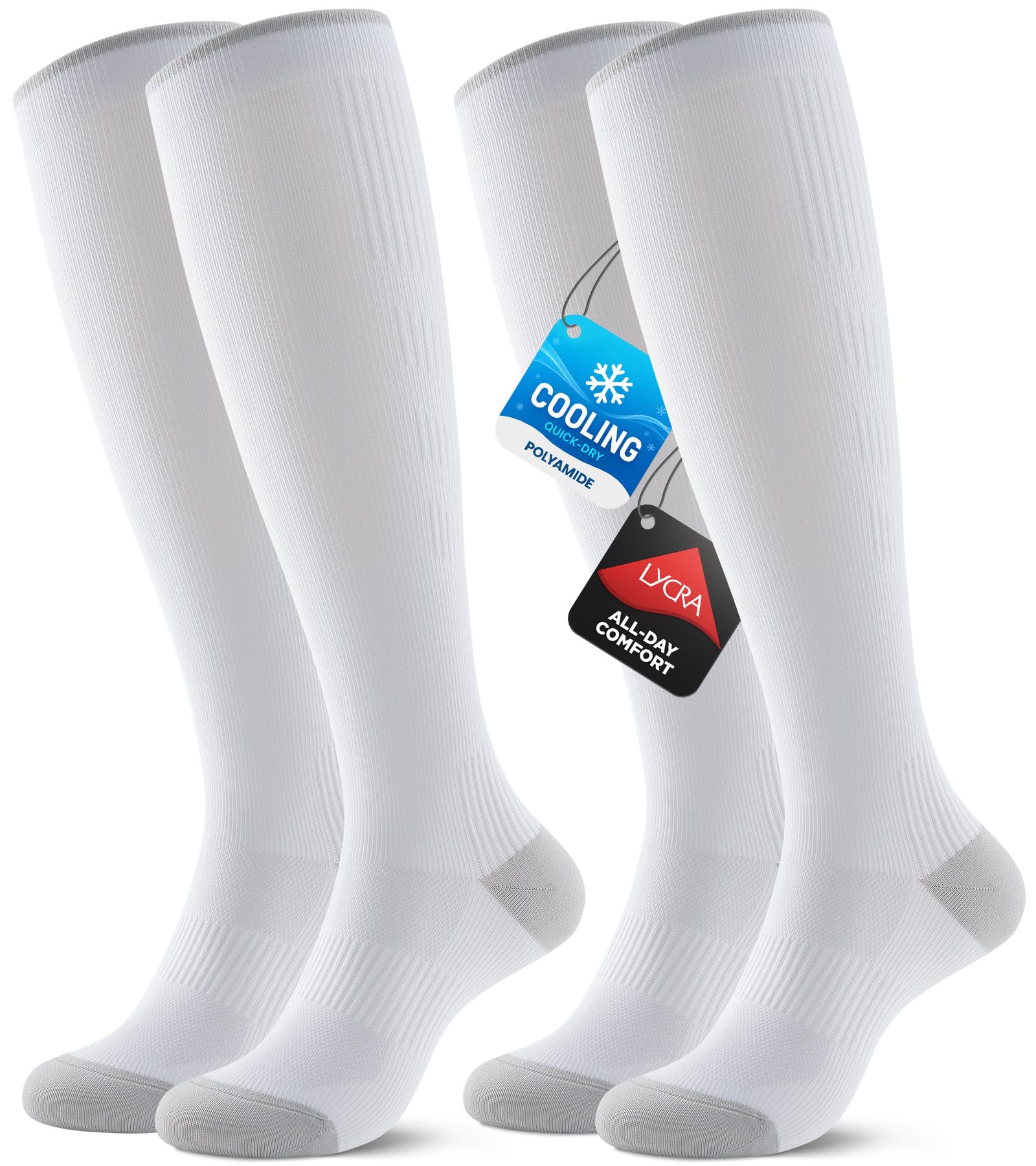
1. Benirap Breathable Compression Socks for Women Men, 20-30mmHg Knee High Circulation for Travel, Flying, Athletic, 2 pairs
Our pick — over 4.5★ from 500+ verified ratings; the strongest balance of quality and price.
A near-perfect rating that backs up the real-world relief thousands of owners describe.
At the 20-30 mmHg level, these socks deliver the graduated pressure needed to keep circulation moving without feeling like a tourniquet on your calf. The package dimensions are remarkably compact — just 3.94 x 3.94 x 0.79 inches — making them one of the smallest travel-friendly options you will find. Many buyers report that the breathable fabric keeps legs cool even during summer months, which is a rare balance at this compression strength.
The thing that wins people over is the immediate relief for standing-heavy days. As owners mention, one family member’s feet “used to swell up and had rashes on them due to standing most of the day but these fixed all his problems faster than any cream ever could.” Another owner with venous insufficiency calls them a new favorite because they are lightweight and easy to put on without fighting the fabric. The top band stays put without rolling, and the material feels good against the skin all day.
The only real trade-off here is the two-pair count. While the quality is excellent, you will need to rotate more often if you plan to wear them daily, especially compared to the eight-pack options below. For anyone who prioritizes a sure fit and proven relief over quantity, this is the pair to start with.
Why owners love it
- Exceptional 4.8-star consensus from over 500 ratings — the crowd favorite.
- 20-30 mmHg compression that customers note eliminates swelling and leg fatigue.
- Breathable construction that stays comfortable even in warm weather.
- Easy to put on and remove, with a non-slip top band.
The honest limits
- Only two pairs per pack, so you will need to wash more frequently.
- Sizing can feel snug if you have very large calves — measure carefully.
Reach for these if: you want the highest-rated, proven relief in the 20-30 mmHg range with a comfortable breathable fabric.
Look elsewhere if: you need a larger rotation of multiple pairs on a strict budget.
2. CHARMKING Compression Socks for Women & Men Circulation (8 Pairs) 15-20 mmHg Best Calf Socks Support for Athletic Cycling
Eight pairs at a 15-20 mmHg level that feels gentle enough for all-day wear without cutting in.
If the idea of having a full rotation for an entire week appeals to you, this multi-pack delivers on volume. What owners praise most is the comfortable fit that stays in place and does not roll down, backed by over 5,400 mentions of fit and 5,200 of comfort.
The material breathes well and looks like a normal sock, which helps if you wear them under trousers or to the office. One owner with chronic illness notes they are “not too tight but great support,” worn 10 to 18 hours daily without discomfort. However, the same review warns that the patterned versions can leave painful indentations compared to the solid colors. If you wear a larger shoe size, check the fit — a size 11½ owner reports the sole runs slightly short.
Keep in mind that this is a 15-20 mmHg sock, so it will not provide the same firm squeeze as medical-grade options. If your doctor specifically recommended 20-30 mmHg for blood pressure management, the Benirap above is a closer match.
The big wins
- Eight pairs give you a full week’s supply without daily washing.
- Comfortable, breathable fabric that 5,200+ owners specifically praise.
- Stays in place — no rolling down or bunching at the ankle.
Know before you buy
- 15-20 mmHg is a lighter compression, not suitable if you need firmer pressure.
- Patterned versions may leave indentations for sensitive legs.
- Large feet (size 11+) may find the sole slightly short.
Ideal for: budget-conscious buyers who want a comfortable, gentle compression option and a full week’s worth of socks.
Think twice if: you require the stronger 20-30 mmHg medical-grade compression specifically.
3. Mojo Compression Socks for Women and Men 20-30mmHg Knee High – Graduated Knee High Compression Stockings for Bariatric Surgery Recovery, Edema, DVT – Beige, Medium – AB201
Firm graduated compression built from 80% Nylon and 20% Lycra for durability and consistent pressure.
Mojo is a long-standing name in this space, and the 20-30 mmHg rating here is the standard for addressing edema, DVT prevention, and post-surgery recovery. The blend of Nylon and Lycra gives it a smooth, thin feel that slides under pants easily, and the reinforced heel and toe add extra life in high-wear areas. Compression is the most-praised feature here — mentioned 126 times by owners — followed closely by fit with 99 mentions.
The roomy toe area gets consistent praise, with owners saying it prevents the pinched-toe feeling that ruins many compression socks by midday. The non-slip cuff keeps the sock firmly in place whether you are walking, standing, or sitting at a desk. That said, the toe seam on some pairs arrives with unfinished excess stitching that can cause minor discomfort — a few owners noted this issue across both grey and black pairs. The sizing also runs long, so if you have shorter legs, the sock may extend higher than your knee bend.
Unlike the lighter 15-20 mmHg CHARMKING pack, this single pair delivers the firm pressure that many doctors recommend for managing circulation issues tied to blood pressure. It is a true medical-grade pick at a mid-range price.
Standout strengths
- 20-30 mmHg graduated compression ideal for circulation, swelling, and recovery.
- Reinforced heel and toe for long-term durability.
- Roomy toe area prevents uncomfortable pinching all day.
- Non-slip top band that stays in place without cutting in.
Things to note
- Toe seam stitching can be unfinished on some pairs, causing minor irritation.
- Single pair only — you will need to buy more for a rotation.
- Long cut may be too tall for shorter individuals.
Grab this for: reliable medical-grade compression that owners consistently trust for edema and circulation.
skip it if: you have very sensitive toes or prefer a softer toe seam finish.
4. +MD 2 Pairs 20-30 mmHg Compression Socks for Women & Men, Knee High Open Toe Stockings, Graduated Support & Comfort Hose
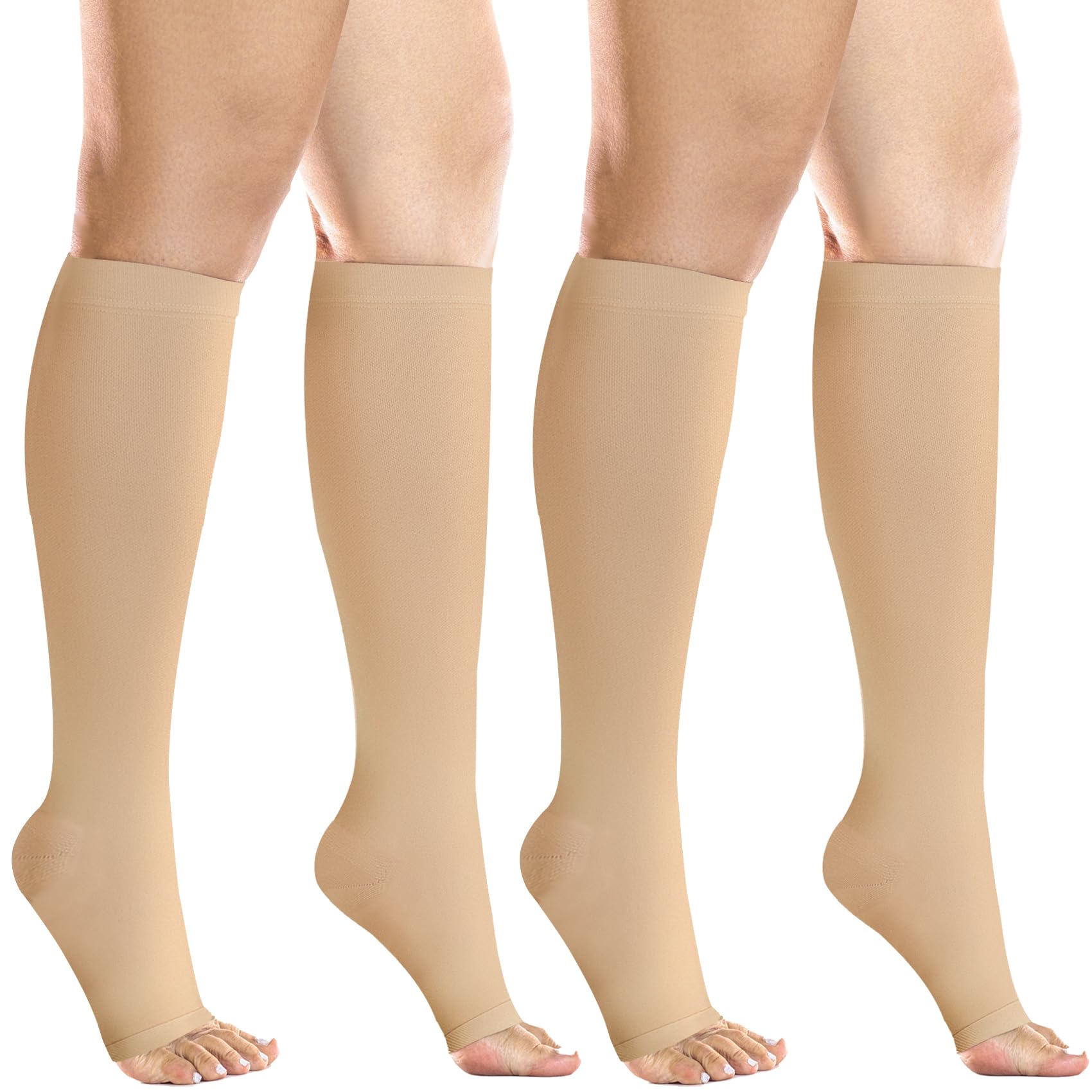
The open-toe design that lets your toes breathe while keeping firm 20-30 mmHg compression where you need it.
If enclosed toes make your feet feel cramped or hot, the open-toe cut of the +MD socks is a welcome alternative. The 20-30 mmHg compression is strongest at the ankle and gradually loosens as it moves up the calf — the same graduated design that supports circulation in the legs. The compression is the most-discussed feature, with 61 positive mentions, and the overall quality is praised by 35 owners, many of whom call it a solid alternative to custom medical options.
The fit here is the most-talked-about aspect at 78 mentions, but Amazon’s data marks it as mixed — meaning some owners find it spot-on while others struggle. The size chart includes a tip for new users: if you are trying compression for the first time, choose a size larger for a more comfortable fit. A few buyers noted that the top band can feel too tight, and after the first wash, the toe opening may begin to roll up slightly, making it tricky to settle inside a shoe.
This pair goes head-to-head with the Mojo above — both are 20-30 mmHg knee-high options, but the +MD wins on breathability with its open-toe design while the Mojo offers a reinforced closed toe for warmth. If you prioritize airflow and have struggled with enclosed toes, this is the pick to try.
Why it stands out
- Open-toe design keeps feet cooler and accommodates toe spacers or bandages.
- 20-30 mmHg graduated compression that owners confirm stops leg swelling.
- Affordable alternative to custom prescription compression stockings.
Watch for
- Fit is inconsistent — measure carefully and consider sizing up.
- Toe opening may roll up after several washes.
- Top band can feel tight on larger calves.
Best for: those who want open-toe flexibility with firm 20-30 mmHg compression and are comfortable following a size chart closely.
Not ideal if: you need a guaranteed consistent fit or prefer a fully enclosed toe for warmth.
5. LEVSOX Cotton Compression Socks for Women&Men 20-30mmHg Knee High Cute Support Sock for Nurses Pregnancy Travel

A cotton-rich fabric at 20-30 mmHg that feels cooler and less synthetic against sensitive skin.
Most compression socks rely on nylon and spandex for elasticity, which can irritate skin or trap heat. LEVSOX uses cotton as the main material, giving you that same 20-30 mmHg compression in a fabric that breathes naturally. Owners with skin allergies report that the cotton construction clears up rashes that synthetic blends caused. The sock also has no seam across the toes, which removes a common source of irritation for long days.
The compression holds up well even after 12 or more hours of wear, and the top band does not cut off circulation — one owner with what they describe as “fat legs” confirms the band is comfortable. The cushioned sole adds a layer of padding that feels good when you are standing on hard floors all day. The downside is the length: the ankle-to-knee measurement is tall, and some users find it causes restriction if they do not roll the top down slightly.
Compared to the CHARMKING 8-pack, this is a single pair at a similar price, so the value proposition is entirely different. You are paying for the cotton material and the comfortable top band, not volume.
What owners love
- Cotton fabric is breathable and skin-friendly, great for sensitive skin.
- No toe seam, so no friction or irritation at the toes.
- Comfortable top band that does not dig in, even for larger calves.
Limitations
- Ankle-to-knee length can be too tall for shorter legs.
- Single pair only — not a bulk value option.
- Cotton may lose elasticity faster than nylon blends over time.
Choose this if: cotton is your preferred fabric and you need a comfortable, breathable 20-30 mmHg sock for sensitive legs.
Pass if: you have short legs or want a bulk pack of socks for daily rotation.
6. Cute Compression Socks for Women – 3 Pairs 20-30 mmHg Graduated Support Lightweight for Daily Wear Travel Nurse
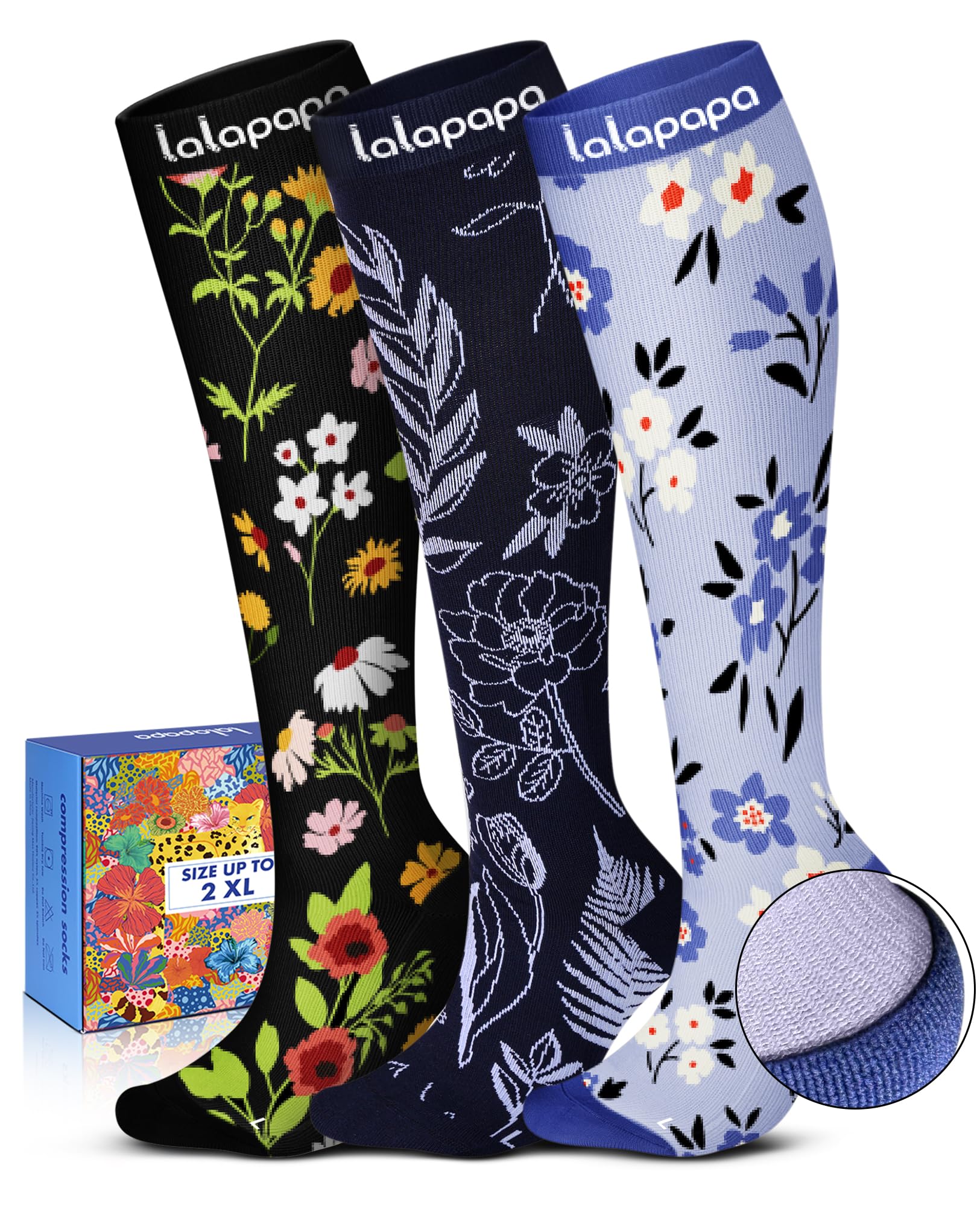
Three pairs of 20-30 mmHg support with soft cushioning and patterns that actually look good.
If the hospital-white look of medical stockings is not your style, this pack stands out with colorful woven designs that still deliver genuine 20-30 mmHg graduated compression. Appearance is the top-praised feature at 80 mentions, followed by comfort at 65. The inside has a soft cushioned layer that feels better against the skin than standard nylon shells, and the compression itself gets high marks for helping with pregnancy swelling and deep leg soreness from blood pooling.
The fit, however, is the most-mentioned aspect at 73 mentions and Amazon marks it as mixed. Some owners with smaller feet find the ankle area too loose, causing wrinkling, while others with wide calves appreciate the roomy cut. One owner received a pair boxed as “extra wide” even though the description did not state that, and felt the compression was weaker than 20-30 mmHg as a result. If you have very narrow ankles or are between sizes, you may want to size down.
These are noticeably more cushioned than the LEVSOX cotton socks above, which makes them a better fit for long shifts on concrete floors but potentially too warm for hot climates. The three-pair count strikes a nice balance between the two-pair Benirap and the eight-pair CHARMKING.
Best aspects
- Attractive patterns and colors that 80 owners specifically praise.
- Soft interior cushioning adds all-day comfort.
- Effective 20-30 mmHg compression for swelling and leg fatigue.
Consider before buying
- Fit runs large for some — can be loose at the ankle.
- Some pairs may be labeled “extra wide” without clear disclosure.
- Cushioned build may run warm in hot weather.
Perfect for: anyone who wants effective 20-30 mmHg compression in an attractive design with extra foot padding.
Not for: those with very narrow ankles or anyone who needs a guaranteed slim fit.
7. Medical Compression Socks for Men & Women, 3 Pairs 20-30mmHg Knee High Graduated Compression Stockings for Circulation, Swelling, Varicose Veins, Flying, Travel, Nurses, Running, Pregnancy
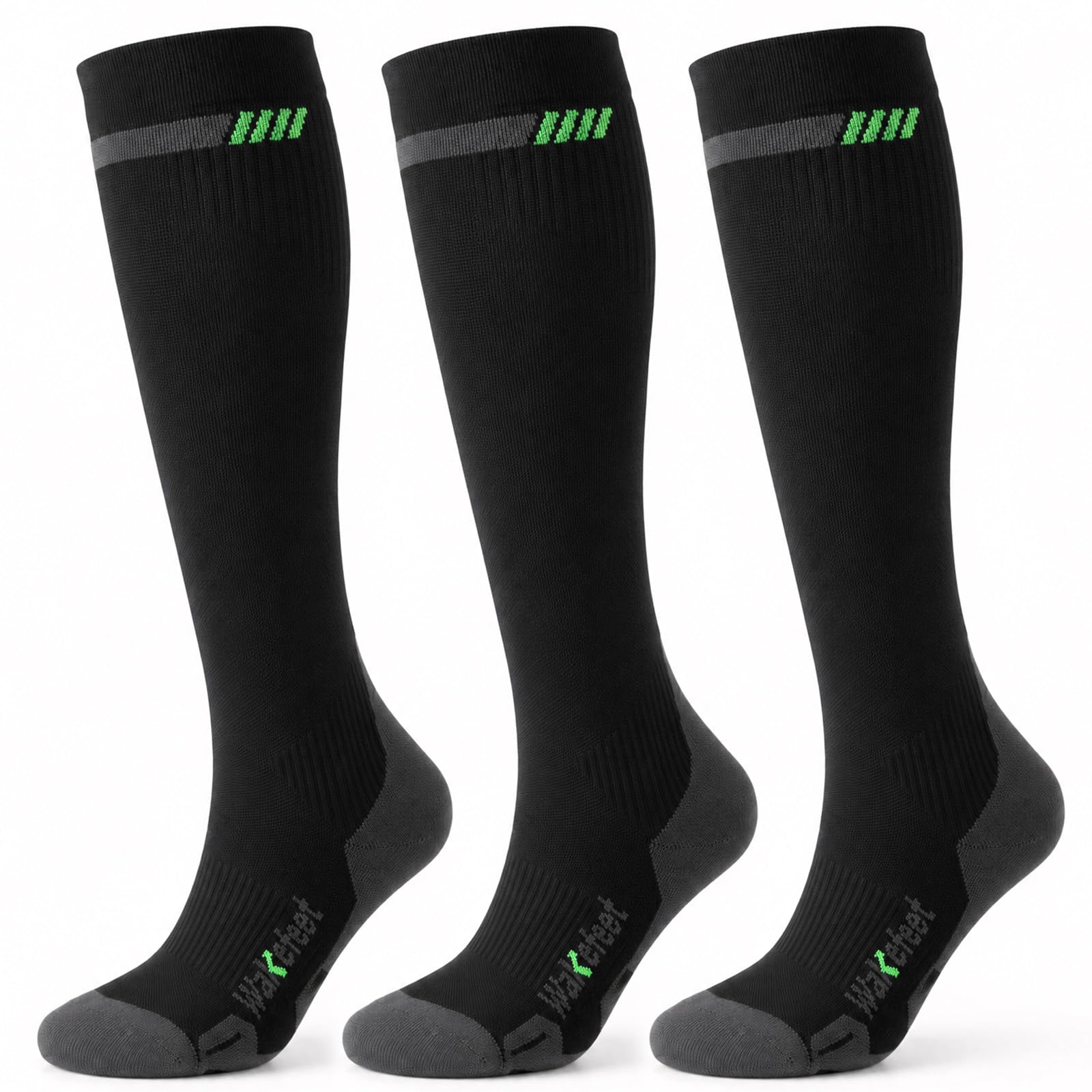
A straightforward three-pack at 20-30 mmHg that focuses on firm support without frills.
Sometimes you just need a no-nonsense compression sock that delivers on pressure and fits reasonably well. This Wakefeet three-pack gives you 20-30 mmHg graduated compression across three pairs, making it easy to rotate through a work week. The compression level and quality each earn 15 positive mentions, and owners consistently say the socks work well at reducing leg and foot swelling. One owner calls them the second set bought from this company, saying “they work,” which is about as direct as praise gets.
The fit is the most-discussed aspect at 16 mentions, but it is rated mixed — some find the socks easy to get on and supportive, while others report the top band cuts into circulation. A smaller number of buyers mention the socks slipping down toward the ankle during wear, which defeats the graduated compression design. If you have average-size calves, you will likely fall into the satisfied camp, but larger legs may find the top band restrictive.
Compared to the Mojo above, this pack gives you three pairs instead of one for a similar price, but the Mojo has a longer track record and more detailed positive consensus on fit. If you are okay with a bit of variability in the fit, the three-pair count here is tough to top for the price.
What works
- Three pairs provide good rotation for daily wear.
- Effective 20-30 mmHg compression for swelling relief.
- Owners consistently praise the supportive feel and comfort.
What to watch
- Fit can be tight at the top band; measure carefully.
- A few reports of socks slipping down during the day.
- Not as much long-term owner feedback as more established brands.
Reach for these if: you want an affordable three-pack with firm compression and are willing to check sizing closely.
Think twice if: you have large calves and need a guaranteed non-binding top band.
8. Ailaka Zipper Compression Socks for Men Women – 20-30 mmHg Close Toe Knee High Medical Compression Socks with Zipper, Zip Up Socks for Varicose Veins, Edema, Recovery, Pregnant, Nurse

The YKK zipper design that solves the single biggest frustration of compression socks: getting them on and off.
If you have ever wrestled with a tight compression sock for twenty minutes, these Ailaka zipper socks will feel like a revelation. The built-in YKK zipper runs up the back of the calf, allowing you to zip the sock into place without pulling, stretching, or fighting the fabric. Ease of use is the top-praised feature with 54 mentions, and the zipper itself gets 43 positive mentions. The 20-30 mmHg graduated compression is made from 70% nylon and 30% spandex, providing the firm squeeze needed for edema, varicose veins, and post-surgery recovery.
The fit here is rated mixed — 35 mentions with some owners finding the sizing runs small. A number of owners say the socks are too long for shorter women, causing the compression to land in the wrong spot on the leg. The size range goes up to 5X-Large, which is wider than almost any other pick here, so plus-size buyers have a genuine option. One owner bought a single pair to test, then immediately ordered two more because the zipper made daily use so much easier.
Compared to every pull-on sock above, this is the clear winner for anyone with limited hand strength, arthritis, or simply no patience for the struggle. The trade-off is that a zipper adds a potential failure point and the fit is less forgiving if you are between sizes.
Why it is unique
- YKK zipper makes putting on and taking off easy.
- Available in sizes up to 5X-Large for wider calves.
- Full toe design with firm 20-30 mmHg graduated compression.
- Durable construction that holds up to daily wear over months.
Bear in mind
- Sizing can run small — measure carefully and consider sizing up.
- Too long for some shorter individuals, causing improper fit.
- Single pair per purchase; no multi-pack option.
Perfect for: anyone who struggles with putting on compression socks or has arthritis, limited mobility, or very large calves.
Not for: those with short legs or anyone who wants a simple pull-on sock without zipper hardware.
9. Medical Compression Socks 20-30 mmHg for Men Women (3 Pairs) – Best Support for Daily Wear, Flying, Sport, Circulation
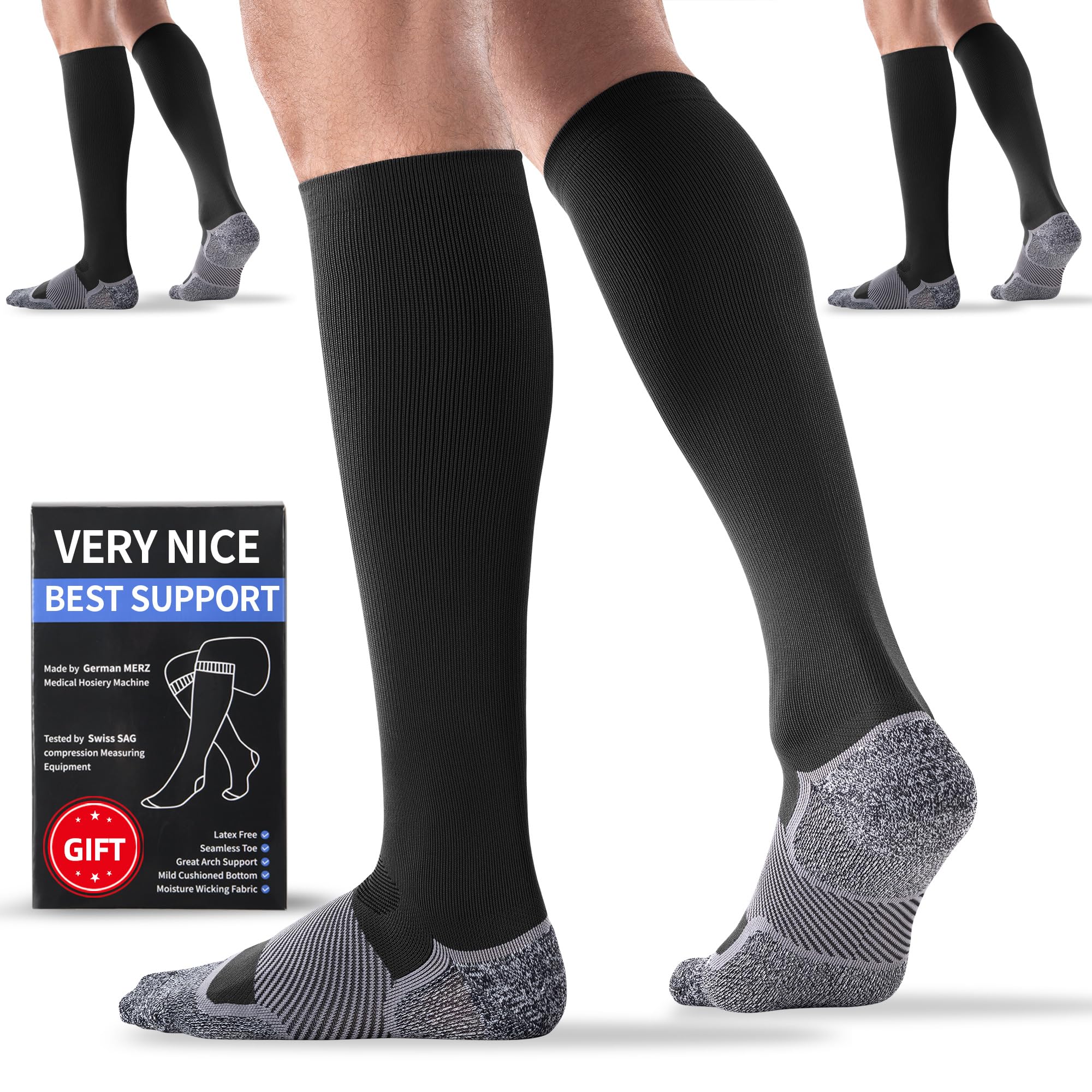
German-made sock machines and a unique inlay knitting method that owners say holds compression longer than pricier brands.
This Bbfrey three-pack is constructed using German medical sock machines with an inlay knitting method designed to maintain consistent 20-30 mmHg pressure over time without sagging. The material is 70% microfiber nylon, which feels smooth and moisture-wicking against the skin. Compression is the most-praised feature here, mentioned 76 times, and quality follows closely at 67. Owners consistently note that the socks hold their shape wash after wash, which is a common failure point in cheaper blends.
The toe area uses smooth stitching with a left-right anatomical design that prevents blisters and irritation. The heel and toe also have light cushioning, which adds comfort without feeling bulky inside shoes. The fit is the most-discussed aspect at 59 mentions, but it is rated mixed — some find the socks run small and can cut off circulation, while others say the sizing is accurate. One owner with a size medium reports the Large is too small and cuts off circulation, so checking the size chart is critical here.
Compared to the Benirap at the top of this list, this Bbfrey pack offers three pairs at a higher price point but with a more technically engineered fabric and a dedicated focus on long-term elasticity. If you plan to wear compression socks daily for months and want them to keep their squeeze, this is the durable choice.
what separates it
- German machine-knit construction for consistent long-lasting pressure.
- smooth anatomical toe design prevents blisters.
- Light cushioning at heel and toe adds comfort without bulk.
- Moisture-wicking microfiber nylon feels smooth and dry.
Be aware
- Fit runs small for some — consider sizing up.
- Limited color options; mostly dark shades.
- Higher price than multi-pack alternatives.
Best for: daily wearers who want a durable, technically built sock that maintains its compression over months of use.
Avoid if: you are between sizes or prefer a looser fit — the compression is firm and unforgiving.
Understanding the Specs
20-30 mmHg vs. 15-20 mmHg Compression
The pressure a compression sock applies is measured in millimeters of mercury (mmHg). Think of it as a gentle hug that is tightest at your ankle and gradually loosens as it moves up your calf. The 20-30 mmHg range is considered medical-grade — strong enough to help with swelling, varicose veins, and circulation issues often tied to blood pressure management. The 15-20 mmHg range is milder, better for everyday fatigue and mild swelling. If a doctor has not specified a level, most people managing circulation or swelling find the 20-30 mmHg range more effective. The trade-off is that it can be harder to put on.
Graduated Compression
Graduated means the sock squeezes hardest at the ankle and gently releases pressure as it moves up your leg. This design helps push blood upward toward your heart instead of letting it pool in your lower legs. All the socks in this guide use graduated compression, but some deliver it more consistently than others. A well-made graduated sock will have the full 20-30 mmHg squeeze at the ankle, roughly 50% of that pressure at mid-calf, and about 25% at the top band. If a sock feels equally tight all the way up, it is not truly graduated and will not support circulation as effectively.
FAQ
Can compression socks actually lower my blood pressure?
What compression level should I choose for high blood pressure?
How do I measure my legs to get the right size?
How long can I wear compression socks each day?
Can I sleep in compression socks?
How do I wash compression socks without ruining them?
How often should I replace my compression socks?
Are zipper compression socks as effective as pull-on ones?
Why do my compression socks roll down during the day?
Can compression socks help with varicose veins?
Final Thoughts: The Verdict
For most users looking for the best compression socks for high blood pressure, the winner is the Benirap Breathable Compression Socks because it combines a highly effective 20-30 mmHg compression with the best owner satisfaction rate in this list. If you want a full week’s rotation at a gentler 15-20 mmHg pressure, the CHARMKING 8-Pack offers unbeatable value. And for anyone who struggles to pull on compression socks at all, the Ailaka Zipper Compression Socks solve that problem completely with a reliable YKK zipper.
How We Picked
We do not accept paid placement. Every pick is matched to a real buyer and a real use-case; we do not hands-on test units.
Sources & Methodology
Specifications: manufacturer listings and product documentation. Review insights: verified customer reviews, as of July 2026. Pricing: not shown on this page (it changes often); check the current price via the retailer link.
As an Amazon Associate, WellFizz earns from qualifying purchases. This does not affect which products we feature.
Related Guides

Mo Maruf
I created WellFizz to bridge the gap between vague wellness advice and actionable solutions. My mission is simple: to decode the research and give you practical tools you can actually use.
Beyond the data, I am a passionate traveler. I believe that stepping away from the screen to explore new environments is essential for mental clarity and physical vitality.