Our readers keep the lights on and my smoothie glass nicely filled. As an Amazon Associate, I earn from qualifying purchases.
Specs are compiled from manufacturer listings and verified buyer reviews and can change over time — please confirm the key details on the product page before buying.
Ground coffee loses flavor immediately; store-bought whole beans go stale in days, but green beans stay fresh for two years and peak minutes after roasting.
I’m Mohammad Maruf — the founder and writer behind WellFizz. This guide is built by comparing the manufacturers’ published specifications and the patterns across verified customer reviews, so you get each pick’s real strengths and trade-offs instead of marketing spin.
If you are chasing a single perfect espresso roast or want to experiment with exotic beans from around the world, this guide to the best coffee roast options helps you choose the machine that matches your kitchen, batch size, and experience level.
Our Picks at a Glance
How To Choose The Best Coffee Roast Machine
Pick a roaster based on your daily coffee volume, desired control level, and roasting location. A machine that roasts 120-gram batches is fine for a single daily drinker, but a household of three will want a 300-gram or larger capacity so you are not roasting every other day. Convection (fluid-bed) roasters are faster and easier to clean, while drum-style roasters give you classic, roasty flavors but require more space and ventilation.
Batch Size and Throughput
Match the roaster’s capacity to how much coffee your household drinks per week. A 120-gram batch (about four scoops of green beans) makes roughly 7-14 cups of brewed coffee. If you go through that in three days, a roaster with a 300-gram to 500-gram capacity cuts your roasting sessions in half. Beginners often buy too small a roaster and end up roasting daily.
Control: Heat, Fan, and Timer
Adjustable heat settings let you dial in light, medium, or dark roasts, and a fan control matters in fluid-bed machines because it keeps beans circulating for even heat exposure. A timer (0-60 minutes) removes guesswork. Most owners get consistent results after 3–5 batches; the best machines let you save and repeat a successful profile.
Ventilation and Smoke Management
Roasting produces smoke and chaff (the papery skin that peels off beans). Every machine in this list should be used in a well-ventilated area — near a range hood, under a microwave fan, or outside. Some roasters include a chaff-collection system. Plan on a little clean-up after every batch, usually a wipe-down of the roasting chamber.
Quick Comparison
| Model | Best For | Batch Capacity | Wattage | Control Type | Amazon |
|---|---|---|---|---|---|
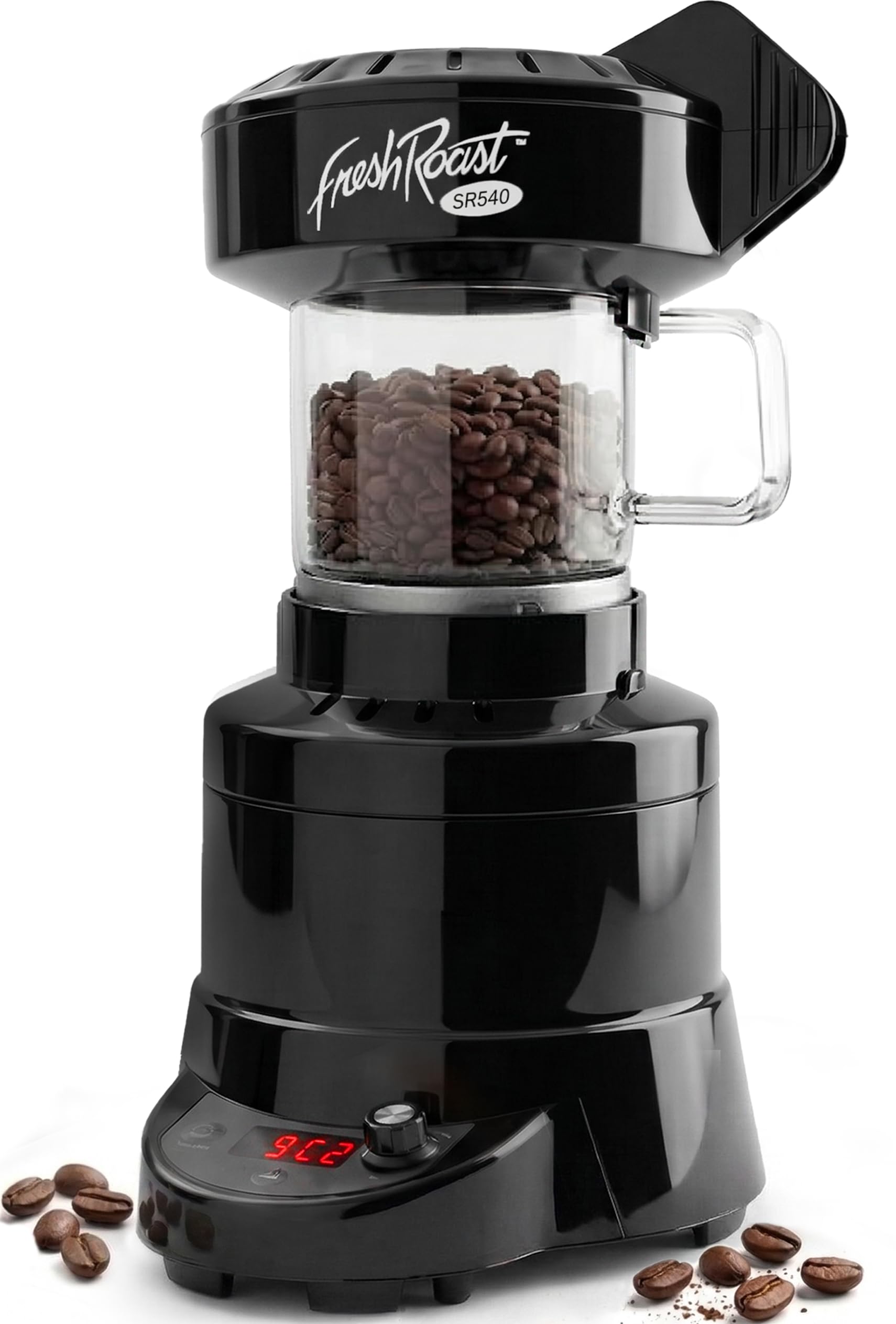
| Fresh Roast SR540★ Best Overall | Overall / Beginner to Pro | 120 g (4 scoops) | — | Fan, Heat, Timer | Amazon |
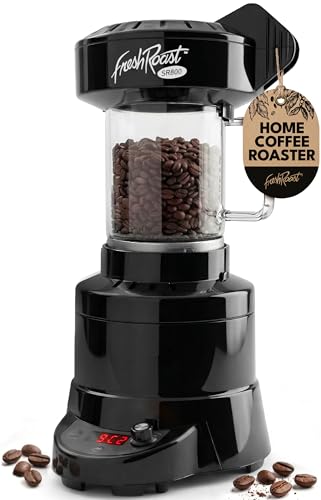
| Fresh Roast SR800Premium Upgrade | Premium / High Volume | 170-226 g (6-8 oz) | — | Fan, Heat, Digital | Amazon |
| JIAWANSHUN 1.1lb (Upgraded) | Value / Versatile | 300-500 g | 1200 W | Temp Dial, Timer | Amazon |
| JIAWANSHUN Electric 1.1lb | Budget / Multi-Food | 500 g (1.1 lb) | 1200 W | Temp Dial (0-240°C) | Amazon |
| GIVEROO 500g | Budget / Entry-Level | 500 g | 800 W | Temp Dial, Timer | Amazon |
| ANGELLOONG 750g | Mid-Range / Large Batch | 750 g (1.65 lb) | 1200 W | Temp (212-464°F), Timer | Amazon |
| DYVEE KAKA-G400 | Enthusiast / Drum-Style | 200-400 g | N/A (Gas) | Gas Burner | Amazon |
In‑Depth Reviews
1. Fresh Roast SR540 Automatic Coffee Bean Roaster
Our pick — over 4★ from 650+ verified ratings; the strongest balance of quality and price.
The crowd-favorite fluid-bed roaster that balances beginner ease with pro-level consistency.
This machine uses a speed roast fluid motion system — a convection fan suspends beans in hot air so every surface roasts evenly without scorching. The SR540 runs 120-gram batches (about four scoops, or enough for 7-14 cups) in under 10 minutes. Real-time temperature display, nine power levels, and independent fan control let you dial in profiles from light to espresso-dark. Buyers report “produced hundreds of flawless batches since 2021.” The top praise goes to quality and reliability — 86 and 76 mentions, respectively — and the consensus is that it delivers great results for the money.
The trade-off is that the analog knobs are not programmable, so you have to watch each batch rather than save a profile. Cooling works well, but you must wait before removing the top. It is best used near a range hood because any fluid-bed roaster throws off smoke and chaff.
Convection consistency: The glass roasting chamber and chaff basket come included, and cleanup is simple — just wipe the glass cup. The build feels rugged enough for weekly use, and owners say it outperforms pre-roasted store coffee by a wide margin.
Reach for this if: You want the easiest path to consistently fresh coffee without a programmable machine, backed by a brand that stands behind its products.
Think twice if: You need larger than 120-gram batches or want to save automated roast profiles.
2. Fresh Roast SR800 Coffee Roaster
A bigger, quieter sibling that bumps capacity to 6-8 ounces and adds digital precision.
The SR800 roasts 170 to 226 grams per batch — roughly double the SR540 — and still finishes in under 10 minutes. The digital control board lets you push a knob to adjust heat, fan speed, and time, and you can change the default start settings to repeat a favorite profile. Performance gets the most praise (97 mentions), followed closely by fan performance (58). Owners say it is ideal for 2-3 coffee drinkers and delivers results that rival machines costing three times as much. As buyers put it: “perhaps the best machine for home coffee roasting.”
The catch lies in a few build details. The chaff catcher’s rim can crack if tapped to clear chaff (blowing compressed air or using a vacuum after cooling works better). The multi-function knob takes a couple batches to get comfortable with. In cooler weather (around 60°F), the machine feels slightly underpowered, and some owners recommend loading 170 grams instead of the full 226 to keep the beans moving evenly.
What owners love
- Larger 170-226g batch — perfect for households
- Digital controls with customizable start settings
- Backed by excellent USA customer service (flat-rate repairs available)
A few notes
- Chaff catcher is fragile — handle with care
- Multi-function knob takes practice
- May need to reduce batch size in cooler weather
Best for: The home roaster who wants a reliable workhorse with a larger capacity and long-term support.
Skip if: You have a tight budget or prefer completely analog controls with no learning curve.
3. JIAWANSHUN Coffee Roaster Upgraded Electric 1.1lb

A drum-style electric roaster packing a 1.1-pound capacity and a wide temperature range at a mid-range price.
This 1200W machine lets you set the temperature from 100°C to 240°C (212°F to 464°F) for precise roast control from light to dark. The recommended roasting load is 300-500 grams for best results, and the automatic mixing stirrer rotates beans evenly throughout the batch. A clear glass lid with four ventilation holes lets you watch the color change. Owners mention that it preheats in 5-6 minutes up to 516°F, then roasts 300 grams of beans to 415-430°F in 13-18 minutes. The honeycomb non-stick interior wipes clean with a damp cloth.
Like many drum-style roasters, the stirring arms can bind on very small beans. At the full 500-gram load, some owners note the roast is not perfectly even and requires a manual shake mid-cycle. The unit is also noisy and produces a strong smell — use it in a well-ventilated area or outdoors.
Versatile performer: Beyond coffee, it roasts peanuts, chestnuts, sunflower seeds, and popcorn. The generous 800-gram total capacity handles larger batches comfortably, and the 1200W heating element outpaces the 800W entry-level machines handily.
Reach for this if: You want a large-capacity electric roaster with broad temperature control and plan to roast more than just coffee.
Think twice if: You need perfect uniformity at max capacity or prefer a convection-based (fluid-bed) system.
4. JIAWANSHUN Electric Coffee Bean Roaster for Home Use 1.1lb

A budget-friendly 1200W electric roaster that tackles 1.1 pounds of beans — and nuts, too.
For roughly the same price as a mid-range grinder, this machine delivers 1200W of heating and a 0-240°C temperature dial. The built-in stirring rod continuously rotates beans for even contact, and the non-stick chassis makes cleanup simple. Coffee quality gets the most praise (22 mentions), with owners calling the results “smooth, balanced, full-flavored.” One owner reported it held up well after one year of use at three times per month. It also roasts chestnuts, peanuts, and peppers — essentially a multi-purpose kitchen tool.
The honest limitation is roast consistency: owners rate evenness at 70-80%, so you get a blend of roast levels in a single batch. Some units have reliability concerns — a few customers note the machine stopping after six months. If you are a perfectionist chasing uniform City+ roasts, you may find this frustrating. For everyday drinking, the flavor blend is entirely acceptable.
Why it earns its spot
- Very affordable entry into 1.1-pound batches
- 1200W heating is faster than 800W alternatives
- Non-stick surface cleans easily
Be aware
- Roasts are not perfectly uniform
- Long-term reliability is mixed in owner reports
- Temperature readings from the dial can drift
Best for: The budget-conscious buyer who wants to roast larger batches of coffee (and other foods) without spending a lot.
Skip if: Uniform roast consistency or long-term warranty support is a priority for you.
5. GIVEROO 500g Coffee Bean Roaster Machine

An 800-watt entry-level roaster that keeps costs low without cutting the essential features.
The GIVEROO uses an automatic auger — a rotating bar that continuously stirs beans for even heat contact. The 0-240°C temperature dial and a built-in timer give you basic but effective control. Reliability is the top positive aspect (27 mentions), and owners say it works well for all roast levels and makes a perfect medium roast. The transparent glass cover with a smoke reduction system lets you monitor progress without opening the lid. Best of all, cleanup is a breeze.
At 800 watts, this machine heats more slowly than 1200W models, and the instructions recommend putting more than 400 grams of beans at a time to avoid unevenness. Some Teflon flaking from the non-stick coating has been reported in longer-term use. It is a capable starter, but if you plan to roast weekly for a year, the higher-powered JIAWANSHUN variants may serve you better over time.
Simple and effective: First-timers love how easy it is — “basically no setup required” — and the small footprint (12.6 x 12.6 x 4.72 inches) slides onto most counters. The 500-gram capacity handles enough for a week of coffee in one go.
Reach for this if: You are trying home roasting for the first time and want the lowest-cost path to a full-sized batch.
Think twice if: You roast often enough that an 800W heater and possible long-term coating issues matter.
6. ANGELLOONG Coffee Roaster Machine 750g

A 1200W drum roaster that handles 1.65-pound batches — the largest capacity on the list.
With 750-gram (1.65 lb) capacity and 1200W heating, the ANGELLOONG roasts up to 750 grams of green beans in about 25 minutes. Temperature control spans 212-464°F, and the 0-60 minute timer lets you set and monitor the roast. The honeycomb pan with black Teflon coating reduces sticking, and the transparent heat-resistant lid has four vent holes. Roast consistency gets the most positive mentions (35), and owners say it delivers even roasts batch after batch. It also handles peanuts, chestnuts, and dried fruit.
The durability picture is mixed: a few reviewers point out the heating element dying after 1-2 years of light monthly use. The machine is also large (13.39 x 13.39 x 8.27 inches) and must be used in a well-ventilated area. Owners note you may need to bend the fixed stirring arm slightly for perfectly even roasts, and jam clearing occasionally requires manual intervention. That said, many call it “an excellent value” compared to roasters costing six times more.
What stands out
- Huge 750g batch — roast once, drink all week
- 1200W for fast preheat and recovery
- Owners praise the even, consistent results
What to know
- Heating element life is reported as 1-3 years
- Large footprint needs counter space
- Stirring arm may need a bend for perfect results
Best for: Heavy-drinking households or small offices that need a large batch of fresh roast with minimal effort per batch.
Skip if: You plan to run the machine more than once a week for years — longevity is a real concern here.
7. DYVEE KAKA-G400 Coffee Roaster (Gas Burner)

A gas-fired drum roaster built for the purist who wants visible, hands-on control over every batch.
This is a completely different approach from the electric machines above. The KAKA-G400 uses a propane or natural gas burner to heat a quartz glass drum that rotates via a safe 12V motor. You watch the beans turn from green to brown through the transparent drum and stop the roast at exactly the right crack. The 304 stainless steel frame and wooden handle give it a premium, industrial feel. Build quality (9 mentions) and performance (8 mentions) are the top praises, with owners calling it “solidly built” and ideal for weekly outdoor roasting.
The catch is the learning curve and the mess. Drum-style gas roasting produces a lot of chaff that escapes through slots, so it really needs to be used outdoors over a propane burner. The maximum load is about 300-400 grams, though small beans can get stuck in the drum tubes and burn. The included thermometer is slow to respond, and removing the glass drum for cleaning is somewhat precarious. As one owner noted: “overpriced and bulky.” It is a specialist tool for the person who enjoys the process as much as the coffee.
Hands-on roasting: With a gas burner, you control the temperature curve directly — no thermostat limiting you. Shoppers say dark roasts in 13 minutes and medium roasts in 10. The 12V motor is safe and can run for hours. It is not for the faint of heart, but the reward is a roast profile no electric machine can duplicate.
Best for: The adventurous enthusiast who wants to master gas roasting and has a suitable outdoor setup.
Think twice if: You prefer simplicity, want to roast indoors, or value a compact machine with low chaff output.
Understanding the Specs
Convection (Fluid-Bed) vs. Drum Roasting
Fluid-bed roasters (like the Fresh Roast SR540 and SR800) suspend beans in hot air using a fan. This gives very even heat and fast roast times (under 10 minutes), with less risk of scorching. Drum roasters (like the JIAWANSHUN models and the DYVEE) tumble beans against a heated surface. They tend to produce a richer, more traditional flavor profile but take longer per batch and need more ventilation. Neither is better — the choice depends on whether you value speed and uniformity or classic depth of flavor.
Wattage and Heat-Up Speed
Higher wattage means faster preheat and quicker recovery when you add cold beans. A 1200W machine preheats in 5-6 minutes; an 800W machine takes noticeably longer. This matters most if you roast multiple batches back-to-back or live in a cooler climate. With electric roasters, the temperature range (typically 0-240°C or 212-464°F) determines how light or dark you can go. Light roasts stay under about 400°F, while dark roasts push toward 450°F or higher.
FAQ
Can I roast indoors with a home coffee roaster?
How much green coffee do I need for a week of drinking?
How long does a roast session take from start to finish?
What is the difference between first crack and second crack?
Can I roast other foods in a coffee roaster?
How do I clean a coffee roaster after each batch?
Why does my home-roasted coffee taste uneven in the first batch?
Is it cheaper to roast my own coffee than to buy pre-roasted beans?
Will my electric roaster work in a 110V outlet outside the US?
How long should I rest coffee after roasting before brewing?
Final Thoughts: The Verdict
If you want one dependable pick, the coffee roast winner is the Fresh Roast SR540 because it combines a proven fluid-bed system, nine power levels, and a rugged build at a price that pays for itself in about 60 batches of premium coffee. If you want a larger batch for a household of drinkers, grab the Fresh Roast SR800. And for a high-value drum-style machine that can also roast nuts and popcorn, the JIAWANSHUN Upgraded 1.1lb is the one to reach for.
How We Picked
We do not accept paid placement. Every pick is matched to a real buyer and a real use-case; we do not hands-on test units.
Sources & Methodology
Specifications: manufacturer listings and product documentation. Review insights: verified customer reviews, as of July 2026. Pricing: not shown on this page (it changes often); check the current price via the retailer link.
As an Amazon Associate, WellFizz earns from qualifying purchases. This does not affect which products we feature.
Related Guides

Mo Maruf
I created WellFizz to bridge the gap between vague wellness advice and actionable solutions. My mission is simple: to decode the research and give you practical tools you can actually use.
Beyond the data, I am a passionate traveler. I believe that stepping away from the screen to explore new environments is essential for mental clarity and physical vitality.