Our readers keep the lights on and my smoothie glass nicely filled. As an Amazon Associate, I earn from qualifying purchases.
Specs are compiled from manufacturer listings and verified buyer reviews and can change over time — please confirm the key details on the product page before buying.
If you are an athlete, your legs are your engine. Swollen calves, achy arches, and that heavy feeling after a long run or a hard practice don’t just slow you down — they kill your next session. The right pair of compression socks pushes blood back up, keeping legs fresh for faster recovery and better performance. The real trick is finding a pair that fits, breathes, and delivers the pressure you need.
I’m Mohammad Maruf — the founder and writer behind WellFizz. This guide is built by comparing the manufacturers’ published specifications and the patterns across verified customer reviews, so you get each pick’s real strengths and trade-offs instead of marketing spin.
These are the best compression socks for athletes, ranked by graduated compression, fit, durability, and comfort that lasts the whole workout.
Our Picks at a Glance
How To Choose The Best Compression Socks For Athletes
Match the compression level to your activity, not just the tightest sock you find. For everyday training and recovery, a milder squeeze keeps you comfortable all day. For long-distance runs or flights, a firmer grade targets deep muscle fatigue. Here is what to look for.
Compression level: the pressure that actually works
Graduated compression means the sock is tightest at your ankle and gradually loosens as it moves up your calf. That design pushes blood back toward your heart, which reduces swelling and speeds up recovery. For daily training, a 15-20 mmHg compression range offers noticeable support without feeling restrictive. If you are standing for hours, flying cross-country, or recovering from a hard race, a 20-30 mmHg to 30-40 mmHg range provides a stronger squeeze that can really cut down leg fatigue. Know that higher pressure is harder to pull on — that is actually a sign it is doing its job.
Fit and sizing: one “one size fits all” rarely fits anyone
A sock that slides down or pinches your toes is worse than no sock at all. Look for brands that offer multiple sizes based on your shoe size and calf circumference. Left-and-right-specific designs provide a better anatomical fit. If you are between sizes, size up. A sock that is too tight can restrict circulation.
Fabric and breathability: keep your feet dry through the miles
Performance fabrics like nylon, spandex, bamboo-based viscose, or polyamide blends wick moisture away and keep your feet from overheating. Copper-infused fibers add antimicrobial properties that help with odor. If you run hot or train in warm weather, look for mesh ventilation panels. Cushioning in the heel and toe softens impact, but thicker pads can make fitting into tight shoes harder — so match the cushion to your activity, not your impulse.
Durability and construction: the test of time
Athletes wear and wash these socks often. Reinforced heels and toes, a smooth toe closure (to prevent blisters), and high needle-count construction (like 200 needle count) all signal a sock that will hold its shape and compression after dozens of cycles. Look for reviews that call out how the sock looks after months of use — that is the real durability signal.
Quick Comparison
| Model | Best For | Compression Level | Material | Pairs | Amazon |
|---|---|---|---|---|---|
| Benirap Breathable Compression Socks★ Best Overall | All-day wear & hot weather | 20-30 mmHg | Nylon/Spandex | 2 | Amazon |
| Zensah Tech+ Compression SocksRunner’s Choice | Serious runners & shin splint prevention | Graduated (not specified) | 82% Polyamide, 18% Elastane | 1 | Amazon |
| NXTRND Compression Sports Crew SocksTeam Sport Gear | Football, basketball & high-impact sports | Not specified | Nylon/Polyester/Spandex | 3 | Amazon |
| Juclise Women’s Coolmax Bamboo Viscose Compression Socks | No-show fit for running & work | 15-20 mmHg | Coolmax Bamboo Lycra | — | Amazon |
| CHARMKING Compression Socks | Budget-friendly multi-pack for everyday use | 15-20 mmHg | Nylon/Spandex | 8 | Amazon |
| Compression Sport Running Socks (TENYSAF) | Cycling & running with big feet | Not specified | Nylon/Polyester/Spandex | 3 | Amazon |
| 6 Pack Copper Compression Socks (Bluemaple) | Value pack for travel & nursing | Graduated (not specified) | Copper-infused Nylon/Spandex | 6 | Amazon |
| CompressionZ 30-40 mmHg Compression Socks | High-compression recovery & travel | 30-40 mmHg | Nylon/Spandex | 1 | Amazon |
| Apolla Performance Compression Crew Socks | Arch & ankle stability for all-day wear | 20-30 mmHg | REPREVE sustainable yarns | 1 | Amazon |
In‑Depth Reviews
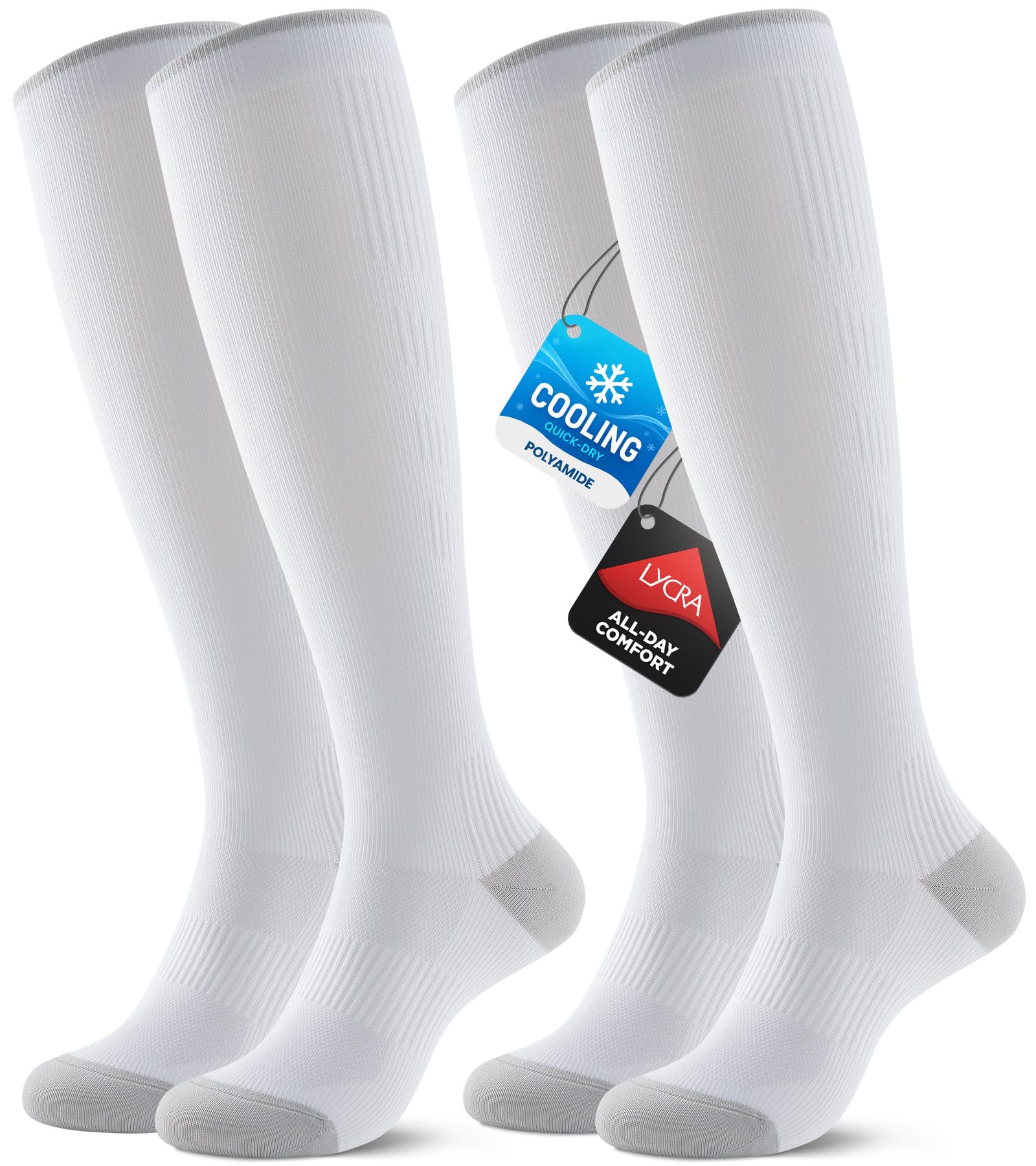
1. Benirap Breathable Compression Socks for Women Men, 20-30 mmHg Knee High
Our pick — over 4.5★ from 500+ verified ratings; the strongest balance of quality and price.
The pair that hits a strong balance of pressure, breathability, and all-day comfort for active legs.
This is the one people reach for when they want serious compression that still feels wearable. At 20-30 mmHg, it delivers 20-30 mmHg compression, compared to the 15-20 mmHg CHARMKING socks, which is the balance for athletes who stand all day, run long, or travel frequently. The feedback is remarkably consistent: owners describe it as “great support and comfort for long hours on feet” and note that it “reduces leg fatigue and swelling” without overheating. The material is light and cooling — buyers report it works “even in the summer” and “doesn’t get too hot,” a major win for anyone who sweats through workouts.
Owners who work long shifts or deal with circulation issues share stories of serious relief: “His feet used to swell up and had rashes on them due to standing most of the day but these fixed all his problems faster than any cream ever could.” That is the real-world proof that graduated compression at this level can make a tangible difference. The 3.94 x 3.94 x 0.79 inch package is compact enough to throw in a gym bag or carry-on, and at 3.53 ounces for the pair, you barely notice them when they are on.
What athletes love
- Firm 20-30 mmHg compression that reduces swelling without turning your legs into sausages
- Breathable and cooling enough for summer workouts, as confirmed by multiple owners
- Easy to pull on and off — a real relief at this pressure level
The honest trade-off
- Only 2 pairs per pack, so you will need to reorder more often if you wear them daily
- Not much data on long-term durability after many washes yet, given the recent launch
The pick if you want: A single pair that actually does the job of serious compression — breathable enough for hot days, firm enough for recovery, and backed by a 4.8-star crowd consensus.
Think twice if: You need a massive multi-pack or the absolute cheapest option per sock; the value here is in quality, not quantity.
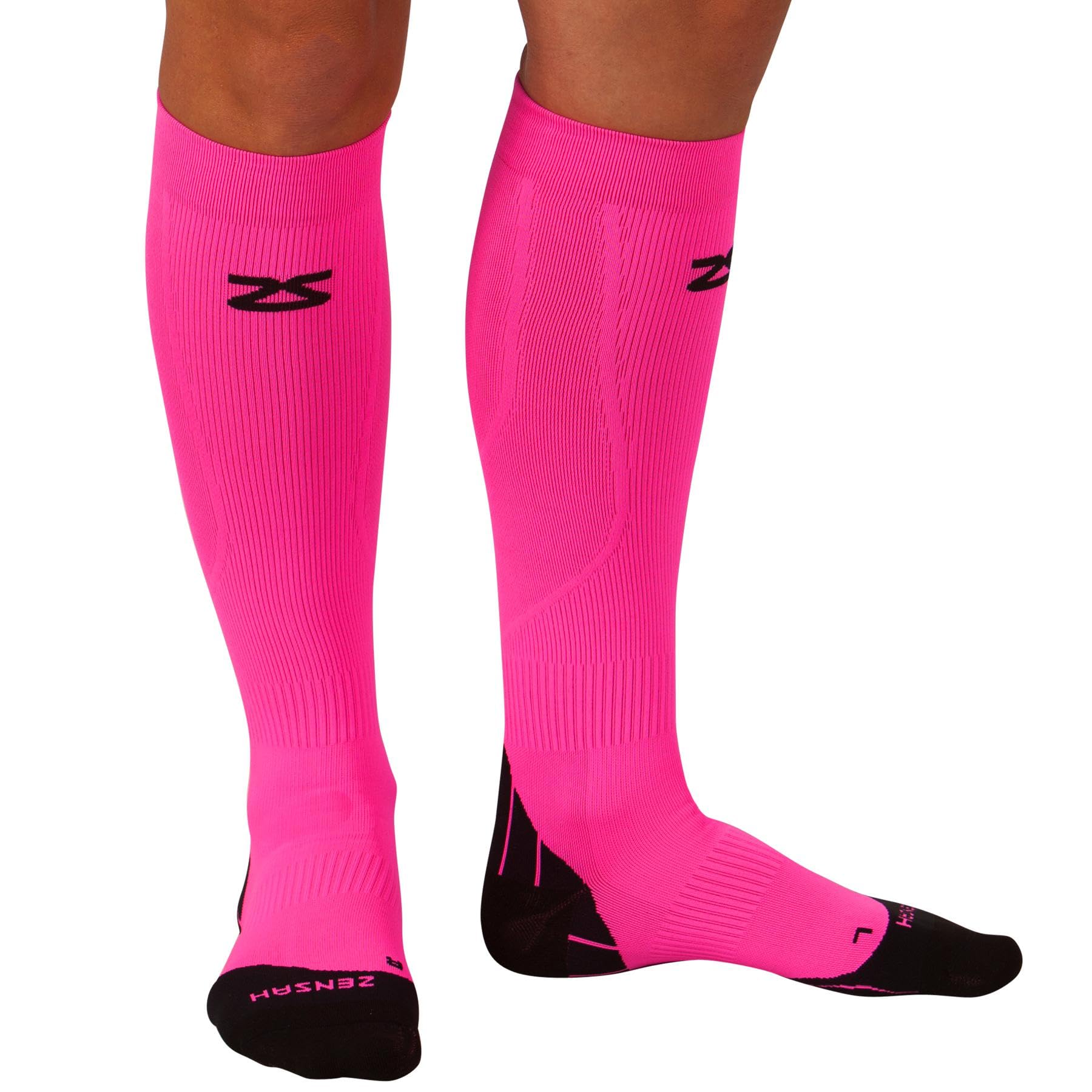
2. Zensah Tech+ Compression Socks – Knee High Running Socks
The gold standard for runners who want to prevent shin splints and keep their legs fresh mile after mile.
If you struggle with shin splints, calf cramps, or just want the best possible recovery sock, this is the one. Zensah uses a 200 needle count construction — a measure of how densely the fabric is knitted — which makes the sock more durable and precise in where it applies pressure. The graduated compression is strongest at the ankle and eases up toward the calf, exactly what you need to push blood back to your heart. The fabric is 82% polyamide and 18% elastane, which makes it lightweight, moisture-wicking, and thermal-regulating. Owners say it “prevents blisters on runs 5+ miles” and keeps feet warm even in subfreezing temperatures. The smooth toe prevents chafing, and the anatomical fit (left and right specific) ensures it hugs each foot properly. The consensus among serious runners is loud: “no other socks even compare” for preventing shin splints.
But the durability backs it up — owners note the socks have “no holes after ~100 runs” and last up to 6 months with lots of wear. The main drawbacks are a narrower top band than previous versions (which can dig in if not adjusted right) and the fact that they are difficult to get on at first, which owners say a provided technique quickly solves. The single-pair format means you will pay more per sock, but for a runner who logs serious weekly mileage, the performance difference is immediate.
Built for distance: This is not an everyday casual sock — it is a targeted performance tool for athletes who know they need shin support and are willing to pay for it. The 4.5-star average across a passionate crowd says the relief is real.
Watch for: The top band change is a recurring note — make sure you position it correctly above your calf muscle, not across the widest part, to avoid digging.
Reach for this if: Shin splints or calf cramps are holding back your running — this sock was designed specifically to address that problem and does so better than almost anything else.
Pass if: You just need mild compression for walking or casual use; the price and pull-on effort are not worth it for light duty.
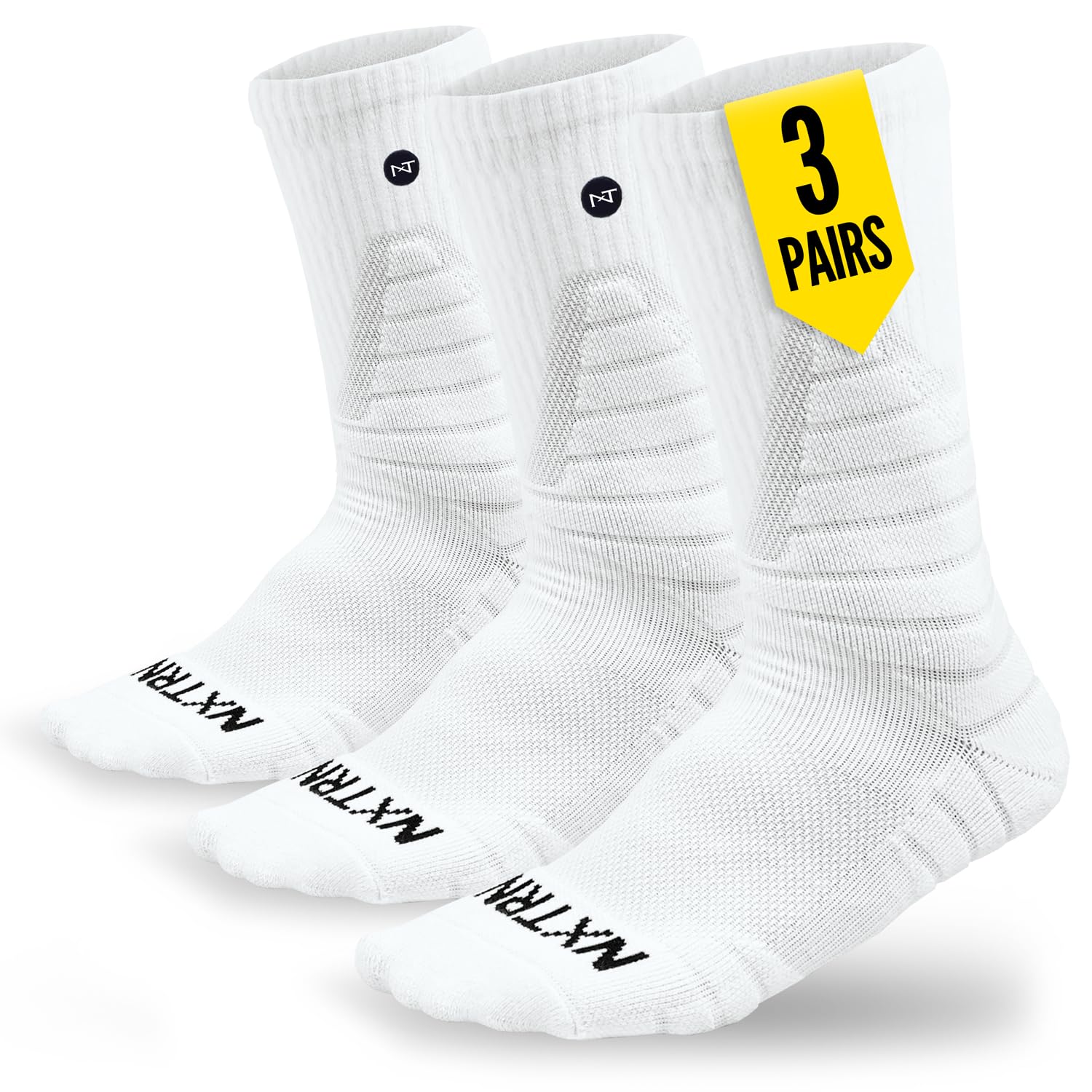
3. NXTRND 3 Pairs Compression Sports Crew Socks for Men
The one your son wants for game day — sturdy padding, team colors, and compression that stays tight all season.
NXTRND is not messing around with vague marketing. The product page jumps straight into compression, ankle padding, soft cushioning, and arch support — the four pillars a football or basketball player actually cares about. The 4.6-star average across 278 ratings tells you owners agree. Buyers specifically mention the “extra padding in the heel and ankle” as a standout feature, calling it “great for my son to play football in” and noting that the socks are “tight but comfortable” and “stay put” through games and washes. The 3-pack format makes it easy to rotate through a week of practices.
The honest trade-off is sizing: owners say the socks “run a bit small” and a size 12 foot in the L/XL (which fits 10-14) was “slightly difficult to get on.” That is common for compression gear — the tightness is intentional — but if your feet are at the upper edge of the size range, you may find the pull-on effort annoying. One owner also found them “slightly overpriced” compared to similar products, though the overall consensus is that the quality justifies the cost. The lack of a stated mmHg compression level means you are trusting the brand’s engineering rather than a number, but the results speak for themselves.
For game-day warriors: If your sport involves cleats, hard cuts, and constant impact, the padding here makes a real difference. The durability is proven — no holes after months of use.
The fit note: Heel and ankle cushioning makes them snug in shoes; if you wear a narrow shoe, try them on before committing to a full rotation.
Pick this for: Any field or court sport where extra padding in the heel and ankle is as important as compression. The colors let you match team gear easily.
Consider alternatives if: You need a stated mmHg compression level for medical confidence or you have very large calves that need a wider top band.
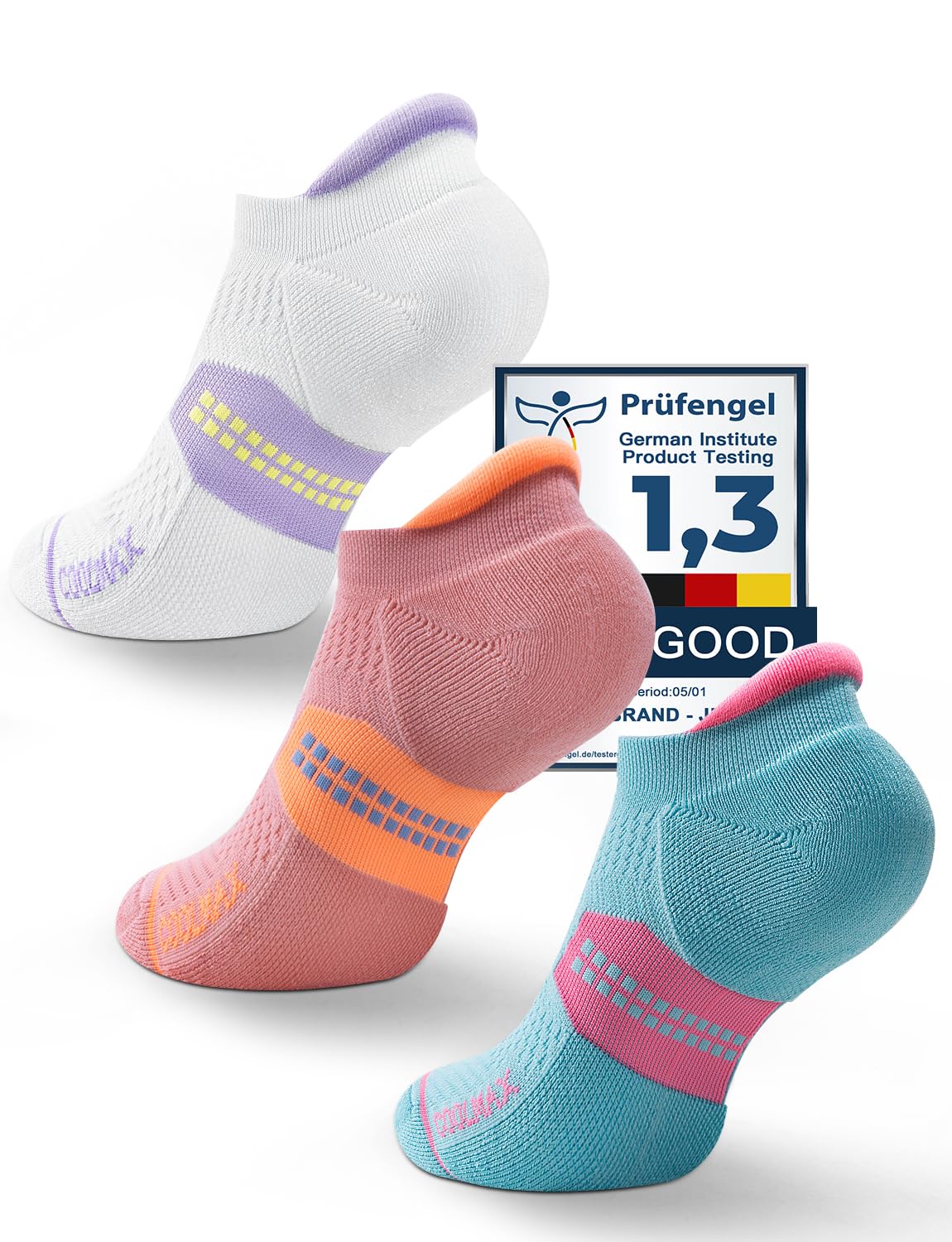
4. Juclise Women’s Coolmax Bamboo Viscose Compression Running No Show Athletic Socks
A no-show compression sock that actually stays on your foot and keeps blisters away — a rare combination.
Most no-show socks are a compromise: they either slide down into your shoe or offer zero support. Juclise solves both with a thoughtful design. The 15-20 mmHg compression level is entry-level firm — enough to reduce foot fatigue without feeling like a medical device. The big innovation here is the handcrafted smooth toe, which owners mention allows them to “bid farewell to blisters” on runs. The breathable mesh panel across the instep keeps feet cool and dry, and the left-and-right-specific fit means each sock is contoured to the foot it belongs on. The 2026 upgrade features enhanced Achilles cushioning for impact protection, which makes it especially nice for runners who heel-strike. The crowd consensus calls it “great quality, comfortable, and well-fitting,” with quality and comfort the most shouted-out aspects.
Compared to the Benirap, which offers stronger compression (20-30 mmHg) for half the size, this is a milder squeeze, making it better for everyday training volume rather than recovery days. The fact that it is a women-specific sock (by design) and comes in a single-pair format means you will pay more per sock than the CHARMKING 8-pack, but the fit precision and no-show profile make it a specialty item for runners who hate bulky crew socks. The biggest practical benefit: “they don’t slide into your shoes” and “the don’t fall down in the back.”
Best for women runners who want the benefits of compression without the high crew sock look. The 15-20 mmHg pressure is mild enough for daily use but noticeable enough to support the arch and reduce foot fatigue during longer runs.
Grab these if: You run in low-cut shoes and need a sock that stays put. The smooth toe and breathable mesh make it ideal for warm-weather training.
Skip if: You need higher compression (20+ mmHg) for recovery or travel, or if a crew/knee-high length is what you prefer for calf coverage.
5. CHARMKING Compression Socks for Women & Men Circulation (8 Pairs)

The eight-pack that stocks your drawer with comfortable everyday compression at the lowest per-pair cost.
If you are just starting with compression socks or you need a week’s worth of pairs to rotate through without thinking, this is the obvious answer. At 8 pairs with 15-20 mmHg compression, it offers 8 pairs compared to the Benirap 2-pack, making it the undeniable value champion. But value does not mean junk — the crowd of over 89,000 ratings gives it a 4.5-star average, with fit being the most praised aspect at over 5,400 mentions. Owners highlight that it is “not too tight but great support,” and that the socks stay in place and do not roll down. The compression is on the milder end, which makes them easy to pull on and wear all day — ideal for cycling, casual runs, or standing on concrete at work. The variety of colors and patterns is a nice bonus.
Here is the honest fit note: some owners with shoe sizes like 11.5 find “the sock sole is slightly short,” and the socks can be “very tight and a bit difficult to get on.” The 15-20 mmHg pressure also means this is not going to deliver the same recovery benefit as the stronger Benirap or Zensah options. For taller users, the knee-high length is generous — one owner noted they are “too long for short legs but still usable.” The bottom line: this is a comfortable, everyday sock that offers light to moderate compression at a price that makes stocking a drawer easy.
The value is undeniable: 8 pairs for the price of 1-2 premium pairs. If you just want compression socks that work for daily activity and don’t demand a huge upfront cost, start here.
Best for: Athletes on a budget who wear compression socks daily and want a fresh pair every workout without hand-washing each night.
Not for: Anyone who needs 20+ mmHg compression for medical recovery or serious shin support — the mild squeeze here is more about comfort than therapy.
6. Compression Sport Running Socks: Athletic Crew Socks for Men Women Cycling Hiking Basketball Work, 3 Pairs (TENYSAF)
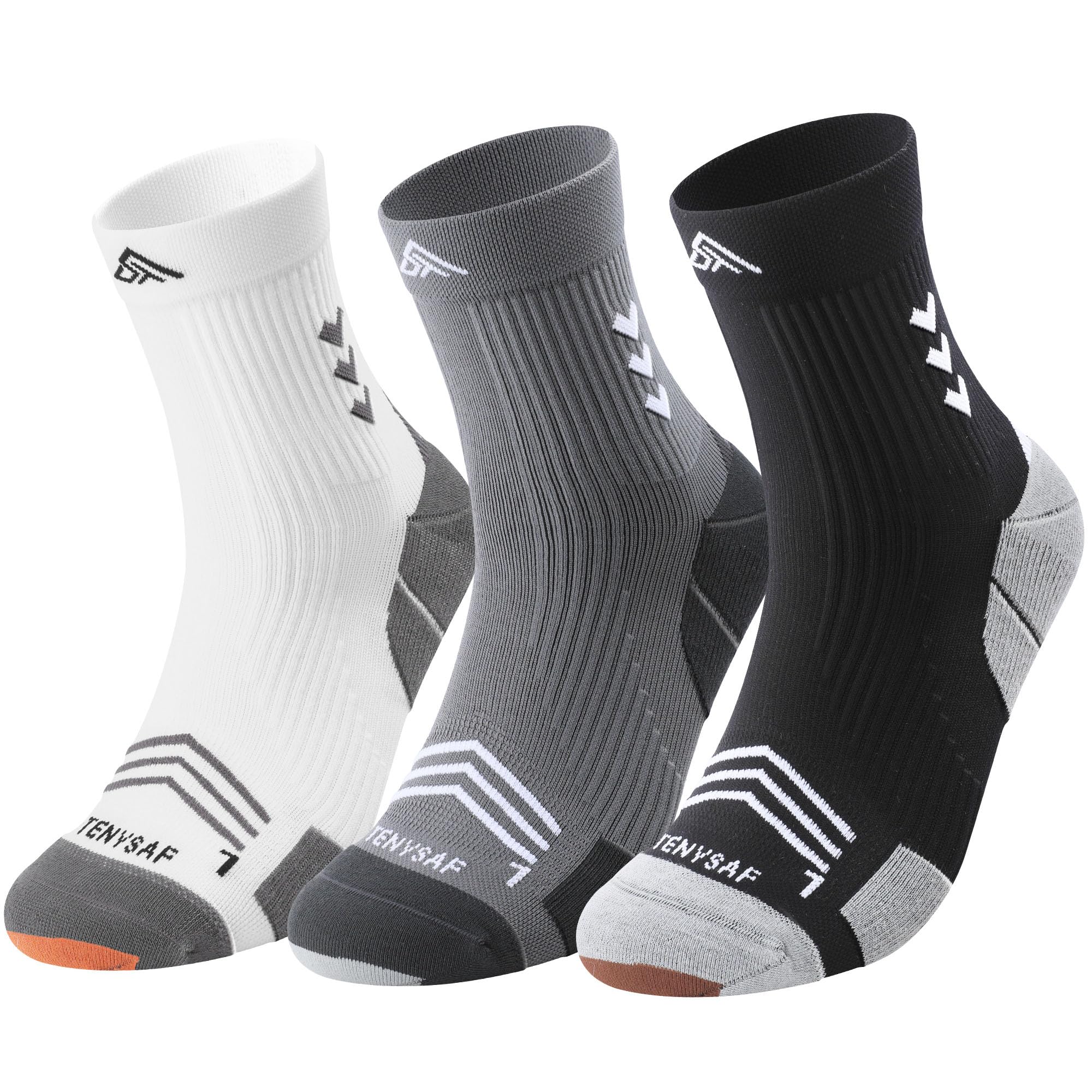
A 3-pack designed for sports-specific needs — and one of the few that truly fits size 12 feet.
The first thing you notice is that owners with big feet are the loudest cheerleaders here: “Fit a men’s size 12 well whereas many socks can be too small.” That alone makes it a standout in a category where many compression socks stop at size 10. TENYSAF built these for cycling, hiking, and basketball specifically, with left-and-right-specific fit, smooth toe construction, and arch support baked in. The 4.5-star average across 383 ratings and the top positive aspect being quality (36 mentions) suggests the construction is solid. Owners call them “firm and snug fit, but not restrictive” and praise the arch support as “excellent.” The 3-pack format gives you a solid week rotation while staying affordable.
The honest caveat is durability: while most owners find them long-lasting, a couple of 3-star reviews note fraying after a single 12-hour wear. The fit through the toe area has also been described as “a little large,” which could lead to bunching in a tight cycling shoe. The compression level is not published in mmHg, so you are trusting the “10-15” gradient implied by the product description rather than a certified number. For the price of 3 pairs, the value per sock is solid, but if you need verified medical-grade compression or guaranteed durability for ultra-marathon training, the Zensah is a safer bet.
The big-foot special: If you wear size 12-16 and have struggled to find compression socks that actually fit, this 3-pack is probably the best discovery you will make this season.
Sized right for: Athletes with larger feet (up to size 16) who cycle, hike, or run and need a supportive sock that does not constrict the toes.
Consider carefully if: You need maximum durability for daily heavy use or a precise mmHg compression rating — those specs are not published here.
7. 6 Pack Copper Compression Socks for Women and Men (Bluemaple)

A six-pack with copper fibers that offers fun colors and decent compression — fit is the catch to nail.
Bluemaple’s angle is copper-infused graduated compression, which adds antimicrobial and odor-resistance benefits to the mix. The 6-pack yields the second-best per-pair value in the list (after CHARMKING’s 8-pack), and the 4.4-star average across 50,000+ ratings tells you most owners are satisfied. The top-lauded aspects are comfort and compression, with over 2,200 mentions each. Owners appreciate that the socks are “easy to get on and off” and do the job of reducing ankle and foot swelling. The colors are bright and cheerful — one owner says “everyone loves my socks.” The graduated compression is strongest at the ankle and gradually decreases, which supports circulation through a 12-hour shift or a long travel day.
The elephant in the room is fit: it is the second most mentioned aspect at over 2,200 mentions, and Amazon flags it as MIXED. The consensus is that this is a solid everyday sock for casual compression, not a medical-grade device. The copper-infused fabric is a nice bonus for odor control but does not replace the need for proper sizing.
Great for travel and nursing shifts: The 6-pack covers your whole week and the copper helps keep them fresh between washes. Just be honest about your size and consider sizing up if you are between sizes.
Pick these if: You want a colorful, affordable 6-pack for everyday mild compression, and you value odor-control properties from copper fibers.
Look elsewhere if: You specifically need 20-30 mmHg or higher compression for serious athletic recovery — some owners find the squeeze here too mild.
8. CompressionZ 30-40 mmHg Compression Socks for Women & Men

The firmest squeeze on the list — 30-40 mmHg meant for serious recovery, travel, or managing swelling.
This is the pair you choose when 15-20 or 20-30 mmHg is not enough. CompressionZ dials the pressure up to 30-40 mmHg, which is typically used for medical-grade support after surgery, during long-haul flights, or for athletes dealing with significant edema. The nylon/spandex blend is reinforced at the heel and toe for durability, and the brand says the sock retains its shape after multiple washes. The crowd over 440 ratings gives it a 4.1-star average, with compression and quality being the top praised aspects. Owners say it “effectively compresses calves and ankles” and “reduces swelling and pain of vein disease.” If you need heavy-duty squeeze, this is the cheapest entry point on the list for that specific feature set.
Here is what you need to know: the higher the compression, the harder the sock is to get on. Owners describe the effort as “difficult to put on but effective” — a sign it is working. The fit feedback is mixed; while the top aspect is compression (51 mentions), fit is the most-discussed aspect at 55 mentions and is labeled MIXED. Some owners find the forefoot and toes tight after a long day, and one noted the top band is “too tight for large knees.” This is not a casual sock — it is a tool for a specific purpose. If you do not need 30-40 mmHg, the Benirap or Zensah will be much more comfortable.
Targeted for heavy duty: If you have a flight longer than 6 hours, post-surgical recovery, or persistent leg swelling, this level of graduated compression delivers results that lower mmHg socks cannot match.
Choose this for: High-compression needs where 30-40 mmHg is the actual target — travel recovery, post-surgical support, or managing chronic swelling in the lower legs.
Avoid if: You have difficulty putting on tight socks, have large calves or knees, or only need light compression for daily training — you will regret the effort-to-benefit ratio.
9. Apolla The Performance Compression Crew Socks for Men & Women, 20-30 mmHg
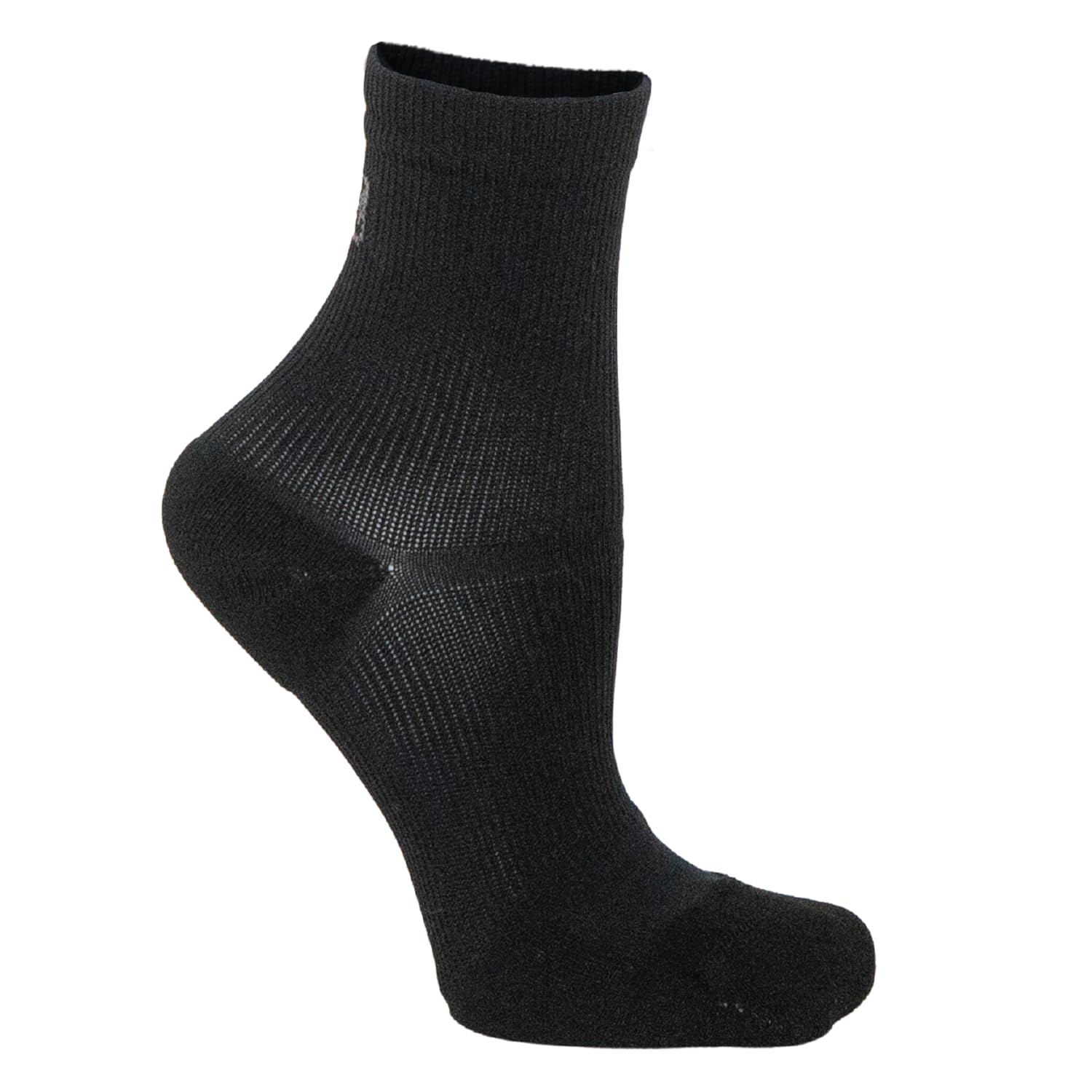
A premium, APMA-recommended sock from Shark Tank that focuses on arch support and ankle stability — but sizing requires patience.
This is the most premium-feeling pick on the list. Apolla’s Performance Crew is made in the USA from REPREVE-certified sustainable yarns and carries the American Podiatric Medical Association Seal of Acceptance — meaning it has passed podiatrist review for foot health. The 20-30 mmHg graduated compression is targeted to provide arch support and ankle stability, and the company describes it as a “sock combined with a shoe.” The design is anatomically correct: each sock is marked L or R to indicate the correct foot. Owners who find the right fit report “no more pain” and say the socks “helped with recovery after long days on my feet.”
The catch is severe and worth stating plainly: fit is the most debated aspect (42 mentions) and is labeled MIXED, while value for money is the top NEGATIVE aspect at 33 mentions. Numerous owners describe them as “too tight,” “way too expensive,” and “impossible to get on,” with one buyer noting they “cracked a sock helper” trying. If you get the sizing right, the support is exceptional. If you get it wrong, you are out a significant amount and frustrated. The 3.7-star average across 614 ratings is the lowest on this list, driven almost entirely by fit complaints and the high price point. For the same or less money, the Zensah offers more consistent satisfaction among athletes.
High risk, high reward: When Apolla fits, it rivals any sock for arch and ankle support. When it does not, the return process is your only salvage. Follow their size chart down to the millimeter and consider going up a size if you have wide feet.
Perfect for: Athletes with medium-to-narrow feet who want a US-made, sustainable sock with podiatrist backing and extremely precise arch wraps.
Skip if: You have wide feet, large calves, or low patience for tricky sizing — the odds of the fit being wrong are too high for this price level.
Understanding the Specs
Graduated Compression (mmHg)
Think of this as pressure measured from your ankle up. Graduated compression is strongest at the ankle and gradually decreases as it moves up your calf. That design pushes blood back toward your heart, reducing swelling and muscle fatigue. The scale goes from mild (15-20 mmHg) which is good for daily training and travel, to firm (20-30 mmHg) which is the balance for most athletes, to medical-grade (30-40 mmHg) for serious recovery or managing edema. Higher mmHg is always harder to pull on — that tightness is a feature, not a defect. If you have never worn compression socks before, start at the lower end so you are not overwhelmed by the squeeze.
Fabric Blend & Moisture Wicking
The material determines whether your feet stay dry or end up soaked by mile three. Nylon and spandex blends are the most common — they stretch well, hold their shape, and dry fast. Polyamide and elastane (what Zensah uses) offer similar performance with extra durability from a higher 200 needle count. Coolmax and bamboo-based viscose (like Juclise uses) add natural moisture-wicking and temperature regulation, great for hot-weather runs. Copper-infused fibers add antimicrobial properties that help with odor. A smooth toe closure is critical for athletes because it prevents the friction that causes blisters on long runs. If you run hot or live in a humid climate, prioritize mesh ventilation panels or natural fiber blends over pure synthetic materials.
FAQ
What compression level (mmHg) do athletes need for running and recovery?
How tight should my compression socks feel when I first put them on?
Can I wear compression socks for all-day use or just during workouts?
How do I know if I am buying the right size compression socks?
Do compression socks actually prevent shin splints?
What is the difference between graduated compression and uniform compression?
How long do compression socks typically last before they lose their elasticity?
Can I wear compression socks on a long flight or car ride?
Apolla socks are expensive — are they actually worth the price?
What does “copper-infused” do for compression socks?
Final Thoughts: The Verdict
For most athletes, the compression socks for athletes winner is the Benirap Breathable Compression Socks because the 20-30 mmHg compression level hits the balance between serious recovery and all-day comfort, and owners consistently describe them as cooling, easy to pull on, and genuinely effective at reducing leg fatigue. If you are a runner who battles shin splints, grab the Zensah Tech+ Compression Socks — the 200 needle count construction and targeted shin support make it a proven weapon against that specific pain. And for the budget-conscious athlete who wants a week’s worth of pairs without sacrificing quality, the CHARMKING 8-Pack delivers comfortable 15-20 mmHg compression at the lowest per-pair cost on this list, backed by a massive crowd of satisfied owners.
How We Picked
We do not accept paid placement. Every pick is matched to a real buyer and a real use-case; we do not hands-on test units.
Sources & Methodology
Specifications: manufacturer listings and product documentation. Review insights: verified customer reviews, as of July 2026. Pricing: not shown on this page (it changes often); check the current price via the retailer link.
As an Amazon Associate, WellFizz earns from qualifying purchases. This does not affect which products we feature.
Related Guides

Mo Maruf
I created WellFizz to bridge the gap between vague wellness advice and actionable solutions. My mission is simple: to decode the research and give you practical tools you can actually use.
Beyond the data, I am a passionate traveler. I believe that stepping away from the screen to explore new environments is essential for mental clarity and physical vitality.