Our readers keep the lights on and my smoothie glass nicely filled. As an Amazon Associate, I earn from qualifying purchases.
Specs are compiled from manufacturer listings and verified buyer reviews and can change over time — please confirm the key details on the product page before buying.
Picking the right microphone for your stream is the single fastest way to sound like a pro instead of a hollow robot. The wrong mic picks up every keyboard clack, dog bark, and AC rumble — the right one makes your voice sound warm, present, and broadcast-ready the moment you hit “Go Live.” This guide breaks down the nine best condenser mics for streaming, comparing their real-world strengths so you know exactly which one belongs on your desk.
I’m Mohammad Maruf — the founder and writer behind WellFizz. This guide is built by comparing the manufacturers’ published specifications and the patterns across verified customer reviews, so you get each pick’s real strengths and trade-offs instead of marketing spin.
Whether you are upgrading from a headset or building your first serious streaming setup, the best course is to focus on how each mic handles background noise, the ease of its controls, and the clarity it delivers for your voice. That is exactly what this rundown of the best condenser mic for streaming covers, with honest verdicts for every budget and style.
Our Picks at a Glance


How To Choose The Best Condenser Mic For Streaming
A condenser mic is the standard for streaming because it captures the subtle highs and warmth of a human voice better than a dynamic mic. But not every condenser is built the same, so knowing what to look for makes the difference between sounding like a pro and fighting background noise all night.
The Polar Pattern — Your Room’s Best Filter
The polar pattern is the shape of the mic’s pickup zone. A cardioid pattern (heart-shaped) is the default for a reason: it captures sound from the front and rejects noise from the back and sides. That means your mechanical keyboard, a fan, or your roommate’s TV stays out of the broadcast. Some mics offer multiple patterns (omnidirectional, bidirectional, stereo) for recording different setups like two-person podcasts or instruments.
USB vs XLR — The Simplicity vs Upgradability Trade-Off
A USB condenser mic plugs directly into your computer — no extra gear required, instant plug-and-play. An XLR condenser mic needs an audio interface or mixer to connect to your PC, which adds cost and complexity. The upside of XLR is the potential for cleaner gain staging, a wider choice of preamps, and the ability to swap out components later. For most new streamers, a good USB mic delivers professional results without the extra hardware.
Onboard Controls — Your Lifeline Mid-Stream
Physical controls you can reach without fumbling through software matter a lot when you are live. A tap-to-mute button, a gain dial, and a headphone jack for zero-latency monitoring are the trifecta of streaming convenience. These features let you adjust your levels, mute a cough, or hear exactly what your audience hears — all without alt-tabbing out of your game.
Quick Comparison
| Model | Best For | Polar Pattern | Connection | Onboard Controls | Amazon |
|---|---|---|---|---|---|
| HyperX QuadCast★ Best Overall | Versatile streaming | 4 selectable | USB | Gain, mute, headphone jack | Amazon |
| Razer Seiren V2 XCompact Pick | Compact noise rejection | Supercardioid | USB | Gain, mute, monitoring | Amazon |
| Blue EmberBest Value XLR | Pro XLR at a value | Cardioid | XLR | None (requires mixer) | Amazon |
| Blue Yeti | Entry-level all-rounder | 4 selectable | USB | Gain, mute, headphone volume | Amazon |
| Sennheiser Profile | Natural vocal warmth | Cardioid | USB | Gain, mute, mix, headphone jack | Amazon |
| Blue Spark SL | Warm XLR vocals | Cardioid | XLR | None (requires mixer) | Amazon |
| RØDE NT1 Signature | Studio-grade silence | Cardioid | XLR | None (requires mixer) | Amazon |
| Audio-Technica AT2020USB-X | Clean USB studio sound | Cardioid | USB | Capacitive mute, headphone jack | Amazon |
| Elgato Wave:3 MK.2 | Onboard DSP convenience | Cardioid | USB | Dial, tap-to-mute, headphone jack | Amazon |
In‑Depth Reviews
1. HyperX QuadCast — USB Condenser Gaming Microphone
Our pick — over 4.5★ from 35,500+ verified ratings; the strongest balance of quality and price.
The crowd favorite that covers every streaming scenario — and survived a drop, still talking.
The HyperX QuadCast earns the top spot because it delivers broadcast-ready sound with a feature set that feels complete. You get your choice of four polar patterns (stereo, omnidirectional, cardioid, and bidirectional), so the same mic handles solo streaming, two-person podcasts, and even recording instruments without swapping hardware. The built-in anti-vibration shock mount uses an elastic rope suspension to isolate the mic from desk bumps and accidental knocks — a real safety net when you are mid-broadcast and your elbow hits the table. Owners consistently praise the crisp, clear audio and the plug-and-play simplicity, with some calling it a “9.7/10” even after a year of daily use. The internal pop filter blocks plosive sounds (those hard “p” and “b” bursts), and the headphone jack lets you monitor your own voice with zero latency.
The tap-to-mute sensor is a standout live-streaming tool: one tap on the top of the mic, and the LED ring goes dark to confirm you are muted. The red lighting is eye-catching, though a few owners note it can be bright in a dark room, and after extended use the glow has been known to dim slightly. At its price, the QuadCast rivals mics that cost significantly more, thanks to its metal construction and support for both 3/8-inch and 5/8-inch threaded setups for boom arms. The bundle includes a sturdy mini-USB cable and a mic-arm adapter, so you are ready to mount it the way you prefer.
Streamer’s choice: The combination of four polar patterns, a built-in shock mount, and tap-to-mute makes this the most versatile USB mic for streamers who want one tool for every show format. The obvious trade-off is the red glow — it can clash with a blue or white RGB setup, and a few owners wish for the RGB version instead.
Who this fits: A streamer or podcaster who wants a single, durable USB mic that works for solo and multi-person recording without buying extra gear.
The one catch: The red LED stays on when the mic is active, so it may not fit everyone’s desk aesthetic — and the pop filter is helpful but not as effective as a dedicated external one for heavy plosives.
2. Razer Seiren V2 X — USB Condenser Microphone
A tiny box that pushes out huge clarity and keeps your keyboard clicks out of the stream.
The Razer Seiren V2 X is built around a 25mm condenser capsule that punches well above its physical size. Its defining feature is the supercardioid pickup pattern — a tighter version of cardioid that is even more aggressive about rejecting noise from the sides and rear. That means a mechanical keyboard sitting next to the mic is barely audible to your viewers, and a loud room fan behind you stays silent. The integrated digital limiter is a safety net that automatically prevents audio clipping when you get excited and raise your voice. Owners often highlight how much of a step up it is from a headset mic, and one owner summed it up: “Good quality, excellent sound, easy to use. It definitely is a directional mic so be mindful.”
The body is plastic, which keeps the weight low on a boom arm, and it connects via USB-C with a longer cable than its predecessor. The front-mounted gain control and mute button are easy to reach without looking. The built-in shock absorber handles table bumps, and the headphone monitoring jack lets you hear your feed in real time. Compared to the larger HyperX QuadCast, the Seiren V2 X is physically smaller and lighter, making it an easier fit for tight desk spaces, though it lacks the multi-pattern versatility of the QuadCast.
Noise-first design: The supercardioid pattern and digital limiter make this the best choice for a streamer in a less-than-silent room who wants to minimize background noise without expensive sound treatment. The trade-off is that you must speak directly into the top of the mic for optimal performance — veer off-axis, and your voice thins out.
Best for: A gamer or streamer who needs a compact, low-profile mic that actively ignores keyboard and fan noise while keeping setup simple.
Consider instead if: You need multiple polar patterns for different recording scenarios (like two-person podcasts) — this mic only offers the one supercardioid pattern.
3. Blue Ember — XLR Condenser Microphone
A slim XLR powerhouse that makes your voice sound like a million bucks for under a hundred.
The Blue Ember is an XLR condenser mic that punches far above its price point, delivering what many owners call “professional sound for the price.” Its custom Blue condenser capsule produces open, accurate sound with impressive headroom, meaning you can speak or sing with energy without distortion. The precise cardioid pattern focuses on your voice and minimizes room reflections. One review summed the studio appeal: “Great cardioid pattern with adjustable gain for ambient noise rejection; requires 2-4 inches from mouth.” The slim, all-metal body is designed to stay out of your camera frame — it measures 1.5 inches wide and 8.62 inches tall — which is a big plus for streamers who want a clean visual shot.
Because it is XLR, you will need an audio interface or mixer (like a Focusrite Scarlett or GoXLR) to power and connect it to your computer. The Ember does not come with an XLR cable, so factor that into your budget. It also lacks a built-in shock mount in the box (you get a mic stand mount), though many owners find it works well enough on a boom arm without one. Its “slightly dark tone” is a theme in owner feedback — it is not a bright, scooped sound but rather a warm, thick voice that some find ideal for vocals and voiceover work. For a streamer ready to step into the XLR world, this is the smartest entry point.
Value benchmark: At this price, the Ember competes with USB mics that cost more, offering XLR-grade detail and flexibility for anyone who already owns or plans to buy an interface. The main adjustment is learning to stay 2-4 inches from the capsule for the best balance of proximity and clarity.
Reach for this if: You want XLR-level audio quality on a budget and already have an audio interface (or are ready to buy one).
The do-not-reach-for: If you want a standalone USB mic with no extra gear, look at USB options like the HyperX QuadCast or the Audio-Technica AT2020USB-X instead.
4. Logitech Creators Blue Yeti — USB Microphone

The USB mic that practically defined entry-level streaming — a three-capsule array for any situation.
The Blue Yeti is a legend in the streaming world for good reason: its custom three-capsule array lets you switch between four polar patterns (cardioid, omnidirectional, bidirectional, and stereo) by turning a single dial. That means you can record a solo podcast in cardioid mode, then switch to omnidirectional to capture a roundtable discussion — all with one mic. The sound is clean, broadcast-quality, and notably sturdy for a USB mic. The included Blue VO!CE software adds a layer of polish with effects, advanced modulation, and HD audio samples for streamers who want to add vocal flair. Onboard controls — headphone volume, pattern selection, instant mute, and mic gain — put everything at your fingertips without needing to alt-tab.
The build is heavy-duty metal, which gives it a substantial desk presence but also makes it less portable. The adjustable desktop stand lets you tilt the mic to tune sound pickup. Owners universally praise the Yeti for being easy to set up, and it remains a top choice for first-time streamers. However, its large size can block a monitor if centered on a small desk, and its sensitivity can pick up room noise if the gain is set high. Compared to the more modern Sennheiser Profile, the Yeti is bulkier and requires software for some of its enhanced features, but its multi-pattern versatility is class-leading at this price.
The benchmark for beginners: Four polar patterns and sturdy build quality make the Yeti a go-to for new streamers who want flexibility without spending on multiple mics. The trade-off is its size and weight — it takes up real desk space and is heavy enough to stress a budget boom arm.
Who it is for: A first-time streamer or podcaster who wants a proven, feature-rich USB mic that can handle solo and group recording right from the start.
Who should skip it: If desk space is tight or you prefer a smaller, less obtrusive mic (like the Razer Seiren V2 X), the Yeti’s footprint might be a deal-breaker.
5. Sennheiser Profile — USB Cardioid Condenser Microphone

Sennheiser’s broadcast pedigree in a tiny USB package that sounds natural, not processed.
The Sennheiser Profile is a cardioid condenser USB mic that prioritizes natural vocal warmth over digital trickery. Its German-engineered capsule delivers a smooth, warm sound that accentuates the body and presence of the human voice without sounding thin or tinny. Owners frequently describe it as “near XLR quality” and praise the fact that it requires no software — just plug it in via USB-C and your computer recognizes it as a standard USB audio device. This simplicity is a huge advantage for streamers who have had bad experiences with buggy audio software. The onboard controls include a gain dial, a headphone volume dial, a mute button that changes color, and a mix control that blends your desktop audio with your mic feed — all accessible without opening a single app.
The Profile’s body is made of metal, giving it a premium feel while still being compact enough (4.37 x 4.37 x 7.95 inches) to fit on a cluttered desk. It comes with a table stand that is practical for desktop use, though many owners recommend a mic arm for better positioning. Compared to the Blue Yeti, the Profile is notably smaller and lighter, and its sound is more neutral — it does not add the bass emphasis that some mics do. The one reported issue is a Windows 11 compatibility hiccup that was resolved by Sennheiser support (a simple setting adjustment). Overall, this is a mic for streamers who want high-quality audio without fighting software.
Software-free purity: The zero-dependency approach (no drivers, no apps) makes this a low-maintenance mic that works across Mac and PC. The catch is that you lose the advanced DSP effects and EQ that software-based mics like the Elgato Wave:3 offer.
Best for: A streamer who values simplicity, natural sound, and a plug-and-play experience without ever touching a configuration panel.
Not for: Anyone who wants built-in vocal effects, compression, or noise gate features without buying separate software.
6. Blue Blackout Spark SL — XLR Condenser Microphone

A warm, broadcast-ready XLR mic that gives your voice that “radio announcer” depth.
The Blue Blackout Spark SL is a large-diaphragm condenser microphone that delivers a distinctly warm, full-bodied sound — what owners describe as a “radio-announcer” tone. Its custom Blue condenser capsule captures focused, transparent sound with excellent detail, and the cardioid pattern keeps background noise to a minimum. The Spark SL includes professional-grade extras that are rare at this price: a 100Hz high-pass filter (which cuts low-end rumble from AC units or desk vibrations) and a -20dB pad (which reduces gain for loud sound sources). Both features give you more control when recording. It also comes with a custom shock mount and a wooden storage box, making it feel like a premium studio tool from the moment you open the package.
This is an XLR mic, so you need an audio interface with 48v phantom power to run it. The Class-A JFET electronics inside the Spark SL are designed to provide studio-quality sound with rich harmonic detail. Owners praise its performance with low and mid-toned voices, making it a great match for streamers and podcasters with deeper vocal ranges. One owner noted it is “perfect for eliminating post-processing” — you can record straight to edit without heavy EQ work. The main trade-off is that it requires careful positioning due to its narrow pickup window, and the all-metal body is dense (despite being listed at 0.72 pounds). For streamers looking to graduate from USB mics, this offers a noticeable step up in vocal warmth.
Vocal warmth specialist: The combination of a large diaphragm, high-pass filter, and Class-A electronics makes this ideal for voices that need depth and presence. The requirement for 48v phantom power and a mixer is the barrier to entry, but the results are worth it for serious broadcasters.
Reach for this if: You have an XLR setup and want a mic that gives your voice a rich, “radio” quality without heavy post-processing.
The catch: Its narrow pickup window means you must stay centered on the capsule, and the metal body is dense enough that it may weigh down a budget boom arm.
7. RØDE NT1 Signature Series — Large-Diaphragm Condenser Microphone

The world’s quietest studio condenser — a 4 dBA noise floor that is practically silent.
The RØDE NT1 Signature Series is built around an HF6 1-inch true condenser capsule, and its headline spec is a 4 dBA self-noise rating — widely considered the quietest in its class. That means the mic adds almost no electronic hiss to your recording, so your voice sounds clean and natural even in quiet passages. The cardioid pattern focuses on your voice and rejects room reflections, and the high SPL handling (up to 142 dB SPL) means you can record loud vocals or instruments without distortion. This is an XLR microphone, so you need an audio interface, but it includes a studio-grade SM6 shock mount, a pop filter, and a premium 6-meter XLR cable right in the box — everything you need to get started.
The build is metal and crafted in RØDE’s precision facilities in Sydney, Australia, backed by a 10-year warranty. Owners often describe the sound as “incredibly clear and natural” with “precise detail.” It handles less-than-ideal room conditions well; one owner noted it handles AC and fan noise effectively when paired with a foam filter and software plugin. Compared to the Blue Ember or Spark SL, the NT1 is a clear step up in noise performance and included accessories — the shock mount and pop filter alone are worth a significant portion of the price. The main downside is that its high sensitivity means it will pick up every little noise in a quiet room, so some sound treatment is recommended. It is heavier than the Ember, but the included shock mount handles most vibrations.
Noise floor champion: The 4 dBA self-noise is the standout spec here, making this the best choice for a streamer who records in a silent room and wants zero background hiss. The 10-year warranty is a rare confidence marker for a long-term investment.
Best for: A serious streamer or podcaster who wants studio-grade silence, a premium build, and the complete accessory bundle (shock mount, pop filter, XLR cable) in one purchase.
Consider instead if: You need a USB connection — the NT1 is XLR-only, so you will need to own or buy an audio interface.
8. Audio-Technica AT2020USB-X — Cardioid Condenser USB Microphone

A studio-standard name goes USB — 24-bit/96 kHz clarity without the interface.
The Audio-Technica AT2020USB-X takes the legendary AT2020 studio mic and adds a USB connection, making it a plug-and-play option for streamers who want the clarity of a pro mic without buying an interface. The high-resolution AD converter operates at 24-bit/96 kHz sampling rate, which captures extremely clear, natural sound reproduction — especially noticeable in vocals and acoustic instruments. The cardioid pattern minimizes background noise, though owners note it is sensitive enough to pick up furnace vents and PC fans if those are close by. The directional pickup is well-suited for a controlled streaming environment. The included custom desk stand is solid and adjustable, and the USB-C to USB-A cable comes with a USB-A to USB-C adapter for broad compatibility.
On the body, the soft-touch capacitive mute button is a slick feature — just tap it to mute silently, and a two-state LED ring lights blue when active and red when muted. The built-in headphone jack lets you monitor your audio in real time with zero latency. Owners praise the sound quality for both vocals and instruments, with one review calling it “very good mic with clear sound, can handle loud electric guitar without loss.” The build uses stainless steel, which feels premium and heavy. Compared to the Sennheiser Profile, the AT2020USB-X has a slightly higher noise floor (80 decibels) and is more sensitive to environmental sounds, so it works best in a treated or quiet room. The LED ring stays on when the computer is off, which is a minor annoyance for some.
Studio heritage in USB form: The 24-bit/96 kHz resolution and Audio-Technica’s reputation make this a strong choice for streamers who want studio-grade detail without an interface. The trade-off is its sensitivity — it picks up everything in the room, so it rewards a quiet environment.
Best suited for: A streamer or podcaster who already has a quiet room and wants the cleanest USB audio reproduction available without switching to XLR.
Not ideal for: A noisy room with close-by PC fans or a loud keyboard — you will need noise-reduction software to suppress the extra pickup.
9. Elgato Wave:3 MK.2 — USB Condenser Microphone
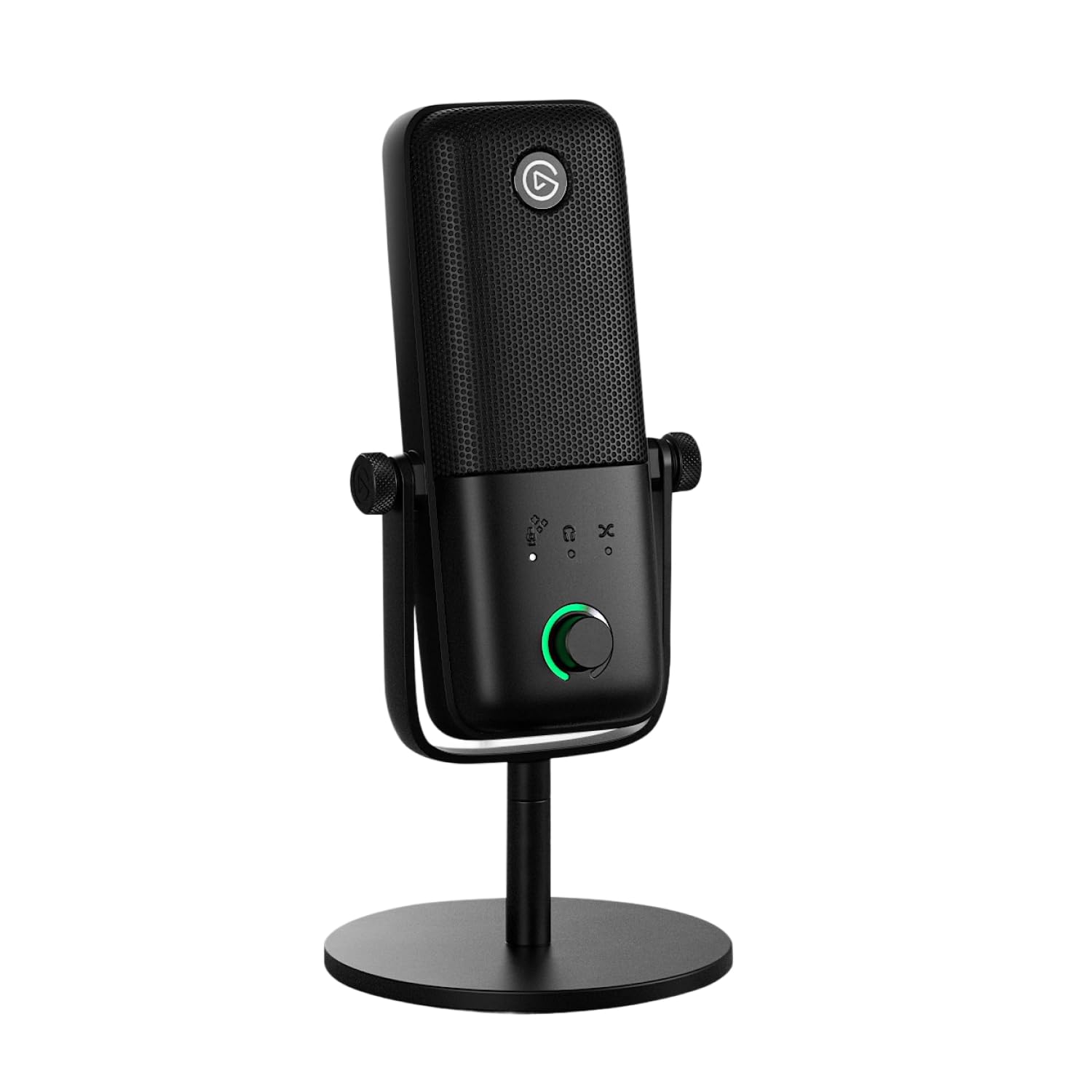
The USB mic that thinks it is a studio mixer — onboard DSP and anti-clipping magic in one.
The Elgato Wave:3 MK.2 is a premium USB condenser mic that packs serious onboard processing power. Its premium condenser capsule delivers focused, studio-quality vocals with a cardioid pattern, and the multi-stage Clipguard 2.0 protection makes audio clipping virtually impossible — even when you shout into it mid-stream. Auto Gain sets your levels perfectly in seconds, taking the guesswork out of calibration. The onboard Wave FX Processor unifies DSP effects (voice enhancer, compressor, EQ) and VST plugins in one signal chain, so you can polish your sound without taxing your computer’s CPU. The Wave Link software is a powerful audio routing tool that owners consistently praise as “intuitive” and “awesome” for its ability to separate audio sources and apply effects.
The multifunction dial and tap-to-mute button give you instant control over volume and muting, with real-time LED feedback. The integrated headphone jack allows zero-latency monitoring. The build is a combination of metal and plastic, giving it a sleek aesthetic, and it connects via USB-C. Buyers report that the sound is “crisp” and that it dramatically reduces background noise, with one comment noting it “delivers outstanding voice clarity, rich and studio-level crispness.” The Wave:3 MK.2 is taller than the Razer Seiren V2 X, and some owners note it can block a monitor if centered on the desk. Compared to the HyperX QuadCast, the Elgato offers superior DSP control but lacks multiple polar patterns — it is cardioid-only. Some reliability concerns exist in the review data, with a small number of units failing after a couple of months.
Streamer-focused features
- Clipguard 2.0 eliminates clipping entirely — a lifesaver for energetic streams.
- Wave Link software gives you pro-level audio routing and effects without a mixer.
- Auto Gain sets your levels automatically, so you never start a stream with bad audio.
Considerations before buying
- Cardioid-only pattern limits multi-person recording without another mic.
- Tall body can block your monitor’s bottom portion if placed on the desk.
- A minority of owners mention units failing after a couple of months of use.
Best for: A streamer who wants software-driven audio control (EQ, compression, noise gate) built right into a USB mic without needing a separate digital mixer.
skip it if: You want a simple, no-software mic like the Sennheiser Profile, or you need multiple polar patterns for podcast-style group recording.
Understanding the Specs
Polar Patterns — How a Mic “Listens”
The polar pattern defines where a microphone picks up sound and where it rejects it. The cardioid pattern (heart-shaped) captures sound from the front and rejects noise from the sides and rear — it is the standard for streaming because it ignores your keyboard and PC fans. A supercardioid pattern is a narrower version that rejects even more side noise but has a small rear pickup lobe. Some mics offer multiple patterns (omnidirectional, bidirectional, stereo), which is useful if you record conversations or instruments with a single mic.
Self-Noise — The Microphone’s Own Hiss
Self-noise is the faint electronic hiss a microphone produces even when no sound is hitting the capsule. It is measured in dBA, and a lower number means a quieter noise floor. For streaming, a self-noise rating of 20 dBA or lower is excellent — you hear only your voice, not a constant background hiss. The RØDE NT1 Signature Series sets a benchmark at 4 dBA, which is practically inaudible. A rating of 16-20 dBA is still very good and will not be noticeable in a live stream.
FAQ
Do I need an audio interface for a condenser mic?
What is phantom power and why does my condenser mic need it?
Is a condenser mic better than a dynamic mic for streaming?
How far should my mouth be from a condenser mic?
What does a pop filter do and do I need one?
Can I use a condenser mic without a boom arm?
Will a condenser mic pick up my keyboard and mouse clicks?
How long do USB condenser mics typically last?
What is the difference between the Blue Yeti and the HyperX QuadCast?
Can I use an XLR condenser mic with a USB audio interface?
Final Thoughts: The Verdict
For most streamers, the best condenser mic for streaming is the HyperX QuadCast because it bundles four polar patterns, a built-in shock mount, and tap-to-mute functionality into a durable metal frame that sounds excellent from the start. If you want a compact mic that aggressively rejects background noise, the Razer Seiren V2 X is the pick. For those ready to step into XLR, the RØDE NT1 Signature Series offers near-silent operation and a complete accessory kit that rivals dedicated studio setups. And if advanced DSP and software control are your priority, the Elgato Wave:3 MK.2 brings a mixer-like experience to a simple USB connection.
How We Picked
We do not accept paid placement. Every pick is matched to a real buyer and a real use-case; we do not hands-on test units.
Sources & Methodology
Specifications: manufacturer listings and product documentation. Review insights: verified customer reviews, as of July 2026. Pricing: not shown on this page (it changes often); check the current price via the retailer link.
As an Amazon Associate, WellFizz earns from qualifying purchases. This does not affect which products we feature.
Related Guides

Mo Maruf
I created WellFizz to bridge the gap between vague wellness advice and actionable solutions. My mission is simple: to decode the research and give you practical tools you can actually use.
Beyond the data, I am a passionate traveler. I believe that stepping away from the screen to explore new environments is essential for mental clarity and physical vitality.