Our readers keep the lights on and my smoothie glass nicely filled. As an Amazon Associate, I earn from qualifying purchases.
Specs are compiled from manufacturer listings and verified buyer reviews and can change over time — please confirm the key details on the product page before buying.
Your legs ache, throb, or feel heavy after standing or sitting for a while — varicose veins do that when blood pools instead of flowing upward. Graduated compression socks are tightest at the ankle and gradually loosen toward the knee, creating a gradient that propels blood upward. The pressure gradient helps veins push blood back toward the heart, counteracting gravity and venous pooling. The medical standard for varicose vein relief is 20–30 mmHg — firm enough to reduce swelling and pain without restricting movement. This guide reviews nine compression socks for varicose veins, detailing why each earns its spot and who it suits best.
I’m Mohammad Maruf, founder of WellFizz. This guide compares manufacturer specs and verified customer reviews to highlight each pick’s real strengths and trade-offs.
Every pick delivers true medical-grade graduated compression of 20–30 mmHg, the level doctors most often recommend for varicose vein relief. if you need an easy-on zipper, a sheer thigh-high, or a budget-friendly three-pack for daily rotation, we have matched you to the right pair of compression socks for varicose veins.
Our Picks at a Glance

How To Choose The Best Compression Socks For Varicose Veins
Match three things: compression level (20–30 mmHg for varicose veins), size based on ankle and calf measurements, and style (knee-high, thigh-high, zippered, or footless) that fits your daily wear. The wrong size or the wrong pressure level means the sock won’t do its job — so measure carefully in the morning before any swelling starts.
Compression Level — Why 20–30 mmHg Is the balance
Over-the-counter mild socks (8–15 mmHg or 15–20 mmHg) help with tired legs or mild swelling from sitting too long, but they do not have enough pressure to push blood out of a bulging varicose vein. That is why 20–30 mmHg is the medical-grade standard — it is firm enough to reduce swelling and improve circulation without cutting off your movement. Anything weaker and you will not get the relief you need; anything stronger (30–40 mmHg or above) usually requires a prescription and fitting from a medical professional.
Graduated Compression — It Matters How It Sits
A true graduated compression sock is tightest at your ankle and gets gradually looser up your calf. This “gradient” design is what physically propels blood upward, counteracting gravity and venous pooling. A sock that squeezes the same everywhere — or worse, too tightly at the top — can actually trap blood below and make swelling worse. Every product here uses a graduated 20–30 mmHg design, so the ladder of pressure is built into the knit.
Fit, Sizing, and Style — Real Life Matters
Your size is not based on your shoe size — it is based on your ankle circumference, calf circumference, and leg length. Measure those with a tape measure and check the manufacturer’s specific chart. Getting a size wrong (even by one step) can make the sock too weak or too painful to wear. For style, knee-high socks are the most common and cover the main vein areas, while thigh-highs or pantyhose styles help if your varicose veins extend above the knee. Zippered socks are a smart option if you have arthritis or limited hand strength that makes pulling on tight stockings a struggle.
Quick Comparison
| Model | Best For | Compression | Style | Pairs | Amazon |
|---|---|---|---|---|---|
| Cute Compression Socks for Women★ Best Overall | Everyday comfort + cute style | 20–30 mmHg | Knee-high, closed toe | 3 pairs | Amazon |
| WAKEFEET Medical Compression SocksBest Value | Men & women, high-value multi-pack | 20–30 mmHg | Knee-high, closed toe | 3 pairs | Amazon |
| Ailaka Zipper Compression SocksEasy-On Pick | Easy on/off with zipper access | 20–30 mmHg | Knee-high, closed toe, zip | 1 pair | Amazon |
| Myshear Medical Compression Tights | Full-leg coverage, footless | 20–30 mmHg | High-waist tights, footless | 1 pair | Amazon |
| XUANSHOW Compression Pantyhose | High-waist support, budget pantyhose | 20–30 mmHg | High-waist tights, footless | 2 pairs | Amazon |
| beister Compression Tights | Unisex high-waist, heavy use | 20–30 mmHg | High-waist tights, footless | 1 pair | Amazon |
| EvoNation Thigh High Stockings | Sheer, fashionable thigh-highs | 20–30 mmHg | Thigh-high, closed toe | 1 pair | Amazon |
| JOBST Relief Knee High | — | 20–30 mmHg | Knee-high, closed toe | 1 pair | Amazon |
| JOBST Relief Open Toe | Open-toe, premium durability | 20–30 mmHg | Knee-high, open toe | 1 pair | Amazon |
In‑Depth Reviews
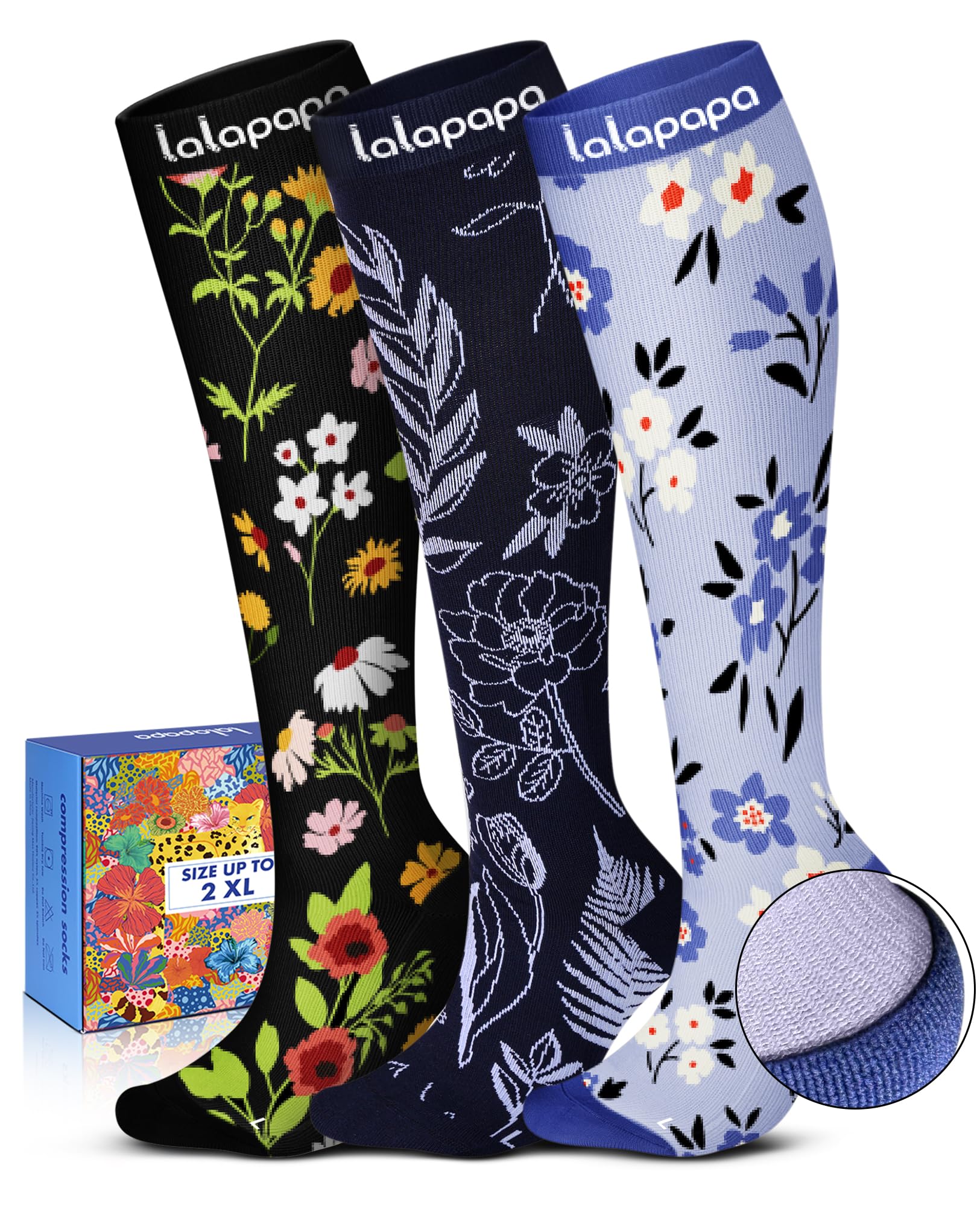
1. Cute Compression Socks for Women — 3 Pairs, 20–30 mmHg
Our pick — 4.5★ from 450+ verified ratings; the strongest balance of quality and price.
The pair that makes your legs feel better and actually look cute doing it.
This three-pack earns the top spot because it nails the whole package: real 20–30 mmHg graduated compression that buyers report “immediately reduced pregnancy swelling, allowed shoes to fit,” and a comfortable interior lining that feels soft against the skin. The crowning detail is the appearance — vivid, playful patterns that make wearing compression feel less like a medical chore and more like a fashion choice.
The fit is where most compression socks trip people up, and here it is mostly a success. Owners mention that after choosing the correct size (based on the chart, not guesswork), the compression is “not too tight, not too loose.” The crowd favorite aspect is the look with over 80 people praising it, followed closely by comfort. A few owners note that some pairs arrived labeled “extra wide” on the box, which does not match the listing description, so it is wise to measure your calf and check the dimensions before ordering.
What wins people over is the cushioning — a soft interior padding that makes them feel plusher than other compression socks, which matters when you are on your feet for a ten-hour nursing shift or a whole day of travel. One new mom bought them for her mother’s swelling and reported “they fit perfectly and really helped her ankles and legs feel so much better.”
What stands out
- Three pairs per pack — great rotation value
- Soft interior cushioning for all-day wear
- Widely praised for easing pregnancy swelling
Watch for
- Some pairs run loose in the ankle area per a few buyers
- Box may say “extra wide” even if description says otherwise
Best for: anyone who wants effective medical-grade compression in a value three-pack without sacrificing style or softness.
Think twice if: you have very narrow ankles — the cut may leave wrinkles that reduce the gradient effect.
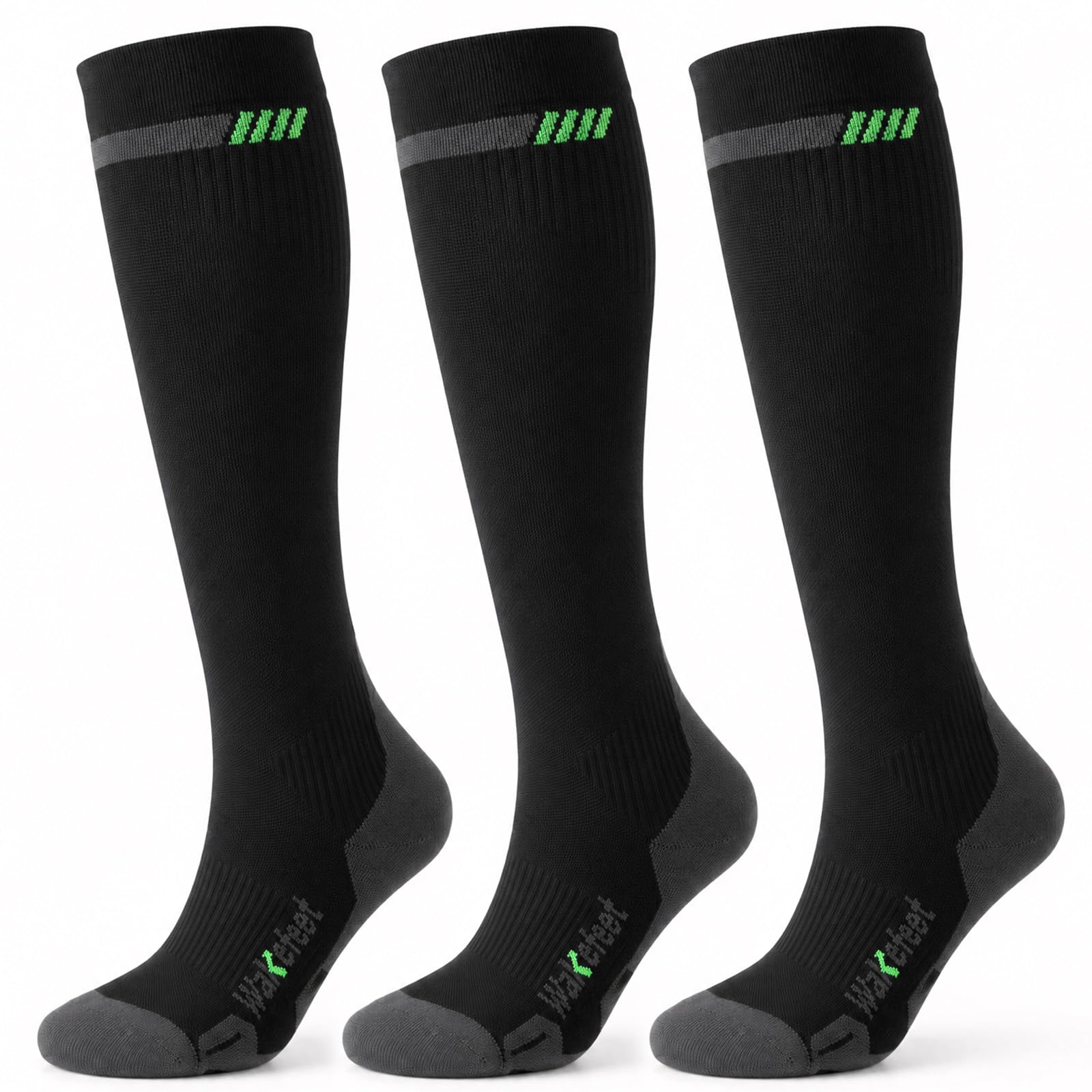
2. WAKEFEET Medical Compression Socks — 3 Pairs, 20–30 mmHg
Serious compression for both men and women without a prescription price tag.
Graduated from 20 mmHg at the calf down to a stronger hold at the ankle, these socks are built for people who stand all day — EMS workers, nurses, teachers — and the review pages confirm it: “My legs are not as fatigued after long days and nights of EMS work.” The thick knitting around the sole and heel adds a layer of cushioning that makes them feel substantial, and the smooth toe closure prevents blisters from seam friction.
The fit is the main conversation here, with more people talking about it than any other feature. Some customers note the sizing chart is spot-on and they “fit like a glove,” while others found them too small and had to return them. If you are between sizes on the chart, taking the larger one is the safer call. The high-elasticity cuff helps the socks stay up without rolling, which is a common frustration with cheaper pairs. A single owner mentioned a design update where the foot section uses a different grey material — something to check if you reorder.
Comfort is the top positive, followed by quality. People wear these for twelve-hour shifts and report they “hold up well” even with cold machine washing and hang drying. The three-pack in a gift box makes rotation easy, and the unisex sizing opens it up for anyone in the household.
Bottom line: hard-wearing medical compression at a price that makes buying several pairs painless — just measure twice before clicking.
Reach for this if: you need a budget-friendly multi-pack with a reinforced sole and true 20–30 mmHg pressure.
Consider another pick if: your calf measurement is close to the top of a size range — a few owners found them too snug.
3. Ailaka Zipper Compression Socks — 20–30 mmHg
Full medical compression that slips on in seconds, not minutes of wrestling.
The struggle of pulling on tight compression stockings is real, and this pair solves it with a high-quality YKK zipper and an extended zipper handle that makes self-donning easy. For anyone with arthritis, post-surgery recovery, or simply a low tolerance for morning sock-battles, this is a standout. The 20–30 mmHg graduated compression is firm, and the material is a durable blend of 70% nylon and 30% spandex that keeps its shape.
Customers consistently call out the ease of use as the top reason to buy — over 50 people mention it. The product page sums it up well: “We tried one pair to see how well they worked. They are easier to put on than his old ones, and are helping to keep the swelling down in his lower legs. We ordered two more this week.” The zipper stays snug against the leg and does not bulge under pants, which matters if you are wearing them under work clothes.
The biggest caveat is sizing. The fit gets called “too tight” or “runs small” by a significant number of owners, so measuring first thing in the morning (before swelling) and choosing a larger size if you are between measurements is critical. The socks also run long for shorter women — a petite buyer found them too long for her frame and got insufficient compression as a result. With sizes from medium to 5X-Large, the range is generous, but the tiny size chart on the packaging needs careful attention.
The honest take: the easiest compression socks to get into, but only if you invest a minute in measuring your leg correctly first.
Best for: anyone who struggles with traditional pull-on compression — the zipper transforms the daily routine.
Not ideal for: short-statured women — the extra length may bunch and reduce the gradient effect.
4. Myshear Medical Compression Tights — 20–30 mmHg

Full-leg graduated pressure without the toe pinch — a footless design that breathes.
These are not your standard knee-highs. The Myshear tights deliver 20–30 mmHg graduated compression from the ankle all the way up to a high-waist elastic band, making them ideal if your varicose veins, swelling, or discomfort extend above the knee. The footless design is a relief for people whose toes feel cramped in closed-toe stockings, and it makes the tights easier to wash and dry. The fabric is 75% nylon and 25% spandex, and buyers describe the material as soft, breathable, and non-irritating through a full work day.
Over 90 owners talk about the fit, and it is the most-discussed aspect for a reason — the sizing runs extremely small. People who normally wear a medium in leggings found the medium barely fit and needed an XL or 2XL based on the chart. If you skip measuring and use your standard pant size, expect a tight surprise. But for those who get the right size, the compression is the top positive, with over 70 owners praising its effectiveness for long retail shifts, nursing, and travel.
The waistband stays put without rolling, and the flat-lock seams lie smoothly under clothes. A buyer called them “a must for varicose veins” and noted that after twelve-hour shifts, “legs feel better at end of day.” The reinforced gusset and tear-resistant construction mean they hold up to repeated washing better than many similar tights.
Strengths
- Full-leg compression from ankle to waist
- Footless design — no toe discomfort
- High-waist band that does not slip
Watch for
- Sizing is non-standard — size up significantly
- No abdominal compression — it is leg-focused only
Pick this if: you need compression that reaches your upper thigh and waist, or if closed-toe stockings bother your toes.
Skip if: you want true abdominal support — these tights focus pressure on the legs, not the belly.
5. XUANSHOW Compression Pantyhose — 20–30 mmHg, 2 Pairs
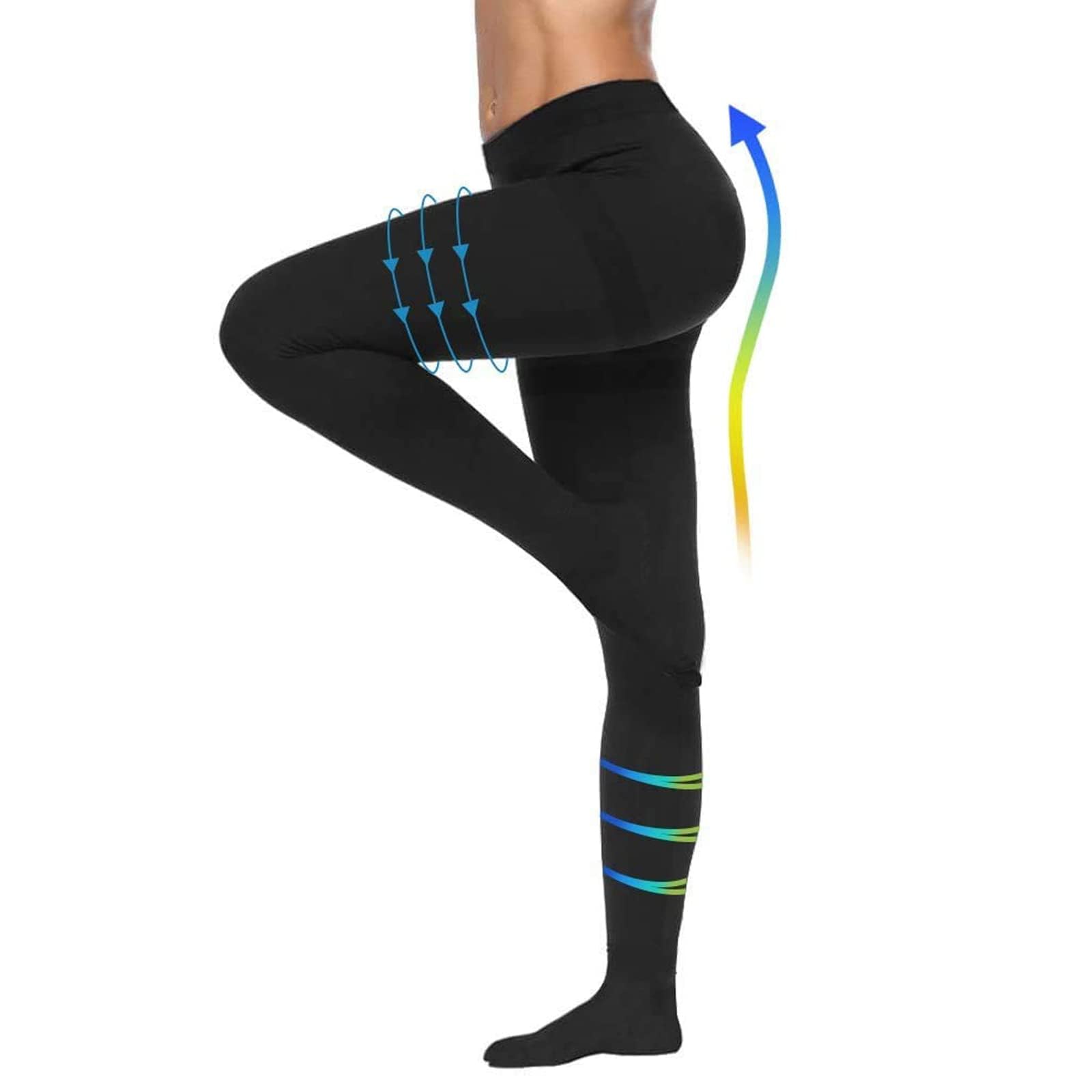
Two pairs of full-leg compression at a price that makes rotating a no-brainer.
For the price of a single high-end stocking, you get two pairs of 20–30 mmHg footless compression pantyhose that cover your legs from ankle to high waist. The opaque medical-grade fabric provides full coverage under skirts, dresses, or pants, and buyers confirm that the compression helps reduce swelling and leg fatigue after long days on their feet. One reviewer with spider veins found them comfortable to use post-sclerotherapy, and another called them “excellent” for anyone working more than eight hours standing.
The fit is the recurring point of friction. While some owners say the sizing is true and the quality is well-made, others report they “run extremely long” — one buyer at 5’4″ found the length reached a foot beyond where it should be, which affects the gradient compression. The waistband stays put according to some, but others note that the tights can slide down when worn open under a dress. Sizes range from S to 2XL, but if you are tall or short, expect to adjust your expectations.
The two-pack in black and beige is practical for weekday rotation. The footless design means you can wear your own socks or shoes without friction, and the high-waist band offers gentle support without digging in. It is a solid entry-level pick for someone who wants to try full-leg compression without spending a lot upfront.
Verdict: a budget-friendly two-pack that works — but take your height measurement seriously before ordering.
Best for: first-time full-leg compression buyers on a budget who need two pairs for rotation.
Not for: shorter women under 5’5″ — the length can overwhelm a smaller frame and ruin the gradient.
6. beister Compression Tights — 20–30 mmHg, High-Waist

Five pressure zones from ankle to waist — the science of gradient in one garment.
Beister uses a 5-interval graduated compression system — the tightest at the ankle, loosest at the thigh — to create a smooth pressure gradient that physically moves blood upward. The fabric blend (70% nylon, 25% spandex, 5% elastane) gives the tights a substantial, opaque feel, and the reinforced gusset at the crotch prevents the tearing that plagues cheaper pantyhose. Over 200 owners cite compression as the standout feature, and another 200 name comfort as the top draw.
The fit, however, is where these tights split opinion. The size chart jumps from S to XL to XXXL, and buyers warn it is inaccurate — one owner bought both L and XL, and only the XL worked. A durability issue surfaced: some owners saw the waistband unravel after about seven wears. For the best experience, measure carefully and size up. If you do, the effects are real: people report immediate relief in their calves and thighs, and the waistband stays snug without rolling.
These are marketed as unisex and work well for nurses, teachers, pregnant women, and flight attendants — anyone who needs strong pressure from ankle to waist. The open-toe design keeps your feet free, and the opaque coverage hides any discoloration or veins beneath the fabric. The footless bottom also means no toe seam irritation.
Take it or leave it: excellent graduated compression, but only if you survive the size chart maze.
Go for it if: you want full-leg compression with a scientifically graded pressure curve and are comfortable sizing up.
Look elsewhere if: you need guaranteed durability — a small number of units had waistband failure within a week.
7. EvoNation Thigh High Compression Stockings — 20–30 mmHg

Medical-grade compression that looks like a sheer designer stocking, not a medical device.
If you want effective 20–30 mmHg compression but hate the medical look, this is your pair. The EvoNation thigh-highs use a sheer 80% nylon, 20% spandex knit that is almost invisible under slacks or skirts, with a lace-silicone band at the top that keeps the stocking in place without digging into your thigh. The closed-toe design includes an ergonomic toe box that gives your toes more space than typical stockings. Buyers confirm the silicone band holds the stocking up through the day and does not slide down.
The sizing is the biggest hurdle. The company uses standardized measurements that do not work well for athletic or curvy thighs — one buyer found the band pinched hard at the top because the thigh measurement did not account for muscle. Measure your thigh circumference at the widest point before ordering. Those who get the fit right are rewarded with even, comfortable pressure that reduces post-surgery swelling, knee pain, and blood pooling in the legs.
The USA-made manufacturing process is computer-controlled for consistent graduated compression, which is a level of precision that cheaper imports often lack. After 12 washes in a delicates bag, one buyer confirmed the stockings held their compression. A pregnant owner wore a medium from the second trimester and said the same pair still fit and worked during the third trimester. The nude shade, however, runs darker than product photos suggest.
High points
- Sheer, fashionable fabric hides under clothing
- Lace-silicone band stops slipping
- USA-made with FDA-tested gradient
Low points
- Sizing does not accommodate larger thighs
- Nude shade is noticeably darker than pictured
Best for: women who want serious medical compression in a sheer, thigh-high style that disappears under clothes.
Skip if: you have muscular or larger thighs — the standardized sizing may pinch or roll.
8. JOBST Relief 20–30 mmHg Compression Stockings — Knee High, Closed Toe

The brand doctors recommend, delivering consistent, durable relief for swollen legs.
JOBST is the name you will hear in a vascular surgeon’s office, and the Relief line brings that clinical-level reliability into an accessible price bracket. The 20–30 mmHg graduated compression is physician-recommended, and the reinforced heel pocket ensures the stocking sits correctly over your ankle bone every time — a small detail that makes a big difference in comfort during 12–14 hour days. One dental hygienist switched from cheaper drugstore nylons that constantly ran and developed holes, and now owns four pairs of these.
The compression is the most-discussed positive feature, with over 50 owners mentioning its effectiveness at dramatically reducing edema (swelling caused by fluid trapped in the body’s tissues) and leg pain. The reinforced toe construction resists runs, unlike sheer pantyhose. Fit is the trade-off: the stockings run small enough that multiple buyers advise ordering one size larger than you measure. One owner at 5’5″ found that a medium was “a bit too long” and would order a Petite next time. The top band can also feel tight and leave marks if you do not size up.
Wash them in cold water on a gentle cycle and hang them dry — buyers who follow that rule report the stockings keep their elasticity and stay up for hours of movement. The only durability complaint comes from a handful of people who say the fabric caught and tore after a month, which is note if you have long nails or wear them with rough footwear.
Bottom line: a trusted medical brand that delivers consistent pressure — but always size up from your chart measurement.
Consider a different pair if: you need a larger range of sizes — the stockings run small and the Petite option is limited.
9. JOBST Relief Open Toe Compression Socks — 20–30 mmHg
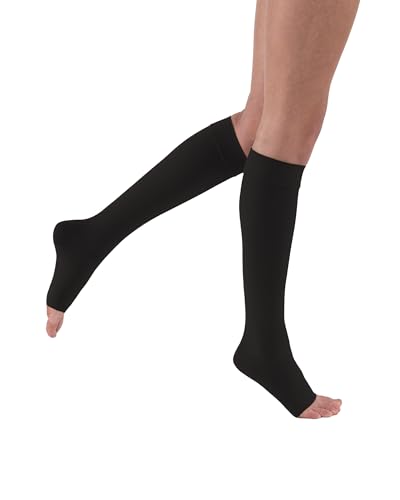
The open-toe version of the medical standard — breathable, durable, and seriously effective.
Sometimes your toes need to breathe, and the JOBST Relief open-toe design gives you a full 20–30 mmHg gradient without cramping your feet. The nylon and spandex fabric is soft against the skin, and the open toe means you can wear toe spacers, bandages, or simply let your toes spread naturally inside your shoes. The reinforced heel pocket lines up the stocking correctly, and the top band uses gentle elastic that does not dig into thin or average legs — though applying a little body lotion under the band can stop it from slipping throughout the day.
Quality is the top praise from owners, with over 40 people calling out how well-made and durable the socks are. People wear them daily for chronic venous insufficiency (CVI) (a condition where the veins in your legs cannot pump blood back up to the heart effectively), in Florida heat, and report that the socks stay breathable and comfortable. The toeless design does expose your toes to potential chafing inside shoes, but a simple fix (wearing thin ankle socks over the stockings) solves that. One owner noted the socks last roughly two months of daily wear before the compression gradually fades, which is consistent with medical-grade stockings at this level.
The criticism is limited but honest: the ankle area at the top of the foot can fold slightly and cause a pressure line, and the socks are very tight to get on at first. But for people who need dependable 20–30 mmHg compression without the pressure on their toes, this is the go-to choice.
Pros
- Open-toe design is breathable and toe-friendly
- Durable construction resists runs and holes
- Physician-recommended gradient compression
Cons
- May fold at the ankle on some leg shapes
- Compression gradually fades after months of daily wear
Best for: people with sensitive toes, toe injuries, or those who simply hate the feeling of enclosed compression socks.
Watch for: potential chafing at the open edge — thin over-socks are a handy workaround.
Understanding the Specs
Graduated Compression
Graduated compression means the sock is tightest at your ankle and gets progressively looser as it goes up your leg. This gradient physically pushes blood upward, counteracting the gravitational pooling that causes varicose veins. A sock with uniform pressure (non-graduated) will not create this pumping effect and will not deliver the same relief — the gradient is the entire point.
20–30 mmHg — The Therapeutic Threshold
Millimeters of mercury (mmHg) is the unit that measures how much pressure the sock applies. 20–30 mmHg is the medical standard for varicose veins and moderate edema. It is firm enough to compress the vein walls and reduce swelling, but it is not so tight that it restricts movement or feels painful. Lower ranges (8–15 mmHg) are for travel or mild tiredness; higher ranges (30–40 mmHg) require a prescription. If you have varicose veins, 20–30 mmHg is where real relief starts.
FAQ
How tight should compression socks feel for varicose veins?
Will compression socks cure varicose veins?
How do I know which size to buy?
Can I wear compression socks to bed?
How often should I replace compression socks?
What is the difference between knee-high and thigh-high compression socks?
Are zippered compression socks as effective as pull-on ones?
Can I wear compression socks during pregnancy?
Final Thoughts: The Verdict
Across the board, the compression socks for varicose veins winner is the Cute Compression Socks for Women because it delivers the full 20–30 mmHg medical gradient in a comfortable three-pack that owners genuinely rave about — and it looks good enough to wear out. If you struggle with
Related Guides

Mo Maruf
I created WellFizz to bridge the gap between vague wellness advice and actionable solutions. My mission is simple: to decode the research and give you practical tools you can actually use.
Beyond the data, I am a passionate traveler. I believe that stepping away from the screen to explore new environments is essential for mental clarity and physical vitality.