Our readers keep the lights on and my smoothie glass nicely filled. As an Amazon Associate, I earn from qualifying purchases.
Specs are compiled from manufacturer listings and verified buyer reviews and can change over time — please confirm the key details on the product page before buying.
Nothing stings quite like slicing a brand-new golf ball into the woods on the first tee. You want a ball that flies far enough, feels decent on the green, and does not make you flinch every time you lose one. The secret to winning at the cheapest golf ball game is ignoring the glossy marketing and focusing on what actually matters for your swing — cover durability, compression, and how many you get per box.
I’m Mohammad Maruf — the founder and writer behind WellFizz. This guide is built by comparing the manufacturers’ published specifications and the patterns across verified customer reviews, so you get each pick’s real strengths and trade-offs instead of marketing spin.
You lose a sleeve of balls every round, or you want a softer feel without paying premium prices. The right cheapest golf balls keep your wallet safe and your game moving — no overpriced logo required.
Our Picks at a Glance


How To Choose The Best Cheapest Golf Balls
Picking the right bargain ball is less about brand loyalty and more about matching the ball’s construction to the way you actually hit. A hard, low-spin ball that flies straight is perfect if you slice, but it will feel like a rock around the greens. Here is what to check before you add to cart.
Piece Construction — Two vs. Three vs. Four
The vast majority of budget-friendly balls use a two-piece design (a solid rubber core wrapped in a hard cover). That is fine for all-around durability and distance, especially from the tee. Three- and four-piece balls add intermediate layers for more spin and feel on approach shots, but they cost more. For the cheapest tier, stick with two-piece unless you see a compelling sale.
Compression — Soft vs. Firm
Compression measures how hard you have to compress the ball for it to spring off the face. Lower numbers (under 60) suit slower swing speeds — seniors, juniors, and anyone swinging a driver under 85 mph. Higher compression (90+) gives better feedback for faster swings but feels like a brick when you do not have the club head speed. Many budget balls do not publish their exact compression, so you rely on owner feedback and brand reputation.
Cover Material — Surlyn vs. Urethane
Surlyn is the tough, cut-resistant plastic found on nearly every value-priced ball. It resists scuffs and keeps the ball round longer, but it spins less on short shots, so the ball tends to roll out after landing. Urethane is softer, grabs the green better, and is standard on premium balls. At the cheapest price point, expect Surlyn — and that is fine if you are not trying to spin the ball back on every approach.
Dimple Pattern — Lift and Trajectory
Dimples are not just for looks. The shape, depth, and number of dimples affect how the air flows over the ball — more aerodynamic dimple designs generate lift and carry. Budget balls often use a simple symmetric pattern that works well for straight, high-launch shots. Do not overthink dimple count; for a cheap ball, consistent flight matters more than a specific number.
Quick Comparison
| Model | Best For | Construction | Number of Items | Item Weight | Amazon |
|---|---|---|---|---|---|
| Nitro Ultimate Distance★ Best Overall | High-loss beginners & juniors | Two Piece | 15 | 1.2 Pounds | Amazon |
| Vice Drive (White)Top Performer | Mid-handicap value hunters | 2-Piece | 2 | 1 Pounds | Amazon |
| Taylormade 2025 Distance+ | Average players seeking tee distance | Multi-Layer | 12 | 45 Grams | Amazon |
| WILSON 2025 Duo Soft | Seniors & slower swing speeds | Two-layer | 12 | 1 Pounds | Amazon |
| WILSON 2024 Chaos | Budget pick for bulk practice | 2-piece | 24 | 16 ounces | Amazon |
In‑Depth Reviews
1. Nitro Nitro Ultimate Distance
The 15-pack that makes losing a ball in the woods hurt a lot less.
The standout number here is the item count — 15 balls for the same money you would normally pay for a dozen of anything else. The 15-ball count adds up fast when you are spraying shots into the rough. The Nitro uses a reactive titanium core (a material that stores and releases energy on impact) paired with a two-piece tournament construction to push distance off the tee, plus an aerodynamic dimple design that improves lift for longer, higher carry.
Buyers report that the pink and bright shades make these balls easy to spot in thicker grass, which cuts down on search time. As buyers put it, “these don’t stick around long with three teen boys losing their golf ball all the time.” The other big win is durability and price point; the 1.2-pound box has enough balls that even a beginner spraying shots into the woods does not feel heartbroken. The trade-off is that these are not designed for high spin or soft feel around the greens — the Surlyn cover (a hard, cut-resistant plastic) means approach shots will tend to release and roll, not bite.
Why the Crowd Loves It
- 15 balls per pack is a huge volume advantage — you get 15 balls in a pack versus 12 in a standard box
- The titanium core and aerodynamic dimples genuinely add carry distance off the tee
- Vibrant multi-colors make the ball easy to find in thick rough, saving you time (and balls)
The Honest Caveat
- Hard Surlyn cover means minimal greenside spin; expect roll-out on short approaches
- Not the softest feel — firmer compression may feel harsh on slow swing speeds
Grab it if you: are a beginner, high-handicap, or juniors losing 5+ balls per round and just want something that flies straight and costs pennies each — the value per ball is hard to argue.
Think twice if you: need soft feel on chips and putts or a ball that stops on a dime — look at the Wilson Duo Soft instead.
2. Vice Drive Golf Balls (White)
A German-engineered bargain that made the Golf Digest Hotlist for a reason.
Vice earned its reputation by delivering tour-level performance ideas at a fraction of the big-brand price. The Drive model is their entry-level ball — a 2-piece Surlyn construction designed specifically for beginners and golfers who prioritize distance off the tee over short-game spin. It also earned a spot on the Golf Digest Hotlist 2020 among “Best Bargains,” which is a solid third-party nod. A new extra-long alignment line on the ball makes aiming on the tee box noticeably easier.
The real story from owners is that this ball is harder than the popular Callaway Supersoft — which means less spin on both your driver and your wedges. That lower spin works in your favor off the tee (it reduces slice), but it also means your wedges will not grab as much, resulting in predictable chip rollout rather than a hop-and-stop. Durability is a mixed bag in the feedback: the 1-pound, two-ball sleeve holds up to full rounds, but some owners note scuffs quicker than expected on cart-path impacts. On the positive side, quality and value for money are the top-discussed aspects — the ball is a straight flier with consistent compression for a fraction of Pro V1 money.
What Stands Out
- Golf Digest “Best Bargain” recognition gives you confidence you are not overpaying
- Less spin actually helps reduce slice on woods, a huge plus for mid-handicap players
- Extra-long alignment line simplifies aiming on every tee shot
The Real Deal
- Harder feel than Supersoft — may not suit players who love a buttery-soft response
- Durability is mixed; some owners mention scuffing faster than the price-per-ball might suggest
Reach for this if you: are tired of your slice costing you strokes and want a predictable, low-spin ball that flies straight off the driver.
Think twice if you: need maximum grip and check on the greens — the Surlyn cover and firm compression will make short-game stopping power a challenge.
3. Taylormade 2025 Golf Distance+ Golf Balls
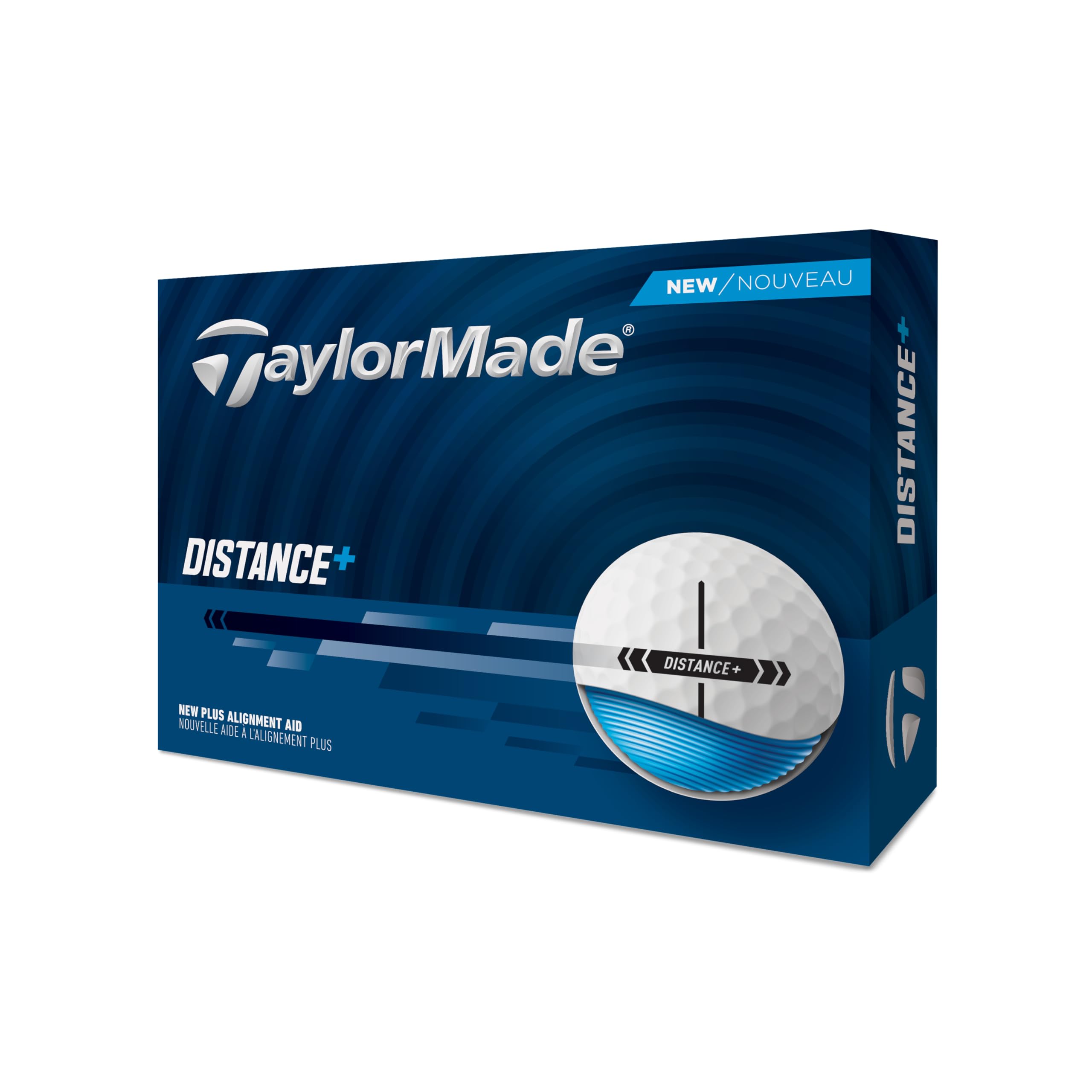
TaylorMade’s newest Distance+ brings a fresh dimple pattern and alignment aid for average swing speeds.
This 2025 release carries two specific updates that matter on the course: a new Extended Flight Dimple Pattern designed to improve lift and carry, and a new Plus Alignment Aid that makes lining up putts cleaner. The core is TaylorMade’s React Speed Core — a high-energy rubber formulation that stores and releases energy on impact to boost ball speed off the driver face. The construction is multi-layer, which is slightly more sophisticated than the two-piece budget norm, though the cover is still ionomer (a durable synthetic that resists cutting).
Owner feedback is consistent here: the balls are “great for average players trying to get maximum distance off the tee without paying the high price for premium (Pro V1, TP5, Chrome Tour, etc.) balls.” The honest trade-off is that they likely spin less on approach shots, so you should not expect dramatic backspin or bite on the greens — the ball will run out a few feet after landing. Quality and value for money dominate the owner discussions, and the 45-gram weight per ball is on the lighter side of the standard range, which can help slower swing speeds generate a bit more carry. The main downside versus the two-piece competition is that the multi-layer construction does not dramatically change the feel — it is still a firm, distance-first ball, not a soft-touch model.
Why it earns its spot: The TaylorMade brand cachet gives you confidence in quality control, and the new dimple pattern is a genuine engineering update rather than a sticker change. For average players chasing fairways, this is a smart middleground between budget Surlyn and premium urethane.
The single thing to know: The react speed core is tuned for driver distance, so expect roll-out on greens, not check — plan your approach aiming for two putts.
Who it fits: Average players (10–20 handicap) who want a recognizable brand name with proven distance performance and are okay trading short-game spin for tee-shot carry.
Who should pass: Players with very slow swing speeds under 70 mph — the firmer feel may not compress enough to get the full benefit of the core technology.
4. WILSON 2025 Duo Soft Golf Balls – 12 Balls

Wilson claims the softest ball in the game — ideal if your swing speed is below 85 mph.
The “world’s softest golf ball” tagline is a big statement, but the owner feedback bears it out — this ball genuinely flies further for slower swing speeds. Wilson uses a High Energy Core that compresses easily on impact and a two-layer construction that reduces spin on longer shots for a straighter flight. That matters when you consider the average senior or recreational player does not have the club head speed to compress a firmer ball. The Surlyn cover keeps it durable enough for a full round without scuffing, and the white color (standard here) is classic but less visibility-boosting than the bright Chaos option below.
Seniors and slower-swing players repeatedly name it as a standout. One owner with an 80 swing speed reported “excellent distance with this ball.” Softness is the top-discussed feature alongside quality — the ball feels buttery on chips and putts, with a short roll-out of only 2-3 feet on greens. The flip side is that the Duo Soft is not built for max distance if you have a fast swing; above-average swing speeds may actually lose yardage because the ball compresses too much and does not spring back efficiently. As a 15-handicap with above-average speed noted, the compression was “great” and the feel “better than Pro V1,” so the experience varies by your swing profile. The biggest practical issue is that the yellow version reportedly feels different (softer) than the white, so stick with white if consistency matters.
Standout stat: Designed specifically for slower swing speeds — owners with 80 mph drivers consistently say it adds real yardage to their drives.
The honest limitation: If you swing fast (95+ mph), this ball may feel mushy and cost you distance off the tee — it is tuned for easy compression, not high-speed energy return.
Best for: Seniors, juniors, or any golfer with a swing speed under 85 mph who wants maximum softness and a straighter flight that still carries well.
skip it if: You hit the ball hard — the low-compression core may fly lower and shorter for high-speed swings; try the Taylormade Distance+ or Vice Drive instead.
5. WILSON 2024 Chaos Golf Balls – 24 Balls

Two dozen multi-colored balls that work out to about a dollar each — perfect for practice rounds.
The pure math of this pack is hard to ignore: 24 balls in a single box, 24 balls versus the typical 12 per dozen. Wilson’s 2024 Chaos uses a 2-piece Surlyn construction — the industry standard for durable, low-spin, distance-first performance. The Surlyn cover (a hard plastic that resists cuts and scuffs) is paired with a solid core that is tuned for average swing speeds, not especially soft but reliable. The multicolors are not just cosmetic; owners consistently point out that the bright shades make the ball easy to spot from far away, which cuts down on the time you spend searching for your ball in the rough.
Owner feedback is overwhelmingly positive about value (the top-discussed aspect after quality). “Can’t beat a dollar a ball,” one buyer put it, noting that performance is comparable to higher-priced balls for practice and casual rounds. The durability is solid — the ball holds up well over 18 holes according to the feedback — though softness receives mixed reactions: some call it super soft, others find it not soft enough. The honest truth is this is a firm-feeling ball ideal for players who lose many balls per round and simply need something reliable that does not hurt the wallet. The trade-off for that bulk price is that the Surlyn cover lacks the premium feel of urethane: approach shots will release and roll rather than check, and fast swing speeds may feel a bit of brittle feedback on full shots.
Why It Wins on Value
- 24 balls — the best cost-per-ball in this list by a clear margin
- Bright multicolor finish makes finding your ball in the rough much faster
- Surlyn cover holds up well over a full round, resisting scuffs and cuts
The Fit Note
- Firm feel — not the soft ball that seniors or slower swing speeds need for maximum carry
- Low spin means wedge shots will release and roll; no hop-and-stop here
Who it is for: High-loss beginners, junior golfers, or anyone who signs up for a scramble and wants a bucket of balls that are easy to track and do not cause a financial pain when one goes into the lake.
Who it is not for: Anyone who needs a soft, high-spinning ball for short-game control — the Chaos is built for distance and durability, not finesse.
Understanding the Specs
Two-Piece Construction vs. Multi-Layer
Two-piece means a solid rubber core covered by a single outer layer of Surlyn or ionomer. It is the simplest, most durable, and cheapest design — perfect for maximum distance and low spin off the tee. Multi-layer (three or four pieces) adds intermediate mantle layers that allow engineers to tune spin separately for driver, long irons, and wedges, giving you more control at the cost of durability and a higher price. For the cheapest golf balls, two-piece is the standard and it works well for most recreational rounds.
Surlyn Cover and What It Means for Feel
Surlyn is a tough, cut-resistant plastic used on nearly all budget and mid-range balls. It provides excellent durability (a ball can last multiple rounds without scuffing), but it produces less friction on the golf club face, which means less spin on approach shots and chips. That translates to more rollout on the green — the ball will land and run forward rather than checking and stopping. Urethane covers, found on premium balls, are softer and grip the grooves on your wedge better, but they scuff easier and cost significantly more per ball. For a bargain ball, Surlyn is the right trade-off: you lose short-game spin but gain durability and a lower price per dozen.
FAQ
What does two-piece construction mean for my game?
Are cheap golf balls as durable as premium balls?
Which cheap golf ball is softest for my slow swing speed?
Will a cheap ball reduce my slice?
How many balls per pack should I buy as a beginner?
Do cheap golf balls have alignment aids for putting?
What is a React Speed Core and does it actually help distance?
Can I use cheap golf balls in a tournament or league?
Final Thoughts: The Verdict
For most players hunting for the best cheapest golf balls, the Nitro Ultimate Distance is the winner because it gives you 15 balls with a reactive titanium core and aerodynamic dimples at a price that makes losing one painless. If you want the softest feel and max carry for a slower swing, grab the WILSON 2025 Duo Soft. And for sheer bulk practice value, the WILSON 2024 Chaos at 24 balls is the one to reach for — nearly a thousand golfers back that pick with top ratings.
How We Picked
We do not accept paid placement. Every pick is matched to a real buyer and a real use-case; we do not hands-on test units.
Sources & Methodology
Specifications: manufacturer listings and product documentation. Review insights: verified customer reviews, as of July 2026. Pricing: not shown on this page (it changes often); check the current price via the retailer link.
As an Amazon Associate, WellFizz earns from qualifying purchases. This does not affect which products we feature.
Related Guides

Mo Maruf
I created WellFizz to bridge the gap between vague wellness advice and actionable solutions. My mission is simple: to decode the research and give you practical tools you can actually use.
Beyond the data, I am a passionate traveler. I believe that stepping away from the screen to explore new environments is essential for mental clarity and physical vitality.