Our readers keep the lights on and my smoothie glass nicely filled. As an Amazon Associate, I earn from qualifying purchases.
Specs are compiled from manufacturer listings and verified buyer reviews and can change over time — please confirm the key details on the product page before buying.
Getting a single grinder to deliver both a silky espresso shot and a clean pour-over is a notorious challenge. Espresso needs a very fine, consistent dust; pour-over wants a coarser, more uniform particle. A machine built for one usually fails at the other, leaving you with bitter shots or watery filtered coffee. This guide covers the models that genuinely handle both jobs — whether you prefer a quick manual crank in the morning or a set-and-forget electric workflow.
I’m Mohammad Maruf, the writer behind WellFizz. This guide uses the makers’ published specs and the patterns across verified buyer reviews — so you get each pick’s real strengths and honest trade-offs, not marketing claims.
Whether you are upgrading from pre-ground coffee or replacing an old blade grinder that burns your beans, the right coffee grinder for espresso and pour over depends on grind consistency, adjustability, and build quality. These three specs separate a good morning cup from a genuinely great one.
Our Picks at a Glance


How To Choose The Best Coffee Grinder For Espresso And Pour Over
Buying a grinder that works for both espresso and pour-over means you are really getting two machines in one. A few key specs decide whether that trade-off succeeds or frustrates you every morning.
Burr Type: Conical Is Your Only Real Option
Flat burrs (two flat metal discs) are good for one brew method only but tend to produce a wider range of particle sizes when you switch. Conical burrs (a cone-shaped piece that grinds against an outer ring) give you a narrower range of particle sizes. That evenness is what you need to keep espresso from channelling (water finding a fast path through the coffee puck) and pour-over from stalling (water pooling on top). Every grinder on this list uses a conical burr set.
Adjustment Precision: Microns Matter
Espresso demands tiny steps — you need to move in fractions of a millimeter (a micron is one-thousandth of a millimeter) to dial in a shot. Pour-over lets you be looser, but the grinder has to cover both extremes without big gaps. Look for click-based or stepless (infinite adjustment) systems that give you at least 30 distinct settings. A grinder that skips from “fine” to “coarse” in three jumps will not serve you well.
Build and Retention: The Everyday Sanity Check
Every gram of coffee left inside the grinder from yesterday’s pour-over will taint today’s espresso shot. Low retention — under 0.5 grams — is critical for switching between methods. All-metal bodies also help: they stay aligned longer than plastic housings, which can flex under the torque of dense espresso beans.
Quick Comparison
| Model | Best For | Grind Settings | Burr Material | Capacity | Amazon |
|---|---|---|---|---|---|
| TIMEMORE Chestnut C3S★ Best Overall | Manual value with patented burr tech | Stepless | S2C Steel | 25 g | Amazon |
| SHARDOR Conical BurrBest Electric Value | Electric convenience with timer precision | 51 | Stainless Steel | 1.4 oz | Amazon |
| KINGrinder K2 | Ultra-precise click adjustment for travel | 120 | Stainless Steel | 20 g – 25 g | Amazon |
| Viesimple Gen 4 | Quiet single-dose electric with anti-static | Stepless | 48mm Conical | 1.06 oz | Amazon |
| TIMEMORE Chestnut S3 | Flagship manual precision for the obsessive | 0.015mm/grid | S2C890 Steel | 1.06 oz | Amazon |
In‑Depth Reviews
1. TIMEMORE Chestnut C3S Manual Coffee Grinder
Our pick — over 4.5★ from 300+ verified ratings; the strongest balance of quality and price.
The manual grinder that delivers electric-level consistency for a fraction of the cost of most electric models
The C3S is the crowd favorite for a simple reason: its patented S2C steel burr (a proprietary stainless steel grinding disc) chews through beans with impressive uniformity. Buyers report that a 15-second spin produces grounds that look identical to the naked eye. That consistency matters most when you switch from a fine espresso setting to a coarser pour-over on the same day.
The all-metal aluminum alloy body weighs 530 grams (about 1.2 pounds) and holds 25 grams of beans — enough for a strong morning cup or two lighter ones. The stepless grinding adjustment means you are not locked into fixed clicks. You can fine-tune between any two points, which is exactly what you need to chase a perfect 25-second espresso shot or a clean V60 (a common pour-over dripper) drawdown. Owners say it has transformed their morning routine, with one buyer writing, “can’t believe how different the coffee tastes.”
The trade-off is that it is manual. You will spend about 15 to 30 seconds cranking per cup. That is fine for one person but a dealbreaker if you need to grind for a crowd or hate any friction before your first sip. Cleaning is brush-only (no water) per the maker, which is standard for stepless grinders but worth knowing upfront.
What wins people over
- Patented S2C steel burr produces remarkably uniform particles
- Stepless adjustment means true infinite control between espresso and pour-over
- All-metal construction feels dense and durable at 530 g
The honest friction
- Manual grinding takes 15-30 seconds per dose — not for the impatient
- Dry brush cleaning only; no water wash
- 25 g capacity tops out at about two cups
Reach for this if: you want the biggest upgrade per dollar — a burr grinder that out-grinds many electrics at this price and lets you dial in both espresso and pour-over manually.
Think twice if: your mornings cannot spare the arm work or you regularly grind for more than two people.
2. SHARDOR Conical Burr Espresso Coffee Grinder
An electric workhorse with 51 grind settings that does not demand a second mortgage
The SHARDOR gives you electric speed and wide grind range for less than many manual-only rivals. Its 40 mm stainless steel conical burr generates minimal heat, protecting the bean oils that carry flavor. The big differentiator here is the precision timer 2.0: you can set the grind time in 0.1-second increments up to 60 seconds, and select between 1 and 12 cups. Once you dial in your pour-over dose, you can walk away and let it grind automatically.
At 165 watts and 6.2 pounds, the SHARDOR is a solid, stable electric. Owners who pair it with machines like the Breville Bambino Plus report that setting 5 produces a fine, clump-free espresso grind right from the start. The anti-static technology (a conductive coating that stops coffee fines from clinging to plastic parts) keeps the ground coffee chamber tidy — a detail that saves you the morning mess routine. The included portafilter cradle (a holder for the espresso machine’s filter basket) lets you grind directly into the basket, skipping the extra transfer step. After a year and a half of four-times-a-week use, one long-term owner reports consistent results with no jams and no noticeable wear.
Better for batch brew than the C3S, the SHARDOR’s timer makes repeatable pour-over a breeze. The recurring note of caution involves the metal clips that hold the bean hopper — a few owners have had them break, though warranty support is described as responsive. The portafilter holder also sags slightly under weight, so you may need to support it by hand while grinding into a full basket. It is a minor ergonomic hitch, not a performance issue.
Why it stands out
- 51 precise settings cover espresso through French press without gaps
- Timer 2.0 allows 0.1-second increments for repeatable dosing
- Anti-static design keeps the counter noticeably cleaner
What to watch
- Hopper clips can be fragile — handle the lid with care
- Portafilter cradle sags slightly; you may need to hold it steady
- Weighs 6.2 lb — not a travel-friendly option
Grab this for: hands-free morning speed — the timer lets you repeat yesterday’s perfect grind without thinking.
skip it if: you need a grinder that disappears into a drawer, or you prefer the ritual of manual grinding.
3. KINGrinder K2 Manual Coffee Grinder
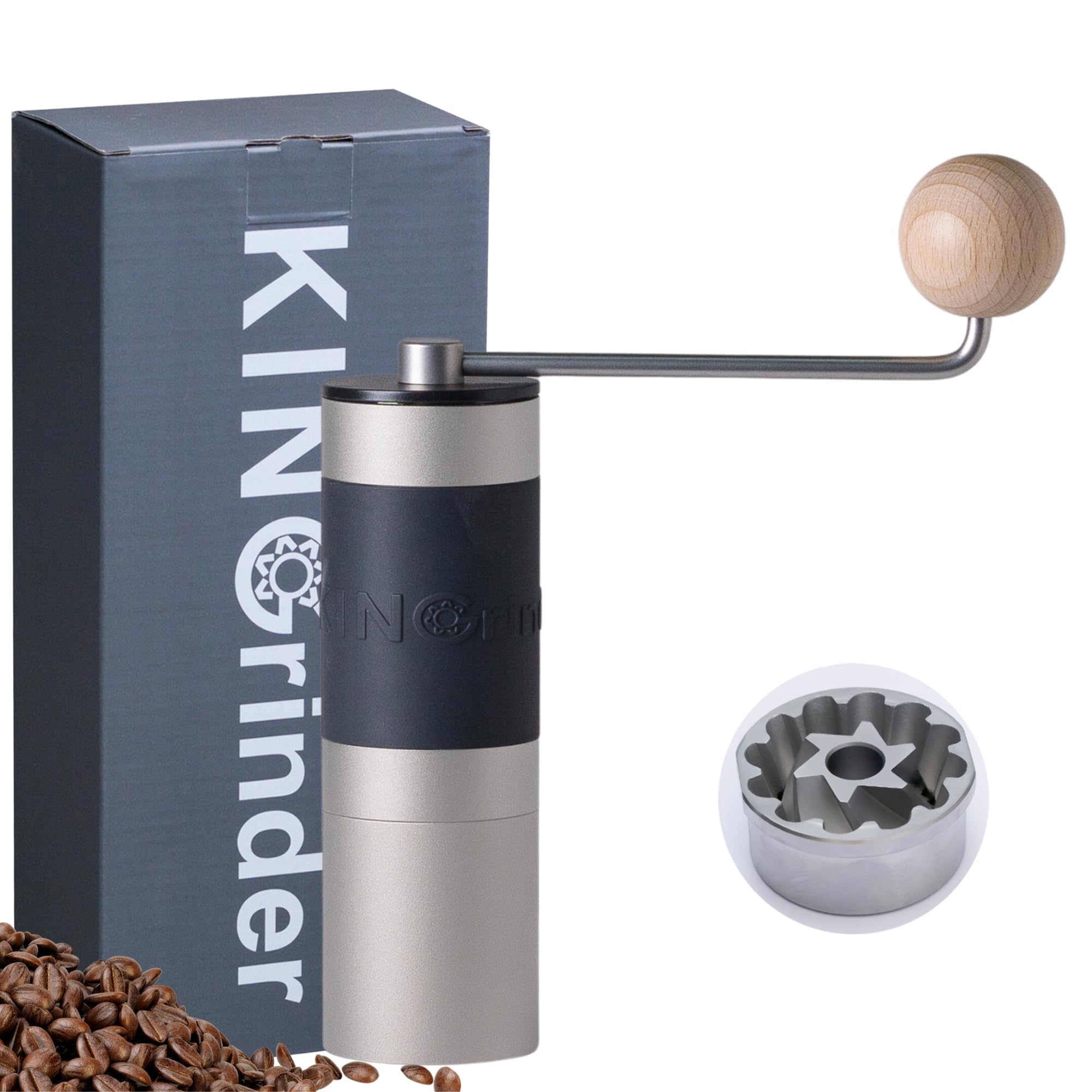
A travel-ready manual that owners say often beats electrics in the cup — reviewers reach for it over their Baratza
The KINGrinder K2 is built around a brutally simple metric: 18 microns (0.018 mm) of adjustment per click. That tiny step size gives you 120 distinct positions to move through as you cross from espresso territory into pour-over range. The interior adjustment design keeps the dial protected from accidental knocks, a smart touch for a portable grinder that might get tossed into a hiking pack or camper van. With 120 click settings, the K2 gives you a defined, repeatable position for every brew method — something the stepless C3S does not offer.
Owners mention that the grind quality is the most-praised feature: 32 owner mentions land on that exact aspect. One owner put it plainly: “I’m reaching for it more than my baratza.” The stainless steel burr set and dual-bearing design keep the grind consistent across 20 g to 25 g doses, and the full-metal aluminum body adds a tactile weight (595 g, or about 1.3 pounds) that feels reassuringly premium. Owners also note it grinds beans fast — daily use for pour-over and even fine espresso settings show no struggle.
The straight handle folds flush against the body for storage, and the whole thing disassembles by hand for brush cleaning. The main caveat is that some owners wish the fine adjustment range went a touch tighter for very light-roast espresso. Still, for the price, buyers widely consider it a bargain.
At 120 clicks: you can dial in a new bean in seconds. The 18 micron steps are fine enough to chase the perfect shot without overshooting.
Perfect for: the traveler or camper who refuses to drink bad coffee — this fits a bag and delivers espresso-grade precision on the trail.
Not for: anyone who wants a one-second electric workflow or who regularly grinds for a full French press batch.
4. Viesimple Gen 4 Single Dose Burr Coffee Grinder
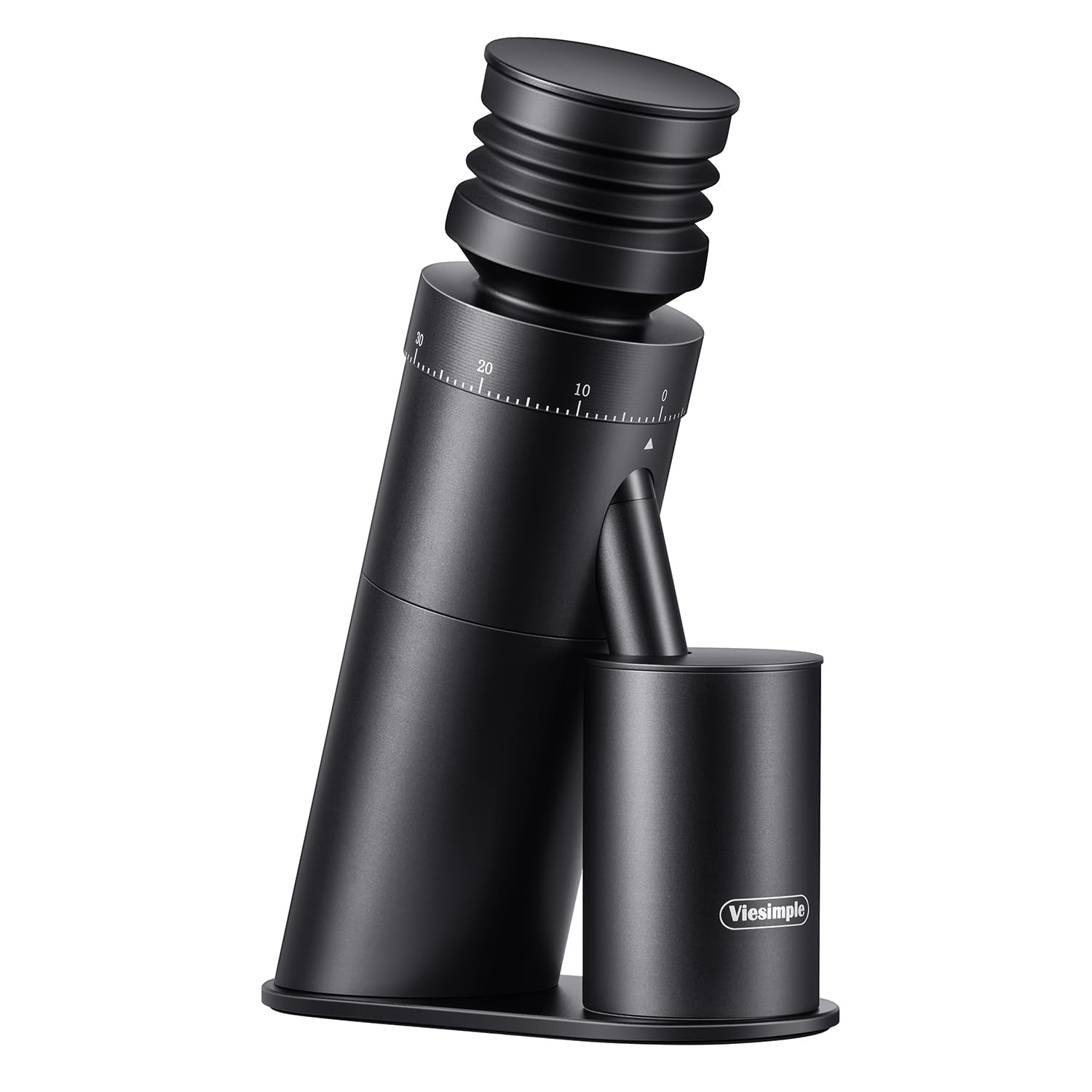
A whisper-quiet single-doser with anti-clogging tech that keeps your counter spotless
The Viesimple Gen 4 tackles the two biggest annoyances of home electric grinders: noise and mess. Its motor runs at less than 50 decibels — quieter than a typical conversation — so your 6 a.m. espresso ritual will not wake the household. The 48 mm conical burr and the anti-static coating keep grounds from flying everywhere, and the magnetic dosing cup snaps back into place automatically, eliminating the fumble of alignment. If the K2 is the travel champion, the Viesimple is the best quiet, counter-friendly electric for apartment dwellers who share living space.
Grind quality earns the most praise by far: 75 owners single it out, with many noting it works smoothly with espresso machines and produces excellent fine grinds. The anti-clogging patent tune the powder channel so that 100% of the grounds discharge, and the blow-out funnel pushes out stray chaff. The result is near-zero retention — a critical spec for anyone switching daily between pour-over and espresso who does not want stale grounds mixing into the fresh batch.
The 48 mm conical burr set and the 100-240V motor make it usable worldwide. The catch is that at 3.39 pounds and 9 inches tall it is compact but not tiny, and the external power supply is a chunky brick that adds to the counter clutter. Some owners also note the grind setting markers can be slightly misaligned — you will need to dial by taste rather than by the printed numbers.
Quiet killer feature
- Under 50 dB noise level — barely audible in the next room
- Anti-static coating leaves less than 0.2% debris residue
- Magnetic dosing cup returns to position automatically
Minor quirks
- External power adapter is large and adds wire clutter
- Grind setting markers may not align perfectly — dial by taste
- Single-dose design means no timer for batch brew
Choose this for: a quiet, clean electric workflow with near-zero grind retention — the best option for apartment dwellers.
Pass if: you need to dose by timer rather than weight, or you prefer the tactile feedback of a manual grinder.
5. TIMEMORE S3 Manual Coffee Grinder

The S3 sets a new manual benchmark with 0.015 mm per grid and a burr set some owners call comparable to a commercial grinder
This is the manual grinder for someone who treats coffee as a precision craft. The S3 uses the proprietary S2C890 steel burr (an upgraded alloy over the standard S2C found in the C3S) and couples it with an external point-to-point digital adjustment ring that moves in 0.015 mm increments — that is 15 microns per grid. That fineness lets you nudge a shot from bitter to balanced with a single turn. The external dial means you can change settings without disassembling the grinder, a huge workflow improvement if you are switching between two brew methods in the same morning. Unlike the C3S’s internal stepless system, the S3 gives you a clickable external ring for faster, repeatable changes.
Quality is the aspect owners praise most (44 mentions), with grind consistency following close behind (30 mentions). The customized high-precision bearings reduce internal tolerance from 7 microns to 5 microns, which translates into dimensional stability that one owner describes as rivaling the EK43 (a commercial grinder) for drip and pour-over clarity. The foldable spring-assisted handle is a clever storage detail — it flattens against the body so the grinder does not tip over or take up extra counter space.
The honest friction is that the grind dial turns easily and does not lock. A few customers note accidentally nudging it while gripping the body near the top, though the external position makes it easy to verify before every grind. Also, while the S3 handles light espresso and moka pot grinds well, some owners say it is not their first choice for hardcore espresso extraction: they recommend a dedicated espresso grinder for that. For pour-over, Chemex, and AeroPress, the consensus is clear: this is a joy to use.
The precision edge: at 0.015 mm per grid, the S3 lets you fine-tune grind size with a precision that most electrics cannot match.
Best for: the coffee enthusiast who wants a last-manual — the S3 delivers grind quality that owners say comes close to that of four-figure electric grinders.
Consider carefully if: you are a dedicated espresso-first drinker who needs sub-micron fine-tuning for ultra-light roasts; a dedicated espresso grinder may still serve you better.
Understanding the Specs
Grind Settings Count
This is the number of distinct positions a grinder can lock into between its finest and coarsest extremes. More settings (30+) mean you can fine-tune the particle size without big jumps that leave you with a shot that runs too fast or a pour-over that stalls. Espresso typically needs settings in the fine third of the range, while pour-over lives in the middle third. A grinder with only 10 settings will likely force a compromise.
Burr Material and Design
Steel burrs handle dense, light-roast espresso beans without dulling quickly. Conical burrs (cone-shaped grinding discs) produce a narrower particle distribution than flat burrs (two flat discs), which is critical when you need the same grinder to handle both a 9-bar espresso extraction (9 times atmospheric pressure) and a gravity-fed pour-over. The “S2C” or “S2C890” markings on TIMEMORE models refer to a proprietary steel alloy and cutting geometry developed specifically for uniform particle size.
Single Dose vs. Hopper
A single-dose grinder (like the Viesimple Gen 4 or any manual) means you weigh your beans first, then grind exactly what you need. This prevents stale grounds from sitting in the machine between brew methods — a key advantage if you switch between espresso and pour-over daily. Hopper-based electrics are more convenient for batch brewing but can trap 5-10 grams of stale grounds inside the burr chamber.
Retention and Static Control
Retention is the coffee that stays inside the grinder after you think it is empty. Every gram of retained grounds from your morning pour-over will contaminate your afternoon espresso shot and vice versa. Look for grinders that claim near-zero retention (under 0.5 grams). Anti-static coatings (conductive finishes that neutralize the electrical charge from grinding) or misting the beans with water before grinding help keep fines from sticking to the chute and the catch cup.
FAQ
Can one coffee grinder really handle both espresso and pour-over well?
What is the difference between stepless and click-step adjustment?
How many grind settings do I need for espresso and pour-over?
Why do some manual grinders cost more than electric ones?
How important is grind retention when switching between brew methods?
Should I wash my manual coffee grinder with water?
How fast should a manual grinder work for a typical dose?
Can I use a manual grinder for espresso if I have an automatic machine?
Is a quiet electric grinder worth the extra cost over a manual?
What does “anti-static” mean in a coffee grinder?
Final Thoughts: The Verdict
If you want one dependable pick, the coffee grinder for espresso and pour over winner is the TIMEMORE Chestnut C3S because it delivers a patented S2C steel burr and stepless adjustment at a price that undercuts electric grinders with fewer features. If you want electric speed with timer precision, grab the SHARDOR Conical Burr. And for the enthusiast who demands sub-micron adjustability in a manual package, the TIMEMORE S3 is the one to reach for — owners say its grind quality rivals high-end grinders.
How We Picked
We do not accept paid placement. Every pick is matched to a real buyer and a real use-case; we do not hands-on test units.
Sources & Methodology
Specifications: manufacturer listings and product documentation. Review insights: verified customer reviews, as of July 2026. Pricing: not shown on this page (it changes often); check the current price via the retailer link.
As an Amazon Associate, WellFizz earns from qualifying purchases. This does not affect which products we feature.
Related Guides

Mo Maruf
I created WellFizz to bridge the gap between vague wellness advice and actionable solutions. My mission is simple: to decode the research and give you practical tools you can actually use.
Beyond the data, I am a passionate traveler. I believe that stepping away from the screen to explore new environments is essential for mental clarity and physical vitality.