Our readers keep the lights on and my smoothie glass nicely filled. As an Amazon Associate, I earn from qualifying purchases.
Specs are compiled from manufacturer listings and verified buyer reviews and can change over time — please confirm the key details on the product page before buying.
You plug your drawing tablet into a computer that stutters on every brush stroke. Your pen feels disconnected, and your creative flow is gone. The right computer eliminates that lag, making your drawing tablet feel instant and responsive.
I’m Mohammad Maruf — the founder and writer behind WellFizz. This guide is built by comparing the manufacturers’ published specifications and the patterns across verified customer reviews, so you get each pick’s real strengths and trade-offs instead of marketing spin.
These are the best computer for drawing tablet setups you can get, explained in plain language.
Our Picks at a Glance


How To Choose The Best Computer For Drawing Tablet
Drawing tablet setups prioritize different specs than gaming or office machines. Brush engines need single-core speed, and large canvases eat RAM.
Pick the Right Processor Class
Your processor (CPU) interprets pen input and renders brush strokes in real time. For smooth brush strokes, choose a chip with a single-core clock speed of 4.0 GHz or higher. An Intel 11th Gen Core i7 or i9, or an AMD Ryzen 7 gives you that headroom. An older processor, like a 3rd-gen Intel Core i7, can struggle with modern art software, especially when you turn on brush texture or smoothing.
RAM and Storage Are Your Safety Net
16GB of RAM is the minimum for smooth multitasking between your art app, reference images, and browser. 32GB gives you real comfort with multi-layer files at 300+ DPI (dots per inch, a measure of print resolution). For storage, an NVMe SSD (a fast solid-state drive that uses the PCIe interface) is non-negotiable – it cuts save times and file-loading pauses to a fraction of what a traditional hard drive takes. A 512GB drive holds your OS, apps, and current projects; a 1TB drive gives breathing room for a large asset library.
Graphics: Integrated or Dedicated?
For 2D illustration and photo work, modern integrated graphics (the GPU built into the processor, like Intel UHD or AMD Radeon Graphics) handle the load just fine. Once you move into 3D modeling (Blender, ZBrush), heavy filter work, or animation, a dedicated GPU (a separate graphics card with its own video memory) – something like an NVIDIA GeForce RTX 3060 with 6GB of VRAM – becomes important. The dedicated GPU also helps drive higher-resolution external drawing tablets without stutter.
Quick Comparison
| Model | Best For | Processor | RAM | Storage | Amazon |
|---|---|---|---|---|---|
| Dell 27 All-in-One★ Best Overall | Zero-clutter creative desktop | Intel Core 7 150U | 16GB DDR5 | 1TB SSD | Amazon |
| Acer ConceptD 3 EzelAlso Great | Creative pro on the go | Intel i7-10750H | 16GB DDR4 | 512GB NVMe SSD | Amazon |
| NIMO Creator LaptopPremium Performer | 4K video + premium graphics | AMD Ryzen 7 8745HS | 32GB DDR5 | 1TB PCIe 4.0 SSD | Amazon |
| HP All-in-One Desktop | Touchscreen AIO desktop | AMD Ryzen 5 7520U | 16GB LPDDR5 | 1TB PCIe SSD | Amazon |
| MSI Creator Z16 | High-end 3D and video rendering | Intel Core i9-11900H | 32GB RAM | 2TB NVMe SSD | Amazon |
| Microsoft Surface Studio 2 | All-in-one digital canvas | Intel Core i7-7820HQ | 16GB RAM | 1TB SSD | Amazon |
| Dell OptiPlex 7060 SFF | Budget multitasker desktop | Intel i7-8700 (6 Core) | 32GB DDR4 | 512GB NVMe SSD | Amazon |
| Dell OptiPlex RGB Desktop | Entry-level / learning setup | Intel Core i7-3770 | 16GB RAM | 512GB SSD | Amazon |
In‑Depth Reviews
1. Dell 27 All-in-One Desktop ec27250
Our pick — 4.5★ from 60+ verified ratings; the strongest balance of quality and price.
A white minimalist desktop that hides its power behind a screen and stashes your keyboard underneath — your desk stays clear for drawing.
The Dell 27 All-in-One stashes your keyboard under the stand base, so your only visible desk item is a single screen. Inside, the Intel Core 7 processor 150U and 16GB of DDR5 RAM drive applications smoothly – one reviewer noted it “runs smoothly between programs.” The 1920×1080 (FHD) IPS display covers 99% of the sRGB color space, similar to the HP All-in-One, but with Dell’s ComfortView Plus, which cuts harmful blue light without washing out colors. The 5MP IR pop-up camera with HDR (High Dynamic Range, for better exposure in varied lighting) keeps you clear on video calls. The tilt adjustment from 0 to 20 degrees helps angle the screen for ergonomic pen work.
The dual Bluetooth speakers with Dolby Atmos produce loud, clear audio. The 1-year onsite service means Dell comes to you if the hardware has an issue. A buyer who switched from HP said they “couldn’t have asked for a better PC.” The 1TB SSD provides ample storage. The integrated graphics handle 2D art and 1080p video easily, but are not built for 3D rendering. The Dell’s 16GB of DDR5 RAM is faster than the Acer ConceptD 3 Ezel‘s DDR4 memory, but capacity matters more for layer-heavy files than speed here.
Ergonomics-first design: The keyboard storage clears your drawing surface, the blue-light filter protects your night sessions, and the single power cable means zero cable management drama.
The catch: With 50% higher contrast than the previous generation, the display looks rich, but the lack of a dedicated GPU means you max out at 2D creative workloads.
Your pick if: You draw every day and want an all-in-one that keeps your desk clean, your eyes comfortable, and your workflow simple — no tower, no cables, no fuss.
Not for you if: You run 3D modeling, video production, or any app that benefits from a discrete graphics card.
2. Acer ConceptD 3 Ezel CC314-72G-72SX Convertible Creator Laptop
You get a Wacom pen built in, a Pantone-validated screen, and a dedicated GPU in one portable package — no separate tablet needed.
The Acer ConceptD 3 Ezel has a special “Ezel hinge” (a sturdy metal mechanism) that lets you tilt the 14-inch touchscreen into an easel position for drawing. The display is a matte 1920×1080 IPS (In-Plane Switching) panel, which gives wide viewing angles, with Corning Gorilla Glass 5 for scratch protection. It is Pantone-validated and covers 100% of the sRGB (standard Red Green Blue) color space with a Delta E under 2, meaning the colors you see on screen will match what prints. To give you context, the Dell 27 All-in-One also covers 99% sRGB, but the ConceptD’s Delta E under 2 is a tighter tolerance for professional color work. Buyers call the hinge an “engineering masterpiece” that feels solid in every mode.
Under the hood is a 10th-generation Intel Core i7-10750H, a 6-core processor that boosts to 5.0 GHz, paired with 16GB of onboard DDR4 RAM and a 512GB NVMe SSD. The NVIDIA GeForce GTX 1650 with 4GB of dedicated GDDR6 VRAM handles heavier compositing and light 3D work – buyers report it runs Red Dead Redemption 2 at 1080p medium-high settings. The built-in Wacom AES 1.0 pen has pressure sensitivity and palm rejection, so you can sketch directly on the laptop screen. A few owners note the orange backlight on the white keys is hard to see, and the battery drains faster under load. For data-driven confidence, the ConceptD’s 512GB NVMe SSD is the same fast storage as the Dell OptiPlex 7060, but in a portable laptop package.
Versatility leader: This is the most adaptable machine on the list – you get a Pantone-validated screen, a dedicated GPU, and a pen-ready touch display all in a 2-in-1 that travels well.
Honest trade-off: The 10th-gen CPU is a generation behind current chips, and the 16:9 aspect ratio gives less vertical space than competing creator laptops. If you need a full mobile drawing studio with zero extra gear, this is the pick.
Reach for this if: You want one device that replaces both your laptop and your screenless drawing tablet, and you value color accuracy and build feel over the newest processor generation.
Look elsewhere if: You do all your drawing on a large external tablet — the 14-inch built-in screen size may feel cramped for multi-monitor workflows.
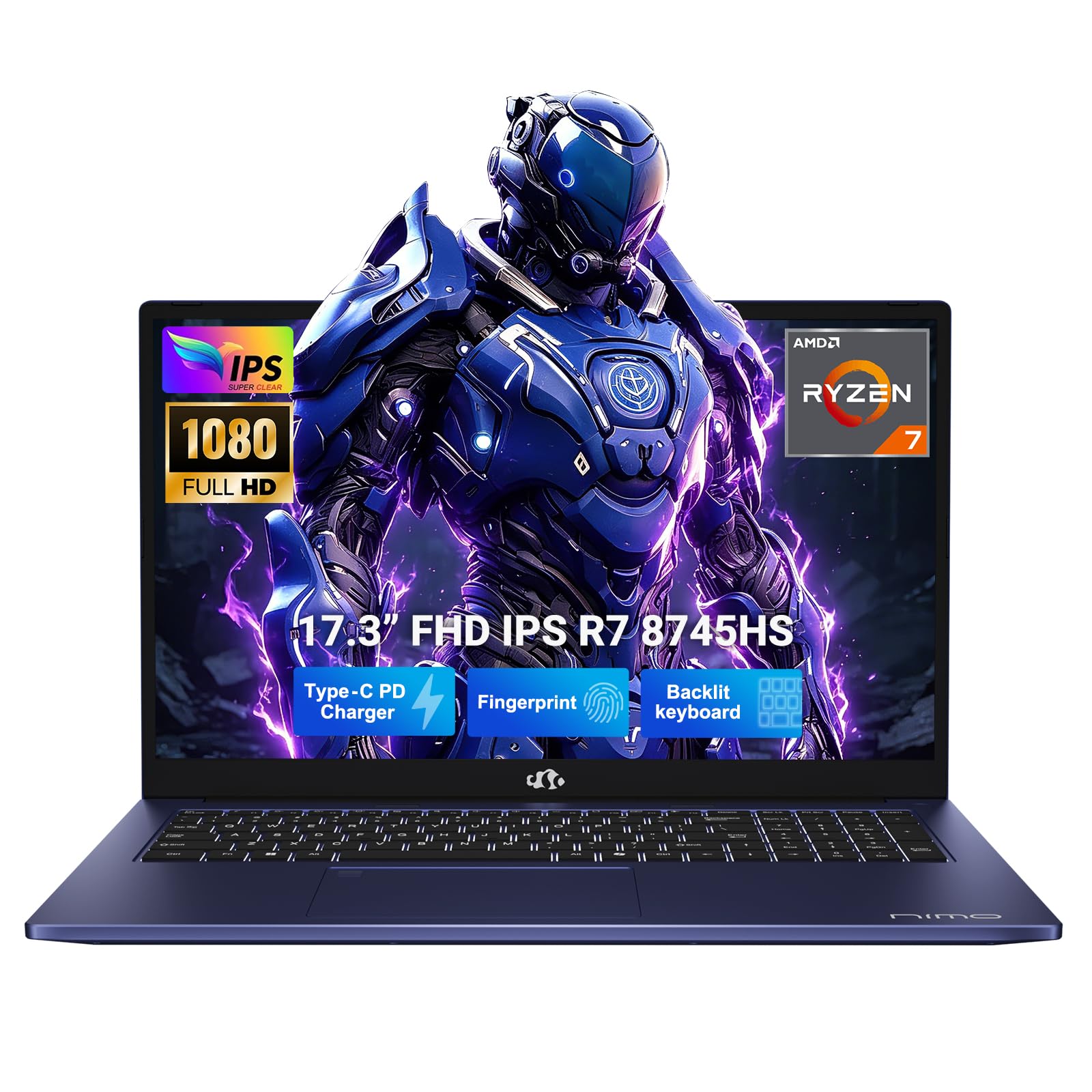
3. NIMO 17.3″ Light Gaming-Creator-Laptop
With 32GB of DDR5 RAM and an 8-core processor, this laptop gives you future-proof headroom that beats most desktops at this price.
This NIMO laptop uses an 8-core AMD Ryzen 7 8745HS processor that boosts to 4.9 GHz. For your drawing tablet, the integrated AMD Radeon 780M graphics are powerful enough to drive 4K displays and handle lightweight 3D modeling without needing a separate graphics card. The 32GB of DDR5 RAM is double the baseline of most machines, so you can keep 100+ layers, a browser with 30 tabs, and Spotify running without a hitch. The 1TB PCIe 4.0 SSD loads and saves projects fast. A network system engineer who bought one called it “absolutely the best choice I have made this year.”
The 17.3-inch display supports up to 4K resolution and has a 180-degree hinge, so you can lay it flat for client reviews. The 100W USB-C PD (Power Delivery) charging means you keep the battery topped through a single slim cable. A developer reviewer did flag that the case and touchpad attract fingerprints, but the consensus is the cooling system keeps the machine running cool under sustained load. The 2-year warranty and 90-day return period add confidence. The 32GB RAM gives this machine the most multitasking headroom in the mid-range – a 2.0x gap compared to the 16GB in the Acer ConceptD 3 Ezel, which can help if you run multiple heavy apps at once.
Spec-forward value: The Ryzen 7 8745HS + 32GB DDR5 combo beats Intel i7-1360P chips on multi-core tasks — more headroom for layer-heavy compositions.
One caution: The Radeon 780M is integrated graphics, not a dedicated GPU. Users running heavy 3D rendering or VR pipelines may hit its ceiling. For 2D illustration and 4K video editing, it sails.
Best for: Creative professionals who juggle large 4K asset libraries and want future-proof RAM capacity without paying for a dGPU they do not strictly need.
Who should pass: Anyone who requires a guaranteed discrete GPU for daily 3D scene work — the integrated Radeon 780M is strong but not a substitute for a GeForce RTX-class chip.
4. HP 27 inch All-in-One Desktop PC
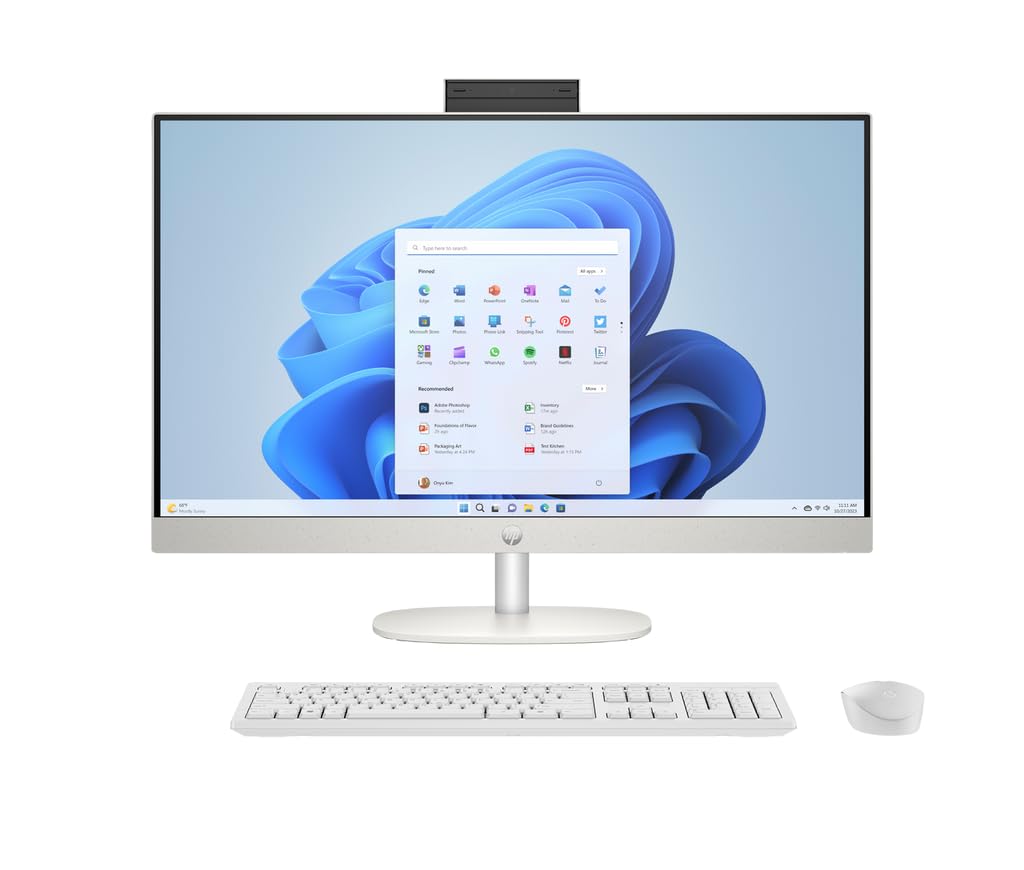
Your monitor is the computer, and it responds to your fingers — no tower, no cable mess, just plug in and draw.
This HP all-in-one solves cable clutter for drawing tablet users. The 27-inch 1920×1080 (FHD, or Full HD) IPS touchscreen covers 99% of the sRGB color space, so what you paint on screen matches prints. The AMD Ryzen 5 7520U processor and 16GB of LPDDR5 RAM handle everyday illustration and photo editing. A long-time HP user who replaced their Dell said setup took minutes and the machine “is the way to go.” The 1TB PCIe NVMe SSD gives you generous local storage. The built-in 1080p IR tilt privacy camera with noise reduction microphones makes this good for client walkthroughs too. The RAM is soldered and not upgradeable, so your workflow is capped at 16GB – a hard limit compared to the upgradeable 32GB in the Dell OptiPlex 7060.
One owner praised it for helping a visually impaired family member read emails — proof of the touch interface. The wireless keyboard and mouse keep the desk clean. The integrated AMD Radeon Graphics mean this is strictly for 2D and light 3D work. Do not expect smooth Blender viewport navigation on complex scenes.
Works from the start: Every review mentions straightforward setup. Connect your drawing tablet via USB or HDMI, and the touchscreen serves as a secondary reference canvas.
Know before you buy: The RAM is soldered and not upgradeable. If your workflow expands to 4K+ video or heavy 3D, you will need to replace the whole unit.
Choose this if: You want a tidy, family-friendly creative desktop with a touchscreen for occasional finger-brushing and the simplicity of a single plug.
skip it if: You plan to edit 4K timelines, run ZBrush, or work with files that push past 16GB of active memory.
5. MSI Creator Z16 Professional Laptop

An 8-core i9 and a dedicated RTX 3060 with 6GB of VRAM make this the pick for 3D rendering and heavy compositing on the go.
This MSI Creator Z16 is the most powerful machine here. It combines an 11th-gen Intel Core i9-11900H (8 cores, up to 4.9 GHz) with a dedicated NVIDIA GeForce RTX 3060 that has 6GB of video memory. That is enough GPU to handle 3D sculpting in ZBrush and viewport-heavy Blender scenes – the Acer ConceptD 3 Ezel‘s GTX 1650 with 4GB VRAM cannot match this for 3D rendering. The 16-inch QHD+ (Quad HD Plus) display runs at a 120Hz refresh rate and supports touch, so scrolling feels fluid. The 16:10 aspect ratio gives you extra vertical space for toolbars.
The 32GB of RAM and 2TB NVMe SSD mean you can keep your entire project library local. The Thunderbolt 4 port (up to 40Gbps, for fast data and display) connects to an external drawing tablet with zero latency. Owners consistently report the aluminum chassis runs hot under sustained load, and the battery drains fast – about four hours of browsing, less during render work. A few owners mention USB port issues and screen glitching on individual units. The 2TB NVMe SSD is 4x the capacity of the Acer ConceptD 3 Ezel‘s 512GB drive, which is a big advantage if you work with large project files.
Uncompromised workstation power: The RTX 3060 alone puts this in a different league from integrated-graphics machines — real-time 3D, GPU rendering, and large-film simulations are all on the table.
The heat is real: Customers note the i9 processor runs extremely hot, making lap use difficult and sustained rendering a thermal challenge. Expect to stay plugged in.
Choose this for: 3D artists, animators, and video editors who need a portable machine that can render on-the-go and drive a high-resolution external drawing tablet.
Think twice if: Your work is primarily 2D illustration — the premium for the RTX 3060 and i9 is unnecessary, and the heat/battery trade-off will frustrate you.
6. Microsoft Surface Studio 2 (Renewed)

A 28-inch touchscreen that tilts into an easel — the closest to a Cintiq that runs Windows, with 13.5 million pixels for true-to-life detail.
The Surface Studio 2 is the only all-in-one built for digital art. Its 28-inch PixelSense display has a dense 4500×3000 resolution – over 13.5 million pixels – which makes fine lines appear at true print resolution. The whole screen tilts from upright down to a 20-degree Studio Mode, turning it into a drafting table. Owners describe the hardware as “well-executed” and say the graphics are “superior to Apple.” A beginner graphic designer called it “100% worth the price” and reports it handles demanding Blender, AutoCAD, and ZBrush files without maxing out. The 4500×3000 resolution is a huge jump from the Acer ConceptD 3 Ezel‘s 1920×1080, giving you far more canvas detail.
Inside sits an Intel Core i7-7820HQ processor with a dedicated NVIDIA GeForce GPU and 16GB of RAM, plus a 1TB SSD. The integrated Surface Pen and Surface Dial support give direct-on-screen drawing. This is a renewed (refurbished) unit. A few buyers noted fingerprints on the screen from previous use, but the consensus is it “looks and performs like new.” The 7th-gen Core i7 is older, so single-core speed lags behind modern chips like the NIMO‘s Ryzen 7 8745HS, and renewed units carry the risk of earlier wear. For studio artists at a single desk, this still has no direct competitor.
class-leading canvas size: No other computer on this list gives you a 28-inch tilting touchscreen with 4500×3000 resolution — it is a standalone digital drafting table.
Old hardware, big footprint: The 7th-gen Core i7 shows its age against modern chips, and the all-in-one design means you cannot upgrade components individually. If you need raw CPU speed for rendering, a modern laptop will beat it.
Your studio companion: You want a dedicated creative workstation where the screen itself is your canvas, and you value size and build over raw component performance.
Not for road warriors: This is a desktop-only device — no battery or portability. If you work in multiple locations, a laptop with a drawing tablet is smarter.
7. DELL Optiplex 7060 SFF Desktop Computer PC (Renewed)

An 8th-gen i7 with 32GB of RAM at a budget price — more memory for heavy layer work than any other machine in its class.
This small-form-factor Dell OptiPlex 7060 packs a 6-core 8th-gen Intel i7-8700 processor that boosts to 4.6 GHz, 32GB of DDR4 RAM, and a 512GB NVMe M.2 SSD. That is enough CPU and memory for heavy layer-based painting and running multiple art apps. Owners call the performance “lightning fast.” One noted the compact tower is “perfect to use right from the start for almost anything” and “super quiet.” The 32GB RAM gives this machine the most multitasking headroom at its price – twice the capacity of the Dell OptiPlex RGB Desktop below, whose 16GB RAM is common in entry-level machines, making this a better fit for serious work.
The graphics run on integrated Intel UHD Graphics 630, which handles 2D art and standard displays up to 3840×2160 but struggles with 3D workloads. The included wireless keyboard and mouse are basic – one owner described them as “poor quality but functional.” A few buyers had connectivity issues from the start, a risk with any refurbished electronics. The 12MB L3 cache (Level 3 cache, a small pool of fast memory on the processor for repeated tasks) is 2.0x larger than the Dell Optiplex RGB Desktop‘s 6 MB, which helps with repeated layer operations.
Best value-per-dollar in RAM: 32GB of DDR4 for this price is rare — you can keep 100+ layers, a browser with 30 tabs, and Spotify running without a hitch.
Buyer reality check: This is a refurbished unit with a mixed track record on accessories and wireless connectivity. The core machine is excellent; the included peripherals may disappoint.
Perfect for: The budget-conscious digital artist who already owns a good drawing tablet and a monitor, and just needs a powerful box to run the software.
Wrong for: Anyone who needs built-in Wi-Fi reliability from the start or wants a polished all-in-one experience with premium peripherals.
8. Dell OptiPlex Desktop RGB Computer PC (Renewed)

The cheapest way to get a monitor, keyboard, mouse, and headset with a desktop that boots Windows 11 — everything you need to start learning digital art.
This Dell OptiPlex bundle is the entry point: a third-generation Intel Core i7-3770 (3.40 GHz) with 16GB of RAM and a 512GB SSD, paired with a 24-inch HDMI monitor, an RGB keyboard and mouse, and a headset. It is a complete workstation for someone who has no computer at all. The RGB front panel with a remote controller adds some flair, and Windows 11 Pro is ready to go. For a beginner learning digital painting with a small tablet, this removes every barrier of piecemeal shopping.
The performance feedback is divided. Several owners call it “great quality and great price” for everyday tasks. But the complaints are real: it has integrated graphics, multiple reviewers point out random crashes and stability issues, and the Wi-Fi is problematic – one buyer could not stay connected. As the review pages sum it up: “Horrible gaming computer. WiFi issues and games can’t always play.” For basic 2D art with a light layer count, it might be enough. The 6 MB cache is a third of the OptiPlex 7060‘s 12 MB, which shows in slower repeated operations. This is a teaching tool, not a professional workstation.
All-in-one starter kit: Monitor, input devices, headset, and Windows license included — zero extra purchases needed to start drawing.
Performance is the limit: The 3rd-gen processor and integrated graphics struggle with modern creative software. This is a learning tool, not a professional workstation.
Who it fits: Absolute beginners or young artists who need a complete budget setup to learn the basics of digital art and don’t expect to render heavy files.
Who should skip: Anyone with a serious creative practice — the stability and performance issues will become a barrier within weeks.
Understanding the Specs
Processor Speed
The processor (CPU) interprets your pen inputs and renders brush strokes in real time. For digital art, you want a high single-core clock speed of 4.0 GHz or higher, because most art apps rely on one or two fast cores. An 8th-gen Intel Core i7-8700 at 4.6 GHz, for example, will feel more responsive in Photoshop than a newer but slower-clocked budget chip. For 3D modeling, more cores help with rendering, but per-core speed still matters most for daily pen interaction.
Dedicated vs. Integrated Graphics
Integrated graphics (built into the processor, like Intel UHD or AMD Radeon Graphics) share the system’s main RAM and are fine for 2D illustration and 1080p video. Dedicated graphics (a separate GPU card like the NVIDIA GeForce RTX 3060) have their own video memory (VRAM) and handle 3D viewport rendering and high-resolution external monitors smoothly. If you work in Blender, ZBrush, or DaVinci Resolve, a dedicated GPU is worth it; for 2D painting, integrated graphics are sufficient.
RAM Size and Type
RAM (Random Access Memory) holds your active project. A 5000×5000-pixel file at 300 DPI with 20 layers can use 8GB of RAM on its own. With an OS and browser open, 16GB is the minimum for comfortable work. 32GB gives you headroom for larger canvases and multiple programs. DDR5 RAM is faster than DDR4, but for most 2D work, capacity matters more than speed.
Display Color Accuracy
For artists who print or deliver to clients, accurate screen colors are critical. The sRGB percentage (99% or higher is good) and Delta E value (under 2 is excellent) tell you how closely on-screen color matches a calibrated standard. Pantone Validation means the display was factory-tested to reproduce Pantone swatches accurately. A high-resolution display (at least 1920×1080 on a 27-inch screen) gives you more canvas real estate for palettes and toolbars.
FAQ
Does my drawing tablet need a specific type of computer to work?
Can I use a drawing tablet with a laptop that has integrated graphics?
How much RAM is enough for digital painting?
Is a touchscreen laptop good enough for digital art?
Do I need a computer with an HDMI port for my drawing tablet?
Will a refurbished or renewed computer work for digital art?
What is the difference between a creator laptop and a gaming laptop for art?
Can I use an Apple computer (Mac/MacBook) with a drawing tablet?
Final Thoughts: The Verdict
Across the board, the computer for drawing tablet winner is the Acer ConceptD 3 Ezel because it combines a Pantone-validated touch display, a Wacom AES pen, a dedicated GPU, and a portable form factor into one package that removes the separate-tablet friction entirely. If you want raw budget value with 32GB of RAM and a fast processor for a permanent desk setup, grab the <
Related Guides

Mo Maruf
I created WellFizz to bridge the gap between vague wellness advice and actionable solutions. My mission is simple: to decode the research and give you practical tools you can actually use.
Beyond the data, I am a passionate traveler. I believe that stepping away from the screen to explore new environments is essential for mental clarity and physical vitality.