Our readers keep the lights on and my smoothie glass nicely filled. As an Amazon Associate, I earn from qualifying purchases.
Specs are compiled from manufacturer listings and verified buyer reviews and can change over time — please confirm the key details on the product page before buying.
Choosing your first CNC machine is a leap from thinking about making things to actually making them. But the market is crammed with options that look identical on a screen and feel completely different once you try to cut actual aluminum or hardwood. This guide cuts through the noise to find the machine that delivers real rigidity, usable precision, and a support network that has your back when something goes wrong.
I’m Mohammad Maruf — the founder and writer behind WellFizz. This guide is built by comparing the manufacturers’ published specifications and the patterns across verified customer reviews, so you get each pick’s real strengths and trade-offs instead of marketing spin.
Whether you are carving circuit boards, aluminum signs, or guitar bodies, understanding the spindle power, frame rigidity, and working area is the difference between a tool you outgrow in a month and one that grows with you. This breakdown of the best CNC machine options lays out exactly where your money matters most.
Our Picks at a Glance
How To Choose The Best CNC Machine
Every CNC purchase is a trade-off between rigidity, power, and working area. A machine with a flimsy frame will vibrate at high speeds, ruining surface finish and breaking bits. A weak spindle will stall on hardwoods and aluminum. A small bed limits what you can make. Here are the three specs that matter most.
Frame Rigidity and Linear Motion
The frame is the foundation. Look for all-metal construction — ideally steel or thick aluminum extrusion. Machines with V-slot wheels are lighter and cheaper but wear faster and introduce play. Linear rails (HG-15 or MGN-15) on all axes are the mark of a serious machine. Dual linear rails on each axis are even better for handling lateral forces during metal cutting.
Spindle Power and Collet System
The spindle determines what you can cut. A 300W brushed spindle is enough for wood, plastics, and light engraving. An 800W trim router or 1.5kW spindle is needed for aluminum and steel. The collet size (ER11 is standard) determines which bit shanks fit. A variable-speed spindle (RPM control) lets you match speed to material so you don’t burn wood or chatter on metal.
Working Area and Expandability
Measure twice, buy once. A 400x400mm bed fits small signs and circuit boards. A 600x500mm bed handles guitar bodies and larger furniture panels. Check if the manufacturer offers an extension kit — this lets the machine grow with your projects. Also consider Z-axis height: a taller Z lets you engrave thicker stock or add a rotary attachment for cylindrical objects like mugs.
Quick Comparison
| Model | Best For | Spindle Power | Working Area | Frame Material | Amazon |
|---|---|---|---|---|---|
| TTC6050★ Best Overall | Professional Work | 500W | 23.6″ x 19.6″ | Aluminum Alloy | Amazon |
| FoxAlien Masuter ProBudget Champion | Beginners | 300W | 15.75″ x 15.75″ | Aluminum | Amazon |
| Genmitsu 4040-PROBest Upgrade Path | Entry-Level Metal | 300W | 15.7″ x 15.7″ | Steel HSS Frame | Amazon |
| Twotrees TTC450 Pro | Large Signage | 80W (775 motor) | 18.1″ x 18.1″ | Aluminum & Steel | Amazon |
| Genmitsu PROVerXL 4030 | Hobbyist Workhorse | 300W | 15.7″ x 11.8″ | C-BEAM Aluminum | Amazon |
| AnoleX 3030-Evo Max | Metal Cutting | 800W | — | Aluminum | Amazon |
| SainSmart 4040-PRO MAX | High-Pass Height | 710W | 16.1″ x 15.9″ | Metal | Amazon |
| FoxAlien Masuter 3S | Speed & Precision | 400W | 15.75″ x 15.75″ | Reinforced Extrusions | Amazon |
In‑Depth Reviews
1. TTC6050 CNC Router Machine
Our pick — over 4.5★ from 50+ verified ratings; the strongest balance of quality and price.
A 500W spindle paired with a 600x500mm bed that brings pro-level capacity to serious hobbyists.
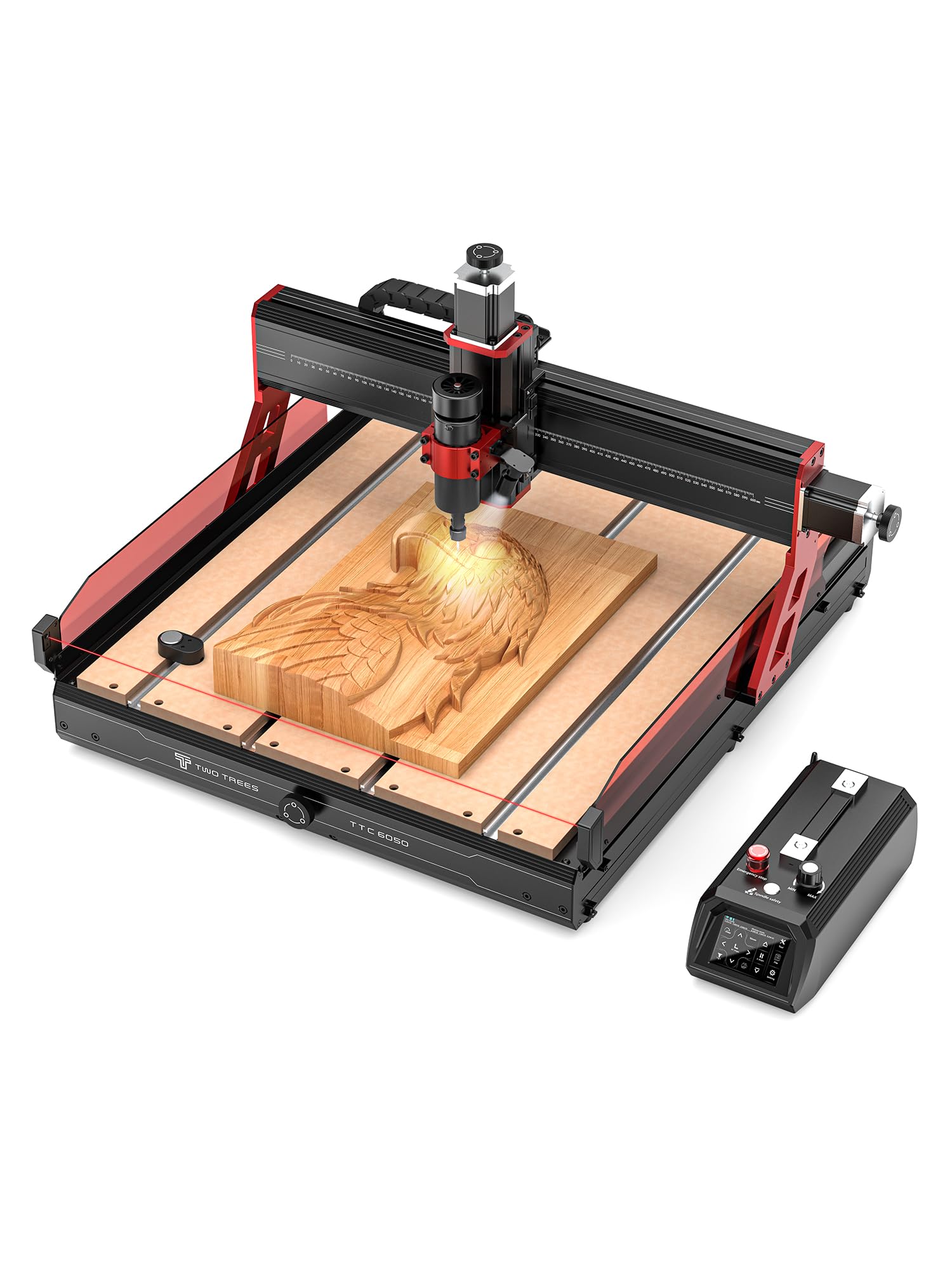
This machine obliterates the cramped-bed problem. The 600x500x100mm (23.6″ x 19.6″ x 3.9″) working area lets you tackle full-size furniture panels and large signage without repositioning. The 500W spindle spins up to 30,000 RPM and accepts tool shanks from 0.5mm up to 6mm via the ER11 chuck. Buyers report that the GRBL control with the 3.5-inch touchscreen makes switching between CNC and laser modes straightforward — no firmware reflash required. Wi-Fi 2.4G and TF card offline operation mean you are not tethered to a laptop.
The 98.8-pound weight and aluminum alloy frame with C7-grade ball screws give it the rigidity to cut carbon fiber, aluminum, copper, and even stainless steel at a positioning accuracy of 0.01mm on X/Y and 0.0025mm on the Z-axis. The engraving speed tops out at 5000mm/min. Some owners note that the included bits are basic — you will want to invest in quality carbide tooling for serious metal work. The machine carries CE, ROHS, and FCC certifications, plus infrared sensors and microswitch limiters for safety.
Put simply: this is the most machine you can get for the money if you need a large bed and real metal-cutting capability. The crowd favors it heavily, with the highest average rating in the lineup.
Why It Leads
- Massive 600x500mm work area handles furniture-sized pieces
- 500W spindle with up to 30,000 RPM cuts metals reliably
- Built-in Wi-Fi and TF card slot for untethered operation
Things to Know
- Heavy 98.8-pound frame needs a sturdy table
- Stock bits are basic; upgrade for serious metal work
- A few owners mention needing technical support for setup
Reach for this if: You want a large-bed, metal-capable machine that can grow with you from wood to stainless steel.
Think twice if: You are on a tight budget or have limited workspace — this unit demands both floor space and a firm foundation.
2. FoxAlien Masuter Pro
The 15-minute assembly and quiet operation that makes this the go-to for beginner CNC users.
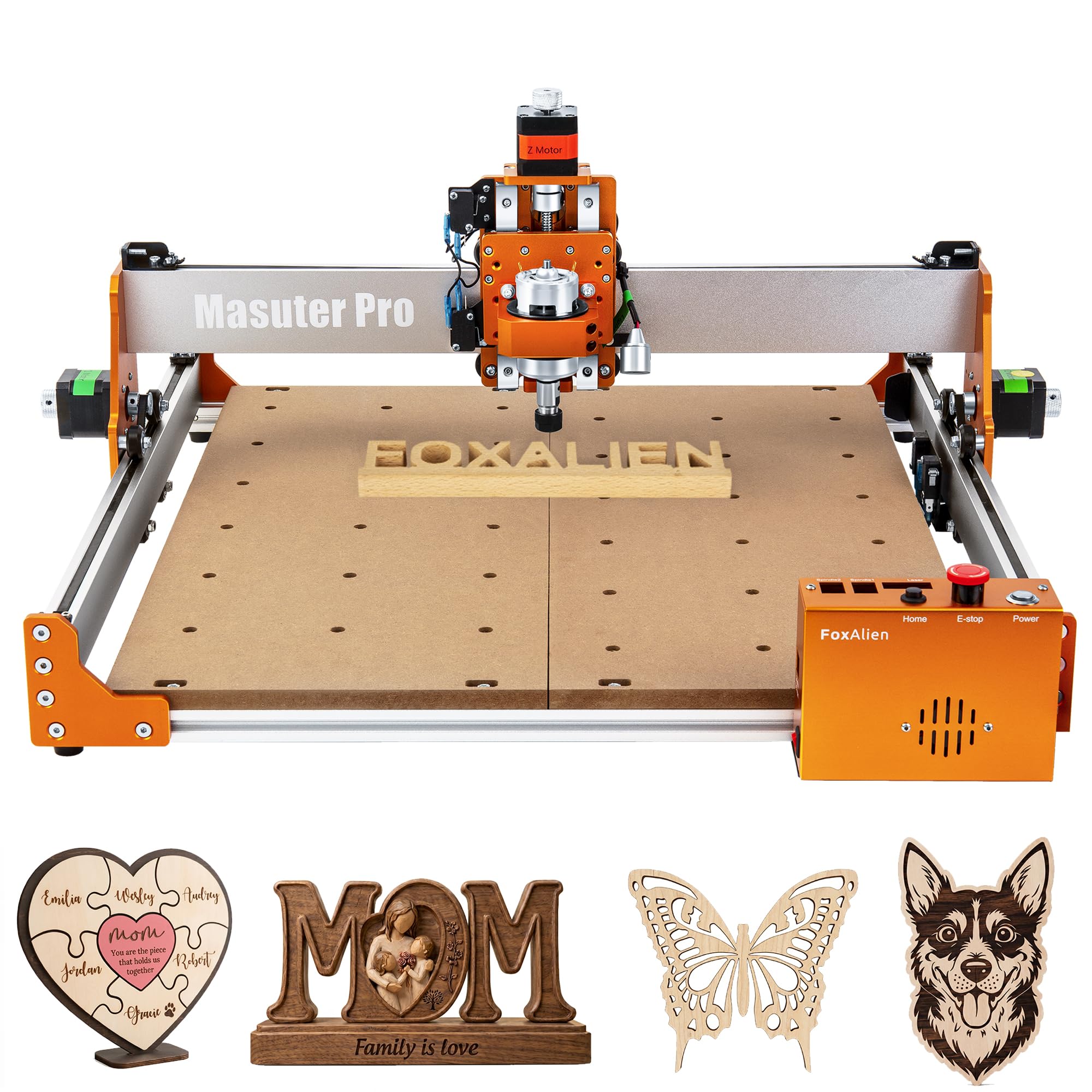
Two things stand out immediately: the all-aluminum frame and the dust-proof controller box with dedicated emergency stop and home buttons. The linear rail Z-axis reduces play compared to the V-slot wheels on cheaper machines. Assembly is genuinely fast — the main parts arrive pre-assembled with pre-wired connections, and a detailed manual guides you through the rest in roughly 10 to 15 minutes. The work area is 15.75″ x 15.75″ x 2.36″ (400 x 400 x 60mm), which is generous for a machine at this price point. It supports 60W and 300W spindles from the start, and you can upgrade to a 1.5KW spindle later via the 65mm clamp.
The thing owners praise most is the build quality — 69 mention it positively. The frame is stable enough to cut wood, acrylic, MDF, nylon, and even light aluminum with careful feeds and speeds. At 13 kilograms (28.6 pounds), it is light enough to move around but heavy enough to stay put during cuts. The 300W spindle spins at a maximum of 10,000 RPM, which is slower than some competitors but perfectly adequate for plastic and wood work. A few owners mention that the included collet is only 1/8-inch, so you will need to buy additional collets for larger bits. Compared to the Genmitsu 4040-PRO, the Masuter Pro is 7.84 kilograms lighter (13kg vs 20.84kg) and has a wider 26-inch width versus 15.7 inches.
The consensus is clear: this is the best entry point if you want a solid foundation you can upgrade later without replacing the whole machine.
What Owners Love
- Fast 10–15 minute assembly with pre-wired components
- All-aluminum frame with linear rail Z-axis for stability
- Accepts spindle upgrades up to 1.5KW via 65mm clamp
What to Keep in Mind
- Only includes a 1/8-inch collet; buy additional sizes separately
- 10,000 RPM spindle is slower than some competitors
- Work area is small for large furniture or signage
Grab this for: A first CNC that is easy to set up, upgradeable, and stable enough for wood and acrylic projects.
Skip it for: Heavy production use or cutting hard metals — the spindle speed and frame rigidity have limits.
3. Genmitsu CNC Router Machine 4040-PRO
A steel-frame machine that lets you swap spindles and add a 4th axis as your skills grow.
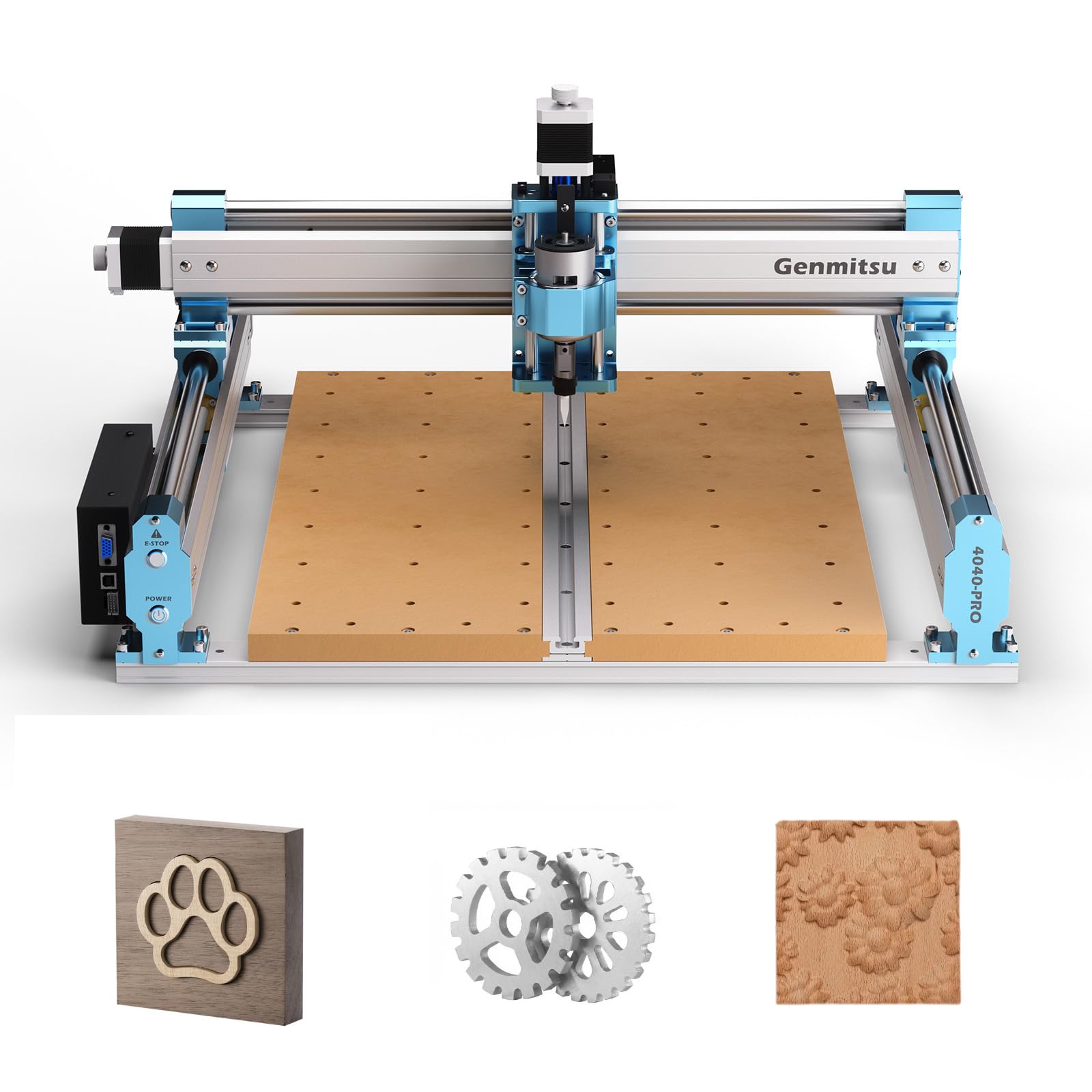
The defining feature here is the steel HSS frame with two 16mm steel linear tubes per axis and dual Y-axis rails. This structure is noticeably stiffer than the aluminum extrusion found on budget machines — the Genmitsu 4040-PRO weighs 20.84 kilograms versus 13 kilograms for the FoxAlien Masuter Pro, meaning it absorbs vibration better during aggressive cuts. The control box uses a Toshiba TB6S109 driver with a 32-bit chip and includes ports for an air assist pump and MPG handwheel. It comes with 42mm and 52mm spindle mounts, compatible with the stock spindle and 300W spindles, plus optional 65mm and 69mm mounts for router upgrades.
The 15.7″ x 15.7″ x 3.1″ working area is nearly identical to the Masuter Pro in width and length, but the Z-axis height of 3.1 inches is roomier than the FoxAlien’s 2.36 inches — a real advantage when cutting thicker stock. Build quality is the top positive aspect among owners, but durability and spindle quality get mixed and negative marks. Several customers note that the stock spindle is weak and recommend upgrading to a trim router for serious hardwood or aluminum work. The spoilboard uses two replaceable MDF boards, so you only swap the damaged half rather than the whole surface. One long-time owner noted that the oil from the linear bearings can stain the spoilboard — put down a sacrificial layer.
For shop space, its 15.7-inch width is a full 10 inches narrower than the Masuter Pro, so it tucks into tighter areas. This is a machine for the owner who plans to mod and upgrade — start with the 4040-PRO, add a router, then bolt on the 4th axis rotary module for cylindrical carving.
Solid and Scalable: The steel frame and dual Y-axis rails give it a rigid foundation that few machines at this price match. Expect to budget for a spindle upgrade if you cut hardwoods or aluminum.
Ideal for: Tinkerers who want a sturdy chassis they can upgrade with routers, 4th-axis modules, and Wi-Fi later.
Not for: Beginners who expect everything to work perfectly from the start with no tweaks or upgrades.
4. Twotrees TTC450 Pro
A 3.5-inch capacitive touch screen makes this the most approachable CNC for newcomers.
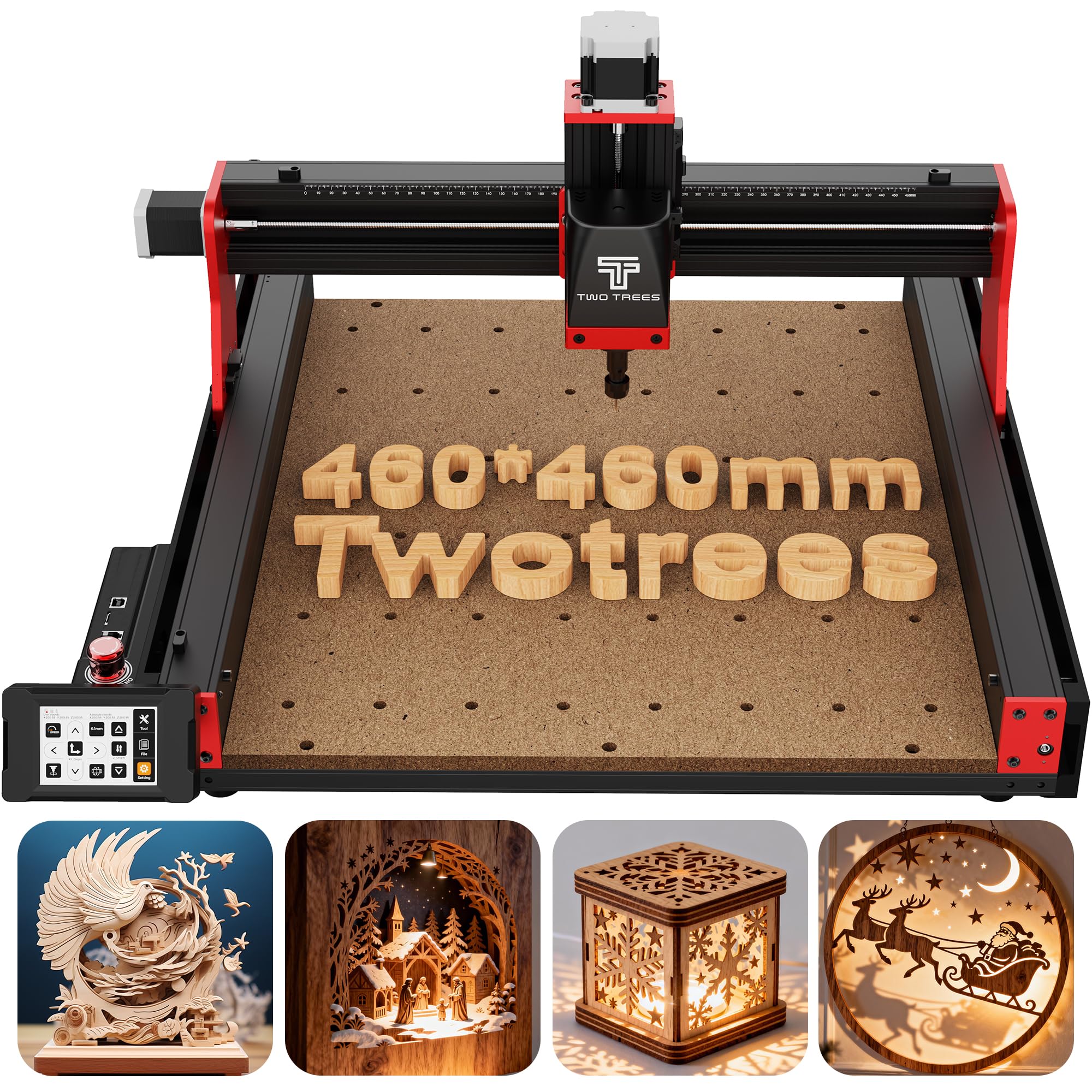
The headline feature is the responsive 3.5-inch IPS capacitive touch screen on the control box — it puts motion control, speed adjustment, tool setting, and laser/CNC switching right under your finger. No digging through G-code senders on a laptop. The control box also has dedicated expansion ports for a 4th-axis rotary module, a laser module, and a 500W spindle speed control so you can upgrade without swapping boards. The working area is an extra-large 18.1 inches square (460 x 460 x 80mm), giving it more X/Y space than the 15.7-inch machines above.
Construction uses aluminum alloy and stainless steel with dual limit switches on all three axes. The Z-axis is driven by a 57 stepping motor with a positioning accuracy of 0.0025mm, which is excellent for detailed relief work. The 775 brushed spindle motor is rated at 80W — that is enough for wood and acrylic but underpowered for anything harder. The included 10 cutting tools, 6 clamping plates, and test materials get you started, but the consensus is you will want to upgrade to the optional 500W spindle port for aluminum or steel. Quality control earns the most positive mentions, though some owners note that the manual is poor and the 24VDC power supply is barely adequate — plan on a power supply upgrade if you run heavy jobs.
At 20.5 kilograms, it is nearly identical in weight to the Genmitsu 4040-PRO but offers a larger bed and a far better user interface. It also carries CE, FCC, and RoHS certifications for global compliance.
Tactile Advantage
- Capacitive touch screen eliminates laptop dependency
- Expansion ports for 4th axis, laser, and 500W spindle
- Large 18.1″ square bed for signage and panels
Reality Check
- Stock 80W spindle is too weak for metals
- Power supply is under-specced; plan an upgrade
- Manual is incomplete — YouTube becomes your manual
Perfect for: Beginners and educators who want a large bed and a user-friendly interface without relying on a computer.
Not ideal for: Anyone planning to cut aluminum or steel from the start — budget for a spindle and power supply upgrade.
5. Genmitsu PROVerXL 4030

A rigid C-BEAM frame with NEMA 23 steppers that upgrades from 15.7 inches to 40 inches as you grow.
This machine is built around the C-BEAM aluminum extrusion, which is significantly stiffer than the V-slot or round-rail frames on cheaper CNCs. The Z-axis uses an optical-axis drive, and the Y-axis has a dual-screw drive — both contribute to the excellent rigidity that owners rave about. It ships with a 300W spindle, NEMA 23 stepper motors, and pre-assembled XYZ modules that cut assembly time to about 2.5 hours. The working area is 15.7″ x 11.8″ x 4.3″, which is narrower in Y than the 4040 machines but taller in Z for thicker material. The included adapter fits a DeWalt DWP611 router drop-in, so you can swap the spindle for a 1HP+ router for heavier cutting.
Weight is a hefty 31 kilograms — that is over 68 pounds of mostly aluminum and steel, which means it sits planted during aggressive cuts. The machine includes XYZ limit switches, an emergency stop, speed control, and a Z-probe. The real advantage is the upgrade path: you can buy extension kits to get to 24″ x 24″ or up to 40″ x 40″. One owner reported that after 150 hours of use, a Z-axis limit wire harness broke, and SainSmart sent a free replacement within a week — the support is a recurring theme. The stock 300W spindle is fine for engraving, but almost everyone recommends upgrading to a router for any real cutting. Some users experienced driver incompatibility with Mac and sensitivity to voltage changes.
For the weight and upgradeability, this is the workhorse of the Genmitsu lineup. The smaller Y-axis bed is the trade-off — if you need 15 inches in both directions, the 4040-PRO or PRO Max are better fits.
Sturdy Foundation
- Rigid C-BEAM frame and dual Y-axis screws dampen vibration
- Upgradeable to 24″ or 40″ working area
- DeWalt DWP611 router mount included
Watch Out For
- 300W spindle is underpowered for deep cuts
- Y-axis width is only 11.8 inches
- Voltage-sensitive controller can stop mid-job
Best for: Hobbyists who want a heavy, rigid platform they can expand over time and upgrade with a real router.
Consider alternatives if: You need a full 15-inch Y-axis or cannot handle a 68-pound machine on your workbench.
6. AnoleX 3030-Evo Max
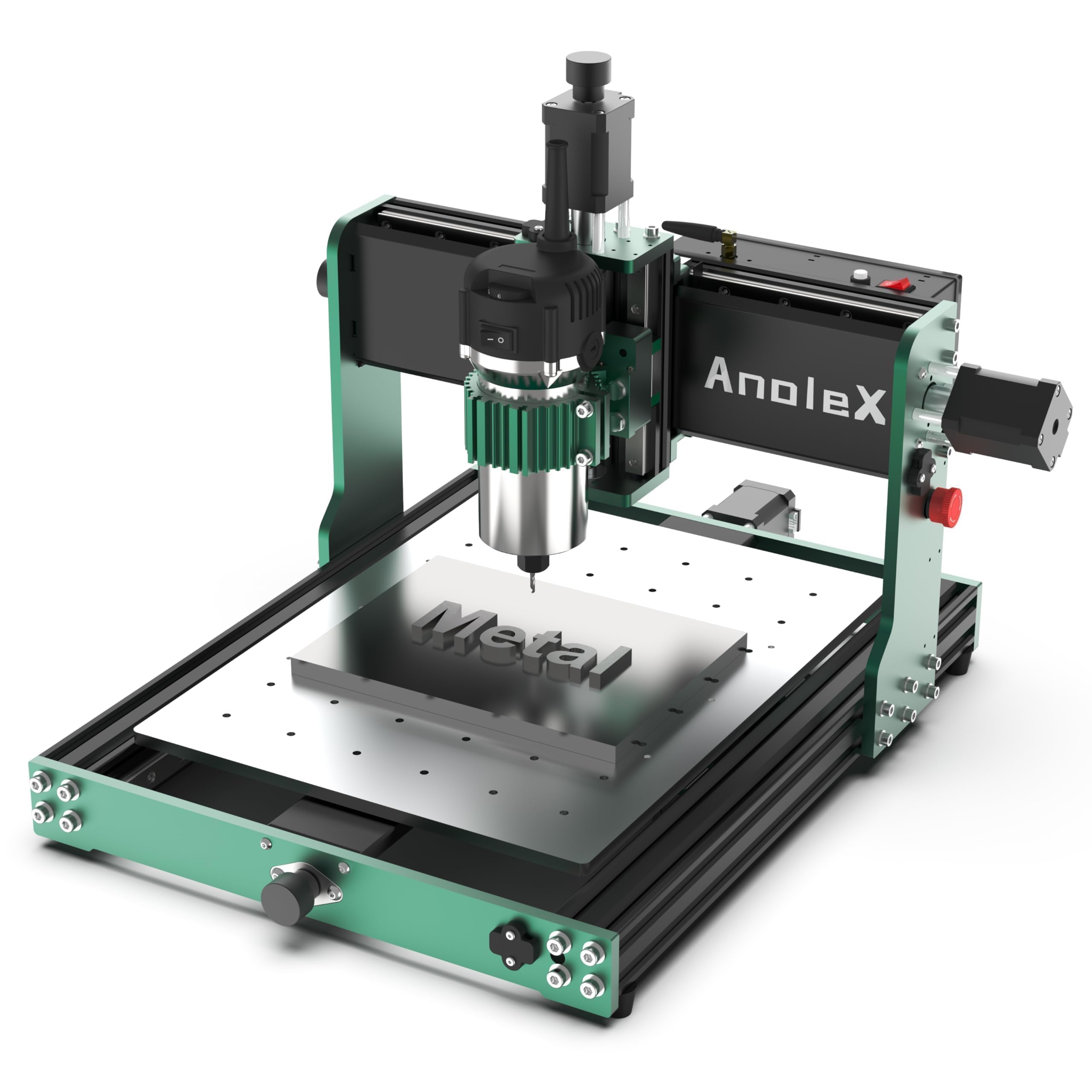
An 800W trim router and dual MGN-15 linear guides on every axis for serious metal cutting.
Most machines in this range ship with a 300W spindle. The 3030-Evo Max delivers an 800W trim router with six speed settings from 8,000 to 24,000 RPM. That is enough power to cut 6061 aluminum plate with a verified accuracy of ±0.05mm. Each axis uses dual MGN-15 linear guides and T8 lead screws, so the motion system is overbuilt for its size. You can upgrade further to closed-loop NEMA 17 motors to eliminate step loss entirely. The repeatability accuracy is ±0.01mm.
The control board runs GRBL 1.3a firmware on a 32-bit ESP32 MCU with built-in Wi-Fi. You can control the machine from your PC, smartphone, or tablet without a USB cable. The macro buttons on the controller are reprogrammable for tasks like homing, pause, or running G-code from the SD card. Build quality is the top positive aspect among owners — 16 mention it positively. Several owners successfully cut steel (4140, 316 stainless, O1 tool steel) with correct feeds, speeds, and carbide bits. The main trade-off is the small 3030 bed size. At 19.72 inches wide and 39.5 pounds, it is compact enough for a desktop. The T8 lead screws have small dead spots that can affect multi-setup repeat accuracy — upgrading to 1204 ball screws solves it.
This machine cuts harder materials than almost any other in its price class, but the small bed and lead screw quirks mean it is best for small metal parts and precision work.
Metal-Cutting Muscle
- 800W trim router with 6 speeds up to 24,000 RPM
- Dual MGN-15 linear guides on all axes for rigidity
- Built-in Wi-Fi and ESP32 control board for wireless operation
Constraints
- Small 3030 bed limits project size
- T8 lead screws have dead spots; ball screw upgrade recommended
- Software bugs can cause random homing — use the E-stop
Reach for this when: Your primary material is aluminum, brass, or steel and you need a machine that can handle it without an immediate spindle upgrade.
Look elsewhere if: You need a large bed for furniture or signage — the 3030 area is restrictive.
7. SainSmart Genmitsu 4040-PRO MAX
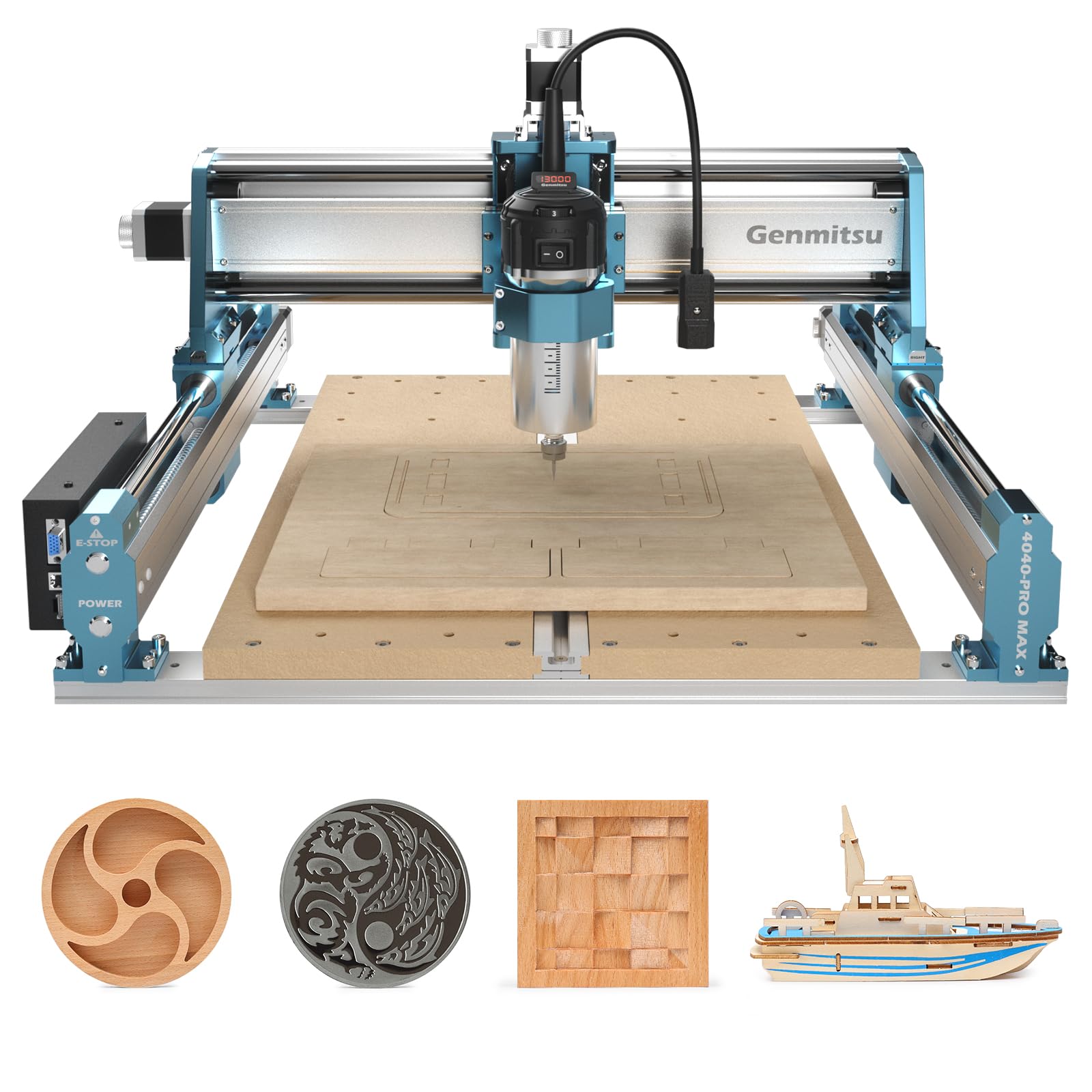
A 100mm pass height (versus the standard 4040-PRO’s 78.7mm pass height) — for engraving mugs and thick stock.
The standout spec is the 100mm pass height. That is over 40% higher than the standard Genmitsu 4040-PRO, which means you can engrave taller materials, add a rotary attachment later, or work with thicker boards without worrying about the Z-axis bottoming out. The machine runs a 710W digital display compact router for power, and the linear guideway structures on the X and Z axes improve motion stability during fast operations. The spoilboard has a reinforced central aluminum T-track bar that prevents the MDF from sagging under load — a thoughtful detail that also gives you an extra clamping option.
Assembly takes about 45 minutes according to owners, and the accuracy is notable — one owner measured +/-0.01mm with minimal backlash. The machine works with Easel, FreeCAD, Carveco, and Vectric software. The 710W router is a significant step up from the 300W spindles on the base 4040 models, giving you real cutting power for hardwoods and soft metals. The major safety caveat is that if you cut all the way through your material, the bit can hit the metal bed and cause tool damage or injury — you need a spoilboard and careful Z-height management. Some units shipped with the router having 0.3mm runout, but support swapped it quickly.
At 4 amps and 0.95 horsepower, this is a serious step up in cutting capability while keeping the same 16-inch footprint.
Tall and Powerful: The extra Z-height and 710W router make it the best choice if you frequently work with thick materials or plan to add a rotary axis. Just watch your Z-height during full through-cuts.
Best for: Users who need to engrave taller stock, cylinders, or thicker wood than the standard 4040-PRO allows.
Skip if: You are a raw beginner — the through-cut safety risk demands attentiveness.
8. FoxAlien Masuter 3S
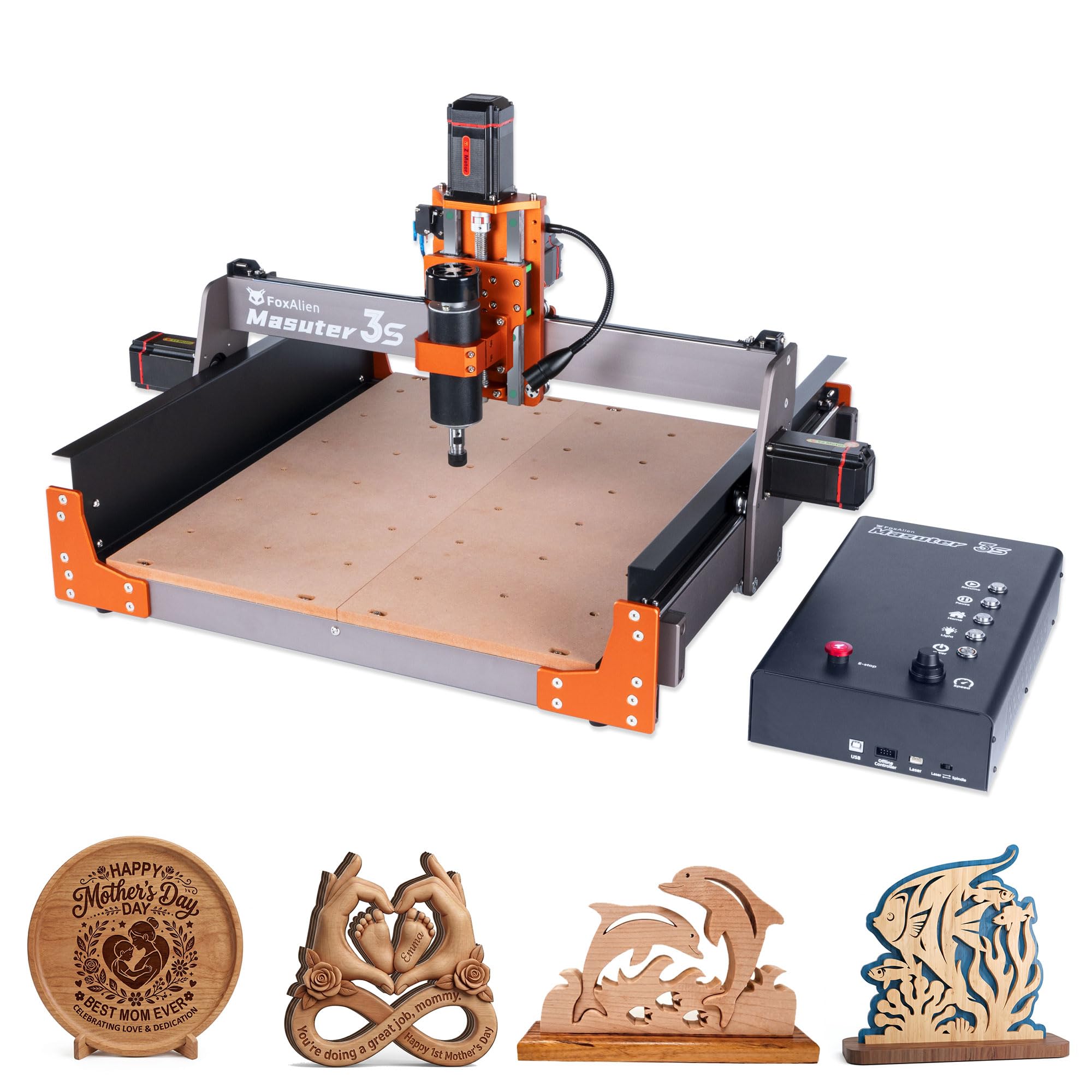
NEMA 23 closed-loop steppers that eliminate step loss while hitting rapid moves of 10,000mm per minute.
The Masuter 3S is the speed-focused sibling in the FoxAlien lineup. The NEMA 23 closed-loop stepper motors deliver 2.2 Nm of torque and eliminate step-loss — a common problem on open-loop systems where the motor loses position during aggressive cuts. The rapid movement speed reaches 10,000mm/min, compared to the TTC6050’s 5,000mm/min. The Z-axis uses dual HG-15 linear rails and a T12 lead screw that minimizes vibration and wobble, achieving an engraving precision of 0.05mm. The frame is built with reinforced 2360mm extrusions for rigidity.
The 400W spindle handles wood, plastics, and soft metals like aluminum, and the 65mm clamp means you can upgrade to a handheld trimmer or 1.5kW spindle. The machine supports the 4th Axis Rotary Module (sold separately) for cylindrical carving on mugs and chess pieces. The working area is 15.75″ x 15.75″ x 3.74″. The dust-proof controller box has tactile shortcut buttons and is compatible with an offline controller for PC-free operation. Owners consistently call out the assembly as straightforward — about 30 minutes with photo instructions — and the customer support as excellent. The stock 48V spindle maxes out at 10,000 RPM, which slows down programs that expect higher speeds for small bits.
The closed-loop motors and fast rapids make this the best choice if you want to minimize cycle times without sacrificing precision. It weighs 26.5 kilograms, so it is portable enough to move but heavy enough to stay put.
Need for Speed
- Closed-loop NEMA 23 motors prevent positional loss
- 10,000mm/min rapid moves speed up production
- Supports 4th axis rotary and laser upgrades
Speed Bumps
- Stock 48V spindle maxes at 10,000 RPM
- Some owners had reliability issues with early units
Reach for this if: You want fast cycle times, closed-loop reliability, and the ability to add a rotary axis for cylindrical engraving.
Hold off if: You need high-RPM spindle speeds for small-diameter bits — consider the AnoleX 3030-Evo Max instead.
Understanding the Specs
Spindle Power and RPM
The spindle is the motor that spins your cutting bit. Power is measured in watts (W) or horsepower (HP). A 300W spindle is good for wood, plastics, and light engraving. An 800W trim router or a 1.5kW spindle can cut aluminum and steel. RPM (revolutions per minute) determines how fast the bit spins — higher RPM (up to 30,000) gives smoother finishes on small bits, while lower RPM (8,000–10,000) prevents burning on large-diameter cutters. Always match the speed to the material: slower for metals, faster for plastics.
Frame and Linear Motion
The frame material determines how much vibration the machine transfers to the cut. Steel frames are stiffest and best for metals. Aluminum extrusion (C-BEAM or MakerSlide) is lighter but still rigid enough for wood and soft metals. Linear guides (HG-15, MGN-15) are hardened steel rails with recirculating ball bearings — they last longer and stay more accurate than V-slot wheels or round rods. Dual linear guides on each axis are better for handling side loads during 3D carving.
Stepper Motors: Open vs. Closed-Loop
Stepper motors move the machine’s axes in precise increments. Open-loop motors are standard and less expensive — if they miss a step due to resistance or acceleration, the machine loses position without knowing it. Closed-loop motors (also called servo steppers) use an encoder to verify position, so if they miss a step, the controller corrects it. Closed-loop systems are essential for high-speed production and metal cutting where a lost step ruins the part.
Control Software and GRBL
GRBL is the open-source firmware that runs most hobby CNC machines. It interprets G-code (the language of CNC) and sends step signals to the motors. Machines that use GRBL are compatible with dozens of sender programs including Candle, UGS, Easel, and LightBurn. Proprietary controllers tie you to the manufacturer’s software. A machine with Wi-Fi or Ethernet lets you send jobs wirelessly — convenient for not leaving a laptop next to the machine.
FAQ
What is the difference between a 300W spindle and an 800W trim router?
Can I cut aluminum with a 300W spindle?
How important is the working area for a beginner?
How long does it take to assemble a CNC machine?
What software do I need to use a CNC machine?
Can I use a CNC machine right from the start?
What is the difference between a lead screw and a ball screw?
How loud is a CNC machine during operation?
Can I add a laser module to a CNC machine?
How do I maintain a CNC machine?
Final Thoughts: The Verdict
If you want one dependable pick, the <best cnc machine winner is the TTC6050 because it pairs a powerful 500W spindle with a massive 600x500mm working area that handles everything from wood to stainless steel. If you want a budget-friendly entry point with easy assembly and upgrade potential, grab the FoxAlien Masuter Pro. And for large-format production that bridges the gap between hobby and small business, the Genmitsu PROVerXL 6050 Plus is the one to reach for — just budget for a spindle upgrade.
How We Picked
We do not accept paid placement. Every pick is matched to a real buyer and a real use-case; we do not hands-on test units.
Sources & Methodology
Specifications: manufacturer listings and product documentation. Review insights: verified customer reviews, as of July 2026. Pricing: not shown on this page (it changes often); check the current price via the retailer link.
As an Amazon Associate, WellFizz earns from qualifying purchases. This does not affect which products we feature.
Related Guides

Mo Maruf
I created WellFizz to bridge the gap between vague wellness advice and actionable solutions. My mission is simple: to decode the research and give you practical tools you can actually use.
Beyond the data, I am a passionate traveler. I believe that stepping away from the screen to explore new environments is essential for mental clarity and physical vitality.