Our readers keep the lights on and my smoothie glass nicely filled. As an Amazon Associate, I earn from qualifying purchases.
Specs are compiled from manufacturer listings and verified buyer reviews and can change over time — please confirm the key details on the product page before buying.
Picking the right microphone for your home studio decides how your voice or instrument actually sounds in the recording. Condenser mics (mics that use a thin, electrically charged diaphragm to capture detail) pick up the breath and the body of a performance. But the difference between a noisy, off-axis mess and a mix-ready take depends on a few critical specs — self-noise (the mic’s own electronic hiss), polar pattern quality (how the mic rejects sound from the sides and rear), and capsule design (the size and construction of the internal diaphragm). Here are the five mics that actually deserve a spot on your desk.
I’m Mohammad Maruf — the founder and writer behind WellFizz. This guide is built by comparing the manufacturers’ published specifications and the patterns across verified customer reviews, so you get each pick’s real strengths and trade-offs instead of marketing spin.
Your best condenser mic for home studio decision depends on how cleanly a mic rejects room sound and how little electronic hiss it adds to your signal.
Our Picks at a Glance


How To Choose The Best Condenser Mic For Home Studio
Picking the right condenser microphone for your home studio depends on matching three things to your space and your voice: capsule type, self-noise, and pattern control. A large-diaphragm capsule (1 inch or bigger) gives vocals a warmer, fuller feel. A small-diaphragm (half-inch) capsule captures instrument detail with more precision. Your room matters too — a low self-noise figure means the mic adds less background hiss, which is critical if you record in a quiet untreated space. And a cardioid pickup pattern (a heart-shaped pattern that captures sound from the front and blocks sound from the sides and rear) is the single best tool you have for keeping your roommate’s TV out of the take.
Capsule Size and Diaphragm Type
A large diaphragm condenser (often with a 1-inch capsule) is the go-to for vocal recording because it delivers a rounder, more present sound with natural low-end heft. A small diaphragm condenser (around half an inch) is built for detail — think acoustic guitar strings, cymbal shimmer, and piano harmonics. If you do one type of source mostly, buy the capsule that fits it. If you want flexibility, some mics offer switchable polar patterns to cover both.
Self-Noise and Dynamic Range
Self-noise is the faint electronic hiss the microphone itself generates. It is measured in decibels (dBA). Lower is better. A figure under 10 dBA means the mic is effectively silent — you will hear only the room. Between 14 and 20 dBA is still good but may require a bit of noise gating in post (a process that silences quiet parts between sounds) if you record quiet sources. A mic with a high SPL (sound pressure level) rating — 140 dB or more — handles loud sources like guitar amps or drums without distorting, so you do not need a separate pad (an attenuator that reduces incoming signal level) engaged for every session.
Polar Pattern, Mount, and Filters
A cardioid pattern is shaped like a heart: it captures what is in front of it and rejects sound from the sides and back. In a home studio, that is your best defense against room echo, computer fan hum, and passing traffic. Most mics also ship with a shock mount (a suspension cradle that isolates the capsule from desk or stand vibrations) and a pop filter (a screen that stops plosive P and B bursts from hitting the capsule). Some premium mics now embed the pop filter directly into the head grille, which saves setup time and keeps the look clean for video work.
Quick Comparison
| Model | Best For | Self-Noise (dBA) | Capsule Size | Polar Patterns | Amazon |
|---|---|---|---|---|---|
| LEWITT LCT 440 PURE★ Best Overall | Ultra-low noise vocal recording | 7 dB | 1 inch | Cardioid | Amazon |
| Shure SM4Top Performer | All-around home studio with RF shielding | — | 1 inch dual-diaphragm | Cardioid | Amazon |
| Aston Origin | Warm, forgiving tone under | — | Large diaphragm | Cardioid | Amazon |
| Blue Blackout Spark SL | Streaming and podcasting value | 16.4 dB | Large diaphragm | Cardioid | Amazon |
| Rode M5 Matched Pair | Stereo acoustic and piano recording | 19 dB | 1/2 inch | Cardioid | Amazon |
| Warm Audio WA47jr | Vintage-voiced multi-pattern versatility | — | Large diaphragm (K47 style) | 3 selectable | Amazon |
| AKG Pro Audio C214 | Reliable studio standard for vocals and guitar | — | Large diaphragm | Cardioid | Amazon |
In‑Depth Reviews
1. LEWITT LCT 440 PURE
Our pick — over 4.5★ from 750+ verified ratings; the strongest balance of quality and price.
The quietest mic on this list, with a self-noise figure that sounds more like a whisper than electronics.
The LEWITT LCT 440 PURE earns the top spot because its audible noise is just 7 decibels — that is whisper-quiet, and it means you can record soft vocals or fingerpicked acoustic guitar without a noise gate fighting you later. That noise floor is dramatically lower than the 19 decibels on the Rode M5 matched pair, so in a quiet room, you hear only the performance, not the mic. Owners describe it as “the best microphone I’ve ever used” and have been recording voice overs, vocal tracks, and acoustic guitar for years with zero issues, according to their reviews. The build uses zinc die-cast metal with a tank-like weight that resists knocks. It ships with a shock mount and a magnetic pop filter, so you have everything except the XLR cable and stand. The single cardioid pattern limits you to front-address use, but that focus is exactly why the audio quality is so pure — no multi-pattern compromise.
Why It Leads
- top-tier 7 dB self-noise for silent operation
- Includes quality shock mount and magnetic pop filter
- Brass capsule delivers rich, detailed low-end and smooth highs
- Handles high SPL without distortion
The Trade-Off
- Cardioid only — no switchable pattern for room flexibility
- No built-in pad or low-cut filter on the mic body itself
Grab this if: clean, noise-free vocal takes and voice-over work are your priority — you want a mic that disappears from the signal path.
Think twice if: you need multiple polar patterns (omni, figure-8) for recording a whole room or two vocalists at once.
2. Shure SM4 Studio Recording Microphone Kit
A home studio mic that treats your laptop’s radio interference like a non-issue, because it is.
Shure’s SM4 is built around a brass 1-inch dual-diaphragm capsule that delivers clean, controlled low-end frequencies and smooth highs — exactly what you want for mix-ready audio that requires little post-processing. what separates it is the built-in RF (radio frequency) shielding technology, which blocks interference from cell phones, laptops, and Wi-Fi routers. If you record at a desk with a computer and a phone nearby, that protection saves you from the buzzing and chirping that haunt cheaper condensers. It captures sound up to 140 dB SPL without distortion, so loud vocal belting or a guitar amp pushed to eleven stays clean. The integrated pop filter and woven mesh Faraday cage (a metal enclosure that blocks electromagnetic fields) minimize plosive bursts and protect the capsule. Owners call the sound “crisp, detailed, warm” and particularly praise how the uniform cardioid pattern rejects off-axis noise, according to their reviews. The kit includes a detachable magnetic pop filter, shock mount, and zippered carrying case — everything but the XLR cable and stand.
Standout Strengths
- Built-in RF shielding stops phone and laptop interference
- Dual-diaphragm capsule reduces proximity effect for consistent bass
- All-metal construction with legendary Shure durability
- Mix-ready sound with less post-production work needed
What to Consider
- High sensitivity picks up room echo without sound treatment
- Does not include a stand or XLR cable in the box
Reach for this if: you record near electronics and want RF-protected audio without extra gear.
Look elsewhere if: your room is completely untreated — the SM4’s sensitivity demands a quiet space.
3. Blue Blackout Spark SL

A studio condenser that brings professional broadcast warmth without the pro price tag.
The Blackout Spark SL uses a custom Blue condenser capsule and Class-A JFET electronics (a type of transistor circuit known for warm, analog sound), which translates to a full, warm audio with rich harmonic detail — exactly what makes voices sound present and polished on podcasts, streams, and vocal takes. The audible noise sits at 16.4 decibels, which is higher than the LEWITT’s 7 dB but still well within a good range for most untreated rooms. That slight self-noise is easily managed with a noise gate if you record quieter sources. It includes a 100 Hz high-pass filter (a switch that cuts low-frequency rumble below 100 Hz) to cut desk vibration and a -20 dB pad for handling loud sources like close-miked guitar amps. The aluminum body is light at 0.72 pounds, so it travels easily, and the included wooden storage box and custom shock mount add a premium feel. Owners praise its “crisp, professional audio with rich vocals” and note it pairs beautifully with the GOXLR Mini for streamlined streaming setups, according to their reviews. The XLR-only connection means you will need an audio interface with phantom power (48V DC power sent through the cable) to use it.
What Wins People Over
- Class-A JFET circuit delivers rich, analog harmonic character
- High-pass filter and -20dB pad add professional versatility
- Lightweight aluminum build with premium wooden case
- Excellent for mid and low-toned voices
One Catch
- Higher self-noise (16.4 dB) than top-tier picks — noticeable on quiet takes
- Build quality reports are mixed; a few units arrive with issues
Buy it for: streaming, podcasting, and YouTube vocals where warm, broadcast-ready sound matters more than dead-silent noise floors.
skip it if: you record very quiet acoustic sources and cannot accept any audible self-noise in the raw track.
4. Aston Microphones Origin

A tank of a mic with a 2-millimeter stainless steel body and a sound that outperforms pricier rivals.
The Aston Origin is built like a piece of studio furniture that could survive a tour — the chassis is 2 millimeters of solid stainless steel, laser-cut and etched. That rigidity translates to low mechanical resonance, so the capsule stays stable even on less-than-ideal stands. The capsule was developed with professional artists, engineers, and producers to deliver what the brand calls “The Aston Sound”: warm, crisp, with low self-noise and a forgiving off-axis rejection that makes it ideal for untreated rooms. A studio owner who used it for acoustic guitar and vocals on an album reported all the tracks made the final mix, according to their review — the low-cut switch effectively suppressed street noise. The built-in pop filter uses stainless steel mesh knit technology, so you do not need an add-on screen for most vocal work. At 1.25 pounds it is heavier than the Blue Spark SL, which gives it a planted feel but also means your stand needs a solid base. Some owners note that third-party shock mounts are hard to find, so stick with Aston’s own accessories.
Why It Stands Out
- 2mm stainless steel chassis is exceptionally durable
- Integrated stainless steel pop filter saves accessory clutter
- Warm, forgiving sound handles less-than-perfect rooms
- Low-cut switch suppresses traffic and HVAC rumble
The Fine Print
- Heavier than most — needs a sturdy stand or boom arm
- Shock mount compatibility is limited to Aston’s own design
Perfect for: vocalists and home recorders who want a warm, forgiving mic that handles a noisy environment well.
Not ideal if: you need interchangeable mount parts or plan to move the mic between multiple booms often.
5. Rode M5 Matched Pair

A pair of pencil condensers that deliver stunning stereo detail for less than a single large-diaphragm mic.
The Rode M5 is a matched pair of small-diaphragm cardioid condensers with 1/2-inch gold-sputtered capsules. Because they are factory-matched to within 1 dB sensitivity, you get consistent left-right imaging for stereo acoustic guitar, piano, or drum overheads without phase cancellation (the sound wave alignment problem that can thin out stereo recordings). Owners call them “the best SDC for the money” and use them to capture the full range of a piano from deep bass to shimmering treble, according to their reviews. The brass enclosure and swivel mounts feel solid in hand. They come with foam windscreens and mounting clips, but you will need XLR cables and stands. The 10-year warranty from Rode backs up the build confidence. The noise level does get mixed feedback — some owners note a constant buzzing on certain chords — so they shine brightest in controlled recording scenarios rather than live, untreated rooms.
What Makes Them Special
- Factory-matched pair for accurate stereo imaging within 1dB
- 1/2-inch gold-sputtered capsules capture instrument detail
- Excellent value for stereo acoustic and piano recording
- 10-year warranty from Rode
Before You Buy
- Higher self-noise (19 dB) than large-diaphragm alternatives — less suited for quiet vocal work
- XLR cables and stands not included
Reach for these if: you record acoustic instruments in stereo — guitar, piano, drum overheads — and want pro detail at a reasonable cost.
Think twice if: vocal recording is your main use; a large-diaphragm condenser will serve you better for that job.
6. Warm Audio WA47jr
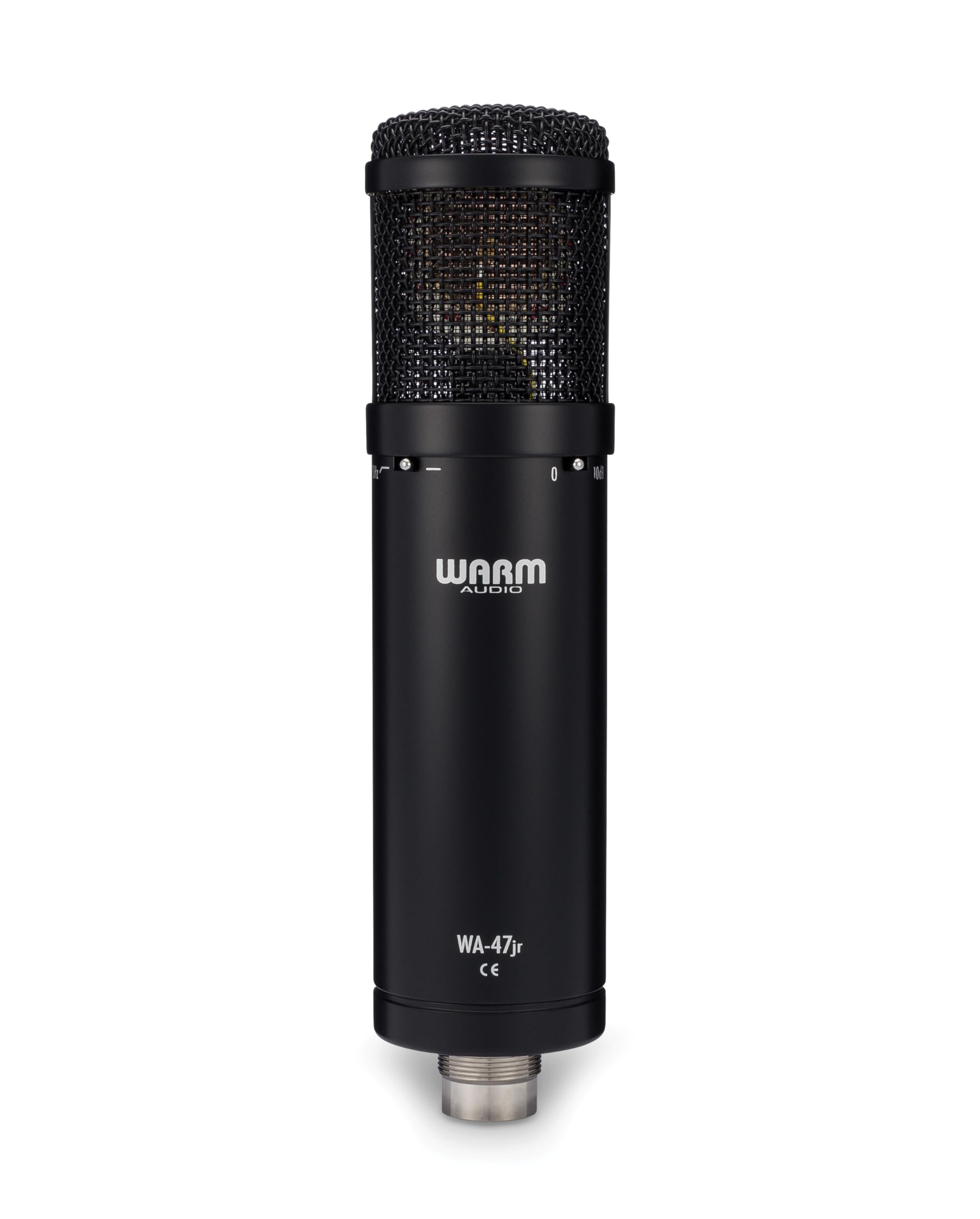
A transformerless homage to the classic ’47 that gives you three polar patterns and a rounded, character-rich tone.
The WA47jr is Warm Audio’s FET (field-effect transistor) transformerless (no output transformer, for a cleaner signal path) take on the legendary Neumann U47 design. It uses a custom K47-style capsule with the same hole pattern and frequency response as the vintage original, and it offers three switchable polar patterns: cardioid, omni, and figure-8. That flexibility alone separates it from the single-pattern LEWITT and Shure picks — you can switch from a focused vocal take (cardioid) to recording a room ambience (omni) without swapping microphones. Buyers describe the sound as “rounded, slightly saturated with character” compared to the pristine high fidelity of the LEWITT LCT 440 PURE, making it a great choice for bright voices that need some warmth, according to their reviews. It has been used for grand piano, violin, and cello in figure-8 mode with a ribbon mic, and buyers report no noise and a clean, silky sound. The 3.59-pound weight is substantial, and the brass build inspires confidence. It comes with a custom shock mount but no carrying case, and some owners note durability mixed reviews — a few units have issues, so buy from a reputable seller.
Why It Stands Apart
- Three switchable polar patterns (cardioid, omni, figure-8)
- K47 capsule delivers vintage warmth and character
- Excellent for bright vocals needing tone-shaping
- Built with brass for solid feel
Points to Know
- Heavier than most — at 3.59 pounds, your stand needs heft
- No carrying case included; durability reports are mixed
Best for: singers with bright voices who want classic tube-like warmth and the flexibility of multiple polar patterns.
Not for: anyone who wants a lightweight travel mic or who needs a pristine, neutral signal with no coloration.
7. AKG Pro Audio C214

The C214 is the single-capsule sibling of AKG’s legendary C414, built to handle screaming loud sources without flinching.
The AKG C214 is a large-diaphragm cardioid condenser that stands out for its 156 dB SPL handling — you can put it in front of a cranked guitar cab or a drum snare without the built-in -20 dB attenuator breaking a sweat. It uses the same capsule design as the C414 (AKG says it sounds closer to the C12), delivering articulate speech without harshness and adding punch to lower frequencies. The integrated suspension system reduces mechanical noise from the stand, so footsteps through the floor do not boom into the recording. Owners who have tested mics from budget models through studio legends call the C214 one of the best for podcast voice, praising its “rich, warm sound without tweaking,” according to their reviews. It is particularly effective on acoustic guitar and vocals in home studio settings. The switchable 20 dB attenuator and bass-cut filter let you tame proximity effect (the bass boost that happens when you sing close to the mic) and record close-up sources without overload. The aluminum carrying case is rugged and scratch-resistant. At 0.8 kilograms (1.76 pounds) it is mid-weight, but the all-metal body feels premium in the hand.
Its Key Strengths
- Massive 156 dB SPL handling for loud sources without distortion
- Integrated suspension reduces mechanical and vibration noise
- 20 dB pad and bass-cut filter for close recording versatility
- Rugged aluminum carrying case included
To Keep in Mind
- Noise level is mixed — some owners mention hissing without quality cables
- Single cardioid pattern only, no multi-pattern flexibility
Reach for this if: you record loud sources (guitar amps, drums, loud vocalists) and need bulletproof SPL handling plus AKG’s proven capsule quality.
Read elsewhere if: you want multi-pattern recording options or need the lowest possible self-noise for whisper-quiet vocals.
Understanding the Specs
Self-Noise (dBA)
Self-noise is the faint hiss the microphone’s internal electronics produce when no sound is hitting the capsule. It is measured in dBA-weighted decibels (a scale adjusted to match human hearing), and lower numbers mean a cleaner recording. For home studio work, a self-noise under 10 dBA (like the LEWITT LCT 440 PURE’s 7 dB) means the mic is effectively silent — you hear only the room and the source. At 16 to 19 dBA (where the Blue Spark SL and Rode M5 land), the hiss is audible on quiet passages but easily dealt with by positioning the mic closer to the source or applying a gentle noise gate in post (processing that silences the quiet gaps between sounds).
SPL Handling and Pad
Maximum SPL (sound pressure level) tells you how loud a source can be before the mic distorts. A rating around 140 dB — like the Shure SM4 — covers screaming vocals and loud acoustic guitar with room to spare. The AKG C214’s 156 dB SPL rating is extreme, letting it sit inches from a snare drum or a cranked amp without the signal breaking up. A -20 dB pad switch attenuates the input by 20 decibels (the unit for measuring sound intensity), so you can record a loud source without overloading your interface — but when you need it, the pad saves the take.
FAQ
Do I need an audio interface to use an XLR condenser mic?
What is the difference between a large-diaphragm and a small-diaphragm condenser?
What does a cardioid polar pattern do for home recording?
How does 7 dB self-noise compare to 19 dB self-noise in practice?
Will a condenser mic work in an untreated room?
What is phantom power and do I need it?
How long does a home studio condenser microphone typically last?
Can I use a condenser mic for streaming and gaming?
Final Thoughts: The Verdict
Across the board, the best condenser mic for home studio winner is the LEWITT LCT 440 PURE because its 7 dB self-noise and detailed 1-inch capsule deliver studio-grade clarity without the studio price. If you want built-in RF shielding and a mix-ready sound that saves post-production time, grab the Shure SM4. And for stereo acoustic recording, the Rode M5 Matched Pair is the one to reach for.
How We Picked
We do not accept paid placement. Every pick is matched to a real buyer and a real use-case; we do not hands-on test units.
Sources & Methodology
Specifications: manufacturer listings and product documentation. Review insights: verified customer reviews, as of July 2026. Pricing: not shown on this page (it changes often); check the current price via the retailer link.
As an Amazon Associate, WellFizz earns from qualifying purchases. This does not affect which products we feature.
Related Guides

Mo Maruf
I created WellFizz to bridge the gap between vague wellness advice and actionable solutions. My mission is simple: to decode the research and give you practical tools you can actually use.
Beyond the data, I am a passionate traveler. I believe that stepping away from the screen to explore new environments is essential for mental clarity and physical vitality.