Our readers keep the lights on and my smoothie glass nicely filled. As an Amazon Associate, I earn from qualifying purchases.
Specs are compiled from manufacturer listings and verified buyer reviews and can change over time — please confirm the key details on the product page before buying.
If you drive heavy equipment onto a construction site, a standard dash cam aimed at a commuter’s windshield won’t cut it. You need a camera that can handle dust, vibration, wide-open terrain, and the constant risk of a blind-spot collision with workers or machinery. The best choices here combine multiple channels, rugged build quality, and smart alerts — not just a single lens pointed at the road. This guide breaks down the five most capable models for site work, from a bumper-mounted 4K system to an 8-channel recorder that watches every side.
I’m Mohammad Maruf — the founder and writer behind WellFizz. This guide is built by comparing the manufacturers’ published specifications and the patterns across verified customer reviews, so you get each pick’s real strengths and trade-offs instead of marketing spin.
Whether you manage a fleet or run a single dump truck, picking the right construction site vehicle dash cam means balancing camera count, night vision quality, and storage capacity against the daily abuse of a job site. Getting that balance right saves you dispute headaches and insurance headaches down the road.
Our Picks at a Glance

How To Choose The Best Construction Site Vehicle Dash Cam
Construction sites throw challenges at a camera that a paved road never will — constant jolts, mud, low-light dawn starts, and a 360-degree risk zone around your vehicle. Here are the specs that separate a true site-ready dash cam from a passenger-car accessory that will quit in a month.
Camera Channels and Placement Options
Standard front-and-rear setups miss the sides entirely. On a site, you often need a bumper-mounted camera (to see the ground near the wheels) plus dedicated side cameras. A 3-channel system (front, rear, bumper) or a 4-channel system (front, rear, left, right) gives you a complete perimeter. Some 8-channel recorders let you add individual cameras to cover every blind corner around a loader or a crane truck.
Waterproofing and Build Quality
Look for cameras rated IP68 — that means they are sealed against dust and can sit in rain or a puddle without failing. The same spec tells you the housing is tough enough for pressure washing. An aluminum die-cast chassis on the main DVR unit handles vibration without cracking and runs cooler than plastic, especially on hot asphalt.
Night Vision and Sensor Quality
Construction starts before sunrise and often runs after dusk. A Sony STARVIS 2 sensor or an IMX323 sensor paired with IR LEDs makes a real difference in capturing license plates and faces in low light. Higher pixel size (measured in micrometers, or µm) means each pixel gathers more light — look for numbers around 2.9µm on rear cameras for better darkness performance.
Storage Capacity and Loop Recording
A 128GB or 256GB SD card fills up fast with 4-channel footage at 1080p. The best systems accept two SD cards (each up to 1TB) or a 2.5-inch SSD up to 4TB. Loop recording (overwriting the oldest files automatically) keeps the camera running without you having to manually clear space — crucial for multi-shift operations.
GPS and Remote Access Features
A built-in GPS module embeds speed and location data into the video, which solves disputes over where an incident happened. Some units add 4G LTE cellular (not just WiFi) so you or a fleet manager can watch live camera feeds from a phone or office PC — a major help if you need to check a load or verify a driver’s route mid-shift.
Quick Comparison
| Model | Best For | Channels | Max Res (Front) | Storage Type | Amazon |
|---|---|---|---|---|---|
| WOLFBOX G900 Tripro Bumper★ Best Overall | Bumper-view + 4K detail | 3 | 4K (3840×2160) | 256GB SD (included) | Amazon |
| JOINLGO 4-CH (B078XG4Q76)Fleet Ready | Fleet video + GPS tracking | 4 | 1080p | 2× SD (max 1TB each) + SSD | Amazon |
| JOINLGO 4-CH 4G LTE (B07D7TT9KT) | Remote live view on site | 4 | 1080p | 2× SD (max 1TB each) | Amazon |
| JOINLGO 8-CH (B08CVBZC2N) | Full perimeter coverage | 8 | 1080p | SSD (max 4TB) + 2× SD | Amazon |
| Garmin Dezl Cam OTR725 | Navigation + dash cam combo | 1 (built-in) | 1080p | 32GB microSDHC (included) | Amazon |
In‑Depth Reviews
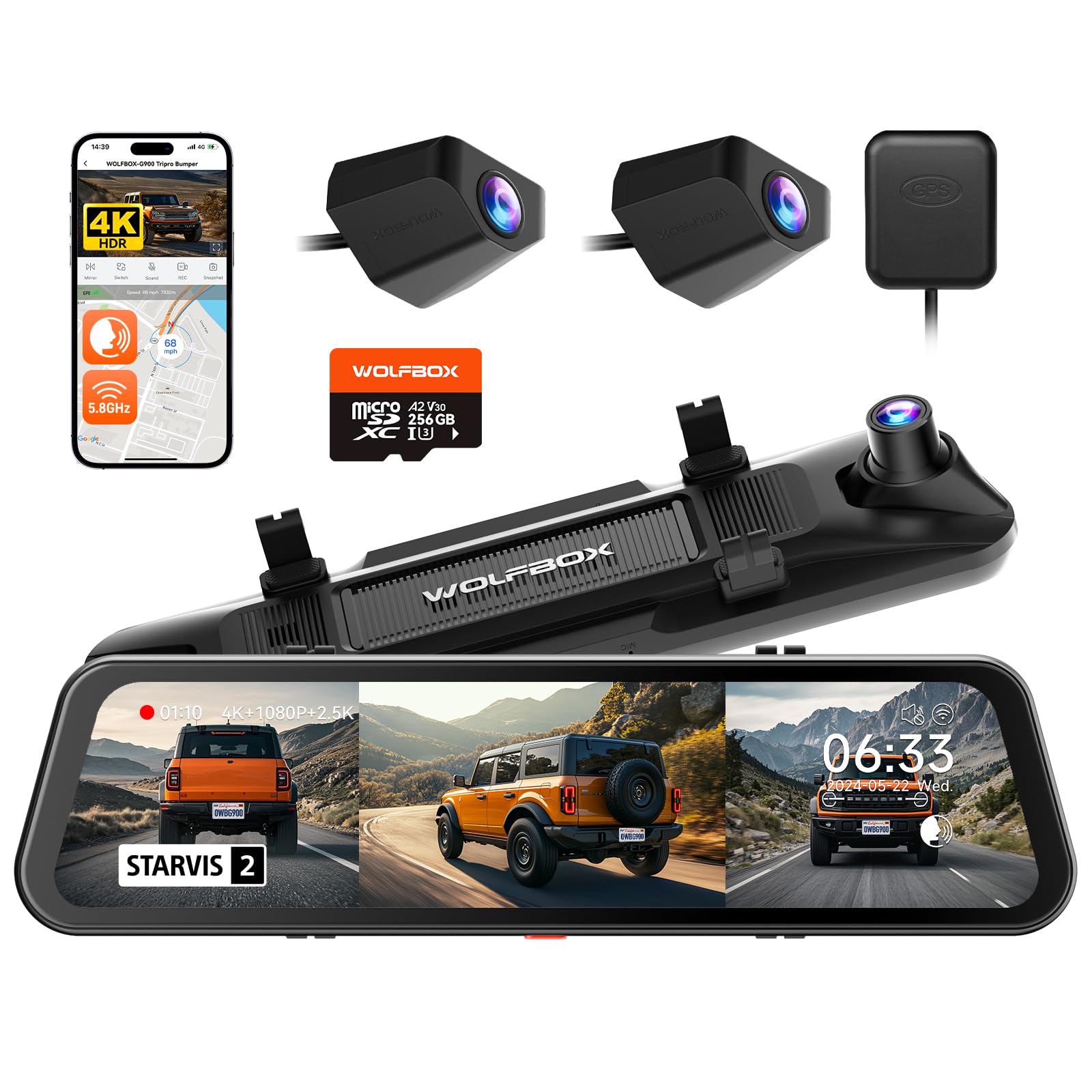
1. WOLFBOX G900 Tripro Bumper Version 3 Channel 4K Mirror Dash Cam
Our pick — over 4★ from 350+ verified ratings; the strongest balance of quality and price.
A bumper-mounted third camera gives you a ground-level view no other mirror cam offers.
This is the only pick on the list that mounts a dedicated 1080P camera on your front bumper, giving you a driver’s-eye view of the dirt, rocks, and tire placement right in front of you. The main mirror camera records 4K 3840×2160 at 30FPS using a Sony STARVIS 2 IMX678 sensor — that extra photosensitive area means the footage stays clear in the dim half-light of a pre-dawn job site start. The rear camera captures 2.5K (2560×1440) thanks to a large 1/1.88-inch sensor with a 2.9µm pixel size, so license plates behind you stay readable even when a dump truck kicks up dust.
The field of view covers a wide 170 degrees — a 170-degree field of view versus the 120-degree cameras on the multi-channel systems reviewed here — which means fewer blind corners when maneuvering near excavators. A pre-installed 256GB card means you can unbox it and start recording immediately. Voice control lets you snap a photo or lock a clip without tapping the screen while bouncing over rough terrain. Buyers report that the bumper camera bracket bolts securely to a license plate, and the waterproof construction survives rain and mud washes without fogging up.
The trade-off is that this system covers only three channels (front, rear, bumper). Unlike the big 4-channel or 8-channel recorders here, it does not give you dedicated left/right side views. Parking monitoring requires a separate hardwire kit.
Tri-channel specialist: If your main risk is what is immediately in front of the bumper and what is behind the tailgate, this delivers the sharpest nighttime image in the group. The 170-degree field of view covers more than enough for most site trucks.
Side-view gap: For a vehicle that needs to watch both flanks (a wide flatbed or a crane truck with outriggers), the four-channel JOINLGO systems below may be a better fit.
Reach for this if: You want the single best low-light sensor and a bumper-level perspective that a standard dash cam cannot give you.
Look elsewhere if: You need four individual side cameras or a built-in GPS navigation screen.
2. JOINLGO 4-CH GPS WiFi 1080P Mobile Vehicle Car DVR Kit
Four cameras, GPS tracking, and a 7-inch screen built into an aluminum housing that handles job site heat.
This system records all four sides simultaneously at 1920×1080 and 30FPS, looping over older footage when the storage fills. The main DVR unit uses an aluminum die-cast chassis with no fan — important on a construction site because there are no spinning blades to suck in dust. An IP68 waterproof rating on each of the four cameras means they survive rain, pressure washing, and mud caking. The cameras also include IR LEDs for night vision and a 2.0MP IMX323 sensor with WDR (wide dynamic range) to balance bright sunlight and dark shadows inside a loading bay.
A built-in GPS module pins speed and location data directly into the video stream, not just a phone app connection. The G-sensor (a small motion sensor that detects impact) automatically locks footage from a bump or hard brake, so a fender-bender at the gate does not get overwritten. A delay-record feature keeps recording for up to 24 hours after shutdown, drawing from the vehicle battery. Owners mention that the 1024×600 7-inch IPS screen is easy to read in bright daylight and that the plug-and-play 4-pin aviation connectors make wiring straightforward even on older trucks.
The shortcoming: this model does not support 4G LTE — no remote live view from a phone unless you are on the same WiFi network. The 120-degree field of view per camera is narrower than the WOLFBOX’s 170-degree lens, so each camera covers less ground.
Quad-coverage workhorse: For a fleet manager who needs GPS-proven location data on every clip and four permanent cameras, this is the most direct path. No installation guesswork — aviation connectors click in place.
No cellular reach: If you absolutely must watch a live feed from an office miles away, the version with 4G LTE below is the correct upgrade.
Best for: Operations that want geo-fence alerts, G-sensor event locks, and a rugged all-metal DVR without paying for cellular data plans.
Not for: A single-vehicle owner who prefers a mirror-mounted unit with bumper coverage and voice commands.
3. JOINLGO 4-Channel WiFi GPS 4G LTE Cellular 1080P Vehicle Bus CCTV DVR Kit

Adds cellular remote viewing to the same rugged four-camera platform.
This unit shares the same core hardware as the previous JOINLGO pick — the same aluminum die-cast DVR, the same 7-inch 1024×600 IPS screen, the same IP68 waterproof full-metal cameras with IMX323 sensors and IR night vision, and the same easy-connect aviation wiring. The critical difference is the 4G LTE module. That cellular chip lets you pull up a live feed from any of the four cameras directly on a smartphone or a PC web browser, even when the truck is miles away from any WiFi. For a site supervisor who wants to check if a driver has arrived at the dump location or verify that the load is secure, this is the feature that saves a phone call.
Like the non-cellular version, this system records all four channels at 1080p 30FPS, supports two SD cards up to 1TB each, and includes a built-in GPS module that records location data in the video. The G-sensor and geo-fence alerts work the same way — set a boundary on a map and get a notification if the vehicle leaves that zone. A delay-record mode continues recording for up to 24 hours after shutdown, powered by the vehicle battery, with 8 seconds of backup from built-in capacitors to safely close the last file.
Buyers do mention that the 4G module requires an active data SIM card (not included) and that the system uses full-size SD cards rather than the more common microSD format. The 120-degree lens per camera is still narrower than what a single wide-angle mirror cam offers.
Remote Access Boost
- Live 4G viewing from phone or PC without being near the vehicle
- Built-in GPS and geo-fence alerts support fleet routing
Real Limits
- Full-size SD cards (not microSD) required; memory cards not included
- Each camera’s 120-degree view is tighter than the WOLFBOX’s 170-degree lens
Grab this when: You manage a truck that works across multiple sites and you want eyes on it from a desk or phone without climbing into the cab.
skip it if: Your vehicle always parks within WiFi range — the non-cellular version costs less and shares the same hardware.
4. JOINLGO 8-CH 4G GPS WiFi 1080P Mobile Vehicle DVR Kit with 10″ Touchscreen
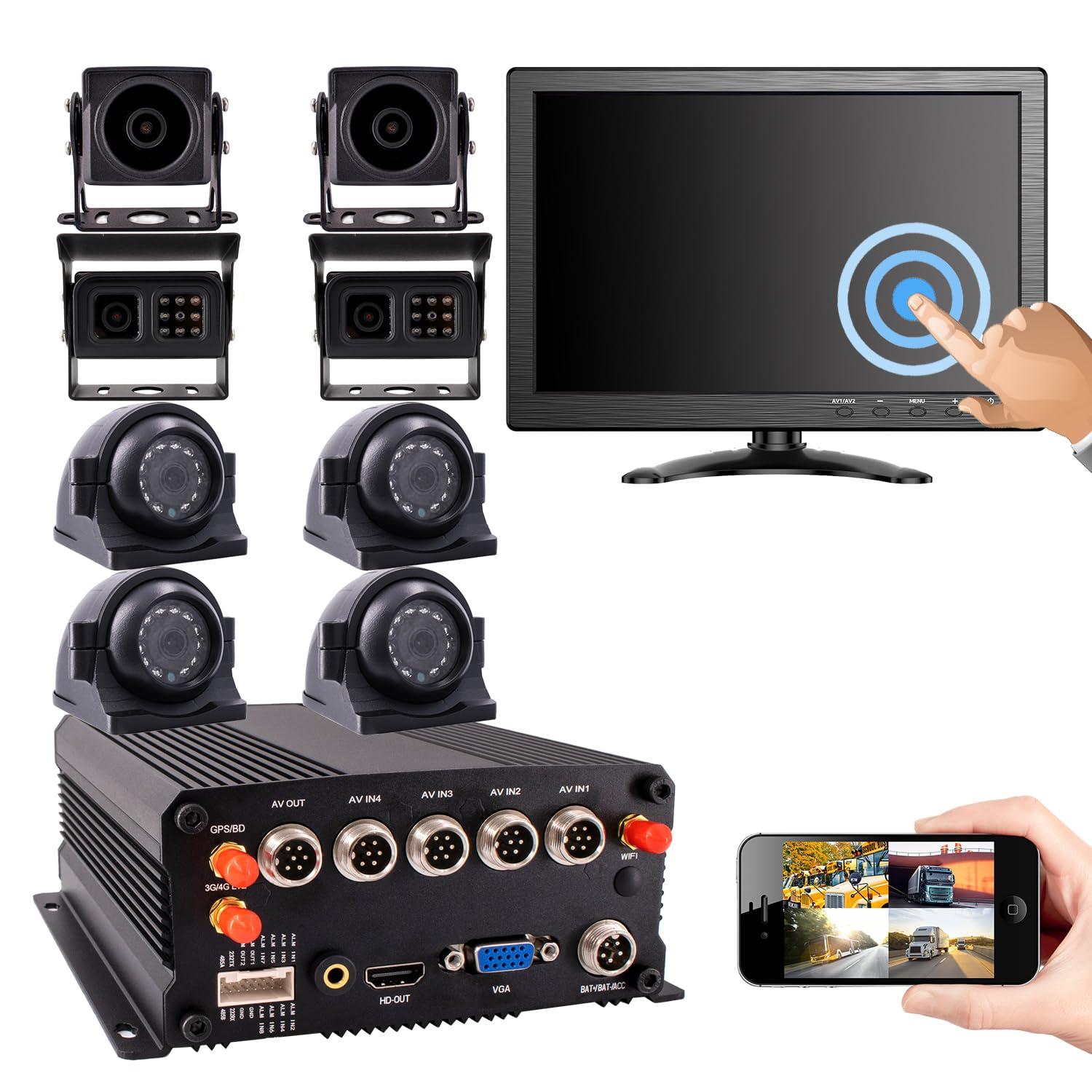
Eight camera feeds on a single 10-inch touchscreen — the most complete perimeter a construction vehicle can get.
This system steps up from the four-channel JOINLGO units by supporting eight individual cameras, all recording at 1920×1080 and 30FPS. The larger 1280×800 resolution touchscreen makes it easier to see small details on a split-screen view, such as a worker standing near the passenger-side blind spot. Storage is equally generous: you can plug in a 2.5-inch SSD (up to 4TB) plus two SD cards (up to 1TB each), giving you weeks of continuous recording before the loop overwrites old files. The same IP68 waterproof cameras, IR night vision, and IMX323 sensors carry over from the smaller JOINLGO systems, so every channel gets the same build quality.
The 4G LTE and WiFi modules are built in, just like the 4-channel cellular version, so a fleet manager can view any of the eight feeds remotely. A G-sensor, geo-fence alerts, and 4-channel alarm inputs are all present. The delay-record mode still reaches up to 24 hours after shutdown with 8-second capacitor backup. Customers note that the 8-camera setup requires more careful cable routing through the vehicle body, and the larger DVR unit takes up more dashboard or under-seat space than the 4-channel boxes.
The catch is the mixed user rating — 3.7 out of 5 from a smaller sample of 19 ratings. Some buyers mention that the initial configuration of eight cameras takes longer than expected and that the touchscreen interface can lag when switching views quickly. This is the most expensive non-Garmin pick on the list, reflecting the hardware cost of eight cameras and a larger display.
Full-perimeter powerhouse: For a cement mixer or a long-bed flatbed where a driver absolutely cannot see the rear corners or the sides, eight channels remove every major blind spot.
Setup commitment: The extra wiring and configuration time mean this is best for a permanent fleet installation rather than a quick weekend project.
Choose this for: A vehicle that needs to watch every single angle — such as a mobile crane with outriggers or a truck that reverses into tight loading docks all day.
Pass on it if: Your risk is limited to what is directly in front and behind — the four-channel or three-channel systems are simpler to wire and cost less.
5. Garmin Dezl Cam OTR725 GPS Truck Navigator with Dash Cam

A truck GPS and a dash cam in one screen — purpose-built for professional over-the-road drivers.
This unit combines a 7-inch touchscreen GPS truck navigator with a built-in 1080p dash cam that records automatically and saves incident clips with embedded GPS data. The navigation is designed specifically for commercial trucks — you enter your rig’s height, weight, length, and hazmat class, and the Garmin routes you around low bridges, weight-restricted roads, and tunnels that ban hazardous materials. The built-in dash cam triggers forward-collision warnings and lane-departure alerts, giving you an extra safety layer when pulling onto a crowded site approach road. Reviewers point out that the aerial-view loading dock imagery helps spot the correct entrance on a chaotic construction site without circling twice.
The bundle includes a 32GB microSDHC card, a USB charging kit, an LCD cleaning cloth, and a P-Bank battery. The device itself weighs 2.6 pounds and measures 8 inches wide by 4.17 inches high, fitting easily on a windshield mount. The Dezl app provides hands-free calling, live traffic and weather, and over-the-air map updates via built-in WiFi — no computer needed. Real-time parking and loading dock ratings from other truckers help you plan a stop that fits your trailer length.
The limitation for site use is that this is a single-channel front-facing camera. It does not record the rear, sides, or bumper. If you need multi-angle coverage for insurance protection around a machine, the 3-channel or 4-channel systems above are better suited. The Garmin is strongest when your priority is routing and navigation first, with dash-cam recording as a secondary benefit.
Navigation First
- Custom truck routing based on height, weight, length, and hazmat
- Built-in dash cam with forward-collision and lane-departure alerts
Site Limitation
- Single front camera only — no rear or side coverage for site maneuvers
- No 4G or remote-view capability; relies on WiFi and app connection
Best for: An over-the-road trucker who needs reliable GPS routing above all else, with a dash cam that automatically saves incident video for insurance.
Not ideal for: A site truck that requires rear, side, or bumper cameras — this unit watches only the road ahead.
Understanding the Specs
Field of View (FOV)
This is the width of the scene a camera can capture at one time, measured in degrees. A 170-degree lens (like the WOLFBOX G900) sees much more of the sides than a 120-degree lens (common on the multi-channel JOINLGO systems). On a construction site, a wider angle reduces blind spots when turning near equipment or workers. The trade-off is that very wide lenses can distort the image at the edges, making distant objects look slightly bow-shaped.
G-Sensor and Event Locking
A G-sensor is a small motion detector inside the DVR that feels sudden jolts — a hard brake, a collision, or a pothole hit. When it triggers, the system automatically locks that video file so it does not get overwritten by loop recording. On a site where backing into a pile of gravel or getting bumped by a loader is common, this saves you from losing the one clip you need for an insurance report.
Loop Recording and Storage
Loop recording means the camera keeps recording constantly, and when the memory card is full, it deletes the oldest open up videos to make room for new ones. The amount of time you can keep on the card depends on the number of channels and the resolution. A 4-channel system recording 1080p on a 256GB card might hold 8-12 hours of continuous footage before starting to overwrite. Larger storage (SSD up to 4TB, as on the 8-channel unit) keeps days or weeks of archives.
IP68 Waterproof Rating
IP stands for Ingress Protection. The “6” means the camera is totally sealed against dust — important when a site is kicking up dry dirt all day. The “8” means the camera can be submerged in water deeper than 1 meter for a sustained period. On a vehicle that gets pressure-washed daily or drives through puddles on graded roads, IP68 cameras survive conditions that would kill a standard consumer dash cam.
FAQ
Will a standard passenger car dash cam work on a construction site truck?
How many cameras do I need for a dump truck or mixer?
Can I watch the cameras live from my office while the truck is on site?
Do I need a large SD card or is a smaller one enough?
What does the G-sensor actually do for me on a job site?
Is the Garmin Dezl OTR725 a replacement for a multi-camera system?
Do I need to buy memory cards separately for the JOINLGO systems?
How do I manage heat inside a metal DVR box on a hot asphalt site?
What is the difference between WiFi and 4G for remote viewing?
Will a 170-degree field of view distort the image too much?
Final Thoughts: The Verdict
For most buyers, the construction site vehicle dash cam winner is the WOLFBOX G900 Tripro Bumper Version because it combines the best low-light sensor on this list, a unique bumper-mounted perspective, and a 256GB card included from the start. If you need four dedicated side cameras and GPS fleet tracking, grab the JOINLGO 4-CH GPS WiFi DVR. And for a driver whose primary need is truck-specific GPS navigation with a dash cam attached, the standout is the Garmin Dezl Cam OTR725.
How We Picked
We do not accept paid placement. Every pick is matched to a real buyer and a real use-case; we do not hands-on test units.
Sources & Methodology
Specifications: manufacturer listings and product documentation. Review insights: verified customer reviews, as of July 2026. Pricing: not shown on this page (it changes often); check the current price via the retailer link.
As an Amazon Associate, WellFizz earns from qualifying purchases. This does not affect which products we feature.
Related Guides

Mo Maruf
I created WellFizz to bridge the gap between vague wellness advice and actionable solutions. My mission is simple: to decode the research and give you practical tools you can actually use.
Beyond the data, I am a passionate traveler. I believe that stepping away from the screen to explore new environments is essential for mental clarity and physical vitality.