Our readers keep the lights on and my smoothie glass nicely filled. As an Amazon Associate, I earn from qualifying purchases.
Specs are compiled from manufacturer listings and verified buyer reviews and can change over time — please confirm the key details on the product page before buying.
Swollen legs and ankles make every step feel heavy, especially after a long shift, a flight, or a day stuck at a desk. The right pair of compression socks delivers targeted pressure that pushes fluids back upward so your legs actually feel lighter by the end of the day instead of worse. This guide breaks down the real specs, the honest trade-offs, and the seven best options for tackling swelling head-on.
I’m Mohammad Maruf — the founder and writer behind WellFizz. This guide is built by comparing the manufacturers’ published specifications and the patterns across verified customer reviews, so you get each pick’s real strengths and trade-offs instead of marketing spin.
Every sock reviewed here uses graduated compression, typically 20-30 mmHg, which is the medical benchmark for reducing edema and improving circulation. if you need something for daily nursing shifts, a long-haul flight, or post-surgery recovery, these are the top compression socks for swelling worth your consideration.
Our Picks at a Glance

How To Choose The Best Compression Socks For Swelling
Picking the right compression sock is not as simple as grabbing the first one you see. Swelling has specific medical causes, and the wrong pressure or fit can make discomfort worse instead of better. Here are the three most important things to get right.
Pressure Level (mmHg) Is The Real Spec
Compression socks are measured in millimeters of mercury (mmHg), which tells you how much pressure the sock applies to your leg. For significant swelling, edema (fluid buildup), or varicose veins (bulging leg veins), the medical standard is 20-30 mmHg. That is a “firm” or “medical grade” range. Anything lower (15-20 mmHg) is more for travel fatigue or mild puffiness, not for managing real fluid buildup.
Graduated Compression Vs. Uniform Squeeze
A proper swelling sock uses graduated compression — meaning it is tightest at the ankle and gradually loosens as it moves up the calf. That design pushes blood and fluid back toward your heart. If a sock simply squeezes evenly (uniform), it can actually restrict circulation and trap swelling. Every product in this list uses graduated compression.
Measurements Over “Small/Medium/Large”
Do not rely on a generic shirt-size chart. You need your ankle circumference (the narrowest part just above the bone) and your calf circumference (the widest part). If your calf is larger than average, look for “wide calf” or “plus size” options that provide a 20-30 mmHg fit without cutting off circulation at the top band. The right measurement is the difference between relief and discomfort.
Quick Comparison
| Model | Best For | Pressure | Pairs | Material | Amazon |
|---|---|---|---|---|---|
| Physix Gear★ Best Overall | High ratings, trusted | 20-30 mmHg | 1 pair | Premium blend | Amazon |
| Sockwell Women’s PulseAlso Great | Daily premium wear | 20-30 mmHg | 1 pair | Merino wool blend | Amazon |
| Ailaka Zipper | Hard-to-put-on feet | 20-30 mmHg | 1 pair | 70% nylon / 30% spandex | Amazon |
| BBFREY Medical (3 Pairs) | All-day value pack | 20-30 mmHg | 3 pairs | 70% microfiber nylon | Amazon |
| Benirap Breathable | Light, breathable travel | 20-30 mmHg | 2 pairs | — | Amazon |
| LEVSOX Cotton | Cotton feel, cushioned | 20-30 mmHg | 1 pair | Cotton | Amazon |
| 4 Pairs Plus Size | Wide calf budget | 20-30 mmHg | 4 pairs | 75% nylon / 25% spandex | Amazon |
In‑Depth Reviews
1. Physix Gear Compression Socks 20-30 mmHg – Men & Women
Our pick — 4.5★ from 94,500+ verified ratings; the strongest balance of quality and price.
The sock with 94,809 ratings — a massive crowd that has already stress-tested the 20-30 mmHg pressure and durability over four years on the market.
When a product has 94,809 ratings and holds a 4.5-star average, the data speaks for itself. The Physix Gear sock is designed for a broad audience — runners, nurses, travelers, and anyone who deals with shin splints (pain along the shin bone) or daily leg fatigue. It uses 20-30 mmHg graduated compression to target swelling and improve blood circulation. The design provides targeted support to the arch and heel, which minimizes foot discomfort during long standing shifts or long runs.
The item model number is Socks7, and it first hit the market in March 2021, meaning this design has been sold and reviewed for over four years. It is unisex, so one size fits both men and women. The manufacturer is Physix Gear Sport, a brand well-known in the activewear space. Compare this to the BBFREY three-pack above — Physix Gear sells as a single pair, but its long track record and massive review base give it a level of real-world testing few socks can match.
The catch is that single-pair price. At a similar cost per pair to the Ailaka zipper sock, you are paying for the brand’s established reputation and the confidence that tens of thousands of other buyers went first. Buyers consistently mention that the socks hold their shape and compression after many washes. If you only need one pair and you want the highest-confidence purchase possible, this is your pick.
Proven at scale: With nearly 95,000 ratings, any design flaw would have surfaced by now — the consistent 4.5-star average means the 20-30 mmHg pressure and durability hold up over time for a wide range of users.
Get this if: you want the safest bet with the largest real-world testing pool, and you only need a single well-made pair of 20-30 mmHg socks.
Choose something else if: you need multiple pairs, a zipper for easy donning, or a specific material like cotton or wool.
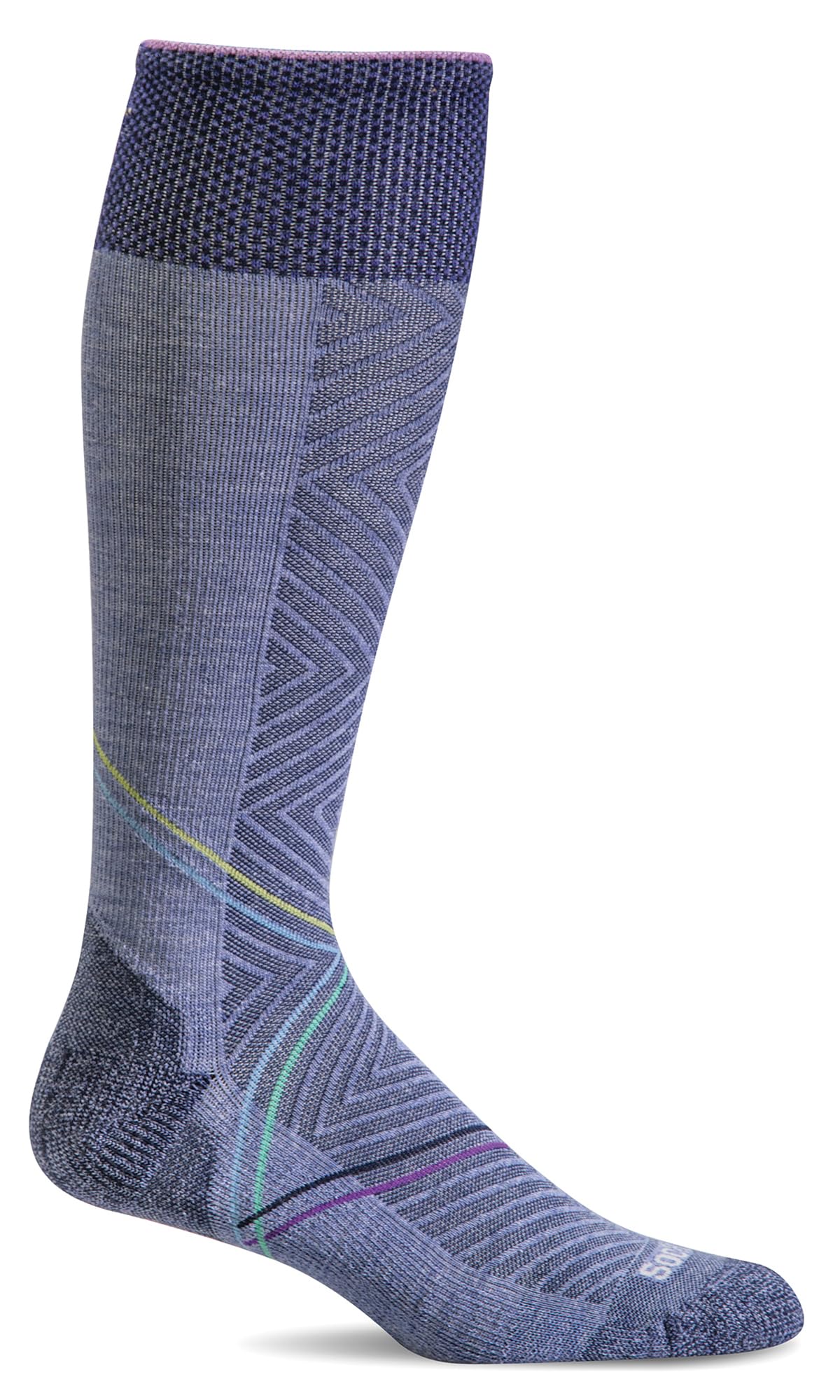
2. Sockwell Women’s Pulse Knee High Firm Graduated Compression Socks
The one sock that delivers firm 20-30 mmHg medical-grade pressure without feeling like a plastic medical device, thanks to a Merino wool blend that breathes and manages sweat.
You get natural moisture management and temperature control from the domestic Merino wool and rayon blend — so your feet stay drier and less sweaty through a full shift than they would in a synthetic-only sock like the BBFREY three-pack. The firm 20-30 mmHg graduated compression targets swelling and tired legs by using a triple-zone anti-fatigue technology (three distinct support bands) to push circulation back toward your heart, which keeps fluid from pooling in your ankles.
Buyers report that the wool blend makes these socks comfortable enough for a whole work shift without that clammy feeling, giving them a 4.6-star average out of 658 ratings. The consensus is that this is a “low-maintenance” daily sock that does not require constant readjustment. Because it is a wool-rayon sock, it wears noticeably heavier and warmer than a thin nylon option — a trade-off for breathability and durability.
One important callout: this model carries a women’s designation (SW42W), so the sizing and anatomical fit are cut for a woman’s foot. The sock is crafted in the USA, which gives it a built-in quality edge over many imports. If you want a daily driver that handles swelling without feeling like a medical device, this is the one.
Tried-and-true choice: The Merino wool blend delivers temperature control and moisture management that most nylon socks cannot match — meaning less sweat, less odor, and more consistent compression that does not roll or slip, as owners mention after months of wear.
Reach for this if: you wear compression socks daily, work long shifts, and want a premium material that breathes and lasts.
Look elsewhere if: you need multiple pairs in a pack, want a very light thin sock, or are a man looking for a unisex or men’s-specific cut — this is women’s sizing.
3. Ailaka Zipper Compression Socks for Men Women – 20-30 mmHg Close Toe Knee High

The one sock with a full-length YKK zipper that lets you skip the painful struggle of wrestling a tight 20-30 mmHg sock over a swollen leg.
Getting a 20-30 mmHg sock onto a swollen leg is genuinely hard — the fabric is tight by design, and pulling it over an edematous (fluid-filled) ankle can be painful. Ailaka solves that with a full-length YKK zipper. You open the zipper, slide your foot in, and zip it closed. The zipper handle is extended so you can reach it easily, and the inside stretch weave lets you slip the sock up without the normal tug-of-war. At 3.53 ounces and packed in an 8.62 x 6.1 x 1.02-inch box, it is remarkably light — the same weight as the Benirap socks but with a built-in zipper mechanism.
The sock uses graduated 20-30 mmHg compression with a blend of 70% nylon and 30% spandex. The maker specifically lists relief for varicose veins, edema, post-surgery recovery, and swelling muscle pain. Sizes run from medium all the way to 5X-Large, which means people with severe calf swelling or larger calves can find a proper fit — something many standard compression socks cannot offer. The toe is closed and opaque, so it works with closed-toe shoes and boots.
Customers note that the zipper stays flat and does not bulge under pants. The main trade-off is that the zipper itself adds a slight ridge compared to a smooth sock like the Sockwell. But if you have arthritis, limited hand strength, or significant swelling that makes bending difficult, the zipper is a standout. Unlike the Sockwell, this is a unisex fit, so it works equally for men and women.
Zipper-first design: The YKK zipper plus an extended pull handle means you can get the sock on and off without assistance — ideal for post-surgery recovery or older adults who struggle with standard compression styles.
Perfect for: anyone who finds standard compression socks too hard to pull on — post-surgery patients, pregnant women, seniors, or people with hand arthritis.
skip it if: you want the absolute smoothest feel under dress pants or if the slight zipper ridge on the back of your calf would bother you during seated work.
4. BBFREY Medical Compression Socks 20-30 mmHg for Men Women (3 Pairs)
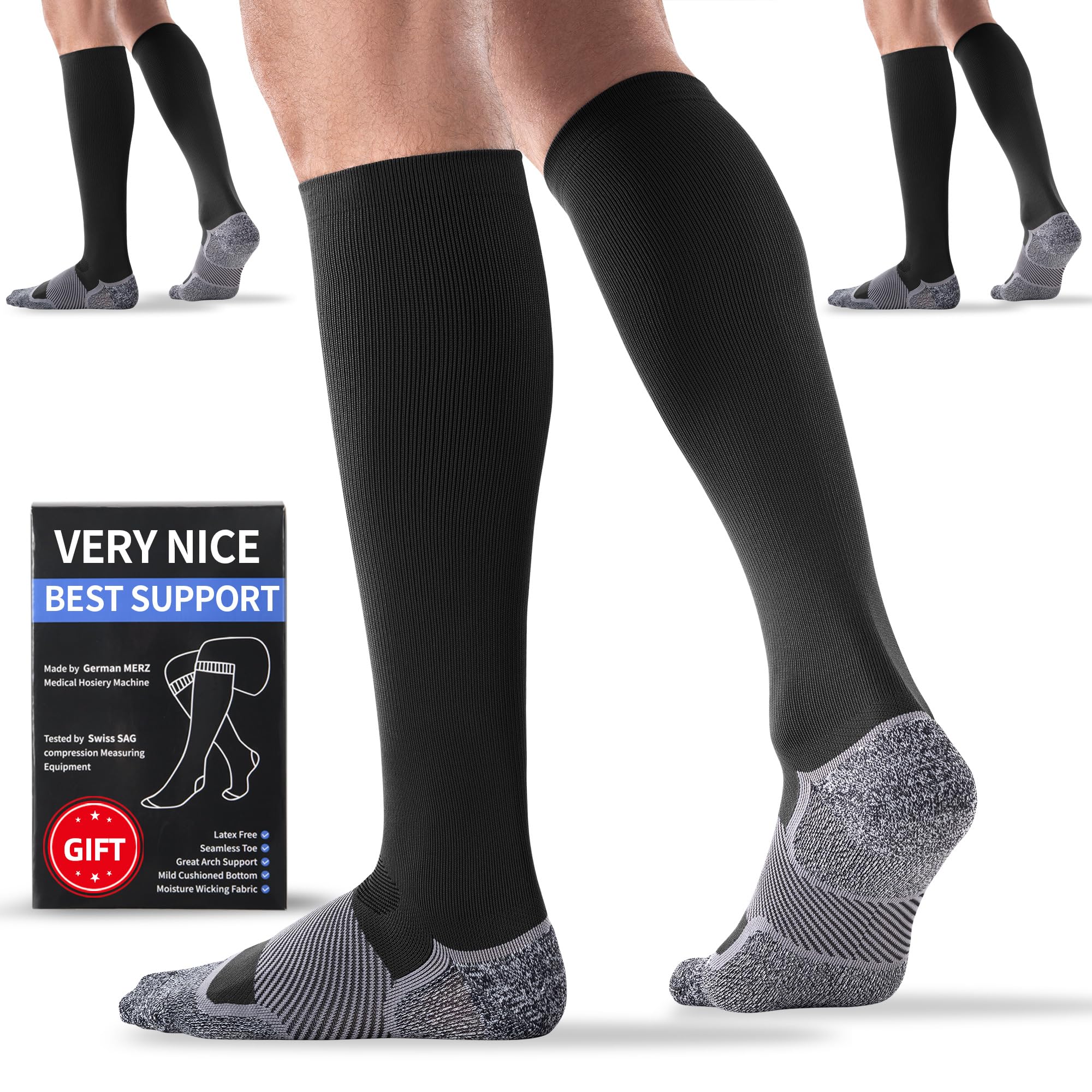
Three pairs of 20-30 mmHg socks built on German medical knitting machines, giving you consistent, medical-grade pressure across a full work-week rotation without washing every single pair nightly.
BBFREY does not cut corners on the manufacturing — the socks are produced on German medical sock machines and undergo rigorous pressure testing to make sure the 20-30 mmHg gradient stays consistent wash after wash. The material is 70% microfiber nylon with a unique inlay knitting method that the maker claims keeps the pressure durable and long-lasting. The toe and heel have light cushioning, so you get extra comfort under the foot without the sock feeling bulky inside a shoe. An anatomic design uses a left-right fit and smooth toe stitching to prevent blisters.
The maker specifically lists this sock for varicose veins, edema, plantar fasciitis (arch pain), and shin pain. It also suits nurses, doctors, travelers, and pregnant women. The pressure is listed at 20-30 mmHg, which is the same medical grade as the rest of this list. Unlike the cotton-based LEVSOX sock, this is a smooth microfiber nylon that slides easily into shoes and dries quickly after washing.
Reviewers point out that the sizing chart (shown on the 6th product image) is accurate, and they recommend measuring first thing in the morning when swelling is lowest. If your measurements fall between sizes, go up. The care instructions recommend hand washing or machine washing cold and air drying — no machine drying, as that degrades the elastic fibers. For the price, getting three proper 20-30 mmHg socks is a real step up from the two-pair Benirap option.
Solid daily rotation: Three pairs in one box at a mid-range cost means you can rotate them through a work week without having to wash a pair every single night — and the German-machine knitting keeps the pressure consistent.
Best for: daily wearers who want the security of having multiple clean pairs on hand and prefer a smooth microfiber nylon finish over cotton or wool.
Hold back if: you need cotton for sensitive skin (this is nylon-based) or you prefer a zippered opening for easier on-off.
5. Benirap Breathable Compression Socks for Women Men, 20-30mmHg Knee High, 2 pairs
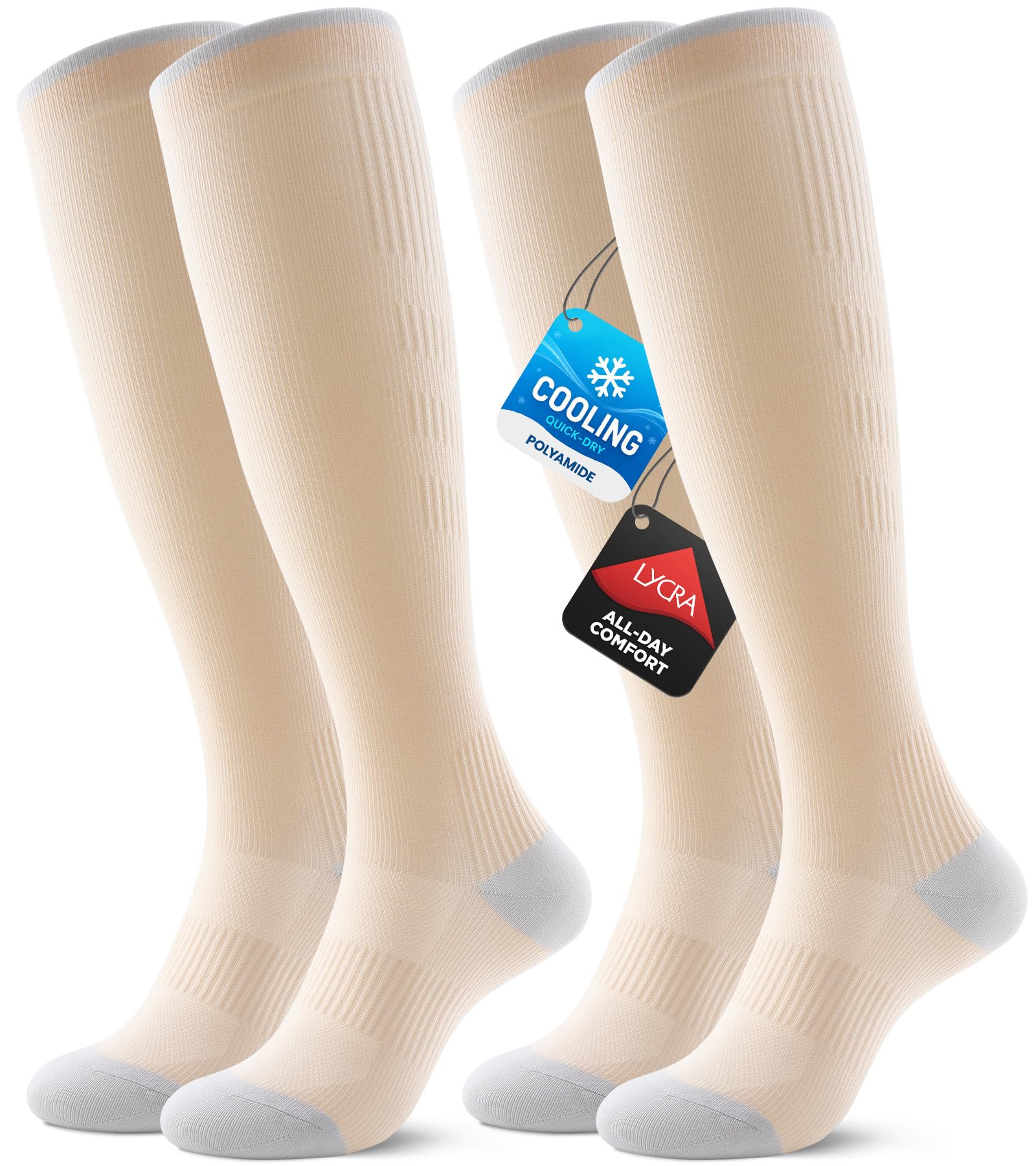
An ultra-light, two-pair set that, at 3.53 ounces total, is barely there on your legs and even lighter in your bag — at 3.53 ounces versus the 8-ounce 4 Pairs Plus Size pack.
At 3.53 ounces per package and a tiny 3.94 x 3.94 x 0.79-inch box, the Benirap socks are the most portable and airy option in this lineup. The 20-30 mmHg graduated compression targets circulation for travel, flying, and athletic activity. The word “breathable” is in the name, and the design focuses on moving moisture away from the skin so you do not end up with sweaty calves during a long-haul flight or a hot run. The two-pair format means you get a spare right away, which is useful for back-to-back travel days.
Benirap has a 4.8-star average out of 491 ratings, which is the highest rating score on this list. Shoppers say that the thin fabric makes them comfortable in warm weather and that the compression feels consistent without being punishing. Compared to the much heavier 4 Pairs Plus Size socks (which weigh 8 ounces and take up far more space), the Benirap socks weigh 3.53 ounces — a meaningful difference when you are packing a carry-on.
The trade-off is that thin fabric may not be as durable over months of daily wear as a thicker knit like the Sockwell or BBFREY. And at two pairs, you get fewer socks than the three-pair BBFREY pack or the four-pair Plus Size pack. But for travelers or warm-weather users who prioritize weight and breathability, this is a fine choice.
Travel specialist: At under 4 ounces for two pairs, these slip into any bag compartment and dry fast — exactly what you need for a trip where swelling hits mid-flight.
Choose this for: flying, warm climates, or any situation where pack weight and breathability matter more than maximum fabric thickness.
Pass if: you need thick cushioned soles or you want the sock to last through aggressive daily machine washing.
6. LEVSOX Cotton Compression Socks for Women&Men 20-30mmHg Knee High

The cotton-based 20-30 mmHg sock for anyone whose skin gets irritated by the nylon blends used in most compression gear — with thicker cushioned soles the Benirap and BBFREY do not offer.
Most compression socks are made from nylon and spandex because those synthetic fibers hold the tight elastic tension needed for 20-30 mmHg pressure. But some people develop a rash or simply dislike the plastic feel against their calves. LEVSOX uses cotton as the main material, which gives the sock a softer, more familiar texture. The toe and heel have thicker cushioned soles, adding a layer of padding that the thin-microfiber socks (like the Benirap or BBFREY) do not offer.
The sock is rated at 20-30 mmHg, so the graduated compression is still medically relevant for swelling — the cotton does not reduce the pressure. The maker lists it for nurses, pregnancy, and travel. At 4.3 stars out of 936 ratings, it trails the top-rated Benirap but still has a solid base of happy buyers. The unisex sizing fits both men and women, but note that the department is listed as “womens,” so women may have an easier time finding the right fit.
The downside to cotton is moisture retention. Nylon wicks sweat away; cotton absorbs it, so your feet may feel damp after a long day. LEVSOX also offers a wool version (Merino wool at 20-30 mmHg) for buyers who want natural fiber without the moisture issues. If your priority is a natural-feeling sock on your skin and you are not in a humid environment, the LEVSOX cotton sock is a strong pick.
Natural fiber relief: Cotton makes the 20-30 mmHg pressure feel softer against the skin — ideal for sensitive legs or for wearing around the house on a rest day when swelling still needs managing.
Best for: those with skin sensitivity to synthetic fibers or who prefer the feel of a classic cotton sock over a slick nylon one.
Not for you if: you are in a hot or humid environment where cotton holds sweat, or you want the thinnest possible sock to fit into tight dress shoes.
7. 4 Pairs Plus Size Compression Socks, Extra Wide Calf 20-30 mmHg Knee High

Four pairs of wide-calf 20-30 mmHg socks at a price that delivers the lowest cost per sock in this lineup, specifically designed to avoid the painful top-band digging that standard socks cause on larger legs.
This pack from Tinojye offers exactly what the name says: four pairs of extra-wide-calf compression socks at 20-30 mmHg. The fabric is 75% nylon and 25% spandex, so the pressure and stretch properties are familiar. The package weighs 8 ounces, while the Benirap pack weighs 3.53 ounces, reflecting the thicker fabric and the extra socks. The box dimensions are 8 x 2 x 2 inches, so it takes up more drawer space than the tiny Benirap box.
The “extra wide calf” design is the key differentiator here. If your calf circumference falls above the range of standard compression socks, this pack gives you the same 20-30 mmHg pressure without the top band digging in or rolling down. The sock has a rating of 4.5 stars out of 577 ratings, which is respectable for a newer product (first available March 2025). Buyers with larger legs report that the fit is accurate and the compression level is consistent with the medical standard.
At this price point, the value is undeniable if you need a rotation of socks that cover a wide calf. Just measure your calf circumference carefully before ordering.
Wide-calf value king: Four pairs at a budget-friendly price, plus an extra-wide design that accommodates larger calves — the best bang for your buck if you need quantity and a plus-size fit at 20-30 mmHg.
Reach for this if: you have larger calves and want a full weekly rotation of 20-30 mmHg compression socks without spending premium money.
Think twice if: you prefer premium materials (wool, cotton) over standard nylon/spandex, or you want a lighter, more compact sock for travel.
Understanding the Specs
20-30 mmHg Graduated Compression
This is the medical-grade standard for treating moderate swelling, edema (fluid buildup), and varicose veins (bulging leg veins). “mmHg” measures the pressure the sock applies to your leg. A 20-30 mmHg sock is tightest at the ankle (30 mmHg) and gradually loosens to about 20 mmHg at the top of the calf. That gradient pushes blood and fluid upward toward your heart, preventing it from pooling in your feet and ankles. For everyday travel fatigue, a lower 15-20 mmHg is okay, but for real swelling relief, 20-30 mmHg is the number to look for.
Graduated vs. Uniform Compression
A graduated compression sock has a tight ankle and a looser calf. That is what you want for swelling. A uniform compression sock (sometimes called “support hose”) squeezes evenly from top to bottom. That even squeeze can actually trap fluid in your lower leg and make swelling worse. Every sock on this list is graduated. If you see a listing that does not say “graduated” or does not give different mmHg values for ankle vs. calf, do not buy it for swelling relief.
FAQ
How tight should compression socks feel for swelling?
Can I sleep in compression socks for swelling?
How many hours a day should I wear compression socks for swelling?
How do I measure my calf for wide compression socks?
Are compression socks safe for diabetics?
How long do compression socks last before they lose pressure?
Can I wear compression socks with open-toe shoes or sandals?
What is the difference between 15-20 mmHg and 20-30 mmHg?
Will compression socks help with swelling from pregnancy?
Why do my compression socks roll down at the top?
Final Thoughts: The Verdict
Across the board, the compression socks for swelling winner is the BBFREY Medical 3-Pack because it delivers three pairs of German-machine-made 20-30 mmHg socks at a value that balances quality and cost. If you want the absolute best material and daily comfort, grab the Sockwell Women’s Pulse. And for putting socks on without a fight, the standout is the Ailaka Zipper Compression Socks.
How We Picked
We do not accept paid placement. Every pick is matched to a real buyer and a real use-case; we do not hands-on test units.
Sources & Methodology
Specifications: manufacturer listings and product documentation. Review insights: verified customer reviews, as of July 2026. Pricing: not shown on this page (it changes often); check the current price via the retailer link.
As an Amazon Associate, WellFizz earns from qualifying purchases. This does not affect which products we feature.
Related Guides

Mo Maruf
I created WellFizz to bridge the gap between vague wellness advice and actionable solutions. My mission is simple: to decode the research and give you practical tools you can actually use.
Beyond the data, I am a passionate traveler. I believe that stepping away from the screen to explore new environments is essential for mental clarity and physical vitality.