Our readers keep the lights on and my smoothie glass nicely filled. As an Amazon Associate, I earn from qualifying purchases.
Specs are compiled from manufacturer listings and verified buyer reviews and can change over time — please confirm the key details on the product page before buying.
You want a scooter that teaches your child balance without causing a fall. The best ones use a lean-to-steer system (steer by shifting your body weight, not twisting the handlebars) and have a low, stable deck so little feet stay planted. This guide walks you through five top-ranked models. It shows you which one fits your child’s age, storage space, and need for a smooth glide. The brand claims each of these scooters helps build coordination, but the real physical specs — weight, handlebar height, and materials — tell you which one will last.
I’m Mohammad Maruf — the founder and writer behind WellFizz. This guide is built by comparing the manufacturers’ published specifications and the patterns across verified customer reviews, so you get each pick’s real strengths and trade-offs instead of marketing spin.
Your rider may be just starting or already carving corners. You will find the right match here — sorted so you can zero in on the children’s scooter that holds up over time without taking up the whole garage.
Our Picks at a Glance


How To Choose The Best Children’s Scooter
A scooter gives your child their first taste of speed. The wrong choice means frustration or a toy that collects dust. Here is what actually matters.
Lean-to-Steer vs. Classic Steering
Traditional handlebar steering on a two-wheel scooter is hard for little kids because it requires complex coordination. Lean-to-steer (the front two wheels tilt when your child shifts their weight) is more natural. It builds balance and lets younger riders stay upright while they learn to turn. Every pick on this list uses some form of lean-to-steer, which is common for children ages two through eight.
Handlebar Height Adjustment Range
This spec determines how many years you get out of the scooter. A good adjustable T-bar (the upright bar with the handles) moves from roughly 24 inches to 32 inches. That fits a toddler who is barely three feet tall and a pre-teen who is almost five feet. If the handlebar only offers two positions, your child may outgrow it in one season. Look for at least three height settings to get the longest use.
Weight Capacity and Deck Width
Most children’s scooters top out at 110 lbs. That covers most riders through age twelve, but the deck width matters too. A narrow deck (around four inches) feels unstable for older kids. A wide deck (five inches or more) gives them room to shift their feet during tricks or long rides. The anti-slip texture is key — wet shoes on a smooth deck mean a skinned knee.
Wheel Size and Material
PU (polyurethane) wheels last longer and roll more smoothly over cracks than plastic wheels. Larger front wheels, around 120mm to 140mm, handle bumps better. The LED wheels on several models here are motion-activated (no batteries required). They light up as the wheels spin, adding visibility at dusk without a power switch.
Quick Comparison
| Model | Best For | Weight | Handlebar Height | Age Range | Amazon |
|---|---|---|---|---|---|
| Micro Kickboard Maxi LED★ Best Overall | Premium long-term build | 2.5 kg | Adjustable T-bar | 5–12 | Amazon |
| BELEEV A8Best Value | Lightest foldable pick | 2.6 kg | 24.40–32.28 inches | 3–12 | Amazon |
| TONBUX Kids Scooter | Widest height range | 3.22 kg | 24.5–34 inches | 3–12 | Amazon |
| Lifemaster 3-Wheel with Seat | Beginner sit-to-stand mode | — | Up to 34 inches | 2+ | Amazon |
| Gotrax KS3 Pro | Compact fold and seat combo | 8 pounds | 25.5–31.5 inches | 2–8 | Amazon |
In‑Depth Reviews
1. Micro Kickboard Maxi LED Kids Scooter
Our pick — over 4.5★ from 900+ verified ratings; the strongest balance of quality and price.
At 2.5 kg it is the lightest premium scooter here, and the 2-year warranty beats every other model.
This scooter stays smooth long after cheaper scooters wobble. The Micro Kickboard Maxi LED uses a lean-to-steer system that feels easy — your child shifts their weight, and the three wheels carve a tight arc without twisting the handlebars. The motion-activated LED wheels (they light up from spinning, no batteries needed) add visibility at dusk and give kids a visual reward that keeps them riding. At 2.5 kg it is lighter than the TONBUX’s 3.22 kg, which makes a difference when your child carries it up steps or you tuck it into a trunk.
The anodized aluminum T-bar and polyurethane deck are built to withstand years of sidewalk use. It supports riders up to 110 lbs, and the adjustable handlebar grows with them from age five into their pre-teen years. The brand offers a 2-year manufacturer’s warranty — the longest protection on this list. Buyers report that the rear brake stays effective after months of hard stops and that the wheels still roll quietly without flat spots.
The trade-off is that the handlebar does not fold, so it is not the most trunk-friendly option for park trips. Also, the age floor of five means it is too tall and fast for a three-year-old beginner.
Built to Last Years
- Lightest premium build at 2.5 kg — easy for kids to carry
- Motion-activated LED wheels need no batteries and stay bright at dusk
- 2-year manufacturer warranty beats every other model for confidence
Storage Reality Check
- Handlebar does not fold, making trunk storage trickier than the BELEEV or Gotrax
- Best for kids ages 5 and up — not a first scooter for toddlers
Buy this for Swiss precision and a warranty that covers elementary school and beyond. The Micro is the scooter that survives your child’s entire elementary school years and still rolls smooth for a younger sibling. Pick the BELEEV A8 instead if you need a foldable frame for a small trunk or hall closet.
2. BELEEV A8 3-Wheel Folding Scooter
A handlebar that adjusts from 24.40 to 32.28 inches across four settings covers ages 3 through 12 — a 50% wider age range than the Gotrax KS3 Pro.
This scooter covers more growth years than the Gotrax KS3 Pro (which tops out at age 8). That extended span makes it a smart buy for families who want one scooter to last through multiple growth spurts. The deck sits low to the ground, so the center of gravity is close to the pavement. That boosts confidence for a beginner learning to balance. The LED wheels glow brighter the faster your child rides — a built-in speed incentive — and they run on motion, not batteries. The lean-to-steer system is responsive enough that most kids pick it up in their first few pushes. The scooter folds into a compact package that fits in a car trunk or hall closet without tools.
The alloy steel frame is durable, but a tall 11-year-old near the 62-inch height cap may find it feels a little small. Buyers mention that the fold latch can loosen slightly after a few months of use and benefits from a quick re-tighten.
Grows with the Rider
- Four adjustable height settings (24.40–32.28 inches) fit ages 3 through 12
- Low-to-ground deck helps beginners find their balance fast
- Folds down for trunk-friendly storage without losing ride quality
Minor Fit Considerations
- Taller pre-teens near 62 inches may feel cramped on the deck
- Fold latch occasionally needs tightening after extended use
The smartest buy for families who want one scooter from toddlerhood to fifth grade. The BELEEV A8’s four-position handlebar is the widest adjustment on any foldable model here. skip it if your kid is already tall for their age — a child over 4-foot-11 will hit the handlebar’s maximum and may prefer the Micro’s taller T-bar range.
3. TONBUX Kids Scooter

The handlebar goes from 24.5 to 34 inches — a full 1.72 inches taller than the BELEEV’s maximum — and the stem has a double-lock to stop it from twisting loose.
The TONBUX fits the tallest kids in the three-to-twelve range without the handlebars hitting their knees. That extra 1.72 inches over the BELEEV means it still feels comfortable in year five of ownership. The double-lock mechanism replaces the standard collar clamp, so the handlebar does not twist loose mid-ride. Buyers call this a safety upgrade that builds confidence. The 5-inch wide anti-slip deck gives both feet room, and the 45 mm rear wheel with a wide brake offers controlled stopping. The motion-activated LED wheels light up on every push. The scooter folds in one second and arrives fully assembled — no toolbox required. At 3.22 kg, though, it is noticeably heavier than the Micro’s 2.5 kg and the BELEEV’s 2.6 kg, so a small five-year-old may struggle to carry it up stairs.
One trade-off: the folding latch is sturdy, but the extra weight means it does not feel as nimble for quick tricks as the lighter models. Buyers with younger kids (age 3–5) sometimes mention that their child prefers a lighter scooter for carrying.
Tall-Kid Friendly
- 24.5 to 34-inch height range is the tallest adjustment of any pick here
- Stem double-lock design prevents handlebar rotation — a real safety win
- Comes fully assembled and folds in one second with no tools needed
Heavier Build
- At 3.22 kg it is the heaviest scooter here, which smaller kids may find hard to carry
- Extra weight reduces agility for quick maneuvers versus the Micro or BELEEV
Grab this for a tall child who needs the tallest handlebar setting and a stem that stays locked. The TONBUX gives you more growth room than any other scooter in this lineup. Consider the lighter Micro or BELEEV if your child needs to carry the scooter themselves — a kid under age six may struggle to lug 3.22 kg up steps.
4. Lifemaster 3-Wheel Scooter with Foldable Seat

The only scooter here with a removable seat that supports up to 44 lbs, built for toddlers not ready to stand the whole ride.
This Lifemaster solves a problem no other model addresses: what do you do with a two-year-old who wants to scoot but lacks balance to stand for more than thirty seconds? A fold-out comfort seat supports up to 44 lbs, with a footrest so little legs do not dangle. When your child gains confidence, the seat removes and the scooter converts to a standard standing mode with a 110 lb limit. The handlebar adjusts to three heights, topping out at 34 inches — the same maximum as the TONBUX — giving this toddler scooter surprising longevity. The PU (polyurethane) wheels are smooth on pavement, and the multi-color LED wheels light up without batteries. The deck is wide and anti-slip, and the lean-to-steer system is gentle enough for a toddler’s first turn. When folded, the scooter measures 23.6 x 11.6 x 9.3 inches — compact enough for a stroller basket.
The catch: the lowest handlebar setting of 27.87 inches still requires a child of at least about 2.5 feet to reach comfortably. Also, the folded size is larger than the BELEEV or Gotrax when collapsed, so it is not the most portable option for airline travel.
Three Riding Stages
- Removable seat with 44 lb limit lets toddlers sit and scoot before they can stand the whole way
- Three handlebar heights (up to 34 inches) give years of use beyond the seat phase
- Folds to a compact 23.6 x 11.6 x 9.3 inches for easy storage
Transition Trade-Off
- Lowest handlebar height of 27.87 inches may still be too tall for very small 2-year-olds
- Folded size is bulkier than the BELEEV or Gotrax when collapsed
Buy this for a hesitant first-timer aged 2–4 who needs a seat to build confidence. The Lifemaster lets them enjoy scooting without the intimidation of standing, then transitions to a standard scooter at age 5. Choose the Micro or BELEEV if your child is already past the seat stage — a 7-year-old will not use it, and the standing-mode deck is shorter than those models.
5. Gotrax KS3 Pro Folding Kick Scooter
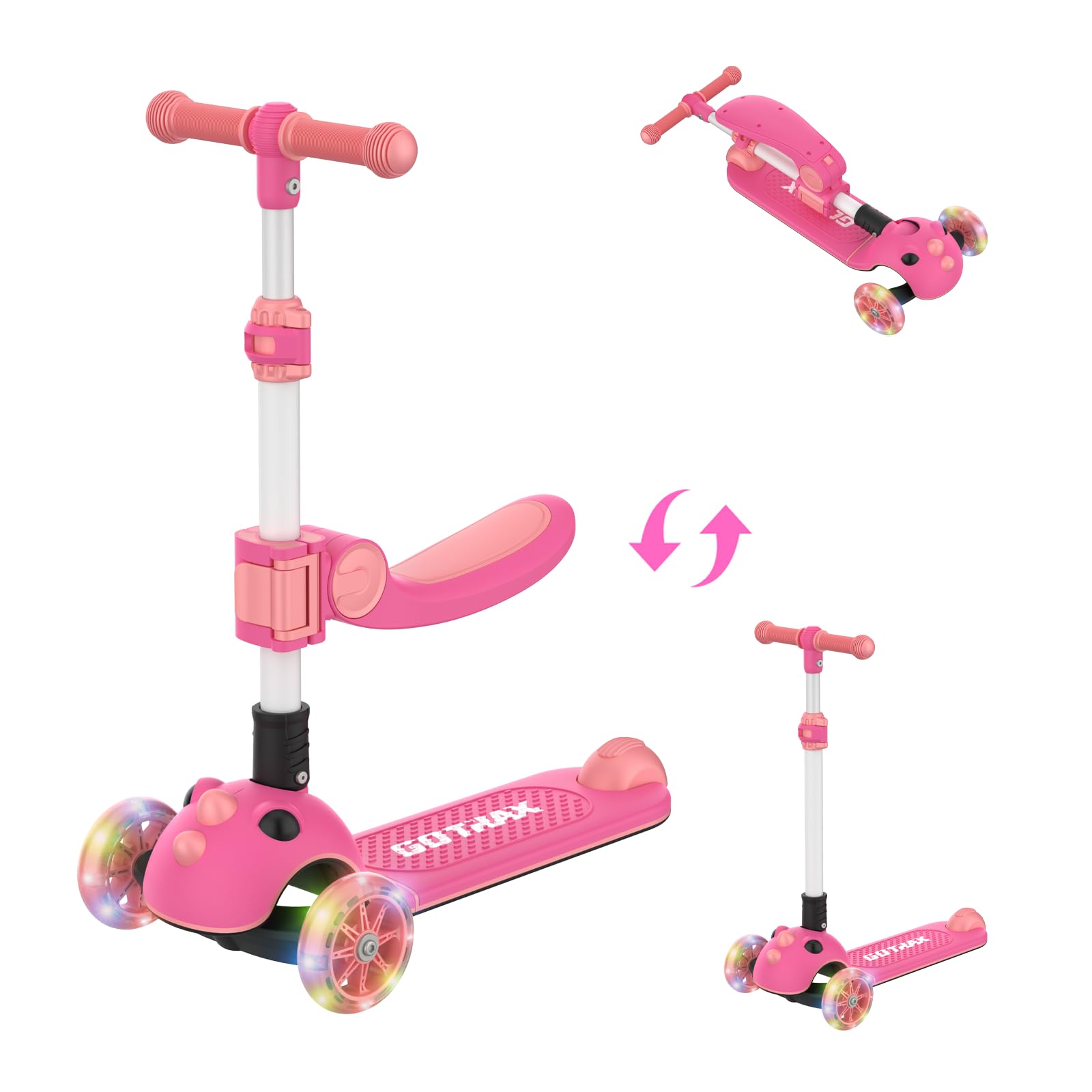
At 8 pounds with a one-key removable seat and the tightest fold of any model here, it switches between sitting and standing in seconds.
The Gotrax KS3 Pro weighs just 8 pounds, yet includes a one-key removable seat. The handlebar adjusts to four heights (25.5, 27.5, 29.5, and 31.5 inches), covering ages 2 to 8. The one-step fold mechanism collapses the frame into a compact 23 x 11 x 31 inch package — the smallest folded footprint of any scooter with a seat. That matters for families with limited closet space or who want to toss it in the car for a weekend trip. The extra-wide 3-inch PU wheels use ABEC-7 bearings (a rating for precision that lets them spin more freely than standard bearings), keeping the ride smooth over sidewalk cracks. The 6-inch wide deck gives both feet room after a push, and the wide foot brake is easy for small feet to find. The LED wheels are bright and motion-activated.
The maximum age recommendation of 8 is the lowest cap in this lineup. A child who starts at age 2 will likely outgrow it by third grade. Buyers also note that the seat is best for lighter kids — children near the 110 lb limit may find the seat feels less stable than the Lifemaster’s dedicated seat base.
Park-Ready Portability
- One-step fold and 8-pound weight make it the easiest scooter to carry and store
- One-key removable seat lets kids switch between sitting and standing mid-ride
- ABEC-7 bearings deliver noticeably smoother rolls than basic bearings on cheaper scooters
Shorter Lifespan
- Age cap of 8 is the lowest here — a 9-year-old will be too big
- Seat stability is less sturdy than the Lifemaster’s for heavier riders near the 110 lb limit
Pick this for a 2-to-7-year-old who needs a compact scooter they can take to the park or on vacation. The one-key seat and one-step fold make it the easiest to pack. Choose the BELEEV A8 or TONBUX if you want a scooter to last through elementary school — the age-8 maximum means you will be shopping again by fourth grade.
Understanding the Specs
Lean-to-Steer Technology
This is the steering system on every scooter here. Instead of turning the handlebars left or right, your child leans their body in the direction they want to go. The front two wheels tilt in response, carving a smooth arc without sudden jerks. It is more intuitive for young kids because it mirrors how their body shifts weight when running or riding a balance bike. The result: faster learning, fewer tip-overs, and a natural progression to a two-wheel scooter later.
Motion-Activated LED Wheels
Several of these scooters have wheels that light up as they spin. “Motion-activated” means no battery to replace, no power button. A small generator inside the wheel hub converts the spinning motion into electricity that powers the LEDs. The faster your child rides, the brighter the lights glow. This makes the scooter more visible to cars at dusk and gives kids a visual incentive to keep pushing — which builds leg strength and stamina.
FAQ
What age is best for a lean-to-steer scooter?
How do I know if a scooter’s handlebar height is right for my child?
Are light-up wheels worth the extra money?
Should I buy a scooter with a seat for my toddler?
How much does a good children’s scooter typically weigh?
Can a 5-year-old use a scooter meant for ages 3–12?
How do I clean and maintain a children’s scooter?
What is the weight limit for most children’s scooters?
Can I take a children’s scooter on an airplane?
How long do the LED wheels last before they stop lighting up?
Final Thoughts: The Verdict
The children’s scooter that earns the top spot is the Micro Kickboard Maxi LED because it combines a Swiss build, a 2-year warranty, and the lightest premium frame at 2.5 kg. If you want the best value for a growing child and need a foldable design, grab the BELEEV A8. For a toddler who needs a seat before they can stand, the Lifemaster 3-Wheel with Foldable Seat is the only one here that offers it.
How We Picked
We do not accept paid placement. Every pick is matched to a real buyer and a real use-case; we do not hands-on test units.
Sources & Methodology
Specifications: manufacturer listings and product documentation. Review insights: verified customer reviews, as of July 2026. Pricing: not shown on this page (it changes often); check the current price via the retailer link.
As an Amazon Associate, WellFizz earns from qualifying purchases. This does not affect which products we feature.
Related Guides

Mo Maruf
I created WellFizz to bridge the gap between vague wellness advice and actionable solutions. My mission is simple: to decode the research and give you practical tools you can actually use.
Beyond the data, I am a passionate traveler. I believe that stepping away from the screen to explore new environments is essential for mental clarity and physical vitality.