Our readers keep the lights on and my smoothie glass nicely filled. As an Amazon Associate, I earn from qualifying purchases.
Specs are compiled from manufacturer listings and verified buyer reviews and can change over time — please confirm the key details on the product page before buying.
Finding a compound microscope that actually shows you what you are looking for without a blurry, dim mess can feel like a lottery. The wrong pick leaves you fighting with cheap plastic knobs, weak lights, and a view that never snaps into focus. This guide walks through the real specs that separate a toy from a proper lab tool — so you know exactly which model belongs on your desk.
I’m Mohammad Maruf — the founder and writer behind WellFizz. This guide is built by comparing the manufacturers’ published specifications and the patterns across verified customer reviews, so you get each pick’s real strengths and trade-offs instead of marketing spin.
Whether you are a student, a hobbyist, or setting up a home lab, the best compound microscope for you depends on how much magnification you actually need and whether the stage and lighting can keep up with what you want to examine.
Our Picks at a Glance

How To Choose The Best Compound Microscope
Every compound microscope works by passing light through a thin specimen on a glass slide, then through a series of lenses that magnify the image into your eye. But the difference between a crisp, usable view and a frustrating, dim one depends on three specific areas: the quality of the objective lenses, the type of stage that holds your slide, and the light source that illuminates the specimen.
Magnification Versus Resolution
A high maximum magnification number (say 2500X) means little if the lenses are not sharp enough to resolve fine details at that level. Look for “achromatic” objectives (multi-element lenses that reduce color fringing around the edges of the image). This is the standard lens type found in virtually every quality microscope in this list — it ensures you see true colors and clear edges rather than a blurry rainbow halo.
Monocular vs Binocular vs Trinocular Heads
A monocular microscope has one eyepiece — fine for a beginner or a child. A binocular head has two eyepieces, which reduces eye strain during longer sessions because you are not squeezing one eye shut. A trinocular head adds a third vertical tube that accepts a camera adapter, so you can capture images or livestream what you see onto a screen. If you want to share what you are looking at, a trinocular or a model with digital camera integration is the route to go.
Mechanical Stage vs Fixed Stage Clips
A mechanical stage uses two adjustment knobs to move the slide left/right and forward/backward in tiny increments. A fixed stage relies on spring clips that you nudge manually. If you ever need to scan a slide methodically or track a specific cell, a mechanical stage is not optional — it saves you from bumping the slide every time you adjust focus.
Quick Comparison
| Model | Best For | Max Magnification | Head Type | Stage Type | Amazon |
|---|---|---|---|---|---|
| Swift SW380T★ Best Overall | Lab-Grade Research | 2500X | Trinocular | Mechanical | Amazon |
| AmScope B120C (with USB Camera)Also Great | Students Who Want Digital Capture | 2500X | Binocular | Mechanical | Amazon |
| OMAX MD827S30LBest for Digital Capture | Built-In High-Resolution Camera | 2000X | Binocular | Double Layer Mechanical | Amazon |
| AmScope B120C | Best Overall Value | 2500X | Binocular | Mechanical (3D) | Amazon |
| OMAX MD82ES10 | Built-In Digital For Mac/PC | 2000X | Monocular | Double Layer Mechanical | Amazon |
| Poothoh Binocular | Research-Grade For Hobbyists | 2000X | Binocular | Dual Mechanical | Amazon |
| PalliPartners Binocular | Complete Kit For Beginners | 2000X | Binocular | Mechanical | Amazon |
| Herwicm 40X-2500X | Budget-Friendly High Magnification | 2500X | Binocular | Mechanical | Amazon |
| Swift SW200DL | Portable Field Use | 1000X | Monocular | Fixed Clips | Amazon |
In‑Depth Reviews
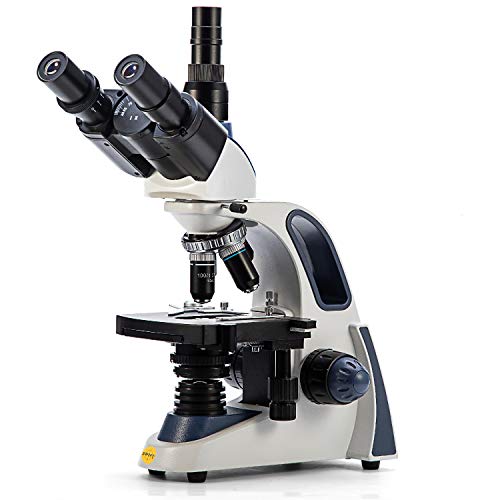
1. Swift SW380T 40X-2500X Siedentopf Trinocular Microscope
Our pick — over 4.5★ from 700+ verified ratings; the strongest balance of quality and price.
The true lab-grade trinocular that lets you stream, record, and share without compromise.
If you need to show a classroom or a colleague what you are looking at without everyone crowding around the eyepiece, the Swift SW380T solves that immediately. Its Siedentopf head (an adjustable binocular body) includes a third vertical tube — a trinocular port — that accepts a microscope camera (sold separately) for livestreaming or recording. At 13.39″L x 9.45″W x 17.72″H, it occupies a bit more vertical space than the AmScope B120C, but the extra height comes with a weight of 4.3 kg and a fully metal frame that feels anchored on a desk. The magnification range of 40X to 2500X is identical on paper to the AmScope, but the built quality and the precision of the coarse/fine focusing system is where this scope pulls ahead.
Reviewers consistently point to the ultra-precise fine-focus knob as the standout feature — coarse focus finds the field quickly, then the fine adjustment snaps the image into crystal clarity without any play or drift. The 30-degree tilt on the binocular head and the fully rotatable body mean you can share the view with someone sitting beside you without losing the image. The illumination is a cool LED that keeps living specimens safe and your eyes comfortable, with variable intensity control. At 4.6 stars from over 700 ratings, this is the highest-rated scope in this roundup, and the consensus is that it earns every star.
The honest trade-off is that you are paying for a trinocular port and a premium metal chassis that does not include a camera — you need to budget for that separately if you want the digital side. For the price, it undercuts many professional medical scopes while matching their key specs.
Lab Precision
- Trinocular head accepts any standard microscope camera for digital use — no special adapter required
- Full metal construction at 4.3 kg feels solid; no flex when turning controls
- 6 magnification levels (40X through 2500X) with interchangeable 10X and 25X wide-field glass eyepieces
One Extra Step
- Camera not included; you need to buy one separately to use the trinocular port
- Taller footprint than comparable binocular scopes — 17.72″H may crowd a shallow shelf
Best for the serious researcher or educator: If you need a sturdy metal scope that can handle daily lab use and easily accept a camera when you are ready to add one.
skip it if: You want digital capture immediately without buying extra gear — the AmScope with the included USB camera gets you there for less.
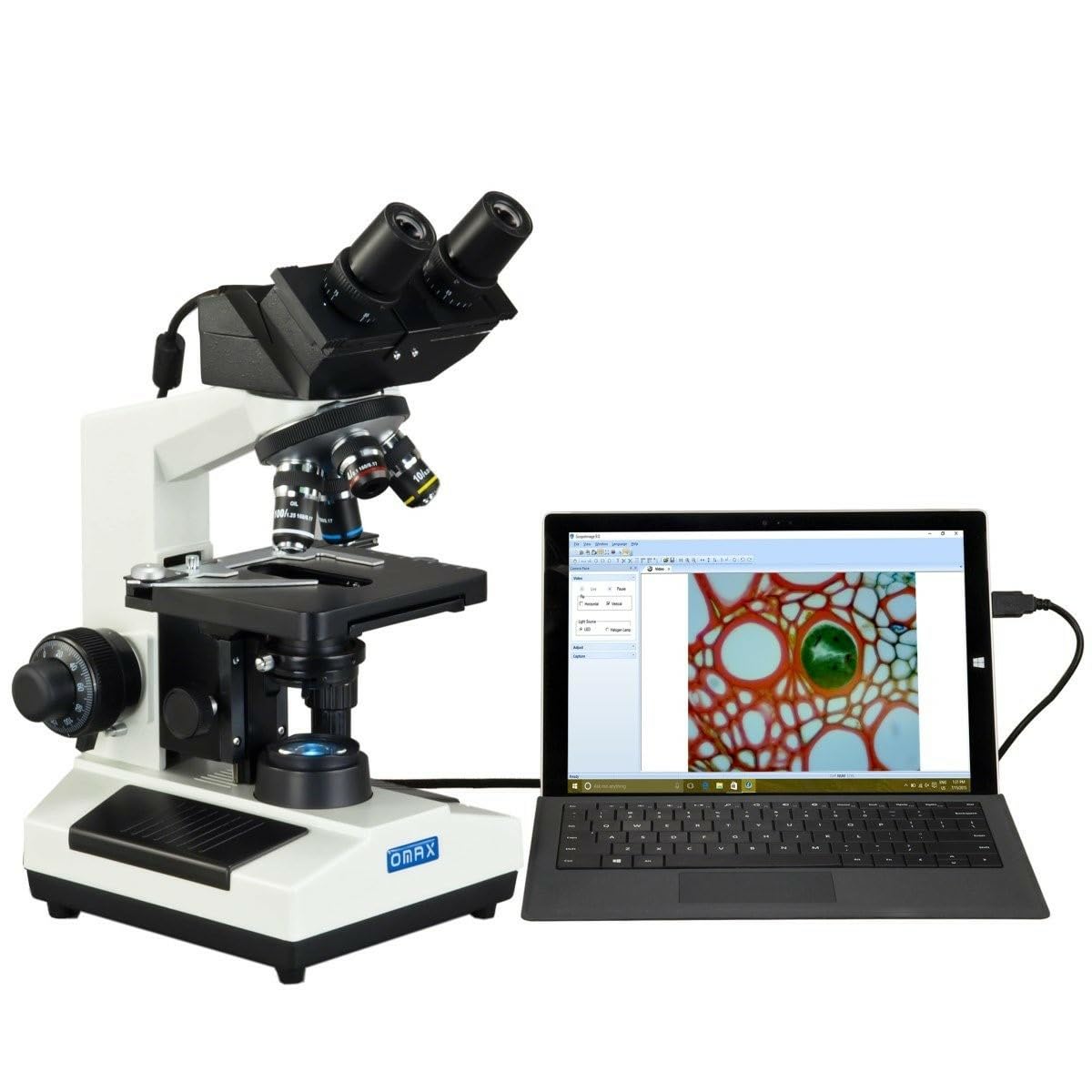
2. AmScope B120C Series LED Binocular Microscope (with USB Camera)
A binocular powerhouse that puts a digital camera in your hands without the add-on cost.
This is the AmScope B120C-E1, and it comes with a 1MP USB microscope camera and professional microscopy software for Windows. That means you can capture what is on the slide, analyze images, and share them with a class or lab group without buying a separate adapter. The magnification range goes from 40X up to 2500X, using achromatic objectives (lenses that correct color fringing) in a revolving turret, so you get clear, accurate color at every step.
The binocular Siedentopf head (the body that holds the eyepieces) is fully rotatable and adjustable for different interpupillary distances — the distance between your pupils — without losing focus. The LED light uses a specialized fly-eye lens to spread even, daylight-balanced illumination across the specimen. That means no hot spots or shadows getting in the way of details. The B120C base model without the camera, measuring 18″L x 12″W x 10″H, already leads the category, and this version simply adds the same proven optics with a digital record-keeping upgrade.
Buyers report that the included software works smoothly on Windows and that the image quality at the 2500X upper end is genuinely usable, not just a marketing number. The catch? The USB camera runs on Windows only; Mac users will need third-party imaging software to view the feed.
The Digital Edge
- Comes with a 1MP USB camera and software so you can capture and analyze images right away
- 4000+ ratings at 4.4 stars — among the most-reviewed and highest-rated scopes in this class
- Dimpled LED light with a fly-eye lens spreads even, daylight-balanced illumination
The Trade-Off
- The included camera software is designed for Windows only; Mac users need to find a third-party solution
- Maximum weight in the mid-range portion of the market; portability is not the strong suit
Who should reach for it: Students and educators who need to document slides or share findings digitally without spending extra on a separate camera adapter.
One real limitation: If you run macOS, the included imaging software will not install; you will need to purchase your own capture program to use the USB feed.
3. OMAX MD827S30L 40X-2000X Digital Biological Binocular Microscope
A binocular scope with a built-in 3MP camera that captures 2048×1536 images — no guesswork.
The OMAX MD827S30L is aimed squarely at the user who wants high-resolution digital capture without juggling a separate camera mount. It comes with a built-in 3.0 megapixel CMOS sensor that shoots still images at 2048×1536 pixels and records video at up to 10 frames per second at 1024×768 resolution. That means you can document a slide for a research paper or a classroom project straight from the scope, without squinting through a phone adapter. The software is compatible with Windows XP through 10, as well as Mac OS.
The dual-layer mechanical stage with oil-immersion condenser (a lens that uses oil between the slide and the lens to increase resolution at high magnification) gives you fine control over specimen positioning. The 3W LED light is replaceable and variable-intensity, running on AC 100V-240V so it works worldwide with just a plug adapter. The adjustable binocular head and the metal framework keep everything stable during long sessions. The maximum magnification of 2000X is slightly lower than the 2500X offered by the Swift and AmScope models, but for most biological specimens (cells, bacteria, pond water), 2000X is already the practical ceiling before image quality degrades.
Owners mention that the 3MP camera is a genuine step up from the 1MP cameras found on many budget digital scopes — images are detailed enough for publication in student-level reports. The catch is that the camera is fixed internally; you cannot upgrade it later or swap to a higher-resolution unit. If you think you will need a higher-megapixel sensor in the future, a trinocular scope with a separate camera mount gives you more flexibility.
High-Res Built In
- Built-in 3MP camera saves you the cost and hassle of adding a separate digital eyepiece
- Double-layer mechanical stage with oil immersion condenser provides professional slide control
- Worldwide voltage (100V-240V) means no step-down transformer needed for international use
The Fixed Sensor
- Camera is built into the head and cannot be upgraded; you are stuck with 3MP
- Maximum magnification of 2000X — if you absolutely need 2500X, the Swift or AmScope offers it
The right call for the digital-first lab: If you want a dedicated, high-resolution camera embedded in the scope for documentation and don’t want to fiddle with external hardware.
Skip if you prefer modularity: The fixed camera means no upgrade path. For that, the SW380T trinocular is the better future-proof bet.
4. OMAX MD82ES10 40X-2000X Digital LED Compound Microscope

A monocular digital scope that works natively with both Windows and Mac — no OS lock-in.
Unlike many digital scopes that only bundle Windows-compatible software, the OMAX MD82ES10 is documented as compatible with Windows and Mac from the start. The built-in 1.3MP camera connects over USB 2.0 to your laptop or desktop — so if you run a MacBook in a classroom or a home lab, you will not be stuck hunting for third-party drivers. The magnification range runs from 40X to 2000X with achromatic (color-corrected) objectives, and the double-layer mechanical stage lets you move slides precisely using the control knobs.
At 9.06″L x 7.09″W x 12.99″H, this is among the most compact scopes in the list — small enough to pack into a bag for fieldwork. The LED illumination uses a fly-eye lens design to spread bright, daylight-balanced light evenly, and the metal enclosure keeps it sturdy despite the small footprint. The single eyepiece (monocular) means you can focus with one eye; it is less ergonomic for long sessions than binocular models, but for quick slide checks or outdoor science, the portability is a real advantage.
The 1.3MP camera is lower resolution than the 3MP sensor in the OMAX MD827S30L. For web-sharing, email, or quick records, it is adequate. For publication-grade stills, you may wish for more pixels. One reviewer noted that the camera captures fine details of onion cells and insect wings clearly, but does have some softness at the highest zoom.
True Cross-Platform
- Mac and Windows compatible with the included software — no third-party programs needed
- Very compact at 12.99″H and metal-enclosed, making it a viable travel scope
- Fly-eye LED provides even, daylight-balanced illumination without hot spots
Resolution Trade-Off
- 1.3MP built-in camera is lower resolution than the 3MP sensor on the MD827S30L
- Monocular head causes eye strain over long periods compared to a binocular model
For the Mac ecosystem user: If you run macOS exclusively and need a digital microscope that works without hacking drivers, this is the simplest route. The compact body also suits fieldwork.
Look elsewhere if: You plan to do extended daily observation — the single eyepiece will get tiring. A binocular head like the Swift SW380T is far more comfortable for long sessions.
5. AmScope B120C Series Student & Professional LED Binocular Microscope

A mid-range binocular that gives you Siedentopf head and 2500X reach without the camera bundle.
The base AmScope B120C is the same optical platform as the B120C-E1 (the camera-bundle option) — a binocular compound scope with a 360-degree rotatable Siedentopf head and a 3D mechanical stage that glides the slide smoothly under the lens. At 40X to 2500X magnification, it matches the top-tier Swift SW380T on range, and it uses the same achromatic objective lenses. The key difference is that you are buying the bare scope without a USB camera — so if you already own a microscope camera or you do not need digital capture at all, you save the camera surcharge.
The LED illumination system is the same fly-eye design used in the AmScope B120C-E1 — bright, consistent daylight-balanced light that does not heat up the specimen. The cast steel enclosure keeps the whole unit solid, and the coarse and fine coaxial focus knobs (one inside the other) let you zoom into focus quickly, then tweak in micro increments. The B120C measures 18″L x 12″W x 10″H — a comfortable footprint for a desk or lab bench, not too massive, but stable enough that you won’t knock it over adjusting the slide.
Customers note that the 3D mechanical stage is one of the best in its class — no wobble, easy to center a slide, and the coaxial knobs feel smooth and responsive. The deal-breaker for some? This is the 2500X capacity, but review consensus says the practical limit for clear viewing is around 1000X-1500X with the supplied objectives, which is normal for this price tier. The 2500X figure requires the 25X eyepiece stacked with the 100X oil-immersion objective, and the image is dimmer at that extreme.
Solid Foundation
- Siedentopf binocular head adjusts to any interpupillary distance without losing focus
- 3D mechanical stage with coaxial coarse/fine focus — smooth, drift-free operation
- Cast steel frame and achromatic lenses deliver the same image quality as the camera-bundle version
No Digital Cable
- Does not come with a camera — if you want digital capture, you need to buy an adapter separately
- 2500X top end is usable but noticeably dimmer; sharpest viewing stops around 1000X-1500X
Smart move for the budget-conscious observer: You get the same premium binocular body and mechanical stage as the pricier AmScope versions — just without the digital add-on you may not need.
The catch: The cast steel body makes it heavier than many mid-range options, so it is not a scope you want to move between rooms frequently.
6. Poothoh Binocular Compound Microscope 40X-2000X with Dual Mechanical Stage

A research-grade binocular scope with dual mechanical stages — two layer control for precision scanning.
Where most student scopes use a single mechanical stage, the Poothoh Binocular ups the ante with dual mechanical stages — meaning separate top and bottom layers allow you to move the slide in X and Y directions with two independent sets of knobs. For anyone doing methodical slide scanning (tracking cell division along a smear, for example), this dual-layer setup reduces the risk of nudging your focus area while repositioning. The magnification range of 40X to 2000X is delivered through multiple objective lenses in a rotating turret. The specification notes “Electronic Eyepieces” — these are essentially built-in camera sensors inside the eyepiece tube, though the camera resolution is not specified.
The LED dual lighting system includes an upper light source for opaque specimens like coins or leaves and a lower transmitted light for glass slides, with adjustable brightness. It also comes with a five-color filter bar that lets you switch between colored filters to enhance contrast on different specimen types — a feature usually found only on pricier lab scopes. The coaxial coarse and fine focus handwheels (one knob nested inside the other) let you scan for the field, then fine-tune without touching a different wheel.
Reviewers point out that the dual mechanical stages are genuinely useful for detailed scanning work and that the built-in LED light is bright enough for the full 2000X range. The catch: the “electronic eyepieces” documentation is vague on actual sensor megapixels, so if you care about the digital capture resolution, you would be better off with the OMAX 3MP model where the camera specs are fully disclosed.
Stage Precision
- Dual mechanical stages give you independent X and Y control for methodical slide scanning
- Five-color filter bar built into the base — switch contrast without buying add-on filters
- Upper and lower adjustable LED lights let you view both opaque objects and transparent slides
Spec Vagueness
- Camera sensor specs are not published — you do not know the exact resolution of the built-in eyepiece camera
- Voltage is listed at 110 Volts only — not worldwide voltage like the OMAX MD827S30L
Ideal if you value stage precision: The dual-layer mechanical setup is rare at this price and makes a real difference if you are tracking specific cells across a slide.
Choose something else if: You need a known camera resolution for documentation — the OMAX MD827S30L gives you that clarity.
7. PalliPartners Binocular Compound Microscope 40X-2000X
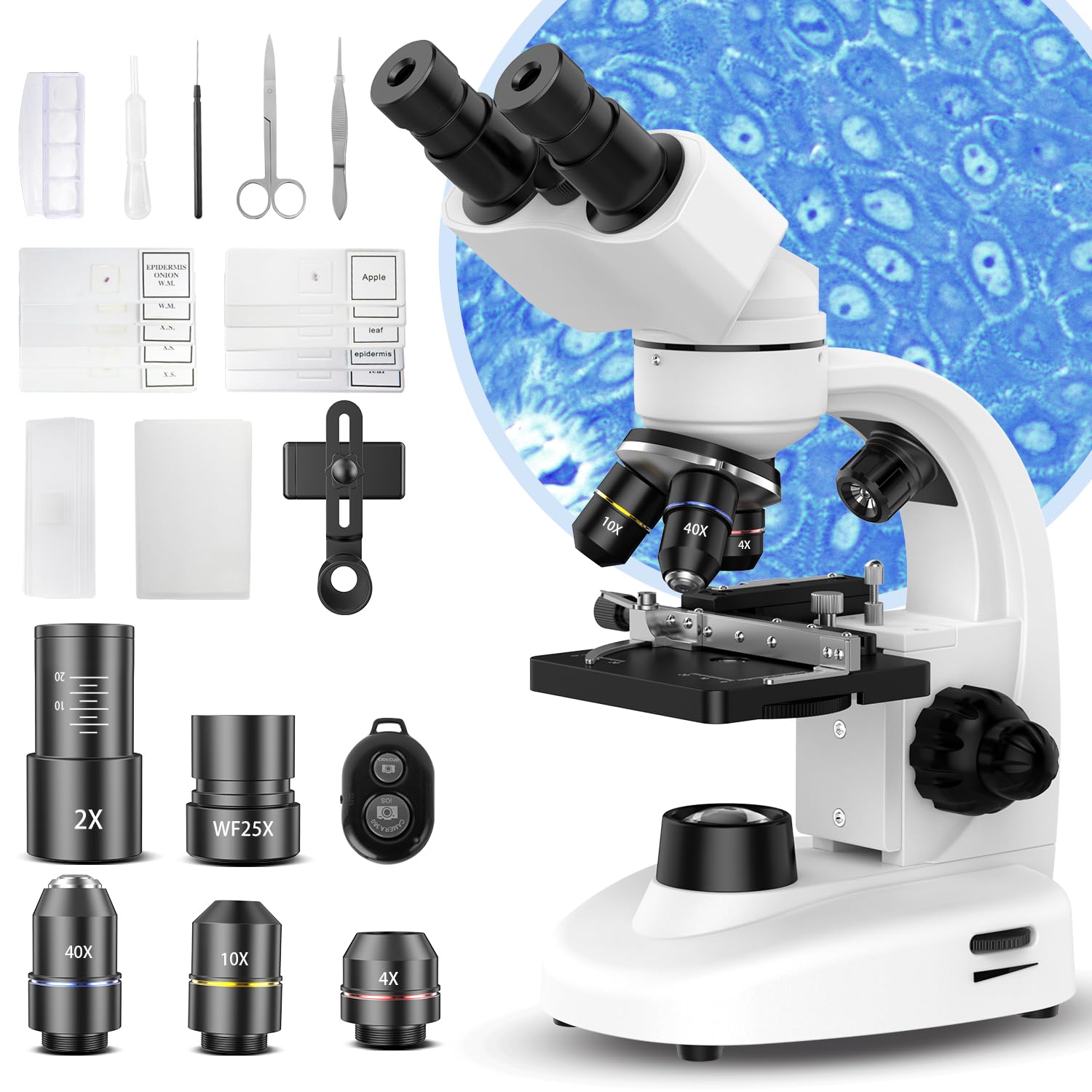
A beginner-friendly kit that comes with prepared slides, blank slides, and a phone adapter.
Opening the PalliPartners box gives you not just a compound binocular microscope, but also 9 prepared specimens (pre-mounted slides so you can start viewing immediately), 18 blank slides, a mobile phone adapter for capturing images, and both WF10X and WF25X wide-field eyepieces. This is among the most complete bundles in the list — you literally do not need to buy anything else to start exploring. The microscope itself reaches 40X to 2000X magnification through a revolving turret of achromatic objectives. The binocular head is inclined at 45 degrees (angled so you look down comfortably) and the interpupillary distance is adjustable for different eye widths.
The dual LED light system gives you an upper incident light for opaque objects (think: leaves, rocks, coins) and a lower transmitted light for standard slide specimens. The large double-layer mechanical stage has scale markings so you can note the coordinates of a specific cell or detail and find it again later. The metal enclosure and corded electric power source make it a stationary lab scope, not a portable field unit. At 4.3 stars from 157 ratings, it is slightly lower-rated than the Swift or AmScope options, but review content suggests this is mostly from buyers who wanted higher-than-expected image quality at the very top of the magnification range.
One owner mentioned that the phone adapter works reliably with most smartphone cases and that the included prepared slides are good quality — onion root tip and bee wing appear frequently. The honest trade-off: at its price, the optics are not as sharp at 2000X as the Swift SW380T, but for a beginner kit that includes everything, the bundle value is undeniable.
Everything Included
- Comes with 9 prepared slides and 18 blank slides — start viewing right from the start
- Mobile phone adapter is included, so capturing images is easy without extra gear
- Upper and lower LED lights with independent brightness for both solid and slide specimens
Optical Ceiling
- Image sharpness at the 2000X top end is not as crisp as the Swift or AmScope scopes
- Fewer total reviews at 157, so the long-term durability record is thinner than category leaders
For the beginner who wants to open a box and start: The prepped slides and phone adapter mean you will be looking at bee wings and bacteria within minutes, no separate purchases required.
Consider an upgrade if: You already know microscopy and need reliable sharpness at the very top end — the AmScope B120C or Swift SW380T will satisfy more.
8. Herwicm Binocular Microscope 40X-2500X Dual LED

A 2500X binocular scope with a telescopic protection lens — practical for student hands.
The Herwicm brings a 2500X maximum magnification to the budget end of the market, matching the top-end spec of the AmScope and Swift models. It uses 4X, 10X, and 40X achromatic objectives in a revolving turret, paired with wide-angle eyepieces that give a larger field of view (the area you can see at one time). The telescopic lens is a clever design choice — it automatically retracts if you crank the objective too close to the slide, protecting both the lens and the specimen from accidental contact. For home education or classroom environments where multiple kids might use the same scope, that spring-loaded protection adds a meaningful safety buffer.
The dual LED lighting system (top and bottom) is labeled as “automatic fill light design” — meaning the light adjusts to fill shadows. The coaxial coarse and fine focusing knobs sit on both sides of the base, giving you a comfortable two-handed grip for fine-tuning. The binocular head has an ultra-wide-angle eyepiece, which Herwicm says reduces eye fatigue during longer sessions. At 14.37″L x 11.41″W x 6.49″H (a 7% larger width than the Swift SW380T which measures 9.45″W), it is slightly wider than many competitors — something to measure on your desk.
One buyer report noted that the plastic elements in the body feel less premium than all-metal scopes, but they also said the image clarity at 400X and 1000X was better than expected for the price. The 240V power supply means you may need a plug adapter depending on your region.
Feature Dense
- 2500X magnification at a low price point — rare in the budget tier
- Telescopic spring-loaded lens protects both the objective and the slide from accidental crashes
- Coaxial coarse and fine knobs on both sides make focusing comfortable for left or right hand
Build Sacrifice
- Body combines metal and plastic components — not as durable as the all-metal Swift or AmScope
- Rated for 240V input only; North American 120V users may need a voltage converter or plug adapter
Solid entry-level choice for a family or classroom: The telescopic lens prevents a common cause of lens damage, making it a safer pick for supervised beginners.
Move up if you plan daily use: The mixed-material build will not hold up to years of frequent lab work the way a cast steel or all-metal frame will.
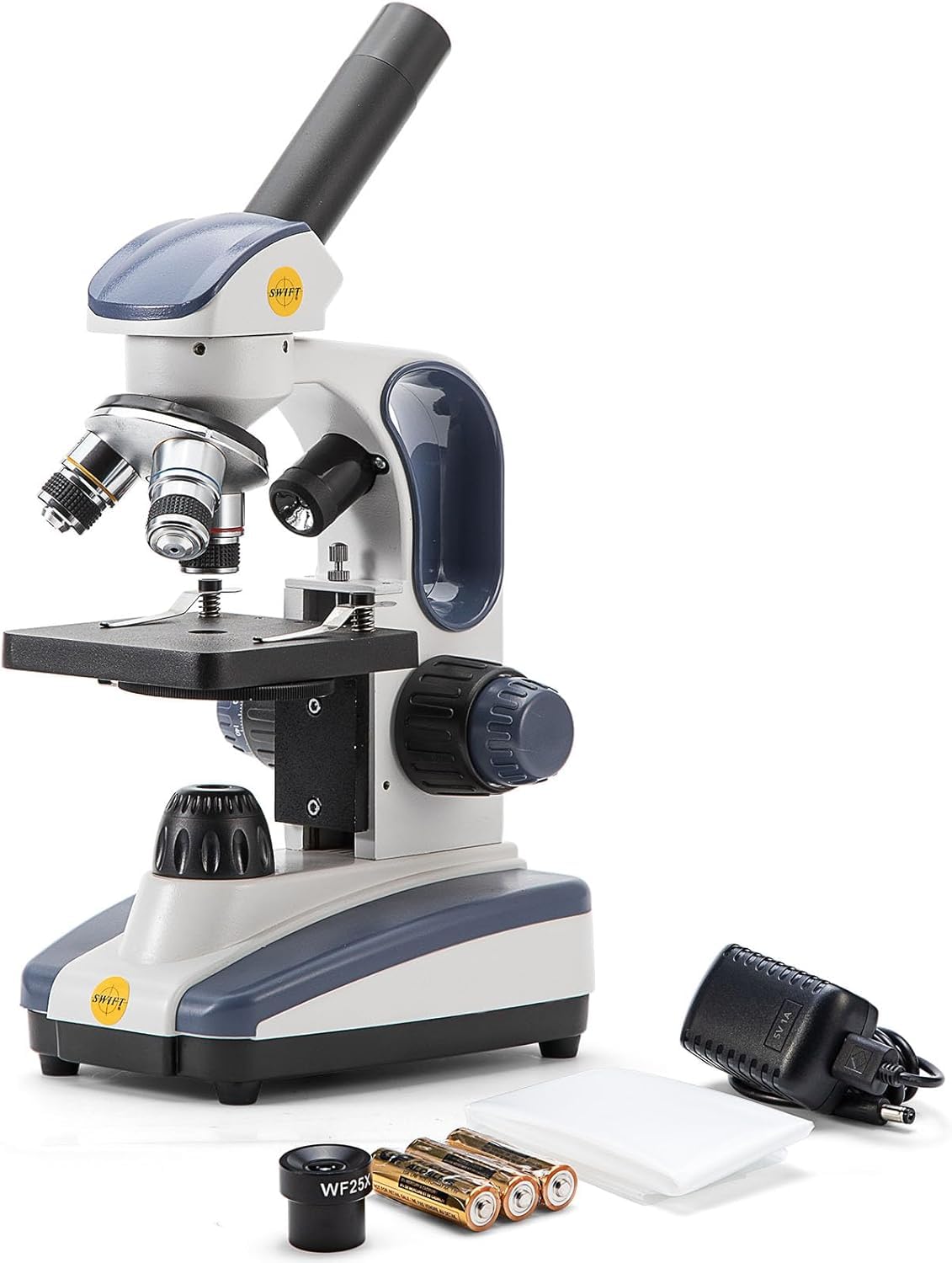
9. Swift SW200DL Compound Monocular Microscope 40X-1000X
A cordless 1000X monocular that can travel to the pond or the science fair.
The Swift SW200DL strips things back to the essentials: a monocular head, a 40X-1000X range, and battery-powered operation that lets you use it anywhere there is no power outlet. At just 5 pounds and with a carrying handle built into the arm, it is the most portable scope in this roundup — genuinely easy to carry to a field site, a science fair table, or between rooms in a school. The monocular viewing means you look with one eye, which is fine for short sessions but gets tiring over longer examinations. The magnification settings are 40X, 100X, 250X, 400X, and 1000X through three glass objectives (4X, 10X, and 40X) paired with wide-field 10X and 25X eyepieces.
The dual illumination system gives you both transmitted light (through the slide) and incident light (from above for solid objects), using cool LED bulbs that protect both eyesight and live specimens. The 45-degree angled monocular head rotates fully, which is useful for sharing the view between two people in a classroom setting. At 1000X magnification maximum (versus the 2500X top end of the higher-tier scopes), it is not designed for the deepest research — it is built for the beginner who wants a simple, durable scope that can go outside. Metal construction with rubberized grips keeps it durable for the inevitable drops and bumps.
One buyer commented that the 1000X image quality with the 25X eyepiece is dimmer than at lower powers, but they praised the SW200DL for its clarity at 400X — the most-used power for typical home and school biology. The cordless capability means no hunting for a wall outlet during science fairs, which is a real convenience.
Go Anywhere
- Battery-powered and lightweight (5 lb) with a carrying handle — genuinely portable
- Dual LED light (top and bottom) means you can view both slides and solid objects anywhere
- Fully rotatable head makes it easy to share the view during one-on-one instruction
Limited Range
- Maximum magnification is 1000X — no 2500X capability like the higher-tier scopes
- Monocular head causes eye fatigue during long sessions; the binocular models are more comfortable
- Stage uses fixed clips rather than a mechanical stage; slide positioning is manual
The right call for outdoor biology and beginners: If you need a scope that runs on batteries and can be carried to a pond or science fair without a power cord, this is your tool.
Not for you if: You need high magnification (above 1000X) or plan to spend hours at the bench — the monocular viewing and fixed stage become limitations quickly.
Understanding the Specs
Magnification vs. Resolution
Magnification is how many times larger the image appears. Resolution is how much fine detail you can actually see at that size. A high magnification number is useless if the lenses (especially the “achromatic” objectives, meaning they reduce the colored fringes that blur images) cannot resolve the detail. In practical terms: a 1000X scope with good achromatic lenses will show you more real detail than a 2500X scope with poor coatings. Within this guide, every product listed uses achromatic objectives, so the comparison depends on build quality and lighting.
Mechanical vs. Fixed Stage
A mechanical stage uses two knobs to move the slide in microscopic steps left/right and forward/backward while the slide stays clamped. A fixed stage uses spring clips that you push with your fingers. If you have ever tried to center a stained blood smear at 1000X using only your fingertips, you know why a mechanical stage is worth the extra cost — it prevents the slide from jumping out of the field when you breathe. The mechanical stage is the single biggest quality-of-life upgrade between entry-level and mid-range microscopes.
FAQ
What is the best magnification for a compound microscope?
What does Siedentopf head mean?
Can I attach a camera to any compound microscope?
Is 2000X or 2500X better?
What is the difference between a binocular and a trinocular head?
How do I clean the lenses on my microscope?
Do I need oil immersion to use 1000X or above?
What does a mechanical stage cost extra?
What kind of maintenance does a compound microscope need?
Final Thoughts: The Verdict
Across the board, the best compound microscope winner is the AmScope B120C-E1 with USB Camera because it bundles a proven 40X-2500X binocular platform with a digital camera and software — turning optical viewing into shareable documentation without extra cost. If you want lab-grade metal construction and a trinocular port for future camera upgrades, grab the Swift SW380T. And for a true digital-first experience with a built-in 3MP sensor that works on both Windows and Mac, the OMAX MD827S30L is the clear pick.
How We Picked
We do not accept paid placement. Every pick is matched to a real buyer and a real use-case; we do not hands-on test units.
Sources & Methodology
Specifications: manufacturer listings and product documentation. Review insights: verified customer reviews, as of July 2026. Pricing: not shown on this page (it changes often); check the current price via the retailer link.
As an Amazon Associate, WellFizz earns from qualifying purchases. This does not affect which products we feature.
Related Guides

Mo Maruf
I created WellFizz to bridge the gap between vague wellness advice and actionable solutions. My mission is simple: to decode the research and give you practical tools you can actually use.
Beyond the data, I am a passionate traveler. I believe that stepping away from the screen to explore new environments is essential for mental clarity and physical vitality.