Our readers keep the lights on and my smoothie glass nicely filled. As an Amazon Associate, I earn from qualifying purchases.
Specs are compiled from manufacturer listings and verified buyer reviews and can change over time — please confirm the key details on the product page before buying.
You grab your chef’s knife for nearly every meal you make. Pick the wrong one, and you crush soft tomatoes, wear out your wrist, and start dreading chopping onions. This guide narrows down seven knives that actually fit a home cook’s hand — backed by published specs and patterns from thousands of real buyer reviews.
I’m Mohammad Maruf — the founder and writer behind WellFizz. This guide is built by comparing the manufacturers’ published specifications and the patterns across verified customer reviews, so you get each pick’s real strengths and trade-offs instead of marketing spin.
The seven knives here range from budget-friendly workhorses to premium German and Japanese steel. Only a few earn the title of best chef’s knife for home cook when you look at daily feel, edge retention, and what over 15,000 buyers said after months of use.
Our Picks at a Glance
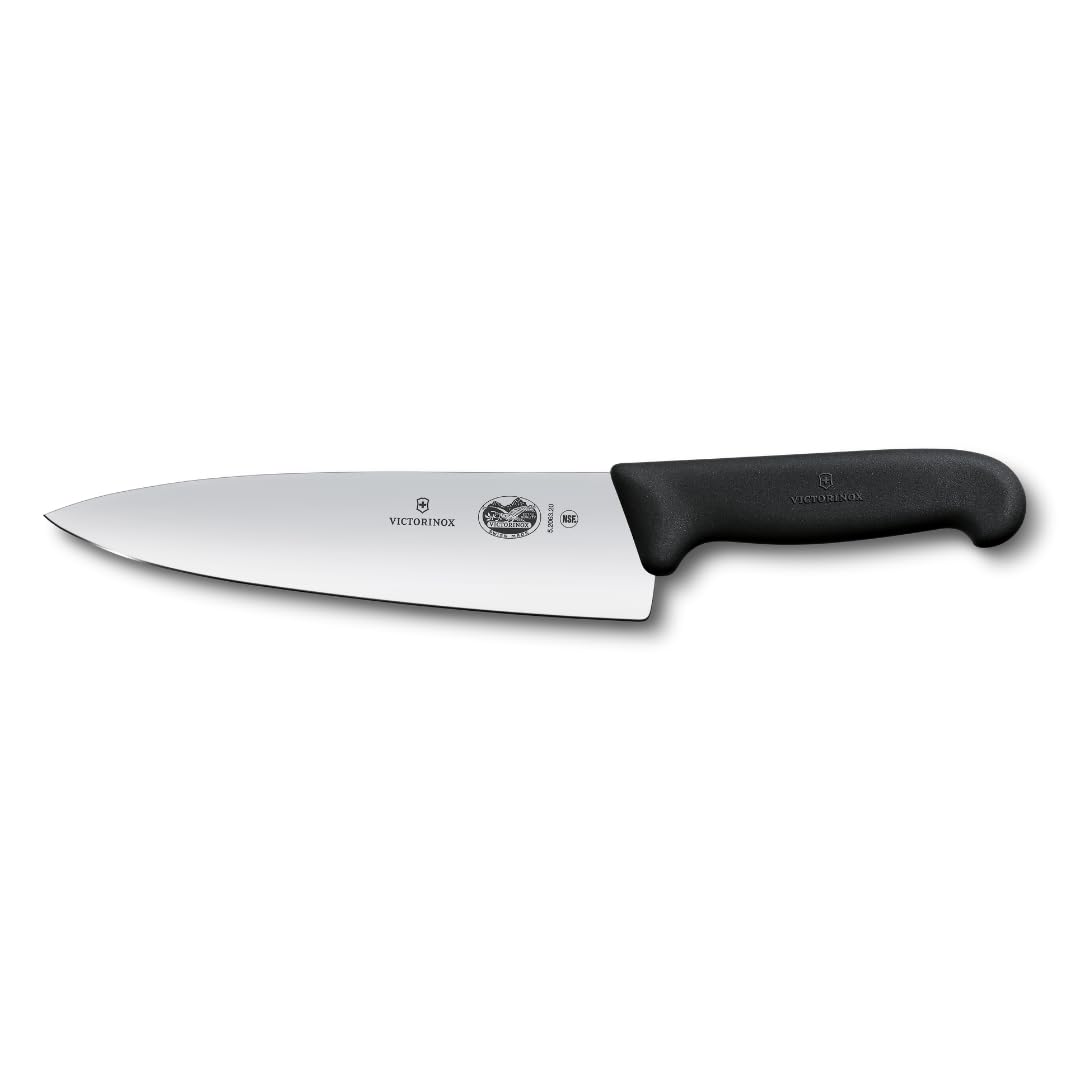

How To Choose The Best Chef’s Knife For Home Cook
A chef’s knife is the one blade you will use for 90% of your chopping, slicing, and dicing. The talk about forged vs stamped, German vs Japanese, and specific steels makes it easy to get lost. Here is what actually matters for a home cook.
Blade Construction: Forged vs Stamped
A forged blade starts as a single piece of steel that is heated and hammered into shape. It is heavier, has a thicker spine (the top of the blade), and a bolster (the thick piece between handle and blade). A stamped blade is cut from a large sheet of steel like a cookie cutter — it is lighter, thinner, and usually cheaper. Chop for 30 minutes a day? A quality stamped blade is often more nimble than a heavy forged one. But a forged knife gives you more heft to push through dense squash. The data here shows both the Victorinox Fibrox Pro (stamped) and the ZWILLING Professional S (forged) have ratings of 4.7 stars or higher from hundreds of reviews. Neither is wrong — choose the feel you prefer.
Steel Type and Hardness
High-carbon stainless steel is the balance. It resists rust and staining (unlike straight carbon steel) but can hold a sharper edge than basic stainless. Hardness is measured on the Rockwell scale (HRC). Most kitchen knives sit between 52 and 58 HRC. Harder steel — like the KYOKU Shogun at 58-60 HRC — stays sharp longer but is more brittle. Do not bone a chicken with it or twist it. Softer steel — around 55-57 HRC, like the ZWILLING — is tougher and easier to sharpen at home with a standard steel rod (a honing rod).
Handle Material and Grip
A handle that turns slippery when wet is dangerous. Thermoplastic elastomer (TPE) handles, like on the Victorinox Fibrox Pro, are designed to stay grippy wet. Wood handles — Pakkawood on the imarku, rosewood on the Victorinox Wood — are beautiful but need hand-washing and occasional oiling. Synthetic polymer handles, like the polyoxymethylene (POM) on the WÜSTHOF Gourmet, resist heat and impact well but feel hard. Fiberglass handles — G10 on the KYOKU — are durable and moisture-proof, but they feel more like a tool handle than wood.
Edge Retention and Sharpening
Every knife dulls eventually. The ZWILLING Professional S has a 15° edge per side (the angle of the blade’s cutting edge) and a 57 HRC rating — a sharp-but-tough mix. The KYOKU Shogun uses a sharper 8-to-12° edge (Honbazuke method, a traditional Japanese sharpening technique) with a VG-10 steel core (a high-carbon stainless steel that holds a very sharp edge) at 58-60 HRC, so it stays sharp longer. But it needs a specific sharpening stone (a whetstone) to restore it. Ask yourself: do you want to sharpen once a month with a quick run on a steel rod, or once every three months with a dedicated whetstone? Your answer points to one of these picks.
Quick Comparison
| Model | Best For | Blade Material | Weight | Construction | Amazon |
|---|---|---|---|---|---|
| Victorinox Fibrox Pro 8″★ Best Overall | Best Overall Value | Stainless Steel | 4.7 oz (estimated) | Stamped | Amazon |
| ZWILLING Professional S 8″Premium German | Premium German Steel | Carbon Stainless | 277 Grams | Forged | Amazon |
| WÜSTHOF Classic IKON 8″ | Best Ergonomics | High Carbon Stainless | 12 Ounces | Forged | Amazon |
| KYOKU Shogun 8″ | Japanese Precision | VG-10 Damascus | 1.4 Pounds | Forged | Amazon |
| WÜSTHOF Gourmet 8″ | Affordable German | High Carbon Stainless | 240 Grams | Stamped | Amazon |
| Victorinox Wood 8″ | Classic Wood Handle | Stainless Steel | 0.1 Kilograms | Forged | Amazon |
| imarku 8″ Chef Knife | Budget Entry Point | High Carbon Stainless | 10.86 Ounces | Stamped | Amazon |
In‑Depth Reviews
1. Victorinox Fibrox Pro 8 Inch Chef’s Knife
Our pick — over 4.5★ from 14,500+ verified ratings; the strongest balance of quality and price.
The professional-grade workhorse that over 14,800 buyers rank at 4.8 stars.
The Victorinox Fibrox Pro is the most recommended chef’s knife because it works without asking for special care. Its 7.9-inch stainless steel blade has a tapered edge that cuts through tomatoes, onions, and meat easily. The data shows it is a stamped blade, not forged, so it is lighter — good for chopping four onions without wrist fatigue.
Compared to the heavier ZWILLING Professional S (277 grams against roughly 4.7 ounces / 133 grams), the Fibrox Pro moves faster through repetitive cuts. Buyers report an honest trade-off: the handle, thanks to its thermoplastic elastomer (TPE) material (a rubbery plastic), is brilliantly grippy when wet but looks plain. It feels like a commercial kitchen tool — functional, not pretty. A rare spec seals it: “dishwasher safe.” You can throw it in the dishwasher without the handle warping. Among these knives, that is uncommon.
Sharp, simple, non-slip: This is the best chef’s knife for home cook if you want a blade that just works, holds its edge, and survives the dishwasher. Its 13.4-inch overall length feels balanced for the 8-inch blade.
The go-to blade: Reach for this if you cook daily, want a light, nimble knife, and care about results more than looks.
Consider something else if: You want a forged, heavy blade for large squash, or you prefer a classic wood handle.
2. ZWILLING Professional S 8-inch Chef’s Knife
The forged German knife that keeps its edge longer — and lets you use the dishwasher.
The ZWILLING Professional S is made in a company-owned German factory using a special high-carbon no-stain steel the brand has refined over nearly 300 years. It is forged from one piece of steel using the Sigma forge process, then ice-hardened with the FRIODUR treatment (a deep-freezing process that makes the steel more durable). This yields a blade with 57 Rockwell hardness and a laser-controlled edge at 15° per side. You can slice a ripe tomato without crushing it even after a month of daily use.
At 277 grams, it is heavier and more substantial than the Victorinox Fibrox Pro (133 grams), giving you more momentum for thick carrots or squash. The surprise in the data: this forged German blade is dishwasher safe — unlike the WÜSTHOF Gourmet (also German, but not dishwasher safe). Its three-rivet ergonomic polymer handle is bonded to the full tang (the steel extends through the whole handle), so it feels solid and balanced. Owners mention the edge holds up well, but note the composite handle does not grip like the Fibrox Pro’s TPE when wet. Keep your hands dry.
Forged resilience, dishwasher freedom: You get the heft of a forged German blade without hand-washing. The 15° edge per side pairs well with a simple steel rod for maintenance.
Ideal for: Anyone who wants a premium forged knife that cuts well, looks timeless, and does not demand special care. It competes with the WÜSTHOF Classic IKON at a lower entry point.
skip it if: You want a lighter knife for fast vegetable prep, or you need a handle that stays tacky when your hands are wet.
3. WÜSTHOF Classic IKON 8-Inch Chef’s Knife
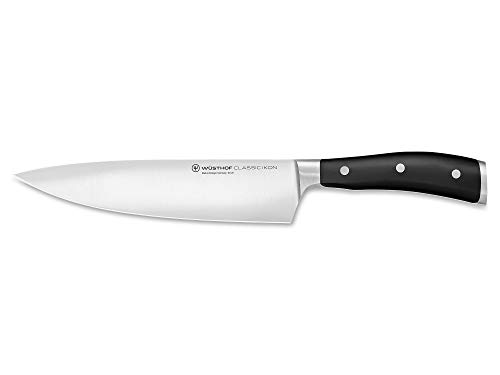
A 200-year German family legacy refined into the most comfortable grip in the kitchen.
The WÜSTHOF Classic IKON comes from seven generations of knife-making in Solingen, Germany. It shows most in the handle. It has a sleek synthetic black handle with a distinctive double bolster design — a thickened piece of steel at the base of the blade — for exceptional balance and professional-style heft. At 12 ounces and 14 inches overall length, it is the longest knife here. That extra reach helps when slicing across a large roast.
What sets the Classic IKON apart in the data is Precision Edge Technology (PEtec). WÜSTHOF claims this yields a blade that is 20% sharper with twice the edge retention compared to previous models. The blade is forged from one block of high-carbon stainless steel and tempered to 58 HRC (one point harder than the ZWILLING’s 57 HRC). It is not dishwasher safe, unlike the ZWILLING, so hand-wash and dry it immediately. Reviewers with smaller hands note the double bolster can make the knife feel slightly forward-heavy compared to a lighter stamped knife.
Ergonomic perfection: Felt wrist fatigue from a poorly balanced knife? The Classic IKON’s double bolster and 8-inch (20 cm) blade are designed to counter that. It is a precision-forged knife that feels molded to your hand.
Best suited for: Home cooks who prioritize a comfortable, balanced grip and want a knife sharper from the start than standard German steel. Its 4.6 rating from 796 reviews backs this.
A consideration: The 58 HRC hardness holds its edge longer, but you need a good honing rod or whetstone — a pull-through sharpener may not work well.
4. KYOKU Chef Knife – 8″ Shogun Series

A 67-layer Damascus blade that cuts like a laser with a 1.4-pound heft you can feel.
The KYOKU Shogun is the heaviest knife here at 1.4 pounds (635 grams) — that weight serves a purpose. The blade is a Japanese 67-layer Damascus VG-10 steel core, cryogenically treated. Its edge is sharpened to an 8-to-12° angle using the traditional 3-step Honbazuke method — thinner than the ZWILLING’s 15° per side. That means it slides through food with very little resistance. Customers note it is almost uncomfortably sharp from the start; you must be careful with your fingers.
The handle is G10 (a fiberglass laminate that is cold-resistant, heat-resistant, and moisture-proof). It will never swell like wood. The knife includes a sheath and a case — a thoughtful addition because the VG-10 steel at 58-60 HRC is brittle enough that you do not want it loose in a drawer. The trade-off: this knife needs a whetstone, not a steel rod, because a standard rod does not match the 8-to-12° edge angle. But if you want a knife that slices fish, bell peppers, and herbs with the least resistance possible, this is it.
Standout strengths
- VG-10 steel core at 58-60 HRC holds its edge substantially longer than 55 HRC German steel.
- 8-to-12° Honbazuke edge is visibly sharper than any other knife here.
- G10 handle is indestructible and moisture-proof — no oiling needed.
Honest trade-offs
- 1.4 pounds is heavy — your wrist will feel fatigue during long prep sessions.
- Requires a whetstone; do not use a pull-through sharpener on it.
- Not dishwasher safe; hand-wash and dry immediately.
The precision pick: Choose the KYOKU Shogun if you want the sharpest edge in the list and are willing to learn whetstone sharpening. It is a laser for precision slicing.
Think twice if: You need a do-everything knife for bones or frozen foods, or you prefer a simple honing steel for maintenance.
5. WÜSTHOF 8″ Gourmet Chef’s Knife, Black

WÜSTHOF’s German heritage in a lighter, stamped package for the budget-savvy cook.
The WÜSTHOF Gourmet series is for home cooks who want the Solingen name without the forged price. It is a precisely laser-cut stamped knife with a synthetic polypropylene handle that resists fading, discoloration, heat, and impact. At 240 grams (about 8.5 ounces), it is lighter than the forged ZWILLING (277 grams) and the Classic IKON (12 ounces / 340 grams), so it is quicker for daily vegetable prep. The data shows a high-carbon stainless steel blade with a plain edge. At 13.23 inches overall length, it feels balanced for the home kitchen.
One clear difference from the WÜSTHOF Classic IKON: this Gourmet knife is not dishwasher safe, and its handle is simple polypropylene (POM) without the IKON’s double bolster ergonomics. It is still a solid performer — 487 buyers rate it at 4.6 stars — and it comes with a limited lifetime warranty. But reviewers point out the edge does not stay as sharp as the precision-forged IKON models. This is an entry-level WÜSTHOF, not a heirloom piece. For heavy duty work like cutting thicker vegetables and meats, the data says the weight and balance still handle the job.
German quality at a lighter weight: If you want a German-made 8-inch chef’s knife without the forged blade’s heft, the Gourmet is a smart pick. The polypropylene handle stays cool and is impact-resistant for daily use.
A practical choice for: Anyone who likes WÜSTHOF but wants something lighter and easier on the budget than the Classic IKON. Hand-wash it and it will last.
One catch: If you want the longer edge retention of PEtec or the dishwasher convenience of the ZWILLING, look elsewhere.
6. Victorinox Wood 8 Inch Chef’s Knife

Swiss precision meets an artisan rosewood handle — but this one is forged, not stamped.
The Victorinox Wood is an outlier. Unlike the famous Fibrox Pro (stamped, 13.4 inches overall), this version is forged from stainless steel with an ergonomic rosewood handle — the data lists its construction as “Forged.” The rosewood handle offers a warm, natural grip that feels different from any synthetic handle here. At 12.4 inches overall, it is a full inch shorter than the Fibrox Pro (13.4 inches), making it a slightly more compact knife that stores easily.
This knife suits meat prep specifically. The data says it is perfect for cutting all kinds of meat, and the straight edge offers precision. But the wood handle changes upkeep: it is not dishwasher safe, and it needs occasional mineral oil treatment to keep the rosewood from drying and cracking. With a 4.7 rating from 290 buyers, most owners love the look and balance. One honest note from reviews: the knife is lighter than expected for a forged blade (0.1 kilograms — roughly 3.5 oz, though that may be the blade weight only). It lacks the heavy momentum of the ZWILLING or KYOKU.
A beautiful forged blade: If you want a knife that looks like a classic heirloom but has Swiss engineering, the Wood is it. The forged construction gives it a stiffness the Fibrox lacks.
Best for: Cooks who prefer a natural wood handle and cut primarily meat. It needs more care than the Fibrox Pro.
Not ideal for: Anyone who tosses their knife in the dishwasher or needs a non-slip wet grip. For wet-grip, stick with the Fibrox Pro.
7. imarku Chef Knife 8 inch
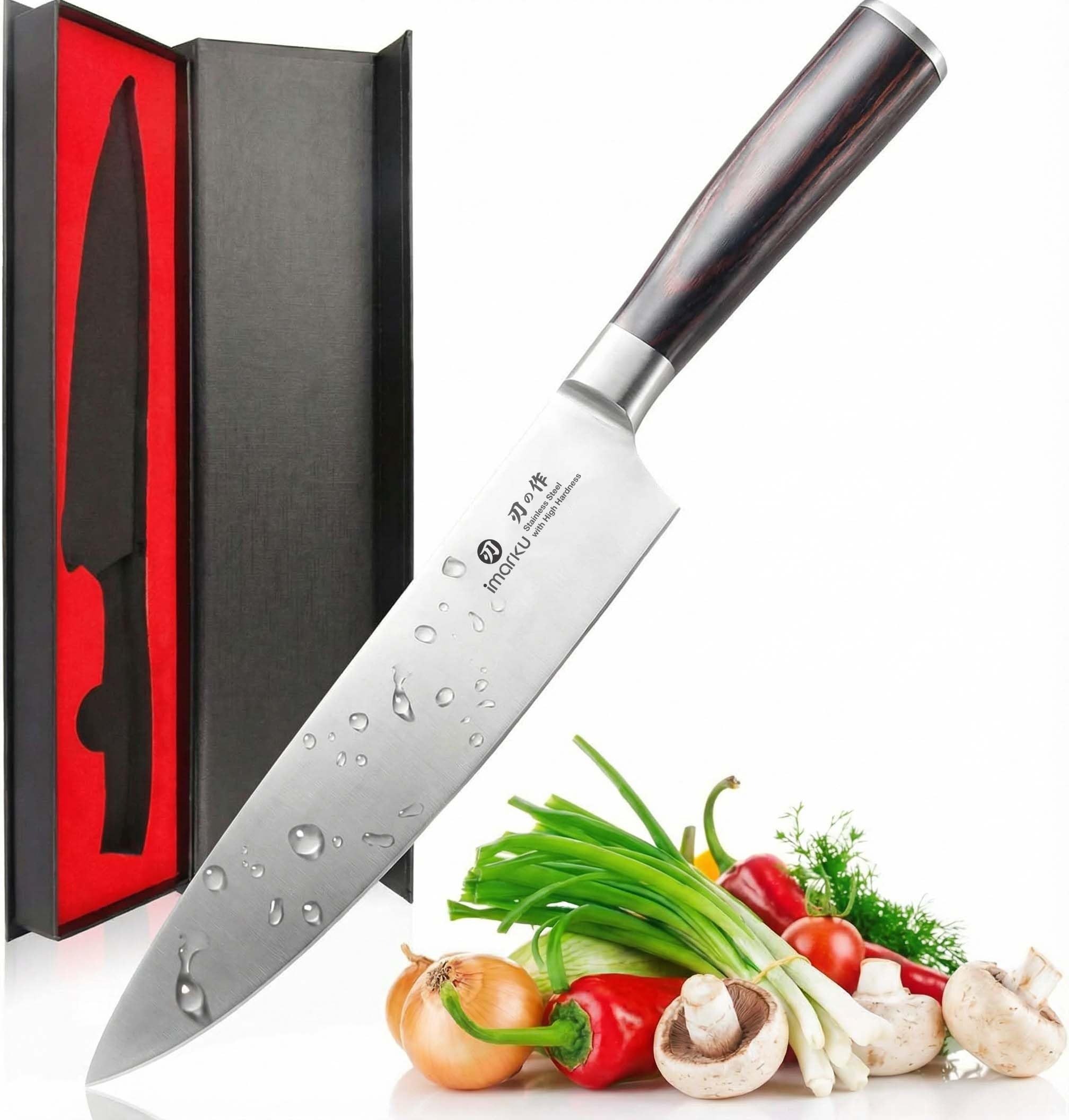
A high-carbon blade with a fancy gift box — the imarku punches above its tier.
The imarku 8-inch chef knife is the budget pick, but it is not a throwaway. It uses hand-forged high-carbon stainless steel with a V-shaped edge sharpened to 10-15° per side, designed to reduce cutting resistance. The handle is Pakkawood (compressed wood layers with resin) — it looks like natural wood but is more durable than raw timber. At 10.86 ounces (about 308 grams), it is slightly heavier than the Victorinox Fibrox Pro but lighter than the forged German knives.
Shoppers say the knife comes in a fancy gift box, making it a popular gift for parents, spouses, or culinary students. The one-year replacement policy and 24-hour customer service are a nice buffer at this price. Two notes: it is not dishwasher safe (the Pakkawood handle will degrade), and its 4.6 rating from 798 reviews suggests good performance, but edge retention is not at the level of the WÜSTHOF or ZWILLING. For a home cook on a budget who wants a knife that looks and feels pricier than it is, the imarku delivers.
Good-looking and affordable: The imarku is a solid entry-level knife for a new cook who wants a high-carbon stainless blade and a wooden handle without spending a lot. The Pakkawood handle is comfortable for extended use.
Reach for this if: You are starting your kitchen kit and want one knife that looks great, cuts well, and does not dent your wallet. The gift box is a bonus for gifting.
Look elsewhere if: You are a heavy daily user who needs the edge to last months between sharpenings — the imarku will require more frequent maintenance than the premium forged knives.
Understanding the Specs
Rockwell Hardness (HRC)
This scale measures how hard a steel blade is. A higher number (like 60) means the blade stays sharp longer, but it is more brittle — it can chip if you cut bone or twist it. A lower number (like 55-57) means the blade is tougher and easier to sharpen, but you will need to hone it more often. Most German kitchen knives sit around 55-58 HRC; Japanese knives often go to 58-61 HRC. For a home cook, 55-58 HRC is a safe, easy range. 60 HRC needs a careful touch and a whetstone.
Edge Angle
This is the angle where the blade meets the cutting surface. A typical Western chef’s knife has an edge angle of 15° to 20° per side, making it durable and easy to sharpen on a standard steel rod. A Japanese knife often has a thinner edge at 8° to 12° per side. A thinner edge cuts with less resistance (the knife seems to fall through food) but is more delicate — it can roll or chip on a hard cutting board or frozen food. Match your sharpening method to the edge angle.
Forged vs Stamped
A forged knife starts as a single piece of steel, heated and hammered into shape. It usually has a bolster (the thick ring between blade and handle) and is heavier and thicker. A stamped knife is cut from a flat sheet of steel, like a cookie cutter. It is lighter, thinner, and cheaper. Forged knives feel more substantial and have better forward momentum for dense foods. Stamped knives feel nimble for fast, repetitive chopping. Neither is universally better — it depends on your cooking.
Handle Materials: TPE, Pakkawood, POM, G10
The handle material dictates grip, durability, and care. TPE (thermoplastic elastomer) is a rubbery synthetic that stays non-slip when wet — the safest grip, but it can look plain. Pakkawood is wood veneer bonded with resin — it looks like natural wood but resists water better than raw wood. POM (polyoxymethylene) is a hard synthetic that resists heat and impact but feels slick when wet. G10 is a fiberglass-based laminate that is very strong, moisture-proof, and textured for grip; it often appears on premium Japanese knives. Wood handles need hand-washing and occasional oiling. Synthetics handle more abuse.
FAQ
What is the best chef’s knife for a home cook on a budget?
Should I get a German or a Japanese chef’s knife?
Is a forged knife better than a stamped one?
What does dishwasher safe mean on a chef’s knife?
How do I sharpen a chef’s knife at home?
Can I use a chef’s knife to cut bones?
How long does a chef’s knife last?
What is the difference between the WÜSTHOF Gourmet and the WÜSTHOF Classic IKON?
Which knife has the best non-slip grip when wet?
Final Thoughts: The Verdict
Across the board, the chef’s knife for home cook winner is the Victorinox Fibrox Pro 8-inch because it combines professional-grade cutting, a non-slip TPE handle, and dishwasher safety at a reasonable price — backed by a 4.8 rating from over 14,800 buyers. If you want the heft and edge retention of a forged German blade, grab the ZWILLING Professional S. And for laser-like Japanese precision that stays sharp through detailed slicing, the KYOKU Shogun 8-inch is your blade.
How We Picked
We do not accept paid placement. Every pick is matched to a real buyer and a real use-case; we do not hands-on test units.
Sources & Methodology
Specifications: manufacturer listings and product documentation. Review insights: verified customer reviews, as of July 2026. Pricing: not shown on this page (it changes often); check the current price via the retailer link.
As an Amazon Associate, WellFizz earns from qualifying purchases. This does not affect which products we feature.
Related Guides

Mo Maruf
I created WellFizz to bridge the gap between vague wellness advice and actionable solutions. My mission is simple: to decode the research and give you practical tools you can actually use.
Beyond the data, I am a passionate traveler. I believe that stepping away from the screen to explore new environments is essential for mental clarity and physical vitality.