Our readers keep the lights on and my smoothie glass nicely filled. As an Amazon Associate, I earn from qualifying purchases.
Specs are compiled from manufacturer listings and verified buyer reviews and can change over time — please confirm the key details on the product page before buying.
Most cheap RC cars look like a bargain in the box, then die after ten minutes of driving or break on the first curb. The real question is not which one costs the least money — it is which one actually survives your driveway, runs long enough for a real play session, and feels fun instead of frustrating. This guide sorts through seven budget-friendly remote control vehicles by what matters most for a kid or beginner driver: battery endurance, real-world durability, and how easy the controls are to learn on first use.
I’m Mohammad Maruf — the founder and writer behind WellFizz. This guide is built by comparing the manufacturers’ published specifications and the patterns across verified customer reviews, so you get each pick’s real strengths and trade-offs instead of marketing spin.
if you need something for the backyard, the park, or the living room floor, these honest breakdowns will help you find a cheap rc car that actually earns its spot in the toy box and keeps running past the first weekend.
Our Picks at a Glance


How To Choose The Best Cheap RC Car
Buying on a budget means you trade some flashy features for reliability. The most common mistake is picking the car with the wildest look or the highest claimed speed, then discovering the battery lasts only a few minutes or the plastic cracks on a tipped-over landing. These are the specs you should actually check before you click “add to cart.”
Battery Capacity and Runtime
This is the single most important spec for a cheap RC car. A low-cost toy that runs for only eight to ten minutes on a charge will frustrate any kid (or adult) before the fun even gets started. Look for a built-in rechargeable battery measured in mAh (milliamp-hours, the unit that tells you how much energy the battery holds). A 500 mAh battery typically gives about 20 to 25 minutes of driving. Two batteries — or a higher capacity like 600 mAh — push that closer to 45 minutes to an hour. Models that still rely on AA batteries (six of them) can get expensive fast, so a rechargeable pack saves you money within a few weeks of regular use.
Controller Frequency: 2.4GHz vs. Infrared
Nearly every budget RC car today uses 2.4GHz (gigahertz, the radio frequency band it operates on) for the controller. This frequency gives you a longer range — often around 50 meters (165 feet) — and lets multiple cars race side by side without interference. Older or cheaper models might use infrared (IR), which requires a direct line of sight and limits you to one car at a time. Always pick 2.4GHz if you plan to play with friends or siblings.
Build Materials and Terrain Ability
A cheap RC car should still survive a few tumbles. The body material matters: ABS (acrylonitrile butadiene styrene, a tough, impact-resistant plastic common in toys and electronics) handles bumps better than basic hard plastic that can crack. Look for rubber tires with deep treads so the car can roll over grass, gravel, or carpet without getting stuck. If you want to drive on sand or in shallow water, you need a sealed amphibious design — most cars will stop working if they get wet.
Quick Comparison
| Model | Best For | Battery | Speed | Weight | Amazon |
|---|---|---|---|---|---|
| AUUGUU Monster Truck★ Best Overall | Budget-friendly all-terrain fun | Rechargeable (25 min) | Standard | 10.56 oz | Amazon |
| DEERC Remote Control CarAlso Great | Imaginative play & longest runtime | 2 x rechargeable (50+ min) | Standard | 1.56 lbs | Amazon |
| Tecnock Gesture Sensing RC Car | Unique dual-mode controls | 2 x 500 mAh (45 min) | Standard | — | Amazon |
| RC Drift Car (Sakeye) | High-speed drifting & swap tires | 2 x rechargeable (40 min) | 18 km/h | — | Amazon |
| MaxTronic Amphibious RC Car | Water play & 360° flips | 600 mAh | 15 km/h | 0.5 kg | Amazon |
| Remote Control Stunt Car (Zalneo) | Modular battery & quick swaps | 2 x 500 mAh (50 min) | Standard | — | Amazon |
| Fisher-Price My Easy RC | Preschool beginners age 3+ | 6 x AA (not included) | 2 speeds (parent-controlled) | 1.06 lbs | Amazon |
In‑Depth Reviews
1. AUUGUU Monster Truck 2.4GHz with Light Spray
The lightest and cheapest car here, built for quick indoor laps and small hands.
At 10.56 ounces, this AUUGUU monster truck is a lightweight — noticeably easier for a three-year-old to carry and place than heavier options like the DEERC which is 1.56 pounds. It uses flexible rubber tires and a sturdy motor that you can drive across rooms, grass, and sand without getting stuck. The “light spray” feature (LED lights that simulate rocket boosters) adds visual drama without a water-filling mess. The 2.4GHz frequency means you can race two or more cars at the same park without signal conflicts.
The big trade-off is run time: the rechargeable battery delivers 25 minutes of play, according to the manufacturer. That is half the endurance of the DEERC or Zalneo, and reviewers point out that the battery is built-in rather than swappable, so you must wait for a full recharge (via USB) before the next session. The body dimensions are compact at 5.7 x 4.3 x 5.3 inches — a 1.9x size gap compared to the larger DEERC — which makes it easy to stash in a backpack but also means smaller wheels that can bog down in tall grass. For the lowest price in the lineup, you get a solid entry-level car that works best for short, spontaneous play sessions.
Why it is a good starter
- At 10.56 ounces, it is very light and easy for young kids to carry
- All-terrain rubber tires handle grass, sand, and carpet without trouble
- 2.4GHz controller lets multiple cars race simultaneously
Where it cuts corners
- 25-minute run time is short — about half of what top picks offer
- Battery is built-in and not removable, so you must charge the whole car
- Compact size and lighter weight mean less stability over rough bumps
Good for: a first-time young driver or a grandparent’s house where occasional, short play sessions are the norm.
Not enough for: a child who demands long uninterrupted play or wants to tackle big jumps and rough terrain.
2. DEERC Remote Control Car with Fog Mist & Music
The longest-playing budget SUV that turns driveways into adventure stories.
The biggest reason kids stop playing with a cheap RC car is the dead battery — and this DEERC model tackles that head-on by packing two rechargeable batteries that deliver over 50 minutes of run time, according to the manufacturer. That is nearly double what most cars in this price range offer. It also stands out with a mist exhaust system (you fill a small water hole in the car, and a cool vapor shoots from the tailpipe) plus built-in music and blue lights, so every drive feels like a mini show.
Buyers report that the 1:16 scale body feels solid for a budget car, and the anti-collision bumper plus anti-vibration tires help it survive tumbles on grass and gravel. The trailer hitch up front and the plastic shovel at the back add a level of imaginative play you do not see on most models. At 1.56 pounds, it is noticeably heavier than the Fisher-Price option by a 47% margin, which gives it a planted feel on the ground. Owners mention the controls are responsive, and the 2.4GHz signal lets two or three kids race together without interference. The main trade-off is that the mist feature requires careful refilling, and the music can get repetitive for parents after a few sessions.
What keeps it running
- Two batteries provide 50+ minutes of total run time — best endurance on this list
- Mist exhaust, music, and LED lights create a dramatic play experience
- Anti-collision bumper and rubber tires handle grass, gravel, and backyard terrain
What to watch for
- Mist feature needs water refills and can leak if the car tips over
- Weighs 1.56 pounds, which feels substantial but might be heavy for very young toddlers
- Music volume is fixed — no mute or volume control on the remote
Reach for this if: your kid loves pretend play and you want the longest driving session per charge in this price tier.
Look elsewhere if: you need a smaller, lighter car for a toddler who struggles with heavier toys.
3. Tecnock Remote Control Car with Gesture Sensing
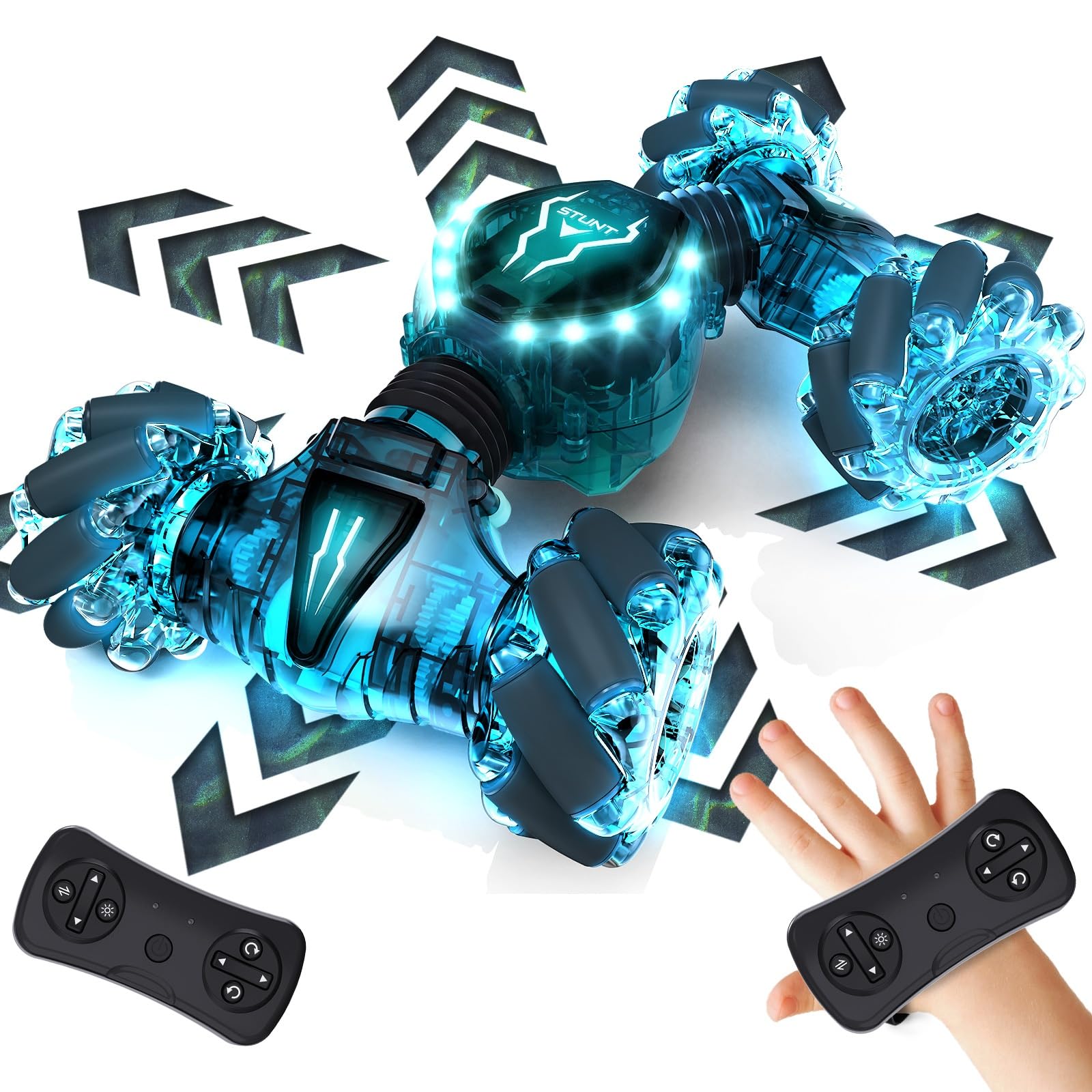
A stunt car your kid can drive with a flick of the wrist.
This Tecnock model flips the usual RC routine by adding a gesture-sensing wristband — a small wearable controller that lets a child steer the car just by moving their hand. A single button switch lets you toggle between the wristband and the standard remote, so a beginner can start with the remote and graduate to gesture control later. The car itself performs 360° spins and drives on both sides (if it flips over during a stunt, it keeps racing right-side-up).
Two 500 mAh rechargeable batteries deliver a combined 45 minutes of play, according to the manufacturer. That is a solid mid-range runtime — not as long as the DEERC, but longer than basic single-battery models like the AUUGUU, which holds 600 mAh but runs for only 25 minutes. The body and wheels light up with LED effects, making evening drives visible and notable. Reviewers mention the controls are intuitive enough for kids ages six to twelve, and the 2.4GHz signal holds steady. The main complaint is that the gesture wristband takes a few minutes of practice to master — some younger kids get confused by the tilt direction at first.
Cool factor highlights
- Gesture-sensing wristband gives a novel way to control the car without a remote
- Two 500 mAh batteries offer 45 minutes of run time, enough for a park trip
- 360° spins and dual-sided driving mean fewer interruptions to flip the car back over
Potential frustrations
- Gesture control has a learning curve for some children
- Body and wheel LEDs are bright but not switchable off on the fly
- Battery swap requires removing a small screw (not tool-free)
Pick this for: a gadget-loving kid who gets excited about novel controls and flashy stunts.
skip it if: your child prefers simple, straightforward driving without having to learn a new control method.
4. RC Drift Car (Sakeye) 4WD 1:16

The fastest car on this list for kids who want to slide corners, not just crawl.
Most cheap RC cars top out at a moderate crawl, but this Sakeye model hits a maximum speed of 18 km/h — noticeably quicker than the 15 km/h of the MaxTronic amphibious car. It also comes with two sets of tires: four smooth drift tires for sliding on tiles and polished floors, plus four regular racing tires for grip on carpet and pavement. That means your child can switch the driving style without buying any extra parts. The car shell is designed to protect against impact damage during drifts, and the wheels are removable and replaceable if they wear out.
The battery setup includes two rechargeable packs, each providing more than 20 minutes of run time for a total of around 40 minutes. A rear water-spray feature (similar to the DEERC’s mist, but triggered from the remote handle) adds a visual effect while drifting. Reviewers highlight the proportional acceleration — you can creep slowly or punch the throttle, which gives a more mature driving feel compared to on-off trigger cars. The catch is that the drift tires work best on very smooth surfaces, so this car is less suited for outdoors on thick grass or loose gravel than a monster-truck-style model.
Performance edge
- 18 km/h top speed makes it the fastest car reviewed here
- Interchangeable drift tires and racing tires expand how you can drive it
- Proportional throttle allows smooth acceleration and controlled slides
Limitations
- Drift tires have limited grip on grass, sand, or thick carpet
- Rear water spray feature adds messy cleanup and can drip inside the car
- 40-minute total run time is decent but shorter than the DEERC’s 50+ minutes
Best matched to: a kid (or adult) who already knows they want to slide around corners and has a smooth driveway or indoor track.
Not ideal for: pure off-road adventures or full-speed running on thick backyard grass.
5. MaxTronic Amphibious Remote Control Car

A 4WD crawler that dives into puddles and flips on land without breaking.
If your child loves water — puddles, streams, or even a bathtub — this is the only car on the list that is built to handle it. The MaxTronic has a waterproof sealed design (the electronics are sealed inside the body) that allows it to “surf” on water at any depth, according to the manufacturer. On land, the 4×4 all-terrain drivetrain and suspension push it to 15 km/h, and the protective cage lets it do 360° flips without damaging the shell. The built-in 600 mAh lithium battery is 20% larger than the 500 mAh packs in the Zalneo stunt car, meaning longer individual sessions before a recharge.
Reviewers appreciate the simplified, kid-sized remote with fewer buttons — toddlers as young as three can figure out forward, backward, and spin without adult help. The 2.4GHz controller has a range of 50 meters, according to the maker, and bright LED lights make it visible in dim light. The USB-C charging is a welcome convenience (most budget cars still use micro-USB). The biggest trade-off is that the car is best on wet surfaces or hard ground — the small wheels struggle in deep mud, and the battery is not removable, so you must plug the whole car in to charge.
Unique strengths
- Waterproof design lets it drive in puddles, streams, and standing water
- 600 mAh battery holds 20% more capacity than the 500 mAh packs in comparable cars
- Simplified remote with fewer buttons is easy for three-year-olds to learn
Drawbacks
- Non-removable battery means you cannot swap packs for instant full charge
- Small tires struggle in soft mud or deep snow compared to monster-truck designs
- No spare battery included — you get one 600 mAh pack only
Choose this if: your play area includes puddles, sprinklers, or a backyard stream, and you want a car that survives getting wet.
Pass on it if: you need the longest possible continuous run time, or you prefer hot-swappable batteries.
6. Remote Control Stunt Car (Zalneo) 4WD 360° Flip
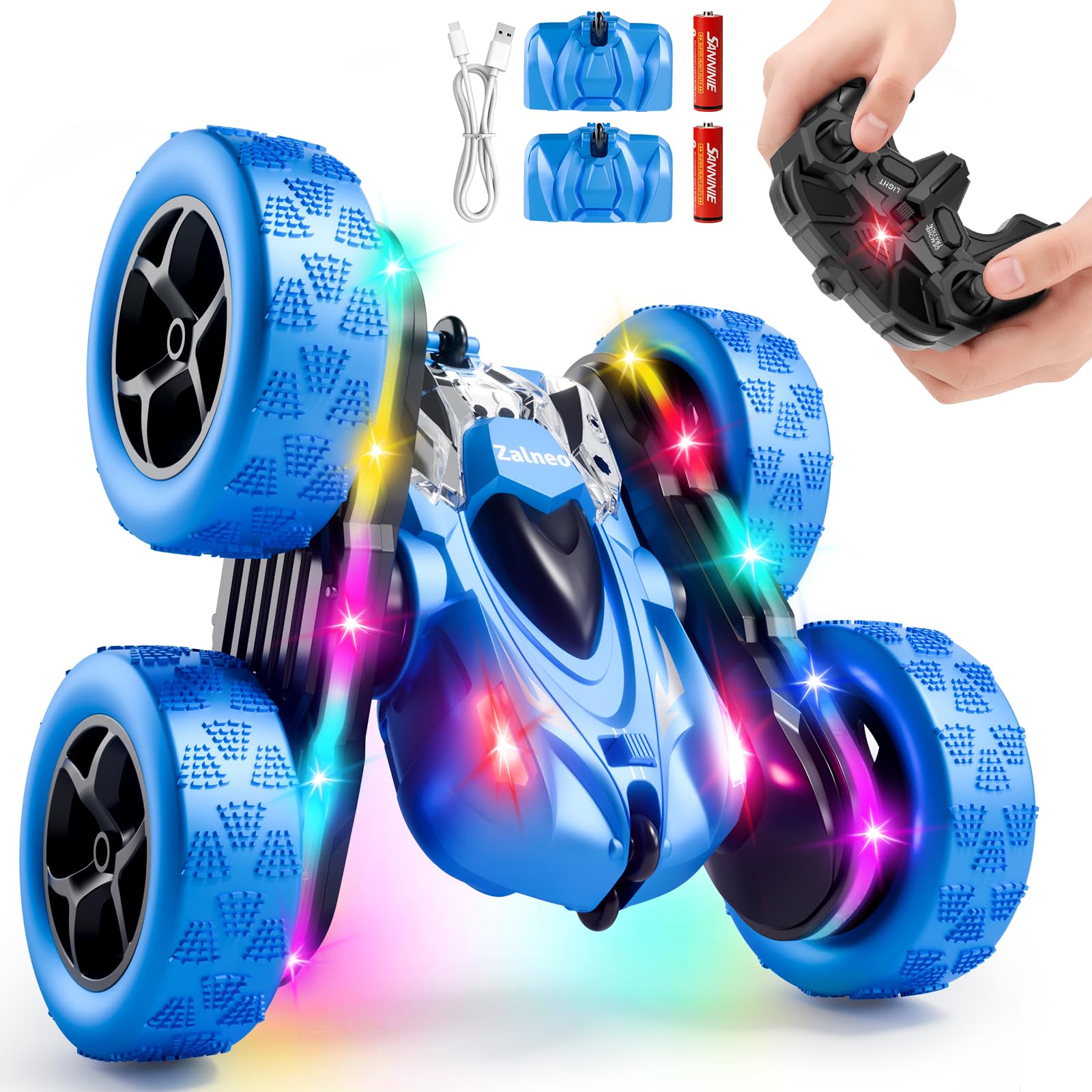
A modular battery stunt car that slides out and swaps in three seconds — no tools.
Battery downtime is the silent fun-killer in cheap RC cars, and this Zalneo model solves it with a modular battery system. Each 500 mAh pack slides out in about three seconds with no screws or prying, so when one runs flat after 25 minutes, you pop in the second pack and keep driving. The total run time is 50 minutes — matching the DEERC for top endurance on this list. An LED indicator on the battery glows while charging and turns off when fully charged, so a child can learn to manage their own power without guessing.
The car offers a “One-Tap Demo” button — press it, and the car runs through a pre-programmed flip-and-spin routine that shows off its 360° flip and double-sided driving capability immediately. Customers note this is especially useful for younger kids who get frustrated learning manual controls at first. A full-length RGB light bar cycles through seven vivid colors, and you can turn the lights off with a button to save battery for speed runs. Deep-lug tires grip carpet, hardwood, lawn, and sand. The catch is that the 500 mAh packs deliver 20% less individual run time than the 600 mAh MaxTronic battery, so if you lose the second pack, your sessions are shorter.
Smart design wins
- Tool-free, 3-second battery swap keeps play going without charging pauses
- 50-minute total run time with both packs — ties for best endurance on the list
- One-Tap Demo button helps beginners feel like stunt pros immediately
Areas to note
- Each pack is 500 mAh (20% smaller than the MaxTronic’s 600 mAh), so individual sessions shorter than some competitors
- Modular batteries are small and easy to misplace if not stored in the case
- Full-length light bar is bright at night but adds no off-road traction advantage
Perfect for: families who want to avoid the “can you charge it again?” loop and keep play sessions continuous with quick swaps.
Not the best fit if: you prefer a single larger battery or worry about losing small modular packs.
7. Fisher-Price Preschool Toy My Easy RC with 2 Speeds

The only car designed specifically for preschoolers, with a remote you control.
Every other car on this list is aimed at kids ages three and up in theory, but the Fisher-Price My Easy RC is actually built around a three-year-old’s abilities. The remote has large, simple buttons and only two speeds — both controlled by the parent, not the child. That means Mom or Dad can set “slow” for indoor driving or “fast” for the park, and the child just learns forward, reverse, left, and right without accidentally launching the car into a wall. Press one button, and the car drives and turns at the same time, which is a clever simplification for tiny fingers that struggle with dual-stick controls.
The car uses four-way driving (forward, reverse, left, right) and has an auto shut-off feature that preserves battery life — important because this is the only model here that runs on six AA batteries rather than a rechargeable pack. Reviewers point out that the AA requirement is both a pro and a con: you can swap fresh batteries instantly, but the ongoing cost adds up quickly if the car gets heavy daily use. At 1.06 pounds, it is lighter than the DEERC and easier for a toddler to carry. The main downside is a total lack of off-road chops — this is a smooth-floor car, not a grass-conquering crawler.
Designed for little drivers
- Parent-controlled two-speed system lets adults choose the safe pace
- One-button drive-and-turn function simplifies steering for ages 3+
- Auto shut-off saves battery life when the child forgets to turn it off
Practical trade-offs
- Requires 6 AA batteries (not included) with recurring replacement cost
- No rechargeable battery means ongoing expense for regular players
- Designed for hard floors and low carpet — will struggle in grass or gravel
Perfect for: a three- or four-year-old who is just learning to drive and needs a parent-controlled, frustration-free introduction to RC cars.
Not for: anyone who already has experience with RC controls, wants outdoor rough-terrain capability, or prefers rechargeable batteries.
Understanding the Specs
Battery Capacity (mAh)
mAh stands for milliamp-hours (milliamp-hours, the unit that tells you how much energy the battery holds). Think of it as the size of the car’s gas tank. A larger number like 600 mAh means the battery holds more energy and will power the car for longer per charge than a smaller 500 mAh pack. On cheap RC cars, the advertised runtime is usually a best-case estimate — real-world driving on grass or doing stunts drains the battery faster. Two batteries (even smaller ones) are often better than one large battery because you can keep playing while the first pack recharges.
2.4GHz vs. Infrared Controllers
The controller frequency determines how far away you can stand and whether multiple cars can run at the same time. 2.4GHz (gigahertz, the radio frequency band it operates on) is the standard you want — it offers a range of roughly 50 meters (165 feet) and allows several cars to race together without the signals crossing. Older infrared (IR) controllers require you to point the remote directly at the car, have a shorter range, and cannot handle more than one car in the same area. Every car on this list uses 2.4GHz, which is excellent.
FAQ
How long do cheap RC car batteries last in real use?
Can I replace the battery in a cheap RC car?
Are cheap RC cars waterproof?
What age is appropriate for a cheap RC car?
Can two kids play cheap RC cars at the same time?
What is the difference between 2WD and 4WD in RC cars?
How fast do cheap RC cars go?
What does the scale (1:16, 1:18) mean in RC cars?
Can I use a cheap RC car on sand?
Do cheap RC cars need assembly?
Final Thoughts: The Verdict
If you want one dependable pick, the best cheap rc car winner is the DEERC Remote Control Car because it combines the longest battery life (over 50 minutes), durable construction, and imaginative features like mist and music that keep kids engaged beyond just driving in circles. If you want a car built for water play and backyard puddles, grab the MaxTronic Amphibious Car. And for the speed enthusiast who wants to drift corners and swap tires, nothing on this list beats the Sakeye RC Drift Car at 18 km/h.
How We Picked
We do not accept paid placement. Every pick is matched to a real buyer and a real use-case; we do not hands-on test units.
Sources & Methodology
Specifications: manufacturer listings and product documentation. Review insights: verified customer reviews, as of July 2026. Pricing: not shown on this page (it changes often); check the current price via the retailer link.
As an Amazon Associate, WellFizz earns from qualifying purchases. This does not affect which products we feature.
Related Guides

Mo Maruf
I created WellFizz to bridge the gap between vague wellness advice and actionable solutions. My mission is simple: to decode the research and give you practical tools you can actually use.
Beyond the data, I am a passionate traveler. I believe that stepping away from the screen to explore new environments is essential for mental clarity and physical vitality.