Our readers keep the lights on and my smoothie glass nicely filled. As an Amazon Associate, I earn from qualifying purchases.
Specs are compiled from manufacturer listings and verified buyer reviews and can change over time — please confirm the key details on the product page before buying.
The right CK-4 oil prevents metal-on-metal wear that destroys diesel engines. This guide compares CK-4 oils that control soot, resist heat, and extend engine life.
I’m Mohammad Maruf — the founder and writer behind WellFizz. This guide is built by comparing the manufacturers’ published specifications and the patterns across verified customer reviews, so you get each pick’s real strengths and trade-offs instead of marketing spin.
Whether you drive a hot-shot pickup, a long-haul semi, or a fleet of work trucks, finding the right ck-4 diesel oil means matching the viscosity to your climate and your engine’s demands — here is how the top contenders stack up.
Our Picks at a Glance

How To Choose The Best CK-4 Diesel Oil
Wrong oil clogs your DPF or leaves your engine unprotected during cold starts. Here are the three things that matter most.
Viscosity Grade: 15W-40 vs 5W-40
Most heavy-duty diesels call for 15W-40 — it is the standard for highway trucks and pickups. A 5W-40 oil flows better in extreme cold (down to -45 degrees Fahrenheit in some cases), so your engine gets lubrication faster on a freezing morning. The trade-off is price: 5W-40 usually costs more per gallon.
API CK-4 Certification
CK-4 is the current API standard for diesel engines built after 2017. It is backward-compatible with older CJ-4 and CI-4 spec engines, but the opposite is not true — a CJ-4 oil can damage your DPF and exhaust gas recirculation system. Always check for the API CK-4 starburst on the bottle.
Flash Point and Shear Stability
The flash point tells you how well the oil resists burning off under high heat. A higher flash point (above 200 degrees Celsius is good, above 400 is exceptional) means less oil consumption and more stable viscosity. Shear stability keeps the oil from thinning out under heavy loads and high RPM, so your engine stays protected during long pulls.
Quick Comparison
| Model | Best For | Viscosity Grade | Flash Point | Rating | Amazon |
|---|---|---|---|---|---|
| Schaeffer SynShield 15W-40★ Best Overall | Extended wear protection | 15W-40 | — | 4.8/5 | Amazon |
| Triax Fleet Supreme 15W-40Long Haul Choice | Extended drain intervals | 15W-40 | — | 4.8/5 | Amazon |
| Hot Shot’s Secret Green Diamond 15W-40 | Reduced wear | 15W-40 | — | 4.8/5 | Amazon |
| Triax Fleet Supreme ESP 5W-40 | Cold-weather starts | 5W-40 | 400 Degrees Celsius | 4.7/5 | Amazon |
| Ultra 1Plus 15W-40 Full Synthetic | Mixed fleet compatibility | 15W-40 | 220 Degrees Celsius | 4.7/5 | Amazon |
| Valvoline Heavy Duty 15W-40 | Budget-friendly synthetic | 15W-40 | 437 Degrees Fahrenheit | 4.8/5 | Amazon |
| Lucas Oil 15W-40 CK-4 | Entry-level value | 15W-40 | — | 4.7/5 | Amazon |
In‑Depth Reviews
1. Schaeffer Manufacturing Co. SynShield 15W-40
Our pick — over 4.5★ from 400+ verified ratings; the strongest balance of quality and price.
Schaeffer SynShield maintains viscosity under heat and flows freely at startup.
Schaeffer packs this gallon with micron moly and penetrate — friction modifiers (tiny particles that coat metal surfaces) that reduce drag inside your engine. That translates to less internal resistance and better fuel economy on long runs. The SynShield formula focuses on strong oxidation and viscosity control, meaning the oil resists breaking down into sludge even when you are towing heavy loads for hours.
It also delivers strong soot-busting capability — soot disperses uniformly instead of clumping into abrasive grit. Buyers report that this oil stands up well in severe operating conditions like extreme heat or constant stop-and-go traffic, where many cheaper oils shear down and lose their protective film.
The 15W-40 viscosity grade is the standard for most modern diesel pickups and semis, so it fits a wide range of engines without needing to second-guess compatibility. At 128 fluid ounces per bottle, you get a full gallon — and with a 4.8 rating across 411 reviews, owners consistently praise how quiet their engines run after switching to Schaeffer.
Friction-fighter standpoint: Micron moly and penetrate additives deliver measurable reduction in internal drag, which owners mention as noticeable engine quieting and smoother idling.
The honest constraint: This is a premium-priced pick; if you are on a strict budget, you will pay more up front than with the mid-range options below.
Perfect for long-haul operators: If your truck works hard every day and you want the best possible wear control, Schaeffer is the one to grab.
Look elsewhere if: You change oil every 5,000 miles regardless — the extra additive cost won’t pay off for short drain intervals.
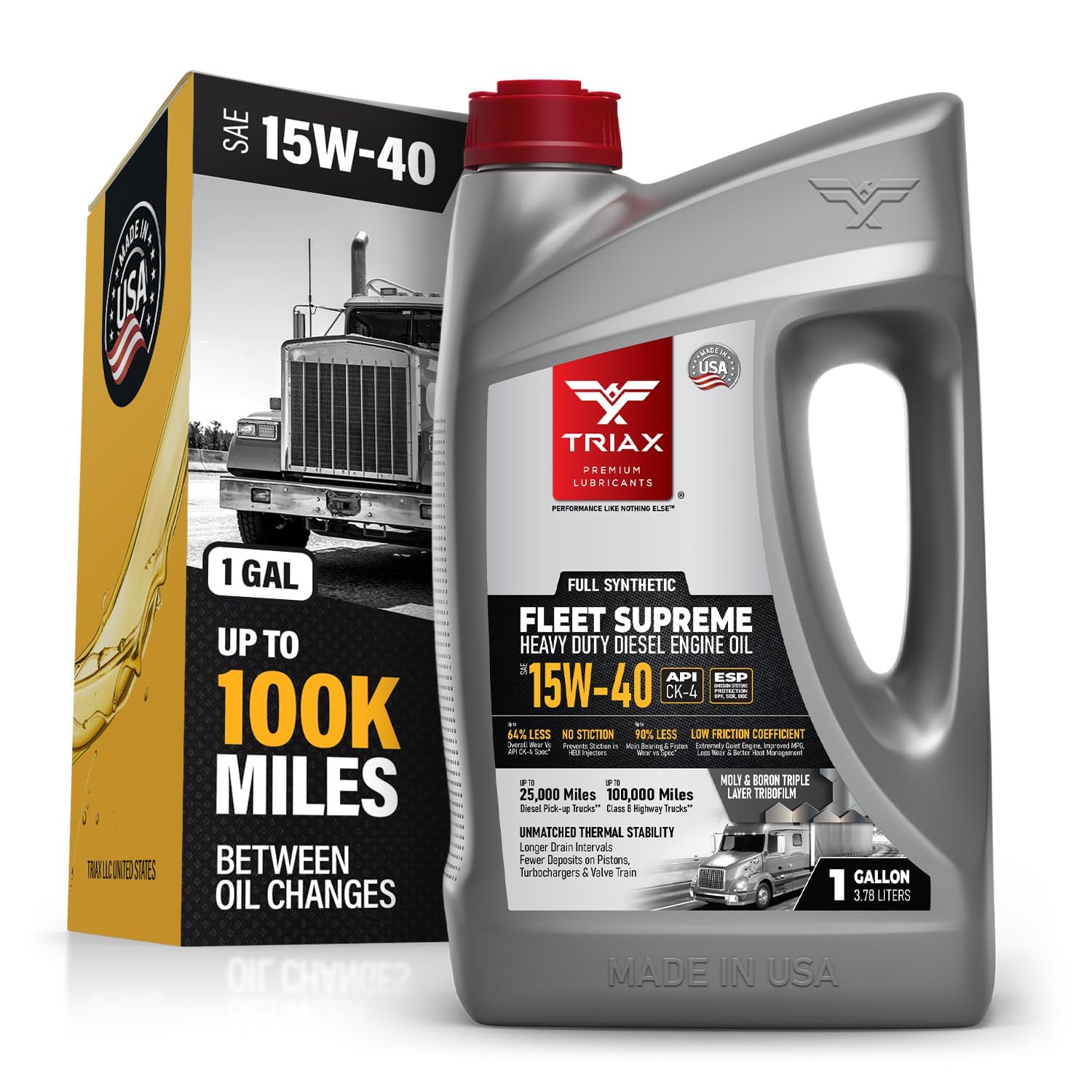
2. Triax Fleet Supreme 15W-40
Triax Fleet Supreme 15W-40 enables over 100,000-mile drain intervals for highway semis.
Triax formulates this oil with Nano-Boron and Moly friction modifiers — a combination that the brand says delivers up to 48% lower wear than industry standards. That means less metal-to-metal contact in your bearings, camshaft, and piston rings. The 15W-40 viscosity resists shearing down under heavy loads, so the oil film stays thick enough to protect your engine during hard pulls.
The big story here is extended drain capability. The spec sheet says highway semi trucks can run this oil for over 100,000 miles, and super duty pickups for 30,000 miles, without compromising protection. Customers note that their engines run noticeably quieter and that turbo spooling feels smoother after switching to Triax — real-world signs that the friction modifiers are doing their job. The oil is fully compatible with Ford Powerstroke, Chevy Silverado, Dodge RAM, and GMC Sierra engines.
Unlike the Schaeffer above, Triax gives you a clearer extended-drain promise backed by a 4.8 rating over 404 reviews. If you run a fleet where oil-change downtime costs money, the longer intervals alone can justify the premium.
Where it leads
- 48% lower wear vs industry standards with Nano-Boron and Moly
- Capable of exceeding 100,000-mile drain intervals for highway semis
- Quieter engine operation and smoother turbo spooling reported by buyers
Where it gives ground
- Not the cheapest per gallon — you pay for the additive technology
- 15W-40 may not flow as well as a 5W-40 in extreme sub-zero cold
Grab it when: You are running a super duty pickup or a semi and want to stretch oil changes to their safe maximum without worrying about accelerated wear.
Skip it for: Light-duty gas trucks or occasional use where the extended-drain capability never gets used.
3. Hot Shot’s Secret Green Diamond 15W-40

Hot Shot’s Secret Green Diamond reduces wear by 71% versus CJ-4 oils.
Hot Shot’s Secret uses a blend of Group III base oils (a high-quality fully synthetic base stock) and their patented FR3 nanotechnology — microscopic particles that fill in the tiny imperfections on metal surfaces, creating a slick layer that reduces metal-on-metal contact. The company claims this formula reduces wear and tear on engine components by 71% compared to CJ-4 spec oils. That matters most during cold starts when the oil is thickest and hardest to pump.
The 15W-40 viscosity also delivers a fuel economy improvement of up to 3%, according to the maker. Combined with CK-4 additive packaging that protects your DPF and EGR systems, this oil is engineered for demanding conditions — think heavy construction equipment, semis, and diesel pickups that work daily. The 4.8 rating from 115 reviews is notably high, and buyers consistently mention how clean their top ends look after multiple drain cycles.
Compared to the Triax Fleet Supreme 15W-40 above, Hot Shot’s Secret emphasizes the anti-wear nanotech angle more directly. If you are rebuilding an engine and want maximum protection from the first start, this is a strong contender.
Nanotech edge: FR3 nanotechnology gets into microscopic crevices to reduce friction, which reviewers point out as lower operating temperatures and quieter valve trains.
The honest reality: The 3% fuel economy boost is claimed, not a guaranteed result — your actual savings depend on driving style, load, and ambient temperature.
Best for: Owners of high-mileage diesel engines or rebuilt motors who want the extra wear protection that nanotech additives provide.
Not ideal if: You need a 5W-40 for extreme cold — this is only available in 15W-40.
4. Triax Fleet Supreme ESP 5W-40
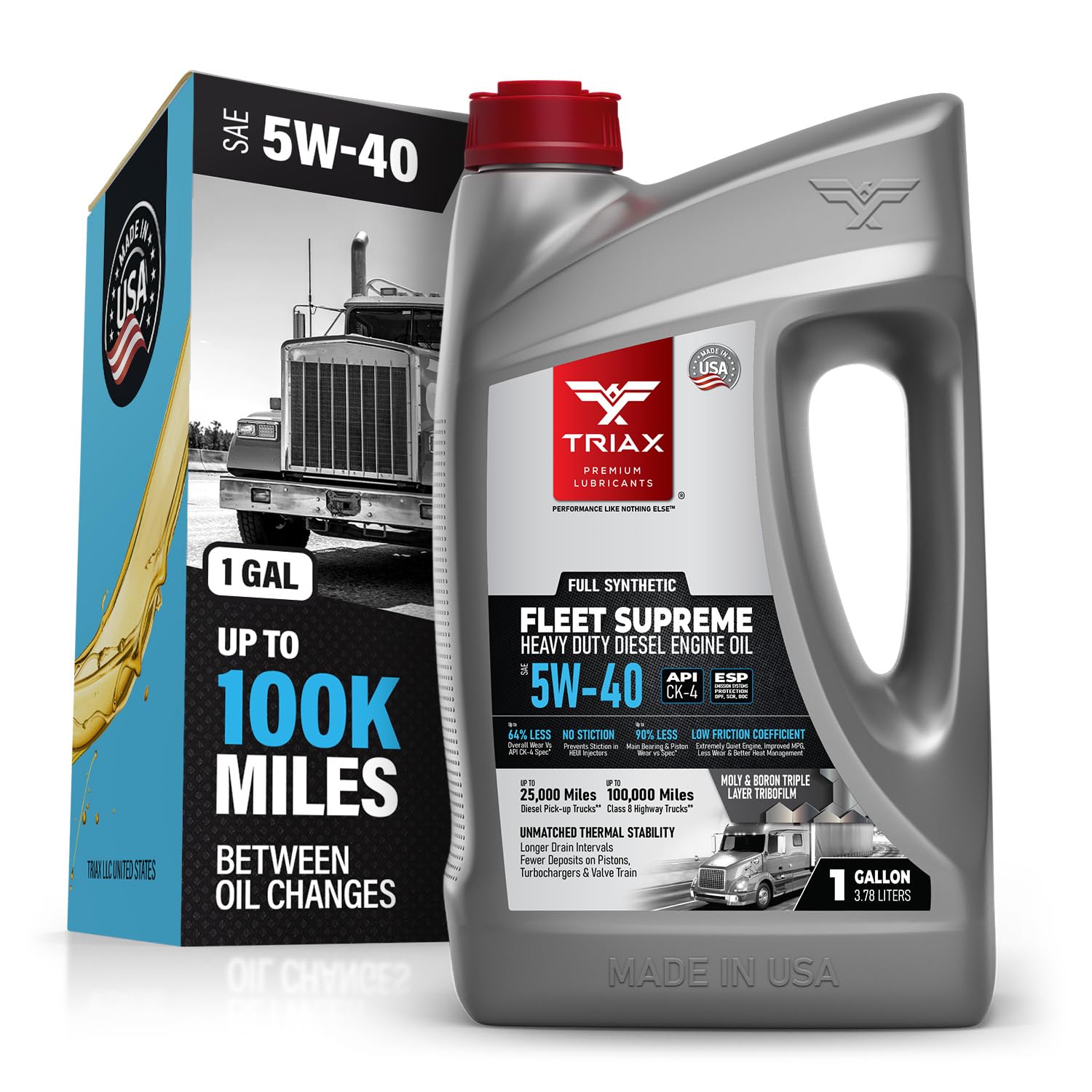
Triax Fleet Supreme ESP 5W-40 flows at -45°F for extreme cold starts.
This is Triax’s cold-weather version of the Fleet Supreme line, and the 5W-40 viscosity grade makes a real difference on freezing mornings. The oil is thinner at startup compared to the 15W-40, meaning it reaches critical engine parts faster and reduces wear during the first few seconds of operation. The spec sheet includes exceptional cold start properties down to -45 degrees Fahrenheit.
Where this oil really stands out is its flash point of 400 degrees Celsius — at 400 degrees Celsius versus the Ultra 1Plus’s 220 degrees Celsius. A higher flash point means the oil resists vaporizing under extreme heat, so you burn less oil and the viscosity stays stable during long hot pulls. Triax adds Nano-Boron and Moly friction modifiers, and claims up to 68% less wear than industry standards.
Shoppers say that this oil stops HEUI injector stiction — a common issue in high-pressure oil systems where the injectors get stuck or misfire. If you are running a Powerstroke or a Duramax in a cold climate, this is the one to consider over the standard 15W-40 options above.
Cold-weather superpower
- Flows at -45°F, protecting engine on the coldest starts
- 400 Degrees Celsius flash point resists burn-off under heavy load
- Stops HEUI injector stiction without extra additives
The give-and-take
- Higher price than a standard 15W-40
- Not ideal for gas engines or mixed-fleet gasoline use
Reach for this when: You live where winter temperatures drop below zero and you want the fastest possible lubrication at startup.
Consider the standard Triax instead if: Your climate is moderate and you do not need the extra cold-flow capability — the 15W-40 version delivers similar wear protection at a lower cost.
5. Ultra 1Plus 15W-40 Full Synthetic

The full synthetic that works in both diesel and gasoline heavy-duty engines.
Ultra 1Plus carries API CK-4 and SN certification, meaning it meets the standard for modern diesel engines and also works in gasoline engines that need API SN. That makes this a good option if you run a mixed fleet — one oil for your diesel dump truck and your gas-powered work van. The 15W-40 full synthetic formula is engineered for 2020+ on-highway trucks and Tier 4 non-road diesel engines (off-road equipment with strict emissions controls).
The flash point is 220 degrees Celsius — which is lower than the Triax ESP 5W-40’s 400 degrees Celsius, so expect slightly more oil consumption under extreme heat. Where this oil excels is compatibility: it is backward-compatible with all older four-stroke diesel engines and protects DPF, EGR, and after-treatment systems. Buyers running older Ford 7.3L and 6.0L Powerstrokes report good results, especially at the mid-range price point.
If you compare it to the Valvoline Heavy Duty below, Ultra 1Plus offers the same API CK-4 certification with the added flexibility of gasoline-engine compatibility — a real advantage if your fleet is not all diesel.
Fleet flexibility: One oil covers diesel and gasoline heavy-duty engines, reducing inventory complexity and the risk of putting the wrong oil in a gas truck.
The honest reality: The 220 Degrees Celsius flash point is adequate for normal operation but falls short of the heat resistance you get from the Triax or Schaeffer oils above — not ideal for extreme sustained high-RPM towing.
Smart pick for: Small fleets or owner-operators who run both diesel and gas trucks and want a single oil that works in both.
Better options exist for: Heavy-towing-only situations where maximum flash point and wear resistance are non-negotiable.
6. Valvoline Heavy Duty Full Synthetic 15W-40
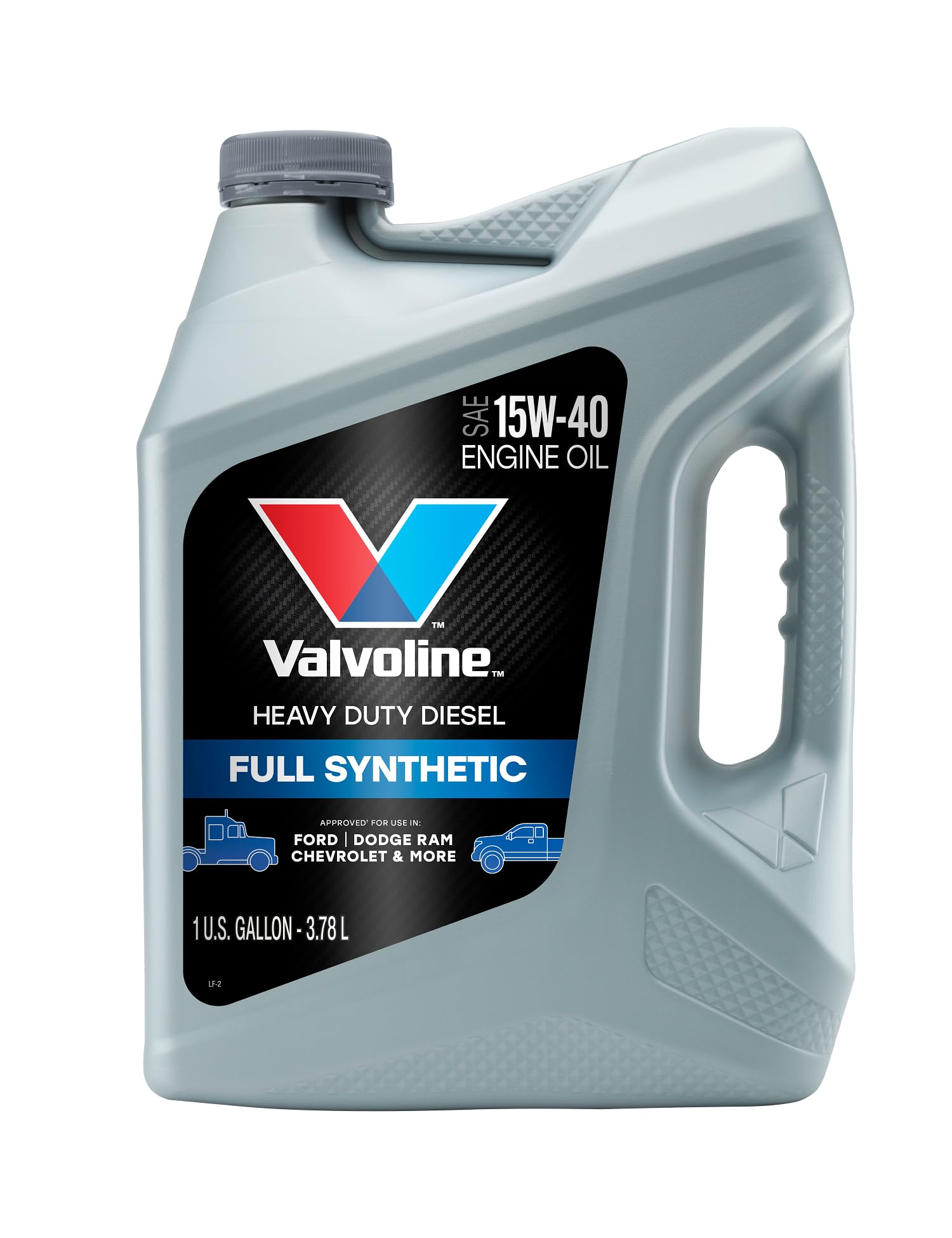
The synthetic that drops valve train wear by 35% versus industry standards.
Valvoline cuts the cost of entry into full synthetic CK-4 protection. The brand tested this formula in a Cummins ISB engine and reports a 35% reduction in valve train wear compared to industry requirements — that is measurable protection for your pushrods and rocker arms. It also delivers up to 28% longer oil life versus industry standards, as tested in a Volvo T-13 engine, meaning you can stretch drain intervals safely.
The flash point sits at 437 degrees Fahrenheit (roughly 225 degrees Celsius), which is comparable to the Ultra 1Plus above. The 15W-40 viscosity meets or exceeds requirements for Cummins CES 20086, Ford WSS-M2C171-F1, Volvo VDS-4.5, Mack EOS-4.5, Detroit Diesel DFS 93K222, and Caterpillar ECF-3 — a laundry list of approvals that tells you this oil is accepted by most major diesel engine manufacturers. Buyers with Ford 6.7L Powerstrokes and Ram 6.7L Cummins engines report good results with normal drain intervals.
Compared to the premium oils above (Schaeffer and Triax), Valvoline lacks the nano-additive technology and the extreme flash point. But if you change oil every 10,000-15,000 miles and want a reliable full synthetic without paying top dollar, this is a strong value play.
Why it earns its spot
- 35% reduction in valve train wear vs industry standards
- 28% longer oil life than industry standards
- Covers most major diesel engine approvals
Where it comes up short
- No advanced nano-additives for extreme friction reduction
- Flash point is lower than premium options — more oil burn-off under sustained heavy load
Best for: Budget-conscious owners of modern diesel pickups who still want full synthetic protection and standard drain intervals.
Upgrade if: You are towing heavy loads daily in extreme heat — the Triax or Schaeffer oils handle that thermal stress noticeably better.
7. Lucas Oil 15W-40 CK-4
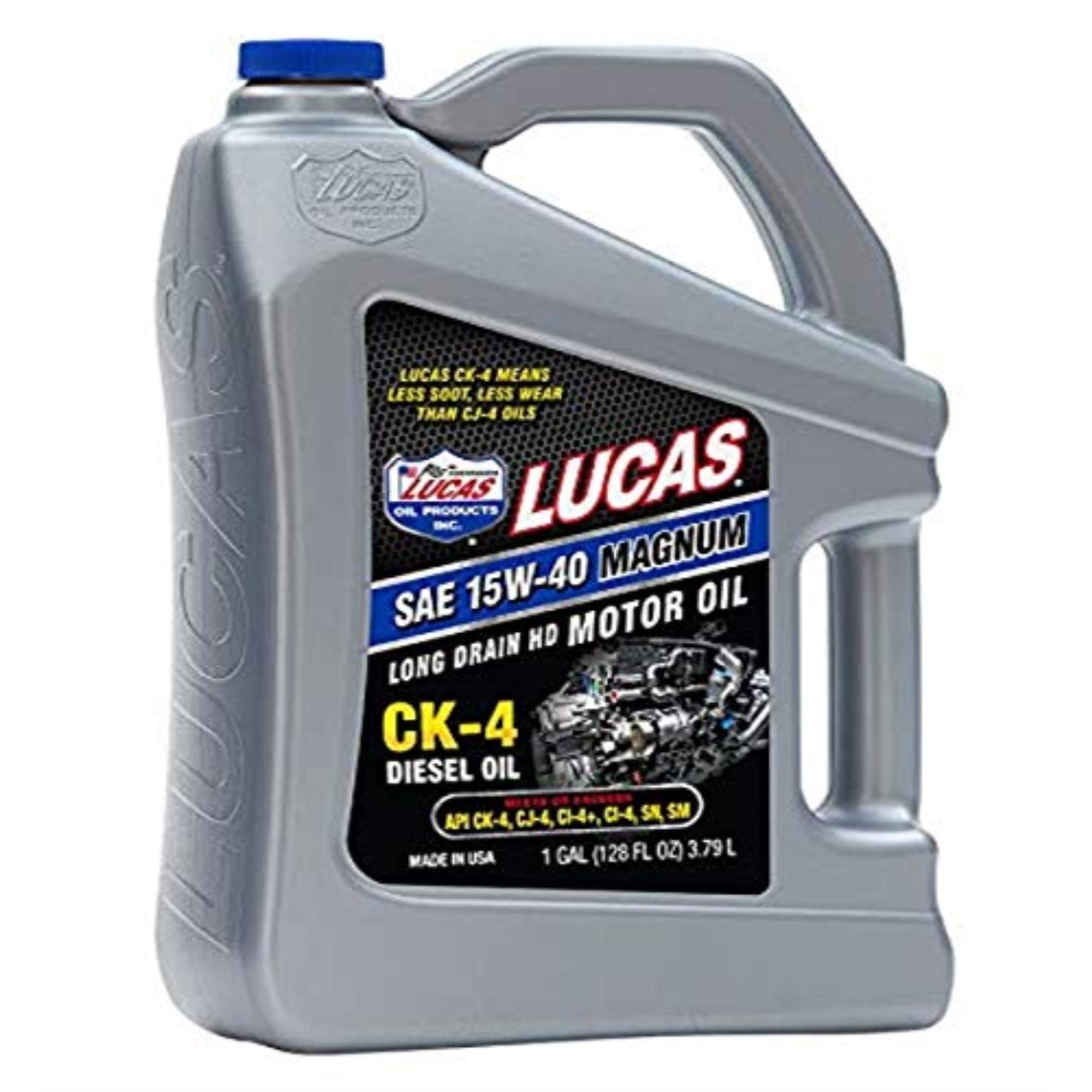
The straightforward heavy duty oil that skips the marketing fluff.
Lucas keeps it simple with a SAE 15W-40 CK-4 formula that focuses on three things: longer engine life, extended oil changes, and less filter maintenance. There are no nano-additives or friction modifiers advertised — just a reliable conventional formulation that meets the CK-4 spec. That makes this a solid choice for older diesel engines that do not need the extra additive package but still require the modern API rating for emissions compatibility.
The 3.55 kilogram bottle delivers 128 fluid ounces, and the 15W-40 viscosity works well across a wide temperature range. Lucas is a brand most truck owners recognize, and the 4.7 rating from 149 reviews confirms that buyers get consistent quality without surprises. This oil fits bus, car, and truck applications, so it covers everything from a school bus fleet to a personal pickup.
Compared to the Valvoline Heavy Duty above, Lucas does not claim specific test results like the 35% wear reduction — so you are buying the brand reputation and the CK-4 compliance rather than engineered performance data. For a beater truck or a vehicle you change oil frequently, that is often enough.
Straightforward approach: No complicated additive tech — just CK-4 compliance, 15W-40 viscosity, and a brand name that has been around for decades.
The catch: You get exactly what you pay for — no extended drain claims, no extreme heat data, and no wear reduction testing published. It meets the spec and stops there.
Smart for: Fleet managers putting miles on older trucks that just need to meet the CK-4 spec without paying for extra additive technology.
Not enough for: Modern high-output turbo diesels where you want the measurable wear reduction and longer drain capability of a premium synthetic.
Understanding the Specs
Viscosity Grade
The SAE grade tells you how thick the oil is at different temperatures. The first number (15W or 5W) is the cold-weather rating — the lower the number, the thinner the oil when you start a freezing engine. The second number (40) is the hot-weather thickness. 15W-40 is the standard for most heavy-duty diesels. 5W-40 flows better in extreme cold, which reduces startup wear in sub-zero climates.
Flash Point
This is the temperature at which the oil starts to vaporize and could catch fire. A higher flash point means the oil resists burning off under high heat, so you lose less oil to evaporation and the viscosity stays stable during sustained heavy loads. Premium oils reach 400 degrees Celsius or higher; budget options typically sit around 200-230 degrees Celsius.
FAQ
Can I use CK-4 oil in an older engine that used CJ-4?
What is the difference between 15W-40 and 5W-40 diesel oil?
How often should I change CK-4 diesel oil?
Will CK-4 oil improve my fuel economy?
Does a higher flash point really matter for my truck?
Can I mix CK-4 oil with a different brand or viscosity?
What does API CK-4 certification actually guarantee?
Is full synthetic CK-4 worth the extra cost over conventional?
Final Thoughts: The Verdict
Across the board, the best ck-4 diesel oil winner is the Schaeffer SynShield 15W-40 because it combines micron moly friction modification with strong soot control and a market-leading 4.8 rating across 411 reviews. If you want the longest drain intervals for a highway semi, grab the Triax Fleet Supreme 15W-40. And for extreme cold-weather starts, the standout is the Triax Fleet Supreme ESP 5W-40 with its -45°F cold-flow capability and 400 degrees Celsius flash point.
How We Picked
We do not accept paid placement. Every pick is matched to a real buyer and a real use-case; we do not hands-on test units.
Sources & Methodology
Specifications: manufacturer listings and product documentation. Review insights: verified customer reviews, as of July 2026. Pricing: not shown on this page (it changes often); check the current price via the retailer link.
As an Amazon Associate, WellFizz earns from qualifying purchases. This does not affect which products we feature.
Related Guides

Mo Maruf
I created WellFizz to bridge the gap between vague wellness advice and actionable solutions. My mission is simple: to decode the research and give you practical tools you can actually use.
Beyond the data, I am a passionate traveler. I believe that stepping away from the screen to explore new environments is essential for mental clarity and physical vitality.