Our readers keep the lights on and my smoothie glass nicely filled. As an Amazon Associate, I earn from qualifying purchases.
Specs are compiled from manufacturer listings and verified buyer reviews and can change over time — please confirm the key details on the product page before buying.
If your spray gun spits, your plasma cutter leaves rust spots, or your sandblaster clogs mid-job, the problem is almost certainly water in your air lines. A compressor naturally squeezes humidity into liquid — and without a proper drying system, that moisture rides straight into your tools and finish work. The right setup strips that water out in stages, so the air reaching your equipment is clean and bone-dry.
I’m Mohammad Maruf — the founder and writer behind WellFizz. This guide is built by comparing the manufacturers’ published specifications and the patterns across verified customer reviews, so you get each pick’s real strengths and trade-offs instead of marketing spin.
Whether you paint cars, run a CNC mill, or power air tools in a busy shop, finding the best compressed air dryer means matching the right filtration stages and flow rate to your actual setup — and knowing which specs actually deliver drier air.
Our Picks at a Glance


How To Choose The Best Compressed Air Dryer
Not every dryer is a match for every job. A simple water trap works fine for blowing dust off a workbench, but painting, plasma cutting, or running a CNC mill demands multi-stage filtration that strips both liquid water and invisible vapor. Here are the key things to check before you buy.
Match the filtration stages to your tools
The most basic setup uses one stage: a particulate filter that catches rust, scale, and bulk water. A two-stage system adds a coalescing filter, which grabs the tiny oil droplets and fine moisture that slip past the first filter. Three-stage systems finish with a desiccant dryer that absorbs water vapor — the stuff you cannot see but that causes fisheyes in paint and corrosion inside tools. If you spray finish coats or use moisture-sensitive pneumatics, skip anything less than a three-stage setup.
Check the flow rate against your compressor output
Every dryer is rated for a maximum flow, typically measured in SCFM (Standard Cubic Feet per Minute) or CFM. If you connect a unit rated at 37 SCFM to a compressor that pushes 50 SCFM, you choke your tools downstream. Look for a dryer whose flow rating equals or exceeds your largest air tool’s demand. For a typical home shop running an HVLP gun or a small plasma cutter, a unit in the 35–50 SCFM range covers most needs. Larger industrial setups need higher — the Schulz ADS-50-UP handles 50 CFM for serious continuous use.
Decide between manual and auto drain
Every dryer collects water that must be removed. A manual drain means you twist a valve at the bottom of the bowl — simple, but easy to forget. An auto drain uses a float mechanism that purges water automatically when it reaches a certain level. If you run your compressor every day or leave it running unattended, the convenience of an auto drain saves you from accidentally spraying water through your lines. For occasional weekend use, a manual drain is perfectly fine and costs less.
Quick Comparison
| Model | Best For | Filtration Stages | Flow Rate | Port Size | Amazon |
|---|---|---|---|---|---|
| 3 Stage Filter Regulator Dryer (1/2″ NPT, Auto Drain)★ Best Overall | Mid-range 3-stage with auto drain | 3-Stage | 100 CFM | 1/2″ NPT | Amazon |
| NANPU 3/4″ NPT 3-StageAlso Great | High-flow shops (141 CFM) | 3-Stage | 141 CFM | 3/4″ NPT | Amazon |
| DaierTek 3/4″ NPT 4-Stage | Comprehensive all-in-one kit | 4-Stage | — | 3/4″ NPT | Amazon |
| Milton 1170‑2 Desiccant Dryer | High-capacity desiccant-only drying | 1-Stage (Desiccant) | — | 1/2″ NPT | Amazon |
| PneumaticPlus SAU430-N04DG-MEP | Premium 3-stage with auto drain | 3-Stage | 37 SCFM @ 90 PSI | 1/2″ NPT | Amazon |
| PneumaticPlus SAU430-N04G-MEP | Compact 3-stage with manual drain | 3-Stage | 37 SCFM @ 90 PSI | 1/2″ NPT | Amazon |
| Schulz ADS-50-UP | Industrial refrigerated drying | Refrigerated | 50 CFM | 1/2″ NPT | Amazon |
In‑Depth Reviews
1. 3 Stage Heavy Duty Industrial Grade Filter Regulator Coalescing Desiccant Dryer System (1/2″ NPT, Auto Drain)
Our pick — over 4★ from 650+ verified ratings; the strongest balance of quality and price.
A three-stage workhorse with an internal float drain you can ignore.
This unit combines a water trap filter, a 0.01-micron coalescing filter, and a desiccant dryer in a single wall-mountable body with 1/2″ NPT ports. The standout here is the auto drain: an internal float mechanism that purges collected water automatically, so you never have to remember to crack a manual valve. For anyone who leaves their compressor running on a timer or uses air tools daily, that convenience alone justifies a look.
Stage 1 uses a 5-micron element in a 5oz metal bowl with a sight glass so you can see water levels. Stage 2 drops to 0.01 microns, removing 99.98% of moisture vapor and oil, and a red indicator pops up when it is time to change the element. Stage 3 uses 5oz of color-changing desiccant beads (blue to pink), and the unit ships with two replacement bags. The regulator adjusts from 7 to 175 PSI, which covers almost every common air tool range.
What makes it stand out
- Internal float auto drain eliminates manual purging — low-maintenance.
- 100 CFM flow and 175 PSI max input cover most home and pro-sumer compressors.
- Clear sight glasses on both filter bowls let you monitor moisture without disassembly.
A trade-off to know
- The 0.01-micron coalescing filter claims 99.98% removal, compared to the DaierTek at 99.99% and the NANPU at 99.998% — a small margin but relevant for critical paint work.
Reach for it if: You want the hands-free convenience of auto-drain technology in a solid three-stage package for a busy garage or workshop.
skip it if: You need the very highest coalescing efficiency (99.998%) for aerospace or show-car finishing — the NANPU edges ahead there.
2. NANPU 3/4″ NPT Air Compressor Filter Dryer Regulator – Industrial 3-Stage
The 141 CFM beast that keeps high-flow tools running dry.
If you run an HVLP spray gun, a plasma cutter, or a sandblaster that gulps a lot of air, the NANPU is the unit that keeps up without starving your tools. The 3/4″ NPT ports match large-diameter piping, which matters when you are pushing air through long lines.
The three-stage design is exactly what moisture-sensitive work needs. Stage 1 uses a 5-micron element to knock out bulk water and debris. Stage 2 drops to a 0.01-micron coalescing filter that catches 99.998% of oil aerosols and sub-micron moisture — the stuff that causes paint blemishes and pitted plasma cuts. Stage 3 finishes with color-indicating desiccant beads that turn from blue to pink when they are spent. Buyers report being “quite surprised as to how good this actually worked” and that once installed it operates without leaks. At 7.39 pounds versus the PneumaticPlus at 4 pounds, but that heft comes from industrial-grade metal bowls and a solid wall-mount bracket.
Why it leads the field
- Industry-leading 141 CFM flow — won’t choke high-demand tools like the 37 SCFM PneumaticPlus units will.
- Three full stages (5-micron, 0.01-micron coalescing, desiccant) for truly dry, oil-free air.
- Includes extra elements and desiccant bags (2 x 5µm, 2 x 0.01µm, 4 x 3.5oz desiccant), plus fittings and tape.
One thing to watch
- Some owners mention the NPT threads can be overcut, requiring liquid pipe dope to seal — plan on using sealant.
Who it fits: Shops with high-output compressors running multiple tools or moisture-sensitive equipment like automotive spray guns and plasma cutters.
Who should look elsewhere: If you only need a small desiccant dryer for a single airbrush or a quiet garage setup, this much flow capacity is overkill.
3. DaierTek 3/4″ NPT 4 Stage Air Dryer for Compressor
A fully-loaded kit with dual desiccant stages and every fitting you need.
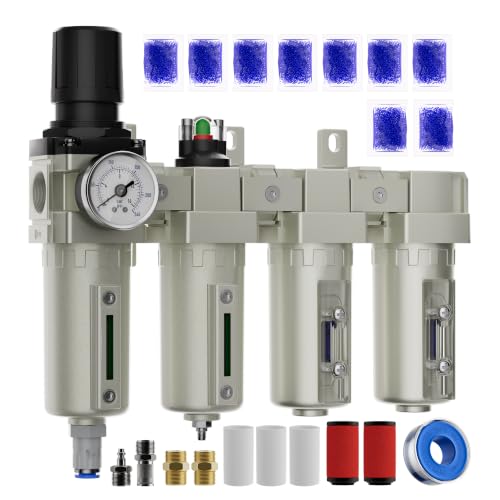
The DaierTek packs four stages into one unit: a 5-micron particulate filter, a 0.01-micron coalescing filter, and two desiccant dryer stages. That extra desiccant stage means more vapor-absorbing capacity before the beads need replacing — a real advantage if you work in humid climates or run long sessions. The 0.01-micron coalescing filter captures up to 99.99% of fine moisture, oil mist, and particles after the primary filter, and a built-in red pop-up indicator tells you when to change it.
Customers note it is an “excellent product, comes with spare filters and incandescent,” and that it fits together easily without leaks. The kit is unusually complete: three 5-micron filter elements, two 0.01-micron elements, nine bags of desiccant beads, a nickel-plated air plug and coupler, two male pipe fittings, and thread seal tape. That means you are set for several filter changes right from the start. The metal bowls and aluminum valve body handle up to 240 PSI — higher than the NANPU’s 175 PSI — so it is safe on systems with higher surge pressures.
What earns it the value slot
- Four-stage design with dual desiccant drying for extra moisture removal versus the standard three-stage units.
- Comes with nine desiccant bead bags and multiple spare filter elements — you won’t need to buy replacements for a while.
- Rated for 240 PSI, handling higher system pressures than many competitors.
One shortcoming
- The 0.01-micron coalescing element’s 99.99% efficiency, compared to the NANPU’s 99.998% — a very small gap, but note for ultra-sensitive finishing work.
Best suited for: The buyer who wants a turnkey system with spare consumables included and the extra drying power of dual desiccant bowls for humid workshops.
Consider something else if: You need the absolute highest coalescing efficiency for aerospace-grade painting where even trace oil causes rejections.
4. PneumaticPlus SAU430-N04DG-MEP Three Stage Air Drying System (1/2″ NPT, Auto Drain)

A compact auto-drain three-stage dryer built for consistent finishing work.
The PneumaticPlus SAU430-N04DG-MEP is the auto-drain version of the well-regarded SAU430-N04G-MEP. It uses the same three-stage layout: a 10-micron particulate element, a 0.1-micron coalescing element, and a pressure regulator, all in a compact footprint with 1/2″ NPT ports. The auto drain purges water automatically, so you do not have to babysit the system during long sessions. Max supply pressure is 250 PSI, and operating pressure adjusts from 0 to 150 PSI.
Reviewers point out it “works as intended” and that they “haven’t had to empty any water out of it yet” even after months of use on a 60-gallon compressor set to 110 PSI. One reviewer using it with a laser engraver noted it provides stronger air assist flow without “spitting” in high humidity. The metal bowl with sight glass lets you monitor moisture levels at a glance, and the bracket and gauge are included. At 37 SCFM at 90 PSI, it flows enough for a single spray gun or most air tools, though the NANPU’s 141 CFM dwarfs it for high-demand setups.
Strengths at this price
- Auto drain removes the hassle of manual purging — ideal for daily-use compressors.
- Solid metal bowl construction with a sight glass for quick visual checks.
- Made in South Korea, with buyers calling the build quality “very impressive for the price.”
Where it falls short
- The 0.1-micron coalescing element, versus the 0.01-micron elements in the NANPU and DaierTek — it will catch less oil aerosol in demanding spray applications.
- 37 SCFM flow, while the top picks offer 100–141 CFM, so it will struggle feeding large-volume tools or multiple users.
Best for: The solo operator who needs an auto-drain three-stage dryer for a single spray gun, CNC machine, or laser engraver and values Korean build quality.
Not the right fit: If you run high-flow tools like sandblasters or need the finer 0.01-micron coalescing protection for critical paint finishes.
5. PneumaticPlus SAU430-N04G-MEP 3 Stage Compressed Air Filter Dryer System (1/2″ NPT, Manual Drain)

The manual-drain sibling that saves money without cutting corners on build.
This is the same base design as the SAU430-N04DG-MEP above, but with a manual drain instead of auto. You save on the price and keep the same 10-micron particulate element, 0.1-micron coalescing element, and 0–150 PSI regulator. At 4 pounds it is the lightest full three-stage unit here — the NANPU is 7.39 pounds, a notable difference if you are mounting it on a wall or a portable cart.
Shoppers say it “has done a good job stopping any oil or water from entering my air lines” and that it is “well made” and “works well” for a plasma cutter. One detailed review notes that for best performance, you need about 30 feet of pipe before the filter so water vapor can condense into liquid that the filter can actually remove — a smart installation tip that applies to any coalescing dryer. The manual drain is straightforward: twist the valve at the bottom of the metal bowl periodically to release collected water. If you run your compressor a few times a week, this is a minor chore. If you run it daily, consider the auto-drain version instead.
What works well
- Lightest full three-stage system at 4 pounds — easy to wall-mount or move between setups.
- Reliable Korean manufacturing with a metal bowl and sight glass.
- Good for moisture-sensitive tools like plasma cutters and CNC mills, per buyer reports.
What to note
- The 0.1-micron coalescing element, versus the 0.01-micron filters competing at similar price points, so oil aerosol capture is less thorough for high-end paint work.
- Manual drain means you have to remember to purge water — skipping it risks water reaching your tools.
Who it suits: Budget-conscious buyers who need a compact, reliable three-stage dryer for occasional use with a plasma cutter, CNC, or air tools, and do’t mind twisting a valve now and then.
Who should pass: Professional painters who need the finer 0.01-micron coalescing protection and auto-drain convenience for daily production work.
6. Milton 1170‑2 1/2″ Compact FRL Desiccant Air Dryer

A massive desiccant canister from a trusted American brand that simply works.
Unlike the multi-stage units above, the Milton 1170-2 is a dedicated desiccant dryer — no particulate filter, no coalescing element, no regulator. It does one thing: absorb water vapor from your air lines using a large bed of desiccant beads. With two 1-quart charges included, it holds far more desiccant than the small bowls found on combo units. Buyers call it “beefy” and note it holds “a LOT of dessicant,” making it a clear upgrade over smaller desiccant units for anyone who needs long runtime between bead replacements.
The body is aluminum (it looks like plastic but is stout metal), rated for 250 PSI maximum pressure. It uses 1/2″ NPT ports and is made in the USA. One caveat: no mounting bracket is included — buyers report making their own and tapping the top cap with a 1/4-20 thread. Milton also provides a pro tip: you can dry the spent beads in an oven at 275 degrees Fahrenheit for 3 hours to reuse them, which extends the value over disposable desiccant bowls. If you need a high-capacity vapor remover and already have a particulate/coalescing setup upstream, this is the perfect add-on.
What makes it special
- Holds two quarts of desiccant — far more than the 3.5–5 oz bowls on combo units, meaning much longer intervals between bead changes.
- Made in the USA by Milton, a long-established pneumatic brand with available replacement parts.
- Desiccant beads can be oven-regenerated at 275°F for 3 hours, so you reuse them rather than buying new bags repeatedly.
The setup gotcha
- No mounting bracket included — you will need to fabricate one or buy an aftermarket bracket.
- No particulate filter or regulator built in, so you need separate upstream components for a complete drying system.
Reach for it if: You already have a good particulate/coalescing filter setup and need a large desiccant final stage for serious vapor removal in a shop that runs tools all day.
pass on it if: You want an all-in-one filter-regulator-dryer combo that mounts as a single unit — this is a standalone desiccant canister that needs companions.
7. Schulz ADS-50-UP Non-cycling Compressed Air Dryer

A refrigerated dryer that handles 50 CFM for continuous industrial use.
The Schulz ADS-50-UP is a completely different animal from the filter-and-desiccant units above. It is a non-cycling refrigerated dryer that uses a refrigeration circuit to chill the compressed air, causing water vapor to condense into liquid that is then drained away. It handles up to 232 PSI maximum inlet pressure and delivers 50 CFM of dry air continuously — enough for a small workshop running multiple tools or light industrial machinery. At 70 pounds and 115V single-phase power, it is a stationary installation, not something you toss in a truck.
An electronic controller on the panel manages the refrigeration cycle for consistent dew point control. The design runs at 65 decibels, which is quieter than a typical shop compressor. The 1/2″ NPT connections are on the smaller side for a 50 CFM unit, so you may need to adapt to larger piping for minimal pressure drop. This is a serious step up from desiccant-based drying because it never needs bead replacement — the refrigeration loop runs continuously, and the condensate drains automatically. For a shop that uses compressed air every day, the upfront cost pays off in zero consumables and consistent dry air regardless of humidity.
Why go refrigerated
- No desiccant beads to replace or regenerate — the refrigeration circuit provides continuous drying with zero consumable cost.
- 50 CFM capacity at 232 PSI handles real industrial throughput for multiple tools or continuous processes.
- Electronic controller maintains consistent performance; 65 dB noise level is reasonable for a shop.
What to consider
- At 70 pounds and a 18.69″ x 18.69″ x 14.56″ footprint, it is a permanent installation — not portable or wall-mountable like the compact three-stage units.
- Requires 115V single-phase power and is overkill for a hobbyist running one spray gun occasionally.
Best for: Commercial shops, auto body shops, or light industrial facilities that need continuous dry air at moderate flow rates without the hassle of replacing desiccant beads.
Not for: Weekend hobbyists or small garage setups — the size, weight, and power requirements make sense only for daily production use.
Understanding the Specs
SCFM and CFM — Flow Rate
SCFM (Standard Cubic Feet per Minute) and CFM (Cubic Feet per Minute) tell you how much air the dryer can process. If your compressor pushes 50 CFM and you hook up a dryer rated for 37 SCFM, the dryer becomes a bottleneck — your tools will feel starved. The rule is simple: the dryer’s flow rating should match or exceed your largest tool’s demand. For a single HVLP spray gun, 30-40 SCFM is enough. For a sandblaster or multiple tools running at once, look at 100+ CFM units like the NANPU.
Micron Rating — How Fine the Filter Catches
The micron number tells you the size of particles the filter element captures. A 5-micron element catches visible dust, rust, and bulk water droplets. A 0.01-micron coalescing element grabs the microscopic oil aerosols and fine moisture that cause paint defects. Lower is better for sensitive work: 0.01 micron captures 99.998% of contaminants versus 0.1 micron at roughly 99.9%. For auto body painting or plasma cutting, stick with 0.01-micron coalescing filters.
FAQ
Do I really need a three-stage compressed air dryer for a home garage?
What is the difference between a coalescing filter and a desiccant dryer?
Will a compressed air dryer reduce my compressor’s pressure or flow?
Can I use a compressed air dryer for a laser engraver?
How often do I need to change the desiccant beads?
What NPT size do I need, 1/2 inch or 3/4 inch?
What does CFM mean on a compressed air dryer spec?
Is a refrigerated compressed air dryer better than a desiccant dryer?
Can I install a compressed air dryer on the intake side of my compressor?
Why does my current filter still let water through to my spray gun?
Final Thoughts: The Verdict
For the majority of shoppers, the compressed air dryer winner is the NANPU 3/4″ NPT 3-Stage because its 141 CFM flow, 0.01-micron coalescing element, and full three-stage design cover every need from painting to plasma cutting without choking your tools. If you want the convenience of an all-in-one kit with spare filters and dual desiccant bowls for humid climates, grab the DaierTek 4-Stage. And for a shop that runs air tools every day and wants to stop buying desiccant beads altogether, the standout is the Schulz ADS-50-UP refrigerated dryer.
How We Picked
We do not accept paid placement. Every pick is matched to a real buyer and a real use-case; we do not hands-on test units.
Sources & Methodology
Specifications: manufacturer listings and product documentation. Review insights: verified customer reviews, as of July 2026. Pricing: not shown on this page (it changes often); check the current price via the retailer link.
As an Amazon Associate, WellFizz earns from qualifying purchases. This does not affect which products we feature.
Related Guides

Mo Maruf
I created WellFizz to bridge the gap between vague wellness advice and actionable solutions. My mission is simple: to decode the research and give you practical tools you can actually use.
Beyond the data, I am a passionate traveler. I believe that stepping away from the screen to explore new environments is essential for mental clarity and physical vitality.