Our readers keep the lights on and my smoothie glass nicely filled. As an Amazon Associate, I earn from qualifying purchases.
Specs are compiled from manufacturer listings and verified buyer reviews and can change over time — please confirm the key details on the product page before buying.
A cordless cultivator that stalls on the second clump of hard dirt leaves you back on your knees with a hand fork. A battery-powered tiller’s ability to spin through compacted soil without bogging down depends on motor speed (RPM), tine steel, and battery capacity—a combination cheap listings rarely deliver. This guide ranks cordless cultivators on the specs that matter for turning over a garden bed and flags trade-offs product pages skip.
I’m Mohammad Maruf — the founder and writer behind WellFizz. This guide is built by comparing the manufacturers’ published specifications and the patterns across verified customer reviews, so you get each pick’s real strengths and trade-offs instead of marketing spin.
Matching RPM, tine count, and tilling depth to your soil type determines whether a cordless cultivator earns its place in your shed or collects dust. Read on for the clearest breakdown of the best cordless cultivator options available right now.
Our Picks at a Glance

How To Choose The Best Cordless Cultivator
Choosing a cordless cultivator depends on matching its motor and battery to your soil, not the brand name. These three specs separate a capable cordless cultivator from a frustrating one.
Motor Speed (RPM) and Tine Quality
The motor’s revolutions per minute (RPM) tell you how fast the tines spin. Higher RPM — around 360 — gives you the muscle to chew through dry, compacted ground without forcing the machine. Lower RPM, like 270, still works fine on loose or previously tilled soil but demands multiple passes on hard clay. Paired with that, steel tines (preferably hardened) resist bending when you hit a rock or root. Count them too: 48 tines spread the cutting load and produce a finer, more aerated tilth than a 4-tine head.
Battery Capacity and Voltage
You are looking for the combination of voltage and amp-hours (Ah). Higher voltage (21V to 22V) generally drives a more powerful motor. Amp-hours tell you how long the battery runs before it needs a recharge — a 2.0Ah battery might last 20-30 minutes of constant tilling, while a 3.0Ah battery stretches that closer to 40 minutes. If your garden is larger than a few raised beds, you want a kit that includes two batteries so you can swap and keep working while the first one charges.
Tilling Width and Depth
Width determines how many passes you need to cover a bed. A 9-inch wide head is a balance for most home gardens — wide enough to make progress but narrow enough to fit between rows of plants. Depth, usually between 6 and 7 inches, is what lets the tines reach below the surface crust to loosen the root zone. Shallow tillers (around 6 inches) are fine for weeding and top-dressing; deeper models (7 inches and up) are better for breaking new ground or mixing in compost.
Quick Comparison
| Model | Best For | RPM | Tilling Width | Weight | Amazon |
|---|---|---|---|---|---|
| MZK ET1401-2★ Best Overall | Value / included batteries | 360 RPM | 11.6″ | 10.4 lbs | Amazon |
| TaskStar TH4000Also Great | Heavy soil / large beds | 360 RPM | 9″ | 12.8 lbs | Amazon |
| DEGGE SY-818 | Runtime / dual 3.0Ah batteries | — | 9″ | — | Amazon |
| Saker SK-TC18B | Lightweight / ergonomic design | 360 RPM | 9″ | 15.1 lbs | Amazon |
| Earthwise TC70020IT | Small beds / senior users | — | 7.5″ | — | Amazon |
| FORDWALT TLDCB20 | Dewalt battery owners | 270 RPM | 8.7″ | 10 lbs | Amazon |
In‑Depth Reviews
1. MZK 20V Cordless Tiller Cultivator ET1401-2
Our pick — over 4★ from 800+ verified ratings; the strongest balance of quality and price.
Surprising pull for the price, but soft soil is its comfort zone.
Its 11.6-inch tilling width is the widest here, meaning you cover a bed in fewer passes than the 9-inch TaskStar or the 8.7-inch FORDWALT. That width is a genuine time-saver if you have long rows or open plots. But the four steel tines, while durable, cannot match the 48-tine refinement of the TaskStar, and the tiller’s depth is not listed — customers note it struggles to go deep in harder soil without you bearing down on it.
Reviewers point out it is “lightweight, and works very well” for small garden jobs, likening it to vacuuming, but note the downside: “it doesn’t go very deep in harder soil.” The battery life draws some complaints too — one reviewer who bought it for weeding wished it came with extra packs because “they do not last long.” A handful of owners also report units that stopped powering on after a long storage period, though the majority of the 826 ratings are positive (4.3 out of 5).
Where it wins
- 360 RPM motor is as fast as the top pick
- Widest tilling path (11.6″) saves time on open beds
- Included two batteries at a mid-range entry point
Where it falls short
- Four tines struggle to break hard, compacted clay
- Battery run time disappoints for larger gardens
- Reports of units failing after extended storage
Reach for this if: You have soft, maintained soil and want the fastest coverage width at the lowest entry point.
Look elsewhere if: Your ground is hard, rocky, or unbroken — the TaskStar’s 48 tines and deeper bite justify the extra money.
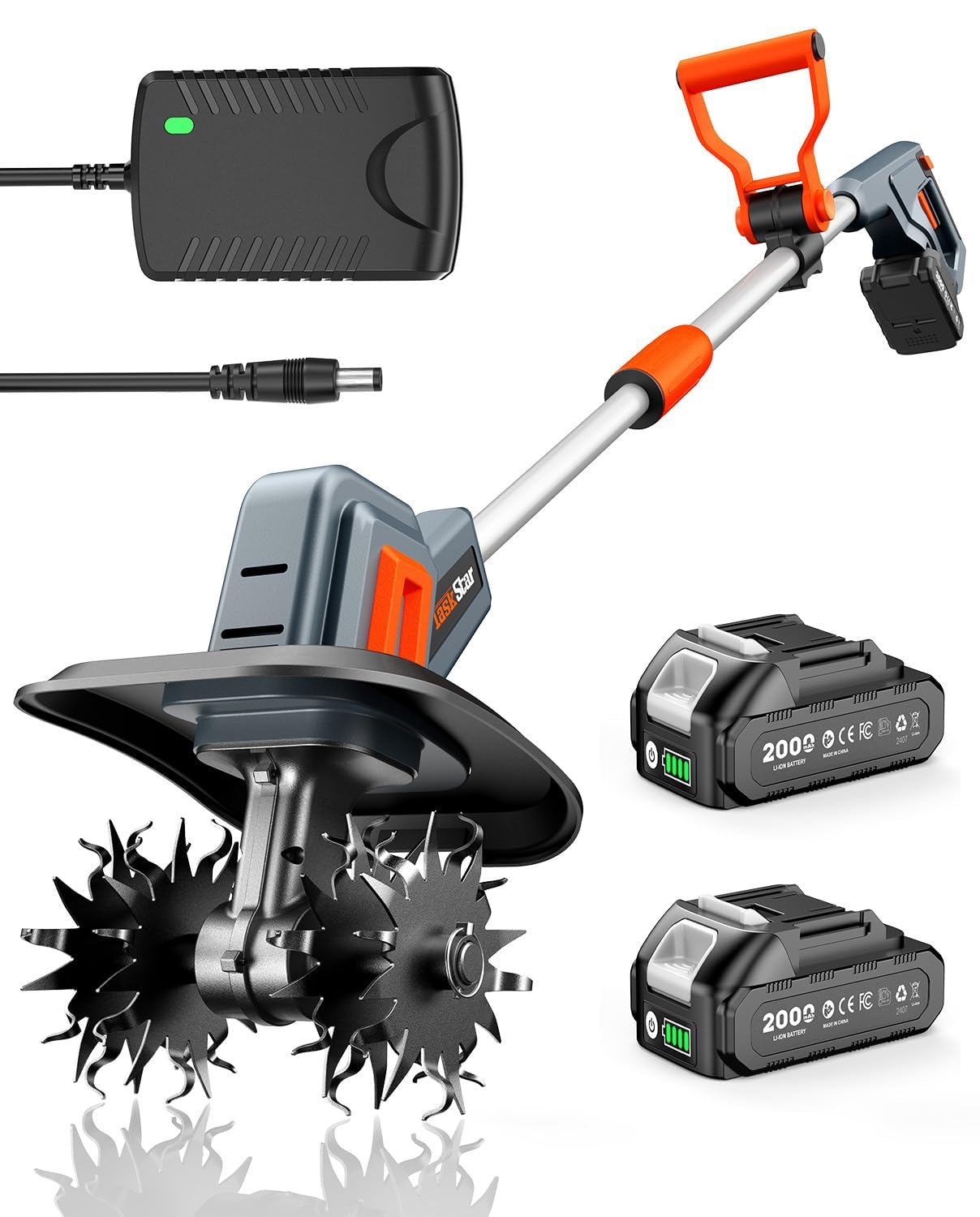
2. TaskStar TH4000 Cordless Tiller Cultivator
The cordless beast that turns tough ground into loose soil without the gas fumes.
This is the heavy hitter of the group. The TaskStar runs at 360 RPM — the same top speed as the MZK but with 48 hardened steel tines instead of four, so the cutting load spreads across more teeth and you get a finer, airier tilth on every pass. It cuts a 9-inch wide path and reaches 7 inches deep, which is the deepest of any pick here and makes it the right tool for breaking new ground or mixing compost into established beds. At 12.8 pounds, it is noticeably heavier than the 10-pound FORDWALT — that extra heft helps the tines bite into hard soil without you having to lean on the handles, but you will feel the weight if you carry it across a large yard.
Buyers report it “tills the soil to the max” and call it a “little beast” on unbroken ground, noting it took multiple passes on new earth but still impressed. The two included 2.0Ah batteries (4,000mAh total) keep you working for about 40 minutes combined, and owners mention the battery life holds up well for a full raised-bed session. The main trade-off: at 12.8 lbs it is less maneuverable for overhead weeding than the lighter picks, and the 3-year warranty is shorter than the 5-year offered by the FORDWALT.
Straight power pick: If your soil is hard-packed or you are expanding a garden bed, the RPM and depth here pull ahead of the MZK and FORDWALT for pure work rate.
One real caveat: The weight and width make it less ideal for tight flower-bed edges compared to the narrower Earthwise.
Best for: Home gardeners with medium-to-large beds who want gas-like breaking power without the fumes or cord.
skip it if: You only need a light weeding tool for small, soft-soil beds — the lighter picks cost less and are easier to maneuver.
3. DEGGE SY-818 Cordless Tiller Cultivator
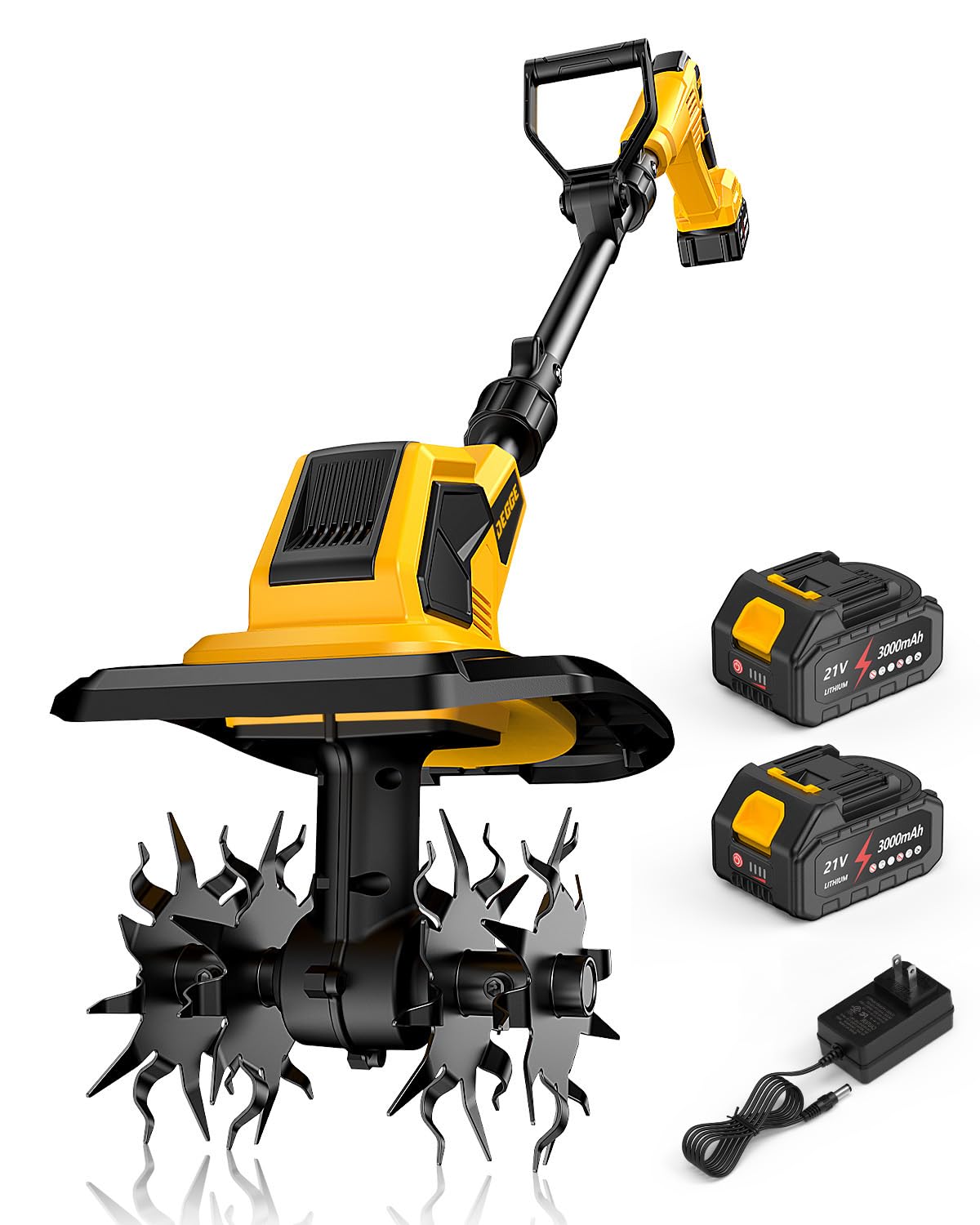
The tiller that keeps running while the others recharge.
The DEGGE stands apart because of its battery pack. It comes with two 3.0Ah 21V batteries — the highest amp-hour rating in this lineup — and each one delivers up to 25 minutes of continuous tilling. Alternate them and you get a solid 50-minute work session without plugging anything in. That is noticeably longer than the MZK’s shorter-lived packs or the single 2.0Ah battery on the Earthwise. The 48 hardened steel tines match the TaskStar’s count and reach 6.7 inches deep across a 9-inch width, so the soil prep is thorough on every pass.
Shoppers say it “works great and has a ton of power” and that the batteries “lasted all day for a big job,” though they note compacted dirt benefits from being watered the day before. The dual-button safety start prevents accidental engagement, a feature the Earthwise shares. The catch: the DEGGE is newer to market (only 73 ratings so far), and the manufacturer does not list its RPM or item weight in the specs, making it harder to compare head-to-head against the TaskStar or MZK on motor speed.
The run-time advantage: With 6.0Ah total battery capacity, you get roughly 50 minutes of tilling .
What you give up: No RPM spec published, so you cannot be certain it spins as fast as the 360 RPM picks; early adopter risk with a smaller review base.
Grab this for: Larger gardens where you cannot afford to stop every 20 minutes to swap and charge — the 3.0Ah batteries keep you moving.
Hold back if: You prefer a proven track record with thousands of ratings; the TaskStar has over 400 reviews and a published RPM you can trust.
4. Saker SK-TC18B Cordless Garden Tiller
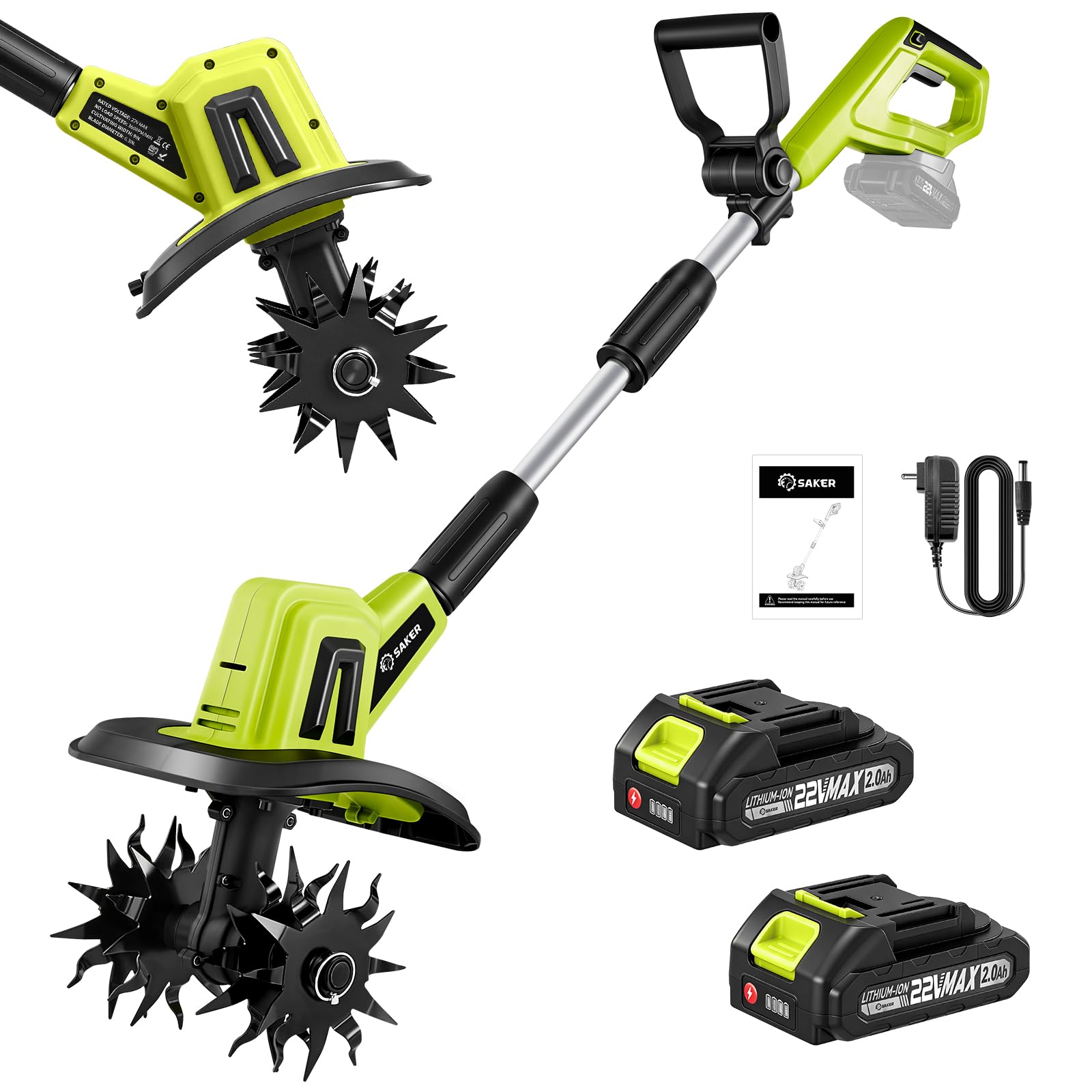
Packs a 360 RPM punch in a frame designed for tired arms.
The Saker matches the top picks on motor speed at 360 RPM, so it spins fast enough to chew through moderately hard soil — but it does it with a design focus on comfort. The adjustable auxiliary handle and ergonomic main handle are meant to reduce fatigue during longer sessions, a detail the bare-bones MZK handle lacks. It delivers a 9-inch tilling width and 6.3-inch depth, which is slightly shallower than the 7-inch TaskStar but still sufficient for most weeding and aeration jobs. Each of the two included 22V 2.0Ah batteries provides up to 30 minutes of runtime, giving you about an hour of combined work.
Buyers report it works “great for weeding” and “loosens dry packed soil 6 inches deep,” though they note it is not powerful enough for hard clay without multiple passes. One owner wished it came with a carrying strap for better stability, and another pointed out the lack of a rear guard means your feet are closer to the spinning tines — note if you wear open shoes. The 4.6-star average across 288 ratings suggests most owners are satisfied, especially for the price.
Comfort highlights
- 360 RPM motor matches top-tier speed
- Ergonomic handles reduce hand fatigue
- Two batteries included for extended sessions
Comfort trade-offs
- 6.3″ depth is shallower than the TaskStar’s 7″
- No rear guard — tines are exposed near feet
- Not suited for hard clay without multiple passes
Best suited for: Gardeners with moderate soil who value a comfortable grip and are willing to make a few extra passes on tough spots.
pass on it if: You need maximum depth for breaking entirely new ground — the 7-inch TaskStar and 6.7-inch DEGGE dig deeper.
5. Earthwise TC70020IT Cordless Tiller Cultivator

Narrow, light, and simple — built for the gardener with small beds and limited strength.
The Earthwise is the most accessible option here. Its 7.5-inch tilling width is narrower than every other pick — the 9-inch Saker and 11.6-inch MZK cover more ground per pass — but that narrow head is exactly what makes it ideal for tight spaces like flower borders, raised beds, and rows where you need precision. It reaches 6 inches deep, which is enough for weeding, aerating, and mixing in soil additives, and the single included 20V 2.0Ah battery keeps the tool light enough for a 70-year-old reviewer to handle without strain. The safety button on top means you must depress it to start the blades, a feature shared with the DEGGE.
Owners mention it “works the ground up easily” and that one owner finished a side garden in 30 minutes that would have taken 90 minutes by hand. The biggest complaint across 783 ratings is battery life — the single 2.0Ah pack runs out faster than the dual-battery kits from MZK or DEGGE, so you may want a spare if your garden is larger than a few beds. The 2-year warranty is also shorter than the 3-year (TaskStar) and 5-year (FORDWALT) offers.
The precision angle: Its narrow 7.5-inch head slips between plants where the TaskStar’s 9-inch head would clip foliage — a real advantage for weeding in established beds.
The runtime limit: At 2.0Ah with no second battery included, you get roughly 20 minutes of work before a 1-hour recharge. For bigger gardens, budget for an extra battery.
Ideal for: Seniors, beginners, or anyone with a few flower beds who wants an easy tool for light weeding and top-dressing.
Not for: Large vegetable patches or hard, never-tilled ground — the Earthwise lacks the RPM, width, and battery runtime for heavy work.
6. FORDWALT TLDCB20 Cordless Tiller Cultivator
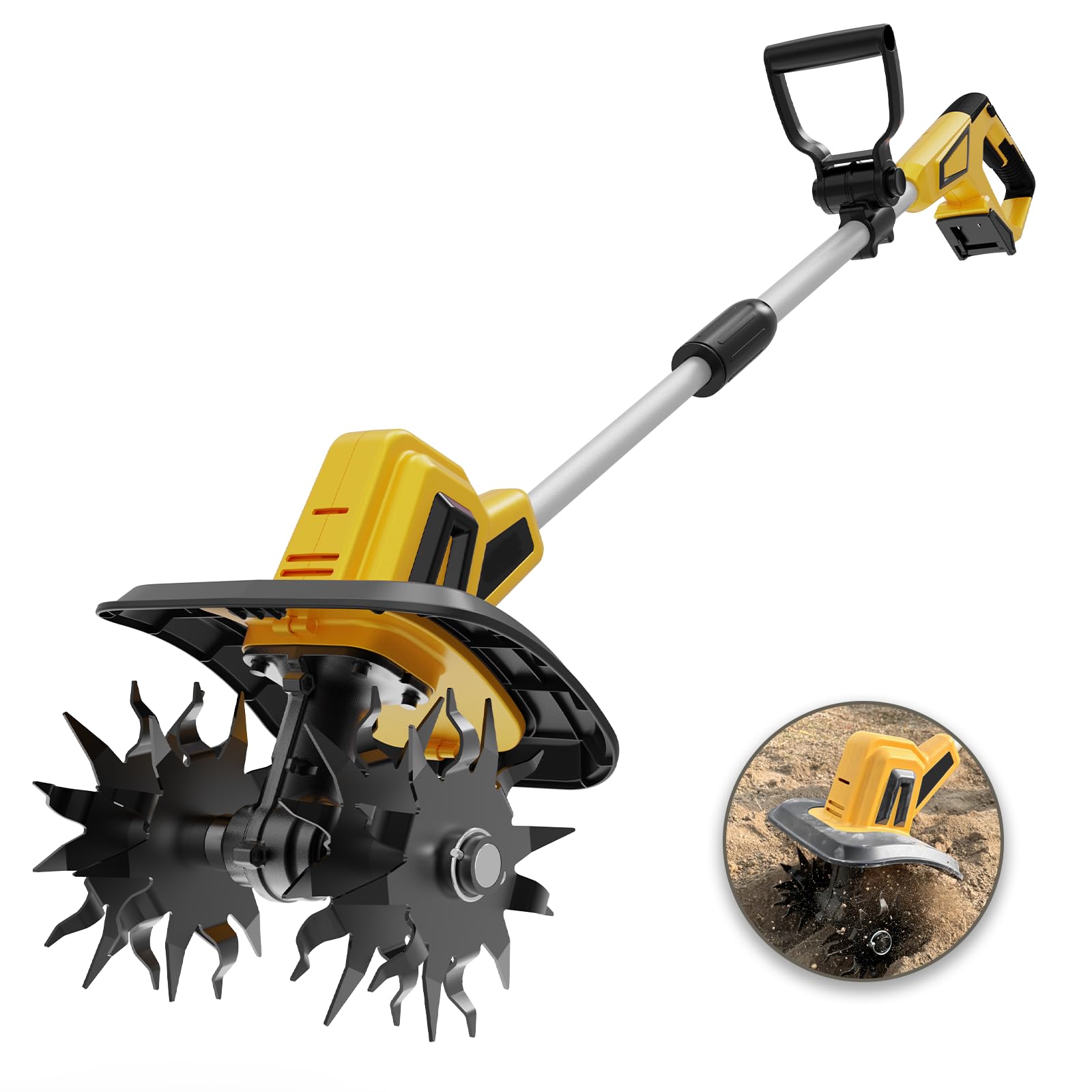
Slower but smarter — runs on the battery you likely already own.
The FORDWALT is a niche pick with a specific advantage: it is compatible with Dewalt 20V batteries. If you already have a Dewalt drill or saw, you can use its batteries here and skip buying another charger and pack. The motor spins at 270 RPM, which is 270 RPM compared to 360 RPM on the TaskStar and MZK, so it is best suited for loose soil, previously tilled beds, and light weed removal rather than breaking new ground. The 48 steel tines and 8.7-inch width (with 6.3-inch depth) give it a decent work footprint, and at 10 pounds it is the lightest full-size option here.
Customers note it “easily cultivated my dry, hard as rock planter” with enough power for the price, but several note a design flaw: “the three battery contacts can get bent easily and hence will not allow the battery to fully engage.” The instructions clearly state it is tool-only (no battery included), yet a few owners dinged the rating for that surprise. The 5-year warranty is the longest of any pick here, which adds confidence despite the slower motor.
Why it makes sense
- Runs on Dewalt 20V batteries — no extra charger needed
- 5-year warranty beats every other pick
- 10 lbs is 2.8 lbs lighter than the TaskStar
Why it lags
- 270 RPM is the slowest motor here — harder work on compacted dirt
- Battery contacts bend easily, causing intermittent failures
- Tool only — no battery included, so upfront cost is hidden
Buy it if: You own Dewalt 20V tools and want a cordless cultivator that shares their battery ecosystem at a low price.
Pass on it if: You are starting from scratch with no Dewalt batteries — the slower motor and bent-contact issue make the TaskStar or Saker a better value when buying a full kit.
Understanding the Specs
RPM (Revolutions Per Minute)
This tells you how fast the tines spin. A higher RPM — like 360 — means the tiller cuts through hard, compacted soil faster because the tines strike the ground more times per second. Lower RPM, such as 270, still works on loose soil but will bog down or require multiple passes on tough clay. If your garden has never been tilled or the dirt is dense, aim for 360 RPM. If you are only fluffing existing beds, 270 RPM is sufficient.
Tine Count and Material
The number of steel tines affects how evenly the soil is broken up. A 48-tine head (like on the TaskStar, DEGGE, and FORDWALT) spreads the cutting force across many points, producing finer soil and better aeration compared to a 4-tine head (like the MZK). Hardened or alloy steel tines resist bending when you hit rocks or roots. For rocky or root-filled ground, more tines and stronger steel mean fewer replacements over time.
Amp-Hours (Ah) and Voltage
Amp-hours measure the battery’s energy capacity — how long it can run before needing a recharge. A 2.0Ah battery might give 20-30 minutes of tilling; a 3.0Ah battery stretches that closer to 40 minutes. Voltage (20V, 21V, 22V) drives the motor’s peak power. Higher voltage generally means more torque to push through hard soil. Two batteries are better than one: you can swap and keep working while the first charges.
Tilling Width and Depth
Width is how wide a strip the tiller clears in one pass. A 9-inch width balances speed with maneuverability for most home gardens. Depth is how far the tines penetrate below the surface. Six inches is fine for weeding and top-dressing; 6.7 to 7 inches is better for breaking new ground or mixing in compost. Deeper tilling reaches the root zone and improves drainage, but it also requires a more powerful motor and heavier unit.
FAQ
Will a cordless cultivator work on hard clay soil?
How long does a cordless cultivator battery last?
Can I use a Dewalt battery in a FORDWALT tiller?
What is the difference between a cultivator and a tiller?
How wide should the tilling path be for a raised bed?
Do I need two batteries for a cordless cultivator?
What safety features do cordless cultivators have?
How do I clean and maintain a cordless cultivator?
Is a 7-inch tilling depth enough for a vegetable garden?
What warranty do cordless cultivators typically have?
Final Thoughts: The Verdict
For most gardeners, the best cordless cultivator is the TaskStar TH4000 because its 360 RPM motor and 48 steel tines deliver the raw breaking power to handle both new ground and established beds without the weight of a gas machine. If you want the longest runtime without stopping, the DEGGE SY-818 gives you dual 3.0Ah batteries that keep you working for nearly an hour straight. And for the best value in soft-soil gardens, the MZK ET1401-2 matches the top motor speed and offers the widest tilling path at a price that is tough to top.
How We Picked
We do not accept paid placement. Every pick is matched to a real buyer and a real use-case; we do not hands-on test units.
Sources & Methodology
Specifications: manufacturer listings and product documentation. Review insights: verified customer reviews, as of July 2026. Pricing: not shown on this page (it changes often); check the current price via the retailer link.
As an Amazon Associate, WellFizz earns from qualifying purchases. This does not affect which products we feature.
Related Guides

Mo Maruf
I created WellFizz to bridge the gap between vague wellness advice and actionable solutions. My mission is simple: to decode the research and give you practical tools you can actually use.
Beyond the data, I am a passionate traveler. I believe that stepping away from the screen to explore new environments is essential for mental clarity and physical vitality.