Our readers keep the lights on and my smoothie glass nicely filled. As an Amazon Associate, I earn from qualifying purchases.
Specs are compiled from manufacturer listings and verified buyer reviews and can change over time — please confirm the key details on the product page before buying.
You get a solid hookup on a fish, and then your budget reel locks up or spins out of control. A decent fly reel does not have to cost a fortune. This guide covers seven affordable reels and matches each to the fish you actually chase, so you can put your money toward flies and gas instead of a headache.
I’m Mohammad Maruf — the writer behind WellFizz. This guide is based on comparing the manufacturers’ published specs and patterns from verified customer reviews. You get each pick’s real strengths and trade-offs instead of marketing claims.
The truth is, a good cheap fly reel is about matching the drag system, weight, and arbor design to your target species — not the brand name.
Our Picks at a Glance


How To Choose The Best Cheap Fly Reel
Seven reels can look similar in a photo, but they behave differently on the water. The differences that matter are the drag system, the arbor size, the material, and whether the reel comes pre-loaded. Here is what to look for.
Drag System: Disc vs. Click-Pawl
A disc drag uses stacked washers (often Teflon and stainless steel) to apply smooth, adjustable pressure as a fish runs. That control is important for bigger fish or lighter tippets (the thin section of line that connects to your fly). A click-pawl drag uses a spring-loaded pawl that catches gear teeth — it makes the classic “click” noise but gives you very little adjustable stopping power. Click-pawl reels are simple and durable, but they work best for panfish, small trout, and short runs, not for a carp or bass that peels off line.
Arbor Size: Large vs. Mid vs. Standard
Large arbor reels have a bigger spool diameter, which helps you pick up line much faster with each turn of the handle. They also reduce line memory — the curl that plastic fly lines develop from sitting on a small spool. Mid-arbor reels sit in between, offering a good balance of speed and a compact size. Standard (small) arbor reels are slower and can cause more coiling, but they are often found on the least expensive models.
Material and Weight
Aluminum reels are standard for durability and corrosion resistance in freshwater. Graphite reels are lighter and cheap to produce, but they can flex under heavy load and may not hold up to saltwater. Some reels use a graphite frame with a stainless steel bearing — that is fine for occasional use. Weight matters because a reel balances the rod; a 100-gram reel pairs naturally with a 3-weight rod, while a 130-gram reel balances a 7-weight rod better.
Pre-Spooled or Not
Many reels in this price range come with a fly line, backing, and a leader already on the spool. That saves you the effort and cost of spooling them yourself. But the included line is often basic — good for learning, but you may want to upgrade after a season. If you already have a favorite fly line, choose a reel sold without line so you are not paying for something you will replace.
Quick Comparison
| Model | Best For | Weight | Drag Type | Arbor Design | Amazon |
|---|---|---|---|---|---|
| Martin Caddis Creek★ Best Overall | Entry-Level Classic | — | Click-Pawl | Standard | Amazon |
| Maxcatch TinoAlso Great | Best Overall Value | — | Disc | Large | Amazon |
| Aventik HVCE Graphite | Premium Performanc | 131 g | Disc | Large | Amazon |
| SF SF-003 Pro | Mid-Range Smoothness | 125 g | Disc | Mid | Amazon |
| Aventik FLK Aluminum | Premium Construction | 0.2 kg | Disc | Large | Amazon |
| SF SF-001 | Budget Champion | 100 g | Disc | Large | Amazon |
| Pflueger Automatic | Specialty Auto-Retriev | 317 g | Automatic | Standard | Amazon |
In‑Depth Reviews
1. Martin Caddis Creek Fly Fishing Reel
The simple click-pawl design that generations learned to fly fish on.
The Martin Caddis Creek is a size 6/5 single-action reel with an aluminum frame and spool. Instead of a disc drag, it uses a metal click-pawl system (a spring-loaded tooth that clicks against gear teeth) with an on/off control — when you flip the drag on, it provides a consistent, light resistance. You can also palm the spool (press your palm against the spinning spool rim) for extra stopping power when a fish runs hard. This design has been around for decades, and it is nearly indestructible and easy to maintain.
Unlike the larger-arbor disc-drag reels above, the Martin has a standard (small) arbor, so you retrieve line more slowly per handle turn. That is fine for small streams where fish runs are short. Buyers report the durable aluminum frame and spool have kept some fishers using the same model for over 40 years. It comes pre-spooled with 20-pound backing, LT6F fly line, and a 5X leader. The honest limitation is that the click-pawl has no adjustable drag tension — it is either on or off — so it struggles with larger, harder-running fish like bass and carp. This is a reel for panfish and trout on small water, not for battling a 20-inch brown trout on a big river.
What works well
- Durable aluminum frame and spool are built to last for decades with basic care
- Simple click-pawl design is easy to understand and maintain — no complex drag stack
- Palming the rim lets you add manual stopping power without any parts to adjust
Where it falls short
- Click-pawl drag has no adjustable tension — on or off only
- Standard arbor retrieves line much slower than the large-arbor reels on this list
Reach for this if: you are new to fly fishing on small trout streams or want a rugged backup reel that will never let you down with a complicated mechanical failure.
Look elsewhere if: you fish larger rivers, target bass or carp, or want an adjustable drag that can handle longer, harder fish runs.
2. Maxcatch Tino Fly Fishing Reel
The first budget reel that buyers report feels genuinely overbuilt for the price you paid.
Buyers consistently describe the Maxcatch Tino as performing like reels costing five times as much, and it earns the top spot here for that reason. It uses a Teflon disc and a stainless steel one-way clutch bearing drag system (stacked washers that engage smoothly when a fish pulls hard), so you get adjustable stopping power without the jerky starts that can spook a trout. The entire body is CNC-cut aluminum — precision-machined from a solid block, not cast — which gives it a rigid feel you normally find above a hundred dollars.
Owners mention the drag control is noticeably good for the cost, and with the reel pre-loaded with WF fly line (weight-forward floating fly line), backing, and a tapered leader, you can spool it onto a rod and fish the same afternoon. The large arbor design helps you pick up line fast when a fish turns toward you. The one caveat: the included line is serviceable but basic, so if you fish every week, you may eventually swap it for a premium floating line. For someone who gets out a handful of times a year, few reels at this price point deliver this level of confidence.
What makes it the top pick
- CNC-machined aluminum frame feels rigid, not flimsy
- Teflon disc drag is smooth and adjustable for fighting larger trout or bass
- Comes fully pre-spooled with line, backing, and leader
The honest trade-off
- Stock fly line is average quality and may need upgrading after a season
- Requires practice to avoid hand interference during the cast because of its compact size
Reach for it if: you want a single reel that handles trout, bass, and panfish without making you wonder what you missed by not spending more.
Look elsewhere if: you need a featherweight reel to balance a short ultralight rod — the all-aluminum body is sturdy but not the lightest.
3. Aventik HVCE Graphite Fly Reel

A graphite-bodied reel that customers note handled a saltwater black drum like reels triple its price.
At 131 grams, the Aventik HVCE is 31% heavier than the SF SF-001 (100 grams), and that extra weight comes from its rugged polymeric (high-strength plastic) body and central disc drag. Reviewers point out that the 7/8 large arbor graphite reel easily handled the drag pull from a 15 lb black drum (a powerful saltwater fish). According to the maker, the one-way bearing means it clicks silently on the retrieve and makes a clear clicker sound when a fish pulls line out, which helps you hear a strike when you are not watching the water.
The drag is smooth and consistent, even in saltwater, thanks to the stainless steel bearing and corrosion-resistant construction. It arrives pre-loaded with WF5F fly line, backing line, and a tapered leader, so you are ready to fish right away. The trade-off compared to the aluminum Maxcatch Tino is that the graphite body can flex more under extreme load, but for most trout, bass, and even light saltwater fishing, shoppers say it performs like a reel that costs two hundred dollars. One reviewer noted it outperforms kit reels they had used before.
Standout strengths
- Central disc drag is extremely smooth with no jerky engagement
- Corrosion-resistant materials make it safe for occasional saltwater use
- Three-year warranty adds confidence on a budget buy
The honest trade-off
- Graphite body is not as rigid as the fully aluminum Maxcatch Tino
- A bit heavier than ultralight reels like the SF SF-001, which some 3-weight rod owners might notice
Choose this if: you fish small rivers and lakes and want a smooth drag that feels like a premium reel, without worrying about corrosion from the occasional saltwater trip.
skip it if: you plan to regularly fight fish over 20 lbs or you prefer the solid, cold feel of an all-aluminum frame.
4. SF SF-003 Pro Fly Fishing Reel

A CNC-machined aluminum reel that buyers report balances better than many reels costing twice as much.
The SF SF-003 Pro uses a fully CNC-machined aluminum frame and a matte gunmetal gray finish. At 125 grams, it is a touch lighter than the Aventik HVCE, making it a natural pairing for a 7-weight or 8-weight rod where balance matters more than raw lightness. The mid-arbor spool (a middle-sized central spool diameter) picks up line faster than a standard arbor but keeps the overall reel compact. The disc drag system delivers smooth, consistent resistance during a fish run, which helps you protect a light tippet from snapping.
Buyers consistently note the smoothness of the drag — one reviewer who owns an Orvis reel said they liked this SF reel more. It comes pre-spooled with orange backing line, a fluorescent yellow weight-forward floating fly line, and a 9-foot 3X tapered leader with a loop. The catch: some users mention the main fly line begins absorbing water after a few hours of continuous fishing, which can make it harder to keep dry flies floating high. That means it is better suited for wet flies and nymphing (fishing with sinking flies) from the start, or you can swap the line for a premium floating line if you fish dry flies exclusively.
What stands out
- CNC-machined aluminum is lightweight, durable, and corrosion-resistant
- Mid-arbor spool balances fast retrieval with a small overall footprint
- Disc drag is smooth enough to protect light tippets
Honest limitations
- Included fly line can absorb water after extended use, affecting dry fly performance
- Mid-arbor retrieves line slower than a full large arbor design like the Maxcatch Tino under intense runs
Grab this for: a 7-weight or 8-weight freshwater setup targeting larger trout and salmon, where the smooth drag and balanced weight matter more than extreme speed.
Look elsewhere if: you fish almost exclusively dry flies and want a line that floats high right from the start.
5. Aventik FLK Fly Fishing Reel
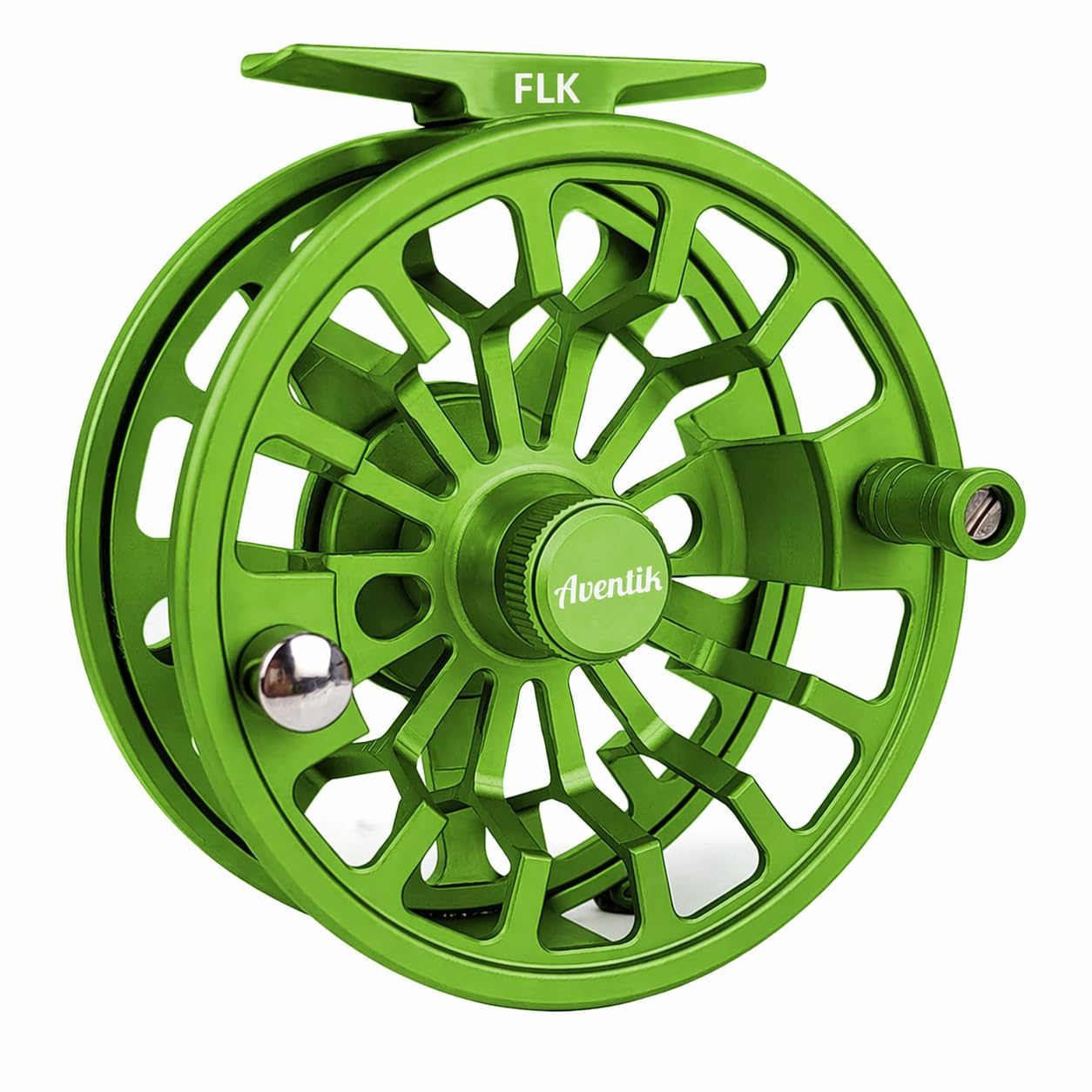
Aircraft-grade aluminum that owners mention feels precision-machined rather than budget-stamped.
The Aventik FLK uses T6061 aluminum cold-forged and tempered, then Type II hard-anodized (an electro-chemical coating that protects against scratches and salt damage), so it resists nicks and corrosion that ruin cheaper cast reels. It weighs 0.2 kilograms (200 grams) — noticeably heavier than the SF SF-001 at 100 grams — and that heft comes from the thick aluminum body. The composite disc drag with a stainless steel one-way clutch bearing engages immediately and smoothly, which helps you avoid the sudden yank that can snap a leader on the hookset.
Buyers praise the smooth winding and easy-to-adjust drag knob. It is a popular choice for Euro nymphing rods (long, sensitive rods used for tight-line nymphing) because the weight balances the extended rod length well. One sharp edge to watch for: customers note that sharp interior vanes on the spool may abrade your fly line or tippet over time. A minute of buffing with fine sandpaper fixes it, but it is a quality-control detail the Maxcatch Tino does not have. For the price, reviewers point out it is a tremendous value with a high-end feel.
Build highlights
- Aircraft T6061 aluminum with hard anodizing is tough and corrosion-resistant
- Smooth, timely disc drag helps prevent backlash and protects light tippets
- 3D-tune large arbor design balances fast line pickup with solid capacity
What to watch for
- Sharp interior spool vanes can fray backing or leader without smoothing
- At 200g, it is the heaviest aluminum reel here and may overbalance a light 3-weight rod
Pick this if: you fish a Euro nymphing or switch rod and want a tough, smooth-drag reel that stands up to hard use while staying affordable.
Avoid it if: you prioritize the lightest possible reel for a short, ultralight rod.
6. SF SF-001 Large Arbor Fly Fishing Reel

The lightest aluminum reel in this lineup at 100 grams with a proven track record.
The SF SF-001 is the lightest full-aluminum reel here at just 100 grams, which makes it a natural match for a 3-weight or 4-weight rod where every gram of nose-heaviness ruins the feel. It uses a disc drag system (stacked disc washers under tension) that provides smooth, adjustable resistance — a step up from the simple click-pawl of the Martin Caddis Creek. The large arbor spool helps you pick up line quickly when a trout turns and runs at you.
Shoppers say that after three years, the reel still holds fly line and backing well, and the drag is acceptable for panfish and smaller trout. The catch is that the fit between the spool and frame is slightly loose on some units — a few owners mention that the leader can slip between the spool and frame. This is not a deal-breaker for casual fishing, but it is worth checking your spool tension before a day on the water. The powder-coat finish also wears faster than the hard-anodized surface on the Aventik FLK. It comes fully pre-loaded with a fluorescent yellow WF3F fly line, 20-pound backing, and a 9-foot 6X tapered leader, so you can fish immediately.
What makes it a value pick
- Ultralight aluminum body at 100g is ideal for balancing light trout rods
- Disc drag provides adjustable stopping power that simple click-pawl reels lack
- Includes everything you need to fish — line, backing, and leader
Known limitations
- Slightly loose spool fit can allow leader to slip between spool and frame
- Powder-coat finish wears faster than the hard-anodized finish on the Aventik FLK
Best for: the budget-conscious freshwater angler who fishes panfish and small trout and wants the lightest possible aluminum reel without the complexity of a click-pawl.
Not for you if: you routinely fight larger fish that put heavy pressure on the spool fit, or you prefer a tighter machining tolerance from the start.
7. Pflueger Automatic Fly Fishing Reel

A spring-loaded reel that winds your line at the press of a lever — a unique tool for specific fishing scenarios.
The Pflueger Automatic is completely different from every other reel here. Instead of a standard handle-crank retrieve, it has an internal spring mechanism. You pull line out against the spring tension; then when you press the line trigger lever, the spring pulls the line back in automatically at about 2.7 inches per trigger press. This frees your right hand to hold a paddle, a net, or a pole while you manage the line with the reel. It weighs 317 grams (more than three times the SF SF-001) because of that spring mechanism inside an aluminum alloy frame.
Buyers who have used it say that while it is functional, the retraction can be inconsistent — sometimes it does not pull line all the way in on the first press. The trigger lever itself is short and has an odd bend, which some users found awkward at first. It also does not always fit snugly on rods with a cherrywood reel seat without a small amount of filing. This is not a reel for delicate dry-fly presentations or fighting big fish with an adjustable drag. But if you fish from a canoe or a float tube (an inflatable one-person boat) and need one hand free, the automatic retrieve is genuinely useful. It is a legacy design that fills a narrow niche, not a general-purpose trout reel.
Unique advantages
- Automatic line retrieval frees your right hand for paddling, poling, or netting fish
- Aluminum alloy frame is lightweight for its size and resists corrosion
- Simple spring mechanism has no complex electronics to fail
Real limitations
- At 317g, it is over three times the weight of the lightest reels like the SF SF-001
- Inconsistent retraction and a short, oddly bent trigger lever take practice to use reliably
Best for: the canoe, kayak, or float-tube angler who values keeping a hand free over casting precision or fighting power.
Not for you if: you need an adjustable drag, you fish moving water where you fight fish actively, or you prefer a standard handle retrieve.
Understanding the Specs
Disc Drag vs. Click-Pawl Drag
The drag system is the most critical performance decision. A disc drag uses stacked washers — often Teflon and stainless steel — that you adjust with a knob. It provides smooth, variable resistance, which helps you tire out a fish without snapping a light tippet (the thin end of your leader). Most of the reels here use a disc drag, making them suitable for larger fish. A click-pawl drag uses a spring-loaded tooth that clicks against a gear. It makes a classic sound but offers only on/off resistance with no fine tuning. The Martin Caddis Creek is the only click-pawl reel on this list, and it works best for small trout and panfish on small water.
Large Arbor vs. Mid Arbor vs. Standard Arbor
The arbor is the central spool diameter. A large arbor spool (found on the Maxcatch Tino, Aventik HVCE, Aventik FLK, and SF SF-001) has a wide diameter, so each turn of the handle retrieves more line — critical when a fish swims toward you and you need to pick up slack fast. A mid-arbor spool (SF SF-003 Pro) offers a balance of quicker retrieval and compact size. A standard arbor (Martin Caddis Creek) is slower and can cause fly line to curl over time, but is simpler and cheaper to manufacture. For most freshwater fishing, a large or mid-arbor saves you frustration during active fish fights.
FAQ
What weight fly line does a cheap fly reel typically come with?
Can I use these reels in saltwater?
Which type of drag do I need for trout fishing?
How do I switch a fly reel from right-hand to left-hand retrieve?
What does 3/4wt or 5/6wt mean on a reel?
Should I buy a pre-spooled reel or a bare reel?
How much backing do these budget reels hold?
Is a heavier fly reel always better?
Final Thoughts: The Verdict
For the majority of shoppers, the cheap fly reel winner is the Maxcatch Tino because it combines a CNC-machined aluminum body, a smooth Teflon disc drag, and a pre-spooled line all at a price that is hard to argue against. If you want a graphite-bodied reel that owners mention feels like it costs two hundred dollars, grab the Aventik HVCE. For an ultralight aluminum reel that balances a 3-weight rod perfectly, the SF SF-001 is your best bet.
How We Picked
We do not accept paid placement. Every pick is matched to a real buyer and a real use-case; we do not hands-on test units.
Sources & Methodology
Specifications: manufacturer listings and product documentation. Review insights: verified customer reviews, as of July 2026. Pricing: not shown on this page (it changes often); check the current price via the retailer link.
As an Amazon Associate, WellFizz earns from qualifying purchases. This does not affect which products we feature.
Related Guides

Mo Maruf
I created WellFizz to bridge the gap between vague wellness advice and actionable solutions. My mission is simple: to decode the research and give you practical tools you can actually use.
Beyond the data, I am a passionate traveler. I believe that stepping away from the screen to explore new environments is essential for mental clarity and physical vitality.