Our readers keep the lights on and my smoothie glass nicely filled. As an Amazon Associate, I earn from qualifying purchases.
Specs are compiled from manufacturer listings and verified buyer reviews and can change over time — please confirm the key details on the product page before buying.
A baby with colic leaves everyone exhausted, frustrated, and desperate for anything that brings real relief. The problem is often hidden in the bottle — swallowed air turns into gas, pressure builds in a tiny tummy, and a peaceful feeding erupts into crying.
I’m Mohammad Maruf — the founder and writer behind WellFizz. This guide is built by comparing the manufacturers’ published specifications and the patterns across verified customer reviews, so you get each pick’s real strengths and trade-offs instead of marketing spin.
Every bottle here uses a vent, liner, or internal system to reduce the air your baby swallows during feeds. best colic bottles balance proven gas-reduction tech with easy cleaning and a nipple your baby will actually accept — no single feature wins alone.
Our Picks at a Glance
How To Choose The Best Colic Bottles
Not every “anti-colic” bottle works the same way. Some use a vent at the base, others rely on a disposable liner that collapses as your baby drinks, and a few drop an internal straw into the bottle. Each approach has a different impact on cleaning time, how the nipple feels, and whether your baby will take to it. Focus on three things first.
The Air-Reduction System
The vent or liner is the core of any colic bottle. A vented base (like on the MAM) lets air enter the bottle through the bottom so it never mixes with the milk. A collapsible liner (like the Playtex Drop-Ins) squeezes the air out by shrinking as the baby drinks. An internal straw vent (like Dr. Brown’s) runs a tube down into the milk. All three stop air bubbles, but the vented-base models are typically simpler to clean, while the internal-straw designs need a small brush.
Nipple Shape and Flow
Wide, breast-shaped nipples (Philips Avent, Pigeon) mimic the feel of breastfeeding and help with switching between breast and bottle. The flow rate matters just as much — a slow flow (Flow 1 or SS) works best for newborns, while a medium flow (Flow 3) suits older babies who can handle more milk per suck. Too fast and your baby may gulp air; too slow and they get frustrated and cry, swallowing air that way.
Material and Durability
Standard plastic bottles are light and shatterproof but can scratch over time. PPSU (a high-heat-resistant plastic with an amber tint) handles temperatures up to 180°C/356°F without degrading — tougher than standard plastic and lighter than glass. Borosilicate glass resists thermal shock and never stains or absorbs odors, but it is noticeably heavier. Your call: glass for purity, PPSU for a lighter feel that still avoids the leaching worry of standard plastic.
Quick Comparison
| Model | Best For | Air-Reduction System | Material | Capacity | Amazon |
|---|---|---|---|---|---|
| MAM Easy Start★ Best Overall | Easy cleaning + 80% colic reduction | Vented base | Plastic (bio-circular) | 9 oz | Amazon |
| Philips Avent PPSU (9 oz)Premium Pick | Lightweight + high heat resistance | Anti-colic valve | PPSU | 9 oz | Amazon |
| NUK Smooth Flow | Budget-friendly + hot-temp indicator | Nipple vent | Plastic | — | Amazon |
| Philips Avent Natural (4 oz) | Breast-to-bottle transition | Anti-colic valve | Plastic | 4 oz | Amazon |
| Playtex Drop-Ins | Travel + minimal cleaning | Collapsible liner | Plastic + disposable liners | 8 oz | Amazon |
| Dr. Brown’s Glass | No plastic + proven gas reduction | Internal vent system | Borosilicate glass | 8 oz | Amazon |
| Pigeon PPSU | Nipple acceptance + 0m+ start | Anti-colic design | PPSU | 5.4 oz | Amazon |
In‑Depth Reviews
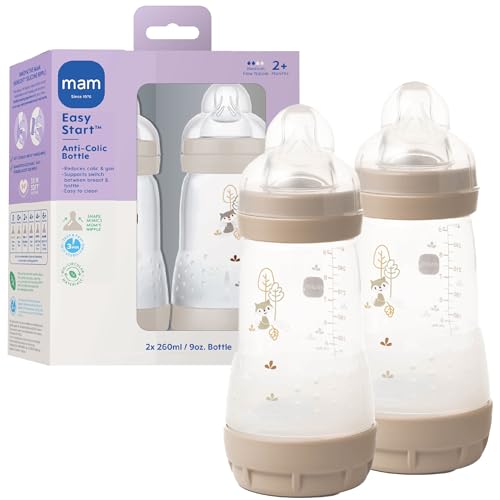
1. MAM 9oz Easy Start Anti-Colic+ Wide Neck Vented Baby Bottle
Our pick — over 4.5★ from 20,500+ verified ratings; the strongest balance of quality and price.
The air-stopping base that cleans in seconds and quiets a gassy baby.
You get less gas because the vented base prevents air from entering the bottle. MAM’s own testing reports an 80% reduction in colic symptoms. The nearly 21,000 reviews averaging 4.8 out of 5 suggest real-world results match up. The medium flow nipple mimics the shape and feel of mom’s nipple, which buyers report achieves a 94% nipple acceptance rate, making it easier to switch between breastfeeding and bottle feeding. Cleanup is easier than with the Dr. Brown’s internal vent, which needs a tiny brush for its separate parts.
The wide neck makes filling and scrubbing simple. The bottle self-sterilizes in its own base in just three minutes — stay clean for up to 48 hours if left untouched in that position. Reviewers also note it prevents nipple inversion and baby choking, a common frustration with less thoughtfully designed bottles. The trade-off is that it lacks a 1 oz measurement line, which some parents prefer for tracking small feeds.
Why It Wins Feed Time
- Vented base keeps air out of milk for less gas
- Self-sterilizes in 3 minutes — stays clean up to 48 hours
- Wide neck is easy to fill and scrub
The One Quirk
- No 1 oz measurement marking on the bottle
Reach for this if: you want the simplest colic-cleaning routine with a vent system that the data shows works for most babies.
Look elsewhere if: you need precise 1 oz volume measurements for small newborn feeds.
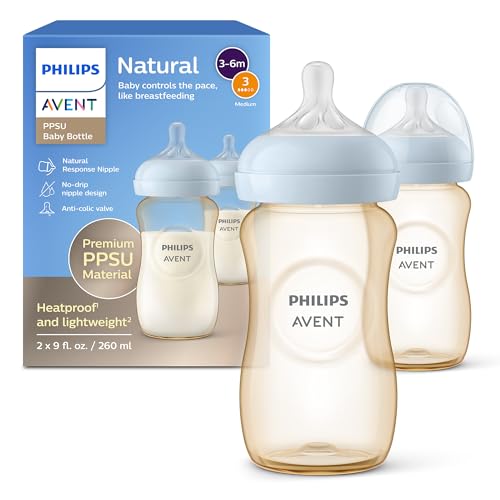
2. Philips Avent PPSU Natural Baby Bottles — Medium Flow (Flow 3), 9oz
The PPSU bottle that looks like glass but weighs like plastic.
You get the same anti-colic valve as the standard Philips Avent Natural bottle, but the PPSU (a high-heat-resistant plastic) is the upgrade. PPSU handles heat up to 180°C/356°F — well above boiling — so you can sterilize repeatedly without the bottle clouding or warping. The Natural Response nipple only releases milk when your baby actively drinks; when they pause to breathe, the flow stops, which mimics breastfeeding and reduces gulping. That is gentler on tummies than the MAM vented base, which does not have pause-responsive flow.
Owners mention that the amber-golden PPSU resists scratches and stains even after repeated dishwasher cycles, unlike standard plastic bottles that tend to fog up. The wide neck makes mixing formula straightforward and works with most bottle warmers. But reviewers consistently say the durability and lighter weight justify the cost, especially for babies who go through two or three 9 oz feeds a day.
Durable by design: PPSU resists heat up to 180°C/356°F and stays clear after months of sterilizing.
One limitation: The 9 oz size and medium Flow 3 nipple suit babies 3+ months — it is not ideal for a newborn.
Best for: parents who want a lightweight, nearly indestructible bottle that survives high-heat sterilization without degrading.
Skip if: you need a slow-flow newborn nipple (this ships with Flow 3 medium only).
3. Dr. Brown’s Anti-Colic Options+ Narrow Glass Baby Bottle, Level 1 Slow Flow, 8 oz, 4-Pack
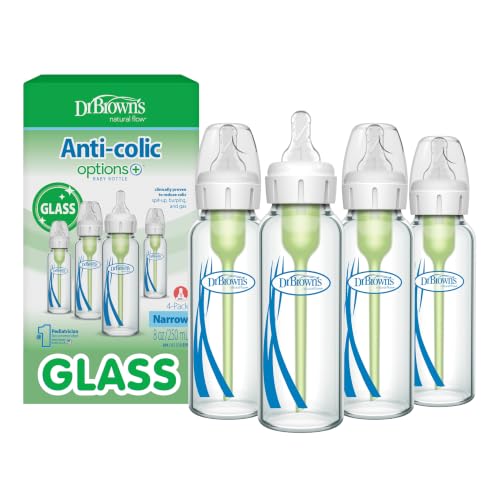
The glass bottle with an internal vent that doctors and parents both trust.
You get vacuum-free feeding from the internal vent system — a small plastic tube that runs down into the milk. The idea is that no air touches the milk, which reduces colic, spit-up, burping, and gas. A 4.8 out of 5 rating across 820 reviews confirms real-world results. The borosilicate glass resists thermal shock, meaning you can go from a hot sterilizer to a cool counter without the bottle cracking, which is a genuine concern with cheaper glass bottles. This glass purity is why parents who want zero plastic exposure choose it over the MAM.
The trade-off is on the cleaning side. Unlike the MAM vented base (which pops apart in two pieces) or the Playtex Drop-Ins liners (which you toss), Dr. Brown’s vent system has multiple small components that need a little brush to scrub thoroughly. Reviewers consistently say to soak the parts before washing. On the plus side, the glass never absorbs odors or stains, and it holds warmth longer than plastic or PPSU — helpful for slow feeders. The slow flow Level 1 nipple works well for newborns, and you swap out the vent system as your baby grows.
What Parents Love
- Borosilicate glass resists thermal shock and never stains
- Internal vent system reduces gas, spit-up, and colic
- Preserves milk nutrients better than unvented bottles
What Takes Extra Effort
- Multiple vent parts need a small brush to clean properly
- Heavier than plastic or PPSU bottles — noticeable on longer carries
Choose this for: the strongest air-barrier system in a material that never degrades, ideal for newborns with severe gas.
Pass if: you want the fewest cleaning steps — the vent parts add 60 seconds and a tiny brush to every wash.
4. Pigeon PPSU Nursing Baby Bottle Wide Neck, Anti-Colic, 5 oz, Pack of 2
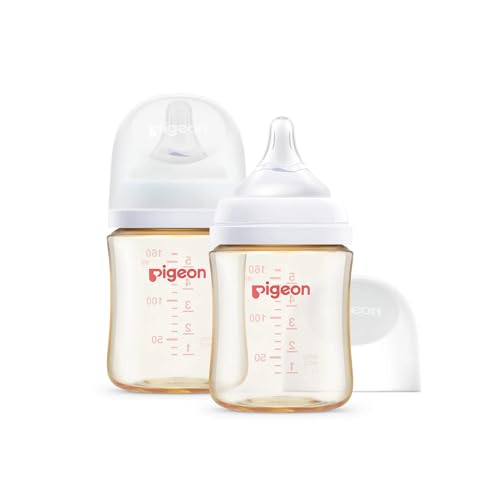
The 5 oz bottle with a nipple designed around how babies actually suck.
You get a nipple built on research about three natural tongue movements babies make while feeding in Japan. The result is a super soft, flexible silicone nipple with a “latch-on line” — a curve that guides your baby’s mouth into the right position for effective sucking. Customers note zero nipple confusion or bottle refusal, and several mention that switching between breast and bottle was smooth. The nipple comes in sizes from SS (0m+) up to 3L, so you can change the flow as your baby grows. That 0m+ SS option is the earliest start of any bottle here.
The PPSU body is lightweight and durable, withstanding repeated sterilizing without clouding. At 5.4 oz it is smaller than the 9 oz MAM or Philips Avent PPSU, which makes it a natural fit for newborns who take small feeds. Some reviewers point out that there is insufficient room to mix four scoops of formula in the 8 oz version, but for the 5.4 oz size this is rarely an issue. The wide neck and streamlined body are easy to hold and scrub. The price is the highest in this lineup, but buyers consistently say the hard-to-find 0m+ SS nipple and the leak-proof design justify the cost.
Latch-first design: the SS nipple is the only 0m+ option in this list, built for newborns who need a super slow flow.
Reality check: at 5.4 oz capacity it works best as a newborn-to-3-month bottle; you will need a larger size as your baby’s appetite grows.
Best for: exclusively breastfed babies who need a bottle that feels and flows as close to the breast as possible.
Not the right pick if: you want a larger bottle (8+ oz) right from the start or you are on a tight budget.
5. Playtex Baby Anti-Colic Nurser Bottle with Pre-Sterilized Disposable Drop-Ins Liners, 8 oz, 3 Count

The only bottle here that tosses the dirty liner instead of scrubbing it.
You skip the vent or valve entirely. Playtex uses a pre-sterilized, disposable Drop-Ins liner that collapses as your baby drinks. No air enters the liner, so your baby never gulps air bubbles — the same mechanism that the MAM and Dr. Brown’s vents achieve, but with zero cleaning of the air-reduction part. One reviewer noted this setup greatly helped their 3-month-old’s reflux. The slow flow nipple provides a good latch with no confusion between breast and bottle.
The 8 oz bottles come in a 3-pack with 15 disposable liners, making them a strong choice for travel or daycare when you cannot wash bottles immediately. The trade-off is waste — you throw away each liner after one use. If you are trying to reduce disposables, this might not fit your routine. But the convenience is real: parents note the liners make formula mixing less messy and that cleaning is reduced to just the nipple and shell.
The Convenience Factor
- Collapsible liners prevent air intake without any vent parts to clean
- Disposable liners make travel and daycare feeds much simpler
- Slow flow nipple supports breastfed babies with a natural latch
The Environmental Trade-Off
- Each liner is single-use — adds to household waste
- You need to keep buying replacement liners, which adds ongoing cost
The verdict: if you are always on the go and washing bottles is a chore, this is your bottle — the liner does the work and you toss the mess.
Not if you hate disposables: the ongoing liner purchase and waste are unavoidable trade-offs.
6. Philips Avent Natural Baby Bottles with Natural Response Nipples (Slow Flow, Flow 2), 4oz, 2-Pack

The 4 oz bottle that won Best of The Bump Award for a reason.
You get the same Natural Response nipple from Philips Avent — the one that only releases milk when your baby actively drinks — but in a 4 oz size with a slow flow (Flow 2) nipple. It won the Best Bottle for Newborns award from The Bump in 2024, and the 4.7 out of 5 rating across 919 reviews backs that up. The anti-colic valve keeps air away from your baby’s tummy during feeding, reducing colic and discomfort. Shoppers say the soft, breast-like nipple prevents rejection and the anti-colic valve reduces tummy pain.
The no-drip nipple design prevents milk from leaking from the tip, which keeps you and your bag dry when you are out. The 4 oz capacity is small — at 4 oz versus the Philips Avent PPSU at 9 oz, you will need to refill or buy a second bottle for a single large feed. But for a newborn who takes 2 oz to 3 oz per feed, the size is actually perfect. It is also the least expensive Philips Avent option, making it a low-risk entry point if you are unsure whether your baby will like the Natural Response system.
Award winner: the 2024 Best of The Bump Award recognizes its suitability for newborns.
The honest trade-off: at 4 oz it is a dedicated newborn bottle — you will outgrow it within a couple of months and need to size up.
Best for: parents of a newborn who want the proven Philips Avent anti-colic system in a small, affordable starter pack.
Skip if: you need a larger capacity from day one or your baby already takes 4+ oz per feed.
7. NUK Smooth Flow Anti Colic Baby Bottle

A budget bottle with a smart temperature strip that tells you when milk is too hot.
You get a unique nipple design — the drinking hole is positioned correctly only when the NUK logo on the nipple is under your baby’s nose — that lets your baby control the speed of the milk flow. This reduces gulping and the air that comes with it. The standout practical feature is the SafeTemp indicator: a thermometer icon on the bottle that changes color when the milk is too hot. No more testing on your wrist or guessing.
Buyers report NUK bottles significantly reduce colic and gas, leaving babies more comfortable after feedings. The bottle is BPA free and dishwasher safe (top rack only). The measurements do not fade over time, which is a common complaint with cheaper bottles. There is a potential quality inconsistency, however — some owners mention that a few nipples do not vent properly and require manual pressure equalization during a feed. At the budget end of this list, it delivers solid anti-colic function with a genuinely useful heat warning feature.
Smart Features
- SafeTemp indicator changes color when milk is too hot — a practical safety check
- Nipple design lets baby control flow speed, reducing air intake
- Measurements stay readable after repeated dishwasher cycles
Possible Inconsistency
- Some nipples may not vent properly, requiring you to briefly loosen the collar during feeds
The budget verdict: for the lowest-cost colic bottle here, you get a smart heat-safety feature that most pricier bottles lack — just check that first nipple before you rely on it.
Ask yourself: if you want a fully consistent vent system from the start, look at the MAM instead.
Understanding the Specs
Vented Base vs Internal Vent vs Collapsible Liner
The vented base (MAM) prevents air from entering the bottle, so air never passes through the milk your baby drinks. The internal vent (Dr. Brown’s) runs a thin tube down into the milk to create vacuum-free feeding. The collapsible liner (Playtex Drop-Ins) is a disposable bag that shrinks as your baby drinks, preventing any air from even entering the bottle. All three stop air bubbles, but the vented base and liner are easier to clean — the internal vent adds extra parts that need a small brush.
PPSU, Borosilicate Glass, and Standard Plastic
PPSU is an amber-tinted, high-heat-resistant plastic that handles temperatures up to 180°C/356°F without fogging or warping — lighter than glass and tougher than standard plastic. Borosilicate glass resists thermal shock (no cracking when going from hot to cold) and never stains or absorbs odors, but it is heavier. Standard plastic is the lightest and cheapest, but it may scratch and cloud over time. Choose glass if you want zero chemical leaching worries; choose PPSU if you want a light bottle that still tolerates high sterilizing temperatures.
Nipple Flow Rates: SS, Slow, Medium, Fast
Nipple flow is labeled differently by each brand: Pigeon uses SS (0m+), S, M, L, 3L; Philips Avent uses Flow 1 (slow), Flow 2, Flow 3 (medium), Flow 4; MAM fits all its nipples with size labels (0, 1, 2). Slow flow (SS or Flow 1) works best for newborns who cannot manage a fast stream yet — they control the pace without gulping air. Medium flow (Flow 3) suits babies around 3+ months who need more milk per suck but still benefit from the anti-colic system. Choosing a flow that matches your baby’s age prevents both frustration and air swallowing.
Self-Sterilizing, Dishwasher Safe, and SafeTemp
Self-sterilizing (MAM) means you add a little water to the bottle, microwave it in its own base, and it is sterile in three minutes — no separate sterilizer needed. Dishwasher safe means you can put the bottle on the top rack, though PPSU and borosilicate glass handle this better than standard plastic. SafeTemp (NUK) is a thermometer icon on the bottle that changes color when milk is too hot — a useful check when you are warming a refrigerated bottle and cannot easily test the temperature.
FAQ
Do colic bottles really stop gas or is it mostly marketing?
Which colic bottle is easiest to clean?
Can I use these bottles for a baby with severe reflux?
How do I know which nipple flow rate my baby needs?
Is PPSU safer than glass for baby bottles?
Will these bottles work with a standard bottle warmer?
How many colic bottles do I need to start?
What is the difference between a vented base and an internal vent?
Can I use these bottles for breastfeeding and bottle feeding interchangeably?
How long does a colic bottle last before I need to replace it?
Final Thoughts: The Verdict
For most buyers, the best colic bottles winner is the MAM Easy Start because it combines a clinically proven vented base with the simplest cleaning routine in this lineup — no tiny brushes, no disposable waste, and a self-sterilizing feature that keeps you from needing a separate sterilizer. If you want a lightweight, durable bottle that survives high-heat sterilization, grab the Philips Avent PPSU. And for a travel-first setup where cleaning is not always possible, the standout is the Playtex Drop-Ins with its disposable liners that collapse as your baby drinks.
How We Picked
We do not accept paid placement. Every pick is matched to a real buyer and a real use-case; we do not hands-on test units.
Sources & Methodology
Specifications: manufacturer listings and product documentation. Review insights: verified customer reviews, as of July 2026. Pricing: not shown on this page (it changes often); check the current price via the retailer link.
As an Amazon Associate, WellFizz earns from qualifying purchases. This does not affect which products we feature.
Related Guides

Mo Maruf
I created WellFizz to bridge the gap between vague wellness advice and actionable solutions. My mission is simple: to decode the research and give you practical tools you can actually use.
Beyond the data, I am a passionate traveler. I believe that stepping away from the screen to explore new environments is essential for mental clarity and physical vitality.