Our readers keep the lights on and my smoothie glass nicely filled. As an Amazon Associate, I earn from qualifying purchases.
Specs are compiled from manufacturer listings and verified buyer reviews and can change over time — please confirm the key details on the product page before buying.
You rely on your coolant to keep the engine temperature stable, but water and plain antifreeze often fall short when the heat climbs or a tiny pinhole starts weeping. The right coolant additive boosts heat transfer, seals small radiator leaks, and protects against cavitation and corrosion that can crack cylinder walls over time. Every pick here targets a different weak spot: track-day cooling, diesel-engine pinhole prevention, or a simple leak fix you can pour in without draining the system.
I’m Mohammad Maruf — the founder and writer behind WellFizz. This guide is built by comparing the manufacturers’ published specifications and the patterns across verified customer reviews, so you get each pick’s real strengths and trade-offs instead of marketing spin.
Whether you drive a daily commuter, a heavy-duty diesel, or a weekend track car, choosing the right coolant additive can mean the difference between a steady gauge and an overheating headache.
Our Picks at a Glance

How To Choose The Best Coolant Additive
Some improve heat transfer for performance driving, some stop leaks from inside the radiator, and others prevent cavitation (tiny vapor bubbles that erode metal) in diesel engines. Match the additive’s primary function to your engine’s specific problem.
Identify your cooling problem first
If your engine runs hot only under heavy load or on hot days, look for an additive that increases the wetting ability of water — like a surfactant — so the coolant makes better contact with hot metal surfaces. If you see a slow coolant drip or a puddle under the car, a stop-leak additive containing sealant particles that plug cracks in gaskets, hoses, or the radiator core is the right approach. For diesel engines, especially older ones, cavitation corrosion eats cylinder walls from the outside in; a dedicated supplemental coolant additive (SCA) with nitrites and other inhibitors is essential. Using the wrong type may not help and could interfere with your existing antifreeze chemistry.
Compatibility with your coolant type
Most modern additives work with DEX-COOL, long-life, and conventional ethylene or propylene glycol coolants, but always check compatibility. Some additives specifically satisfy ASTM D2570 and D1384 corrosion tests for glycol-based systems, which means they won’t accelerate rust or scale buildup. For late-model European or Asian cars specifying a particular phosphate or silicate content, pick an additive that matches that chemistry rather than a universal stop-leak product.
Quick Comparison
| Model | Best For | Temperature Drop Claim | Item Weight | Primary Function | Amazon |
|---|---|---|---|---|---|
| Red Line WaterWetter 2-Pack★ Best Overall | Track-day & performance driving | 10-15°F (buyer reported) | 12 ounces | Heat transfer boost | Amazon |
| DEI Radiator ReliefPro Grade | Severe overheating reduction | Up to 30°F (from maker) | 2.14 pounds (0.97 kg) | Temp reduction & anti-corrosion | Amazon |
| Cummins Fleetguard DCA60L | Diesel cavitation protection | N/A (cavitation prevention) | 1.23 pounds | Cavitation & corrosion inhibitor | Amazon |
| Mishimoto Liquid Chill | Daily driver temp reduction | 6°F (buyer verified via OBD) | — | Coolant temp reduction | Amazon |
| XADO ATOMEX Stop Leak | Small radiator & gasket leak repair | N/A (sealant) | 11.9 ounces | Leak seal & prevention | Amazon |
| Valvoline Zerex G48 Concentrate | European vehicle OE spec | N/A (antifreeze additive) | 9.31 pounds | OE-spec corrosion protection | Amazon |
In‑Depth Reviews
1. Red Line 80204 WaterWetter Super Coolant — 12 Ounce (2 Pack)
Our pick — over 4.5★ from 500+ verified ratings; the strongest balance of quality and price.
The surfactant that doubles your water’s cooling ability for when the gauge climbs past comfort.
This additive is built around a single mission: making water wetter so it transfers heat more efficiently. The idea is that coolant (especially straight water) has surface tension that prevents it from fully contacting hot metal surfaces inside the engine block and radiator. WaterWetter reduces that surface tension, allowing the liquid to pull heat away faster. One bottle treats 3 to 5 gallons (about 13.2 to 15.9 liters) — enough for most passenger cars, but large cooling systems need two bottles, and small ones take just 1 ounce (3 to 4 capfuls) per quart.
Buyers consistently report seeing the coolant temperature drop by a real 10-15°F on hot track days, and one track-car owner noted the gauge stays below 230°F in summer traffic with the AC on. Unlike the Mishimoto Liquid Chill, which targets a 6°F drop for daily drivers, WaterWetter is aimed squarely at higher-stress conditions. It satisfies ASTM D2570 and ASTM D1384 corrosion tests for glycol-based antifreezes, so it is safe to add to new or used coolant — including DEX-COOL and long-life types. The 2-pack offered here is cost-effective if you change coolant regularly or own multiple vehicles that could each use a bottle.
Straightforward verdict: If you push your car hard on the street or track and want a proven cooling assist without changing your entire coolant chemistry, WaterWetter is the additive to pour in. skip it if your only concern is a slow leak — for sealing, you want the XADO stop-leak below instead.
Reach for this if: you run a performance car, track vehicle, or simply live in a hot climate and want the coolant gauge to stay steady under load. Look elsewhere if: your coolant system has an active leak that needs sealing, not just better heat transfer.
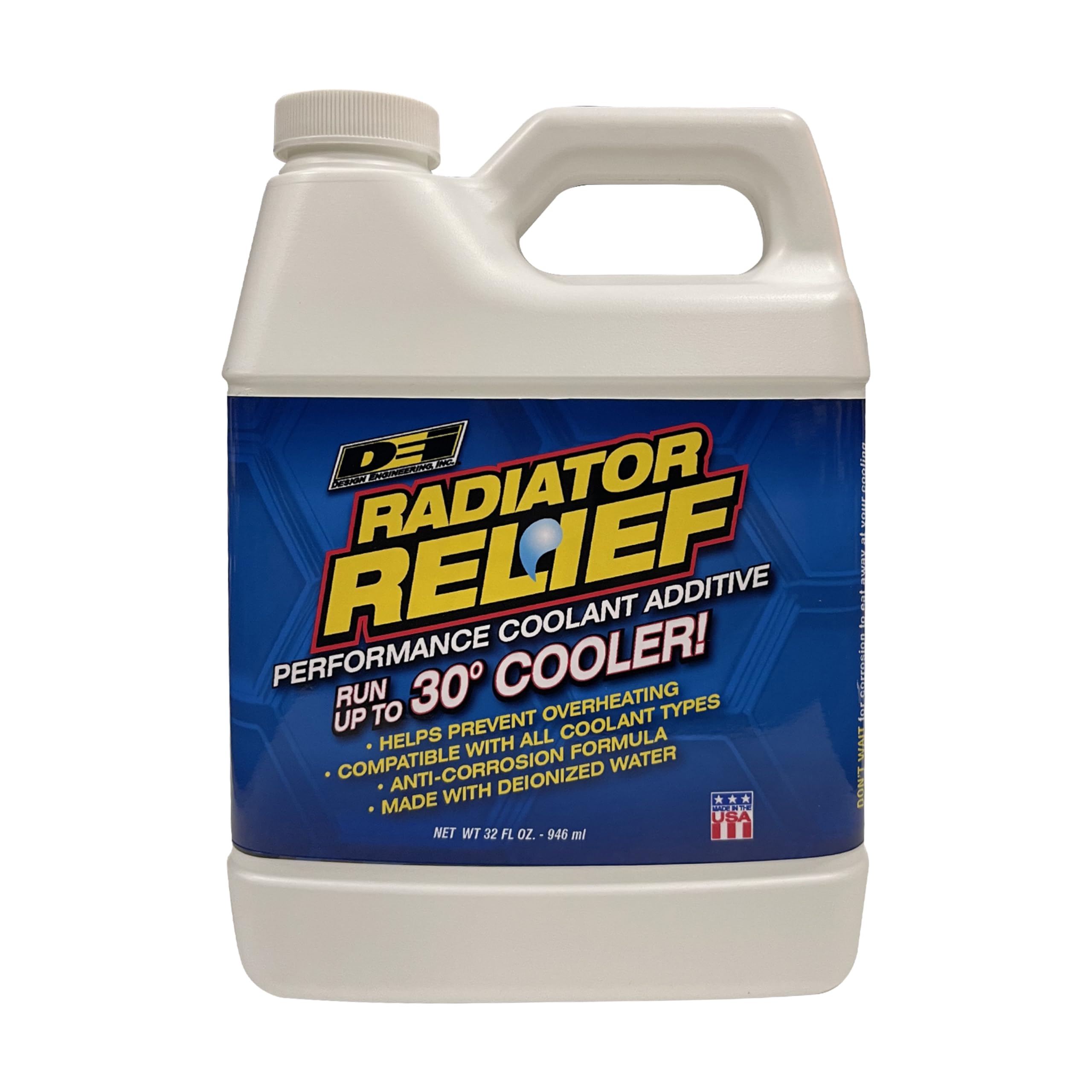
2. DEI Radiator Relief Coolant Additive — 32 oz
The heavy-hitter that claims a 30°F temperature drop and backs it with real owner data.
The maker of DEI Radiator Relief states it lowers engine temperatures by up to 30°F, and buyers’ real-world readings support that claim. One Subaru Outback owner in Georgia saw coolant temps drop by about 12°F — into the low 190s — in 95°F weather, while a 1973 Corvette driver measured a 10-12°F difference after adding about half the bottle. DEI Radiator Relief claims up to 30°F temperature drop, while Red Line WaterWetter typically achieves 10-15°F, making DEI the stronger choice if you are fighting chronic overheating. The 32-ounce bottle (0.97 kg) provides a lot more fluid than the Red Line 2-pack at 12 ounces, and the dosage is simple: 1 ounce per quart of coolant.
Unlike the Mishimoto additive, which reduces temps by 6°F based on OBD-scanner data from a single daily commute, DEI targets a broader audience — gas and diesel engines, cars, trucks, RVs, ATVs, snowmobiles, and motorcycles — with a non-toxic, non-corrosive formula that also fights electrolytic corrosion and reduces scale buildup. One reviewer who tried WaterWetter first reported that temperatures varied with it, but switching to DEI Radiator Relief made the engine run cooler and held the temp steady. The main trade-off is the larger bottle size: you need to store a 32-ounce container, and some small cooling systems may not need that much additive.
Best use-case: A vehicle that runs hot consistently, especially in stop-and-go traffic or on hills. If your car currently creeps past 200°F and you want maximum thermal margin, DEI is the strongest single-additive move. pass on it if your cooling system already runs at spec temps and you just want leak protection.
Ideal for: owners fighting high operating temps, especially in larger vehicles or older engines. Not for: a system that only needs a small leak plug — the XADO is better for sealing tasks.
3. Valvoline Zerex G48 Concentrate Antifreeze/Coolant — 1 GA

The OE-correct concentrate that removes the guesswork from European cooling system service.
If you drive a Mercedes, BMW, Audi, or another European brand that specifies a phosphate-free, silicate-based coolant, the Zerex G48 is the additive concentrate that matches that spec exactly. The 1-gallon (9.31 pounds) jug is a concentrate, not a pre-mix, meaning you dilute it 50/50 with distilled water before filling the system. One reviewer noted that it worked perfectly for a Mercedes cooling system service — the color matched, and after a thermostat replacement, heater and coolant temperature were ideal.
What sets the G48 apart from the other additives on this list is that it is a full coolant concentrate, not a booster. The Fleetguard DCA60L, by contrast, is a supplemental additive for diesels, not a replacement coolant. If you are simply topping off or refilling a European car that requires G48 spec, this is the exact fluid — no mixing of different additive chemistries needed. Keep in mind that the Valvoline weighs 9.31 pounds, while the Fleetguard DCA60L weighs 1.23 pounds, so shipping weight is substantial, and you need to handle mixing yourself.
One buyer warned to make sure you get the specific coolant for your car, not a generic universal formula. If your American or Asian vehicle does not require a G48 or similar phosphate-free spec, this additive is overkill and a cheaper universal coolant will work fine.
Right tool: A direct drop-in for Euro cars that demand G48 spec. If your owner’s manual says “use G48,” this is the bottle to grab — no additive mixing required.
Buy this for: older Mercedes, BMW, and other makes specifying G48 coolant concentrate. Pass if: your car uses a different spec (DEX-COOL, HOAT, OAT) — using the wrong chemistry can cause gelling or accelerated corrosion.
4. Cummins Filtration Fleetguard DCA60L Coolant Additive — 16 oz DCA4

The diesel-specific SCA that attacks pinhole cylinder wall pitting before it starts.
Diesel engines, especially the wet-sleeve type found in many Cummins and other heavy-duty powerplants, are vulnerable to cavitation erosion — tiny vapor bubbles imploding against the cylinder wall surface, slowly wearing pinholes through the metal. The Fleetguard DCA60L is a supplemental coolant additive (SCA) formulated with DCA4 chemistry that introduces nitrites and other inhibitors to prevent that erosion. One buyer with a diesel confirmed it “helps minimize pinhole development in the cylinder walls,” which is exactly why this product exists. The 16-ounce (1.23 pounds) bottle is lightweight compared to the 9.31-pound Valvoline Zerex jug, making it easy to keep as a spare.
Beyond diesel engines, one owner used it in a Miller Coolmate 3 TIG welder cooling system to stop electrolysis (galvanic corrosion between dissimilar metals). The Fleetguard additive is not intended for general spark-ignition engines running standard coolant — it is built for systems that require SCA testing and maintenance. It holds a 4.7 out of 5 star rating from 93 reviews, and buyers report it corrects SCA levels when added at the recommended dosage. The main limit is that you need to know your current SCA level or follow the diesel manufacturer’s maintenance schedule; dumping it into a gas car’s cooling system is pointless and may overshoot the treatment level.
Niche but essential: If you own a diesel truck, tractor, generator, or welding rig with a wet-sleeve design or that requires DCA4 treatment, this Fleetguard bottle is a non-negotiable maintenance item.
Best for: diesel owners who need to maintain SCA levels per the manufacturer’s schedule or new owners who suspect cavitation risk. Not for: gasoline engine cooling systems that have no cavitation risk — use a heat-transfer additive like WaterWetter instead.
5. XADO ATOMEX Stop Leak Radiator Coolant Additive — 250 ml

The targeted sealant for those tiny, stubborn weeps that keep leaving puddles.
XADO ATOMEX is a stop-leak additive that works differently from the thermal-performance products above. Instead of improving heat transfer, it contains particulate sealants that circulate through the cooling system and lodge themselves in small cracks, sealing them from the inside. One buyer with a 2017 Ford F-150 3.5L EcoBoost reported it “fixed all tiny leaks” and has had no leaks since application. The 250-milliliter bottle (11.9 ounces) is very close in weight to the Red Line WaterWetter 2-pack at 12 ounces — but the XADO is a single bottle rather than a pair.
The manufacturer advertises compatibility with gasoline and diesel engines, and the sealants are safe for gaskets, rubber hoses, aluminum, plastic, and steel radiators. Not all buyers had success — one reviewer saw no effect and used another product that plugged the leak in 10 minutes. Results depend heavily on the size and location of the leak; very large cracks or busted radiator tanks are beyond this bottle’s ability. For a healthy engine experiencing a minor seep, the XADO is an affordable try-before-repair option. The 3.9 out of 5 star rating from 59 reviews reflects the mixed outcomes typical of any stop-leak product.
Low-risk first try: If you have a slow coolant drip and want to avoid a full radiator replacement, pour in XADO and see if the leak stops. It is a budget-friendly test that works for a lot of owners.
Try this if: you notice a small but persistent coolant loss and want a simple pour-in fix before replacing parts. Skip if: the leak is large, rapid, or coming from a visibly damaged area (cracked plastic tank, burst hose) — those need mechanical repair, not a sealant.
6. Mishimoto MMRALC Liquid Chill Radiator Coolant Additive

The precise ODB-scanner-proven additive for the daily driver wanting a predictable drop.
Mishimoto Liquid Chill is a thin 4-fluid-ounce bottle (product dimensions: 2 x 2 x 6 inches) that targets a specific, verified temperature reduction. One buyer tested it over a 10-mile commute using an OBD scanner — same route, same ambient air temperature — and found that the engine coolant temp dropped by 6 degrees Fahrenheit with the Liquid Chill added. That is a smaller drop than the Red Line WaterWetter’s typical 10-15°F but the test was controlled and clearly documented, giving confidence that the product does its job consistently.
The dosage depends on your vehicle type: sport compact cars take 1 bottle, trucks and SUVs need 2 bottles, and ATV or dirt bike cooling systems use 1 ounce per quart. The additive is non-corrosive and comes with a Mishimoto Lifetime Warranty. One Impala owner (3.6L V6) reported the car went from running around 200°F down to a steady 195°F after adding Liquid Chill. The packaging is compact at 2 x 2 x 6 inches — much smaller than the Valvoline Zerex G48 jug at 7.67 x 3.93 x 11.81 inches. Note that the product works best when your cooling system is already in good condition; it reduces existing scale buildup and prevents future corrosion, but it will not fix a clogged radiator or a failing water pump.
For the data-minded daily driver: If you want a small, measurable improvement in coolant temperature and appreciate a buyer’s test-backed figure, Liquid Chill delivers a reliable 6°F penalty on the commute.
Best for: owners who want a lightweight, single-dose additive that can lower temps a few degrees without a full coolant change. Not for: extreme overheating or track conditions where the bigger 10-15°F drop from Red Line or DEI is necessary.
Understanding the Specs
Temperature Drop
This is the number that tells you how much cooler the engine can run after adding the product. The Red Line WaterWetter and DEI Radiator Relief make the biggest claims — 10-15°F and up to 30°F respectively — while Mishimoto Liquid Chill targets a smaller 6°F drop. The drop depends on your engine’s starting temperature, driving conditions, and overall cooling system health. A healthy system with a functioning radiator and water pump will see more benefit than a partially clogged one.
Cavitation Protection
Cavitation occurs when tiny bubbles form in the coolant near hot metal surfaces and implode against the metal, slowly eroding pinholes through cylinder walls and water pump impellers. This is most common in wet-sleeve diesel engines. Supplemental coolant additives (SCAs) like the Fleetguard DCA60L contain nitrites and other chemicals that create a protective layer on the metal, preventing the bubble implosions from causing damage. If you own a diesel, this is not optional — it is part of routine maintenance.
FAQ
Can I add a coolant additive to my existing antifreeze without flushing the system?
Will a stop-leak additive clog my heater core?
How much additive do I need for my car?
Is it safe to mix different brands of coolant additive?
Will a coolant additive fix a head gasket leak?
Can I use a diesel SCA in a gasoline engine?
How often should I add a coolant additive to my system?
Does coolant additive reduce the freezing protection of my antifreeze?
Will a coolant additive void my vehicle’s warranty?
Is adding a coolant additive the same as doing a coolant flush?
Final Thoughts: The Verdict
If you want one dependable pick, the coolant additive winner is the Red Line WaterWetter 2-Pack because it delivers proven 10-15°F temperature reduction with a simple pour-in formula that works in any glycol-based coolant. If you drive a diesel that needs cavitation prevention, grab the Cummins Fleetguard DCA60L. And for a small, data-backed daily driver improvement, the standout is the Mishimoto Liquid Chill.
How We Picked
We do not accept paid placement. Every pick is matched to a real buyer and a real use-case; we do not hands-on test units.
Sources & Methodology
Specifications: manufacturer listings and product documentation. Review insights: verified customer reviews, as of July 2026. Pricing: not shown on this page (it changes often); check the current price via the retailer link.
As an Amazon Associate, WellFizz earns from qualifying purchases. This does not affect which products we feature.
Related Guides

Mo Maruf
I created WellFizz to bridge the gap between vague wellness advice and actionable solutions. My mission is simple: to decode the research and give you practical tools you can actually use.
Beyond the data, I am a passionate traveler. I believe that stepping away from the screen to explore new environments is essential for mental clarity and physical vitality.