Our readers keep the lights on and my smoothie glass nicely filled. As an Amazon Associate, I earn from qualifying purchases.
Specs are compiled from manufacturer listings and verified buyer reviews and can change over time — please confirm the key details on the product page before buying.
You pick the wrong tires for your Class C motorhome, and you are not just giving up a smooth ride. You are risking how the rig handles on wet pavement, in crosswinds, and under a heavy load. This guide cuts through the tire jargon to show you three Load Range E options in the common 225/75R16 size that are built for the demands of a Class C, whether you are a full-time RVer or a weekend traveler.
I’m Mohammad Maruf — the founder and writer behind WellFizz. This guide is built by comparing the manufacturers’ published specifications and the patterns across verified customer reviews, so you get each pick’s real strengths and trade-offs instead of marketing spin.
Each tire here supports heavy loads and offers specific advantages for life on the road, helping you narrow down the class c motorhome tires that match your driving habits and budget without guesswork.
Our Picks at a Glance

How To Choose The Best Class C Motorhome Tires
Class C motorhomes are heavier than pickup trucks and have a more rigid suspension, meaning your tires carry a bigger load and face more sidewall stress during turns. Three numbers matter most: the size (225/75R16 is the standard for most Class C rigs), the load range (E is the safe baseline), and the tread pattern (how well it sheds water and resists uneven wear).
Load Range and Load Index
Load Range E means the tire can handle up to 80 PSI of air pressure, which gives it the capacity to carry the heavy weight of a fully loaded motorhome. The Load Index, shown as a number like 115, tells you the maximum weight per tire — 115 equals 2,679 pounds. Add all four tires together and you get the gross capacity your rig needs to stay under.
Tread Pattern and Water Evacuation
A motorhome weighs several tons, so the momentum on wet pavement is huge. Tires with four wide grooves or advanced water-channeling treads reduce the risk of hydroplaning (when the tire rides on a layer of water instead of the road). The deeper and wider the grooves, the more water gets pushed out.
Tread Life Warranty
Motorhome tires often wear differently than car tires — the rears bear the drivetrain load and can scrub unevenly. A warranty that covers 40,000 to 70,000 miles gives you a benchmark for how long the manufacturer expects the rubber to last under normal use. Shorter warranties usually point to a softer compound that grips well but wears faster.
Quick Comparison
| Model | Best For | Load Range | Weight | Item Diameter | Amazon |
|---|---|---|---|---|---|
| Hankook DynaPro HT RH12★ Best Overall | Quieter highway rides with wet-road confidence | E | 40 Pounds | 29.2 Inches | Amazon |
| Firestone Transforce HT3 | Budget-friendly durability for mixed towing and RV use | E | 37.5 Pounds | 29.3 Inches | Amazon |
| Firestone Transforce CV2 | Commercial-grade curb protection and long wear | E | 37.9 Pounds | 29.3 Inches | Amazon |
In‑Depth Reviews
1. Hankook DynaPro HT RH12 Radial Tire – 225/75R16 115S E1
Our pick — 4.5★ from 850+ verified ratings; the strongest balance of quality and price.
A reinforced under-tread and four wide grooves keep this tire quiet and stable in rain — a strong difference from the Firestone HT3’s bare-bones warranty.
This tire weighs 40 pounds, while the Firestone Transforce HT3 weighs 37.5 pounds and the Firestone Transforce CV2 weighs 37.9 pounds, because of an extra layer of rubber under the tread that resists pothole damage. Those four wide grooves push water away from the contact patch, which reduces the risk of hydroplaning — the tire riding on a layer of water — when you drive through a sudden downpour at highway speed. Buyers report that the Hankooks are “quieter and smoother than the old Michelins” they replaced, a clear sign the tread pattern cuts down cabin noise.
The snow kerf (thin slits molded into the tread blocks) gives you extra biting edges for traction on slush or light snow, making this a strong choice if you drive into shoulder seasons. The stiff center rib improves steering response — meaning the tire tracks straighter with less wandering in the lane — which matters when a crosswind catches the tall side profile of a Class C. The load capacity sits at 1,984 pounds per tire at 80 PSI max pressure.
Unlike the Firestone Transforce HT3 below, which lacks a published mileage warranty, the Hankook offers a 70,000-mile limited tread life warranty for P-metric sizes, though the LT-metric version (which your motorhome likely takes) is backed by a 40,000-mile limited warranty.
What Stands Out
- Reinforced under-tread protects against impact damage from road debris.
- Four wide grooves reduce hydroplaning risk on wet highways.
- Quieter ride than Michelin Defenders, per buyer reports.
What to Keep in Mind
- At 40 pounds it is slightly heavier than the Firestone options, adding a bit of unsprung weight.
- LT-metric warranty is 40,000 miles rather than the 70,000 miles on the P-metric version.
Reach for this if: you prioritize wet-road safety and a quiet cabin for long highway stretches.
Look elsewhere if: you need a commercial-grade sidewall for frequent curb impacts in tight campgrounds.
2. Firestone Transforce HT3 All Season LT225/75R16 115/112R E Light Truck Tire
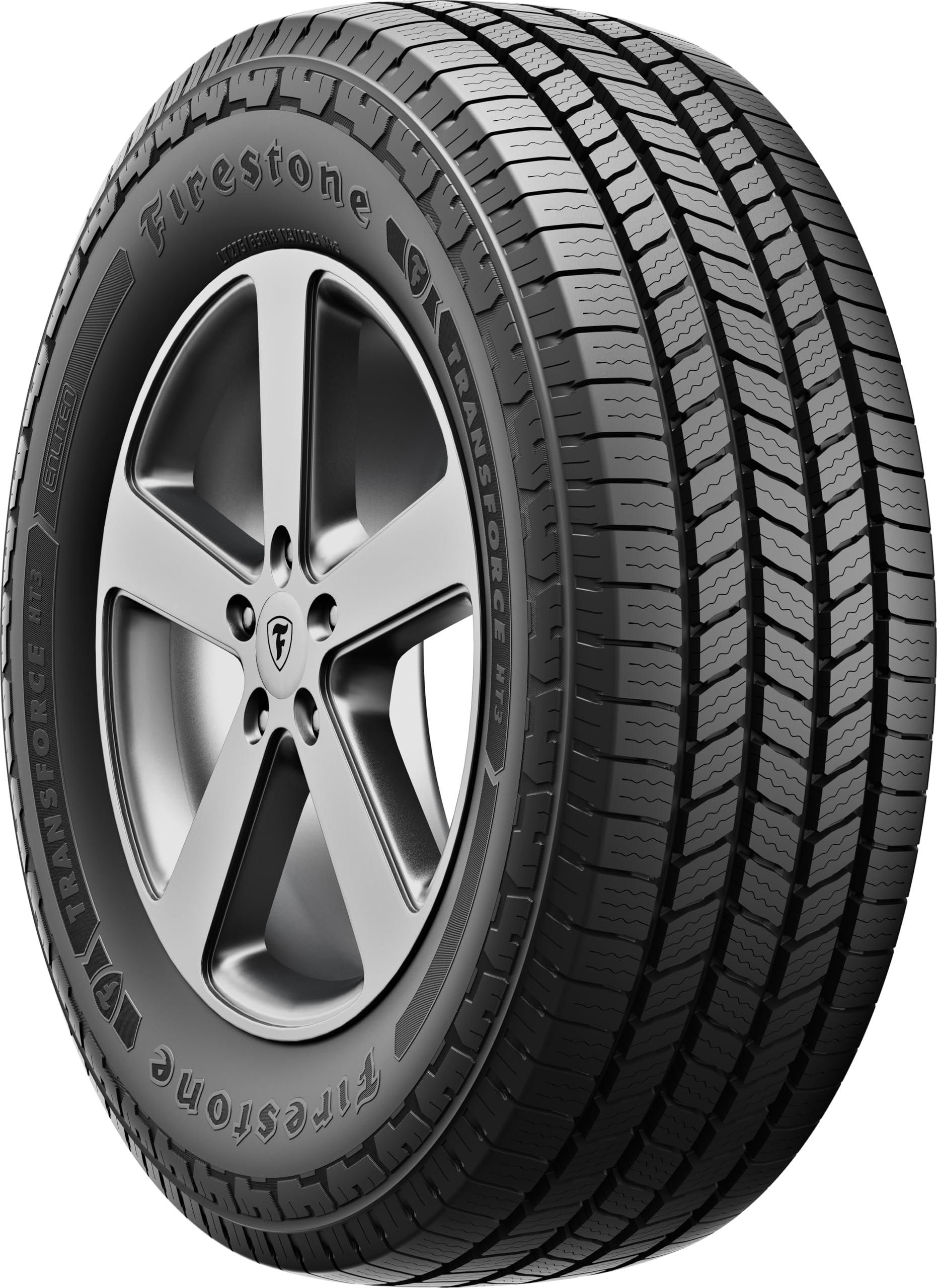
At 37.5 pounds, this is the lightest and most affordable tire here, and it still carries the Load Range E rating needed for a Class C.
At 37.5 pounds per tire versus 40 pounds per tire for the Hankook, your motorhome’s suspension has less unsprung weight to manage, which helps ride comfort on bumpy roads. The wear-resistant tread compound is engineered to handle fully loaded trucks and resist the irregular wear patterns that often show up on the drive axle of a heavy RV.
The advanced tread pattern uses angled grooves to evacuate water from under the tire, giving you confident wet traction without the snow-specific cuts that the Hankook carries. The sturdy sidewall adds protection against scuffs from tight campsite turns, and the heavy-duty construction with reinforced materials handles the toughest loads — essential for a Class C that tows a small car or carries full freshwater tanks. The item diameter of 29.3 inches matches the Firestone CV2 below, so ride height stays consistent if you mix these two Firestone models across axles.
Where this tire falls short of the Hankook above is in the warranty detail — the Transforce HT3 does not advertise a published tread life warranty comparable to Hankook’s 40,000-mile LT coverage. That makes the Hankook a better bet if you want a guaranteed mileage benchmark.
Price-Smart Performance: The Transforce HT3 gives you Load Range E construction, a wear-resistant compound, and a price point that leaves room in the budget for mounting and balancing. It is a solid choice for the owner who wants proven Firestone quality without paying extra for winter-tread features they may never use.
Best suited for: the budget-minded motorhome owner who drives primarily in warm, dry conditions and values a lighter tire.
One real trade-off: no published mileage warranty to protect against premature wear if you run heavy loads often.
3. Firestone Transforce CV2 LT225/75R16 115/112R E Commercial Tire
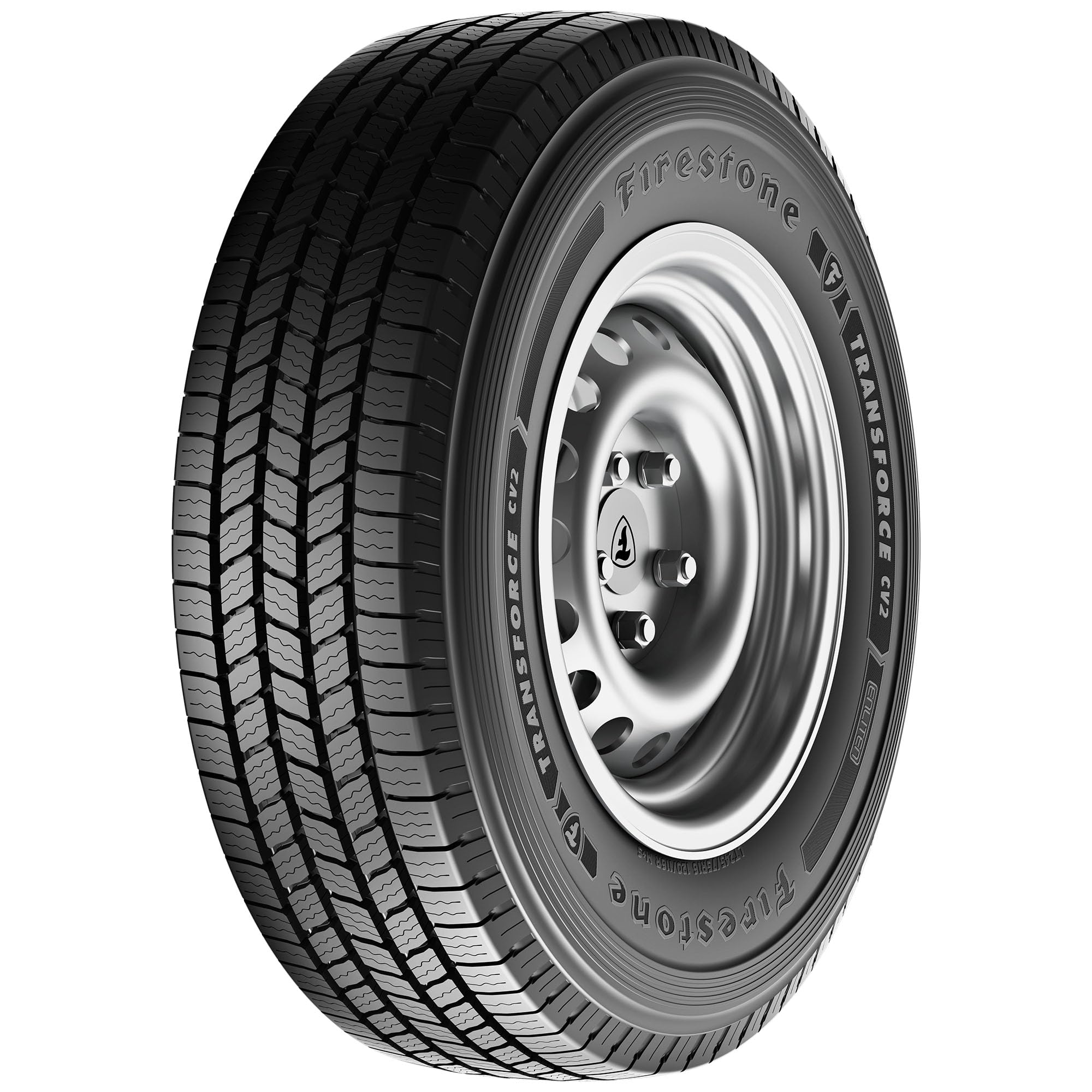
Its sidewall is reinforced for city-style curb scrapes, and full-depth 3D sipes keep wet-road grip alive as the rubber wears — a feature the budget HT3 lacks.
The Transforce CV2 is designed as a commercial tire for vans and work trucks, which means its sidewall is reinforced to handle impacts from tight city driving — a feature that translates directly to campground maneuvering where low curbs and narrow lanes are the norm. Full-depth 3D sipe technology (tiny zigzag cuts in the tread that stay sharp as the rubber wears) gives you biting edges for enhanced grip on wet and snowy roads, so the tire maintains responsiveness in challenging conditions even after thousands of miles. Buyers confirm that the tire delivers “good wear” when used on a 32-foot RV.
The sturdy tread pattern resists irregular wear for extended tread life, meaning the tire is less likely to develop the choppy wear pattern that heavy motorhomes can cause on softer compounds. tune construction reduces rolling resistance, which improves fuel efficiency — helpful when you are cruising hundreds of miles between fuel stops. The item weight of 37.9 pounds splits the difference between the lighter HT3 and the heavier Hankook, and the 29.3-inch diameter keeps the speedometer reading accurate if you are swapping from the Transforce HT3.
The catch: this tire carries a universal fit type rather than a vehicle-specific fit, so while it fits the correct 225/75R16 size and Load Range E, it does not have a specific OE endorsement for motorhomes. The Hankook above is a safer bet if you want a vehicle-specific fit designation and a published mileage warranty.
Built Tougher
- Reinforced sidewall protects against curb damage during tight turns.
- 3D sipe technology keeps wet-road grip as the tire wears down.
- Commercial-grade tread resists the irregular wear common on heavy RVs.
Things to Note
- Universal fit type means no specific motorhome OE certification.
- At 37.9 pounds versus 37.5 pounds for the HT3, a negligible difference for most.
Go with this if: you navigate tight campgrounds, bumpy back roads, or worksite-style parking areas where sidewall protection matters most.
Pass on this if: you want a published tread life warranty and a vehicle-specific fit for your motorhome.
Understanding the Specs
Load Range E and Load Index 115
Load Range E means the tire is built to hold up to 80 PSI of air pressure, which supports the heavy weight of a fully loaded Class C motorhome. The Load Index 115 tells you the maximum load per tire: 2,679 pounds. Multiply that by four tires and you get 10,716 pounds of total capacity — a number that should exceed your motorhome’s gross vehicle weight rating (GVWR) by a safe margin. Never run a tire below the load range recommended on your vehicle’s door placard.
225/75R16 Size
This is the standard tire size for many Class C motorhomes built after the mid-2000s. The “225” is the tread width in millimeters, “75” is the sidewall height as a percentage of the width, and “16” is the wheel diameter in inches. Sticking to this exact size keeps your speedometer and odometer accurate, and it ensures the tire fits correctly inside the wheel well without rubbing against suspension components during turns. A wrong size can cause clearance issues and uneven load distribution.
FAQ
What does Load Range E mean for a Class C motorhome?
Can I use LT tires on my Class C motorhome?
How long do Class C motorhome tires typically last?
What is the difference between HT and commercial tire treads?
Will a 225/75R16 tire fit all Class C motorhomes?
What does the 115/112R rating on these tires mean?
Should I replace all six tires on a Class C at the same time?
How often should I check the tire pressure on my motorhome?
What causes uneven wear on motorhome tires?
Can I mix different tire brands on my Class C motorhome?
Final Thoughts: The Verdict
For most Class C owners, the class c motorhome tires winner is the Hankook DynaPro HT RH12 because it combines a reinforced under-tread, a 40,000-mile LT warranty, and quiet highway comfort that buyers specifically praise over older premium brands. If you prioritize budget savings and a lighter tire, grab the Firestone Transforce HT3. And for navigating tight campgrounds with commercial-grade sidewall protection, the standout is the Firestone Transforce CV2.
How We Picked
We do not accept paid placement. Every pick is matched to a real buyer and a real use-case; we do not hands-on test units.
Sources & Methodology
Specifications: manufacturer listings and product documentation. Review insights: verified customer reviews, as of July 2026. Pricing: not shown on this page (it changes often); check the current price via the retailer link.
As an Amazon Associate, WellFizz earns from qualifying purchases. This does not affect which products we feature.
Related Guides

Mo Maruf
I created WellFizz to bridge the gap between vague wellness advice and actionable solutions. My mission is simple: to decode the research and give you practical tools you can actually use.
Beyond the data, I am a passionate traveler. I believe that stepping away from the screen to explore new environments is essential for mental clarity and physical vitality.