Our readers keep the lights on and my smoothie glass nicely filled. As an Amazon Associate, I earn from qualifying purchases.
Specs are compiled from manufacturer listings and verified buyer reviews and can change over time — please confirm the key details on the product page before buying.
Your legs feel heavy and sore the morning after a hard workout, and you want something that really speeds up recovery — not just a pair of thin tights that claim to help. Real compression pants for recovery apply graduated pressure (tighter at the ankle, looser at the hip) to push blood flow back to your heart and reduce muscle soreness. But many leggings labeled “compression” are just tight fabric that loses its squeeze after a few washes. This guide breaks down the published specs and patterns from verified customer reviews so you see exactly which pair supports your muscles and which ones are mostly a fashion piece.
I’m Mohammad Maruf — the founder and writer behind WellFizz. This guide is built by comparing the manufacturers’ published specifications and the patterns across verified customer reviews, so you get each pick’s real strengths and trade-offs instead of marketing spin.
You want compression pants for recovery that push blood flow and reduce soreness, not just another pair of tights that feel tight for five minutes and then stretch out — here are the four best options, ranked by real-world muscle support and durability.
Our Picks at a Glance

How To Choose The Best Compression Pants For Recovery
Recovery compression works by applying graded pressure to your legs, which helps push deoxygenated blood back toward your heart and reduces muscle vibration during movement. But not every pair labeled “compression” actually applies enough — or the right type — of force. Here is what to look for when you want pants that genuinely speed up your recovery, not just squeeze for the sake of squeezing.
Fabric Density and Graduated Pressure
A true recovery pant uses a dense, multi-directional stretch fabric that maintains its tension wear after wear. Look for at least 20% elastane or Lycra in the blend — that extra stretch fiber is what keeps the pants from turning into saggy sweatpants after a few washes. The more nylon or Coolmax polyester in the mix, the longer the fabric holds its shape and the more consistent the squeeze.
Targeted Support vs. All-Over Squeeze
General compression tights just squeeze everything evenly. Better recovery models use something called a support web — integrated bands of tighter fabric that run along your quads, hamstrings, and around the knees. These mimic kinesiology tape, giving extra stability to joints and major muscle groups without restricting your full range of motion. If you are recovering from an injury or have weak knees, a targeted support design is far more effective than a simple uniform compression pant.
Seam Placement and Chafing
Flatlock seams are the standard for any quality compression pant — they lie flat against the skin so you do not get friction burns during long runs or sleep. But also check the gusset (the crotch area). A well-designed gusset with a double front seam prevents the “adjustment every five minutes” problem that buyers of cheaper single-seam pants commonly report. If you plan to wear these for hours during recovery or under shorts, seam design is not a minor detail.
Quick Comparison
| Model | Best For | Fabric Content | Weight Class | Support System | Amazon |
|---|---|---|---|---|---|
| DRSKIN 3-Pack★ Best Overall | Budget multi-pack baselayer | 92% Polyester / 8% Spandex | Thin / Light | General uniform compression | Amazon |
| CW-X Stabilyx | Targeted joint recovery | 80% Coolmax / 20% Lycra | Lightweight | 2-way support web | Amazon |
| 2XU Core Tights | Graduated compression training | 72% Nylon / 28% Lycra | Lightweight | Graduated compression legs | Amazon |
| Under Armour HeatGear | Lightweight all-day wear | 84% Polyester / 16% Elastane | Super-light | Ultra-tight second-skin | Amazon |
In‑Depth Reviews
1. DRSKIN Men’s Compression Pants (3-Pack)
Our pick — 4.5★ from 33,500+ verified ratings; the strongest balance of quality and price.
A three-pack of compression pants that is tough to top for the price.
If you go through compression gear fast — whether from jiu-jitsu training, daily gym sessions, or just want spares for the week — the DRSKIN 3-Pack delivers three pairs for what the 2XU charges for one. The fabric is 92% polyester and 8% spandex, a thin, lightweight blend that one buyer described as “very thin” but “excellent quality.” A 250-pound jiu-jitsu athlete who ordered the 3X said they are “fairly tight, but that is the whole point of compression” and held up well under the friction and grinding of grappling.
The advanced quick-dry tech and UPF 50+ UV shield (blocking over 98% of rays) make these functional for both indoor training and outdoor runs. One thing buyers flag: the front seam design can be inconsistent. Some pairs arrive with a single center front seam, while others have a more “guy-friendly” double front seam that requires less adjustment when sitting. If you expect heavy-duty recovery-grade compression, some reviewers warn you might be disappointed — these are more of a snug baselayer than a high-pressure performance tight. But as a value-packed bundle for daily training and layering, they are a smart buy.
In direct comparison, the DRSKIN uses less than half the stretch fibers (8% spandex) compared to the Under Armour (16% elastane) or the 2XU (28% Lycra), so the compression will naturally be lighter and less durable over many washes. For casual use or as a spare set, they are fine — for serious recovery, spend more on one of the picks above.
Best Value Bundle
- Three pairs for a very low price — ideal for high-turnover sports like grappling or heavy daily training.
- UPF 50+ UV shield blocks over 98% of UVA/UVB rays for outdoor training.
- Quick-dry fabric wicks sweat and dries fast, keeping you fresh during and after workouts.
- Buyers report sizing runs true to the chart (e.g., 5’11” 250 lbs fit well in 3X).
The Budget Trade-Offs
- Only 8% spandex — the lowest stretch-fiber content here — so the compression is lighter and less durable.
- Mixed seam quality: some packs have single center front seam, others have double front seam; owners mention needing to adjust more often with single-seam pairs.
- Not suitable for high-grade recovery compression; better as a general baselayer.
Solid pick if: you need multiple pairs for the cost of one premium pair and are using them for daily training, not high-grade recovery therapy.
Pass if: you want graduated compression or targeted muscle support — the 8% spandex blend simply cannot deliver that level of squeeze.
2. CW-X Stabilyx Joint Support Compression Tights

The pair that wraps your knees and core like built-in kinesiology tape.
If your recovery goal is to fix sore knees and stabilize shaky hips after hard runs, this is the only pair on the list with a dedicated support system for that job. The CW-X Stabilyx uses a 2-way stretch support web (a tight mesh of fabric bands) that runs around your knee joints, quads, hamstrings, and lower back — mimicking the targeted pull of kinesiology tape. The body fabric itself is 80% Coolmax polyester and 20% Lycra spandex, a moisture-wicking blend that buyers report stays cool even in 80°F heat, while the flat seam construction eliminates the chafing that cheaper tights cause on long sessions.
Reviewers are blunt about one thing: these are expensive. But they also call them the “Cadillac of compression tights” — durable enough for hard workouts and effective enough that one reviewer noted faster recovery after high-intensity intervals. The catch, as some owners mention, is the slight rigidity behind the knees and a small insecure pocket. Also, the reflective emblems reportedly crack and peel after washing, which is a nuisance if you run in low light. For anyone recovering from leg injuries or who does heavy squats and sprints, the support web here is something no other product in this lineup offers.
Unlike the 2XU Core Tights, which provide a strong but general graduated squeeze down the leg, the Stabilyx delivers that same muscle compression PLUS a targeted web that specifically locks down the knee joint — making it a smarter pick if you have any instability in that area.
Targeted Support That Works
- 2-way stretch support web stabilizes knees, hamstrings, and core — not just a uniform squeeze.
- 80% Coolmax polyester fabric wicks sweat fast and stays breathable in warm temps (buyers confirm comfort in 40-80°F range).
- Flat seam construction reduces chafing during long runs or recovery sleep.
- UPF 50+ protects against UVA/UVB rays during outdoor sessions.
The Honest Trade-Offs
- Premium price point is the highest on this list.
- Small pocket is insecure — no zippered back pocket for valuables.
- Reflective emblems crack and peel after a few washes according to buyers.
- Slight rigidity behind knees reported by some runners.
Reach for this if: your main concern is knee or joint support during recovery — the support web is unique among these picks and genuinely stabilizes the area.
Look elsewhere if: you just need a general compression layer without joint stabilization and want to save money.
3. 2XU Men’s Core Compression Tights
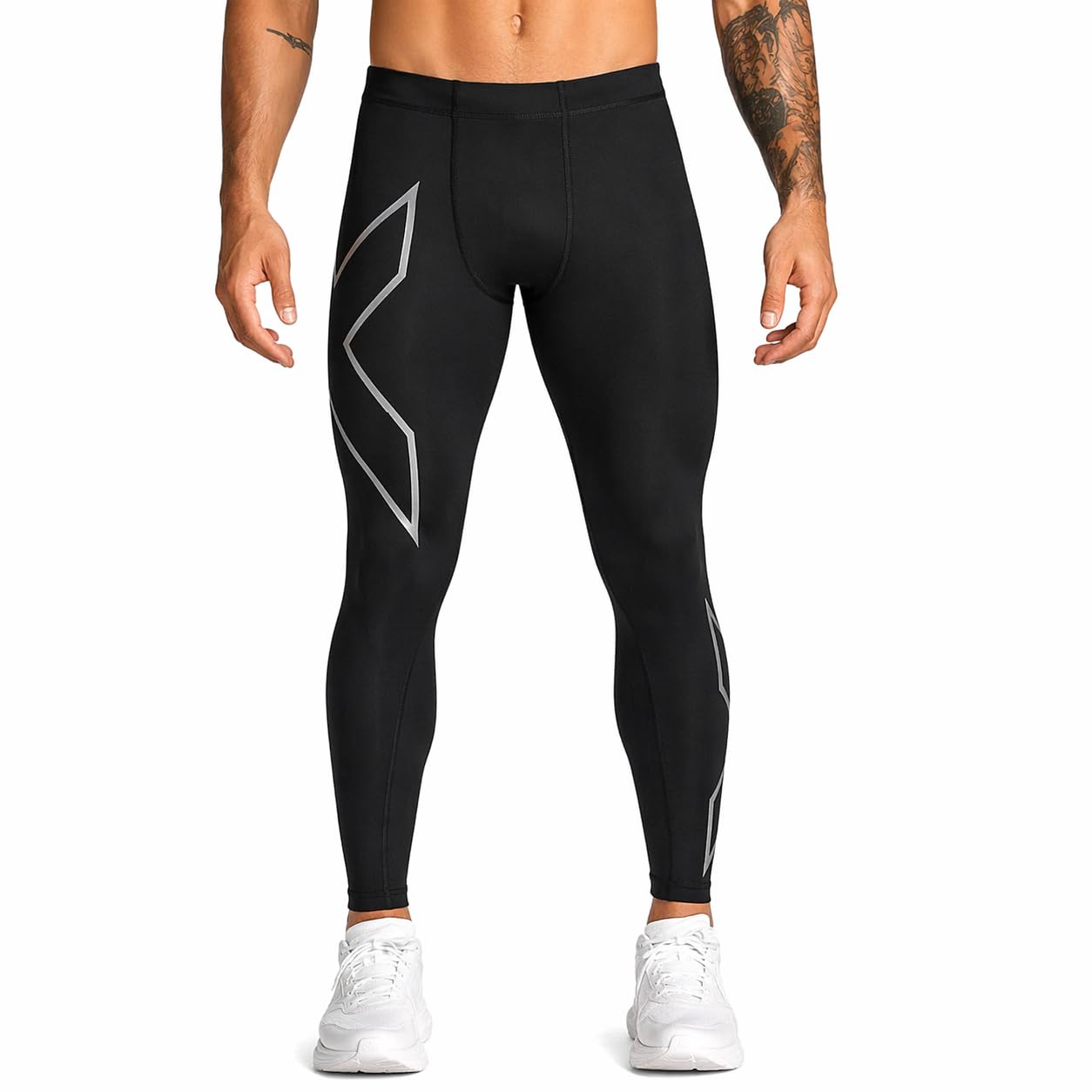
Elite-grade graduated pressure that serious runners swear by for race recovery.
This is the pair that ultramarathon runners reach for — one buyer mentioned using the 2XU Core Tights as their go-to for 8 years of injury-free winter running. The fabric is 72% recycled nylon and 28% Lycra, a noticeably denser blend than the Under Armour option (which uses only 16% elastane), meaning the squeeze stays consistent wash after wash. The graduated compression design provides a tighter feel around the calves and ankles that gradually loosens up the leg, which is exactly what you want for pushing blood flow back toward the heart during recovery.
Customers note the compression is “very tight, slightly less than MCS/Hyoptik but still excellent support.” A 5’7″, 157-pound runner wearing a size small found they offered maximum support during 2-5 mile runs and helped reduce soreness afterward. The drawstring waistband lets you dial in the fit, and the quick-drying yarns prevent that sticky sweat feeling when temperatures rise. The honest catch: the tightness makes them genuinely difficult to put on, and at this price point they are an investment — though that same ultramarathon reviewer advises watching for sales, where they drop to around a pair.
For a buyer comparing these to the budget DRSKIN 3-Pack, the difference is night and day: the 2XU uses 28% Lycra versus DRSKIN’s 8% spandex, which translates into substantially more durable, sustained compression that will not bag out after a few training cycles.
Serious Recovery Compression
- 72% recycled nylon and 28% Lycra fabric provides strong, durable graduated compression that outlasts cheaper blends.
- Drawstring waistband allows for a customized fit around the waist.
- Flatlock seams reduce chafing during long runs and gym sessions.
- Quick-drying yarns keep you cooler during high-output training.
What to Know Before Buying
- Very tight fit makes them difficult to pull on (reviewers point out this is a common experience).
- Premium price is a barrier for casual users; best found on sale.
- The tightness may be too much for those who just want light support.
Buy these for: serious recovery after running or leg-day training — the graduated compression is scientifically sound and the build quality lasts.
Skip them if: you are on a tight budget or want a pair you can slip on quickly without a wrestling session.
4. Under Armour Men’s HeatGear Armour Leggings

The lightweight, moisture-wicking baselayer that feels like a second skin.
Under Armour’s HeatGear is the original performance baselayer, and this version delivers the ultra-tight, second-skin fit that the brand is known for. The fabric blend is 84% polyester and 16% elastane, making it noticeably lighter than the 2XU Core Tights — which means it is ideal for wearing under shorts during cool morning walks or as a base under a wetsuit, as one owner reported. Strategic mesh panels add ventilation exactly where you heat up most, and the moisture-wicking material pulls sweat away from the body and dries fast.
At 1.4 pounds for the package, these are the lightest on the list, and the ergonomic design places seams off high-abrasion zones. A “drop-in Strength Pocket” on the right side is a handy addition for stashing a phone or keys during a run. However, some shoppers say the fabric feels a bit thin and question its long-term durability — one reviewer who got them on a Black Friday deal commented they feel “lightweight” and “may not be very durable over time.” They are a solid mid-range option if you prioritize a barely-there feel over maximum recovery pressure.
Compared to the DRSKIN 3-Pack, the Under Armour has double the elastane content (16% versus 8%) and that HeatGear sweat-wicking technology, so it holds its compression shape better and stays drier during active recovery. But if you need serious graduated pressure for post-workout recovery, the 2XU or CW-X provide more targeted support.
Light and breathable baselayer: The 84% polyester / 16% elastane blend with mesh panels makes these the best pick for wearing under shorts in moderate weather (buyers confirm comfort at 55°F under gym shorts).
The one weakness: Several buyers flag the material as thin and potentially less durable than higher-density fabric blends — not the best choice if you need pants that survive years of heavy training.
Grab these for: a lightweight, moisture-wicking baselayer that works well for cool-weather activities and everyday gym wear.
Think twice if: you need the highest possible graduated compression for serious recovery — the fabric is thinner and the squeeze is less targeted than the premium options.
Understanding the Specs
Fabric Blend and Stretch Fiber Percentage
The percentage of spandex, elastane, or Lycra in the fabric determines how tightly the pants squeeze and how long they keep doing it. More stretch fiber means stronger, longer-lasting compression. The DRSKIN uses just 8% spandex — fine for a thin baselayer, but the fabric will inevitably loosen. The 2XU uses 28% Lycra, which delivers a much denser, more sustained pressure against your muscles. If your main goal is recovery, aim for at least 16-20% elastane — the higher the number, the more durable the squeeze.
Graduated vs. Uniform Compression and Support Webs
Uniform compression simply squeezes your entire leg evenly. Graduated compression applies more pressure at the ankle and gradually decreases it moving up the leg — this is the design proven to aid venous blood return and reduce muscle soreness after exercise. A “support web” goes further by adding integrated bands that target specific joints (knees, hips, lower back) with extra stabilization, mimicking the effect of kinesiology tape. The CW-X Stabilyx is the only pick on this list with a full support web, making it the best choice if you have joint instability or are recovering from a specific leg injury.
FAQ
Will compression pants for recovery actually help me feel less sore the next day?
Can I wear compression pants for recovery while I sleep?
What is the difference between graduated compression and uniform compression?
How should compression pants fit — should they be painful to put on?
How long do compression pants for recovery last before they lose their elasticity?
Can I wear compression pants for recovery in hot weather?
What size should I buy for compression pants?
Are more expensive compression pants worth the higher price for recovery?
Do compression pants for recovery work for knee injuries?
Can I use compression pants for recovery if I am not an athlete?
Final Thoughts: The Verdict
For the majority of shoppers, the compression pants for recovery winner is the CW-X Stabilyx because its 2-way support web is the only design here that actively stabilizes joints during recovery — not just squeezes. If you want a serious graduated compression feel for running and leg-day recovery, grab the 2XU Core Tights. And for a budget-friendly multi-pack that works as a solid baselayer for daily training, the DRSKIN 3-Pack is a great entry point.
How We Picked
We do not accept paid placement. Every pick is matched to a real buyer and a real use-case; we do not hands-on test units.
Sources & Methodology
Specifications: manufacturer listings and product documentation. Review insights: verified customer reviews, as of July 2026. Pricing: not shown on this page (it changes often); check the current price via the retailer link.
As an Amazon Associate, WellFizz earns from qualifying purchases. This does not affect which products we feature.
Related Guides

Mo Maruf
I created WellFizz to bridge the gap between vague wellness advice and actionable solutions. My mission is simple: to decode the research and give you practical tools you can actually use.
Beyond the data, I am a passionate traveler. I believe that stepping away from the screen to explore new environments is essential for mental clarity and physical vitality.