Our readers keep the lights on and my smoothie glass nicely filled. As an Amazon Associate, I earn from qualifying purchases.
Specs are compiled from manufacturer listings and verified buyer reviews and can change over time — please confirm the key details on the product page before buying.
You reach for your chef’s knife more than any other tool in the kitchen — and when you are working a busy line or a long prep list, a blade that does not hold its edge or feels clumsy in your hand turns every slice into a frustration. This guide breaks down the seven best options for professional chefs, each reviewed by its real-world performance, steel quality, and how it handles a full shift of use.
I’m Mohammad Maruf — the founder and writer behind WellFizz. This guide is built by comparing the manufacturers’ published specifications and the patterns across verified customer reviews, so you get each pick’s real strengths and trade-offs instead of marketing spin.
if you need a rugged German workhorse that can handle bones and hard squash or a razor-sharp Japanese gyuto (a chef’s knife with a thinner, lighter blade) that glides through fish and vegetables, these seven knives cover the spectrum from mid-range value to premium performance. For professional chefs seeking the best chef knife for professional chefs, this roundup focuses on what matters most: edge retention, balance, and comfort during hours of use.
Our Picks at a Glance

How To Choose The Best Chef Knife For Professional Chefs
Picking a chef knife for daily pro use depends on three things: the steel, the handle, and the weight. You need a blade that takes a beating and stays sharp through a dinner rush, a handle you can grip for hours without fatigue, and a balance that makes the knife feel like an extension of your arm.
Steel Type and Hardness (HRC)
German stainless steel — like the special formula high carbon steel ZWILLING uses — is tough and forgiving at around 57-58 HRC. It resists chipping when you hit a bone or chop through a hard squash. Japanese steels like VG10 and SG2 are harder, typically 60-63 HRC, which means they hold a razor edge much longer but are more brittle and require care. If you are rough on knives, German steel is safer. If you prioritize a feather-light, ultra-sharp slice for fish and veggies, Japanese steel wins.
Handle Design and Balance
A full-tang handle — where the steel runs the full length of the grip — gives you the best balance and durability. Western handles (like the ergonomic polymer three-rivet design on ZWILLING) fill your palm and suit chefs who use a pinch grip. Japanese wa-handles, such as the octagonal ambrosia wood on the Yoshihiro, are lighter and narrower, reducing fatigue during long prep. The key is finding a handle that matches your hand size and grip style without slipping, even when wet.
Edge Angle and Geometry
A wider edge angle, like the 15° per side on the ZWILLING, is more durable and easier to maintain on a steel. A narrower angle, like the 9.5° to 12° on the Miyabi Birchwood, cuts with almost no resistance but is more fragile and needs honing on a water stone. Pros who work with delicate ingredients love a thin edge. Those who break down chickens and chop hard veg regularly will prefer the tougher angle.
Quick Comparison
| Model | Best For | Blade Length | Steel Type | Weight | Amazon |
|---|---|---|---|---|---|
| ZWILLING Professional S★ Best Overall | All-purpose German workhorse | 8 in | High Carbon Stainless Steel | 277 g | Amazon |
| KAWAHIRO GyutoBest Value | Value sharpness and gift appeal | 8.24 in | VG10 Stainless Steel | 6.72 oz | Amazon |
| WÜSTHOF Classic IKON | Premium German feel and balance | 20 cm | High Carbon Stainless Steel | 12 oz | Amazon |
| Shun Kanso 8” Chef’s Knife | Lightweight Japanese precision | 8 in | AUS10A Stainless Steel | 0.44 lbs | Amazon |
| Dalstrong Valhalla | Stunning design and durability | 8 in | 9CR18MOV Stainless Steel | 1.76 lbs | Amazon |
| Yoshihiro VG10 Damascus Gyuto | Classic Japanese craftsmanship | 8.25 in | VG10 Stainless Steel | 0.3 lbs | Amazon |
| Miyabi Birchwood SG2 | Ultimate sharpness and luxury | 8 in | SG2 Micro Carbide Steel | 1.18 lbs | Amazon |
In‑Depth Reviews
1. ZWILLING Professional S 8-inch Chef’s Knife
Our pick — over 4.5★ from 850+ verified ratings; the strongest balance of quality and price.
The German-made tank that takes a beating and stays scary sharp.
This is the knife you grab when you need one tool that does everything — slicing tomatoes paper-thin, breaking down a chicken, rocking through a pile of herbs — and does not complain. The ZWILLING Professional S is forged from a single piece of special formula high carbon steel in the company’s own German factory, then ice-hardened using the FRIODUR process (a cryogenic treatment that makes the blade start sharper, stay sharper longer, and resist chipping). At 57 Rockwell hardness (a scale measuring how hard the steel is) and a 15° edge per side, it hits the balance where a tough, durable edge meets easy maintenance on a honing steel (a rod used to realign the blade’s edge). Buyers report “excellent balance and ergonomic handle; ideal pinch grip,” and many note it is “very sharp out of box; can slice cherry tomatoes paper-thin.”
Compared to the lighter KAWAHIRO below, the ZWILLING is noticeably heavier at 277 grams — a heft that gives you authority through dense ingredients. The ergonomic polymer three-rivet handle is bonded to the full tang, so there is no wobble, and the handle is dishwasher safe (though you should hand wash to protect the edge). The only real downside for some pros is the weight: chefs who prefer a nimble, feather-light gyuto for delicate fish work may find the ZWILLING a bit hefty after a few hours. But for an all-purpose, near-indestructible line knife, this is the one that keeps coming out of the drawer shift after shift.
Precision German edge
- FRIODUR ice-hardened blade for superior edge retention and resilience
- Precision honed to a laser-controlled 15° edge per side for ideal cutting angle
- Perfectly bonded ergonomic handle with three rivets for a secure pinch grip
Costs more than most
- Heavier than Japanese-style knives at 277 g, may fatigue some users
- 57 HRC is less hard than premium Japanese steels, meaning more frequent honing
Pro chefs: You want a durable, all-day workhorse that can handle hard squash, chicken bones, and fine slices without chipping — and you prefer a substantial feel in hand.
Budget buyers: You need an ultra-light blade for delicate, high-volume fish or vegetable prep, or you prefer the thin edge geometry of a Japanese gyuto.
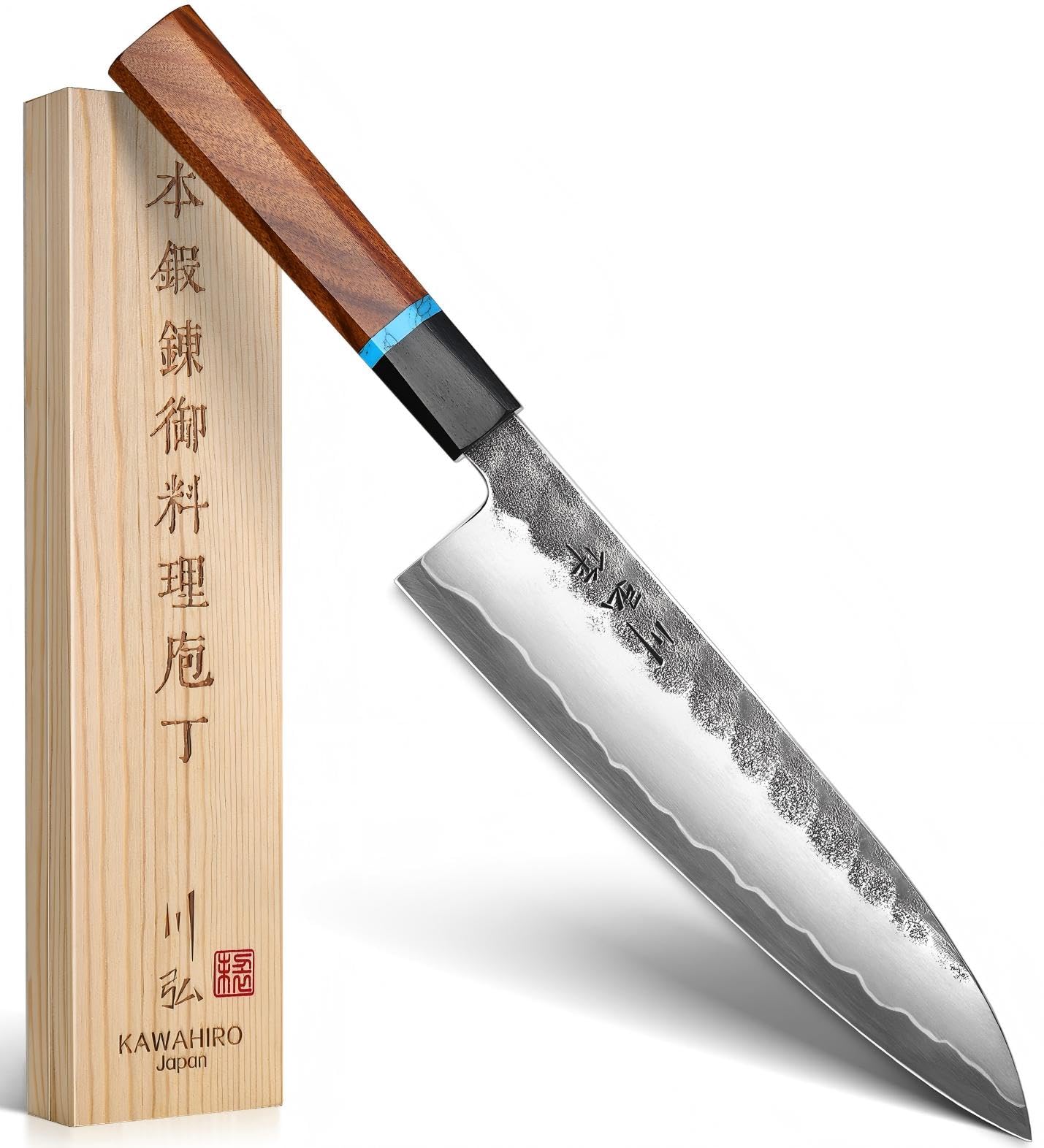
2. KAWAHIRO Japanese Chef Knife, 8 Inch Hand Forged VG10 Gyuto
A feather-light VG10 gyuto that punches way above its price tag.
At just 6.72 ounces, the KAWAHIRO is lighter than the WÜSTHOF Classic IKON at 12 ounces, and you feel that difference the moment you pick it up. This knife is built for speed and precision — the 8.24-inch blade is hand-forged from VG10 stainless steel cored in 3-layer composite steel, giving it a hard edge that holds sharpness well through a prep session. The octagonal wa-handle made from ruby wood, turquoise, and ebony is slim and ergonomic, reducing fatigue during long hours of slicing meat and vegetables. One reviewer noted “minor edge chipping after 6 months, easily fixed,” which is typical for a hard Japanese steel around 62+ HRC — it takes a razor edge but asks for careful use (no bones, no twisting).
The black forged finish and the wooden gift box make it a strong contender for a gift, but for a pro chef, the real story is the edge. It arrives extremely sharp from the start and glides through ingredients with minimal effort. The 8.24-inch blade is actually slightly longer than the ZWILLING’s 8-inch, giving you a touch more reach. The catch is that this knife is not dishwasher safe and requires hand washing and drying immediately, especially with acidic ingredients. If you treat it right, it delivers Japanese-level slicing performance at a mid-range price that undercuts most premium options.
Hand-forged VG10 core
- Extremely lightweight at 6.72 oz, reduces hand fatigue during long prep
- VG10 stainless steel core with 3-layer composite cladding for excellent edge retention
- Beautiful octagonal wa-handle made from ruby wood, turquoise, and ebony
Requires careful care
- Hard steel (~62+ HRC) can chip on bones or hard squash; requires careful use
- Not dishwasher safe and requires immediate drying after cutting acidic foods
Sharpness seekers: Chefs who want a nimble, lightweight Japanese gyuto for high-volume vegetable and fish prep without spending over.
Low maintenance cooks: You need a knife that can handle bones, frozen foods, or heavy chopping — stick with a German steel workhorse.
3. WÜSTHOF Classic IKON 8-Inch Chef’s Knife
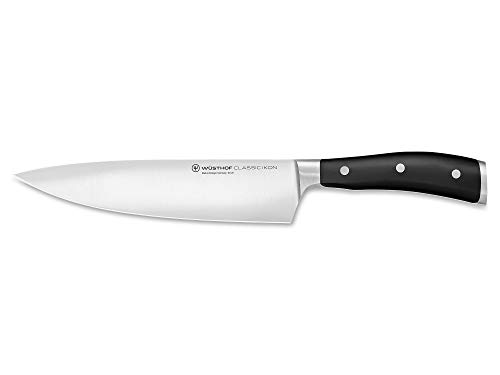
The partial-bolster German design that balances beauty and brute capability.
The WÜSTHOF Classic IKON is the knife you buy when you want the durability of German steel with a more refined, balanced feel than a standard workhorse. The 8-inch blade is forged from a single block of high-carbon stainless steel and tempered to 58-degree HRC (Rockwell hardness) — slightly harder than the ZWILLING’s 57, and the Precision Edge Technology (PEtec) sharpening yields a blade that is 20% sharper with twice the edge retention of previous WÜSTHOF models, according to the brand. The double bolster design (the thick metal band between blade and handle) gives the knife a professional-style heft at 12 ounces, but unlike a full bolster, the partial bolster lets you sharpen the entire edge without interference. One buyer shared, “I’ve been using it 2 months and I love it,” praising its ability to dice onions and prepare watermelon without issue.
The sleek black synthetic handle is designed to resist fading and discoloration, and its contours fit naturally in the hand whether you have smaller hands or larger ones — a reviewer with smaller hands noted it “fits perfect in the hand, even with my smaller hands and waning grip.” The blade length is 20 centimeters, which converts to about 7.9 inches, slightly shorter than the 8.24-inch KAWAHIRO. The catch? At 12 ounces, it is significantly heavier than the featherlight Yoshihiro (0.3 lbs) or the KAWAHIRO (6.72 oz), so chefs who prefer a light, nimble blade for extended prep may tire faster. It is also not dishwasher safe, despite the synthetic handle’s resilience.
Ergonomic handle grip
- PEtec sharpening makes blade 20% sharper with twice the edge retention of older WÜSTHOF models
- Partial double bolster provides excellent balance without blocking full-edge sharpening
- Ergonomic synthetic handle resists fading and fits a wide range of hand sizes
Premium price tag
- Heavier than Japanese alternatives at 12 oz; may cause fatigue during long shifts
- 58 HRC is less hard than VG10 or SG2 steels, requiring more frequent honing
Comfort priority: A professional who wants a premium German knife with a refined handle and a slightly harder, longer-lasting edge than the ZWILLING.
Value hunters: You need the absolute lightest possible knife for high-volume prep, or you are on a tighter mid-range budget.
4. Shun Kanso 8″ Chef’s Knife

A handcrafted Japanese blade that feels like an extension of your hand.
The Shun Kanso is named after a Zen philosophy meaning “simplicity,” and the knife lives up to that — no frills, just a razor-sharp 8-inch blade made from AUS10A high-carbon stainless steel refined with vanadium, honed to a precise 16-degree edge. The narrow gyuto-style blade gives you high maneuverability for detailed work, while the contoured tagayasan handle (a wood so dense it is called “iron sword wood”) provides a secure, comfortable grip for both left- and right-handed users. The butt of the handle also doubles as a bottle opener and hanging hook, a small but thoughtful touch for a busy kitchen. Chefs with larger hands report it “feels like an extension of my hand, and the balance is perfect,” especially praising the bolsterless design that avoids the irritation a full bolster can cause on the index finger.
At 0.44 pounds, the Shun is lighter than the WÜSTHOF (12 oz) and the ZWILLING (277 g), making it a solid middle ground between a heavy German knife and the ultra-light Yoshihiro. The AUS10A steel is harder and holds an edge longer than standard German stainless, but like all Japanese knives, it is not dishwasher safe and should not be used on bones or frozen foods. One chef and restaurateur wrote: “This is by far the best handling knife I’ve ever used.” The trade-off is that the tagayasan handle may require occasional oiling to prevent drying, and the 16-degree edge, while sharp, is not quite as thin as the 9.5–12 degree edge on the premium Miyabi.
Lightweight stainless blade
- AUS10A steel with vanadium refinement delivers razor-sharp precision at a 16-degree edge
- Bolsterless design prevents index finger irritation during extended pinch-grip use
- Tagayasan handle (“iron sword wood”) is extremely durable and comfortable for all hand sizes
Less durable edge
- Not dishwasher safe; handle may need occasional oiling to prevent drying
- 16-degree edge is sharp but not as thin as premium Japanese options (9.5–12°)
Home cooks: Professionals who want a mid-weight Japanese knife with excellent edge retention and a comfortable, non-irritating handle for daily use.
Heavy duty users: Chefs who need a thicker, more durable edge for heavy chopping, or those who prefer a heavier knife for momentum through dense ingredients.
5. Dalstrong Chef Knife – 8 inch – Valhalla Series
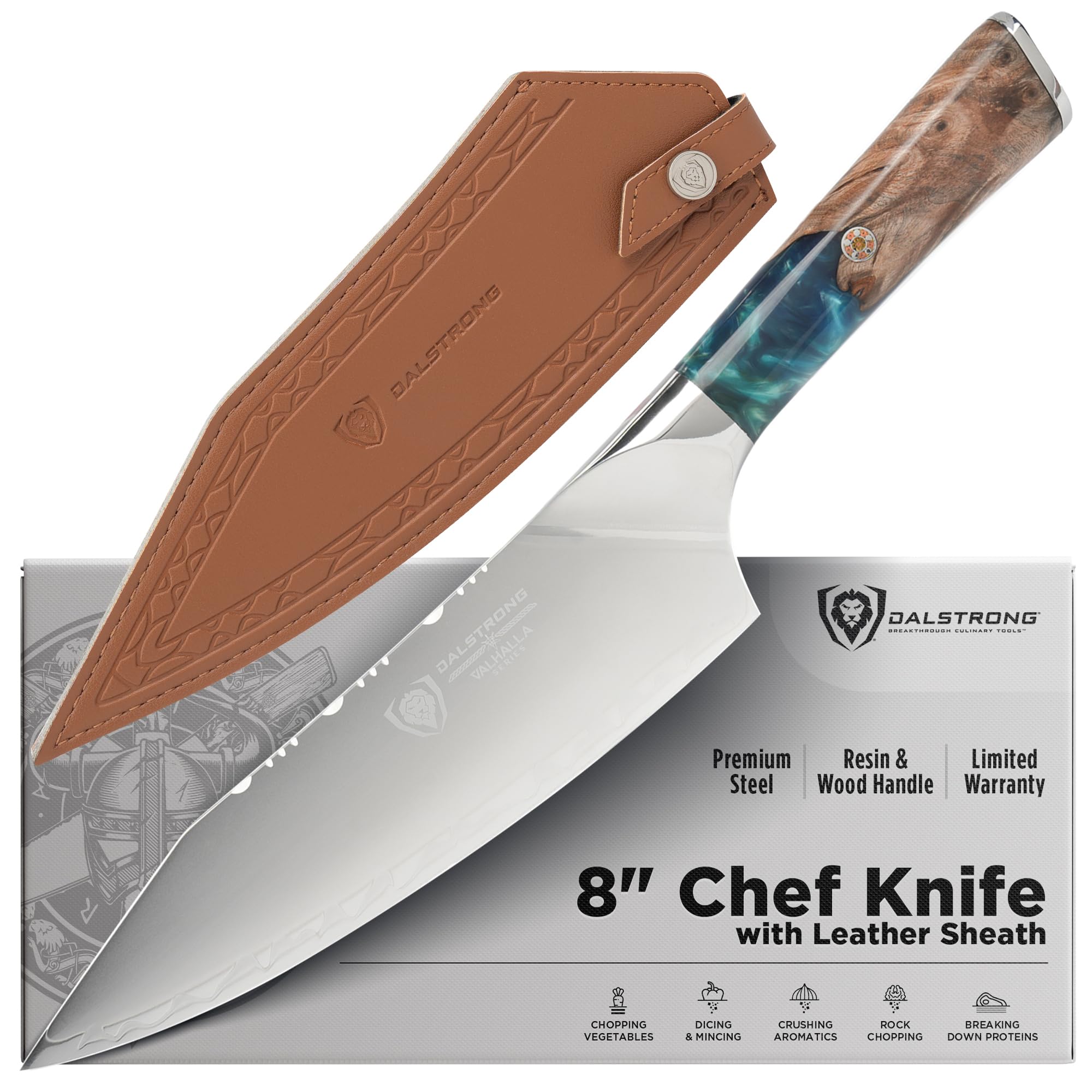
The showstopper that brings Norse-inspired artistry to a pro-grade blade.
The Dalstrong Valhalla is an 8-inch chef knife built around 9CR18MOV high-carbon stainless steel forged to 60+ HRC, with Dalstrong’s Lionshield heat/cold treatment and D3 sharpening that yields a hand-sharpened 8–12° edge per side. This is a seriously sharp blade that owners mention “slices soft tomato with no pressure,” and a professional chef reviewer noted it is “professional approved” and praised its balanced weight and edge retention. The real showpiece is the handle: individually cast celestial resin and stabilized wood, so no two handles look exactly alike, paired with a stainless bolster for rock-solid balance. It comes with a Valhalla-embossed leather sheath and premium gift packaging.
At 1.76 pounds, the Dalstrong is the heaviest knife on this list — significantly heavier than the featherlight Yoshihiro (0.3 lbs) and even the substantial WÜSTHOF (12 oz). That heft gives you momentum through dense ingredients, but some customers note it can feel “heavy, slightly unbalanced handle.” The 9CR18MOV steel is a good mid-range stainless that takes a sharp edge and resists corrosion, but it does not hold an edge as long as the VG10 or SG2 steels in the Japanese options. One buyer mentioned a loose handle after 4 months of light use, though the company responded immediately and replaced the knife in 2 days. The lifetime warranty and responsive US-based support add confidence for a professional investment.
Aggressive blade design
- Hand-sharpened 8–12° edge per side for razor-sharp slicing from the start
- Unique celestial resin and stabilized wood handle — no two knives alike
- Includes a leather sheath and lifetime warranty with responsive US-based customer support
Heavy for some
- Heaviest in the lineup at 1.76 lbs; may feel unbalanced to some users
- 9CR18MOV steel holds edge less long than premium VG10 or SG2 options
Bold styling: A chef who wants a conversation-piece knife that still performs at a pro level, with a bold aesthetic and a solid warranty.
Traditionalists: You need a lightweight knife for all-day prep, or you prefer a simpler, purely functional design without the visual flair.
6. Yoshihiro VG10 46 Layers Hammered Damascus Gyuto (8.25″)
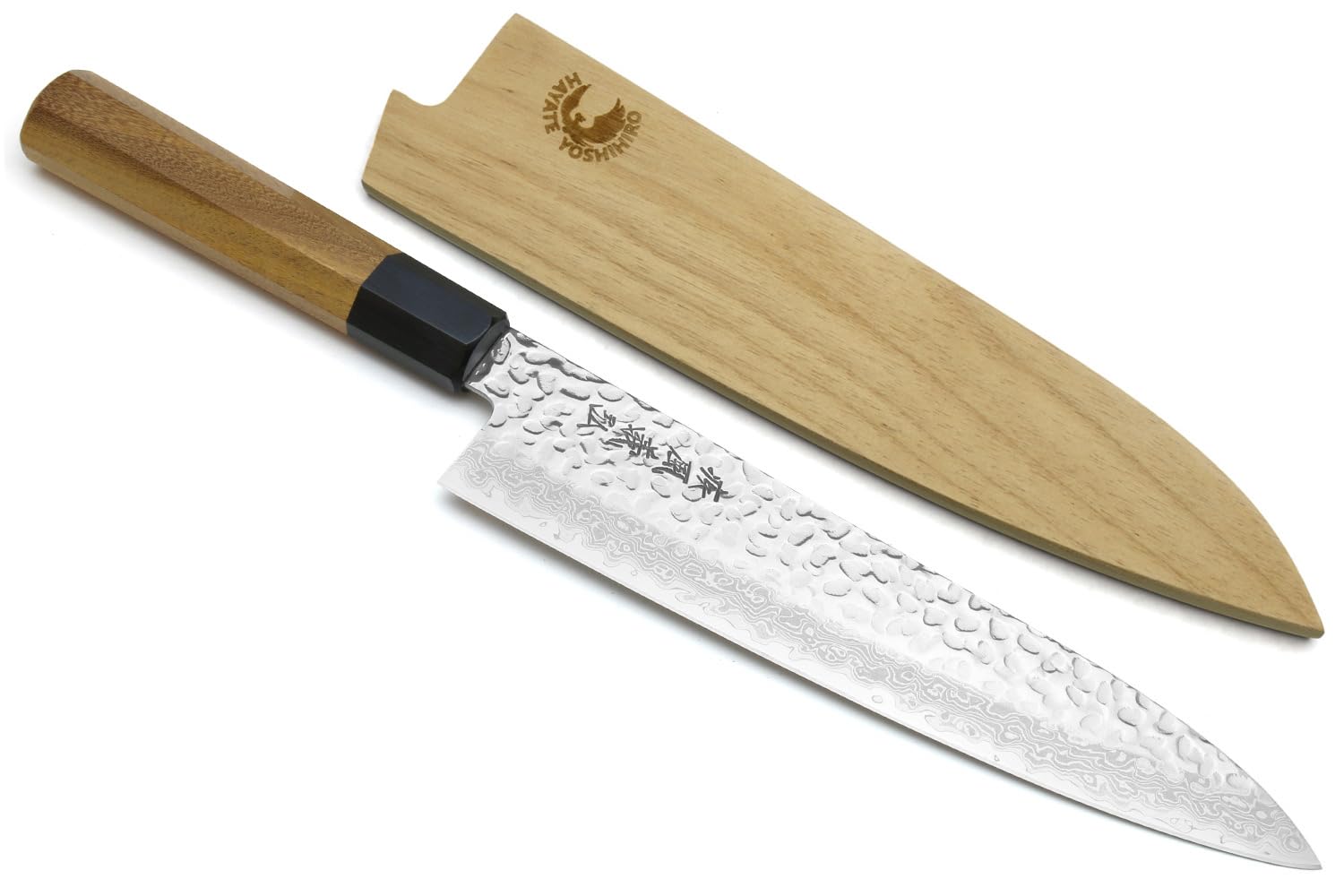
A true Japanese gyuto that brings 46-layer Damascus prestige to a pro kitchen.
The Yoshihiro VG10 Hammered Damascus Gyuto is handcrafted in Japan with 46 layers of steel in the Damascus tradition surrounding a VG10 core, hardened to 60 HRC. The 8.25-inch blade is double-edged and features a hammered texture that reduces friction and prevents food from sticking — a practical advantage during high-volume prep. The traditional Japanese wa-style octagonal handle is made from ambrosia wood, which is lightweight (the whole knife weighs just 0.3 pounds) and ergonomically welds to your hand. A protective natural magnolia wood saya (sheath) is included, protecting the blade during storage. One professional reviewer noted it handles “150-300 covers nightly” in a fine dining environment and praised its edge retention with regular honing.
At 0.3 pounds, the Yoshihiro is by far the lightest knife here — noticeably lighter than the Shun (0.44 lbs) and a fraction of the Dalstrong (1.76 lbs). That makes it ideal for chefs who want minimal hand fatigue during extended prep sessions. The catch is that the thin blade is more fragile than a German knife; one owner reported they “bent tip on thick brisket” and warned it needs a ceramic sharpener. The unfinished ambrosia wood handle also requires occasional oiling to prevent drying and cracking. This knife is not for heavy chopping or bone work, but for precise slicing of fish, meat, and vegetables in a professional environment, it is an exceptional value in true Japanese craftsmanship.
Damascus layered steel
- Extremely lightweight at 0.3 lbs, reduces fatigue during long, high-volume prep shifts
- 46-layer Damascus cladding with hammered texture reduces food sticking to the blade
- Includes a natural magnolia wood saya for safe storage and display
High maintenance
- Thin, fragile blade; tip can bend on dense ingredients like thick brisket
- Unfinished ambrosia wood handle requires regular oiling to maintain condition
Knife collectors: You are a fine-dining or high-volume chef who needs a featherlight, razor-sharp gyuto for fish, meat, and vegetable prep — and you are comfortable maintaining a delicate blade.
Daily drivers: Your daily prep includes bones, hard squash, or any heavy chopping that would risk chipping or bending a thin Japanese edge.
7. Miyabi Birchwood SG2 Japanese Chef’s Knife, 8-inch

The pinnacle of Japanese blade craft — SG2 steel honed to an almost surgical edge.
The Miyabi Birchwood is the most expensive knife on this list and arguably the most advanced. It uses SG2 micro carbide powder steel — a premium alloy that combines extreme hardness (around 63 HRC) with very fine carbide distribution, allowing it to take and hold an incredibly sharp edge. The blade is hand-honed using the three-step Honbazuke process to a 9.5° to 12° edge, which is the thinnest angle in this lineup (the ZWILLING is 15°, the Shun is 16°). That means it cuts through meat, fish, and vegetables with almost no resistance — reviewers point out it is “exceptionally sharp” and “easy for slicing.” The 100-layer flower Damascus pattern on the blade is forged in Seki, Japan, and paired with a handle made from Karelian birch, a light, warm wood that is perfectly balanced at the bolster. Hand length is 5.39 inches, giving a generous grip.
At 1.18 pounds, the Miyabi is heavier than the Yoshihiro (0.3 lbs) and the Shun (0.44 lbs), but the balance is so precise that it feels lighter in hand. The catch is significant: this blade is brittle. It is not for bones, hard squash, or any twisting motion. The birchwood handle can also stain easily if not dried immediately, and the knife does not come with a sheath. One professional reviewer noted it is “not for beginners or students” and requires careful handling and hand washing. For a professional chef who works primarily with fish, boneless meat, and vegetables, the Miyabi Birchwood delivers the highest level of sharpness and edge retention in the group — but it demands respect and maintenance in return.
SG2 super steel
- SG2 micro carbide powder steel with Honbazuke hand-honing to a 9.5–12° edge for extreme sharpness
- 100-layer flower Damascus pattern, handcrafted in Seki, Japan
- Light Karelian birch handle perfectly balanced at the bolster for easy maneuverability
Extremely expensive
- Brittle blade; not suitable for bones, frozen foods, or heavy chopping — risk of chipping
- Birch handle can stain easily; does not include a sheath for storage
Ultimate performance: The professional chef who demands the sharpest possible edge for delicate fish, meat, and vegetable prep and is willing to invest in careful maintenance and handling.
Budget conscious: Anyone who needs a multi-purpose line knife that can handle bones, heavy chopping, or occasional abuse — choose a German steel option instead.
Understanding the Specs
Rockwell Hardness (HRC)
This number tells you how hard the steel is. Most German knives sit around 57-58 HRC, which is tough and resists chipping — good for all-purpose use. Japanese knives like the KAWAHIRO and Miyabi go up to 60-63 HRC, which means the blade stays sharp much longer but is also more brittle. If you frequently cut through bones or hard squash, a lower HRC (57-58) is safer. If you want a razor edge for fish and vegetables, a higher HRC (60+) gives you that precision.
Edge Angle
The angle of the cutting edge measured in degrees per side. A wider angle like 15° (ZWILLING) is more durable and easier to maintain on a honing steel. A narrower angle like 9.5°–12° (Miyabi) cuts with almost no resistance but is more fragile and needs sharpening on water stones. The Shun Kanso sits in the middle at 16°, offering a good balance of sharpness and durability. Your choice depends on what you cut most and how often you are willing to sharpen.
Blade Steel Types
German high-carbon stainless steel (used by ZWILLING and WÜSTHOF) is tough, corrosion-resistant, and easy to maintain. Japanese VG10 (KAWAHIRO, Yoshihiro) is harder and holds a sharper edge longer but requires more care. AUS10A (Shun) is similar to VG10 with added vanadium for wear resistance. SG2 micro carbide powder steel (Miyabi) is a premium option with extremely fine carbides for the sharpest possible edge. Dalstrong’s 9CR18MOV is a good mid-range stainless that balances sharpness and durability.
Handle Materials and Shapes
Western handles (ZWILLING, WÜSTHOF) are usually made from synthetic polymer or composite, are dishwasher safe (though hand washing is recommended), and feature a full tang with rivets for durability. Japanese wa-handles (Yoshihiro, KAWAHIRO) are typically octagonal or D-shaped, made from wood, and are lighter and more ergonomic for a pinch grip. The Shun Kanso uses tagayasan (iron sword wood), which is very dense and durable. Handle choice affects fatigue and grip security, especially in a busy kitchen where hands get wet.
FAQ
What is the difference between a German and Japanese chef knife?
Does a professional chef need a VG10 or SG2 steel knife?
Can I put a professional chef knife in the dishwasher?
How often should I sharpen my chef knife?
Is a heavy knife better for professional use?
Will a Japanese chef knife chip on bones?
What does the Rockwell hardness (HRC) number mean for a chef knife?
What is the best handle shape for long prep sessions?
Is a Damascus blade actually better for cutting?
How do I maintain a wood-handled chef knife?
Final Thoughts: The Verdict
Across the board, the chef knife for professional chefs winner is the ZWILLING Professional S because it strikes the best balance of durability, edge retention, and comfort at a mid-range price — it is tough enough for daily abuse and sharp enough for precise work. If you want a lightweight Japanese blade with stunning value, grab the KAWAHIRO Gyuto. And for the ultimate in cutting performance and craftsmanship, the Miyabi Birchwood SG2 is the knife that sets the standard for razor-sharp precision in a professional kitchen.
How We Picked
We do not accept paid placement. Every pick is matched to a real buyer and a real use-case; we do not hands-on test units.
Sources & Methodology
Specifications: manufacturer listings and product documentation. Review insights: verified customer reviews, as of July 2026. Pricing: not shown on this page (it changes often); check the current price via the retailer link.
As an Amazon Associate, WellFizz earns from qualifying purchases. This does not affect which products we feature.
Related Guides

Mo Maruf
I created WellFizz to bridge the gap between vague wellness advice and actionable solutions. My mission is simple: to decode the research and give you practical tools you can actually use.
Beyond the data, I am a passionate traveler. I believe that stepping away from the screen to explore new environments is essential for mental clarity and physical vitality.